INTRODUCTION
Rice is the world's most important food crop and a major food grain for more than a third of the world's population (Prasertsak and Fukai, Reference Prasertsak and Fukai1997). About 75% of the world's rice supply comes from 79 million ha of irrigated rice production in Asia (Cabangon et al., Reference Cabangon, Tuong and Abdullah2002). China's 31.7 million ha of rice fields account for about 20% of the world's rice area and produce about 35% of total rice production (FAO, 2001). Rice is also the greatest consumer of water among all crops and uses about 80% of the total irrigated freshwater resources in Asia (Bouman and Toung, Reference Bouman and Tuong2001). However, freshwater for irrigation is becoming scarcer because of increasing competition from urban and industrial demand (Bouman and Tuong, Reference Bouman and Tuong2001; Guerra et al., Reference Guerra, Bhuiyan, Tuong and Barker1998; Tuong and Bouman, Reference Tuong, Bouman, Kijne, Barker and Molden2003). Water resource limitations threaten the sustainability of irrigated rice systems in many countries, and water-saving rice cultivation methods are urgently needed to keep up with future food demands. Producing more rice with less water, as well as with less land and less fertilizer if possible, is important for the sustainability of rice production systems in the future.
Recently a water-saving rice cultivation method known as the system of rice intensification (SRI) developed in Madagascar during the early 1980s (Laulanié, Reference Laulanié1993; Stoop et al., Reference Stoop, Uphoff and Kassam2002; Uphoff, Reference Uphoff2007) has generated considerable debate globally. Reports in Uphoff et al. (Reference Uphoff, Fernandes, Yuan, Peng, Rafaralahy and Rabenandrasana2002) indicate that SRI methods can raise rice output with reductions in water requirements and external inputs. The reported impacts of SRI methods on yield compared with conventional practice can vary widely, e.g. with irrigated methods, from increases of 78% in Indonesia (Sato and Uphoff, Reference Sato and Uphoff2007) to 244% in The Gambia (Ceesay et al., Reference Ceesay, Reid, Fernandes and Uphoff2006), and from unirrigated (rainfed) SRI, from 32% in India (Sinha and Talati, Reference Sinha and Talati2007) to 100% or more in Myanmar (Kabir and Uphoff, Reference Kabir and Uphoff2007). However, the results obtained from some field trials and farmer fields have shown that grain yield of SRI rice decreased compared to conventional practice and the range was from −1% to −55% (McDonald et al., Reference McDonald, Hobbs and Riha2006). SRI is not a fixed technological package, but rather a set of principles for raising the productivity of all of the factors involved in rice production: land, labour, capital, seed and water (Stoop et al., Reference Stoop, Uphoff and Kassam2002). This introduces diverse influences of quality of management, timing, etc., and also the variability of biological processes and potentials in soil systems which can differ widely among agro-ecosystems (Uphoff et al., Reference Uphoff, Ball, Fernandes, Herren, Husson, Laing, Palm, Pretty, Sanchez, Sanginga and Thies2006).
Some researchers have suggested that SRI benefits may be limited to resource-poor farmers in areas with poor soils and that one should not expect to achieve SRI benefits much beyond Madagascar (Dobermann, Reference Dobermann2004; McDonald et al., Reference McDonald, Hobbs and Riha2006). Others have suggested that SRI has no inherent advantage over conventional practices and that the extraordinarily high yields reported (up to ca. 20 t ha−1) are simply the consequence of measurement errors (Sheehy et al., Reference Sheehy, Peng, Dobermann, Mitchell, Ferrer, Yang, Zou, Zhong and Huang2004). SRI results have also been characterized as non-scientific, based on ‘unconfirmed field observations’ (Sheehy et al., Reference Sheehy, Sinclair and Cassman2005; Sinclair and Cassman, Reference Sinclair and Cassman2004). Such contentions have not gone unchallenged, however (Stoop and Kassam, Reference Stoop and Kassam2005).
In the controversy brewing in the literature, little attention has been paid outside China to the evaluations of SRI reported by Chinese scientists, perhaps because most were not published in English, e.g. Tao and Ma (Reference Tao and Ma2003); Wang et al. (Reference Wang, Cao, Jiang, Dai and Zhu2003a); Yuan (Reference Yuan2001); Zhong et al. (Reference Zhong, Huang, Liu, Li, Wu and Ouyang2003). Of particular interest should be the effects, if any, of SRI methods on the efficiency of water and inorganic nitrogen (N) use since water is increasingly a limiting factor in many rice-growing areas, and N application rates are getting ever higher, adding to the costs of production and thereby lowering net farm incomes, and also raising environmental concerns over groundwater pollution (Aparicio et al., Reference Aparicio, Costa and Zamora2008; Shindo et al., Reference Shindo, Okamoto and Kawashima2006).
China is currently the world's largest consumer of N fertilizers, accounting for 30% of the world N consumption (FAO, 2001), with low N use efficiency, and apparent recovery efficiency of N fertilizer of about 30–35% for rice (Peng et al., Reference Peng, Buresh, Huang, Yang, Zou, Zhong, Wang and Zhang2006). Concentrations of nitrate in groundwater supplies in some parts of China have already reached several times the maximum level currently accepted by the US Environmental Protection Agency (Hatfield, Reference Hatfield2004). This makes it important to assess the impact of SRI on N efficiency.
The objective of this study was to compare rice yields, water requirements and productivity as well as the effects of different N-fertilizer rates when producing rice with SRI methods compared to continuous flooding of paddy fields. We wanted to identify possible cultivation system × N interaction effects that bear on N uptake and use efficiencies, so as to evaluate the optimum amounts of N application under SRI and traditional flooding (TF) practice. This could help to determine what savings, if any, could be made in both water and N-fertilizer applications – having positive economic and environmental implications – without sacrificing yield and even possibly enhancing yields.
MATERIALS AND METHODS
Experimental sites
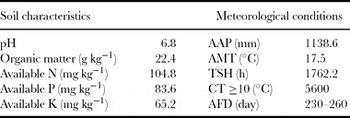
In 2005 and 2006, field experiments were conducted at Huajiachi Experimental Station (30°16′N, 120°12′E, 4.3 m asl) of Zhejiang University, Hangzhou, China. The region is classified as humid sub-tropical with a monsoon climate. The soil at the study site is classified as Huangson paddy soil (clay loamy typic Hapli-Stagnic Anthrosol) and the main soil characteristics of the site and meteorological conditions are presented in Table 1. The cropping pattern in this region includes early-season rice + late-season rice + upland crop and mid-season rice + upland crop. On the Huajiachi Experimental Station, rice production practices are the focus for research. Accordingly, rice had previously been grown on this soil for more than 10 seasons.
Soil characteristics and meteorological conditions.

AAP: annual precipitation; AMT: annual mean temperature; TSH: total sunshine hours; CT ≥10: cumulative temperatures above 10 °C; AFD: annual frost-free days.
Experimental design and cultural practices
The field experiment utilized a split-plot randomized complete block design in triplicate. Main plot treatments were two cultivation systems: TF and SRI. Split-plot treatments were four N rates: N0 (no fertilizer N), N1 (80 kg N ha−1), N2 (160 kg N ha−1) and N3 (240 kg N ha−1) as urea. The P and K fertilizers (54 kg P2O5 ha−1 as calcium phosphate, 67.5 kg K2O ha−1 as potassium chloride) and 60% of the N fertilizer were incorporated one day before transplanting as basal fertilizer, and the remaining N fertilizer was broadcast, also as urea, at the tillering and booting stages of the rice, 20% in each application.
The size of all subplots was 5.5 m × 4.2 m. All plots were surrounded by consolidated bunds lined with plastic sheets installed to a depth of 0.3 m to prevent seepage between plots. Land preparation for both TF and SRI was the same, with wet tillage and harrowing. Seedlings were transplanted (one seedling per hill) at 15 days old in 2005 and 13 days old in 2006 for SRI, and 20 days old in both 2005 and 2006 for TF. Transplanting spacing between hills was different: 25 cm × 30 cm for SRI and 25 cm × 17 cm for TF, to give plant populations, respectively, of 13.3 and 23.5 m−1. A japonica rice variety was used (Bing 98110) transplanted on 19 May and harvested 19 October in 2005, while, in 2006, seedlings were transplanted on 13 May and harvested on 13 October.
TF plots were kept continuously flooded from transplanting until one week before harvest except for paddy field drainage at the end of the tillering stage. Water depth was initially 2 cm and gradually increased to 10 cm during the rice-growing season. SRI plots were kept saturated for the first week after transplanting and then were kept with a thin layer (2 cm) of water until 15 days after panicle initiation; during the rest of the cycle, plots were maintained without standing water for 3–7 days (varying by temperature and resulting rates of evapotranspiration) before re-irrigation with tap water. Each main plot was irrigated separately. Irrigation water was provided from a tap to a depth of 2 cm for SRI each time, as measured by a plastic ruler inserted into the plot. The volume of water applied during each irrigation event was measured using a water meter.
Sampling and analysis
At maturity, plants were sampled diagonally across two 5 m2 harvest areas per sub-plot to determine grain yield. Five randomly selected rice hills were sampled from inside the harvest area for determination dry weight of grain and straw after the samples were dried at 70 °C. Total N content was determined using the standard Kjeldahl's method (Bao, Reference Bao2000).
Data were calculated on the basis of dry weights and the following parameters were calculated using the following equations:
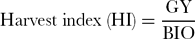




where:
BIO is total above-ground biomass on a dry-weight basis,
GY0 is grain yield without N application (N0),
GYF is grain yield with fertilizer N application (N,)
N0 is not applied with N fertilizer,
NF is fertilizer N applied,
I+R is the total amount of irrigation water and rainfall during crop season,
I is the total amount of irrigation water during crop season.
Statistical analysis
Analysis of variance was performed on a split-plot design with cultivation system as the main factor and N rates as the sub-factor in each year. Means were compared by least significance difference (LSD) at the 5% level. Analysis of variance was carried out for the two-year period, considering the year as a random effect. Statistical procedures were conducted using the data processing system software (Tang and Feng, Reference Tang and Feng2002).
RESULTS
Grain yields, biomass and harvest index
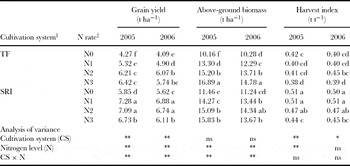
In both years, grain yield of SRI was significantly greater than TF (Table 3). Over the whole range of N application rates, average yield under SRI increased by 21% in 2005 and 22% in 2006. Application of N gave higher average grain yield than zero-N controls (Table 2). Among N treatments, the maximum yield under SRI was 7.3 t ha−1 in 2005 and 6.9 t ha−1 in 2006 with 80 kg N ha−1, while the maximum yield under TF was 6.4 t ha−1 in 2005 and 6.1 t ha−1 in 2006, using twice as much fertilizer, 160 kg N ha−1 or more.
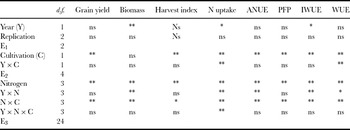
Analysis of variance of various parameters that were measured in this study.

*, p < 0.05; **, p < 0.01; ns, not significant.
ANUE: agronomic N use efficiency; PFP: partial factor productivity of applied N; IWUE: irrigation water use efficiency; WUE: water use efficiency.
There was a significance difference in above-ground biomass between 2005 and 2006 (Table 2) and above-ground biomass under SRI was higher than for TF in N0 and N1, although these were lower than TF in N2 and N3 in both years (Table 3). The average above-ground biomass from TF and SRI was not significantly different in either year. With an increase in fertilizer N rate, above-ground biomass increased and in N3 was higher than, or similar to those in N2, with the exception of SRI in 2006 (14.34 t ha−1 in N2 and 13.67 t ha−1 in N3). Harvest index under SRI significantly increased compared to TF in both years (Table 3). The smallest harvest index under SRI and TF was in N3 in both years. Significant interaction effects were observed between cultivation system and N application rates on yield and above-ground biomass, although there were no significant interaction effects for harvest index (Table 3).
Effects of the system of rice intensification and fertilizer N rate on grain yield, above-ground biomass and harvest index in 2005 and 2006.

Values with the same letters in a column are not significantly different by LSD at the 0.05 level across all cultivation systems.
† TF: traditional flooding; SRI: the system of rice intensification.
‡ N0: no fertilizer N; N1: 80 kg ha−1; N2: 160 kg ha−1; N3: 240 kg ha−1.
*, p < 0.05; **, p < 0.01; ns, not significant.
Nitrogen uptake
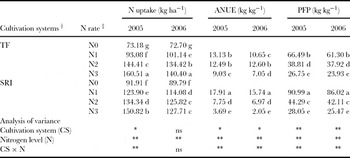
Table 2 indicates that the N uptake by rice was significantly different between the two years, and the average N uptake was 122 kg ha−1 and 113 kg −1 in 2005 and 2006, respectively. N uptake by rice under SRI was higher than TF in N0 and N1; however, in N2 and N3 it was lower than TF in both years (Table 4). Compared with TF, average N uptake by rice under SRI (125 kg ha−1 in 2005, 114 kg ha−1 in 2006) showed an increasing trend and the difference in 2005 was significant. With N application rates increasing, total N uptake by rice under SRI and TF significantly increased. However, there was no significant difference between N2 and N3 under SRI in 2006. There was a significant interaction between cultivation system and N rates on total N uptake in 2005.
Effects of the system of rice intensification and fertilizer N rate on N uptake, agronomic N use efficiency and partial factor productivity of applied N (PFP) in 2005 and 2006.

Values with the same letters in a column are not significantly different by LSD at the 0.05 level across all cultivation systems.
† TF: traditional flooding; SRI: the system of rice intensification.
‡ N0: no fertilizer N; N1: 80 kg ha−1; N2: 160 kg ha−1; N3: 240 kg ha−1.
*, p < 0.05; **, p < 0.01; ns, not significant.
Nitrogen use efficiency
Agronomic N use efficiency values ranged from 7.1 to 13.1 kg grain kg−1 N applied under TF and from 2.0 to 17.9 kg grain kg−1 N applied under SRI (Table 4). Compared with TF, ANUE was higher in N1 and lower in N2 and N3 with SRI methods in both years. The maximum ANUE under TF was in N2 in 2006, however, the maximum ANUE in 2005 was in N1 and similar to those in N2. Under SRI, the maximum ANUE was in N1 in both years. With the N rate increasing, the PFP under both SRI and TF significantly decreased. Compared with TF, PFP under N1 and N2 was higher with SRI; however, there was no significant difference in N3 between TF and SRI. The interaction effects of cultivation systems and N rates on ANUE and PFP were significant.
Water productivity
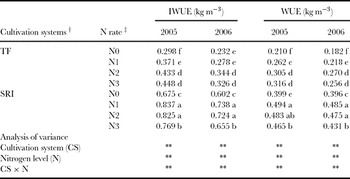
Rainfall during the rice growth period was 599 mm in 2005 and 486 mm in 2006. The average amount of irrigation water applied was 868 mm under SRI and 1435 mm under TF in 2005, and 933 mm under SRI and 1763 mm under TF in 2006. This resulted in an irrigation water saving of 567 mm and 830 mm in 2005 and 2006, respectively, with SRI practices, a reduction of 39.5% and 47%, compared to TF. Changes in overall WUE and in IWUE are shown in Table 5. Compared with TF, average WUE and IWUE under SRI were, respectively, increased by 68% and 100% in 2005, and 94% and 130% in 2006. IWUE was significantly different in both years (Table 2). Both WUE and IWUE were significantly affected by cultivation system, by N rates, and by their interaction.
Effects of the system of rice intensification and fertilizer N rate on irrigation water use efficiency (IWUE) and total (irrigation +rain) water use efficiency (WUE) in 2005 and 2006.

Values with the same letters in a column are not significantly different by LSD at the 0.05 level across all cultivation systems.
† TF: traditional flooding; SRI: the system of rice intensification.
‡ N0: no fertilizer N; N1: 80 kg ha−1; N2: 160 kg ha−1; N3: 240 kg ha−1.
*, P < 0.05; **, P < 0.01; ns, not significant.
DISCUSSION
The above-ground biomass, N uptake by rice and IWUE were affected by the growing season (in 2005 and 2006), and the interaction effects of cultivation system, N and year on N upake by rice were significantly different (Table 2), which was probably because of the different weather conditions. In 2005, the rainfall was more than in 2006 during the rice growing season, and the average temperature was slightly higher in 2005 (26.5 °C) than in 2006 (25.2 °C).
Yield and water use efficiency
SRI significantly increased grain yields compared to TF while using much less irrigation water and with resulting higher water use efficiency in both years. Similar results have been reported from other studies in China (Tao and Ma, Reference Tao and Ma2003; Yu et al., Reference Yu, Zhu and Wang2003; Zhong et al., Reference Zhong, Huang, Liu, Li, Wu and Ouyang2003). They reported grain yield increases of 26–51%, 10–12%, and 19% from SRI compared with TF. These results are consistent with studies conducted in other countries as cited above. Increased grain yields with SRI methods may be attributed to greater root activity and delayed root and leaf senescence during later growth stages according to the research of Chinese scientists (Chen et al., Reference Chen, Zhu, Rao, Lin and Zhang2006; Lu et al., Reference Lu, Huang and Liu2006; Xu et al., Reference Xu, Ma, Wang, Liu, Huang, Ma and Ming2003). Compared with TF, the root activity during the growing stage and the N content of plants under SRI were increased, and the leaf senescence at late growth stages was delayed (Lu et al., Reference Lu, Huang and Liu2006). Xu et al. (Reference Xu, Ma, Wang, Liu, Huang, Ma and Ming2003) reported that SRI delayed the ageing of roots and leaves at late growth stages compared to TF, and root bleeding intensity under SRI was higher than TF at the grain-filling stage, and was significantly correlated with grain yield. Satyanarayana (Reference Satyanarayana2005) also reported that transplanting young seedlings carefully and at wider spacing gives rice plants more time and space for tillering and root growth. Rupela et al. (Reference Rupela, Wani, Kranthi, Humayun, Satyanarayana, Goud, Gujja, Punnarao, Shashibhushan, Raju and Reddy2006) reported that SRI plots had about five times greater root-length density, seven times more root volume, and ten times more root mass and length of roots in the surface soil profile (top 15 cm). In addition, SRI gave higher grain yield associated with an increase in tiller number compared to continuously flooded rice (Ceesay et al., Reference Ceesay, Reid, Fernandes and Uphoff2006; Kabir and Uphoff, Reference Kabir and Uphoff2007; Sinha and Talati, Reference Sinha and Talati2007).
Nitrogen use efficiency
In our study, the maximum ANUE and PFP were observed under SRI at the relatively low fertilization rate of 80 kg ha−1 N, and under TF at 160 kg N ha−1. Furthermore, ANUE under SRI was higher than TF in N1 and lower than TF in N2 and N3. PFP under SRI significantly increased in N1 and N2 compared to TF, however, there was no significant difference in N3 between SRI and TF. This is because SRI plots likely had higher N uptake from the indigenous supply due to the changes in the environment for growing rice and a better root system. SRI is characterized by soil-water and solar radiation regimes that are essentially different from those of conventional wetland rice under irrigated practices, and this cultivation change may affect the structure and functioning of soil biota, nutrient status and cycling, and root system due to aerobic soil condition with SRI practices. Bonkowski (Reference Bonrowski2004) indicated that under more aerobic soil conditions, there will be larger populations of soil microbes that contribute to biological processes for supplying N needs of plants. Rupela et al. (Reference Rupela, Wani, Kranthi, Humayun, Satyanarayana, Goud, Gujja, Punnarao, Shashibhushan, Raju and Reddy2006) reported that microbial biomass N, microbial biomass carbon, dehydrogenase, root mass, root density and root volume were higher under SRI than in flooded rice. Therefore, it is important that adjustments in recommendations for fertilizer N input should be made for SRI crops.
Interactions between nitrogen fertilizer and water management (rice cultivation)
Interaction effects between cultivation system and N rate for grain yield, above-ground biomass, N uptake and N use efficiency (ANUE, PFP) were all significant with the exception of N uptake in 2006. Such interactions between N rate and other water-saving rice cultivation methods have been reported before (Beleder et al., Reference Belder, Spiertz, Bouman, Lu and Tuong2005; Fan et al., Reference Fan, Jiang, Liu, Zhang, Lu, Zeng and Christie2005). Wang et al. (Reference Wang, Cao, Ding, Tian and Jiang2003b) reported that there were significant interactions between N fertilizer and water management, and when water stress increased, the effect of N on increasing nitrogen uptake and on decreasing nitrogen dry matter production efficiency was diminished. Fan et al. (Reference Fan, Jiang, Liu, Zhang, Lu, Zeng and Christie2005) also observed interactive effects of non-flooded mulching cultivation and N rate on crop yield, crop N uptake and N cycling. Optimal N management is important to increase grain yield and enhance the water and N use efficiency of SRI crops. Further research is required on N fertilizer management under SRI, however, to assess in more detail the relations between environmental conditions, rice yields and input costs. Also, soil biological dynamics should be studied to evaluate the extent to which SRI methods with more aerobic soil conditions and organic soil nutrient amendments may be mobilizing more N through biological processes (fixation and cycling) to account for the higher yields being obtained with lower inputs of exogenous inorganic N.
CONCLUSIONS
The present study shows maximum grain yield of rice and higher ANUE and PFP was achieved at a relatively low N fertilizer rate (80 kg ha−1) with SRI, significantly lower than the 160–240 kg ha−1 N applied in the TF. SRI plots had a higher harvest index than TF in both years. With SRI, irrigation water requirements were reduced by about half compared to TF. Against the background of increasing fertilizer costs, irrigation water shortages, and growing pollution/environmental problems in today's world, these findings deserve consideration and further investigation for the sake of sustainable rice production.
SRI should not be considered as a fixed technological package, but rather as a set of principles for raising the productivity of all of the factors involved in rice production: land, labour, capital, seed and water (Stoop et al., Reference Stoop, Uphoff and Kassam2002). Related studies on the interaction of SRI and soil fertility, climate, and variety characteristics should be pursued.
Acknowledgements
This research was supported by the National Natural Science Foundation of China (No. 30571082); the Key International Co-operative Project of Ministry of Agriculture (948 Program, No. 2003-Z53) and the Key Project of Agricultural Construction Adjustment of Agriculture Ministry of China (2003-01-02A).