Introduction
The importance of knowledge as a critical resource for innovation has encouraged knowledge-based organizations to pay greater attention to their knowledge management (KM) strategies. Information systems play an important role in the implementation of such strategies. They act as knowledge flow facilitators and can be used to encourage KM creation, transfer, and application (Liebowitz, Reference Liebowitz2008). From a technology perspective, a knowledge management system (KMS) strategy can be seen as the choice of a set of specific information system functionalities (and associated organizational rules) in order to support KM activities (knowledge creation, transfer, and application).
Prior research has shown that successful use of information system functionalities to support KM activities is not only influenced by technical factors, but also by “less rational but highly influential” factors such as the organizational culture (OC) context (Alavi et al., Reference Alavi, Kayworth and Leidner2006; Leonardi and Treem, Reference Leonardi and Treem2012; Dulipovici and Robey, Reference Dulipovici and Robey2013; Wiewiora et al.,. Reference Wiewiora, Trigunarsyah, Murphy and Coffey2013). Various studies suggest that OC context shapes employees' KM behaviors and the way they consider KMS to support organizational KM processes (De Long and Fahey, Reference De Long and Fahey2000; Gray and Densten, Reference Gray and Densten2005; Alavi et al., Reference Alavi, Kayworth and Leidner2006). However, few studies have attempted to investigate how OC might be associated with the KMS functionality choices to support knowledge creating, transfer, and application.
Organizations frequently possess KM tools which have the potential to become important KM enablers if they fit in to their current OC. We state that having a framework to analyze the effective use of KMS functionalities through the lens of OC would help organizations to make their organizational KM initiatives more efficient. By using the above as a base, we define the following research question to guide our work: how can we help an organization to articulate OC, the effective use of its KMS, and KM outcomes?
In this paper, we propose a three-dimensional OC framework to identify, understand, and structure the different patterns of the KMS use in an organization. We also present a case study which illustrates the application of the framework in the area of development assistance and capacity development.
Background
KMS and organizational KM processes
KMS provides the necessary infrastructure for organizations to implement organizational KM processes (knowledge creation, transfer, and application) (Alavi and Leidner, Reference Alavi and Leidner2001).
Many models to support organizational KM processes have been proposed (Wiig, Reference Wiig1993; Nonaka and Takeuchi, Reference Nonaka and Takeuchi1995; Szulanski, Reference Szulanski1996; McElroy, Reference McElroy1999; Zack Reference Zack1999; Dalkir, Reference Dalkir2011; Harrison and Hu, Reference Harrison and Hu2012). Rodriguez-Elias et al. (Reference Rodrıguez-Elias, Martınez-Garcıa, Vizcaıno, Favela and Piattini2008) have made a relevant synthesis of KM's main activities involved in organizational KM processes with the two perspectives of tacit and explicit knowledge:
• Identification refers to the location of crucial internal and/or external (from the environment) knowledge and knowledge sources. Here, technologies can be useful to identify formal sources but also informal sources such as experts and communities for example.
• Codification deals with formalization of knowledge that has been identified as crucial, when it can be made explicit and then articulated into words, text, drawings, or other symbolic forms. Knowledge transfer strategies focusing on explicit knowledge attempt to increase organizational efficiencies by codifying and reusing knowledge mainly through advanced Information Technologies (Choi et al., Reference Choi, Simon and Davis2008). The codification stage is often critical in organizations, since individuals frequently do not use the existing KMS functionalities to perform it because they spend too much time attempting to make their knowledge explicit (Rodriguez-Elias et al., Reference Rodrıguez-Elias, Martınez-Garcıa, Vizcaıno, Favela and Piattini2008). Moreover, it can be difficult for some employees to know how to express their ideas. That is why it is useful to identify KMS functionalities that may facilitate codification of knowledge when possible.
• Storage activity allows storing and updating of explicit knowledge in knowledge repositories. Here, specific attention must be paid to the updating mechanisms depending on the type of explicit knowledge: there is knowledge that does not change over a long period of time, but there is also knowledge that is constantly changing. Storing and updating explicit knowledge often requires much work from users to input their explicit knowledge and this can lead to the situation where KMS storage functionalities are unused. Providing automatic support at certain stages could reduce users' workloads.
• Diffusion refers to the dissemination and deployment of information sources of knowledge. Diffusion of explicit knowledge may be enabled with mechanisms which allow the provision of information about explicit knowledge that has been stored (search engines, information retrieval systems, etc.). On the other hand, tacit-oriented knowledge diffusion strategies will focus on a personalization approach where knowledge is communicated through direct person-to-person contact and through socialization processes supported by communication and collaboration technologies (Choi et al., Reference Choi, Simon and Davis2008).
• Acquisition activity facilitates individuals' contextualization and interpretation of knowledge (tacit or explicit) in order to perform an activity, make a decision, etc. However, providing technologies to assist users in this activity can be a challenging job (Marwick, Reference Marwick2001). If the user has too much information or too many available knowledge sources, identifying which is the most useful for a particular purpose can be a complex task. This can be performed by, for example, pushing personalized information to the user, based on his/her interests, profile, etc.
KMS refer to a class of information systems applied to managing organizational knowledge. They are IT-based systems developed to support and enhance the organizational processes of knowledge creation, transfer, and application (Alavi et al., Reference Alavi, Kayworth and Leidner2006; Kuo and Lee, Reference Kuo and Lee2011).
These KMS have appeared in various forms and formats in different organizations and incorporate various technologies/functionalities (e.g. information repositories, data warehouses, intranets, search engines, data filters, collaboration tools, intelligence agents) to facilitate the creation, transfer, and application of knowledge both within and outside the firm's boundaries (Quaddus and Xu, Reference Quaddus and Xu2005).
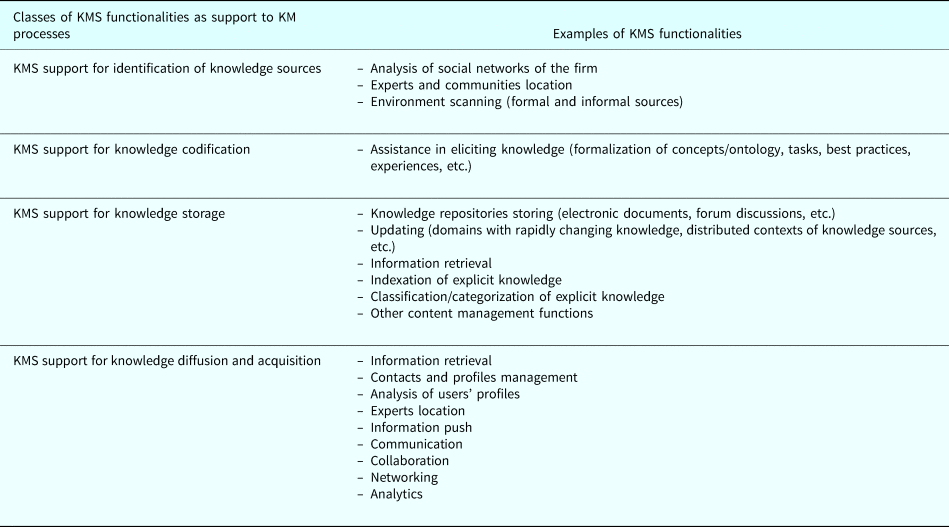
Relying on the literature review (Alavi et al., Reference Alavi, Kayworth and Leidner2006; Rodriguez-Elias et al., Reference Rodrıguez-Elias, Martınez-Garcıa, Vizcaıno, Favela and Piattini2008; Shadbolt, Reference Shadbolt2012; Von Krogh, Reference Von Krogh2012) and the previous dimensions of KM processes, KMS can be categorized into four sets of functionalities that support KM processes: (i) KMS support for identification of knowledge sources, (ii) KMS support for knowledge codification, (iii) KMS support for knowledge storage, and (iv) KMS support for knowledge diffusion and acquisition.
This categorization helps identify current functionalities which support KM processes in the organization.
We give examples of functionalities which could be integrated in a KMS to support an understanding of organizational KM processes (Table 1).
KMS Functions to support organizational KM processes

Adoption and effective use of KMS
The existing research on KMS covers two main issues:
– The first issue covers the general principles of building, creating, and implementing a KMS (Chait, Reference Chait1999; Sarvary, Reference Sarvary1999; Thierauf, Reference Thierauf1999)
– The second issue concerns adoption and effective use of KMS. Without the employees' use, the KMS becomes ineffective as a KM solution (Nevo and Chan, Reference Nevo and Chan2007). Therefore, understanding how to successfully adopt a KMS remains a high priority, especially since management has made great efforts in taking KM initiatives (Poston and Speier, Reference Poston and Speier2005).
Our paper deals with this second issue.
The factors influencing KMS use are a major concern to the MIS Communities. In this paper, the term “KMS use” refers to how individuals may appropriate a given set of functionalities for their KM activities. In the literature, various factors affecting KM adoption and effective use, have been identified: individual traits, job design/task characteristics, technology characteristics (ease of use, characteristics of human-computer interface, and flexibility and effectiveness of search mechanisms) (Lin and Huang, Reference Lin and Huang2008; Moreno and Cavazotte, Reference Moreno and Cavazotte2015), and organizational systems and individual cultural factors (Quaddus and Xu, Reference Quaddus and Xu2005). These factors may contribute to individuals not using the KMS to turn knowledge into effective action.
Among the different research models developed to understand adoption and effective use of KMS we can cite: the Technology Acceptance Model (TAM), the Innovation Diffusion Model (IDT), and the Task-Techno Fit model (TTF).
– Technology acceptance model (TAM)
TAM has become one of the most widely used models for Information Technology (IT) adoption (Davis, Reference Davis1989; King and He Reference King and He2006; Venkatesh and Bala, Reference Venkatesh and Bala2008). TAM posits that individuals' intentions to use an IT is determined by two beliefs. The first is perceived usefulness, defined as the extent to which a person believes that using a particular system will increase his or her job performance. The second is perceived ease of use, defined as the extent to which a person believes that using the target system will be free of effort. Due to the fact that the adoption of KMS in organizations basically involves understanding the behavioral intentions of individual use, TAM can most likely provide a reasonable depiction of user intention for use of KMS.
– Innovation diffusion model (IDC)
Another well-known theory is IDT, as proposed by Rogers (Reference Rogers1995). It has been widely applied to the relevant IT and IS research (Lee and Kim Reference Lee and Kim2007; Ryu et al., Reference Ryu, Kim and Lee2009; van Rijnsoever et al., Reference van Rijnsoever, van Hameren, Walraven and van Dijk2009). According to IDT, the decision to adopt a specific IT innovation depends on the perceptions of five significant characteristics: relative advantage, compatibility, complexity, trial ability, and observables (Rogers, Reference Rogers1995).
– Task-Techno Fit model (TTF)
Most of the concepts discussed above (e.g. usefulness, quality, effectiveness, etc.) are supported by the idea of appropriateness, that is, by the assumption that the system must suit a person's needs related to the accomplishment of a certain task. In fact, research has shown that the utilization of an information system and the improvement in performance it may generate depends on the extent to which the technology provides features and support that “fit” the requirements of an individual's portfolio of tasks. This is the so-called concept TTF which has been employed to explain the actual use of different types of technology (Goodhue and Thompson, Reference Goodhue and Thompson1995; Dishaw and Strong, Reference Dishaw and Strong1999; Strong et al., Reference Strong, Dishaw and Bandy2006).
However, the OC dimension is not overly present in these adoption models. Prior KM research has shown that certain types of organizational values will lead to different types of KM behavior and that these behaviors will lead to varying outcomes (De Long and Fahey, Reference De Long and Fahey2000; Alavi et al., Reference Alavi, Kayworth and Leidner2006). These studies suggest that we would expect individuals to respond more favorably to KM technologies whose use supports one or more of the organization's underlying values. As such, their values would influence directly, or indirectly, their use of KM tools in addition to their KM-related behaviors and the outcomes of those behaviors (Fig. 1).
Relationships between OC, effective use of KMS, and KM outcomes – adapted from De Long and Fahey (Reference De Long and Fahey2000).

Although, the KM-culture research has helped to validate the importance of cultural values for companies' KM initiatives and provided insights into some important values, it still lacks frameworks and analysis outlining how specific types of cultural values might relate to KM technology adoption and subsequent outcomes.
The purpose of this paper is to provide a framework to help managers articulate how culture affects their unit's ability to create, transfer, and apply knowledge through KMS use. This will help them design KMS strategies to either adapt to the culture or to try to reshape it to support the firm's KM objectives.
Linking organizational culture (OC) to KMS
Organizational culture
Formal organizational context (structure and systems, sources of coordination, and expertise) and cultural attributes of the organization affect efficiency of knowledge transfer (Burgelman, Reference Burgelman1983; Ghoshal and Barlett, Reference Ghoshal and Bartlett1994; Wiewiora et al., Reference Wiewiora, Trigunarsyah, Murphy and Coffey2013).
Gibson and Birkinshaw (Reference Gibson and Birkinshaw2004) referred OC to the systems, processes, values, and beliefs which collectively shape individual-level behaviors in any organization.
OC is a complex and rich construct. On the one hand, the very richness of this construct provides organizational researchers with a multitude of ways to explain social group behaviors. However, this same richness often leads to much confusion and misunderstanding in OC research due to the sheer range of conceptualizations of culture (Alavi et al., Reference Alavi, Kayworth and Leidner2006). To put some boundaries around this concept without sacrificing its richness, we refer to a three-level conceptualization model shared by many authors (Schein, Reference Schein1990; De Long and Fahey, Reference De Long and Fahey2000; Cameron and Quinn, Reference Cameron and Quinn2005) which depicts culture in terms of norms, practices, and values.
At the deepest level, culture consists of values which are tacit preferences of what the organization should strive toward and how it should do so. As an example, an organization can promote openness and trust as core values to stimulate innovation. Values are often difficult to articulate and even more difficult to change. Their impact on knowledge creation, transfer, and application is manifested in behaviors.
Norms are generally derived from values, but they are more observable and easier for employees to identify. Thus, they are more susceptible to change. We can give as an example in an organization, the social norms governing the way individuals should interact to share knowledge.
Practices are the most visible symbols and manifestations of an OC. They are a way of understanding any broad set of repetitive behaviors, such as how people in an organization interact (via formal or informal channels). Practices provide the most direct levers for changing behaviors needed to change knowledge creation, transfer, and application.
Values, norms, and practices reflect different levels of observability of an organization's culture. But the concepts are also fundamentally interrelated. Values are manifested in norms that, in turn, shape specific practices.
Various studies provide evidence to suggest that OC is a factor influencing management behaviors (and outcomes) by shaping the patterns and qualities of interactions needed to leverage knowledge amongst individuals. Additionally, it seems that OC influences the way individuals consider KMS as a support to knowledge creation, transfer and application (De long and Fahey, Reference De Long and Fahey2000; Gray and Densten, Reference Gray and Densten2005; Alavi et al., Reference Alavi, Kayworth and Leidner2006). The way in which KMS are considered by individuals within a certain context shapes the acceptance and the use of such systems within this particular context (Fig. 1).
There are many theoretical and methodological frameworks which have been proposed to identify dominant OCs in an organization (Hofstede, Reference Hofstede1990; Schein, Reference Schein1990; Denison and Spreitzer, Reference Denison and Spreitzer1991; Cameron and Quinn, Reference Cameron and Quinn2005).
We can cite the well-known “Competing Value Framework” (CVF), developed by Cameron and Quinn (Reference Cameron and Quinn2005), to classify/categorize OC types. With the CVF, OC is assessed relying on two dimensions: internal versus external and stability versus flexibility.
However, most of these frameworks just help to identify global organizational systems but do not help to articulate the relationships between the current OC and the use of KMS by individuals in order to support their KM activities. De long and Fahey (Reference De Long and Fahey2000) have proposed an interesting framework to explore the ways OC shape KM behaviors. We have chosen to build upon this prior work by exploring further the relationship between OC and KMS use.
A three-dimensional framework to articulate OC and the effective use of KMS
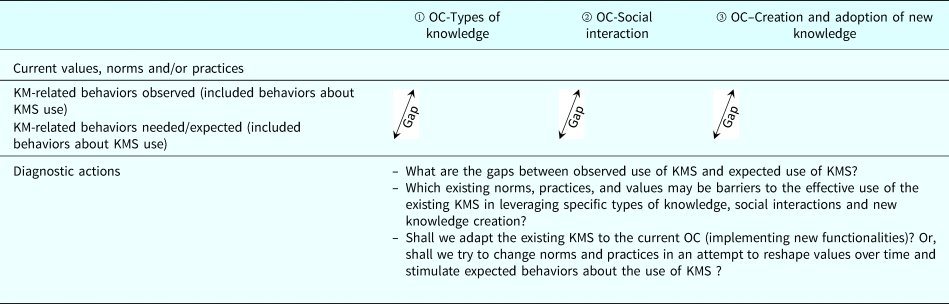
Relying on the previous work of De Long and Fahey (Reference De Long and Fahey2000) and Alavi et al. (Reference Alavi, Kayworth and Leidner2006), we propose a three-dimensional framework to understand and evaluate how OC influences effective use of KMS. These dimensions provide diagnostic tools for analyzing how OC (values, norms, and practices) affect an organization's KM-related behaviors and particularly KMS use for knowledge creating, transfer, and application.
Dimension 1: OC shape assumptions about which knowledge is important
OC influences what is perceived as useful, important, or valid knowledge in an organization. It can be related to the nature of knowledge (tacit vs. explicit), or to a particular set of knowledge.
OC shapes what a group defines as relevant knowledge, and this will directly affect which knowledge a unit group focuses on and the effective use (or not) of the current KMS. For example, let's take an entrepreneurial engineering group whose values and norms encourage lots of experimentation and frequent, informal interactions. Is this group expected to use a formal, procedurally oriented knowledge repository? Can the KMS be adapted to fit the culture? Or should management invest in OC change?
On the other hand, in a company with a focus on information management, documentation, expertise, formalization, stability, routines, centralization, continuity, and control, individuals will be likely to use KMS functionalities for explicit knowledge storage and access.
The first dimension of our framework helps to:
– Identify behaviors that would demonstrate that a particular set of essential knowledge-building activities is critical to an organization.
– Identify the existing norms, practices, and values which can explain the current behaviors. There can be different subcultures and then different behaviors reflecting different views of knowledge.
– Clarify which existing norms, practices, and values may be barriers to the effective use of the existing KMS to leverage specific types of knowledge. And to ask whether those elements of the OC can be changed to support these behaviors. Or to ask whether the KMS can be adapted to the culture?
Dimension 2: OC creates a context for social interaction
OC establishes the organizational context for social interaction and knowledge distribution. It embodies values, norms, and practices that shape how people and groups interact and has a major impact on knowledge creation, transfer, and application. For example, let's take a company which is interested in sharing lessons learned from the big data initiatives in its different entities. A lack of norms or practices to support the sharing of this knowledge across units means that there is no organizational context where one unit's valuable experiences about big data is likely to be transferred on to others. Thus, the potential value of applying this big data knowledge elsewhere in the company can be lost.
Furthermore, the lack of norms or practices to create organizational context for social interaction is likely to undermine the effective use of KMS functionalities for knowledge diffusion, distribution, or sharing. Let's take two entities which are not expected to continually share knowledge and collaborate, and are without routine practices to do so. A new collaborative platform can surely improve the environment for knowledge sharing. But, unless executives address long-standing interaction patterns shaped by different values and norms, the benefits of the collaborative platform will be limited.
The impact of OC on the context for social interaction can be observed with the existing norms and practices associated with important core values: interactivity, collaboration, orientation of collective knowledge (vs. individual knowledge), orientation toward the existing knowledge, and expertise.
• Interactivity
Norms and practices that increase the volume of interactions (by bringing people together) have a real impact on the effectiveness of knowledge sharing, creation, and application. They vary from one organization to another. One traditional firm may rely on formal communications processes and meetings designed to periodically bring people together, while a more entrepreneurial firm will expect frequent, unplanned, and unstructured interactions amongst individuals. In these organizations, formal and informal communications are valued differently. And this may result in different patterns in the use of the existing KMS. For the entrepreneurial firm, formal communication functionalities (such as intranets or portals) can be used less because their norms and practices are oriented toward informal interactions.
Even an existing KMS can provide multiple channels (messaging, calendaring, online chat, online meetings, discussion forums, application sharing, team rooms for project teams, other types of communities, etc.) to reduce communication barriers, unless norms and practices support a higher level of interactivity between the right individuals or groups, these channels will have relatively little impact on the effectiveness of knowledge sharing and application.
• Collaboration
Another way that culture shapes the context for social interactions is through norms and practices that promote collaboration between functions and operating units (for problem solving, as an example). These norms prevent a silo mentality, develop a sense of collective knowledge and are more likely to lead to creating and sharing new knowledge of all types.
The impact of collaboration value relies on the recognition of team-based performance and collective accomplishments instead of valuing individual knowledge. Because, as long as people benefit from not sharing, the organization's ability to leverage their knowledge will be limited and the investment in a KMS will not change the culture by itself.
• Orientation toward the existing knowledge and expertise
Norms and practices that stimulate/encourage employees to seek out and build on existing knowledge and expertise, create a context for social interaction.
Thus, codification initiatives must be encouraged and expertise recognized. KMS must provide functionalities for explicit knowledge storage and expert location to encourage individuals to connect with others and share their knowledge in order to increase their own social capital and then be attractive for assignments in need of their expertise.
Alavi et al. (Reference Alavi, Kayworth and Leidner2006) and Rodriguez-Elias (Reference Rodrıguez-Elias, Martınez-Garcıa, Vizcaıno, Favela and Piattini2008) point out two barriers which can limit the use of KMS for codification functionalities and encouraging individuals to prefer local initiatives:
• the burden of formal rules for the storage in knowledge bases which can result in significant delays in posting submitted knowledge contributions,
• the centralization of knowledge repositories when the organization is, in fact, in a distributed context (contributions to knowledge repositories provided from diverse sources that may be distributed throughout the entire organization). The management of knowledge repositories in a centralized form can lead to less reactivity in the updating of knowledge contributions thereby leading to relatively outdated content of some central repositories. As a result, these repositories are not used as widely as they could be.
The second dimension of our framework helps to:
– identify current norms and practices that encourage or discourage a high frequency of interaction, a collaborative knowledge use, a reusing of the existing knowledge and expertise
– understand how the existing values, norms, and practices facilitate or limit effective use of communication and collaboration functionalities of the existing KMS.
Dimension 3: organization culture shapes creation and adoption of new knowledge
Organizations need to be able not only to adopt or create new knowledge, but also to legitimize and distribute it to change strategic direction and resource allocations faster than their rivals. Openness and innovation are values than can help an organization rapidly acquire and distribute knowledge throughout the organization to enhance decision making and performance.
• Openness
Openness deals with norms and practices that strongly encourage the exploitation of knowledge from the external environment (both informal and formal sources). For example, a norm could be to expect that units always build on structured knowledge acquired from outside the organization, and not simply by absorbing it.
• Innovation
Value placed upon innovation is characterized by norms and practices that go beyond encouraging social interactions and involve individuals gathering data from diverse sources, exercising their judgment to transform data into information, and then engaging in intense interaction and discourse to produce new knowledge that can be the basis for actions. Innovation is a cultural mindset bringing people to the questioning of fundamental beliefs and existing ways of working that have shaped the organization's earlier successes. Implementing these values is a difficult challenge but a key element in creating new knowledge for the organization and developing adaptability capacities.
Openness and innovation are values which encourage local initiatives and make possible the emergence of formal and informal communities within the organization.
When these values (openness, innovation) are strong in an organization, KMS are viewed as vehicles which accelerate innovation (the process) via cross-pollination of ideas across communities (Alavi et al., Reference Alavi, Kayworth and Leidner2006) and the exploitation of knowledge from the external environment (De Long and Fahey, Reference De Long and Fahey2000). Thus, in this cultural context, it seems relevant to give more importance to environment scanning (from formal and informal sources), storage (of information scanned from sources), communication, and collaboration functionalities in the KMS supporting knowledge creation and application.
In this cultural context, due to an important number of local initiatives, organizations should:
• avoid imposing specific communication and collaboration tools in their KMS, but should rather propose a panel of tools that communities could adapt to their local sharing practices.
• choose a management of knowledge repositories in a distributed form to increase the use of KMS storage functionalities.
The third dimension of our framework suggests several diagnostic actions:
– Identify examples of critical new knowledge adopted or created with input from the external environment that lead to innovation within the organization.
– Find evidence about the degree of participation in both acquiring knowledge critical to the business and challenging the fundamental assumptions and beliefs of the organization.
– Identify current values, norms, and practices that encourage or discourage individuals from building on and extending structured knowledge from the external environment.
– Identify current KMS functionalities that support processes of new knowledge creation and innovation; identify norms and practices that may be barriers to their effective use; identify possible KMS evolutions to support valuable norms and practices.
Research case study
The organization under study is an international player in the area of development assistance and capacity development. Its role is to help to achieve the eradication of poverty and the reduction of inequalities and exclusion by helping countries to develop policies, leadership skills, partnering abilities, and institutional capabilities. This organization works in more than 150 countries.
Its organizational chart is subdivided into three levels:
– Global level with executive offices, Human Resources office, and Audit office
– Regional level with regional bureau (Africa, Asia and Pacific, the Middle East, Europe, Latin America, and the Caribbean)
– Local level where the country's offices of each regional bureau are located.
KM activities are streamlined to coordinate work at the global, regional, and local levels and capture the knowledge generated by the country offices. Here, KM activities are important for development work, either directly through externally oriented evidence collection, analysis, knowledge capture, generation, and transfer or indirectly by improving organizational effectiveness and efficiency and fostering a culture of transfer and learning.
Research method
We take a positivist approach to the case study, assuming, a priori, that there are discoverable relationships between OC and effective use of KMS and KM outcomes. Our case is exploratory in the sense that it is a first step toward validating/testing the proposed OC framework (Table 2). The final goal is to suggest, in the basis of the analysis, relevant actions for the KMS strategy.
Diagnosing effective KMS use through the three-dimensional framework

Data collection
Three primary data sources were used: (1) semi structured telephone interview (2) questionnaire, and (3) review of organizational documentation. The use of multiple sources of evidence to collect empirical data increases the validity of the research case study (Yin, Reference Yin2009).
First, we conducted semi-structured interviews with 13 executive employees at various company locations. All interviews were recorded and then transcribed for analysis. Respondents were first asked to characterize their OC and then to describe their units' particular KM approaches. Each respondent was asked to describe the specific KM practices that he or she engaged in and to discuss their outcomes. The respondent was also asked to describe the KMS functionalities used in support of KM activities and to highlight any resistance that he or she might have noticed in his or her business unit. Having data from these three separate sources enabled us to triangulate the results of our interviews analysis.
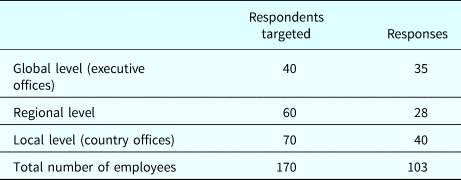
Second, a questionnaire was made available to 170 employees at the three organizational levels (global, regional, and local) through a web-based version (Table 3). The goal was (1) to identify current KMS functionalities and (2) to capture their perception of norms and practices underlying the use of KMS. They had a 2-week survey period in which to enter their responses and make their comments. A copy of the questionnaire is presented in Appendix 1.
Respondents

The third source of data came from a review of organizational documentation (white papers, strategy plan, etc.) which helped to understand the strategy of the organization, its goals, values, and organizational structures.
Data analysis
A draft of the case study has been reviewed by peers and respondents from the studied organization with the aim to reduce false reporting, and to strengthen validity of the findings.
Case description and analysis
KM activity in the organization under study supports areas of development work, either directly, through externally oriented evidence collection, analysis, knowledge capture, generation and exchange initiatives and engagement in policy debate, or indirectly, by improving organizational effectiveness and efficiency and fostering a culture of learning and exchange.
An investment in a KMS is made principally in the Teamworks global knowledge networking platform. This platform is the most advanced corporate peer-to-peer platform within the organization and integrates other important KM functionalities such as a system for capturing knowledge, public online forums for public consultations and knowledge mobilization, together with a knowledge base for accessing staff profiles. The Executives we interviewed reported that, with the Teamworks global knowledge networking platform, there was more engagement with and more satisfaction about workers’ knowledge evidencing that the KMS investment has had a generally favorable impact on getting work done better. For them, units had more control over asking and solving their own queries.
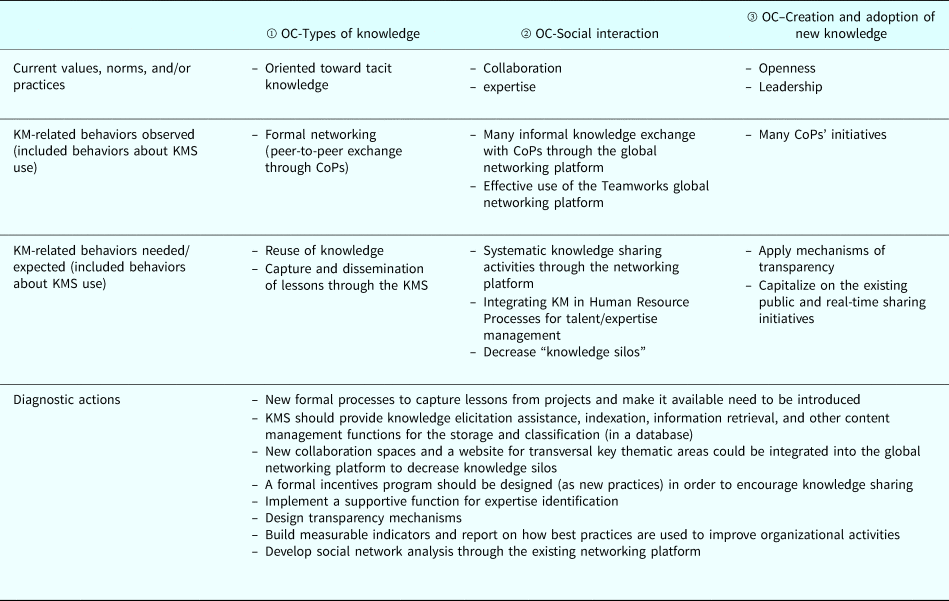
However, the analysis of our interviews and questionnaires suggest distinct patterns in how employees or communities of users actually use the global networking platform. We used our three-dimensional framework to identify, understand and structure the different patterns of the KMS use. The following text discusses the relationships we found between OC (values, norms, and practices), KMS use and outcomes. From this analysis, concrete managerial actions are also proposed in order to strengthen the KM strategy of the organization studied. We have presented our results in Table 4.
Patterns of KMS use (synthesis)

Pattern 1: KM is people-centric rather than document-centric
Most of the organization's knowledge is tacit, being stored in the minds of its employees. Only a little part of this tacit knowledge is documented and made available in the KMS. Therefore, KM is people-centric rather than document-centric with the Teamworks global knowledge networking platform.
• Reuse of knowledge
There has been increasing demand for knowledge about innovative approaches and solutions from regional offices. However, there are multiple approaches for capturing and aggregating lessons within the organization's network (formal, lengthy reports, guidance notes, etc.). Therefore, the potential reuse of knowledge is difficult to realize consistently. The current process of knowledge codification does not follow a standard model in order to produce the quality and impact that is needed for the organization.
It is an organization that is very advanced in the area of “formal networking” and less so in the area of “capturing knowledge” with a codification approach.
For respondents, the system of capturing and transferring experiential and organizational knowledge needs to be stronger. New formal processes and IT support to capture tacit knowledge and make it available need to be introduced.
• Culture of learning before, during and after
The organization wants to embed an OC of “learning” in project cycles so the different units look into past experiences and apply the lessons learned from similar projects. Executives who were interviewed gave a few examples of local initiatives which remain rare.
The organization expects that during their life cycle, projects systematically capture, and disseminate experiences and lessons (including both successes and failures) in order to inject them into the project processes. With that purpose in mind, new formal processes must be defined for knowledge project capitalization and systematic lessons learned as new campaigns must be introduced. New functionalities must also be implemented. For example, a web-based internal question and answer exercise can serve as a supply mechanism for a repository of lessons learned in order to extract and consolidate points of learning from both employees and clients.
In summary, the KMS should provide knowledge elicitation assistance in order to extract and codify lessons learned from previous projects. Moreover, indexation, information retrieval, and other content management functions for the storage and classification (in a database) along with access to these lessons learned must be implemented.
Pattern 2: social interactivity
• Communities of practices (CoPs)
Communities of practices (CoPs) are an important collaboration enabler for the organization.
With CoPs and the Teamworks global networking platform as technological support, the organization has created a very advanced corporate peer-to-peer platform, connecting practitioners across regions, flattening hierarchies, and increasing informal knowledge exchange amongst employees.
However, our interviews highlighted a side effect characterized by the emergence of new thematic silos which often prevent cross-practice sharing and interdisciplinary work. This can be explained by the fact that CoPs are directly aligned with thematic business units.
New collaboration spaces and a website for transversal key thematic areas could be integrated into the global networking platform to leverage synergies and decrease information silos.
• Knowledge sharing value
Even though the organization has invested in the Teamworks global networking platform, the knowledge sharing is not yet fully institutionalized as a natural cross-functional exercise. Systematic knowledge sharing activities are not put in place for all the units and their effectiveness is not monitored as they occur.
During our interviews, respondents pointed out the fact that there is a lack of reward for this sharing of knowledge and for providing support to colleagues in other units. A formal incentives program should be designed (as new practices) in order to encourage knowledge sharing.
• Expertise
Within the organization, expertise is recognized as an important value. However, potential for the identification by management of talent and expertise is underutilized. KM is not consistently emphasized in Human Resources processes as a core criterion for recruitment and staff development.
The existing knowledge base storing the staff “profiles” lacks incentives for widespread accessibility and use. In addition to this, implementing a supportive function for expertise identification (an open wide expertise Roster) can provide universal access for business units to a pool of expertise, enabling the organization to draw from a pool of qualified practitioners and experts at any time and mobilize staff members to be available for ad-hoc initiatives and virtual projects.
Pattern 3: strengthening openness, innovation, and leadership attitudes
• Openness and transparency to be shared with and to learn from the public
Citizens are the ultimate priority and target for the organization. A significant effort is required in order to engage external expert communities and the global public in development solutions with a view to learning and sharing the organization's knowledge with different stakeholders.
Executive staff insisted on the importance of (1) designing global transparency mechanisms to promote openness of information toward the public and (2) capitalizing on the existing public and real-time sharing initiatives in the different regions? These actions will facilitate the adoption (by employees and the public) of future KM functionalities – such as public blogging and online forums – to support interaction with the public.
• Innovation and leadership
Even though the organization is recognized as an innovator and leader in the arena of knowledge networking, it intends to solidify this leadership by capitalizing on its competitive advantage with community-created knowledge and experience with public dialog and crowd-sourcing initiatives.
For the respondents (interviewees and questionnaires), the role of the Teamworks global networking platform is essential to that goal. The platform must be maintained and improved, not only focusing on its particular strength in a people-centric knowledge flow, but also strengthening its codification and sharing approach with new formal processes and incentives. Furthermore, KM leadership of the organization can be strengthened with a controlled approach, enabling a regular monitoring of KM outcomes. This can be done by building measurable indicators and reporting on how lessons have been learned and how best practices are used to improve organizational activities. To sum up, through the existing networking platform, the potential of evidence-based statistics, including social network analysis, for incentives, business intelligence, and data-driven decision making, must be exploited.
Discussion and lessons learned
Table 4 is a synthesis of the three main patterns of KMS use we have identified in our case study. We discuss, in this part, our findings and their managerial implications.
Competing values
The first pattern of the KMS use (Table 4) that we highlighted in the case study shows a tension between two values:
– a strong orientation toward individuals by privileging socialization logics for the sharing and transferring of knowledge;
– a desire to give more space to the capture of knowledge through the codification logic of specific tacit knowledge, by supplying the organization with formal codification processes.
However, for many years, the organization chose to heavily invest in social networks (with incentives), rather than in systems for capturing experiential knowledge. Therefore, the organization will eventually be faced with a huge challenge once it decides to migrate from a strong socialization logic (orientation toward tacit knowledge) to a dual logic of socialization and codification.
It would be interesting in future research to analyze how organizations manage tensions between competing values for successful KM initiatives.
KMS regulation: between autonomy and control
The first and third use patterns (Table 4) highlight the management's desire to supervise and control the autonomy generated by the “Teamworks global knowledge networking” platform, notably by setting up indicators to evaluate the effectiveness of learning, tools for analyzing social networks (and therefore traceability of inter individual exchanges) as well as formal procedures and rules for the systematic codification of project experiences.
Thus, the objectives of the KM platform oscillate between two well identified logics in the literature (Khalil and et Dudezert, Reference Khalil and et Dudezert2014):
– on the one hand, an autonomy logic which assumes that technical systems will increase the flexibility of users in terms of access, sharing, and creation of new knowledge;
– on the other hand, a logic of control which postulates that these systems will improve the control of practices and allow a better monitoring of individuals in such a manner that they comply with the organization's objectives.
Strengthening, through the platform, the control exercised over individuals involved in the exchange and collaboration processes can hinder the release of collective intelligence and otherwise conflict with creativity. On the other hand, the autonomy created by the implementing of the KMS could thwart the interests of the organization for the benefit of vested interests or groups.
How should the organization under study then regulate the tension between autonomy and control for its KM platform? There is little research on how regulatory modes are built when implementing a KMS. The theory of social regulation may be a relevant angle of approach (Reynaud, Reference Reynaud1989). This theory aims at understanding how rules (prescribed and implicit) are formed, transformed, and maintained within an organization and position the autonomy/control dialectic at the heart of understanding the dynamics of collective action.
Knowledge management platform and silos preventing knowledge sharing
The second pattern of use shows that the platform significantly contributes, within CoP and functional units, to the performance of exchange and collaboration processes. This can be explained by the strong anchoring of the organization on values that focus on individuals with a logic of socialization.
The main difficulty lies in the sharing and the transfer between CoP and between functional units. Previous work by Hansen et al. (Reference Hansen, Nohria and Tierney1999) can partly explain these limitations of the platform. Indeed, this research shows that virtual KM platforms, do not often allow strong ties between entities, and this hampers the ability to transfer complex knowledge between them. Instead, these platforms provide weak links, only useful for project teams to search for knowledge within other units. Also, the use of personal “networks of knowledge” could be an alternative to transfer specific, contextual, and complex knowledge, but also to share a cultural context and create intercultural empathy.
Our research has certain limitations:
– The data were gathered from a single organization so it is difficult to generalize from a single case in relation to other cases.
– The case study shows the applicability of the proposed framework (Table 2). However, for its transferability, we need to go further and propose a guideline on how to apply it (the elaborating process).
– A complete validation of the proposed framework implies a measurement of the benefits obtained from the application of changes concerning OC and the KMS. However, this is a very difficult task, since results appear over the long term and it is difficult to measure how a new KMS strategy has contributed to benefits in knowledge creation, transfer, and application.
Conclusion
The main contribution of this paper is the elaboration of a three-dimensional framework which can help organizations to determine the degree of fitness of their KMS to the OC context. Each dimension of the framework provides a particular view that can be taken in assessing how different aspects of OC are most likely to affect the use of a KMS. This framework is a diagnostic tool that organizations can use to analyze what OC barriers there are to a successful use of the current KMS for knowledge creation, transfer, and application.
The case study we have performed in an international organization in the area of development assistance and capacity development was a pilot to test the applicability of the proposed framework. New applications in other organizations will help to refine our three-dimensional framework.
The goal of the proposed framework is to provide a first level of analysis. For changes, a larger and deeper analysis must be done in order to see: whether there is a shared perception of need for change; whether the climate for this is supportive or not (i.e. encouraging open debate and trust); and whether or not powerful subcultures and countercultures exist. Furthermore, organizations must keep in mind that profound changes in their KMS strategy, can engage them in a long term cultural change effort.
Thierno Tounkara has a PhD in Computer Science from the Dauphine University (France, Paris). Since 2003, he is Associate Professor at Institut Mines-Telecom Business School, in the Information Systems Department. He delivers courses in Information System Design, Project Management and Knowledge Management. He has written over 30 scientific articles on Knowledge Management and Engineering. He worked at ONERA, First Aerospace Research Player in France, as KM engineer for 3 years. In 2000, he joined the French Knowledge Management Club, an association rallying a lot of French companies.
Assessment of how a KMS fits with organizational culture
In completing this questionnaire, you are providing a picture of how the KMS of your organization supports knowledge activities (knowledge creation, transfer, and application) and the values that characterize it. There are no correct or incorrect answers as every organization and individual will produce a different set of answers. Just be as accurate as you can.
Please rate each of the statements by dividing 10 points between A, B, C, and D depending on how similar the description is to your organization (10 is very similar and 0 is not at all similar to this firm). The total points for each question must equal 10. Rate for both how you feel the firm is now (NOW).
For example, in question 1, assume that you gave 7 points to A, 1 point to B, 2 points to C, and 0 points to D in the “NOW” column. This would indicate that the KMS of the organization fits predominantly with “A” characteristics focusing on information management, documentation, expertise, and formalization.