Introduction
The initial clinical presentation of multiple sclerosis (MS) can be highly variable based on the extent and location of central nervous system (CNS) involvement. MS is diagnosed using a combination of clinical, imaging, and laboratory parameters outlined in the revised 2010 McDonald criteria.Reference McDonald, Compston and Edan 1 , Reference Polman, Reingold and Edan 2 These criteria require the presence of dissemination of demyelinating lesions in both time and space, as well as “no better explanation for the findings than MS” in order to make the diagnosis. Most patients present with an attack or relapse, which is defined as “patient-reported symptoms or objectively observed signs typical of an acute inflammatory demyelinating event in the CNS, current or historical, with duration of at least 24 hours, in the absence of fever or infection.”
The high clinical variability at the time of initial presentation can make it difficult to discriminate those patients with likely demyelinating disorders from those with other conditions. In 2008, an international consensus-based effort by MS experts led to the identification of clinical and imaging “red flags” that should lead the clinician to consider a diagnosis besides MS.Reference Miller, Weinshenker and Filippi 3 The phrase “red flag” was used to indicate that something in the history, examination, or clinical investigation was not suggestive of MS. The expert panel distinguished between red flags of major, intermediate, and minor significance, based on how strongly suggestive the signs or symptoms were of a diagnosis besides MS.
Another study by Carmosino et al Reference Carmosino, Brousseau, Arciniegas and Corby 4 retrospectively reviewed the charts of all new patients to a university-based MS center for evaluation of possible MS and noted that about 33% were diagnosed with MS or possible MS based on the McDonald criteria, 31.5% had another neurological condition, 22.5% had a probable psychiatric disease (somatoform disorder, mood disorder, or anxiety disorder), and 12.5% had no clear diagnosis. In this study, both an atypical history and normal neurological examination were highly predictive of a condition besides MS.
Kelly et al Reference Kelly, Chaila and Kinsella 5 performed further exploration of atypical symptoms and red flags to assess their predictive value in distinguishing MS and clinically isolated syndrome (CIS) from other entities, including medically unexplained symptoms (MUS), in clinical practice. The retrospective analysis included 244 patients with suspected MS who were referred to a neuroinflammation clinic and were subsequently assessed for the presence of atypical symptoms and red flags. Atypical symptoms had a sensitivity of 84%, specificity of 90%, and a positive likelihood ratio (PLR) of 8.4, whereas red flags had a sensitivity of 47%, specificity of 88%, and a PLR of 3.9 for the exclusion of MS/CIS. The presence of atypical features was more useful as a marker of non-demyelinating disease because they encompassed the entities of both medically unexplained symptoms and other neurological disease (OND), whereas red flags appeared to have a secondary role for identifying ONDs, such as neuropathies, migraines, seizure disorders, and myelopathy.
These studies suggest that a notable portion of patients who present to MS clinics for evaluation are found to not meet criteria required for the diagnosis of MS or related conditions such as CIS, radiologically isolated syndrome (RIS), optic neuritis (ON), transverse myelitis (MS), or neuromyelitis optica spectrum disorders (NMOSDs). Attempts have been made to clarify predictors that would differentiate demyelinating disorders from ONDs or MUS. Identification of specific predictive markers for non-demyelinating disease would aid in the recognition of patients whose initial presentations are not consistent with demyelinating diseases. Similar markers have been described within other neurological sub-specialties. The “teddy bear sign” is said to be present in patients who present for prolonged EEG monitoring with a toy animal, and has been used to differentiate between epileptic and non-epileptic events.Reference Burneo, Martin and Powell 6 The “sunglasses sign” is the phenomenon in which patients with putative visual loss wear sunglasses to their neuro-ophthalmologic evaluation.Reference Bengtzen, Woodward, Lynn, Newman and Biousse 7 The presence of this sign has been found to be highly predictive of nonorganic vision loss.
The purpose of our study is to determine whether patients who present with a self-prepared list of symptoms in preparation for their first visit for evaluation of possible MS have a higher probability of having a non-demyelinating disorder. We would like to evaluate whether this action, which we term the “list sign,” has utility in determining whether or not a patient has a demyelinating disorder.
Methods
The study was approved by the New York University Langone Medical Center (NYULMC) Institutional Review Board, with all patient information de-identified. All new patients who presented for outpatient evaluation to a neurologist at the MS Comprehensive Care Center at NYULMC were recruited retrospectively from September 2012 to July 2014. A comprehensive medical record review of these subjects was conducted 6 months after initial presentation at the clinic to ensure longitudinal collection of data as needed for diagnostic clarification. Historical information was collected in a standardized fashion, with medical and neurological review of systems collected on the same checklists by the neurologist. Subjects who brought in a list to enumerate their symptoms during their first visit to the MS center were identified as having a “list sign.” Restrictions were not placed upon the organization, form, or number of items on the list. These lists, which along with any medical information brought in by the patients, were included in the medical charts and were reviewed during this study. No subjects were encouraged or instructed to bring in a list as a part of their initial evaluation. Additional factors that were examined included referral source, age, gender, occupation, marital status, initial symptoms, history of psychiatric and medical problems, neurological examination, and personal review of MRI of the brain and spinal cord. A patient was defined as having a demyelinating disease if the revised 2010 McDonald’s criteria were met or if they had a presentation consistent with CIS. Patients with RIS, TM, ON, or NMOSDs were also included in the demyelinating group. All other patients were classified as having non-demyelinating conditions. Based on these criteria, patients were given an initial diagnostic impression of either demyelinating disease or not, and this initial impression was correlated with the final diagnosis after investigation was completed to ensure accurate diagnosis.
Sensitivity, specificity, and positive predictive values were calculated to evaluate the utility of a positive list sign as a screening test to identify non-demyelinating disease. The 95% confidence intervals for the proportions were calculated using the exact binomial method. For categorical factors, the percentages were compared between those who did and did not have the list sign using the Fisher exact test. Significance was set at a 2-sided p value <0.05.
Results
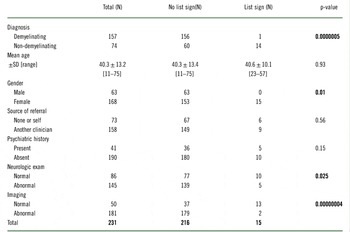
Of the 300 consecutive new patients seen in the clinic during the course of this study, 233 were seen for evaluation of possible MS and were enrolled in the study for inclusion in the data analysis (Table 1). Within this group, 157 (67.3 %) were diagnosed with demyelinating disease. Two subjects were lost to follow-up prior to diagnostic clarification of presenting complaints. The remaining 74 (31.8%) patients were determined to have non-demyelinating disease, which encompassed both ONDs and MUS.
Patient characteristics by whether or not patient brought in a self-transcribed list of symptoms to the initial appointment in the MS clinic

P-values are listed in the last column; significant p-values of <0.05 are bolded.
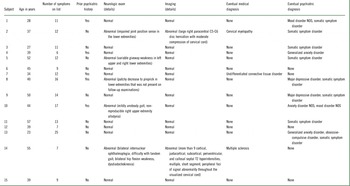
A positive list sign was observed in 15 patients, of whom only one (6.6%) was diagnosed with a demyelinating disease (Table 2) We calculated that the list sign had a sensitivity of 0.19 (95% CI 0.11–0.30) and a specificity of 0.99 (95% CI 0.96–0.99) for identifying non-demyelinating disease. The positive predictive value or the probability that a patient had non-demyelinating disease if he or she presented with a list sign was 0.93 (95% CI 0.66–0.99).
Individual characteristics and findings of patients with a positive list sign

Of the 14 patients with a positive list sign but no evidence of demyelinating disease, 2 (13.3%) were determined to have other medical diagnoses that explained some of the reported signs and symptoms. One patient was found to have a cervical disc herniation, while the other patient was diagnosed with an undifferentiated connective tissue disorder. In both cases, the patients’ lists included multiple symptoms that could not be attributed to their respective medical diagnoses. List sign patients documented a mean of 12.07 (SD of ± 2.13) distinct symptoms on their lists, and these spanned a range of 3 to 10 systems in the typical 14-item medical review of systems.
All patients who presented with a list sign were female. Patients who presented with the list sign were more likely to have normal neuroimaging and neurological examinations than those without the list sign. Both of these factors attained statistical significance in our data analyses.
Upon initial presentation, 5 of the 15 patients (33%) with a positive list sign endorsed a past psychiatric history. After longitudinal assessment of these 15 patients in our interdisciplinary clinic that includes psychiatric services, 8 patients with a positive list sign met The Diagnostic and Statistical Manual of Mental Disorders, Fifth Edition (DSM-5) criteria for somatic symptom disorder, 4 met DSM-5 criteria for a mood disorder, 3 met DSM-5 criteria for an anxiety disorder, and 1 met DSM-5 criteria for obsessive-compulsive disorder. 8 Five patients met criteria for more than 1 DSM-5 diagnosis.
Discussion
Our results show that the list sign is useful in identifying non-demyelinating disease in patients who present for assessment to a tertiary care MS clinic for evaluation of possible demyelinating disease. Approximately 32% of all new patients who presented for MS evaluation to our clinic were diagnosed with non-demyelinating disease. However, within the subgroup of new patients who presented with the list sign, 93% were ultimately diagnosed with non-demyelinating disease. The presence of this sign has a high specificity of 0.99 in identifying such patients. This is comparable to Kelly et al’s findingReference Kelly, Chaila and Kinsella 5 that the presence of atypical symptoms at the time of presentation excludes MS with a specificity of 90%. This similarity bears special notice, since most of the lists included a panoply of varied symptoms that invoked multiple organ systems on a routine review of systems. Indeed, the unusual combinations of symptoms that were identified on the self-prepared lists would be considered to be atypical presentations for MS or an associated demyelinating disorder.
The presence of the list sign is also strongly associated with normal neurological examinations and neuroimaging. Of the five 5 sign subjects with abnormal neurological examinations in our study, one was eventually diagnosed with MS and the other was found to have cervical myelopathy. The remaining 3 subjects had only mild, inconsistent abnormalities, which either were difficult to localize or were not reproducible upon follow-up evaluation, further supporting the clinical utility of a thorough examination in these cases.
Patients with the list sign were commonly referred to the specialty MS clinic after other physicians had completed extensive and mostly unremarkable evaluations to address the somatic complaints. Such patients often meet DSM-5 criteria for somatic symptom disorder, which requires (1) distressing somatic symptoms; (2) excessive thoughts, feelings, or behaviors related to the somatic symptoms; and (3) persistent somatic complaint. This diagnosis replaces the DSM Fourth Edition, Text Revision (DSM-4-TR) diagnosis of somatization disorder, which required 4 pain symptoms, 2 gastrointestinal symptoms, 1 sexual symptom, and 1 pseudoneurological symptom for which no organic cause can be found. A critical update in the DSM-5 criteria is that a diagnosis of somatic symptom disorder does not require that the somatic symptoms are medically unexplained, allowing for patients to have co-existing medical diagnoses.Reference Sharpe 9
At least 2 of the list sign patients who did not meet criteria for a demyelinating disorder were later discovered to have other disorders, specifically cervical myelopathy and undifferentiated connective tissue disorder. A close evaluation of the lists from these 2 patients revealed that some, but not all, of the transcribed symptoms were related to their identified pathologies. Caution is therefore advised before dismissing all organic etiologies on the basis of ruling out MS in patients with the list sign; Carmosino et al Reference Carmosino, Brousseau, Arciniegas and Corby 4 report that approximately half of patients who ruled out for MS at the time of initial evaluation were found to have another neurological condition. As such, in spite of the high specificity of the list sign for identifying non-demyelinating disorders, we must maintain clinical rigor when evaluating those with atypical symptoms and a high level of health-related anxiety.
In patients with list sign for which demyelinating disorders have been ruled out, the question then becomes one of how the physician should address the patient’s list of somatic complaints. For patients with somatic symptom disorder, several authors highlight the importance of the primary care physician in managing somatization through collaboration with the patient, limiting the number of referrals to specialists, scheduling regular appointments, and setting appropriate goals for treatment.Reference Smith 10 – Reference Croicu, Chwastiak and Katon 12 There is evidence for cognitive-behavioral therapy and for selective serotonin reuptake inhibitors (SSRIs) to decrease the intensity of somatic preoccupation,Reference Kroenke 13 although many patients with somatic symptom disorder may resist psychiatric referral. For the specialist who has already received the referral, it is our opinion that a direct and respectful approach is best, in which the physician clearly states that the patient does not meet diagnostic criteria for MS or a related demyelinating disorder. The physician should also acknowledge the stress and impairment that the patient may experience from a multitude of somatic complaints and collaborate with the patient to find suitable methods to manage his or her anxiety. Additionally, the over-diagnosis of MS is not uncommon, and may lead to overtreatment and unnecessary anxiety for the patient.Reference Solomon, Klein and Bourdette 14
One strength of our study is the unambiguous presentation of the list sign. While there may be uncertainty regarding the atypicality of presenting symptoms, the list sign is readily identified. Additionally, the presence of a self-prepared list allows the clinician to better enumerate the multiple issues that are ailing the patient and to allow for consideration of other medical etiologies for these symptoms.
One limitation of our study relates to the study population. Subjects were drawn from a tertiary referral clinic in a major academic center, which may not reflect the patient population of a general neurology clinic. Additionally, the utility of the list sign may be limited if new patients are encouraged to prepare a summary of their symptoms beforehand to help facilitate their initial visit with their provider. Another limitation is the study’s retrospective nature, which restricts the nature of data that can be collected. Gathering data in a prospective manner would have allowed for deeper inquiry into the reasons why patients bring a self-prepared list to their appointment and potentially gain understanding about the psychological and practical factors that might be at play.
Conclusion
When used in conjunction with the history, neurologic examination, and imaging, the list sign can help guide diagnostic evaluation for other medical or neurological etiologies. Additionally, most patients with the list sign tend to have a high level of anxiety related to their reported symptoms. This recognition will allow the clinician to adopt an early, direct, and collaborative approach with regard to managing these issues and minimizing further functional impairment by avoiding unnecessary tests and consultations. In the same ways that the “teddy bear sign” has been used to identify possible non-epileptic seizures and the “sunglasses sign” has been used to identify non-organic visual loss, we conclude that the list sign has utility in identifying non-demyelinating disease.
Disclosures
Deepti Anbarasan, Gabriel Campion, and Paul Campion do not have anything to disclose. Jonathan Howard has the following disclosure: Demos-Springer, writer/book contract, book royalties.