


INTRODUCTION
The World Health Organization (WHO) estimates that over one billion people lack access to improved water sources [1]. Contaminated drinking water contributes substantially to the 3–5 billion episodes of diarrhoea that occur annually, 80% of which occur among children aged <5 years [Reference Ford2], and kill over two million people [Reference Kosek, Bern and Guerrant3]. In 1992, the Centers for Disease Control and Prevention (CDC) and Pan American Health Organization (PAHO)/WHO developed the Safe Water System (SWS) to prevent diarrhoea through the promotion of household water treatment, safe water storage and behaviour change communications [4]. Point-of-use water treatment and safe water storage, has been shown to reduce diarrhoea risk by 25–85%, depending on the population, setting, and other factors [Reference Crump5–Reference Lule9].
CARE Kenya implemented a SWS programme in Nyanza Province, Kenya in 2000, in response to a high diarrhoeal disease burden and poor drinking water access [Reference Makutsa10]. Rainfall in the province is seasonal with the heaviest (long) rains usually occurring from March to May and short rains falling between September and November [Reference Adazu11]. Available water sources include Lake Victoria, rivers, streams, ponds, springs, and boreholes. During dry seasons, rainwater and water from other sources is less available. In 2003, Population Services International (PSI) initiated a social marketing campaign to sell bottles of SWS disinfectant solution (dilute sodium hypochlorite) under the brand name WaterGuard® at a price of 20 Kenya Shillings ($US 0.26) through the commercial sector. In 2005, PSI Kenya sold over 800 000 bottles of WaterGuard, each of which can treat 1000 l of water.
To extend the reach of the social marketing programme [Reference Montazeri12], in February 2005 the SWS was implemented in 45 public primary schools in three districts of Nyanza Province: Suba, Homa Bay and Rachuonyo. The participating schools are located in rural communities populated by the Luo ethnic group. Fishing (for those living near Lake Victoria), raising cattle, and subsistence farming are the principal occupations.
Two teachers from each school were trained in organized group training sessions on SWS use and proper handwashing practices (including six steps: wet hands, rub all hand surfaces completely for 10–15 s, rub between fingers, clean under nails, rinse, and air dry), teachers were provided with training materials suitable for classroom use and instructed to form safe water clubs with students of all grades, teach SWS and hygiene to students, and encourage them to teach their parents. Between May and July 2005, clay pots, modified for safe storage with a narrow mouth, lid, and spigot; a years' supply of WaterGuard to treat water for drinking and handwashing; 200-l plastic water tanks with taps for handwashing; and soap were distributed to participating schools. The handwashing stations were placed in a central location in close proximity to the latrines in each of the schools.
In February 2006, we conducted an evaluation to determine if this school-based SWS and hygiene programme improved knowledge, attitudes and practices regarding water handling and hygiene among schoolchildren and their parents.
METHODS
School surveys
A random sample of nine out of 45 project schools (three from each of three districts) was selected for the evaluation. The head teacher in each of the nine schools was interviewed regarding the number of teachers, students, and functioning latrines; drinking water collection, storage and treatment practices; handwashing facilities; and soap availability at the school using a standard questionnaire at baseline and final evaluation. Where available, stored drinking water was tested for free chlorine residual using the N,N-diethyl-phenylenediamine (DPD) colorimetric method using Hach Free and Total Chlorine kits (Hach Co., Loveland, CO, USA).
Student surveys
In May 2005, a random sample of 390 students in grades 4–8 from the nine project schools was selected for a baseline survey, and in February 2006, a new random sample of 363 students in grades 4–8 from the same schools was selected for a final evaluation. For both surveys, sampling was weighted based on student population per school and per district.
Bilingual interviewers used a standardized questionnaire to interview students about knowledge, attitudes and practices regarding water sources, water storage, water treatment, handwashing, sanitation, and sources of health information. At final evaluation, interviewers administered a similar questionnaire with additional questions specific to the SWS and handwashing training, and observed each student washing their hands to assess whether they correctly used the handwashing practices taught to them. Both baseline and final student surveys were translated from English to Dholuo, and back-translated into English.
Household surveys
For the baseline household survey, the homes of the 390 selected students were visited and the mother or guardian was interviewed. A similar procedure was used for the 363 students selected for final evaluation; the baseline population was not used to minimize the possibility of the baseline survey influencing parents' behaviour and biasing final evaluation results.
The baseline household questionnaire included questions about household demographic and socioeconomic characteristics, water sources, water handling and hygiene practices, sanitation, and sources of health information. Observations were also made about water storage vessels, handwashing facilities and latrines, and stored drinking water was tested for residual free chlorine. Questionnaires and observations for the final evaluation were similar to the baseline survey, with additional questions specific to the SWS and handwashing intervention. Interviewers also asked to observe parents' handwashing practices to determine whether they could reproduce the method taught to students. Both baseline and final household questionnaires were translated from English into Dholuo, and back-translated into English.
Student absenteeism
To determine whether the project had an impact on student absenteeism, data from weekly absenteeism reports prepared for the Ministry of Education for 2004 and 2005 by each of the nine project schools and, for comparison purposes, nine neighbouring non-project schools all of which were located within a 10 km radius of the nearest project school, were abstracted and analysed. Rates of students absent per person-week of observation were calculated and compared for the period before and after implementation of the intervention.
Data analysis
Data from the baseline and final evaluation were entered into an Microsoft Access database. Statistical analysis was performed using SAS software version 9.1 (SAS Institute, Cary, NC, USA). We describe the frequencies, and weight-adjusted analysis. Weighting was based on the total school size sampled from grades 4–8 and household size for comparison of baseline and final evaluation. Univariate analysis was carried out using the Rao–Scott χ2 test of association using the F distribution as a reference. The weighted observed proportions, confidence intervals, and P values for the difference were reported for data from the baseline and final evaluations.
Informed consent
The evaluation protocol was approved by the Institutional Review Board (IRB) of Emory University. The National Center for Infectious Diseases at the CDC determined that this activity was programme evaluation of public health practice and that IRB regulations did not apply. Oral informed consent was obtained from all participants and personal identifiers were permanently removed from the database.
RESULTS
School surveys
At baseline, seven (78%) schools reported that they provided water to their students. Two schools reported treating their water, one by allowing the water to settle and the other with WaterGuard. For drinking water storage, two schools reported using plastic containers and five used water tanks. ‘Leaky tins’ were available for handwashing at two (22%) schools; one school had soap available. The median number of latrines at the schools was six (range 2–13); the ratio of students per latrine was 42:1 (range 26–264).
At final evaluation, all nine schools had functioning water storage vessels and handwashing tanks. Containers in eight schools were filled with water, and seven had detectable chlorine residuals in all drinking water and handwashing vessels. Schools used 6·3 bottles of WaterGuard per month (range 1·5–11·8) with bottles lasting ~2 days (range 1–4 days). The median number of latrines per school had increased to 10 (range 3–13), and the ratio of students per latrine was 35:1 (range 24–57). Five (56%) of the nine schools had increased the number of latrines available to students by the time the final evaluation was carried out, possibly due to increased hygiene awareness in the schools.
Student surveys
Demographic characteristics
At baseline, 390 students from grades 4–8 were interviewed, with a range of 14–22% of students selected from each grade. Overall, 172 (44%) of the students interviewed were female, median age was 13 years (range 9–20 years) (Table 1).
Demographic information for students, parents/guardians, and male and female heads of household at baseline and final evaluation

During the final evaluation, we interviewed 363 students from grades 4–8, with a range of 16–24% of students selected from each grade. A small proportion of children in the overall school population were not attending the same school at final evaluation due to migration, taking up employment, or other reasons. Overall, 164 (45%) of the students surveyed were female, median age was 13 years (range 8–18 years) (Table 1). During the previous year, 320 (89%) students had attended the same school, and 245 (67%) had a sibling attending the same school.
Water storage practices in schools
At baseline, when asked which containers were used for water storage in school, 119 (31%) students from nine schools indicated that there were none, 186 (48%) reported plastic tanks or superdrums (which are typically used for rainwater collection), 35 (9%) indicated clay pots or buckets, and 26 (7%) reported jerry cans.
In the final evaluation, 358 (99%) students indicated that they drank water at school from the project storage containers; three students reported using drinking water from their teacher's house, one brought water from home, and one did not respond. Only 48 (13%) of 363 students indicated that they needed to leave school to get water; however, all but two of these students mentioned that they drank from the project storage containers when water was available.
Water treatment
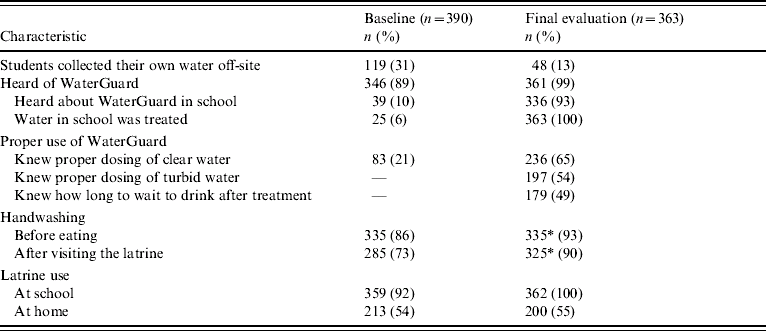
At baseline, 346 (89%) of 390 students had heard of WaterGuard, 39 (10%) reported hearing about it in school, and 83 (21%) knew the correct dose for treating clear water (Table 2). Overall, 292 (69%) students believed that the drinking water in their school was not treated; the remainder reported that the methods used to treat water included boiling (11%), settling or filtering (11%), WaterGuard (6%), and solar disinfection (2%).
Knowledge and practices related to water collection and treatment, handwashing, sanitation and diarrhoeal diseases among students in intervention schools in Suba, Homa Bay and Rachuonyo districts
* n=360.
At final evaluation, 361 (99%) of 363 students had heard of WaterGuard and 100% indicated that their school used it to treat drinking water (Table 2); while 115 (32%) said they took treated water home with them. The sources of information about WaterGuard were reported to be a teacher by 330 (91%), safe water clubs by 32 (9%), and both sources by 26 (7%) students; other frequently named information sources included radio (46%), posters or wall branding (21%), and family members (37%). The correct dose of WaterGuard for clear water was correctly stated by 236 (65%) students, a significantly greater percentage than at baseline (P<0·01). In addition, 197 (54%) knew the correct dose for turbid water, and 153 (42%) for both clear and turbid water, while 179 (49%) students correctly stated the waiting time before drinking treated water. Most students reported that they had taught others about WaterGuard, including their parents (56%), neighbours (38%), and students in other schools (17%).
Handwashing
At baseline, when asked about when they washed their hands, 335 (86%) students said before eating, 285 (73%) said after using the latrine, and 237 (61%) mentioned both occasions (Table 2), while 27 (7%) said they used soap.
At final evaluation, 98% of students said that they washed their hands at school and 99% at home. Of 360 students asked about when they washed their hands at home, 335 (93%) said before eating, 325 (90%) after visiting the latrine, and 302 (83%) mentioned both occasions. When asked to demonstrate how they washed their hands, 201 (56%) students used soap, 263 (73%) rubbed all hand surfaces for 10–15 s, 226 (63%) cleaned under their nails, and 274 (77%) rinsed and air-dried their hands. When we refined our analysis to examine four (used soap, rubbed all hand surfaces for 10–15 s, cleaned under nails, and air-dried) out of the six possible correct steps of handwashing, the median number of correct handwashing steps was three (range 0–4). Wet hands, and rub between fingers were not included in this set of analysis as, on observation, these variables often fell under the headings of the four variables selected for analysis.
Household surveys
Demographic characteristics
The median age of parents/guardians was 39 years (range 15–83) at baseline and 37 years (range 15–85) in the final evaluation; 86% of parents/guardians at baseline and 84% in the final evaluation were female. Fewer than 19% of female and 9% of male heads of household reported having no formal education. Fewer than 26% of female and 15% of male heads of household reported that they could not read (Table 1). The median number of persons per household was five at baseline (range 2–11) and six (range 2–14) at final evaluation. There were no statistically significant demographic differences between populations in the baseline and final evaluation.
Water sources
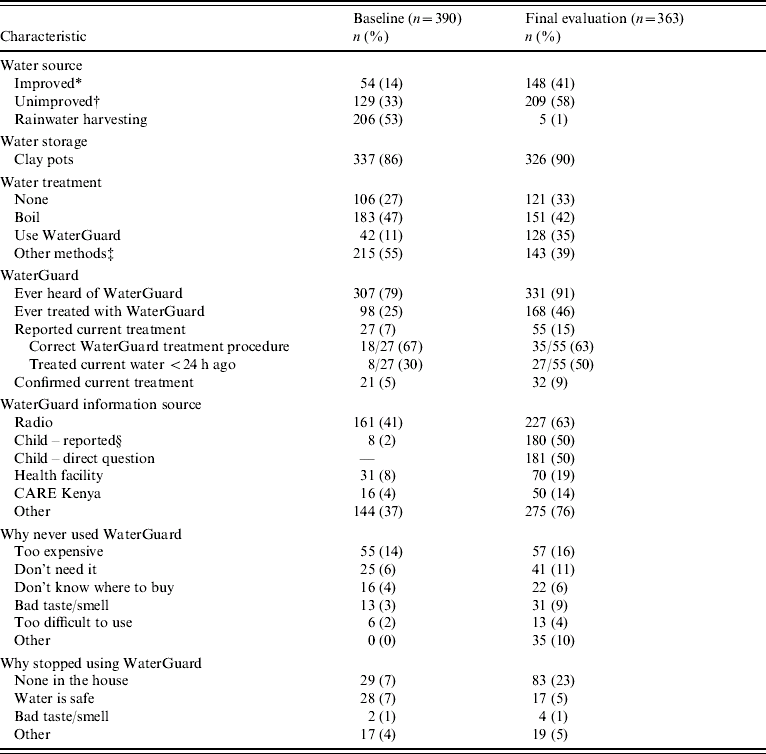
At baseline, which took place during the rainy season, 53% of parents/guardians reported currently using rainwater, 33% used unimproved sources (defined as surface water, open well or spring), and 14% used improved water sources (defined as piped water, protected well, protected spring or borehole; Table 3). During the final evaluation, which took place in the dry season, 58% of parents/guardians reported using unimproved, and 41% improved water sources; only 1% reported using rainwater harvesting.
Characteristics of household water source, storage, treatment, and parents' sources of information on water treatment at baseline and final evaluation
* Piped water, protected well, protected spring or borehole.
† Surface water, open spring or open well.
‡ Ineffective water treatment methods including sedimentation, and cloth filtration.
§ Unprompted question where the respondent freely reported that their child was a source of information on WaterGuard.
Water storage and treatment
Clay pots were used for household water storage by 86% of parents/guardians at baseline and 90% in the final evaluation (Table 3). In the final evaluation, lids were present on 97% of water storage containers.
When asked an open-ended question about water treatment practices, 27% of parents/guardians at baseline and 33% at final evaluation reported that they did not treat their water. At baseline, 47% of parents/guardians reported boiling and 11% used WaterGuard, while at final evaluation, 42% reported boiling and 35% used WaterGuard (Table 3).
When asked specifically about WaterGuard, at baseline, 79% of parents/guardians had heard of the product but only 25% said they had ever used it. At final evaluation, awareness of WaterGuard increased to 91% of parents/guardians and the percentage that reported ever using WaterGuard increased to 46% (Table 3).
At baseline, 27 (7%) of 390 households reported treating their current drinking water with WaterGuard, and 21 (5%) households had stored water samples which tested positive for residual free chlorine (Table 3). Of six households with water samples with no detectable chlorine; four (67%) were in households where parents/guardians reported treating water more than 24 h previously. At final evaluation, 55 (15%) of 363 parents/guardians reported treating their current water with WaterGuard, and 32 (9%) households had stored water samples which tested positive for residual free chlorine. Of 23 stored water samples with no chlorine residuals, WaterGuard treatment had occurred more than 24 h previously in 11 (48%).
At baseline, the most frequently reported source of information on WaterGuard was radio (41%); only 2% reported hearing about it from their child in school. At final evaluation, 63% had heard about WaterGuard on the radio and 50% from their child in school (Table 3).
The most frequently reported reason for never using WaterGuard at baseline (14%) and final evaluation (16%) was that it was too expensive. Other reasons for never using WaterGuard in the final evaluation included not needing to use it (11%) and bad taste or smell (9%). Among parents/guardians at final evaluation who had tried WaterGuard but stopped using it, the most common reported reason was that they had no WaterGuard in the house (23%); while only 1% reported stopping because of its taste or smell (Table 3).
On weighted univariate analysis of water treatment variables, a significantly higher proportion of households at final evaluation reported ever using WaterGuard (P<0·01) and currently using WaterGuard (P<0·01) than at baseline. There was a trend towards increased awareness of WaterGuard (P=0·07) and correct WaterGuard treatment procedure (P=0·08) from baseline to final evaluation. The increase in confirmed WaterGuard use was not statistically significant (Table 4). In the overall analysis, weighted and unweighted statistics were similar.
Univariate analysis of characteristics of water treatment and hygiene among parents at baseline and final evaluation

* Estimated% is the weight-adjusted sample proportion.
† 95% CI is the confidence interval for the population proportion.
‡ P values for the difference in population proportions.
On weighted univariate analysis, parents of children in the safe water club (50%, 95% CI 18–81) were more likely to report currently using WaterGuard than parents whose child in school was not a member of the safe water club (28%, 95% CI 15–40, P=0·02).
Hygiene
At baseline, 73% of parents/guardians reported washing their hands before eating, 45% after defecating, and 29% before preparing food. In contrast, at final evaluation 90% of parents/guardians reported washing their hands before eating, 68% after defecating, and 53% before preparing food (Table 5).
Parents' source of information and knowledge on handwashing, hygiene and sanitation at baseline and final evaluation

* Correct handwashing procedure on observation is defined as the use of water, soap, and rubbing fingers, palms, wrists and cleaning between nails.
† Unprompted question.
On weighted analysis, soap was observed in 74% of households at baseline and 90% at final evaluation (P<0·01; Table 4). When asked to demonstrate how they washed their hands, 76% of parents/guardians used soap and 38% were able to demonstrate four of the six key handwashing steps taught to their children (Table 5).
At baseline, the most frequently reported source of hygiene information was CARE Kenya (17%) while children were only cited by 2% of parents/guardians. At final evaluation children were reported as a source of hygiene information by 18% of parents/guardians; when asked directly, 33% of parents/guardians acknowledged learning from their child (Table 5).
At final evaluation, 92 (25%) of 363 parents/guardians reported changing their handwashing behaviour because of what their child had told them about handwashing; 58% of parents/guardians who said they did not change handwashing behaviour reported that they already practised correct handwashing procedures before their child told them about it.
Student absenteeism
The project was implemented during the June–July school term in 2005. The rate of absent students per person week reported to the Ministry of Education was 35% lower during the 2005 September–November school term than the 2004 September–November term [Fig. (a)]. In contrast, absenteeism rates calculated for nine neighbouring non-project schools were 5% higher in the 2005 September–November term than in the same term in 2004 [Fig. (b)]. Higher rates of absenteeism were seen in the beginning of the term in all schools because in rural Kenya many children work in the fields and return to school late. Absenteeism was low during the end of each term when exams, which are compulsory for advancement to the next grade, were held.
Weekly absenteeism rate for (a) nine intervention schools; (b) nine non-project schools in the September–November school term in 2004 (–■–) and 2005 (- - ▲ - -).

DISCUSSION
In a pilot project, the provision of safe drinking water, handwashing facilities, and hygiene education in primary schools in rural western Kenya reduced student absenteeism by 35%. This conclusion is strengthened by the finding that absenteeism in neighbouring comparison schools increased by 5% during the same period. The findings are consistent with evaluations of school-based hand hygiene programmes in the United States which showed a reduction in absenteeism following the implementation of use of hand sanitizers, hygiene education, or a combination of these interventions [Reference Guinan, McGuckin and Ali13–Reference Kimel15].
In Kenya, the likelihood of faecal contamination of the school environment is high because many schools, including the ones described in this evaluation, have few latrines, inadequate water supplies, poor quality of available water sources, water storage in containers that permit hands to touch and contaminate stored water, and a lack of handwashing facilities. Besides impacting school attendance, the resulting burden of diarrhoeal diseases and parasitic infestations has a negative impact on students' growth, nutritional status, physical activities, cognition, concentration, and school performance [1]. Findings of other research studies have suggested that health education on personal hygiene and interventions to prevent disease caused specifically by parasitic worm infections can have a beneficial impact on the health of students and may be cost effective [Reference Luong16–Reference Stanton and Clemens21]. Furthermore, interventions that contribute to decreased absenteeism could facilitate improved learning, and have important implications for the country's development [Reference Del Rosso and Marek22].
Our evaluation suggested that safe water and hygiene knowledge transfer took place from teacher to student following training and the installation of handwashing and drinking water stations in public schools in rural western Kenya. Students' knowledge of the correct WaterGuard treatment procedure for clear water increased significantly from baseline to final evaluation and was probably facilitated by the universal WaterGuard treatment of water stored in improved containers in the schools. Students' knowledge of the appropriate times to wash their hands also increased substantially from baseline to final evaluation and over half of the students were able to demonstrate at least three of six key steps of handwashing they had been taught. These findings support claims that schoolchildren are a ready, reachable, and important target for health interventions [Reference Tobin and van Koppen23, Reference Alibhai, Ahmed and Scott24].
The evaluation also demonstrated water treatment and hygiene knowledge transfer from student to parent and some evidence of behaviour change among parents. Parents' awareness and reported use of WaterGuard increased substantially from baseline to final evaluation. The proportion of households with confirmed WaterGuard treatment also increased modestly, but this difference was not statistically significant. Parents' knowledge of the appropriate times to wash their hands and the proportion of households with soap also increased substantially from baseline to final evaluation. The relatively modest changes of behaviour when compared to larger increases in knowledge, particularly regarding WaterGuard use, are consistent with behaviour change theory which asserts that behaviour change occurs in stages over time as a gradual, dynamic process [Reference Lauby25–Reference Thevos27]. With continued messages, changes in water treatment and hygiene practices can take place over time [Reference Luby28]. A follow-up survey is planned in project communities to assess changes in practices over a longer time period and the sustainability of the intervention. Additionally, the provision of flyers or leaflets on safe water and hygiene for students to take home for their parents as a reminder of correct practices may help with retention of the information.
Children's potential effectiveness as agents of change in the home was suggested by the finding that parents who reported that their children influenced their water treatment behaviour had a higher degree of awareness of WaterGuard than parents who did not acknowledge their children's influence, and were significantly more likely to know the correct WaterGuard dose, report current use, and have chlorine residuals in their stored water. In addition, 25% of parents reported changing their handwashing behaviour based on what their child taught them, and 38% were able to demonstrate the handwashing procedure taught to their children which, although baseline data for comparison are lacking, still represents a fairly high awareness of the correct technique. Results also suggested that membership of safe water clubs may have enhanced children's role as agents of change.
The disparity between reported current WaterGuard use and the presence of chlorine residuals in stored water could be explained by parents/guardians treating their water more that 24 h before testing, using an incorrect WaterGuard treatment procedure, or by information bias inherent to such surveys. This problem could be mitigated in training by emphasizing the importance of treating household drinking water every 24 h and the correct water treatment procedure.
This evaluation highlighted several barriers to using WaterGuard to treat water. Among parents/guardians who had never used the product, the main barrier was product cost, which has been a common finding among populations with little disposable income [Reference Freeman29]. While product taste or smell was a barrier to 9% of never users, it was cited by only 1% of parents/guardians who stopped using WaterGuard. A belief that there was no need for the product was another important barrier. Lack of availability of the product did not appear to be a major barrier. In previous studies, the principal barriers to product use were cost, knowing where to buy the product, and taste and smell [Reference Quick30–Reference Kirchhoff32]. Improved education about the product and the importance of water treatment could help lower some of these barriers.
This evaluation had several important limitations. First, because of extensive social marketing of WaterGuard by PSI, there was a high baseline level of awareness of WaterGuard, which made it difficult to assess the impact of the school intervention on knowledge of WaterGuard. However, there were no changes in WaterGuard promotional activities during the course of the evaluation, while the proportion of parents/guardians that reported hearing about WaterGuard from their children increased from 2% to 50%.
Second, because of resource limitations, we were unable to verify students' reports of handwashing behaviour through structured observations [Reference Curtis33] or microbiological methods [Reference Pinfold34]. In future evaluations, we hope to incorporate objective measures of handwashing as reports of hygiene behaviour are notoriously unreliable [Reference Curtis33].
Third, because baseline and final evaluations took place in different seasons, water sources varied. At baseline, which took place during the rainy season, 43% of schools and 53% of households reported using rainwater catchment, while no schools and only 1% of households reported using rainwater at final evaluation. This difference in water sources may have affected water treatment behaviours.
Fourth, because handwashing facilities were not present in the schools at baseline, we were not able to observe students' handwashing practices and therefore had no basis for comparison of handwashing practices observed at final evaluation. Future studies should include observations of handwashing at baseline and follow-up.
Fifth, time and resource constraints limited the evaluation to nine schools, which inhibited our ability to determine whether school characteristics and activities were predictors of changes in students' and parents' knowledge and practices. In further school evaluations, we plan to increase the number of participating schools, and capture absenteeism data routinely.
The school-based safe water and hygiene programme described in this paper shows promise for reducing absenteeism by improving the quality of the school environment, and for changing behaviour in the home through knowledge transfer from students to parents. A follow-up evaluation is planned to determine the sustainability of the behaviours promoted in this intervention. Lessons learned from this evaluation will be applied as the project is scaled-up to more schools.
ACKNOWLEDGEMENTS
The authors thank the following individuals and groups for their contribution to the evaluation: Jairus Odhiambo Owino, Aringo Otieno George, Elvis Omondi Odera, George O. Omondi, Maurice Owiti Okech, Benard Okello Odipo, Kennedy Juma Owuoth, Selesa A. Otieno, Philip O. Luta and Gerald Ndungu, CARE Kenya, Homa Bay, Kenya; teachers and students from Kirambo Primary School, Olweya Primary School, Powo Primary School, Obera Primary School, Lwanda Kawuor Primary School, Omoya Primary School, Sino SDA Primary School, Masanga Primary School and Nyawango Primary School, Nyanza Province, Kenya; Matthews Aboka, Assistant Provincial Director of Education, Nyanza Province, Kenya; Rick Rheingans, Center for Global Safe Water at Rollins School of Public Health, Emory University, Atlanta, GA, USA, Mark Pendergrast, Essex Junction, VT, USA; Clarice Odhiambo, Coca-Cola Africa Foundation.
Funding for project implementation and evaluation was provided by the Coca-Cola Africa Foundation. Additional support for the evaluation was provided by the United States Agency for International Development through an Inter-Agency Agreement with the CDC, the Bureau of Oceans, Environment and Science of the United States Department of State, and a grant from the Coca-Cola Company to the Emory University Center for Global Safe Water.
DECLARATION OF INTEREST
None.



