


Cognitive Model
Rationale for early intervention
Depression is the fourth leading cause of disease and disability worldwide and is a major public health problem (Murray and Lopez, Reference Murray and Lopez1997; World Health Organization, 2002). It is a highly recurrent disorder with successive episodes increasing the risk of further episodes (Lewinsohn, Zeiss and Duncan, Reference Lewinsohn, Zeiss and Duncan1989). A significant percentage of first/second onsets occur relatively early in the lifespan and are nonresponsive to anti-depressant medication, which is the usual first-line treatment. Around 50% of patients do not respond to an initial trial of anti-depressants and after a series of treatments as many as 30% will be nonresponsive (Hirschfield et al., Reference Hirschfield, Montgomery, Aguglia, Amore, Delgado, Gastpar, Hawley, Kasper, Linden, Massana, Mendlewicz, Moller, Nemeroff, Saiz, Such, Torta and Versiani2002). These individuals are at high risk of recurrent and chronic depression because there is a significant lengthening of the course of the episode, in some cases over several years (Judd et al., Reference Judd, Paulus, Scheffler, Akiskal, Endicott, Leon, Maser, Mueller, Solomon and Keller2000). In contrast, episodes for treatment responders average approximately 20 weeks (Solomon et al., Reference Solomon, Keller, Leon, Mueller, Shea, Warshaw, Maser, Coryell and Endicott1997) and major episodes in community samples only 12 weeks (Spijker et al., Reference Spijker, de Graaf, Bijl, Beekman, Ormel and Nolen2002). Extended first/second episodes increase hopelessness about recovery (Papakostas et al., Reference Papakostas, Petersen, Pava, Masson, Worthington, Alpert, Fava and Nierenberg2003), reinforce unhelpful cognitive-behavioural strategies (Joiner, Reference Joiner2000) and maintain social and interpersonal problems (Hammen, Reference Hammen1991, Reference Hammen2003).
Recurrent and chronic depression incur heavy costs to an individual, their family, their workplace and wider society, so there is considerable global benefit in treating high risk first/second onsets effectively and minimizing relapse and recurrence (Chisholm, Sanderson, Ayusi-Mateos and Saxena, Reference Chisholm, Sanderson, Ayusi-Mateos and Saxena2004; World Health Organization, 2002). Previous CBT interventions with anti-depressant nonresponders have concentrated on patients with multiple previous episodes (Fava, Rafanelli, Grandi, Conti and Belluardo, Reference Fava, Rafanelli, Grandi, Conti and Belluardo1998; Moore and Blackburn, Reference Moore and Blackburn1997). However, the cognitive processes associated with first/second onsets appear to be substantially different to more recurrent depression (Dozois and Dobson, Reference Dozois and Dobson2003; Ma and Teasdale, Reference Ma and Teasdale2004) and the prevalence of major life stress is also much greater in first/second episodes (Monroe and Harkness, Reference Monroe and Harkness2005). Models need to be adapted to take this into account; therefore this paper describes a cognitive model for first/second onset depression that has been precipitated by major life stress and is unresponsive to first-line therapeutic interventions. The model is rooted in self-regulation theory (e.g. Carver and Scheier, Reference Carver and Scheier1998), and firstly concerns how personal identity becomes disrupted by major life stress, and secondly how subsequent self-regulation can maintain and deepen depressed mood.
Self regulation theory
As understood in the current model, self-regulating processes access self-representations that allow an individual to recognize who they are, identify their current actions and engage with desired goals (Vallacher and Wegner, Reference Vallacher and Wegner1989). By a “self-representation” we mean any particular mental model of the self (Johnson-Laird, Reference Johnson-Laird1983). The self is not a single schematic entity, but a dynamically shifting system with access to multiple representations and the capacity to generate possible selves – mental models of who one could become. Particular models of self are associated with relevant memories, beliefs and goal states, and at any point some self-representations are in the foreground of attention (i.e. in focus) and others are in the background (i.e. out of focus). Self-representations compete for attention and have differential impacts on affect, mood and behaviour (Brewin, Reference Brewin2006).
Self-representations have multiple levels of meaning. For example, a mental model of “self lifting a piece of plastic” is unlikely to be significant in the context of a person's values and aspirations. It has low action identification, because it only concerns the mechanisms by which an action is implemented, not its purpose, meaning or effects (Vallacher and Wegner, Reference Vallacher and Wegner1989). A model of “self answering a telephone” has potentially higher action identification, and “self receiving a job offer” would in most cases have very high meaning and value. Meaning is a function of the significance of events within an individual's desires, aspirations or values. Although emotion can be associated with meanings at multiple levels, intense affect or long-lasting moods are most likely in association with high level identities, that is, dominant goals or self-representations that are core to personal identity. This view concurs with theories of emotion that suggest a key function of affect is to signal junctions within an individual's goals and plans (Oatley and Johnson-Laird, Reference Oatley and Johnson-Laird1987).
Currently focused self-representations provide the range of goals with which an individual can engage, and it is normal to be engaged with multiple selves and goals; some short-term, others long-term. In uncertain environments it is also normal to engage and disengage from goals flexibly, depending on environmental possibilities, goal valuation and desired rates of change. In adaptive self-regulation, multiple selves with valued goals generate motivation, reasons for action and a higher-order sense of value. In contrast, we believe that first/second episodes of depression usually result from dysregulation of personal identity and associated goal engagement systems. Processes that normally maintain stable and flexible identity become dysregulated, usually following an interaction or series of interactions with severe stressful events.
Precipitation of first/second episodes
One of the striking features of first/second episodes is the high prevalence of major life events that have a precipitating effect (Bebbington et al., Reference Bebbington, Brugha, MacCarthy, Potter, Sturt, Wykes, Katz and McGuffin1988; Dolan, Calloway, Fonagy, De Souza and Wakeling, Reference Dolan, Calloway, Fonagy, De Souza and Wakeling1985; Ezquiga, Ayuso Gutierrez and Garcia Lopez, Reference Ezquiga, Ayuso Gutierrez and Garcia Lopez1987; Mitchell, Parker, Gladstone, Wilhelm and Austin, Reference Mitchell, Parker, Gladstone, Wilhelm and Austin2003). This is far less the case as depression becomes more recurrent, when depressogenic processes can be re-activated in response to mild dysphoric mood or minor stressors (Lewinsohn, Allen, Seeley and Gotlib, Reference Lewinsohn, Allen, Seeley and Gotlib1999; Segal et al., Reference Segal, Kennedy, Gemar, Hood, Pedersen and Buis2006). The current model places a particular significance on precipitating events because we believe they provide clues to the nature of subsequent maintenance. In itself severe stress is not a good predictor of depression because there is such diversity in the idiosyncratic meanings and emotions associated with stressful events. There is also a lot of variability in the strategies used to survive and recover. Consequently, researchers emphasizing depression's social origins have relied on measuring the implications of adverse events from the perspective of the affected individual, suggesting an underlying constructivist epistemology (Brown and Harris, Reference Brown and Harris1978; Brown, Harris and Hepworth, Reference Brown, Harris and Hepworth1994).
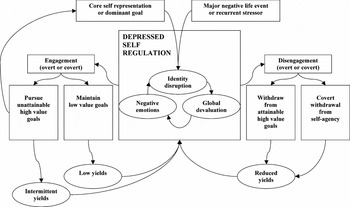
The current model is constructivist and not a social or interpersonal model, because we believe the diatheses for first/second onsets are intra-psychic: specifically, narrow self-representation and goal over-investment and these are only interpretable within individuals’ idiosyncratic values and aspirations. The model predicts that first/second depression episodes are precipitated by a diathesis-stress interaction between core or unconsolidated self-representations and major adverse events (see Figure 1). By “core” we mean a stable self-representation that is self-defining, essential, or pervasive across situations and time. It has high-level meaning, value and action identification, and is usually in the foreground of attention. In some cases it may be a possible self rather than an actual self. Core self representations usually develop in adulthood or late adolescence and contrast with the very different idea of a core belief or early maladaptive schema. By “unconsolidated” we mean an emergent self-representation that is not yet stable or self-defining, but in which a great deal has been invested. In many cases, these types of self-representation are associated with dominant goals, by which we mean goals that are primary in salience or importance, upon which other goals are typically contingent or dependent.
Cognitive-behavioural model for first/second onset depression precipitated by major life stress

Examples of such diatheses-stress interactions include the following (see below for more information regarding the treatment of these cases): (a) when the person's core self-representation as a protecting parent is disrupted when an adult child develops an incurable illness; (b) when a woman's unconsolidated self-representation as a valued partner is disrupted when her fiancée unexpectedly ends their relationship and makes a legal challenge for joint property; (c) when a wife's core self-representation as a cherished life partner is disrupted by her husband becoming unfaithful and abusive; (d) when a hard working career woman's core self-representation as a successful professional is disrupted by the birth of an unwanted child; (e) when a person's core self-representation as a respected doctor is disrupted when medical qualifications are not recognized after settling in a new country.
This hypothesis is a development of over-investment models, where individuals who have relied on a single social role are vulnerable to depression if that role is lost and there are no valued alternatives (Champion and Power, Reference Champion and Power1995). People who are over-invested are at risk of depression when stressful events disrupt the relevant role or goal (Lam, Green and Power, Reference Lam, Green and Power1994; Lam, Green, Power and Checkley, Reference Lam, Green, Power and Checkley1996) and over-investment is probably also reflected in compartmentalized self-organization (Dozois and Dobson, Reference Dozois and Dobson2001; Taylor, Morley and Barton, in press). In other cases, generally adaptive self-regulation can be affected by severe stress that disrupts several valued self-representations. The critical factor is whether adverse experiences interact with one or several highly-valued self-representations, de-stabilize personal identity and result in global self-devaluation such as becoming “totally useless”, absolutely worthless”, etc. The resulting negative emotional states, such as shame, embarrassment, guilt, sadness, maintain identity disruption and create the setting conditions for further global devaluations. The model suggests that this is an essentially normal response to adverse events affecting a highly valued aspect of the self, and whether these temporary moods stabilize into a major depressive episode depends on subsequent self-regulation.
Maintenance of depression
When personal identity is de-stabilized and the self is globally devalued, there are a number of adaptive self-regulation strategies that generally help to re-establish a valued identity. An individual can attempt to solve problems that are threatening core self-representations. If the problems are insoluble, alternative self-representations can be brought into attentional focus, or alternative high value goals can be accessed and activated. Individuals can also move to different environments that are less limiting or hostile. These various strategies involve change, uncertainty and risk, but they have the potential to re-establish a valued and stable identity through engagement with valued goals that are realistic and attainable. They are all directed towards re-establishing identity, meaning and value, and involve an open-minded and flexible orientation towards the future. We suggest that when these types of strategies are employed, in most cases depression will be mild and relatively short-lived. However, there are a range of unhelpful strategies that dysregulate personal identity and are likely to deepen and maintain depressed mood. Essentially these strategies run counter to diversification. They are guided by the strategic principle of maintaining or protecting core self-representations that were formerly successful in stabilizing euthymic mood. This conservative or inflexible orientation towards change is manifest through dysregulation of behavioural inhibition and activation systems (Carver and White, Reference Carver and White1994), and we propose there are characteristic patterns of goal engagement and disengagement that form the component processes.
Dysfunctional engagement
We propose there are two main types of dysfunctional goal engagement that maintain depressed mood: pursuing unattainable high value goals, and maintaining engagement with low value goals (see Figure 1).
Pursuing unattainable high value goals. Unattainable high value goals are often associated with core self-representations that have been affected by adverse events. They typically have an idealized, over-valued or fantasized quality; for example, seeking a cure for an incurable illness or waiting for an abusive partner to revert to being respectful. The key problem with engaging with an unattainable goal is the inevitability of failure, usually after an extended period of high investment and further adversity. There is a low probability of progress and a high probability of frustration or despair, alternating with periods of false hope (Wrosch, Scheier, Miller, Schultz and Carver, Reference Wrosch, Scheier, Carver and Schultz2003). We suggest that one of the reasons people get entrenched in repeated engagement with unattainable goals is a prior history of positive reinforcement in the relevant self-representation. Over a long time period, goals linked to these self-representations can have been successful in stimulating positive affect in both self and important others. Consequently, in adverse situations when identity has been disrupted and mood depressed, re-engagement with self-representations and goals that have a long history of positive reinforcement is understandable as a means of attempting to regulate affect and enhance mood.
A number of processes can also maintain repeated engagement in spite of limited progress towards the goal. At a behavioural level, histories of positive reinforcement can take a long time to extinguish and this is exacerbated by intermittent negative reinforcement, for example, occasions when an adult child's illness appears less severe or a partner is marginally less abusive. Engagement can also be maintained by accessing images or autobiographical memories congruent with the goal, such as an image of a miracle cure or memories of happy times in a relationship. Depression is more usually associated with hopelessness and the recollection of negative events, but we predict that unattainable goals are maintained by accessing memories of positive events that are relevant to the goal. This is likely to occur only intermittently, but is sufficient to maintain overt or covert engagement with unattainable outcomes. Finally, strongly-held beliefs with imperatives that one should, ought or must engage in the goal can maintain engagement in the absence of progress.
In response to engagement with unattainable goals, key therapeutic strategies include: (1) Helping patients to recognize explicitly what their goals (and intermediate stops towards these goals) are – in some cases goals are vague or implicit; (2) Explore and discover that their goals are unattainable – surveying the opinions of respected others can be a powerful strategy; (3) Learn which specific thoughts and behaviours are maintaining engagement – patterns of reinforcement, recollection and belief-following can be used to demonstrate the effects of intermittent yields; (4) Encourage disengagement from the unattainable goal – this is best achieved by firstly constructing an alternative desirable goal with which patients can engage. Depression symptoms such as concentration, attention or decision-making difficulties often interfere with engaging in alternatives, so these need to be anticipated or tested explicitly in advance. In some cases an unattainable goal may need to be abandoned entirely, in others the goal needs to be modified.
Maintaining engagement with low value goals. This type of goal is attainable but not highly rewarding, so there is generally a low yield of what the individual enjoys and values, and this also maintains depressed mood. In some cases it is a direct consequence of engaging with high value unattainable goals, such as waiting for an abusive partner to revert to being respectful – instead there is continued engagement with experiences that violate core values. It fits with the perspective “better the devil you know”, where people remain in adverse situations out of the fear that change would produce an even worse situation, and a preference for the certainty offered by the status quo. In this type of situation, alternatives exist but they are construed as costly or high risk, and adverse low value experiences are construed as safe. The general therapeutic strategy is to limit engagement with low value goals and disconfirm the costs and threats associated with change. This is normally achieved through behavioural experiments within the adverse situation or considering withdrawal from adverse situations altogether.
In other cases, engagement with low value goals appears to be forced by environmental possibilities, for example a medic who had to work in a fast-food outlet to support his family while retaking his medical qualifications in a new country. The therapeutic strategy in this type of case is to help identify as high action identification as possible within the enforced goal, in other words, explore as explicitly as possible what if any aspect of the activity maps onto the individual's value system. It may be possible to increase attention onto a valued aspect of the activity that had been hitherto out of attentional focus. In tandem with this, explore ways of making the forced engagement as time-limited and temporary as possible, and assist in activating alternative high value goals that have not previously been considered or accessed.
In other cases there is systematic undervaluation of the value of certain activities, for example, a mother who appraises childcare as a valueless activity that simply frustrates her career ambitions. Minimizing investment in childcare created secondary problems in her relationship with her child that ultimately increased the interference with her professional ambitions rather than decreased them. The therapeutic strategy in such cases is to encourage integration and more balanced investments by re-appraising the value of the low value goals. This involves exploring possibilities within the current value system, or it could involve experimenting with different underlying values.
Dysfunctional disengagement
We propose there are two main types of dysfunctional disengagement that also maintain depressed mood: withdrawing from attainable high value goals, and covert withdrawal from self-agency (see Figure 1).
Withdrawing from attainable high value goals. Within normal functioning, disengagement from certain goals can be adaptive. It is normal to disengage from goals that have low value, are no longer desired or have become unattainable (Wrosch, Scheier, Carver and Schultz, Reference Wrosch, Scheier, Miller, Schultz and Carver2003). However, we propose that during depressed mood, disengagement systems become dysregulated, reflected in non-engagement, partial engagement, or rapid disengagement from attainable goals that are potentially of high value. These attainable goals are usually associated with alternative self-representations, that is, self-representations that have not been directly affected by adverse events.
The main explanation of withdrawal from attainable goals is that attentional and behavioural resources are directed towards core self-representations, so alternative selves and goals tend to lose retrieval competition for attention and goal activation (Brewin, Reference Brewin2006). They are less likely to be accessed or generated, because in most cases the adversity affecting core selves is grabbing attention and demanding goal engagement. The therapeutic strategy in this type of case is to shift attention on to alternatives to re-balance goal investments across multiple selves.
A second proposed mechanism is over-generalization from the core self to alternative selves. If selves are not sufficiently differentiated from each other, then devaluation of a core self can have the same impact on alternatives, precisely because they are not construed as alternatives. The problem in such cases is self-representation becoming overly generalized and undifferentiated. The self is construed as a single, global, negative entity rather than an ecology of different possibilities. The therapeutic strategy is to differentiate the core self from alternatives as a means of identifying them, and opening the possibility of activating alternative goals that were not contingent on the core self.
The third proposed mechanism is when alternative selves have been differentiated and accessed, relevant goals are appraised as incurring high costs, high risks or low yields and it is therefore pointless to engage with them. In cases where patients cannot access reasons to engage, the underlying problem is attenuation of behavioural activation. In cases where patients have several reasons not to engage, the underlying problem is amplification of behavioural inhibition (Carver and White, Reference Carver and White1994). Cases of intermittent or partial engagement typically have features of both. The therapeutic response is to elicit patients’ reasons for engaging and reasons for not engaging in goals, and encourage testing out the accuracy of their beliefs about high costs, high risks or low yields, usually through behavioural experiments. The rationale is that if they are mistaken in these beliefs, they could be missing out on enjoyable and valuable experiences that would help their recovery from depression. Usually costs and risks are magnified and yields or benefits are underestimated, so in most cases engaging with alternative goals disconfirms the relevant beliefs. In cases with unconsolidated self-representations personal identity is under-determined; there are too many degrees of freedom and people need to engage in a few goals consistently in order to consolidate and develop. In cases with narrow self-representation personal identity is over-determined; there are too few degrees of freedom and people need to diversify in order to open up new possibilities.
Covert withdrawal from self-agency. This is a covert form of disengagement. We propose that disruption to a core self-representation can leave people deeply unrewarded for high pre-morbid investment, and one response is to retreat into a less agentive relationship with oneself. The characteristic features are reduced attention to personal desires and resistance to making decisions or commitments. The effects are analogous to an internal “shutdown” or stasis, where there is a strategic decision to give up, self-limit, or withdraw from being a self-managing agent. In this psychological state, other people tend to be perceived as powerful agents with influence and decision-making ability, whereas the self is construed as passive or powerless (Barton and Morley, Reference Barton and Morley1999). This may result from repeated failures to influence subjectively important outcomes – suggesting helplessness – but our primary claim is that it is maintained by implicit beliefs that disengagement from an agentive relationship with oneself reduces costs, brings valuable benefits, and is protective against certain risks. Suspending personal agency, limiting decision making and retreating into internal withdrawal is appraised a safe option that is most likely to ensure survival (Gilbert, Gilbert and Irons, Reference Gilbert, Gilbert and Irons2004). It is possible this strategy has evolutionary benefit in certain circumstances, particularly when there is a major threat or on-going stress, but it can become dysfunctional when it is maintained for an extended period across a wide range of situations.
Consequently, covert withdrawal is usually characterized by having few (or no) reasons to stay engaged with oneself, and many reasons to suspend personal agency. We therefore believe it is associated with suicidal ideation and intent. The therapeutic response is to elicit what these reasons are and test out their basis in reality. For patients who are disengaged from themselves and highly resistant to change, it is usually helpful to explore the benefits of depression and the potential costs of recovery, from their perspective. The therapeutic aim is to re-establish personal agency by exposing the patient to the benefits of attending to desires, commitment and decision-making, and to the usual costs of stasis and inactivity.
Conclusion
We propose that the model described in this paper has validity in the treatment of depression that has been precipitated by major life stress and/or is maintained by current adverse circumstances. These conditions are particularly prevalent in first/second onset depression and there is potential therapeutic advantage in offering cognitive therapy based on this model when first/onset treatments are non-responsive to first-line interventions, usually anti-depressant medication. We believe that individual case formulations that target the specific thoughts and behaviours indicated in this model will be most likely to disrupt the processes maintaining depression, and should be reflected in cognitive change, behavioural change and ultimately good treatment outcomes.
Clinical Case Series
Rationale for case series
The purpose of the clinical case series was to provide an initial test of the effectiveness of CBT based on the model presented in Figure 1. The specification of the model followed the general strategies outlined by Clark (Reference Clark2004) for developing new treatments, particularly drawing on the interplay of extant theory, experimental science and clinical innovation. The interventions in the case series used established CBT procedures, such as thought challenging, behavioural activation, and behavioural tests, but the innovation was refining the specific targets to which these procedures were applied. In established CBT for depression, the criterion for targeting a thought or belief is that it is negative, biased, dysfunctional or a product of an underlying depressive schema (Beck, Rush, Shaw and Emery, Reference Beck, Rush, Shaw and Emery1979). In the current model, the criterion is that it has a maintaining effect on identity disruption, devaluation and dysregulated goal engagement/disengagement. This is not true of all negative thinking, so only those thoughts that meet these criteria are targeted, and in some cases they are positive thoughts, not negative, such as the false hopes attached to unattainable goals (Barton, Reference Barton2000). We propose that these thought patterns and cognitive processes are the products of disrupted personal identity and dysregulated strategies for maintaining or establishing core self-representations. Consequently, current self-representations and goal engagements are given greater priority than early maladaptive schema, core beliefs or dysfunctional attitudes, and these are targeted using an individualized case-formulation that maps the individual features of a particular case onto the maintenance processes described in Figure 1.
Method
Design
A consecutive case-series design was used. This used observations from successive cases to specify the detail of the underlying model and refine the cognitive and behavioural targets for change. Hypotheses and treatment methods generated from Cases A and B were explored systematically in Cases C and D, and these were subsequently refined further in Case E.
Protocol
After a baseline assessment period, treatment was delivered in two phases. In the acute phase, a maximum of 20 individual CBT sessions in a 16-week period was available, with the first author (SB) acting as therapist. The second author (PA) acted as clinical supervisor throughout. The acute phase continued until patients achieved three successive weekly Beck Depression Inventories less than 10 (Beck, Ward, Mendelson, Mock and Erbaugh, Reference Beck, Ward, Mendelson, Mock and Erbaugh1961). The number of acute phase sessions needed to treat was one of the measures of interest. In the continuation phase, a maximum of six optional booster sessions in the 8 months following the end of the acute phase was available. The aim was to help patients maintain their treatment gains and prevent relapse and recurrence (Jarrett et al., Reference Jarrett, Kraft, Doyle, Foster, Eaves and Silver2001; Hollon, DeRubeis et al., Reference Hollon, Jarrett, Nierenberg, Thase, Trivedi and Rush2005). Outcome evaluations were conducted immediately post acute phase and at 1-year following that date. The treatment followed recognized procedures in CBT for depression (Beck et al., Reference Beck, Rush, Shaw and Emery1979) and the model presented in Figure 1 was used prioritize which thoughts, beliefs and behaviours were the treatment targets. All acute phase treatment sessions were video-recorded to test therapist adherence.
Inclusion and exclusion
Participants had to be aged 18–65 and meet Research Diagnostic Criteria (RDC) for a current Major Depressive Episode (MDE) according to DSM-IV criteria (American Psychiatric Association, 1994). This was assessed using the relevant modules of the Structured Clinical Interview for Diagnosis (SCID I; First, Spitzer, Gibbon and Williams, Reference First, Spitzer, Gibbon and Williams1996; Spitzer, Williams, Gibbon and First, Reference Spitzer, Williams, Gibbon and First1992). At the point of screening, the episode had to have lasted for at least 12 months and have been non-responsive (or only partially responsive) to at least one course of anti-depressant medication at an adequate dose for an adequate period (Thase, Reference Thase2004). Patients had to be in their first or second major episode of depression, with moderate or severe symptom severity (Beck Depression Inventory greater than 20). Past history of depression was also assessed using relevant modules from the SCID I (First et al., Reference First, Spitzer, Gibbon and Williams1996). Borderline personality disorder, bi-polar disorder, addiction problems and learning disability were excluded, but DSM-IV Axis I disorders that were secondary to the depression were not excluded.
Participants
Participants were recruited from referrals to the Newcastle Cognitive and Behavioural Therapies Centre, a treatment centre in the North East of England. After a routine clinical screening to assess the patient's suitability for CBT, potential participants were given information about the case series with an option to attend a screening appointment. Seventeen patients were offered a research screening, seven accepted and attended, and five met the inclusion criteria and consented to participate. The participants were four women and one man, with an average age of 38.4 years (SD = 10.7). Two were married, one was separated, and two lived with partners. They had an average of 2 children (range 0–4, SD = 1.6). They had various types of employment: call centre worker, education support worker, family support worker, physiotherapist, and unemployed doctor working in a fast-food shop. Two had been educated to graduate level, the others to British “A” level or similar. Three of the participants were in their first major episode of depression; two were in their second. The episode had a mean duration of 43 months (range 18–60, SD = 15.5). Three of the five had been non-responsive to a single course of anti-depressant medication (Fluoxetine 20 mg; Venlafaxine 37.5 mg; Dothiepin 75 mg) and these corresponded to Level 1 treatment-resistance (Thase, Reference Thase2004). The other two patients were non-responsive (or unstable/partial responders) to two sequential courses of anti-depressant medication, corresponding to Level 2 treatment-resistance (Fluoxetine 20 mg followed by Citalopram 20 mg; Venlafaxine 37.5 mg followed by Mirtazipine 45 mg). Three of the prescribers were general practitioners and two were psychiatrists.
Measures
The following measures were used.
Hamilton Depression Rating Scale – 17 item version (HDRS; Hamilton, Reference Hamilton1960). This is a structured clinical interview that measures depression severity and it was one of the outcome measures. It was administered during baseline assessments, post acute phase, and at one-year follow-up. The standard 17-item version was used. In line with recent outcome studies, a score of 12 or less was used to determine treatment response and 7 or less to determine full remission (DeRubeis et al., Reference DeRubeis, Hollon, Amsterdam, Shelton, Young, Salomon, O'Reardon, Lovett, Gladis, Brown and Gallop2005).
Beck Depression Inventory (BDI; Beck et al., Reference Beck, Ward, Mendelson, Mock and Erbaugh1961). The BDI is a widely used self-report measure of depression symptoms in psychiatric populations. It has good psychometric properties and high concurrent validity with other depression measures (Beck, Steer and Garbin, Reference Beck, Steer and Garbin1988; Beck and Steer, Reference Beck and Steer1991). It was completed at intake screening, before each treatment session, post acute phase, and at one-year follow-up. It provided a measure of continuous change across treatment, and was used to calculate indices of reliable and clinically significant change.
Beck Hopelessness Scale (BHS; Beck, Weissman, Lester and Trexler, Reference Beck, Weissman, Lester and Trexler1974). This is a 20-item self-report questionnaire that measures hopelessness about the future. It has a high degree of internal consistency and good concurrent validity (Beck et al., Reference Beck, Weissman, Lester and Trexler1974). More balanced and attainable goal investments would be expected in treatment responders, reflected in lower levels of hopelessness post treatment.
Automatic Thoughts Questionnaire (ATQ; Hollon and Kendall, Reference Hollon and Kendall1980). This is a 30-item questionnaire that measures negative automatic thinking. Participants rate the frequency of negative cognitions in the preceding week on a 5-point scale. The measure yields a score of 30–150 where higher scores indicate more negative automatic thinking. It has good internal consistency (alpha = 0.96, Hollon and Kendall, Reference Hollon and Kendall1980). Negative automatic thinking would be predicted to decrease with treatment response.
Sentence Completion Test for Depression (SCD; Barton, Morley, Bloxham, Kitson and Platts, Reference Barton, Morley, Bloxham, Kitson and Platts2005). This is a 15-item sentence completion test that also measures negative automatic thinking. Respondents complete sentences using their own words, and the number of negative completions is a reliable measure of depressive thinking. Higher scores indicate more negative thinking and a threshold of 5 or greater indicates significant depressed mood. The test has good internal consistency (alpha = 0.94) and good specificity and sensitivity (Barton and Morley, Reference Barton and Morley1999). Scores would be expected to decrease across successful treatment.
Results
Treatment integrity
The main questions were whether the therapist was adhering to recognized CBT procedures and conforming to the specific actions prescribed by the current model (McGlinchey and Dobson, Reference McGlinchey and Dobson2003; Waltz, Addis, Koerner and Jacobson, Reference Waltz, Addis, Koerner and Jacobson1993). A subsidiary question was whether actions associated with alternative CBT models were used, such as those emphasizing early childhood experience and maladaptive schemas. These actions were not proscribed but the emphasis was on recent and current goal investments, and they were therefore viewed as non-essential. There were therefore three categories of therapist behaviour used in the adherence test (see Appendix): (1) Recognized CBT procedures – essential (12 items); (2) Actions prescribed in the current model – essential (14 items); (3) Actions prescribed in schema-focused models – acceptable but non–essential (4 items). Good adherence should be reflected in high frequency of the essential types, and a generally low frequency of the non–essential type.
Twenty-five of the 72 acute phase treatment sessions (over 30%) were selected to test adherence. Sessions were selected randomly within stratification, with approximately equal numbers from each patient balanced across the first and second halves of treatment. A graduate psychologist who was blind to outcome observed the video records of the relevant sessions and judged the absence or presence of each therapist action. Items were rated on a 5-point scale (0 = action present not at all in this session; 1 = to a very limited degree; 2 = to some degree; 3 = to a moderate degree; 4 = present extensively). The mean item ratings were: Recognized CBT procedures = 2.48 (SD = 0.65); Actions prescribed in the current model = 2.05 (SD = 0.95); Actions prescribed in schema-focused models = 0.20 (SD = 0.12). This pattern confirmed good adherence to the current model and recognized CBT procedures, with only occasional exploration of early experience and schema-focused interventions. Inter-rater reliability was assessed with a second graduate psychologist who was also blind to outcome and the first rater's scores. The second rater made judgements on 12 of the 25 therapy sessions, chosen at random but with at least two sessions from each of the five cases. An intra-class correlation was computed for the mean item totals from both raters on the overlapping cases, which yielded highly acceptable inter-rater reliability (ICC = 0.85).
Posttreatment outcomes
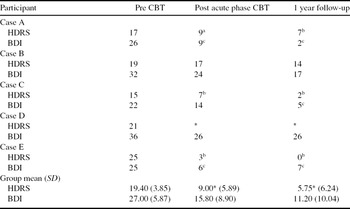
The five patients received an average of 14.2 sessions of CBT in the acute phase (range 8–20), and 2.4 sessions (range 0–6) in the continuation phase. One patient dropped out of treatment after 8 sessions without achieving remission. Her last observed BDI score (session 8) was carried forward as a post-treatment measure. Posttreatment outcomes on both the HDRS and BDI are presented in Table 1. HDRS data was missing for the non-completer, so this measure was used in the completer analysis only and the BDI was used to test intention-to-treat effects sizes and indices of clinically reliable change. For the four treatment completers, HDRS scores of equal or less than 12 were needed to determine treatment response and equal or less than 7 for full remission. At posttreatment three of the four cases had responded to treatment and one of these had achieved full remission. The completer pre-post effect size on the HDRS was Cohen's d = 1.96 (the corresponding ES for the BDI was d = 2.02).
Pre, post and 1 year follow up outcomes (n = 5)

HDRS: Hamilton Depression Rating Scale, 17-item.
BDI: Beck Depression Inventory.
aTreatment response (HDRS).
bFull remission (HDRS).
cReliable and clinically significant change (BDI).
*Data missing from non-completer.
BDI data were available at each time-point for all of the cases, with the last observation carried forward for the non-completer as the posttreatment score. Reliable change was determined by reductions in BDI scores greater than could be attributed to measurement error (Jacobsen and Truax, Reference Jacobsen and Truax1991; Jacobsen, Roberts, Burns and McGlinchey, Reference Jacobsen, Roberts, Berns and McGlinchey1999). Following Cahill et al., (Reference Cahill, Barkham, Hardy, Rees, Shapiro, Stiles and Macaskill2003), a threshold of 6.18 BDI points was set for significant symptom relief, which is 1.96 times the standard error of the difference between two test scores. This was derived from standard deviations observed in normal samples (Nietzel, Russel, Hemmings and Gretter, Reference Nietzel, Russel, Hemmings and Gretter1987) and the BDI's mean test-retest reliability (r = 0.75; Beck et al., Reference Beck, Steer and Garbin1988). In practice a 7 point BDI reduction was needed for reliable symptom relief. Following the Jacobsen and Truax (Reference Jacobsen and Truax1991) recommendations, 2 standard deviations above the mean in normal samples (i.e. 13.46; Nietzel et al., Reference Nietzel, Russel, Hemmings and Gretter1987) provided a stringent test of clinical significance, therefore clinically significant change required a posttreatment BDI score equal or less than 13. At posttreatment, there was reliable symptom change for all 5 cases (mean reduction = 12.40, SD = 5.23) and 2 of these were clinically significant changes. The intention-to-treat pre-post effect size was d = 1.7.
Follow-up outcomes
Follow up data were obtained one year after the end of acute phase therapy. HDRS data were only available for the four completers, but follow up data on the BDI were obtained for the non-completer allowing a full intention-to-treat analysis. On the HDRS the three treatment responders during the acute phase all met criteria for full remission at follow-up; therefore no patient relapsed and the three who had responded to acute phase treatment consolidated their gains in the following 12 months. The pre-follow-up effect size for completers on the HDRS was d = 2.51 (the corresponding ES for the BDI was d = 3.40). On the intention-to-treat analysis using the BDI, reliable symptom relief was present for all cases comparing pre-treatment with follow-up symptom levels (mean reduction = 16.80, SD = 5.07). Three of these were clinically significant reliable changes, the same cases achieving full remission at follow-up measured by the HDRS (see Table 1). The intention-to-treat pre-follow up effect size was d = 2.15. Notwithstanding the small sample size, and therefore large confidence intervals, very large effect sizes were observed on pre-post and pre-follow up measures for both intention-to-treat and completer analyses, using both HDRS and BDI as outcome measures.
Cognitive change
Pre-treatment cognitive measures were available for all participants, but there were missing data for two of the cases at posttreatment and follow-up (one non-completer, and one full responder). In spite of missing data, the means on each of the measures followed the expected pattern, with decreasing hopelessness and negative cognition across treatment. The small sample and missing data prevented any inferential statistics, and the results are presented to allow comparison with other published studies (BHS: pre-treatment mean = 12.0 (6.0), posttreatment mean = 6.67 (3.79), follow up mean = 3.00 (1.0); ATQ: pre-treatment mean = 85.6 (14.28), posttreatment mean = 60.0 (13.89), follow-up mean = 58.0 (25.24); SCD: pre-treatment mean = 7.0 (1.58), posttreatment mean = 3.33 (2.31), follow-up mean = 2.00 (0.0)).
Discussion
This study provides initial evidence that the cognitive-behavioural model presented in Figure 1 has validity in the treatment of major depression. Specifically, cognitive-behavioural therapy that adhered successfully to the prescribed targets resulted in three out of five cases achieving clinically reliable change and full remission at one year posttreatment. This is in spite of having been in the index episode for an average of 43 months prior to commencing CBT, which is approximately 8 times greater than the course of anti-depressant responders (Solomon et al., Reference Solomon, Keller, Leon, Mueller, Shea, Warshaw, Maser, Coryell and Endicott1997) and 14 times the course of major episodes in community samples (Spijker et al., Reference Spijker, de Graaf, Bijl, Beekman, Ormel and Nolen2002). The pre-post effect sizes were within the normal large range for relevant outcome studies (Dobson, Reference Dobson1989; Gloaguen, Cottreaux, Cucherat and Blackburn, Reference Gloaguen, Cottreaux, Cucherat and Blackburn1998), and the most encouraging finding was the degree to which these gains were maintained and extended over the following 12 months. Compared with other types of treatment, CBT is known to protect against relapse and recurrence but relapse rates of over 30% are still commonplace (Jarrett et al., Reference Jarrett, Kraft, Doyle, Foster, Eaves and Silver2001). Even with good posttreatment outcomes, some drift back to pre-treatment symptom levels would be expected in a 12 month follow-up, and the fact an opposite trend was observed provides encouraging evidence for the model's validity and the treatment's efficacy. Sustained treatment effects also fit with the rationale for early intervention - to treat the current episode effectively and have a prophylactic effect on future depression. It should be fully acknowledged, however, that the small sample size entails large confidence intervals around the reported effect sizes, and replication on a larger sample of patients is needed to increase confidence in the findings. Notwithstanding this, we believe there are a number of reasons why this model is capable of supporting effective and lasting interventions.
First, it has been developed and specified for the particular population in question, that is, patients early in their depression history with episodes precipitated by major life stress whose depression is entrenched and unresponsive to anti-depressant medication. Although diathesis-stress models of depression are well-established, few if any have been incorporated into treatment protocols at the level specified in the current model (Monroe and Simons, Reference Monroe and Simons1991). Cognitive and behavioural change occurred in the context of the major stress that had precipitated the depression, not irrespective of it. The dysfunctional cognitions and behaviours targeted for change were therefore those most closely affected by adverse events, and/or those having a maintaining effect on the adversity itself (Hammen, Reference Hammen1991). We believe this maximized the specificity of the treatment targets for this patient group, and moderated the level of subsequent stress that would otherwise have been generated (Harkness, Monroe, Simons and Thase, Reference Harkness, Monroe, Simons and Thase1999). In this respect, the intervention contrasts with Mindfulness-based CT which is effective in preventing relapse/recurrence when depression has already become highly recurrent (i.e. 3 or more episodes), but is less effective for first/second onset depression when significant life stress is present (Ma and Teasdale, Reference Ma and Teasdale2004; Teasdale et al., Reference Teasdale, Segal, Williams, Ridgeway, Soulsby and Lau2000). If alternative CBT interventions have differential effects on depressed sub-populations this could be extremely valuable for the development of the field.
Second, we believe that in those cases achieving remission the emphasis on self-diversification initiated a process of change and psychological development that continued after the end of acute phase treatment. We believe patients were learning CBT skills in the normal way, and this is part of what helped to prevent relapse, but the explicit rationale to engage with attainable goals across a range of self-representations provided a particularly strong developmental trajectory; for example, to build new friendships, change jobs, develop new interests, and not only to solve current problems and alter biased thought processes. Established CBT for depression can unquestionably also have these effects, but we believe there was a bonus effect for making self-diversification an explicit and focal part of the intervention. However, we have no objective measure of this specific outcome, so this claim needs to be tested prospectively with dedicated measures in a larger sample of patients.
Third, the intervention was CBT combined with anti-depressant medication. The therapeutic strategy was to add CBT as an adjunct to medication, because there is good evidence from recent meta-analyses of an advantage for combined therapy over either modality on its own (Friedman et al., Reference Friedman, Detweiler-Bedell, Leventhal, Horne, Keitner and Miller2004; Hollon, Jarrett et al., Reference Hollon, DeRubeis, Shelton, Amsterdam, Salomon, O'Reardon, Lovett, Young, Haman, Freeman and Gallop2005). Although these patients had not responded (or only partially responded) to medication prior to CBT, it is possible that the addition of CBT improved adherence to medication or interacted with the cognitive effects of anti-depressants at a more fundamental level. In this model CBT is not in competition with pharmacotherapy; on the contrary, we believe there is good potential for further studies to examine the interactive effects of CBT and anti-depressants, particularly in patients who have been resistant or non-responsive to either treatment until the other is added.
We acknowledge some limitations within this research. The findings would have been strengthened by measuring change in the specific cognitive and behavioural targets prescribed by the model. However, the adherence test provided good support for the specificity of the intervention. Future studies need to test the possibility that recovery occurs through processes not directly targeted by the treatment, or indeed by non-specific effects, such as the therapeutic context or therapeutic alliance. The study had a single therapist who conducted the pre, post and follow-up assessments, so the possibility of bias cannot be ruled out. Larger studies with independent assessors that test whether the effects generalize to other patients and therapists are now both possible and necessary.
Acknowledgments
The authors would like to acknowledge helpful comments from Tracy Thorne, Rob Dudley, John Gray, Gillian Hardy, Hamish McAllister-Williams, Kevin Meares and Stephen Morley, and the helpful assistance of Jan Richards, Sarah Walker and Karin Foran.
Appendix: Treatment adherence checklist
Items 1–12: Recognized CBT procedures (essential)
1. Negotiated and set an agenda for the session
2. Reviewed homework from the previous session
3. Negotiated and set homework tasks for the next session
4. Encouraged engagement with understanding and solving problems
5. Explored memories of triggering events for emotional reactions or moods
6. Elicited particular thoughts, feelings and/or behaviours associated with a target problem
7. Broke depression down into specific problems or treatment goals
8. Encouraged discovery of how thoughts, feelings and behaviours maintain depression
9. Elicited self-appraisals or self-evaluations within particular situations
10. Evaluated or challenged thought content as a means of influencing mood
11. Evaluated or challenged cognitive processes as a means of influencing mood
12. Evaluated, tested or activated behaviour as a means of influencing mood
Items 13–26: Actions prescribed by the current model (essential)
13. Elicited memories of events precipitating this episode of depression
14. Elicited specific self-representations rather than viewing the self as a global entity
15. Elicited the values attached to specific self-representations
16. Elicited the hopes, goals or expectations attached to specific self-representations
17. Explored the “attainability” of goals, hopes or expectations
18. Evaluated whether current goals are under and/or over-valued
19. Encouraged disengagement from unattainable goals
20. Encouraged problem solving around blocked or frustrated goals
21. Encouraged problem solving when depression symptoms interfere with goals
22. Explored alternatives to engaging with low value goals
23. Encouraged engagement with attainable goals
24. Focused attention on desires for the future
25. Encouraged decision-making and commitment
26. Encouraged realistic rates of progress towards goals
Items 27–30: Actions prescribed in schema-focused models (acceptable but non-essential)
27. Explored the impact of childhood experiences on the development of personal identity
28. Explored and challenged early maladaptive schema
29. Explored and challenged dysfunctional assumptions learned from childhood or adolescence
30. Explored and challenged compensatory strategies learned from childhood or adolescence



Comments
No Comments have been published for this article.