1. Introduction
In the first half of the nineteenth century, dairy farming was an important economic sector only in the hinterland of major urban centres, and in regions where fodder was readily available and environmental conditions were not favourable for grain production (Orland, Reference Orland, Sarasúa, Scholliers and Molle2005: 217–18; Vatin, Reference Vatin1990: 15–34). The development of the sector accelerated in the 1860s, when the implementation of a number of commercial treaties encouraged trade in milk by-products and the dissemination of milk-skimmers significantly increased butter production. This process was supported by transport improvements, particularly in railways, and new technical facilities for milk keeping.Footnote 1 Other factors which came into play in the 1880s further boosted this development. Among these were the increase in imports of cereal from overseas, especially wheat for human consumption and maize for cattle fodder, and the increase in income levels, both of which were brought about by the industrialisation and urbanisation processes then in progress (Bieleman, Reference Bieleman2005: 229–30; Grigg, Reference Grigg1992; Henriksen and O'Rourke, Reference Henriksen and O'Rourke2005: 523–5). Another no less important factor was the growing demand for liquid milk that followed scientific improvements in the nutritional value of the product, with increased calcium and vitamin content, and in delaying contamination by harmful bacteria through pasteurisation and refrigeration (Murcott, Reference Murcott1999: 315–27). Knowledge of these advances was disseminated by public institutions, the healthcare sector and dairy firms, leading to new consumption preferences among the population. In the nineteenth century, proteins and calories were generally regarded as the most desirable nutrients, and for this reason fresh milk was only consumed as part of liquid diets prescribed for health or age reasons, or as a nutritional supplement, mixed with other foodstuffs such as cereals and tubers to increase its energy value, or to facilitate the intake of stimulants such as tea or coffee. In the early twentieth century, however, milk was accepted as a basic food, especially for infants, and demand increased quickly (Atkins, Reference Atkins1980 and Reference Atkins2010; Hartog, Reference Hartog, Atkins, Lummel and Oddy2007: 131–2; Nicolau et al., Reference Nicolau, Pujol and Hernandez2010; Orland, Reference Orland2007: 164–6).
To date, agrarian and economic history has focused on analysing the dairy sector in those regions where its development was most intense and has connected this with the availability of fodder (Bieleman, Reference Bieleman2005; Carmona and Puente, Reference Carmona, Puente and Garrabou1988; Henriksen and O'Rourke, Reference Henriksen and O'Rourke2005; Knibbe, Reference Knibbe1993; Pujol, Reference Pujol2002). Our knowledge of the development of the sector in Mediterranean Europe, and of the role played by biological innovations, remains very limited, however.Footnote 2 This article presents new evidence relating to these issues, with two objectives: firstly, to reiterate the significance of these innovations on agrarian development from the mid nineteenth century (Harwood, Reference Harwood2012; Kloppenburg, Reference Kloppenburg1988; Olmstead and Rhode, Reference Olmstead and Rhode2008; Pujol, Reference Pujol2011) and secondly, to present new evidence on the environmental and technological limitations which hampered this process in Mediterranean Europe until well into the twentieth century (Pujol, Reference Pujol2011).
The paper is divided into three sections. In the first section, we present new evidence for the development of the dairy sector in different Central and Northern European countries between the mid nineteenth century and the 1930s, and for the belated and limited spread of this process in Spain. This section also details how cattle numbers and milk yields impacted on the sector. After then considering the effect of the improvement of animal healthcare and the availability of fodder on the development of the dairy sector, the second and third sections will focus on cattle breeds and their improvement. In particular, the second section examines the possibilities and limitations of these improvements in the bovine sector, analysing the progress made in this regard in Atlantic Europe from the nineteenth century. The third section examines the limited impact of these innovations in Spain and the important role played there by the bulls and cows imported from other countries.
2. The development of dairy farming in Europe before the Second World War
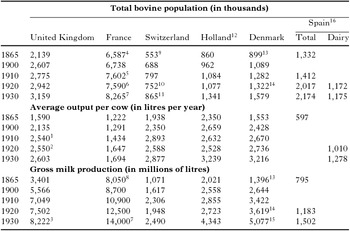
As noted above, the significant advances in dairy farming in Central and Northern Europe from the mid nineteenth century have already been subject to systematic analysis elsewhere. Table 1 shows: a) information collected from different authors and institutions concerning the dairy cow population, milk yields and gross milk production in several countries where the development of the dairy sector was significant; and b) our estimates for Spain (for a detailed breakdown, see Appendix 1). Although these estimates may be refined, we believe that they reflect the main trends in the European dairy sector in the study period. Between 1865 and 1900 milk production increased by eight per cent in France; twenty-five per cent in Holland; between fifty and sixty-five per cent in Switzerland and the United Kingdom and nearly one hundred per cent in Denmark. The expansion of the sector in the first third of the twentieth century was no less significant. Between 1900 and the 1930s, milk production grew by almost fifty per cent in the United Kingdom, Holland, France, and Switzerland, and again by nearly one hundred per cent in Denmark. As a result, the availability of milk for human consumption increased sharply. Towards the end of the nineteenth century, the amount of milk available for general consumption in the form of liquid milk, cheese, butter and condensed milk, was around 130 litres per capita per annum in the United Kingdom; 160 litres in France; between 400 and 470 litres in Holland and Switzerland and nearly 950 litres in Denmark. Shortly before the Second World War, these figures had climbed to nearly 150 litres in the United Kingdom; 250 litres in France; between 490 and 530 litres in Switzerland and Holland, and nearly 1,400 litres in Denmark.Footnote 3 It is, therefore, no surprise that the consumption of dairy products was already high in these countries by the late nineteenth century and that this consumption grew even further in the twentieth century, reaching very high levels (Henriksen et al., Reference Henriksen, Lampe and Sharp2012; Pirtle, Reference Pirtle1922: 5). Specifically, the consumption of fresh milk in the 1930s reached nearly 100 litres per capita per annum in the United Kingdom; 130 litres in Holland and Denmark and nearly 250 litres in Switzerland.Footnote 4 Milk consumption in urban areas was even higher in some cases. In the 1930s, the consumption of fresh milk was around 100 litres per capita per annum in Paris, London, and Berlin: 140 litres in Amsterdam and Prague; around 190 litres in Oslo and Vienna; between 230 and 270 litres in Copenhagen, Stockholm, Berne and Zurich, and over 300 litres in Lucerne (Bacon and Cassels, Reference Bacon and Cassels1937: 628; Bulharowski, Reference Bulharowski1929:7; Llovet, Reference Llovet1934: 15).
The dairy sector in Europe, 1865–1930.

Notes: (1) 1909–13, (2) 1924-22, (3) 1936, (4) 1881, (5) 1908–12, (6) 1923–27, (7) 1928–32, (8) 1875, (9) 1896, (10) 1918–22, (12) 1928–31, (12) 5-year period averages, centred around the year indicated on table, (13) 1881, (14) 1921–24, (15) 1928–32, (16) See Appendix 1.1.
Source: UK: Institut International d'Agriculture, 1940–41: 126–9; Mitchell, Reference Mitchell1988: 202–3; Mitchell, Reference Mitchell1998: 379 and 383; Pirtle, Reference Pirtle1926: 233 and 277; Rew, Reference Rew1892: 253–4; Taylor, Reference Taylor1976: 596. France: INSEE, 1951: 118–19 and 1946: 93; Toutain, Reference Toutain1971: 1951–1953. Switzerland: Annuaire Statistique de la Suisse, 1930: 143–53 and 1950: 118. Holland: Knibbe, Reference Knibbe1993: 264–5. Denmark: Danmarks Statistisk, 1925: 54 and 1930:38. Spain: see Appendix 1.
Table 1 also illustrates that the growth of the dairy sector in these countries was not only based on the substantial increase in the size of the cattle population, but also on a significant growth in milk yields, especially in the second half of the nineteenth century. According to our calculations,Footnote 5 the increase in yields between 1865 and 1930 accounts for over fifty per cent of the growth in gross output in the United Kingdom, France and Denmark, and between forty-two and forty-seven per cent in Switzerland and Holland. We must, however, keep in mind that in the last two countries, yields were already high by the mid nineteenth century (Table 1). Around 1860, the yields were of nearly 2,000 litres per cow per annum in Switzerland, and 2,400 litres in Holland. Also, the impact of yields on the growth of gross output was very stable in Switzerland during the period under consideration, whereas in the other cases the impact was particularly high in the period between 1865 and 1900. During this period, yields account for nearly sixty per cent of gross production growth in the United Kingdom, nearly seventy per cent in France and Denmark, and around fifty-two per cent in Holland. In the first third of the twentieth century, however, the impact of yields on the growth of gross production was between fifty and fifty-seven per cent in the United Kingdom and France, forty-three per cent and forty-seven per cent in Denmark and Switzerland and only thirty-seven per cent in Holland.Footnote 6
The evolution of the dairy sector in Spain was very different. Firstly, cow's milk production and consumption remained very low until the late nineteenth century. According to our estimations (Appendix 1.1), total production was below 800 million litres, and yields were around 600 litres per cow per annum. Moreover, nearly 550 million litres were used to feed calves, and only 250 million litres were therefore available for human consumption, mostly in the form of liquid milk. As a result, the consumption of cow's milk was uncommon in general and negligible in many regions. The average amount available for human consumption was barely fifteen litres per capita per annum. This figure is supported by other evidence, such as the family budget estimates for the period between 1849 and 1905 and the nearly 200 reports on public health issued by municipal doctors between 1860 and 1910.Footnote 7 These studies rarely mention the consumption of cow's milk, and in the few cases where it is mentioned the estimated consumption was in most cases around fifteen litres per capita per annum. Milk consumption was somewhat higher in cities, especially in the north. Around 1900, milk intake was of between twelve and twenty litres per capita per annum in Barcelona and Valencia, nearly thirty litres in Madrid and between forty and sixty litres in Oviedo and Santander (Ayuntamiento de Barcelona, 1902: 526; Calatayud, Reference Calatayud and Medina2016; Junta Consultiva Agronómica, 1892, volume 2: 260; Luís, Reference Luís y Yagüe1903: 43; Pérez, Reference Pérez1991: 164–6).
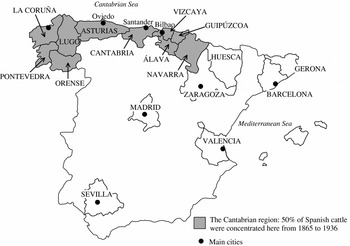
Map of Spain and geographical references cited in the text.

Secondly, although the situation improved in the first third of the twentieth century, the availability of milk for human consumption remained at low levels with the exception of a few regions (Table 1 and Appendix 1.2 and 1.3). In 1925, total output reached 1.2 million litres, and the amount used for human consumption was a little over 800 million litres, once more almost exclusively in the form of liquid milk. In 1933, total production was nearly 1.3 million litres, 1.1 million of which was used for human consumption. This means that the available average increased from fifteen litres per capita per annum in the late nineteenth century to thirty-eight litres in the mid 1920s and to a little over forty-five litres ten years later. At the same time, while the availability of milk in the Cantabrian and the Atlantic regions and the Pyrenees in the 1930s was above 100 and even 200 litres per capita per annum, in the central and southern provinces the average was in most cases under twenty-five litres (Appendices 1.2 and 1.3). Within these regions, in only a few cities was the availability of milk above forty-five litres, especially in Barcelona, Madrid and Valencia, where it was over seventy litres. In Seville and Saragossa, which were also important cities, the average was between thirty-three and forty litres per capita per annum (Calatayud, Reference Calatayud and Medina2016; Doaso, Reference Doaso1931: 26–8; Mas, Reference Mas1933: 20–1).
Finally, although in the Spanish case the impact of yields and cattle population on output growth cannot be calculated, everything suggests that the impact of the latter variable was much higher than in Central and Northern Europe. By 1890, few Spanish cows were milked regularly, and the relevant statistical data are lacking (Junta Consultiva Agronómica, 1892, volume 1: 160 and 295; volume 3: 442 and 449). According to the engineers working for the National Agricultural Agency (Servicio Agronómico Nacional), intensive milking was mostly practised in and around big cities, but the number of cows there was still low. In Madrid and Barcelona, the country's two main cities, yields reached nearly 3,000 litres per cow per annum, but the number of dairy cows was still under 4,000 in total (Luís, Reference Luís y Yagüe1903: 42–3; Puente, Reference Puente1992: 34). By way of contrast, in rural areas, in most cases yields were under 500 litres per cow per annum (Appendix 1.1). In 1925 and 1933, however, the number of dairy cows for the whole country was estimated at 1.2 million, and the yields at 1,010 and 1,280 litres per cow per annum respectively (Table 2). At the same time, the number of cows in Madrid and Barcelona soared to 14,000, but their yields had not grown significantly since the nineteenth century. In Barcelona, the yields were 3,400 litres per cow per annum, and in Madrid 2,700 litres.
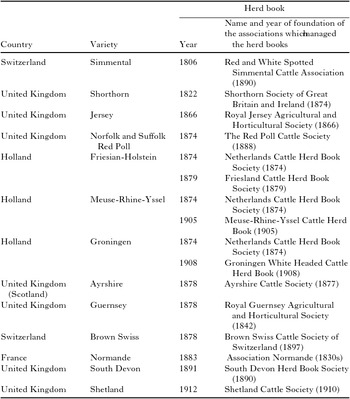
Herd books of the main varieties of dairy cows, 1806–1912.

Source: Own work based on Friend, Reference Friend1978; Porter, Reference Porter2007; Oklahoma State University, Breeds of Cattle (http://www.ansi.okstate.edu/breeds/cattle/).
In short, the Spanish dairy sector did not begin to develop until the late nineteenth century, and this process was only significant in the northern cattle-breeding regions and the hinterland of the big cities. This process, so our calculations show, was in large part due to the increase in the number of dairy cows. On the other hand, the sector tended to stagnate from the mid 1920s, although the demand for milk kept on growing. In the city of Barcelona, the price of milk in constant ‘pesetas’ dropped by about fifteen per cent between 1898 and 1920, but climbed up again afterwards to rise above nineteenth-century levels. By the 1930s prices were ten per cent higher than in 1920 (Pujol et al., Reference Pujol, Nicolau and Hernández2007).
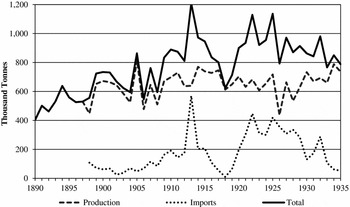
Traditionally, these phenomena have been causally linked with the availability of fodder. It is well known that this increased sharply in Central and Northern Europe from the mid nineteenth century, but in Spain the increase can only be attested from the 1890s, and then only in northern regions and in a few irrigated areas.Footnote 8 Outside these regions, environmental conditions severely hampered crop rotation and intensive fertilisation. New evidence also indicates that the availability of fodder in Spain stagnated after the First World War. Fields sown with alfalfa and other fodder increased from 138,000 hectares in 1900 to nearly 385,000 in 1913, and remained stable thereafter. The availability of maize followed a similar trend (Figure 1). Production increased from a little over 400,000 tonnes in the 1890s to 790,000 tonnes in 1914, but then also stagnated. At the same time, maize imports, which had been increasing between 1902 and 1913, dropped significantly during the war and did not recover until the period between 1921 and 1925. After 1925 they began to fall once again, and by 1935 they were at a very low level.
Availability of maize in Spain, 1890–1935.

The development of the dairy sector was, however, also affected by other factors. Although the availability of fodder had a direct impact on yields and the number of dairy cows that could be kept, there were other important influences. In particular, yields were increased by better treatment of animal diseases (foot and mouth, contagious bovine pleuro-pneumonia, rinderpest, bovine tuberculosis and brucellosis), and by changes in the breeds used and their enhancement, especially through improvements in mammary gland function (Simm, Reference Simm1998; Womack, Reference Womack2012). In the following section, we shall focus on breed innovations. This does not mean, however, that we disregard the impact of developments in animal health-care on yields. These developments are well documented in Western Europe, especially in Great Britain (Fisher, Reference Fisher1980 and Reference Fisher2003; Spinage, Reference Spinage2003; Woods, Reference Woods2004 and Reference Woods2011) and must have had a beneficial impact on the improvement of breeds. For example, increased animal survival would allow better selection of breeding bulls and a more precise evaluation of the milk yields of pregnant cows.
3. Innovation in dairy cow breeds in Central and Northern Europe
The innovation in cattle breeds, as with other biological innovations, is linked to agrarian developments, many of which were well-known in Europe before the turn of the nineteenth century. Furthermore, some studies have suggested that early innovations could have had multiple causes, including cultural factors. With the intensification of trade and competition, economic reasons gained in importance, and innovations accelerated. The objectives pursued were still varied, including greater disease resistance in animals and the changing fat content in milk, but increasing milk yields was always a key target.Footnote 9 In this context, however, it is necessary to clarify two points. First, in contrast with wheat and other seeds, experimentation with large farm animals was not economically viable. These animals were expensive, costly to maintain and slow to produce offspring. Moreover, as was later pointed out by geneticists, the number of genes involved in milk production was too high. For these reasons, the decision to improve these animals by inbreeding was endorsed by these specialists. Under natural reproduction conditions, inbreeding was the most suitable method for the elimination of recessive traits which have a negative effect on milk yields and/or the fat content of the milk. This method however, was not free from controversy, especially at the beginning, and was costly and time-consuming (Theunissen, Reference Theunissen2008: 656–7 and 660–3). For these reasons, experts only recommended it in areas where milk yields were already high. Where this was not the case, and milk demand increased rapidly, the obvious alternative was to adapt more productive breeds from other regions. The success of this type of innovation was not, however, guaranteed, since yields were determined not only by the particular breed, but also by the environmental conditions to which that breed had been adapting for generations. As well as temperature, this could involve the impact of disease and the morphology and nutritional characteristics of the fodder, which could vary widely between regions. If the process of adaptation did not work, the only alternative was to try to improve local breeds by cross breeding, which was an even more complex, costly and uncertain process (Derry, Reference Derry2003; Matz, Reference Matz2011; Wood and Orel, Reference Wood and Orel2001).
Second, the selection of studs remained problematic until the 1950s. For the identification of a good stud, the productivity of the cows that had been bred needed to be ascertained, and often, by the time this information was known the studs had aged or died. Their breeding life was short, at between eight and ten years, and the number of fecundations limited. Moreover, studs were frequently slaughtered when still young, especially in small farms. In these cases, farmers often selected fast-growing studs to sell for meat when they were between three and four years old and their price was still high (Theunissen, Reference Theunissen2008: 661–4).
Despite these limitations, considerable success was achieved in Lucerne and Zurich (Switzerland), Drenthe, Friesland and Overijssel (Holland), Jutland (Denmark), Northumberland, Durham and York (England), Ayr (Scotland) and Jersey and Guernsey (Channel Islands). The contribution of new specialists in zootechnics and the work carried out by a large number of public agencies and agricultural associations were both important in this regard. Zootechnicians and veterinarians helped to better define the physical traits desired in the breeds that were to be improved. Public and private agencies promoted new laws and regulations aimed at encouraging innovation and its spread. Examples include the periodical organisation of cattle fairs in which prizes were awarded for the best studs and cows; occasional bans on the importation of foreign breeds, which aimed to protect the ‘purity’ of local breeds and/or prevent the dissemination of illnesses; and the establishment of herd books. This last innovation helped to define, as early as the second half of the nineteenth century, the main dairy breeds which remain in use now: Brown Swiss, Jersey, Guernsey, Ayrshire, Milking Shorthorn, and especially the Friesian/Holstein (Bieleman, Reference Bieleman2005: 230–2; Orland, Reference Orland, Schrepfer and Scranton2003: 175–7; Porter, Reference Porter2007).
The herd book registered the animals belonging to the selected breeds and their genealogies and evaluated their ‘purity’ according to the physical parameters set forth in the regulations. In this regard, the associations played another role by contributing to eliminate the recessive traits caused by random crossing over time. These registries also offered cattle breeders better opportunities for commercialisation, and more quality guarantees for their customers. In short, the herd book resulted in a significant, but hard to calculate, reduction of transaction costs in the emerging livestock markets (Orland, Reference Orland, Schrepfer and Scranton2003: 180; Theunissen, Reference Theunissen2008: 651–4).
Innovations in Switzerland and, especially, Holland were particularly influential on Spanish dairying. The improvement of Swiss cows began in the early nineteenth century, with early cattle exhibitions organised in Berne (1807), Lucerne (1811) and Appenzell (1846). With the support of new regional organisations, these meetings soon became annual events. As a result, newly improved cattle breeds were presented in the universal exhibitions in Paris (1855) and London (1862). Finally, in 1879, the Swiss Brown Race breed was defined and the corresponding herd book, valid for the whole of Switzerland, established. During this process, the breed was introduced into Germany, Italy, France, Russia and Spain, and also the United States (1862), where the Brown Swiss Breeders’ Association was created in 1880 with its own herd book (Orland, Reference Orland, Schrepfer and Scranton2003: 176–8; Pirtle, Reference Pirtle1926: 42).
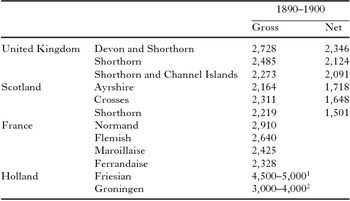
Dutch cattle were also improved during the nineteenth century, and some animals were already enjoying a good reputation by the 1850s, especially the Friesians, whose yields oscillated between 3,000 litres and 4,000 litres per cow per year (Houghton, Reference Houghton1897: 38–41). This prestige encouraged the introduction of the breed in other countries, especially the United States, where a herd book was established in 1872. A few years later, in 1885, the Holstein-Friesian Association of America was constituted, and the breed, which came to be known as the Holstein, was vastly improved with regard to its yields, to the detriment of the milk's fat content. The Friesian breed was also introduced into Canada, where a new herd book was established (1891), and several European countries, including Spain. During this process, one herd book was created in Bohemia (1872) and three in the United Kingdom (1909, 1914 and Reference Rossell1919) (Bieleman, Reference Bieleman2005: 230–1; Porter, Reference Porter2007: 57 and 341). In Holland, the first herd book was established in 1874. This register was national in scope and included three breeds: Black and White or Friesian, Meuse-Rhine-Yssel and Groningen. Four years later, in 1879, a specific herd book for the Friesian breed was created; a similar step was taken for the Meuse-Rhine-Yssel breed in 1905, and in 1908 for the Groningen breed. As a result of these actions, in some cases yields reached 4,000–5,000 litres per cow per annum in the late nineteenth century (Bieleman, Reference Bieleman2005: 232). Yields from other breeds also increased, but not proportionately as much (Table 3).
Yields of dairy cows, 1890–1900 (litre per cow per annum)

Notes: (1) In Frisia; (2) In Groningen.
Sources: United Kingdom and Scotland: Rew, Reference Rew1892: 253–4; France: Pirtle, Reference Pirtle1926: 317; Holland: United States Consular Reports, 1888: 512.
Following these advances, innovation focused on three targets in the first third of the twentieth-century: the improvement of the genealogical and visual information of the herd book, including the addition of photographs; the organisation of better breeding services; and, especially, the improvement of stud selection processes with the creation of milk production registries (Pirtle, Reference Pirtle1926: 293; Orland, Reference Orland, Schrepfer and Scranton2003: 180–3). In some cases, new, highly reputed studs were also obtained, such as the bull Adema 197 in Holland, but this only occurred towards the end of the period under consideration (Theunissen, Reference Theunissen2008: 648–9).
The first milk register (Cow Testing Association or Milk Control Association) was created in Denmark in 1895. This example was followed in Holland in 1896 and in Germany in 1897. These associations soon multiplied (Orland, Reference Orland, Schrepfer and Scranton2003: 183; Pirtle, Reference Pirtle1926: 221, 264, 265, 279, 293 and 346). By 1914 there were 792 such associations in Germany, including a grand total of nearly 350,000 registered cows (3.4 per cent of the total); by 1933 there were 2,897. By the mid 1920s the number of such associations was 553 in Holland and 1,038 in Denmark (in this case with 394,181 registered cows, thirty per cent of the total). In England these initiatives started later and did not develop quite so fast. The first association was created in 1914, and nine years later, by 1923, there were fifty-five, which included 104,000 registered cows, only 3.5 per cent of the national herd total. Alongside these associations, Bull Societies, aimed at establishing pooling fecundation services on a local level, were also created, although we know little of their activities. By the early 1920s there were 519 in Holland and 1,274 in Denmark.
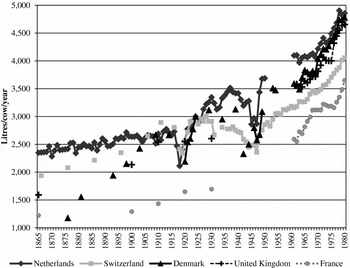
Despite these initiatives, yields did not increase again significantly until after the Second World War (Figure 2), that is, until new diets gave a boost to animal care and a new technological framework opened up the possibility of further improving the breeds in use to a significant degree. These included the introduction of the Holstein-Friesian breed from the United States, the spread of artificial insemination with frozen sperm and antibiotics, and the development of new fecundation strategies following advances in animal genetics (Bieleman, Reference Bieleman2005: 235–9; Foote, Reference Foote2002: 3–6; Porter, Reference Porter2007: 57–8, 95 and 340–1; Woods, Reference Woods2007).
Milk yields in Western Europe, 1865–1980.

4. The new breeds in Spain
The development of the dairy sector in Spain also involved important biological changes. These changes were, however, very different from those discussed in the previous section. For generations, Spanish cattle had been adapted to their use for work, and, once the animals had gone past their working age, for meat. Only in a few regions, notably in Galicia, were calves specifically bred for meat (Domínguez, Reference Domínguez, Barciela and Vittorio2003: 466; Martínez, Reference Martínez1991: 9–11; Puente, Reference Puente1992: 93–4, 190–2). As late as the 1890s, calves were castrated shortly after birth, and cows were undernourished, because farmers considered them a cause of expenditure rather than a source of income. This was even the case with the breeds with higher yields, such as Tudanca, Pirenaica, Pasiega, Campurriana or Campoo and Asturiana de los Valles.Footnote 10 When milk demand began to increase in the late nineteenth century, few breeders and technicians supported the use of inbreeding to improve these varieties of cattle. As noted above, this was a costly and slow process, and the chances of success in Spain were considered limited.Footnote 11 It was attempted in Guipúzcoa with the Pirenaica breed from 1905, but the initiative was all but abandoned a few years later. By the end of the First World War, no mention of this attempt can be found in the sources (Mendizabal et al., Reference Mendizabal, Ibarbia and Etxaniz2005: 42–8; Echevarria and Asarta, Reference Echevarria and Asarta1976: 230–1). Moreover the demand for meat had also been rising since the late nineteenth century, especially, once more, in cities, and until well into the twentieth century, transport infrastructures in Spain were much better prepared for the commercialisation of cattle than of milk from cattle-breeding areas (Puente, Reference Puente1992: 169–70; Pujol and Nicolau, Reference Pujol and Nicolau2005). In contrast with other European cities, where railways freighted over seventy per cent, and sometimes as much as ninety per cent, of the milk consumed,Footnote 12 in Spain, as late as the 1930s, only about seventeen per cent of the milk consumed in Madrid, and thirteen per cent in Barcelona, arrived by train. The rest was produced in urban dairies or by farmers located within distances of under sixty kilometres (Ayuntamiento de Madrid, 1929: 248; Doaso, Reference Doaso1931: 27; Mas, Reference Mas1935: 25; Vila, Reference Vila1979: 124–5).
In this context, it is hardly surprising that dairy producers and cattle breeders opted to introduce improved breeds from abroad. The target was twofold. Dairy producers, who were mainly located in cities and their hinterland, aimed to develop more efficient ways to meet the new milk demand, while cattle breeders sought to adapt these animals to their regions and improve local breeds by absorbent crossbreeding.
In the first instance, the Friesian breed was the most common choice because it adapted well to the environmental conditions at low altitudes and its yields were higher.Footnote 13 In the second case, the Swiss breed was often chosen because it was the same type as the local breeds (Alpine), and it made better use of short-stemmed mountain pastures (Rossell, Reference Rossell1923: 23). New breeds did not, however, adapt well, absorbent crossbreeding attempts failed, and the Friesian breed eventually displaced the Brown Swiss because of the pressure posed by urban demand. Ultimately, the sector ended up depending on Friesian cattle and a wide range of mixed varieties which provided higher yields than local breeds due to their hybrid vigour, but the reproduction of these varieties rested upon the periodical import of bulls and cows from abroad.Footnote 14 It is still uncertain whether a different institutional framework could have corrected this situation. Besides, agronomic engineers and veterinarians stressed on several occasions that imports did not bring the best cattle and that crossbreeding with native breeds generally lacked the necessary technical supervision (Dirección General de Ganadería, 1932–1933: 48). In addition, Spanish public agencies were seldom aware of this type of innovation: the first herd books and Cattle Yield Testing Regulations were not issued until 1935 (Reglamento de Libros Genealógicos y Comprobación de Rendimientos del Ganado Vacuno), and the second not until 1960.
In Guipúzcoa the imports of Brown Swiss began in 1843 but did not become significant until 1863, when local government agencies imported eight bulls and a cow and promoted crossings with the Pirenaica breed by creating new stud depots (148 in 1883) (Mendizabal et al., Reference Mendizabal, Ibarbia and Etxaniz2005: 40–1). In the following years, this activity was carried out intensively, and by 1917 there were 30,399 new Swiss x Pirenaica; 17,055 Pirenaica; 542 undetermined and 138 Friesian cattle in the province.Footnote 15 This practice soon spread to Vizcaya and Álava (also in the Basque Country), Navarre, Huesca, Asturias, Galicia and Santander. In the Basque Country and Navarre this also involved the active participation of local government agencies such as the Guipuzcoa, Vizcaya and Navarre Provincial Councils.Footnote 16 In Santander, imports began in 1865 and crossings with the Tudanca, Pasiega and Campurriana were carried out. Catalonia was also an important destination for these imports. In this region, however, the earliest imports supplied urban dairies in Barcelona (1860) while cattle-breeding areas in the north of the region did not start importing until some years later (1885) (Rossell, Reference Rossell1919: 63).
In Asturias and Navarre the crossing of local breeds with Swiss was soon abandoned. In both regions, the first generations of hybrid cows presented poorly defined traits, and their yields did not exceed that of the local breeds (Junta Consultiva Agronómica, 1920, volume 2: 8 and 37). In Galicia and Huesca, these practices yielded similar results, and the Swiss breed and absorbent crossbreeding were abandoned as early as the 1890s (Junta Consultiva Agronómica, 1892, volume 2: 213 and 345).Footnote 17 Sooner or later, the new cattle's ability to produce milk also decreased in Santander (where this occurred with fourth generation animals), the Basque Country and Catalonia. As a consequence, the interest in Brown Swiss rapidly waned (Junta Consultiva Agronómica, 1920, volume 2: 75).
After these failures, the Friesian breed, which was the most sought after in urban dairies, also expanded to cattle-breeding regions, where it replaced the Brown Swiss. In Santander, for example, the bovine population in 1935 included 92,132 Friesian and 40,729 Brown Swiss or derivatives of this breeds; 35,255 Tudanca; 17,268 Campurriana, and 16,576 undefined cattle.Footnote 18 The substitution of Swiss for Friesian was even more acute in Catalonia, mostly because of the high milk demand in the largest city, Barcelona. By 1922, the estimation was that for every twelve Brown Swiss animals in the region there were 100 Friesian or related cows (Rossell, Reference Rossell1923: 29).Footnote 19
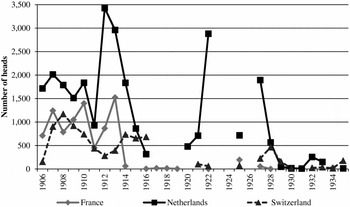
Foreign trade statistics provide further evidence for this trend, even though they do not include stud-specific information and the country of origin of dairy cows is only recorded from 1906 onwards. As shown in Figure 3, imports of Friesian cows were already predominant in the early twentieth century. Furthermore, this was almost the only breed whose import continued after the First World War, despite these imports being discontinuous (Domínguez and Puente, Reference Domínguez, Puente, Germán, Hernández and Moreno2009: 143–6). In contrast, imports of Swiss cows, which were still high in the early twentieth century, nearly disappeared from 1916 onwards. Figure 3 also shows the sharp drop in 1927 that affected Friesian cows, to the point that imports ceased almost completely in the 1930s. This coincides with the above mentioned stagnation of the dairy sector.
Imports of dairy cows (1905–35).

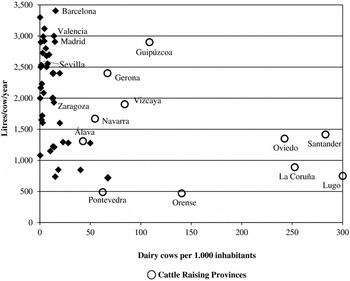
Thereafter, and as could be expected, the Spanish dairy sector was split into two areas: on the one hand, cattle-breeding regions in the north, which specialised in rearing dairy cows for the supply of consumption centres,Footnote 20 and on the other hand, milk production centres, mostly located in the cities and their hinterland, which specialised in dairy production. As a result, the number of dairy cattle in cities and their hinterlands was lower, but their yields were higher (Figure 4).
Yields and cows per thousand inhabitants, Spain, 1933.

5. Conclusions
In this article we put forward new evidence for the development of the dairy sector in Great Britain, France, Holland, Denmark, Switzerland and Spain between the mid nineteenth century and the 1930s. In Central and Northern Europe, the development of the sector was continuous and intense, and was based, especially in the second half of the nineteenth century, on the increase of yields. In Spain, on the other hand, the process did not begin until the 1890s and tended to stagnate after the First World War. Furthermore, progress can only be detected in the northern cattle-breeding regions and some big cities and their hinterland. Also, in contrast to Northern and Central Europe, the development of the dairy sector in Spain was mostly due to the increase in the number of dairy cattle. In order to explain these divergent trajectories, the availability of fodder has been considered, but special attention has been paid to the breeds in use and their improvement. It is likely that improvements in animal healthcare also had a lot to do with this, but a detailed analysis of this aspect is beyond the scope of this article.
Concerning breed improvement, we have shown that this sort of innovation had a very different impact in both regions. In Northern and Central Europe, innovations in cattle breeds progressed quickly in the nineteenth century, and the main dairy cattle breeds that are still in use now had already been defined by 1870 to 1900. In the first third of the twentieth century, although innovation continued at a brisk pace, the increase in milk yields started to slow down in some cases, probably as a result of the limitations of inbreeding methods based on natural fertilisation. In Spain, in contrast, the impact of these activities was negligible. Inbreeding improvement was deemed inappropriate for the native breeds, absorbent crossbreeding failed, and breeds developed in Northern and Central Europe adapted poorly to Spanish conditions. As a result, the sector ended up depending on periodical imports of bulls and cows from these other countries (first Swiss and then Friesian). We have also seen how the ultimate predominance of the Friesian breed was caused by the high demand for them in urban areas, and we noted that the progressive reduction of imports from 1927 also contributes to better explaining the eventual stagnation of the Spanish dairy sector thenceforth.
In summary, this article has presented a new case study that has two important implications for rural, agrarian and economic historians. First, we presented the new analytical possibilities that can result from the consideration of innovation in seeds, plant, and animal varieties in these fields. Second, we discussed the relevance of environmental and biological restrictions in the development of the agrarian sector from the mid nineteenth century. Obviously, our conclusions do not question the role also played by institutional factors. In order to gain a better understanding of the development of the agrarian sector in Europe in the period under scrutiny, however, the interaction between technological and institutional conditions should be more considered.
Acknowledgments
This article is funded by the Spanish Ministry of Science and Innovation project HAR2013-47182-C02-01. We wish to thank Roser Nicolau, Francesc Muñoz, Emanuele Felice and the editors and referees of this journal for their helpful comments.
Appendix 1 Cow's milk production and consumption in Spain, 1865–1933
-
A: Number of cows (in thousands)
-
B: Number of dairy cows (in thousands)
-
C: Daily average milk output per cow (in litres)
-
D: Duration of productive period (in days)
-
E: Days of the productive period reserved for breastfeeding calves
-
F: Average gross output per cow per annum (in litres)
-
G: Gross output (in millions of litres)
-
H: Amount of milk reserved for rearing calves (in millions of litres)
-
I: Net production (in millions of litres)
-
J: Net production for direct consumption (in millions of litres)
-
K: Net supply for direct consumption per capita per annum (in litres)
1.1. Cow's milk production and consumption in Spain, 1865–1890

1.2. Cow's milk production and consumption in Spain, c.1925

1.3. Cow's milk production and consumption in Spain, 1933