Introduction
Since the September 11, 2001 terrorist attacks in New York (New York, USA), there has been increased emphasis on disaster preparedness, and preparation for sudden threats from natural, intentional, or technological disasters has become a major focus of training for prehospital providers.
During mass-casualty incidents, rapid assessment and timely triage of injured patients to an appropriate level of care is critical. Prehospital providers frequently are faced with an overwhelming number of injured patients and the scale of casualties often exceeds the available resources in the field.Reference Ma, Norvell and Subramanian 1 It may be exceedingly difficult in a prehospital environment to accurately differentiate the severity of injury without standard advanced imaging equipment. Unlike traditional diagnostic equipment, ultrasound typically is battery powered and amenable to transportation to a disaster scene. Ultrasound's portability, ease of use, and accuracy make it appealing for rapid screening and diagnosis in disaster situations. Prior studies have shown that screening ultrasonography is highly reliable in the evaluation of victims of mass-casualty incidents.Reference Beck-Razi, Fischer, Michaelson, Engel and Gaitini 2 - Reference Zhou, Huang and Wu 6 However, there are some potential challenges to the successful implementation of ultrasound at disaster scenes. While it may be possible to perform ultrasound examinations at the scene of a disaster, the first responders may not be able to accurately interpret the ultrasound images. Even with basic knowledge, complex or unclear findings may be encountered that require a more expert opinion, which may not be available on scene. Furthermore, even if successful image acquisition can occur at the disaster scene, members of the trauma team at the receiving hospital would not have immediate access to such information.
Telemedicine is a rapidly-developing area of prehospital care which allows transfer of diagnostic data from prehospital providers through the phone or internet to remote locations for consultation and treatment recomemndations.Reference Nelson and Chason 7 Prior studies have investigated the feasibility of real-time wireless transmission of ultrasound images to remote locations.Reference Ferlin, Vaz-Oliani, Ferreira, Tristão and Oliani 8 - Reference Blaivas, Lyon and Duggal 11 In a study done by Strode et al, Focused Assessment with Sonography for Trauma (FAST) examination ultrasound images were transmitted successfully from an ambulance to a remote site, via satellite, for review.Reference Strode, Rubal and Gerhardt 12 However, there was a reduction in image quality when the transmitted images were reviewed remotely. Later studies reported improved image quality upon a satellite transmission from the field for off-site review.Reference Garrett, Boyd and Bauch 13 , Reference Huffer, Bauch and Furgerson 14
Transmission of real-time ultrasound video compared to still images is desirable since video provides additional detail and increases the confidence of the reviewers. Additionally, while satellite technology may not be readily available and is expensive, most of the developing countries now have mobile phone coverage. This is the case for parts of Africa and India where mobile phone video transmission would be more accessible than satellite capability. The objectives of this study were to evaluate the feasibility of transmitting real-time portable ultrasound video via commercially available video mobile phones from a simulated disaster triage location and to determine the ability of emergency physicians to accurately interpret the transmitted FAST ultrasound examinations.
Materials and Methods
This was a prospective, single-blinded study on the feasibility of transmitting real-time ultrasound video, intended for immediate interpretation, via a mobile phone from a simulated disaster triage area. The institutional review board at Medical College of Georgia approved the study with waiver of written informed consent since no patient-identifying information was collected at any point.
The study was performed in two locations. The first location was a simulated disaster scene put on for an Advanced Disaster Life Support (ADLS) course. Nineteen volunteers were assigned specific injuries and assembled in a large, outdoor school parking lot. The second location was the emergency department (ED) of an urban, tertiary care facility with an annual volume of 78,000 patients. The facility supports an emergency medicine residency training program and is a Level I trauma center. Hospital credentialing in emergency ultrasound, based on American College of Emergency Physician guidelines, is available to all attending emergency physicians meeting the criteria. 15 The four emergency physicians who contributed to this study were credentialed by the hospital to perform bedside ultrasound examinations. Each had performed more than 300 FAST ultrasound examinations before the study. Physicians in the ED were in possession of an off-the-shelf, widely available video mobile phone with a video resolution of 176 × 144 pixels from a 1.3 megapixel camera (Sony Ericsson S700i, Sony Corporation, Tokyo, Japan) capable of receiving video from an identical mobile phone at the simulated disaster scene.
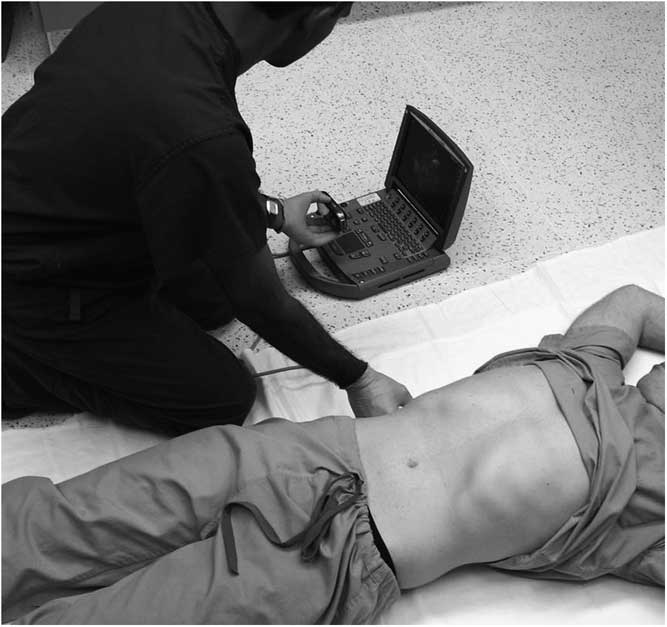
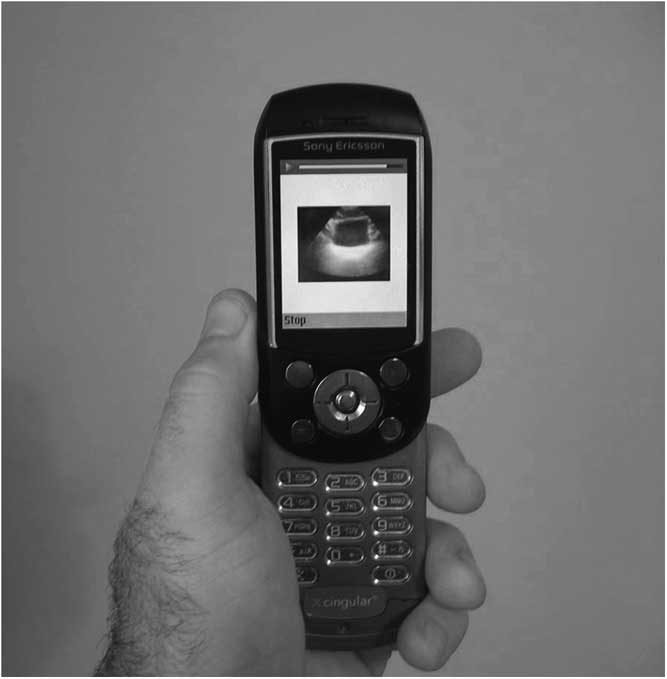
All persons 18 years of age or older who were assigned injuries at the simulated disaster scene were eligible for enrollment. A FAST examination was performed on each patient using a 3.5 MHz micro-convex transducer on a SonoSite Titan ultrasound system (Bothell, Washington USA). The FAST examination consisted of four standard views: right upper quadrant; subxiphoid; left upper quadrant; and pelvic. A single emergency physician sonologist performed the FAST examination and controlled the video phone camera. The phone was held in one hand and the ultrasound probe in the other. The lens of the camera phone was aimed at the screen of the ultrasound machine (Figure 1). The camera was set on “auto” and no adjusting was performed, other than subtle changes in distance from the lens to the screen in an effort to optimize the image size. Once the ultrasound examination was completed, the recording was ended and the video was transmitted to the ED approximately 170 miles away (Figure 2). The study was performed outside during moderate rain, although conducting the study in the rain was not intentional.
An Emergency Physician Sonologist at a Simulated Disaster Scene Performing a FAST Examination and Recording It on His Video Mobile Phone Abbreviation: FAST, Focused Assessment with Sonography for Trauma.

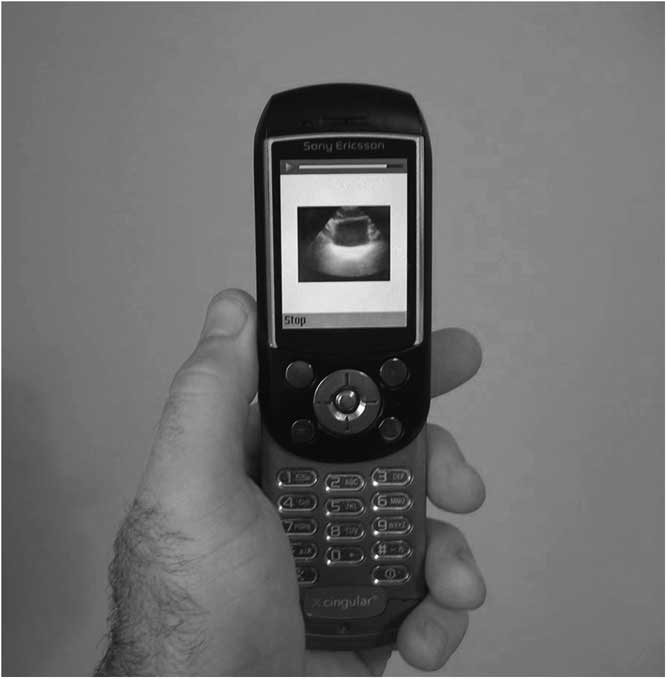
A video of a FAST examination occurring 170 miles away is being received and reviewed. The bladder portion of the FAST examination is being reviewed. Abbreviation: FAST, Focused Assessment with Sonography for Trauma.
The sonologist and receiving emergency physicians reviewed the videos and filled out a data collection form independently for each ultrasound examination. Each FAST examination video was assessed for pathology, such as free fluid. Other variables collected included image quality data and overall confidence level regarding whether or not a complete and adequate examination was visualized. A 10-point Likert scale was used to grade the images. All data were collected on standardized data sheets. All analyses were performed in SAS version 9.1 (SAS Institute Inc., Cary, North Carolina USA). Continuous data were presented as means and medians with 95% confidence intervals. Spearman's rank correlation coefficient was used to examine the agreement between the reviewers and sonologist.
Results
A total of 19 videos were collected on 19 simulated patients. None of the subjects in the simulated disaster declined the FAST examination. The median time for video transmission was 82.5 seconds (95% CI, 67.7 seconds-97.3 seconds). There were no failures of video transmission.
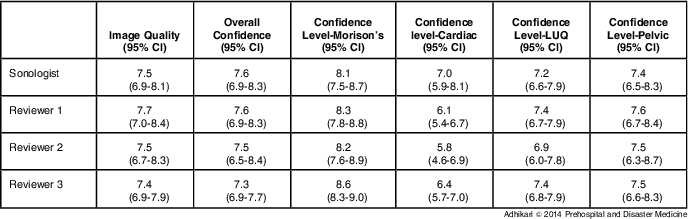
Table 1 summarizes the mean scores for emergency physician reviewers and the sonologist. There was moderate agreement between the reviewers and sonologist in image quality rating and overall confidence level scores (rho = 0.6). The cardiac view had the lowest mean confidence scores for all reviewers. No pathology was noted by the sonologist who obtained the images on the simulated patients. However, reviewers raised the possibility of the presence of a minor amount of free fluid in three cases (two pelvic and one left upper quadrant).
Mean Scores (on a 10-point Likert Scale)

Abbreviation: LUQ, left upper quadrant.
Discussion
The availability of standard medical services, such as diagnostic imaging, is limited at disaster scenes. Trauma, in particular, has become a highly imaging-dependent specialty and the availability of onsite imaging for triage purposes is highly desirable. Traditional imaging equipment, such as plain x-ray and computed tomography, are large and cumbersome, thus rendering them essentially nonportable. This limitation, combined with the fact that they require a significant external energy source, virtually eliminates their use at a disaster scene.
Portable ultrasound has been described previously as a potential solution to the lack of imaging capability at disaster scenes.Reference Keven, Ates and Yagmurlu 3 , Reference Dean, Ku and Zeserson 4 These units have many positive attributes, including durability, small size, and utilization of battery pack power. Prior studies in disaster situations have proven the potential utility of portable ultrasound.Reference Dean, Ku and Zeserson 4 , Reference Mazur and Rippey 5 However, to the authors’ knowledge, no prior studies have investigated the real-time transmission of ultrasound videos from a disaster site to a remote location. The utility of ultrasound at disaster scenes may be diminished if the operator is not experienced enough to make accurate diagnoses, or if the receiving facility does not act upon the reported ultrasound interpretation without actually reviewing the ultrasound examination itself.
One previous study evaluated the transmission of still images of ultrasound examinations in an ED via commercially available camera mobile phones.Reference Blaivas, Lyon and Duggal 11 It was found that experienced sonologists interpreting the images could not decipher measurements and had less confidence in their interpretations. Video, as opposed to still images, allows the reviewer to visualize an entire organ or area, such as the junction between the liver and kidney. A single image could fail to show the fluid located in just a slightly different plane.
In this study, the authors were able to successfully transmit FAST examination video from a remote simulated disaster scene via a commercially available mobile phone. The reviewers felt confident that they were able to rule out pathology, and there was moderate agreement between the reviewers and the sonologist actually performing the scan in rating image quality. Disagreements between the emergency physician reviewers were inconsistent and revolved around possible small amounts of fluid. The technology utilized in this study is widely available around the world. The ultrasound machine utilized is a basic portable machine frequently found in developing areas of the world. The mobile phones also had modest resolution, eclipsed by the latest smart phone models. They are widely available around the world and, as opposed to the most popular models of smart phones at the top of the North American market, these phones are inexpensive and sold widely in the developing countries. Thus, it is reasonable to expect first responders in developing areas to be able to use similar technology with similar success, rather than face the barrier of access to modern technology.
Limitations
This study has a number of limitations, including the use of subjects at a simulated disaster triage area, none of whom had any detectable injuries on ultrasound. Although it rained somewhat heavily on the day of the exercise, image acquisition and transmission in other weather conditions, such as extreme sunlight, were not tested. All emergency physician reviewers had significant experience with the FAST examination. However, physicians wishing to receive and interpret ultrasound examinations obtained and transmitted from a remote disaster scene would likely have similar expertise.
Conclusion
Real-time portable ultrasound video transmission via commercially available video mobile phones from a simulated disaster triage location was feasible and emergency physicians were able to accurately interpret video of FAST ultrasound examinations. Ultrasound seems to be ideally suited for disaster scenes and its use could improve the triage process and ultimately improve patient care.