Introduction
In histories of the Western world and Japan in the early modern period from roughly 1600 to 1850, societies start out as predominantly rural and gradually become more urban as people move from villages to towns, and shift away from agricultural production to other activities.Footnote 1 This model is found in works in the Marxist tradition, the Annales School, English social history associated with the journal Past and Present, modern political economy of the sort represented by Barrington Moore Jr., and the Japanese historiography on the village community. Historians of the period focus on ‘agrarian systems’ (meaning agriculture, tenure, and land taxation) as the background for understanding society, politics, and culture because both population and production are mainly located in rural society. Recent essays in global history have dubbed the span from the Neolithic age to the Industrial Revolution as the ‘agrarian era’.Footnote 2
Histories of early modern Siam have tended to follow the same model. This article explores the possibility that Siam in the high Ayutthaya era was a predominantly urban society, and only later become ‘ruralized’.
On early modern Siam, there is no significant work that focuses on the social aspects of its history. Guided by the source material, historians have written either about the trading economy, using mostly foreign sources and accounts, or about monarchy and warfare, using chronicles and other indigenous sources.Footnote 3 The two main historical overviews, by David Wyatt and Barend Terwiel, concentrate on the political story, with almost no social context other than a sketch of the official systems of labour control.Footnote 4 However, Victor Lieberman, intent on setting Southeast Asian history within a comparative international context, adopted the agrarian approach. Two key variables in his model of the rise and fall of states are the size of the agrarian surplus, and the ability of states to capture a large proportion of this. In his sweeping account of Siam from the thirteenth to nineteenth centuries, a peasant society is perhaps more salient than in any other work on the period.Footnote 5 Historians writing on other aspects of Siam often assume a peasant society.Footnote 6 Michael Vickery summarized the Three Seals Code as ‘a body of law concerned with life in an agrarian polity’.Footnote 7
There is no accepted vocabulary for the periodization of Southeast Asian history. The term ‘early modern’ is borrowed from European historiography. Here we are following Anthony Reid and Victor Lieberman who both applied the term to Southeast Asia for the period from the fifteenth century on. Reid explained that this timing ‘sees the emergence of the forces that would shape the modern world’.Footnote 8 Here we focus on the period from the mid-sixteenth to the early eighteenth centuries. Earlier than that, data are almost non-existent. Later than that, as explained below, the process of ‘ruralization’ had begun.
The first section surveys the sources, noting the lack of evidence on rural society, and warning that in itself this lack proves nothing but does suggest that an alternative to the standard view is worth contemplating. The second and third sections argue that the economics of subtropical food production could support a distribution of the population between town and country that is very different from that found in temperate zones. The fourth sifts the scant evidence on demography to suggest where Siam's population might have lived. The fifth reviews foreign visitors’ accounts and a detailed Thai description of Ayutthaya, finding a more commercial and industrial city than that suggested by its usual classification as ‘port and court’. The sixth argues that the systems of taxation and labour dues that supported the state were appropriate for a predominantly urban society. The last sketches the ‘ruralization’ that transformed Siam from the early eighteenth century onwards into a smallholder peasant society that historians have projected back into the past.
Siam here means the lower Chaophraya River plain below the hills, with extensions to Khorat, the upper peninsula, and some ports on the west coast of the upper peninsula. It does not include Lanna or Isan.
This article draws on a wide range of sources—chronicles, laws, indigenous literature, mural images, foreign accounts, maps, indigenous descriptions, and historical remnants in the landscape. These sources have problems of many sorts, including uncertain dating (laws, literature), accuracy (chronicles), and cultural bias (foreign accounts). However, these are problems found in historical sources everywhere with differences only of degree, and should not deter historians from wondering about big issues.
The absence of rural society in the sources
Chronicles
In the royal chronicles of Ayutthaya, covering four centuries (1350s to 1767) and amounting to 380,000 words in Richard Cushman's English translation of the eight principal versions, paddy or rice fields are mentioned in 20 passages. In seven of these, they are merely background to a battle or passing army. In another seven, they are being worked to provision an army, usually when the army is on campaign outside Siam. Other, more interesting, mentions are discussed below. Farmers or peasants appear only three times, once each as victims of an army attack, as background for a royal intrigue, and as recruits for a revolt.Footnote 9
Laws
The laws of Ayutthaya, as collected in the Three Seals Code in 1805, are very extensive (1,700 pages in the printed edition) and cover many aspects of society (slavery, marriage, inheritance, theft, public disorder, debt, revolt, warfare, religion). There is no law on agriculture or other key aspects of agrarian society such as irrigation. The only part which deals with rural society at any length is a segment of the ‘Miscellaneous Laws’, a code on disputes between people arising from issues such as credit, purchase, hiring, the use of boats and carts, gambling, and magic. One part deals with disputes arising from agriculture, such as livestock straying onto a neighbour's land; burning stubble; stealing of crops, livestock, fish, implements, trees, soil, or water; and disagreement over land boundaries, occupancy, and land sales.Footnote 10 In passing, these clauses mention land deeds and land sale contracts, but there are no laws regulating land registration or transfer. Indeed, in the laws on contract and inheritance, no general distinction is made between moveable and immoveable property, and land has no special status in the code.Footnote 11
Livestock also get scant attention. In the law on theft, the longest and most detailed of all the codes, there is a single clause itemizing fines for theft of livestock. Several laws refer to ‘cattle, buffaloes, horses, and elephants’, but this four-animal grouping is conventionally used to indicate animals used for transport rather than farming. The management of irrigation, another common concern of agrarian law and subject of dispute, is not treated anywhere outside a fleeting mention in the ‘Miscellaneous Laws’. These absences are striking when compared to early law codes from Lanna, Laos, and southern Thailand, which have detailed provisions on the theft of livestock, upkeep of irrigation works, and other agrarian topics.Footnote 12 The law on theft pays much more attention to urban types of theft, including housebreaking and mugging. The Three Seals Code as a whole devotes considerable attention to contracts, credit, and public order, issues that matter to an urban, commercial society, and has very little on land, water, and livestock, issues that matter to a rural one.
Descriptions by visitors
In the many descriptions of Siam by Chinese, European, and Persian visitors from the sixteenth to eighteenth centuries, there are few passages devoted to rural society, and no attempt to paint a detailed verbal picture of a village or a rural landscape.
In part this can be explained by the visitors’ routes and interests. Most arrived at the mouth of the Chaophraya River, travelled up to Ayutthaya for a rather short stay, and ventured no further. Most were traders or diplomats who focused their accounts on matters related to trade and diplomacy. Yet, there were exceptions. The Persian envoys who arrived in Ayutthaya in 1685 had travelled overland from Tenasserim (Tanaosi) and visited Suphanburi, among other places, en route. Jacques de Bourges made the same trip by a different route in the 1660s. The Belgian adventurer Jacques de Coutre rambled around central Siam for several weeks in the 1590s and also visited Suphanburi.Footnote 13 Nicolas Gervaise appears to have spent some time beyond Ayutthaya in the 1680s. In the turmoil of 1685–1688, several Europeans travelled between Ayutthaya and Lopburi. While many of these visitors described in long and fascinated detail the differences between aspects of urban Siam and their parallels in familiar Europe, there is no similar description of the contrasting nature of rural landscape, village architecture, or agrarian practice between their home territories and Siam.Footnote 14 The scribe of the Persian embassy noted, ‘From Mergui all the way to Shahr Nāv [Ayutthaya] there were no settlements, villages or buildings to speak of.’Footnote 15
Literature
Rural society does not figure prominently at all in the literature of the early modern era. In most works this is not surprising as the plots are set in the heavens or a royal court, and often based on a jataka (a didactic tale of a previous life of the Buddha). The exception is The Tale of Khun Chang Khun Phaen which tells a realistic, contemporary story and presents a panorama of the society. The characters travel widely around Siam and neighbouring territories. On leaving a town, they plunge immediately into the ‘forest’ and emerge only on reaching their destination. On the overland route between Suphanburi and old Kanburi, a distance of around 110 kilometres traversed several times in the tale, only three villages are mentioned.
In the 20,000 lines of the tale, paddy fields are mentioned only ten times, each time incidentally, and never described. Farmers or peasants appear only once, in a scene set not in Siam but in Lanna, which was probably added in a nineteenth-century revision of the tale. Agriculture is mentioned (briefly) in only three scenes. Two of these are set not on the plain of Siam proper but in the hills: one in a bandit lair and the other in a Lawa village in the western hills.Footnote 16
Painting
In the wat (Buddhist monastery) murals and illustrated manuscripts that survive from the early modern era, there is no sign of a paddy field, a peasant, nor a village landscape.
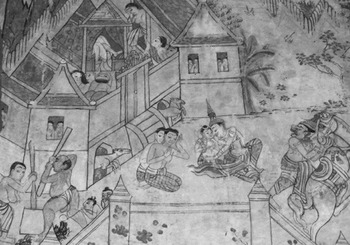
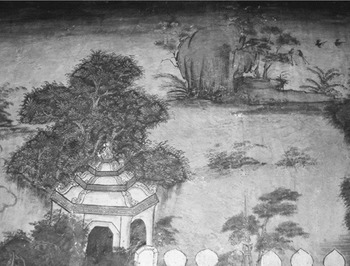
Around twenty wat have murals which are believed to date from the late Ayutthaya or early Bangkok eras and to have remained largely unchanged by subsequent restoration work. The earlier of these have formal designs with rows of votive figures, but later examples feature storytelling from the life of the Buddha and jatakas. Such storytelling presented opportunities for the artists to include realistic vignettes in the background and the margins, a practice that began in the late Ayutthaya era and flourished in early Bangkok. Although the stories are set in the past, the artists convey the contemporary urban landscape through the distinctive architecture of roofs, houses, wat, city walls, gates and palaces, and through vignettes of people at work and at play (see Figure 1). By contrast, the areas beyond the city walls are portrayed as forest or wilderness (see Figure 2). There are no signs of a village or farmer. The only people depicted are traders and other travellers crossing from one city to another.Footnote 17
Urban street life. Detail from mural at Wat Chong Nonsi, Bangkok. Source: Gerhard Jaiser, Thai Mural Painting, Bangkok: White Lotus, 2009, Plate c01a; used with permission.

Chinese wilderness beyond the city wall. Detail from Wat Bot Samsen, Bangkok. Source: Jaiser, Thai Mural Painting, Plate c17b; used with permission.

A few illustrated manuscripts have survived, mostly portraying jatakas or illustrating the Three Worlds cosmology. Again, there is no sign of a village, a peasant, or a rice field.Footnote 18
While the portrayal of the city emphasizes the distinctive Thai architecture of palaces and temples, the non-urban scenes borrow their style and motifs from Chinese painting, showing rock formations, trees, and flowers never seen in a Thai landscape. In one of the best preserved examples at Wat Bot Samsen, Bangkok, a lively portrait of a city ends at the city wall, beyond which is a wilderness with Chinese-style rock-forms and foliage (see Figure 2).Footnote 19
Appraisal
The near absence of rural society in the sources proves nothing. Proving the absence of anything in history is logically fraught. In the case of each category of sources, there are good reasons why fields, farmers, and villages do not appear. The chronicles focus tightly on the exploits of kings and ignore everything else. Laws on rural topics might have been among the legal manuscripts that were omitted when the Three Seals Code was compiled in 1805.Footnote 20 Foreign visitors to Siam were either traders or diplomats and they focused on matters of trade and diplomacy. The storytellers that composed Khun Chang Khun Phaen and other literary works may have found rural society too ordinary to merit description. The Buddha's life story and jatakas—the subjects of wat murals and manuscript paintings—are set in cities, palaces, and the wildernesses where the Buddha meditates, not in villages. Art historians such as No Na Paknam argue that no concept of landscape painting took root and the use of Chinese style and motifs became a convention that all muralists followed.Footnote 21
And yet the cumulative absence in all of these sources gives us some reason to pause and reflect. Could it be that these sources present an accurate impression of a society that was predominantly urban? While agriculture was present, was it much less significant than in the peasant society usually assumed to have existed? And was this low significance the reason why it was overlooked by the chroniclers, law-makers, artists, poets, and foreign visitors?
Labour input in the production of food
In temperate areas of Europe and Asia, the production of food with the technology of the early modern era required a high input of labour time. Because of low ambient temperatures, crop growth extended over several months. Land preparation, sowing, weeding, and harvesting were labour-intensive. Grain required further processing (grinding, baking) before it could be eaten. Animals needed constant tending to protect them against the weather and various predators, and further input of labour in butchery and cooking. Illustrations of rural life, such as Pieter Breughel's paintings of the Netherlands in the sixteenth century, teem with figures engaged in the preparation of food. Most of the population had to work in agriculture in order to generate a surplus to feed a minority in the towns. In Britain in 1500, the ratio of rural-to-urban population was around three to one. This constraint was later removed by two factors. First, an ‘agricultural revolution’ raised the returns to agricultural labour by applying new techniques and technology. Second, imperialism and the falling costs of maritime freight gave access to outside sources of food. By 1850, the ratio of rural-to-urban population in Britain had reversed to one to three.Footnote 22 Other temperate areas, including Western Europe, Japan, and North America, have followed a similar trajectory.
Conditions in the tropical and subtropical zone were very different for the simple reason that plentiful water and higher temperatures greatly facilitated the production of food, especially grains, with a much lower labour input.
The scribe of a 1685 Persian mission to Siam described rice cultivation as follows:
When the time is right for planting, they plough the land in a careless manner and scatter seed all over the surface of the soil. Then they depart and wait for nature to provide them with results. The monsoon arrives just after their ploughing and the fields become saturated with water. . . When the plants reach maturity, the farmers return in their boats and gather the harvest.Footnote 23
La Loubère described the same process: ‘They till them and sows them, when the Rains have sufficiently softened them, and they gather their harvest when the waters are retired.’Footnote 24 Land was prepared with a simple wooden plough or by trampling with buffaloes. Seed was sown broadcast. Nutrients were supplied by monsoon rains and river silt. Monsoonal flooding dealt with weeds. In some places, the water height was controlled by bunding the fields,Footnote 25 but around Ayutthaya the ‘floating rice’ simply grew upwards as the floodwaters rose, needed no tending but some guarding.Footnote 26 The only period of more intense labour input came at the time of harvest, threshing, and storage, and this requirement was often eased by communal labour. The grain then needed no further processing beyond a few minutes of pounding and cooking. The yield per unit of area was low and unreliable but the yield per unit of labour was very high. After describing the techniques used in Siam, a Japanese junk captain noted in 1690, ‘Because cultivation is such an easy task there the price of rice is far cheaper than in other countries.’Footnote 27
Some of the population may have relied on other sources of carbohydrate that grew wild and were freely available all year round, including bananas, various edible roots such as sweet potatoes, taro, and yams (kloi) found in forests, and lotus seeds and various nuts such as water caltops (krajap) found in waterways and ponds. Gervaise noted that, ‘No commodity anywhere in the country is cheaper than brown sugar’,Footnote 28 made from the juice of a palm tree.
Proteins and vegetables were found by forms of everyday hunting and gathering. The waterways teemed with fish, prawns, and shellfish which were mainly caught by labour-economical forms of trapping.Footnote 29 Gervaise commented that that, ‘the river abounds in fish’, and ‘without stirring out of doors, anyone can catch more fish in an hour than he can eat in several days’.Footnote 30 The Abbé de Choisy put it more sensually, ‘there are so many [fish] in the river that when bathing they come and rub against your legs’.Footnote 31 The scribe of the Persian embassy noted, ‘In Siam the region around the city and even the very edges of the city itself provide much game, especially blue and white haqārs [a bird].’Footnote 32 Other protein came from various small animals, lizards, frogs, snakes, and insects, also collected or trapped. Larger animals were hunted in nearby forests, especially wild boar and deer; Siam exported around 150,000 deer hides a year to Japan in the mid-seventeenth century. Many were caught close to the capital during the monsoon flood when ‘all the wild animals of the forest—deer, antelopes, wild cattle and other animals—take shelter in the high places, and the Siamese go there with many boats for hunting.’Footnote 33
Vegetables were not cultivated on any scale until the early nineteenth century. Instead people cultivated kitchen gardens, and collected roots, leaves, shoots, and cress that grew naturally in hedgerows, paddy field banks, ponds, and rivers. Fruit was abundant and available in the same way.Footnote 34
This contrast between temperate and tropical is not simply a post hoc theoretical exercise, but was a matter of wonderment to some European visitors to early modern Siam. In the 1630s Jeremias Van Vliet concluded that, ‘Siam is a country that has more than most other countries of everything that the human being needs.’Footnote 35 Gijsbert Heeck, visiting in 1655, was struck by the ‘superabundance’.Footnote 36 Cornelis van Neijenrode, writing in 1621 after five years in Siam, also used the term ‘superabundance’ and noted ‘even in lean years people can look after themselves very comfortably’.Footnote 37 Simon de La Loubère in the 1680s concluded that with rice and fish so cheap, and arrack available at two sous for a Parisian pint, ‘it is no wonder if the Siameses are not in any great care about their Subsistence, and if in the Evening there is heard nothing but Singing in their Houses’.Footnote 38
Food production and residence
In early modern Siam, the production of food did not require a year-round commitment of labour, but a small daily amount of hunting and gathering, and a few days a year for rice farming. People did not have to live in settlements dedicated to agricultural production (that is, villages), but could live in towns and travel out to paddy fields ringed around these urban areas and along nearby waterways.
The areas immediately adjacent to Ayutthaya and other cities were known as thung, meaning a plain but, more specifically, a rice-growing plain.Footnote 39 Some of the few mentions of paddy fields in the chronicles are in the form ‘the paddy fields [thung] of the walled city of Nakhon Ratchasima’ or ‘the paddy fields of Kamphaeng Phet’,Footnote 40 meaning the fields that lay adjacent to that city and supplied its staple food. Two mentions of paddy fields in the chronicles confirm that some people lived in the city and travelled out to work the fields. During an attack on Ayutthaya in the 1580s, the besiegers,
planned the campaign as a lengthy undertaking and would maintain positions to prevent the inhabitants of the Royal Metropolis from being able to issue forth to work the paddy fields.Footnote 41 (Emphasis added)
Similarly, during the Burmese attack in 1766, ‘The inhabitants [of Ayutthaya] went out to gather the rice, but were surprised by the Burmese, who led them captive to their camp.’Footnote 42 Early in the reign of King Borommakot (1733–1758), the chronicles describe this scene:
At the season for threshing rice, however, His Majesty went to thresh at the Sweetmeat Plain crown fields. Then He took the rice and placed it in small ox carts and He had all His Holy Royal Sons, His Holy Royal Daughters, His maids in waiting and His ladies pull them to the interior of the Palace Enclosure.Footnote 43
These ‘crown fields’ (na luang) were situated on the thung rice plain to the northeast of the city, and were overseen by the land ministry (krom na), one of the four original royal ministries. The titles of officials in this ministry suggest that it managed granaries, supplied the royal household with food, and organized official feasts.Footnote 44 Possibly other great households in the Ayutthaya nobility had similar holdings where they grew rice to feed their family and their many dependents, while ordinary folk had smallholdings. Van Neijinrode noted in 1621, ‘everyone, whatever his status, cultivates land of his own (especially rice and paddy) and engages in fishing’.Footnote 45
How much land would have been needed to supply Ayutthaya with rice? The population of the city (discussed below) may have been 250,000 in the seventeenth century. According to the earliest available data, the annual consumption requirement was 2.4 piculs or 144 kilograms of cleaned rice per head, and the average yield of paddy was around 4.24 piculs per rai (0.16 ha). On the basis of these figures, the city's rice could be grown in a circle with a radius of 10.4 kilometres.Footnote 46
Because transport was most efficient by water, the supply zone would not have been circular but would have stretched along the rivers and canals which extended from Ayutthaya in all directions. In 1685 Père Tachard recorded ‘vast plains reaching out of sight covered with rice’,Footnote 47 along the river from Ayutthaya to Lopburi, and the Abbé de Choisy repeatedly mentioned the ‘broad landscapes of rice’ close to the city.Footnote 48
Not all the rice came from these adjacent areas. The Description of Ayutthaya,Footnote 49 a Thai document probably written soon after the destruction of the city in 1767 as a memoir of its former state, records that rice was brought by boat from other growing areas, mostly northwards up the Chaophraya river system.Footnote 50 La Loubère mentions that some rice was grown outside the delta using methods of transplantation and water control, and that this type of rice was ‘more substantial, better relisht, and keeps longer’.Footnote 51 As a result, it may have been favoured for provisioning junks. From the 1620s, the Dutch carried rice to Batavia in years of shortage there, and later also to Melaka and Formosa, but only in modest amounts.Footnote 52 Enough rice to feed the city could be found from areas reachable by boat in a few hours.
Because of the relative ease in growing or finding food, there was no need for a majority of the population to be dedicated to food production, as was the case in the temperate areas of the world. Many may have practised agriculture as a part-time activity by commuting from an urban residence. Of course, some people did live in villages but these were clustered around the urban centres, especially along the nearby rivers.Footnote 53 The landscape has to be imagined, not as today's stipple of villages, but as urban centres separated by areas of forest and wilderness.
Urban residence was also shaped by a cultural preference that encoded a basic instinct for survival. Forests were home to snakes, tigers, elephants and other life-threatening predators, as well as the agents that transmitted malaria and other lethal fevers. In The Tale of Khun Chang Khun Phaen, the father of one principal character dies from a fever contracted while travelling through the forest, and the father of another dies at the hands of a robber gang that uses the forest as refuge. When a youth departs on a journey through the forest, his mother calls on the gods and spirits to protect him from ‘tigers, buffaloes, and other wild animals’.Footnote 54 As Philip Stott notes in a classic article, in traditional Thai thinking, there was ‘a crucial contrast between Tai “civilized” space and Nature beyond normal social control’.Footnote 55 The mueang (town) was safe and civilized, whereas pa (forest) was dangerous and wild. Modern epidemiology shows that large concentrations of population are needed to convert diseases from epidemic and catastrophic to endemic and manageable.Footnote 56 Perhaps observation of this fact over centuries had been encoded in the cultural preference for mueang. There is a hint of this coding in a legend on the origins of Ayutthaya where the foundation of the city is associated with overcoming smallpox.Footnote 57
Some very rough demography
The only estimate of Siam's population in the late Ayutthaya period was made by La Loubère in the 1680s:
The Siamese do therefore keep an exact account of the Men, Women and Children; and in this vast extent of Land, according to their own Confession, they reckon'd up the last time but Nineteen Hundred Thousand Souls.Footnote 58
Some scholars have surmised that this figure included only the able-bodied men recorded in the registers, and that the total would therefore have been more than double. However, La Loubère specifies that the figure includes men, women, and children, and the figure is consistent with later estimates. In the 1820s, John Crawfurd proposed a figure of 2.8 million. Barend Terwiel's careful sifting of travellers’ accounts from the early nineteenth century suggested a population of a million at most. Sir John Bowring estimated around 2 million in 1855, and Prince Dilok Nabarath reckoned 3 million in the 1900s.Footnote 59 Seen in the perspective of these figures, La Loubère's figure is credible.
Working from the maps and observations of European visitors in the seventeenth century, Anthony Reid estimated Ayutthaya's population in the range of 150,000 to 200,000.Footnote 60 His figure was based on Tachard's estimate of a population of 200,000, Gervaise's estimate of 60,000 to 120,000 ‘fighting men’, and a calculation of a total ground area of 15 square kilometres (7.2 on and roughly the same off the island), with an average density of 10,000 people per square kilometre.
Reid's estimate may be low. In 1617, the East India Company board believed the city was ‘as great a city as London’.Footnote 61 In 1685, Véret, the manager of the French company in Ayutthaya, thought it was ‘a bigger city than Paris’,Footnote 62 and a Dutchman estimated the population at half a million.Footnote 63
Reid's estimates of the area of the city off the island was based on seventeenth-century European maps, which showed suburbs around the southern and eastern sides, areas with which the Europeans were familiar, but had little detail on areas to the north or west.Footnote 64 However, the 20 ferries that gave access across the moat from the suburbs were distributed rather evenly around the island, suggesting the population was rather evenly distributed too.Footnote 65 The densest distribution of the remains of old wat is in the area to the north of the city. Judging from the location of old wat remains, the occupied area off the island was at least twice that on the island, giving a total city area of 20–25 square kilometres.
Reid's estimate also ignores the population living on the water. According to the Description of Ayutthaya, rafts and boats used as dwellings were moored in several rows along four to five kilometres of the river around the southern side of the city and down the Bangkok (now Chaophraya) River to the south. The Description noted, ‘By estimate, around the city of Ayutthaya the number of rafts used as both dwellings and shops is around twenty thousand—certainly no fewer.’Footnote 66 If each housed a family of five, the floating population would have been 100,000. The number of such craft may have been fewer a century earlier, but Engelbert Kaempfer sketched some examples, portraying them as crowding the river in the map made in his notebook while walking around Ayutthaya in 1690, and he reported that each housed not one family but ‘two, three, or more Families each’.Footnote 67
Arriving at any reliable estimate of Ayutthaya's population is impossible. Calculating the population based on the area is hazardous because the density was highly variable. Parts of the island were reported as very densely populated and other parts ‘desart’,Footnote 68 while information on the suburbs is scant. However, visitors felt the city was large: remains show the site sprawled over 20–25 square kilometres, and the waterways added to the residential area. A minimum of 250,000 people, based on an average density of 10,000 per square kilometre on land plus 50,000 on the water, seems reasonable.
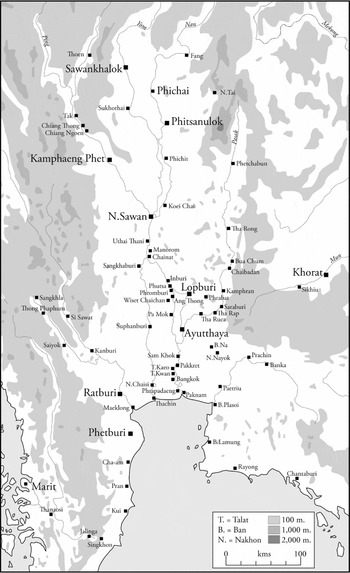
Information on other urban centres of Siam is very sparse as there are no eyewitness accounts of any detail. However, there are three sources which identify the major places: first, those towns that appear in the chronicles with the prefix mueang; second, those listed as towns of first, second, and third class, meaning administrative centres, in the provincial list in the Three Seals Code;Footnote 69 third, those recorded as major places in accounts and maps composed by foreign visitors.Footnote 70 These three sources very largely coincide, giving a total of around 70 places, plotted on Map 1. This count excludes several places down the peninsula that were more loosely connected to Ayutthaya by tributary relationships,Footnote 71 and some towns on the Mon coast that were only fleetingly and loosely under Siamese influence.Footnote 72
Major places in early modern Siam.

A handful of these towns were sizeable. Phitsanulok had been a capital in its own right until the mid-sixteenth century, and was still the ‘second city of the kingdom’, according to Gervaise, and ‘a city of great commerce, fortified with fourteen Bastions’, according to La Loubère.Footnote 73 Gervaise called Kamphaeng Phet ‘an ancient city and of great importance in the Indies. It is almost as large as the capital and has an equally numerous population.’Footnote 74 Si Satchanalai/Sawankhalok was a major centre of ceramic production. All three of these were ancient towns with celebrated wat that were focal points of craft, learning, and pilgrimage. All three were also assembly points for goods collected from the forest for export via Ayutthaya.
Kamphaeng Phet is one of few old city sites that have not been hidden or destroyed by modern urbanization. Its walled city was much smaller than that at Ayutthaya, but there are ruins scattered over an area of 20 square kilometres to the north, and another five square kilometres across the river to the south. Si Satchanalai/Sawankhalok, another old city site that has not been hidden by modernization, has ruins scattered over an area around half the size of Kamphaeng Phet. In both these places, the remains include many ruins that look like small wat, suggesting a large population. However, there are no studies that attempt to date when these cities reached such an extent. Phitsanulok's past has been more heavily obliterated, but the extant monuments are spread on both banks of a five-kilometre stretch of the Nan River.
Mergui/Marit was an important port, situated on ‘a great and populous Island’.Footnote 75 Along with the inland town of Tenasserim/Tanaosi, also a ‘considerable place’,Footnote 76 it dominated the portage route across the upper peninsula. Khorat was a garrison town and another assembly centre for forest goods. Lopburi was a second capital during Narai's reign (1656–1688), and Choisy reported that ‘The suburbs cover half a league with houses, as in the city of Siam.’Footnote 77 Nakhon Sawan stood at the most important junction on the river system. These and another three old towns—Phichai, Ratchaburi, and Phetchaburi—figured in several visitors’ lists of the ten or so most important provincial centres.Footnote 78 Sukhothai, Tak, Chanthaburi, and Bangkok also made it to some of these lists.
From the above, admittedly scant, information, we can imagine that ten principal places ranged in population size from 20,000 to over 100,000 people, with an average of 50,000 each. In that case the capital and these ten places would have accounted for almost two-fifths of La Loubère's estimated total population of 1.9 million.
Other towns were probably much smaller. Gervaise reported that,
there are only nine [places] which can justifiably be called cities, the rest being, strictly speaking, only small towns and villages, lacking both the size and amenities to make them comparable to towns in France.Footnote 79
If the remaining 60 ‘major towns’ ranged in size from 5,000 to 10,000 people, with an average of 7,500 each, then the towns and cities would have contained around 1.2 million or around three-fifths of the total population. This computation is intended as an illustration, not an estimate.
The rest of the population was strung along the waterways. La Loubère's map plots another 26 unnamed places, all along the rivers, mostly around the northern cities. As La Loubère was a careful recorder, who would not have added data at random, these are probably smaller places whose names would have cluttered his map. In The Tale of Khun Chang Khun Phaen, characters travel down the river from the northern cities to Ayutthaya, naming around 40 places not in the accounting above.Footnote 80 The poem ‘Nirat Nakhon Sawan’, relating a journey upriver from Ayutthaya in 1656, records the places passed, many the same as in Khun Chang Khun Phaen. Footnote 81 Valentyn and La Mare mapped the course of the river from Ayutthaya to the sea, with Valentyn showing eight and La Mare around 20 places not in the accounting above. These sources suggest there were smaller settlements sited at intervals of ten to 20 kilometres along the major waterways, and more densely than that in the stretches close to the capital.
The area outside the capital of Ayutthaya most keenly observed by foreign visitors was this stretch of river between Ayutthaya and the sea. Like several other observers, Gijsbert Heeck noted that this stretch was lined with ‘many large and small villages, hamlets, and other settlements’ and that ‘most were occupied by farmers who made their living with horses, cows, buffaloes, and pigs . . . [and] also keep many chickens and ducks’.Footnote 82 He described paddy fields on the stretch from Bangkok to Ayutthaya where ‘the city houses crowded along the banks, particularly on the right-hand side, which was so lively with people that it was as if one had entered a suburb [in the Netherlands]’.Footnote 83 He also observed that these villagers had other occupations, with each settlement having its own specialization:
we saw that in some of them there lived none but various types of potters, and in others only cutters of firewood. . . In some villages there lived only boat-builders, and in some only carpenters or those who had tree nurseries. . . We also passed a village where only coffins were made.Footnote 84
Even here, low down the settlement hierarchy, food production was not the sole activity, and perhaps not the major one either. These were not the semi-subsistent rice-growing villages of the high age of Siam's peasant society, but a sort of riverside ribbon ‘rurbanism’.
The calculations here are obviously very, very rough, but it is possible that the majority of the population of early modern Siam lived in urban places and villages near them.
Urban society at work
What did Siam's urban residents do for a living? Ayutthaya is sometimes described as a ‘port and court city’, engaged with foreign trade and the affairs of the king. Is that accurate?
Joost Schouten wrote that, ‘The Siammers who live in Towns and populous places, are either Courtiers, Officers, Merchants, Watermen, Fishermen, Tradesmen, or Artificers.’Footnote 85 Van Vliet observed that in ‘the town and other centers of population, the people earn their living by trade, court services, navigating with junks, barges and prauws, fishery and industries, and handicrafts by making of ingeniously worked golden and silver objects’.Footnote 86 Gervaise noted more concisely, ‘the majority of the population is engaged in trade’,Footnote 87 and La Loubère wrote, ‘The most general Professions at Siam are Fishing for the common people, and Merchandize for those that have wherewith to follow it.’Footnote 88 The longest list of occupations, compiled by Van Neijenrode, included:
. . . house carpenters and shipwrights, sculptors, gold and silversmiths, masons, goldbeaters, stonecutters, painters, tinkers, weavers, plumbers, coppersmiths, turners, brickmakers and potters, lumber and timber sawyers, chest and cabinet makers, minters, and thousands of pedlars of cloth and other goods . . . surgeons and thousands of doctors, scribes and jurists of a kind, sellers of sweets, foods and clothing . . . fishermen and tillers of land . . . masses of labourers and common slaves . . . no lack of scribes, attorneys or lawyers . . .Footnote 89
Several observers also mentioned that a large proportion of the city's population was in the monkhood. Van Vliet estimated there were 20,000 monks,Footnote 90 and Choisy reported that ‘Twenty thousand have been enumerated within the city confines, and many more in the quarters on both sides of the river, stretching two leagues above and below the city.’Footnote 91 In the Description of Ayutthaya, Ayutthaya appears as a thriving commercial and industrial city, based on four main types of demand.Footnote 92
First, as a port: there are settlements making fishnets, lead weights, and other gear for fishing, potteries making jars for cargo, and woodworkers making barrels and chests for cargo. There are several boatyards plus areas specializing in making ribs and other timbers, oil for caulking, other chandlery, and anchor ropes and chains.
Second, as a capital: there is a workshop for making elephant howdahs (the conveyance of kings and nobles), and several boatyards for building royal barges and war craft. There are workshops making sa (mulberry) paper and accordion books needed for administration, along with markets selling books and whiteclay powder used for writing. One quarter specializes in the sale of a wide variety of musical instruments, probably used in court entertainment. There is a market selling fireworks for cremations and public celebrations, and a Firework Village where they may be made.
Third, as a religious centre: one locality specializes in making Buddha images, two others make coffins, and another makes various articles for cremations. Two markets specialize in monks’ robes and other monastic requirements; another makes various ritual items; another specializes in monks’ fans; another sells small votive images; and two localities prepare betel nut and other items for ordinations and other ceremonies. Two settlements catch fish and birds that are sold for people to release for making merit at festival times.
Finally, the city is a centre of population creating demand for a wide range of everyday goods. Several places sell house components, including timber posts; beams and joists; wall panels of wood, woven bamboo, or woven leaves; tiles of various designs; and nails and other metal fixings. Many more make and sell everyday household articles such as rattan or wooden furniture; trays, tables, and salvers; knives, axes, and other metal implements; earthenware pots and jars; metal and brass bowls and other receptacles; mattresses and other bedding; children's toys; cradles; woven mats; various kinds of basketware containers; teeth polishers; and flints and torches for lighting. There are four settlements of weavers, and many markets selling thread, parts for spinning wheels, and parts for looms, suggesting a sector of household textile production. Several localities specialize in processing food: milling rice, making sweets, pressing oil, distilling liquor, slaughtering pigs, and making noodles.
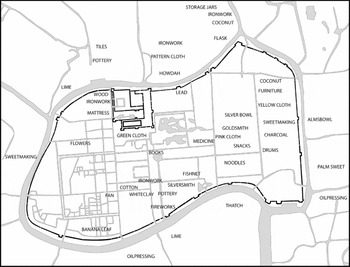
The city also celebrates its industriousness in the naming of its streets, markets, and quarters. Many cities name areas after historical figures (Vauxhall in London, Sukumwit in modern Bangkok), after buildings or landmarks (Whitehall, Silom), or after old villages subsumed within the city (Fulham, Bangrak). In Ayutthaya, there were some quarters named in similar ways, but the vast majority were named after an economic function, after the things made and sold there (see Map 2): Silver Quarter, Gold Quarter, Lead Quarter, Iron Quarter (two), Wood Quarter (two), Cotton Quarter, Lime Quarter, Coconut Quarter, Noodle Quarter, Oilpress Quarter (two), Banana Leaf Quarter, Charcoal Quarter, Medicine Quarter, Green Cloth Quarter, Pink Cloth Quarter, Patterned Cloth Quarter, Tray Quarter, Flask Quarter, Potters Village (two), Thatch Quarter, Bench Workshop Village, Howdah Workshop Village, Mattress Quarter, Book Quarter, Whiteclay Quarter, Firework Village, and Drum Quarter. The names of some wat also contain hints of local economic activity, such as kite, gold, sweet making, red cloth, gong workshop, and cotton.
Ayutthaya quarters named after products, based on information from the mid-eighteenth century in the Description of Ayutthaya.

These names suggest Ayutthaya was a commercial and industrial city, making and selling a wide variety of goods—and proud of it.
Of other urban places in Siam, we have no descriptions. However, there is no reason they should not, as in other societies, have mirrored the activities of the capital with minor adjustments and on a diminished scale. Their populations would have included a small elite of officialdom, a rotating cadre of people serving these officials as labour dues, many monks, and people engaged in riverine trade, in collection of trade goods from the nearby forests, and in the production and sale of foodstuffs, construction materials, household goods, clothing, and ritual goods.
Systems of state extraction
The state's systems for extracting resources also suggest that early modern Siam was a predominantly urban society rather than a rural one. In agrarian societies in the early modern world, most states relied on taxing land or agricultural produce. This was true in India and China, the two areas which had close commercial and diplomatic contact with Siam and which influenced many aspects of state practice.
In the Ayutthaya laws, there is a clause stating that all land belongs to the king and that sale of land is forbidden, but other clauses show that land was sold and mortgaged. Officials were ordered to intervene in disputes over occupancy, and to reassign rice land that had been abandoned.Footnote 93 These segments of the law codes are expressly designed to manage disputes among people and do not address the issue of land law in general. Some land taxes were collected. Van Vliet recorded that ‘For each plough, His Majesty receives one fuangh or 3 ½ stuiver, and also the tenth, eighth, or seventh part of the paddy in proportion to the fertility of the fields’, and La Loubère mentions that ‘On Forty Fathom Square of Cultivated Lands, a Mayon or quarter of a Tical by year: but this Rent is divided with the Tchaou-Meaung [provincial governor] where there is one; and it is never well paid to the King on the Frontiers.’Footnote 94 These taxes on land were not a significant source of revenues. Gervaise noted, ‘rice, like corn in France, is tax-free’.Footnote 95 In the Civil List, there is not a single official devoted to land revenue, a big contrast to the massive land revenue bureaucracies found in Indian states and elsewhere. As noted above, the Ministry of Land was one of the smallest departments, and the titles and posts of its officials suggest they were engaged in provisioning the palace and army. One indication that the yield from land tax was small comes from later history. In 1811, the Bangkok government carried out an extensive land survey, probably in preparation for launching a new land tax. Ten years later, this land tax yielded only 1 per cent of total government revenues.Footnote 96
The Ayutthaya state raised its funding mainly from commerce.Footnote 97 The kings traded overseas, specializing in the export of exotic goods collected from the extensive forests by unpaid labour. The kings also raised dues on imports and exports by others, and were active in domestic commerce.Footnote 98 Fees were levied on urban markets. Customs posts collected tolls along the inland trade routes, especially the waterways. Siam is littered with place names beginning ‘Dan’, indicating a customs post, and many such posts are depicted graphically on the earliest surviving local maps from the early nineteenth century.Footnote 99 Revenues were raised mainly from the forests and from the urban economy, not from land and agriculture.
The state also extracted labour dues. In the 1630s, ‘in the whole country the common class of people, who are not slaves, are divided under quartermasters . . . if His Majesty needs people, these quartermasters are requested to provide the required number’.Footnote 100 Fifty years later, La Loubère reported that all males were registered at the age of 16, and people were considered so important that ‘they count them every year’,Footnote 101 though it is more likely the censuses were less frequent. These levies were used for warfare, service in the royal household, construction and repair of temples, crewing royal ships, manning the port facilities and royal warehouses, and other public works as ‘earth-carriers, brickmakers, woodcutters and miners’.Footnote 102 In late Ayutthaya, people were conscripted for six months of the year, usually on a month-on, month-off rotation. High nobles raised manpower levies in the same way on a smaller scale.
Such a system of manpower levies would be relatively efficient in a concentrated urban society, but difficult to administer and highly inefficient in a rural society scattered over a wide area. The practice of conscripting people on alternate months would have been impossibly disruptive in an agrarian society with a seasonal rhythm.
When a rural society did develop later in Siam and become the dominant segment (see below), the system of manpower levies collapsed and was replaced by tax-farming, including taxes raised on agricultural produce, and some tentative attempts at land taxation.
Ruralization
In the more recent past, people have spread out from Siam's urban areas, scything down the disease-bearing forest, founding villages, and blanketing the Chaophraya plain with paddy fields.
This ‘ruralization’ began in the early eighteenth century. A key factor was the growing demand to export rice to southern China.Footnote 103 Earlier, Siam had occasionally exported rice to the lower peninsula and Java in times of shortage. The first shipment to China was sent in 1722. Sarasin Viraphol estimates that the annual average from the 1720s to 1760s was around 6,000 tons.Footnote 104 In 1748 the government noticed that land clearance had become significant and alerted officials to monitor the process, issue deeds to facilitate collection of taxes, and fine farmers who failed to declare new land.Footnote 105 Several laws were proclaimed to recover ‘runaways’ from labour service, suggesting people were moving to a new ‘land frontier’.Footnote 106
These trends were disrupted by the half-century of conflict with Burma that began in the 1750s. These wars also drained people away from the cities as they fled from the Burmese armies and the Siamese conscription agents. The trends of change resumed in the early nineteenth century, with several contributing factors. Rice was in growing demand in China, the peninsula, and the archipelago. The population increased through the natural ‘bounce’ following war, forced resettlement of thousands of people into Siam as a result of Bangkok's military expansion to the south, east, and north, and rising in-migration from southern China. Canals built as military highways helped to open up and drain areas of the lower Chaophraya plain.
From the mid-century, the pace accelerated as colonialism elsewhere in Southeast Asia increased the numbers of people who no longer grew their own food, and as shipping costs fell. Siam's rice exports expanded from 62,000 metric tonnes a year in the late 1850s to 1.5 million tonnes in the 1930s. Over the nineteenth century, the paddy area expanded by an average of 300,000 rai (48,000 hectares) a year.Footnote 107 The movement of this ‘land frontier’ transformed the landscape of Siam from tracts of forests separating towns into the grid of paddy fields and villages familiar today. As population increase became steady, and as the additional population took up residence in paddy-growing villages, the demographic structure was transformed into the classic ratio of an agrarian society with three-quarters of the population resident in the villages. With this shift in the structure of society, the old systems of state extraction of resources no longer functioned. By the 1840s, the government had begun abandoning labour dues in favour of taxes raised in large part on the expanding agricultural surplus.
Over the nineteenth century, a smallholder peasant society emerged. Historians have tended to project this peasant society back into the past, and the availability of the Europe-based model of agrarian society has made this easy.
Conclusion
The sources for the history of Siam in the early modern era are strikingly lacking in information on rural society. While this absence may be due to omission and bias in the sources, it prompts some re-evaluation of the usual assumptions. This article has examined the proposition that rural society may have been much less significant than in the model of a peasant society prevalent in the temperate zones.
Unlike in the temperate zones, there was no need for the majority of Siam's population to be fully dedicated to the production of food. Rice could be produced by part-time ‘commuter’ agriculture, and other foods found by everyday hunting and gathering. Food production did not require a rural-urban ratio of three-to-one as found in early modern Europe, or four-to-one as in Siam after ‘ruralization’.
The population was clustered in urban centres and along nearby waterways. Cultural preference, based on the instinct for survival, may have reinforced an affinity for urban residence. The scant data on Siam's demography is consistent with a pattern in which the majority of people lived in urban centres. Descriptions of Ayutthaya in foreign and local sources show it was a commercial and industrial centre, capable of employing many in non-agricultural pursuits. There are no descriptions of smaller urban centres, but also no reasons to imagine they differed greatly from the capital, except in scale.
The state systems for raising resources are consistent with a predominantly urban society. Revenues came mainly from trading profits and trade taxes, while the systems of labour dues seem designed for an urban rather than a rural society.
Of course, this food production system depended on an abundance of land which in turn was a function of a low density of population. Why did the population remain so low when food was so easily available? The answer requires another article, but the basic point is simple. In the tropics in the pre-modern era, morbidity was high because many viruses, bacteria, and parasites thrived. Susceptibility to malaria and similar fevers is not variable according to diet. Equipping a community with immunity requires scale, time, and stability. Warfare and migration probably inhibited the process in Siam. Control on the high rate of morbidity came only with modern medicine in the twentieth century, in the course of which the population increased around ten times.
This argument rests on this series of propositions in combination, not on any single one. Moreover, it is a thesis not a proof. The issue is whether this is a better framework for understanding early modern Siam than the classic agrarian model.