

Introduction
Microbial insecticides are ideal components of integrated pest management programmes to provide an environmentally safe and sustainable alternative to largely hazardous, broad spectrum and synthetic insecticides (Khalique and Ahmed, Reference Khalique and Ahmed2005). Moreover, most of the strains of the tropical armyworm Spodoptera litura (Fab.) (Lepidoptera: Noctuidae) in India have exhibited high levels of resistance (61- to 148-fold) against several synthetic insecticides (Kranthi et al., Reference Kranthi, Jadhav, Kranthi, Wanjari, Ali and Russell2002). Bacillus thuringiensis (Bt)-based microbial insecticides have proved to be effective against lepidopteran defoliators (Sharma and Ansari, Reference Sharma and Ansari2004). Additionally, several plant species have been reported to possess insecticidal properties (Raheza, Reference Raheza1998; Singh, Reference Singh, Dhaliwal and Singh2000). The efficacy of several plant extracts has been assessed against many insects, mostly stored grain insects such as Annona squamosa L. (Annonaceae) against the rice weevil Sitophilus oryzae (L.) (Coleoptera: Curculionidae) (Rout, Reference Rout1986) and the bean weevil Callosobruchus chinensis L. (Coleoptera: Bruchidae) (Islam, Reference Islam, Schmutterer and Ascher1987); Pongamia pinnata (L.) Pierre (Fabaceae) against the lesser grain borer Rhyzopertha dominica (Fab.) (Coleoptera: Bostrichidae) (Sighamony et al., Reference Sighamony, Anees, Chandrakala and Osmani1986); ash of Acacia arabica (Lam.) Willd. (Fabaceae) against the grain weevil S. granarius (Hustache) (Rahman et al., Reference Rahman, Taleb and Biswas2003); and Datura stramonium L. (Solanaceae) against the red flour beetle Tribolium castaneum (Herbst) (Coleoptera: Tenebrionidae) (Lohra et al., Reference Lohra, Singhvi and Panwar2001).
Besides, the insecticidal properties of active components have also been exploited. Leaf extracts of Eucalyptus spp. (Myrtaceae) showed 100% mortality at 0.5% concentration, against root knot nematode Meloidogyne incognita (Heteroderidae) (Gill et al., Reference Gill, Mehta, Malik, Malik and Walia2001). Crude oil (5%) from A. squamosa seeds resulted in 60% mortality in S. litura larvae (Babu et al., Reference Babu, Rao and Joy1998). Nicotiana tabacum L. (Solanaceae) leaf extracts effectively restricted the development of safflower aphids Dactynotus carthami Hille Ris Lambers (Homoptera: Aphididae) populations with significant increase in yield (Kulat et al., Reference Kulat, Nimbalkar, Nandanwar and Hiwase2000). Nevertheless, continuous use of any plant protection strategy is bound to pose certain unwarranted consequences, the most important being development of insecticides resistance in insects. To avoid or delay this process, a combination of microbial pesticides with insecticidal compounds of plant origin consisting of diverse compounds with novel and different modes of action can help in reducing the risk and probability of simultaneous resistance development through synergism (Regev et al., Reference Regev, Keller, Strizhov, Sneh, Prudovsky, Chet, Ginzberg, Koncz-Kalman, Koncz, Schell and Zilberstein1996; Khanuja et al., Reference Khanuja, Satapathy, Singh, Kumar, Arya, Tripathy, Shasany, Darokar and Kumar2002). We therefore studied the efficacy of combinations of B. thuringiensis (Bt) and some plant extracts against S. litura larvae and investigated whether there is any synergistic activity due to this combination. The plants included in the study are abundantly available and easily accessible in India, either in forest areas or as weeds or planted for aesthetic purposes along roadsides. Using plant extracts for management of S. litura will on one hand reduce dependence on synthetic insecticides and on the other hand also help in maintaining a desirable ecological balance. S. litura was selected as the test insect mainly because of its wide host range, including soybean, which during the last decade witnessed three pest outbreaks (Ramana et al., Reference Ramana, Reddy and Krishnamurthy1988; Singh et al., Reference Singh, Verma and Nema1989).
Materials and methods
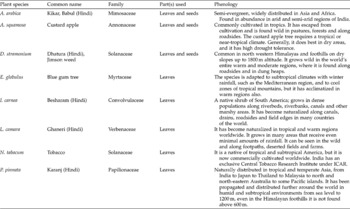
A laboratory experiment was conducted at the Directorate of Soybean Research (DSR), Indore, using combinations of 11 plant extracts from eight popular and commonly available plant species (Table 1) and the B. thuringiensis subsp. kurstaki (Btk) strain HD-1 (DiPel® 8L, 17,600 IU/mg; Valent Bio-Sciences Corporation, USA).
Details of plants used

Extract preparation
As the study was envisaged for small-scale and resource-poor farmers, a simple extract preparation method was used, which did not affect the plant properties. The leaves/seeds were washed thoroughly in tap water and then three times with distilled water to remove any surface contaminants. The leaves were then chopped and immersed in distilled water overnight. The next day they were crushed in a mixer-grinder with distilled water. Seeds were first crushed in a mixer-grinder and then soaked in distilled water overnight and again churned to make a fine paste. After crushing, the material was filtered through Whatman No. 42 filter paper. Leaves and seeds (100 g for both) were taken along with 500 ml of distilled water, and the filtrate obtained was used as the stock solution, which was subsequently diluted to different concentrations, namely 25, 50, 75 and 100%. Btk was used at the recommended dose of 1.0 litre/ha applied through 750 litre of water (Sharma, Reference Sharma2000). Accordingly, 0.026 ml Btk was added to 20 ml of each extract to establish the desired combinations.
Initially S. litura larvae were collected from soybean fields of the Research Farm of DSR. Depending on the larval instars they were reared separately in glass jars on soybean leaves until pupation. All jars were kept in an entomological chamber at 75 ± 5% relative humidity and 26 ± 1°C. Male and female pupae were separated on the basis of their genital openings. We kept ten pairs of pupae in egg-laying jars. Honey solution (10%)-soaked cotton swabs were provided as food for the adults. After maturing, the females laid eggs in batches on the paper lining. Adults were transferred daily to fresh oviposition jars. The egg masses and neonate larvae were handled following the method of Kumar and Ballal (Reference Kumar and Ballal1991). After completing one life cycle, the next larval generation was used for the laboratory study.
To test the compatibility of Btk+extract combinations and compare their efficacy with Btk alone and a control (water only), ten pre-starved 2nd instar S. litura larvae were released in Petri dishes (15 cm diameter) with fresh soybean leaves. The leaves and the larvae were sprayed with the different treatments using a hand-held sprayer. A total of three replications were used for each concentration along with the control. Observations on larval mortality were recorded every 24 h up to 6 days post-treatment. With this, we intended to assess the efficacy of plant extracts in a similar way as is usually done with synthetic insecticides. The experiments were set up using a two-factor completely randomized design. The percentage of larval mortality was subjected to arcsine transformation prior to an analysis of variance, using the MSTAT-C program. Significance was set at the 5% probability level.
Results and Discussion
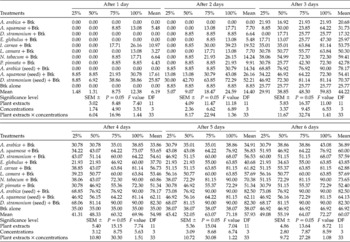
The objective of this study was to test whether combinations of plant extracts and Btk could prove to be more effective than Btk alone for S. litura control. Mean larval mortality after 6 days showed that all combinations of plant extracts with Btk enhanced larval mortality in comparison with Btk alone except for A. arabica leaf extract, indicating a synergistic response (Table 2). With 65.9% the highest mean larval mortality was recorded for the combination of Btk and D. stramonium seed extracts, followed by A. arabica seed (55.9%), N. tabacum leaf (47.5%) and A. squamosa seed extracts (47.7%). A distinct concentration effect was observed with 27.1 and 47.7% larval mortality at 25 and 100% concentrations, respectively.
Larval mortality (%) due to combination of plant extracts at different concentrations+Btk, and Btk alone

DF, degrees of freedom.
The combination of D. stramonium seed extracts and Btk showed the highest larval mortality (25.9%) on day 1, which was significantly higher than those of the other treatments (Table 2). Except for day 3 post-treatment, D. stramonium seed extracts and Btk consistently caused highest mortality among all tested combinations.
Btk alone did not cause any larval mortality on day 1 (Table 2). The crystal protein of Btk undergoes a log phase before reaching sufficient levels to cause larval mortality. Moreover, Bt Cry protein crystals (protoxins) need some time to become toxic through a series of processes involving solubilization of the crystal in the insect midgut, proteolytic processing of the protoxin by midgut proteases, binding of the Cry toxin to midgut receptors and insertion of the toxin into the apical membrane to create ion channels or pores (Knowels, Reference Knowels1994; Schnepf et al., Reference Schnepf, Crickmore, Van Rie, Lereclus, Baum, Feitelson, Zeigler and Dean1998). Yet combining Btk with plant extracts, even in low concentrations, resulted in substantial mortality post-treatment (Table 2). Nathan et al. (Reference Nathan, Chung and Murugan2006) reported synergistic effects of Bt with botanical insecticides and found such combinations effective when applied at low doses against the larvae of the rice leaf folder Cnaphalocrocis medinalis (Guenée) (Lepidoptera: Pyralidae).
In this study, larval mortality caused by plant extracts fortified with Btk was considerably higher than those by Btk alone, indicating the synergistic effect of the combination. Gill et al. (Reference Gill, Cowles and Pietrantonio1992) reported that larvae chronically exposed to botanical insecticides and bacterial toxins showed a reduction in weight and showed a significant reduction in ACP, ALP and ATPase activities. The high mortality of S. litura larvae in the D. stramonium seed extracts and Btk combination can be attributed to the presence of certain active principles such as hyoscyamine (Miraldi et al., Reference Miraldi, Masti, Ferri and Barni Comparini2001) that contributes to the insecticidal properties of the plant.
The immediate insecticidal effect of the plant and Btk combination was less apparent. Yet with time, the interactions between chemical plant constituents, e.g. aporphine alkaloids in the A. squamosa seed (Oliver-Bever, Reference Oliver-Bever1986), and the Btk crystal protein resulted in enhanced efficacy of the combination. Regev et al. (Reference Regev, Keller, Strizhov, Sneh, Prudovsky, Chet, Ginzberg, Koncz-Kalman, Koncz, Schell and Zilberstein1996) attempted to increase the insecticidal effect of delta endotoxin crystal protein CryIC against S. littoralis by combining it with endochitinase. They found that when applied together with low concentrations of CryIC, a synergistic toxic effect was obtained and concluded that a combination of the Cry protein and an endochitinase could result in effective insect control in transgenic systems in which the Cry protein is not expressed in a crystalline form. Macintosh et al. (Reference Macintosh, Kishore, Perlak, Marrone, Stone, Simms and Fuchs1990) reported enhanced efficacy of Bt to the tune of 2–20% when a protease inhibitor was added even at as minimal a dose as 4 μM. Khanuja et al. (Reference Khanuja, Satapathy, Singh, Kumar, Arya, Tripathy, Shasany, Darokar and Kumar2002) not only found differences in the efficacy of stem, leaf and seed extracts of Albizia lebbeck (L.) Benth. (Fabaceae) against Spilarctia obliqua Walker (Lepidoptera: Arctiidae), but also synergistic action when used along with the Bt delta endotoxin.
Yet we also observed antagonistic effects in certain plant extracts and Btk combinations, resulting in relatively low larval mortality in the combinations compared with Btk alone. For instance, 5 days post-treatment, Btk alone resulted in 38.1% larval mortality, which was significantly more than that in the combinations of 25, 50 and 75% A. arabica leaf extracts and Btk (Table 2). The differences between A. arabica leaf and seed extracts fortified with Btk can be attributed to differences in their chemical constituents and their interaction with Bt.
Our results clearly establish that plant extracts, particularly seed extracts of A. arabica, A. squamosa and D. stramonium and leaf extracts of N. tabacum, are not only compatible with Btk but have a synergistic effect on larval mortality in S. litura. Hence it is worth exploring these plant extracts and Btk combinations for S. litura management under field conditions. Possibly, these combinations are also effective against other soybean infesting caterpillars, namely Chrysodeixis acuta Walker and Diachrysia orichalcea Hübner (both Lepidoptera: Noctuidae).