It is now, I presume, quite understood that wire-fencing is the best and cheapest fencing that can be adopted in almost any circumstances (Munro, Reference Munro1850: 426)
It is not at all probable, that however durably wire-fences may be erected, they will ever supersede thorn hedges or stone dykes on farms. (Stephens, Reference Stephens1855: II, 596)
Introduction
Technology is one of the underpinnings of society, no matter how primitive or advanced. The economic development of colonial societies depended heavily on technology imported from the country of origin and subsequently adapted for local conditions. The history of technology in Australia has been a neglected field of historical study (Blainey, Reference Blainey1964), but the past two decades have seen at least two major Australian studies of technological (Todd, Reference Todd1995) and technical (Raby, Reference Raby1996) change and transfer. The difference is primarily one of semantics, and although less correct, ‘technology’ seems to be the more common usage for essentially the same thing: accumulation of information (in both objects and knowledge), and possession of the know-how or capacity to use that knowledge (Raby, Reference Raby1996: 7–8). Todd's two case studies (cyanide extraction of gold, and development of an effective anthrax vaccine) clearly showed the role of persistent scientific experimentation to develop effective technology in the Australian colonies. Raby looked more broadly at agricultural innovation.
The introduction of iron wire into colonial rural fences is an ideal case because fences were essential in the burgeoning industrial-scale pastoral industries developing in Australia in the nineteenth century. Further, at the time of the introduction of wire into colonial Australia, wire fences were still being developed in Britain. Thus it is instructive to consider the date of the first wire fences, and how the British technology was imported and adapted by the colonists to better suit local environmental and economic conditions.
Although fences were built at Sydney Cove in 1788 soon after the founding of the colony of New South Wales, they were relatively uncommon for decades (Pickard, Reference Pickard1999, Reference Pickard2007). Because squatters expanded on land they did not own, there was no incentive to build fences. Instead the flocks of sheep were managed using shepherds (Pickard, Reference Pickard2008). After a complex series of unrelated changes in legislation, dingo control, stock management, technology, labour conditions, and attitudes of landholders, fences became the most economical and productive way of managing stock. Although a range of wooden fences continued to be erected, an increasing number of these new fences were based on the new technology of wire, initially iron but steel after the mid-1880s. A century and a half later, it is reasonable to ask when and where the first wire fences were built in the Australian colonies. An answer provides important information on technology transfer from the mother country, and subsequent adaptation and innovation in the colonies.
Winslade (Reference Winslade1994) re-examined official data from various sources including the Chief Inspector of Stock and the New South Wales Statistical Registers to construct detailed time-series of wire imports and fence erection in eastern Australia to address the question of ‘uncertainty and conjecture over the timing and extent of large-scale fencing (and wire fencing) activity’. While he answered his question on the large-scale adoption of fencing, he was not concerned with when and where wire fences were first built in Australia. In this paper I examine various claims for the first wire fences in the Australian colonies. The focus is on plain wire that preceded barbed wire by many decades. I start by summarising earlier and contemporary fencing practice in Britain to provide a context, as well as looking at contemporary fencing in the United States of America to compare how fencing developed in two frontier colonies. My conclusions must be regarded as tentative as I have only used published sources. Given the immense amount of unpublished primary material in archives (diaries, invoices, station accounts, inspection reports, survey plans, etc.), it is likely that earlier dates will be found. But for an exercise like this, it is unrealistic to search these sources systematically in the hope of finding some document with information on wire fences. A similar problem arises with the many regional and local newspapers. Rather, the discovery will be almost accidental by someone looking at archives for some other purpose. Finally I consider what wire fences tell us about technology transfer and local innovations in nineteenth-century colonial Australia.
Prior and contemporary practice in Britain
At the end of the eighteenth century the most common fences in Britain were hedges, ditches, banks and walls, either singly or in various combinations (e.g. ‘A land owner’, 1775; Erskine, Reference Erskine1790; Hodskinson, Reference Hodskinson1794: pp. 26–30; ‘A Lincolnshire Grazier’, 1805: pp. 379–89). Temporary fences for allowing sheep to graze crops such as turnips progressively were made using wooden hurdles. Although Smith (Reference Smith1891: p. 330) comments that ‘Probably in about 1840 plain solid rolled wire was first used for fencing purposes [in Britain]’, wire was used in 1822 to fence gardens and other sections of country estates:
This fence may either be an evergreen hedge, paling, low wall, or sunk fence, and with or without a wire-fence to exclude the smaller quadrupeds. . . . In very small villas the lawn may embrace the garden or principal front of the house, . . . and may be separated from the park, or park-like field, by a light wire fence. (Loudon, Reference Loudon1822: pp. 508, 1178)
In 1836 George Clerk Craigie erected ‘Wire Fences on the top of Haha enclosures’ in Scotland (Solicited testimonial in Charles D. Young and Company, 1847a: p. 8). The London and Birmingham Railway used temporary wood fences with three rails, and additional palings where sheep adjoined, to protect the real fence, a hedge of quick (White Hawthorn Crataegus monogyna), while it grew on a mound alongside the railway (Evidence of Robert Stephenson, House of Commons Select Committee on Railways, 1839: p. 285). Once wire became more readily available, railway companies were among the biggest builders of wire fences (Charles D. Young and Company, [1848]). Although there were centuries of experience with hedges in Britain, most railway companies were having financial difficulties, and wire lowered their fencing costs.
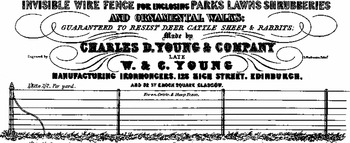
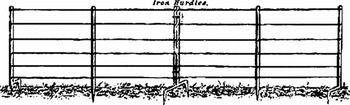
Manufacturers were quick to capitalise on the increased demand, and by the end of the 1840s, wire fences were being advertised in catalogues (Charles D. Young and Company, 1847b: p. 1. See Figures 1 and 2). James D. Young (probably from the firm Young, Peddie, and Company) described wire fences in detail in 1850 (Young, Reference Young1850). By the end of the century, fencing catalogues displayed an almost bewildering choice of designs and materials available to landholders. Traditional hurdles were offered in iron (Figure 2), and ‘continuous iron fencing’ with solid iron posts up to fifty millimetres square, was developed. The horizontal elements were typically rod or tube up to twenty-five millimetres diameter, or flat bar up to twenty-five by six millimetres, or eighteen millimetres square (e.g. Hill and Smith Brierley Hill Ironworks, 1894.)
A more convenient and aesthetic alternative to bolting hurdles together was an ‘invisible iron fence’ made possible by using wire rather than thick bars or rods.

Iron hurdle using bars and rods advertised in 1847. With minor variations, many manufacturers made these hurdles that could be bolted together to form a continuous fence. This is probably similar to the hurdles sought by George Russell for the Clyde Company property Golfhill (Victoria) in 1854.

While keeping in mind Raby's (Reference Raby1996, p. 64) warning that ‘agricultural writers, popularisers and propagandists tended to be well ahead of general farming practice in Britain’, we can follow the adoption of wire fences through five successive editions of Henry Stephen's influential Book of the Farm. There is no mention in the first edition (Reference Stephens1844), but the second (Reference Stephens1855) and third (Reference Stephens1877) plagiarise the information in Young (Reference Young1850). The fourth (Reference Stephens1891) and fifth (Reference Stephens1908) editions add more material and illustrations, but the basic text is similar. The real change in the later editions is the addition of more fence designs, but these are taken from manufacturers’ catalogues. The description of hedge establishment and management changed little through the editions. While this may reflect cultural inertia on the part of landholders in a well-developed agricultural landscape, a more prosaic explanation may be that the essential elements of wire fences were set down by James D. Young in 1850, and these changed little over the following decades.
Contemporary fences in the United States
British colonists settling in Virginia and New England in the seventeenth century took with them knowledge of contemporary fencing practice in Britain. They found extensive forests of pine and other trees that could provide ample fencing material, but initially few fences were built as the few livestock were herded to avoid loss and damage to crops. The English common law principle that the owner of stock was responsible for their restraint to prevent damage to another's crops was reversed fairly quickly. Legislation in several colonies decreed that farmers had to protect their crops with a sufficient fence to keep stock out. There was good reason for this change. The rapidly multiplying herds of cattle generally wandered semi-feral in the woods, and it was impractical to fence them in because this would have required supplementary feeding in the bitter winters (Anderson, Reference Anderson2004).
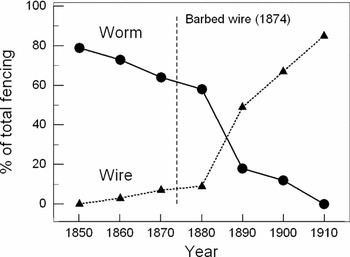
In the forested areas, worm or Virginia fences became the standard. They were easy and relatively quick to put up, could be easily repaired, and plenty of wood was available. In 1850, some seventy-nine per cent of the 5.5 million kilometres of fences in the United States were worm fences (Primack, Reference Primack1969). By 1870, fences totalled 8.1 million kilometres and worm fences made up sixty-four per cent, with the bulk of the remainder also being wood. But many writers and government agencies were deeply concerned at the amount of timber used, the realisation that the seemingly endless pine forests would be exhausted within perhaps twenty-five years, and at the waste of ground occupied by these fences (Washburn and Moen Manufacturing Company, 1882). Also by this time, settlers were on the edges of the almost treeless prairies and they needed an alternative to timber fences (Hayter, Reference Hayter1939; Hewes, Reference Hewes1981). Hedges were one approach (Warder, Reference Warder1858), but they were expensive, required a lot of labour, and most species could not cope with the cold winters (Danhof, Reference Danhof1944: pp. 180–84). Another solution was the relatively new technology of wire, and plain wire was used from at least 1816.
In 1816 the memoirs of the Philadelphia Agricultural Society contain a paper read January 8th, in which instances are given of Wire fencing already in use . . .
‘Cost of common fence for 100 acres for fifty years, $3,080; cost of Wire Fence for the same period, $1,751; . . . With regard to the strength of a Wire Fence, we do not hesitate to express our belief in its sufficiency to resist any attack that may be required. We have given it a fair trial . . . with the most breachy cows . . . and it is remarkable that even dogs avoid passing over it.’ (Washburn and Moen Manufacturing Company, 1882: p. 14)
The enthusiasm is a trifle overdone, as it is unlikely that any plain wire fence intended for sheep or cattle would be a barrier to dogs. Despite this, over the next sixty years, at least ‘three hundred and fifty thousand miles of plain galvanized iron wire was used for fencing purposes in the twenty years preceding 1870’ (Washburn and Moen Manufacturing Company, 1882: p. 16, italics in original). The wires were stapled to the relatively soft timber posts, but there were problems with both the wire and the mode of erection (Capron, Reference Capron1856–7). The jaundiced attitude of the Washburn and Moen Manufacturing Company (1882: p. 16) to plain wire is fairly easy to understand. As a major wire manufacturer, they manufactured both plain and barbed wire, but apparently saw huge future expansion of barbed wire, and so denigrated plain wire:
But the farmers and herders were never thoroughly happy in its use. The fence of plain and single wire was susceptible to all changes of temperature. It snapped in cold, and sagged in heat. It had no terrors for cattle. They pressed up to the boundaries of the pasture, and easily lunched through the fence on the adjacent crop. Growing more resolute they broke bounds altogether, or contentedly sawed their itching necks or polls on the smooth wire, in the acme of creature satisfaction, until the fence gave way. It shows the stress of fence necessities most strongly, that with all these attendant evils, the plain wire fence held its place, and grew in use and favour.
It is likely that many of the problems with plain wire were the direct result of uneven quality due to relatively primitive manufacture by rolling rather than drawing. Also, inclusions of slag and other impurities in poorly smelted iron would seriously reduce breaking strain. Expedients such as helically coiling the wire to allow for expansion and contraction were tried but with limited success. The solution to these problems came with steel wire of better quality, and especially with the successful commercialisation of barbed wire in 1874 after its invention by Joseph Glidden (Glidden, Reference Glidden1874; Krell, Reference Krell2002: pp. 11–45). His design was so simple and effective that it remains the most common barbed wire manufactured and used in the United States today (Campbell and Allison, Reference Campbell and Allison1986).
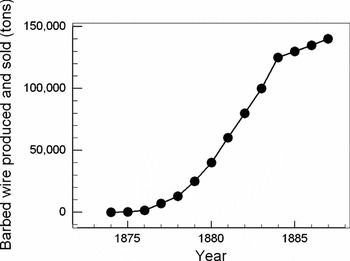
The adoption of barbed wire for fences in the United States was incredibly fast, with exponential production from 1874 to 1884 before slowing considerably (Figure 3). By the mid-1880s, wire fences had overtaken worm fences as the dominant structure (Figure 4). By 1910, wire made up eighty-five per cent of the total 22.4 million kilometres of fences, while all wooden fences, including worm, had fallen to a mere fifteen per cent (Primack, Reference Primack1969). Such a rapid change would only be possible in an expanding agricultural frontier where settlers needed to secure their boundaries and subdivide to facilitate management. Huge orders from railroad companies also contributed to the increasing production. Not all companies were compelled by statute to fence, but in the event of stock death on the railroad tracks, a sufficient fence was an essential requirement for successfully defending a damages claim (Thornton, Reference Thornton1892: chapter III).
Barbed wire produced in the United States 1874 - 1886 (estimate for 1887).

Changes in the contribution of worm and wire fences to total fencing in the United States, 1850–1910, showing the influence of the commercialisation of barbed wire in 1874.

Wire in colonial Australia
Although there were relatively few fences in the colonies for decades, those that were erected incorporated the elements beloved of economists: they made maximum use of cheap local material and available labour. The popular brush fencesFootnote 1 were messy to the critical gaze of visiting English commentators who simply did not understand that economic conditions differed in the colonies (Raby, Reference Raby1996: pp. 64–5). The objective was to build effective fences as cheaply as possible, not create some idyllic and aesthetic Antipodean landscape aping England. Hedges were tried but could not compete with cheaper alternatives.
As Australian pastoralists acquired secure tenure and realised that sheep in paddocks were more productive than shepherded flocks, they began building fences in earnest (Pickard, Reference Pickard2007). Wire was an obvious choice, and this was recognised by British merchants who could see an almost limitless market for iron wire in Australia (Figure 5). Within three years of the founding of South Australia, British firm John Henderson Porter advertised ‘Iron fence, hurdles, bedsteads, wire-work. - Porter's Improved Iron Fence, now so generally used in this country, and from its portability and other peculiar advantages so suitable to South Australia, Sydney &c.’ (Stephens, Reference Stephens1839, advertising supplement). However, given the ready availability of trees suitable for splitting into posts and rails (Stephens, Reference Stephens1839: footnote on pp. 62–3), it is unlikely that many iron fences were imported. Most likely referring to large orders, Smith (Reference Smith1891: p. 331) notes that ‘the first orders received by [British] manufacturers for fencing wire for the Australian Colonies was in about the year 1856 or 1857’. However, the partnership of John Thain Just and John Baptist Austin the younger advertised extensively in Adelaide newspapers in 1853 and 1854, and ‘prominent in all their advertising was notification that they carried 20 imperial miles of fencing wire’ (Skinner, Reference Skinner2006: pp. 14–15).
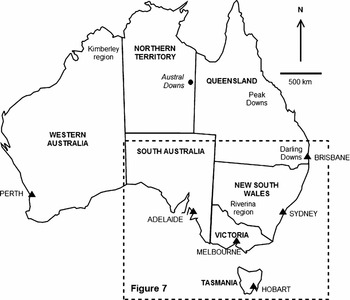
Australia showing states and various regions mentioned in text. Solid dot at Austral Downs indicates early wire fence location. Dashed box outlines more detailed map of South Eastern Australia in Figure 7.

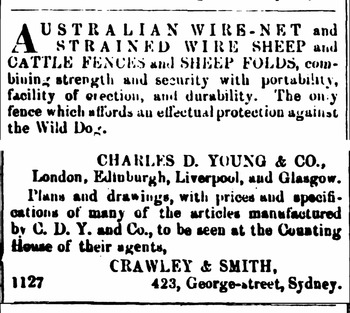
The Scottish manufacturer Charles D. Young and Company had active local agents in New South Wales and Tasmania from the early 1850s. The Hobart Courier published ‘infomercials’ with direct extracts from the company's catalogues (18th January and 1st February 1854). Testimonials of landed gentry in Britain in the latter article may not have convinced smaller farmers in Tasmania, but perhaps the intended audience was the local squattocracy. The 18th January article notes that ‘Mr. Clebune . . . has a quantity of galvanized wire-fencing at present on hand’. The Sydney firm of Crawley and Smith advertised a range of the Charles D. Young and Company's iron and wire products in The Maitland Mercury (New South Wales) in March and April 1854 (Figure 6). The list of items advertised matches those described in the catalogue prepared specifically for the Australian market (Charles D. Young and Company post-1851).
Details from an advertisement of Crawley and Smith, Sydney agents for Charles D. Young and Company, listing wire fences.

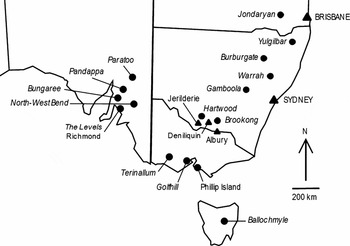
Shipping reports note wire imports, ranging from four bundles (an iron industry standard package weighing sixty-three pounds) (Maitland Mercury, 17th March 1849: p. 4) to eighty-five tons (South Australian Advertiser, 6th October 1869: p. 3). By late 1853 wire was available from merchants in Geelong (Brown, Reference Brown1968: p. 81), and ‘by early 1860 Melbourne firms were advertising wire in the Deniliquin newspapers’, and by 1861 storekeepers at Albury and Jerilderie had wire for sale by the ton’ (Buxton, Reference Buxton1967: p. 41) (see Figure 7 for locations). Thus wire was available in major cities from the late 1840s, and in regional centres a few years later. Despite local availability, many pastoralists preferred to import wire directly from manufacturers or agents in Britain, rather than use local suppliers (see below). It is not possible to gauge the extent or aggressiveness of marketing of wire by either the manufacturers or their local agents. Many of the companies no longer exist or their records are lost. A systematic search of the several hundred city and regional newspapers would provide a good estimate of newspaper advertising and infomercials, but that is beyond the scope of this paper. Suffice it to say that by the mid-1850s, few pastoralists would have been unaware of the local availability of wire.
South Eastern Australia showing places mentioned in the text. Solid dots indicate locations of early wire fences, triangles show towns.

It is worth considering how much wire was required for fencing at this time. Although the quantities quoted seem impressive, the twenty miles kept in stock by Just and Austin in Adelaide was only enough to fence one square mile with a five-wire fence. One imperial ton (0.91 tonnes) would make over one-half mile of five-wire fence, the standard at the time, but more fence if thinner gauges were used (Table 1). Unlike the United States where sub-zero temperatures in winter caused so many problems, there were no real impediments to using plain wire in Australia other than the hard wood of fence posts. Iron or even steel staples were too soft, so drilling holes for the wires became standard practice. As barbed wire did not appear in Australia until the 1880s, it played no part in the first decades of the development of wire fences in Australia.
Lengths of wire and fences per ton of the Birmingham Wire Gauge sizes most commonly used in colonial Australian fences.

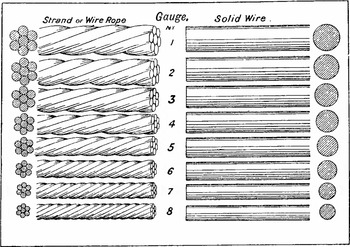
Note: See Figure 8 for wire gauges.
The evidence for first wire fences in Australia
Having set the historical context, I will now examine the various published claims in each colony. There are several detailed claims for the earliest wire fence, but Cannon (Reference Cannon1973: p. 90) is typical of the more general statements:
The first wire fences were introduced during the gold rush years in areas where natural timber and stone were scarce. Called ‘bull wire’, the material was an expensive imported product - up to £20 a ton - and had to be at least ¼ in. thick because of its low tensile strength.
Such generalities are problematic, and do not stand up to scrutiny. Cannon's source for this assertion is Palmer (Reference Palmer1961), a fairly elementary history of fencing, with no primary sources. Wire fences were built before the gold rushes, and there is little evidence that wire fences were initiated in areas lacking timber and stone (Pickard, Reference Pickard2007). Equally problematic are some specific assertions about early (wire) fences:
The Hentys in south-western Victoria were probably the first to use fences to control stock. Their fence consisted of heavy wooden posts spaced at 2.7 metres, and seven strands of a heavy enough, iron wire 6 mm in diameter. So strain lengths to support this wire are only 150 metres. (Buxton, Reference Buxton1981: p. 47)
The first sentence is factually incorrect. Fences were used decades before the Hentys settled near Portland in western Victoria in the early 1830s, and the station diaries record that on 11th December 1835 men were ‘repairing brush fence’ (Peel, Reference Peel1996: p. 100). More important is the suggestion that this ‘first’ fence was wire. Such a fence is not described in two detailed histories of the activities of the Hentys (Bassett, Reference Bassett1954; Peel, Reference Peel1996). Unfortunately Buxton gives no date and no source for his assertion. Unless and until some primary source is found, Buxton's claim has to be discounted.
New South Wales
Yulgilbar: wire in 1854?
In June 1854, Edward David Stewart Ogilvie (1814–96) was determining the lines of several wire fences on Yulgilbar (29° 13.2′S 152° 34.2′E), immediately west of Baryulgil on the Clarence River (Farwell, Reference Farwell1974: p. 202). Whether he actually erected the fences is not recorded, but if we assume that he did, then this is perhaps the earliest recorded wire fence in New South Wales.
Burburgate: wire in 1856
John and Charles Lloyd owned Burburgate (30° 53′S 150° 11′E) on the Namoi River, adjacent to Gunnedah on the northern slopes of New South Wales, and Charles was the resident manager.
In the year 1856 [Charles Lloyd] personally planned and carried out the erection of many miles of wire fencing for sheep paddocks at Burburgate, his elder brother [John Lloyd], then in England, having sent out sufficient wire to erect forty miles of fencing. Mr. Lloyd recently informed the writer that these miles of fencing were the first of the kind adopted in New South Wales. (Anon, 1911: p. 385.)
Eric Rolls (Reference Rolls1984: p. 166) provides some more information, but gives no sources:
John Lloyd sent fencing wire from London soon after he arrived [in 1854], sufficient for seventy kilometres of five wire fence. He thought sheep would do better running free in paddocks instead of being shepherded, an idea generally scorned for another ten years. The wire arrived at the end of 1854 but the track across the Breeza plain was boggy. It lay waiting for months on the wagons till the track dried. It was the middle of 1856 before the first fence was run fifteen kilometres round a lambing paddock near the house on Burburgate. Someone had put up short lengths of wire fencing in Victoria in 1854. The paddocks on Burburgate were the first big wire fenced paddocks in Australia.
The travails of the Lloyds in getting wire to their fences were not atypical. Remote stations may have had to transport the wire several hundred kilometres by dray from the nearest coastal or river port, or later, from a railway siding.
Gamboola Station: wire in 1858
Gamboola Station (33° 08′S 149° 00′E) thirteen kilometres south east of Molong in central western New South Wales was owned by the Smith brothers. John Smith began ordering wire on 11th March 1857: ‘whilst in Sydney ordered through Flower, Salting and Co. 3 tons of fencing wire, namely one ton each number 3, 4, and 6’ (Mac.Smith, Reference Mac.Smith1972: p. 74). Smith must have thought that his order was confused, so he clarified this in a letter a few days later:
Gamboola 16 March 1857.
Dear Sirs, I am in some doubt as to whether the word ‘galvanised’ was used in the order I left with the other day for the importation of fencing wire. I wish to have the best prepared fencing wire without mentioning ‘galvanised’ which I have been told is not the best.
Yours etc. John Smith
Messers Flower, Salting and Co
Sydney’ (Mac.Smith, Reference Mac.Smith1972: p. 115, underlining in original.)
Presumably using this wire, ‘about the year 1858 he erected a wire fence, the first of its kind in the Western districts. The paddock so enclosed is still know [sic] as ‘The Wire Paddock’ at ‘Gamboola'’ (Mac.Smith, Reference Mac.Smith1972: p. 193).
The Riverina: wire in 1858
The Riverina is an ill-defined region between the Lachlan and Murray Rivers, and east to about Albury and Wagga Wagga. It was primarily settled by Victorian pastoralists who started fencing in the 1850s:
An experiment in fencing a cattle run is about to be tried on the south side of the [Lachlan] river by using iron wire instead of wooden rails, the wire to be suspended to round wooden posts by means of small iron staples. (Maitland Mercury, 17th December 1857, cited in Jervis, Reference Jervis1952: p. 23)
Most sheep stations were unfenced in the late 1850s and in 1861:
The only improvement on the Lower Deniliquin run was an uncompleted fence, and this had been erected by the Tysons in 1859 as a two-rail cattle fence. On converting to sheep in 1861 five wires had been added, and when the station was advertised for sale later in the year it was said that a ‘small outlay would make it completely sheep proof’. (Buxton, Reference Buxton1967: p. 37)
Cattle stations, on the other hand, were more often fenced, typically with post-and-two-rail fences. Some had changed to wire: ‘Conargo station, on the Billabong, had fifty-four miles of post and wire fencing’ in 1861 (Buxton, Reference Buxton1967: p. 38, italics in original). As cattle growers switched to the more profitable wool, they modified their post-and-rail fences, usually by adding wire to make them sheep-proof.
Hartwood: wire pre-1866
Hartwood (35° 21′S 145° 21′E), a Riverina property, about forty kilometres north east of Deniliquin, was one of the first to use wire fences (Fetherstonhaugh, Reference Fetherstonhaugh1917: p. 305).
Brookong: wire in 1866–1868
Brookong Station (35° 17′S 146° 34′E) on Brookong Creek fifteen kilometres south west of Lockhart, was another large Riverina property. In 1866 Cuthbert Fetherstonhaugh, an experienced pastoralist, was appointed manager of Brookong by the owners George Hebden and Henry Osborne, and almost immediately he wanted to fence the boundaries. He actively sought information on wire fences from managers of other properties including Hartwood and was impressed with the efficacy of wire fences.
Soon after taking charge at Brookong, Mr. Hebden sent me up enough wire to enclose a paddock of 5,000 acres; this was at that time looked upon as a small paddock. I was not long in getting it erected. Economy was the order of the day, and I put up sixteen-foot panels and five wires. The wires were braced with lighter wire, a very bad plan, as we afterwards found out. (p. 316)
The 127,500 hectares were completely enclosed by a wire boundary fence in 1868 (p. 317).
Warrah: wire in 1867–1868
After initially choosing poor quality land near Port Stephens, the Australian Agricultural Company was granted far better land on the Liverpool Plains at Warrah (31° 39′S 150° 40′E) in the early 1830s, but the 100,000 hectares remained essentially undeveloped until the early 1860s (Robertson, Reference Robertson1964). The ‘Court’ of directors in England was keen to increase stock numbers by fencing and subdividing Warrah:
As early as September 1862 the Court remarked on the ‘great deal of iron wire fencing’ in existence in the colony and urged [General Superintendent, Edward Christopher] Merewether to consider fencing Warrah, but the latter was not enthusiastic. [Stock Superintendent, Samuel] Craik, fully occupied as he was, agreed with Merewether that fencing could well wait. There then arose the unusual situation of colonial management hesitating when being advised by the Court to spend money on Warrah. Merewether's skeptical attitude to fencing was long-lived, and but for the persistent pressure of the Court it is possible that Warrah might have remained unfenced longer than it did. Merewether was curiously behind the times in his ideas about fencing, for he was not at all certain that a post-and-rail or a log fence would not be more suitable than wire. It was not until May 1867 that Merewether acceded to the Court's repeated request that he pay a visit of inspection to Victoria. There he saw ‘a great variety of wire, stone, log and brush fences and obtained all necessary information with respect to the construction and cost of each’. A few weeks spent conversing with the well-established squatters of the Western District of Victoria caused a change in attitude on Merewether's part which some years of prompting from the Court had failed to induce. (Robertson, Reference Robertson1964: pp. 30–31)
By 1868 ‘The forty miles of fencing sent out in 1867 had all been erected at East Warrah’, and ‘By the end of 1875 the subdivision of East Warrah was finished, and the enclosure of the western half of the estate in a ring fence was well on towards completion’ (Gregson, Reference Gregson1907: pp. 256–7, 294).
Victoria
Phillip Island: wire in 1842
Phillip Island (38° 27′S 145° 14′E) is an internationally known tourist destination for the nightly parade of Little Penguins returning to their nest burrows. However, it has an important place in Australian fencing history.
Some 30 miles of fence - five wires on posts 15 ft. apart . . . was what McHaffie erected shortly after taking up his run [in 1842].
The erection of 10,000 posts in the quickest possible time would be no small undertaking to a property-owner today. . . . McHaffie had a single furrow plow, a 25 lb. post driving hammer, a cart, and great ingenuity. His need was pressing enough for him to cast aside the methods and materials then customary.
On several parts of Phillip Island the original fence lines can still be found - a ridge with a ditch on each side. The ridge had lightened McHaffie's task as well as his outlay. The loose soil on the ridge helped the output of the hammer-man. The ditches would make the five wires as effective against cattle as six or seven. (Piesse, Reference Piesse1960: p. 1363)
The wires were ⅜ inch (nine millimetres) in diameter, equivalent to Birmingham Wire Gauge 00 G, considerably thicker than No. 1 G (Figure 8). The total mass of the 150 miles (241 kilometres) of wire would have been at least 135 tonnes. It is not possible to calculate the cost of buying and shipping the wire as the records do not exist. But it is likely that the fence cost more than the fifty pounds per mile of a post-and-rail fence at the time (Joyce, Reference Joyce1949: p. 46; Lancelott, Reference Lancelott1852: volume 1, p. 137). McHaffie's bold innovation was a very expensive gamble, and somewhat financially irrational. Also, he only had a twenty-five year lease, so he obviously expected to amortise the first cost over this period. Unfortunately there is no information on why McHaffie chose wire for his fences.
From at least the 1870s, most catalogues of British wire manufacturers included full-size engravings of wire. The wire gauge used in this example would be Birmingham Wire Gauge. Although stranded wire was commonly used in Britain, it was very rarely used in colonial Australia.

Golfhill and Terinallum: wire in 1854
Starting in 1836 the Clyde Company partnership of Scottish investors backed by the J. and A. Dennistoun company, purchased several adjoining and separated runs in Victoria. George Russell became manager of the Clyde Company's estates in 1844. By 1849, the main property, Golfhill (38° 00′S 143° 58′E, forty kilometres north west of Geelong) was 29,420 hectares. The subsidiary property Terinallum (37° 52′S 143° 00′E), eighty-five kilometres further west, was 23,310 hectares (Wilson, Reference Wilson1849: p. 7). In 1845 ‘there were no fences’ on Golfhill (Brown, Reference Brown1935: p. 245). Realising the benefits of better fencing not only to secure his boundaries against diseased sheep, but also to form paddocks for better management of his sheep, Russell began investigating wire fences in 1851 during a visit to Scotland. On his return from Scotland, he ordered considerable quantities of wire, iron posts and iron hurdles. The exchange of letters between Australia and Scotland shows the way in which the company sought and evaluated information on possible alternatives:
When in the [Scottish] Highlands the other day I saw some fencing for sheep wh. I think wd. Suit well for P.P. [Port Phillip] It consists of a turf wall or bank about 2 feet high or upwards, wooden stakes drove into the bank at distances about 10 feet apart, & two wires, the lower about 9 in. above the bank, the upper about a foot above the lower wire; These wires were attached to the stakes by staples: let me know how you think such a fence would answer, & I could send out a lot of wire; it I beleive [sic] can be got cheap. Such a fence might do for paddocks, or even for boundary lines by & bye. (Letter from George Russell (in Scotland) to William Lewis, 6th August 1851; Brown, Reference Brown1963: p. 117)
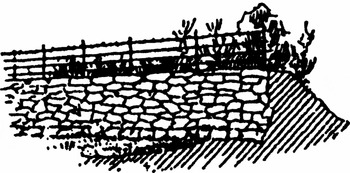
According to Kerr (Reference Kerr, Birmingham and Bairstow1987: p. 134), a fence with this structure was built on the Clyde Company's properties in Victoria. Stephens (Reference Stephens1855: Volume 2, p. 596) briefly mentions a similar structure: ‘three wires above the height of a turf or stone dyke’, and such a composite fence was illustrated by Vernon (Reference Vernon1909: p. 257) (Figure 9).
Composite fence of the type seen and described by George Russell in Scotland in 1851. A post-and-wire fence is erected on top of a stone-faced bank.

Within two years, James Riley, one of Russell's neighbours obviously considered that wire was a better proposition than post-and-rails fences:
I beg to inform you that it is my intention to commence fencing in this property, And as Mr George Russell's land joins this I give you as his agent notice that I shall call upon you to make one half of the dividing fence, . . . As there is great difficulty in getting timber split & carted, I propose doing it with Iron wire, which can be put up at about one half the cost and makes a more lasting fence. (Letter James Riley to William Lewis, 23rd July 1853; Brown, Reference Brown1963, p. 494)
Lewis replied on 1st August 1853 agreeing ‘to put up his half, and suggested a meeting in Geelong to discuss the type of fence’ (Brown, Reference Brown1963: p. 494). Russell continued to pursue information on wire, and ordered a mile of iron fences (Figure 2) typical of English practice at the time:
I want you to send out as soon as possible some iron fencing: the enclosures here were originally fenced in with posts & rails of split timber, the usual and one of the most substantial modes of fencing here, but it is not very durable & only lasts about 10 years; much of it requires to be renewed, but, from the high rate of labour & expense of cartage from the forests where the splitting timber grows, I think, taking durability into account, that iron will be much cheaper. It is intended to be a secure fence against horses & cattle, & I think should consist of three rods of iron with iron posts or stakes to fix into the ground to which the horizontal rods are fixed: the upper rod of iron should be very strong, the thickest of which fences of that description are made; the other two rods may be a little lighter: the distance between the upper rod & the middle one should be 14 inches, & between the middle rod & the lower one 12 inches, the upper rod being four feet nine inches from the ground. I think this fence had better be made in the shape of hurdles or flakes, say ten feet or twelve feet long each flake, with an iron stake for fixing in the ground at each end & one or two stretchers between the rods, according to the enclosed section; these stakes should be made to unscrew - that is, the rods to seperate [sic] from the stakes & put up in bundles for the convenience of transport. I would like to have a lineal mile of this description of fencing ordered, & from one half to one third of it, or 600 yards to 900 yards, sent out as soon as it can be got ready. (Letter George Russell to J. and A. Dennistoun, Glasgow 3rd October 1853; Brown, Reference Brown1963: pp. 526–7)
As active partners in the company, Dennistoun Brothers and Company continued seeking and providing information on wire fences to Russell:
We enclose a pamphlet about wire fencing. J. & A. D.[ennistoun of Glasgow] are sending us on trial 25 miles, say

Please give us your opinion as to the propriety of importing this description of fencing regularly. (Letter Dennistoun Brothers & Company to George Russell, 22nd November 1853; Brown, Reference Brown1963: p. 554.)
Unfortunately Dennistoun Brothers and Company do not say which company provided the pamphlet sent to Russell. Several British iron manufacturers published illustrated catalogues at this time, with a range of iron fences.
We are obliged by your remarks about wire Fencing: when our shipments arrive, we shall advise you what the price landed in Geelong is. The first outlay of Fencing will of course be very considerable, but we should think that once this is incurred there ought to be annually a considerable saving in the working of a Station. (Letter Dennistoun Brothers and Company (Robert Sellar) to George Russell, 3rd December 1853; Brown, Reference Brown1963: p. 578)
We are arranging for your order for Wire fencing, and think of making an alteration in the form which you want it which will not much increase the expense but will make a more secure and substantial Railing. In the way you order it there would always be two iron standards for the hurdles close together (where they join). We are thinking of a plan whereby the Hurdles may be joined together and the uprights kept apart so as to give more strength to the Fence. (Letter J. and A. Dennistoun (Glasgow) to George Russell, 17th January 1854; Brown, Reference Brown1968: pp. 12–13)
By mid-1854 it seems that Russell wanted to try wire fencing (Figure 2) rather than the hurdles he had earlier specified, and in his ‘Report of Operations of Clyde Company to 31 December 1853 by George Russell to J. and A. Dennistoun, 28 April 1854’, he is quite explicit:
I note what you say about the iron fencing & have no doubt the alteration proposed will be an improvement. I am trying some of the wire fencing here this winter, having purchased as much in Geelong as will fence two miles at £130 per mile with Iron straining posts & iron gates, which last adds to the expence [sic]. I should like you to send us out to Geelong as much Galvanized wire as will fence 5 miles of fencing 6 wires in height, or 30 miles of wire in all; the wire I should like to be the heavier sorts, say an equal proportion of No. 2, No. 3, & No. 4; the importance of fencing is becoming every year more apparent, & I should like to accomplish a few miles every year. (Brown, Reference Brown1968: p. 81)
Russell was also erecting wire fences on Terinallum at the same time (Brown Reference Brown1963, p. 582).
‘Western’ Victoria: post-and-rail-and-wire fences in 1863
According to Fetherstonhaugh (Reference Fetherstonhaugh1917: p. 74)
None of the runs in Victoria were at this time [c. 1853] fenced, . . . Within a year of this time, however, the Wattons, of Balham Hills [approx. 37° 10′S 145° 32′E], higher up the Goulburn [River], fenced their run with stringy bark saplings laid end on end - what was called a ‘snake fence’. This was in 1854. I have never been able to hear of anyone else having fenced as early as this. There were many brush fences in the ‘far west’ of Victoria in 1858, but only on the boundaries so far as I recollect. The first wire fences I remember in the west were erected about 1863, and most of them had a top rail. What a lot of money has been wasted in Australia in putting top rails on wire fences, involving having to make short panels and giving a fence with a much shorter life.
It is difficult to interpret ‘west’ in this context, as Balham Hills was north of Melbourne. Apparently Fetherstonhaugh was unaware that wire had been used since 1854 at Golfhill. This is surprising as George Russell should have enjoyed a well-earned reputation as a progressive and innovative pastoralist.
South Australia
The Levels: wire 1852 - 1864
The Levels (34° 48′S 138° 36′E), some five kilometres north of Adelaide, had several absentee owners before Bell Freeman leased it in 1848 becoming the first European to live there. He bought the property in 1852, and sold it in 1864 to Charles Brown Fisher (Bell, Reference Bell1996). At some stage, a wire fence was built on the boundary along the Main North Road:
It is asserted that the first wire fence in South Australia was put up there on a corner block of the estate abutting the road between Dry Creek and Gawler. It was a great curiosity and the talk of the countryside. The fence consisted of seven wires (No. 4), nearly as thick as one's little finger. The posts were cut from gums in the Mount Lofty Ranges, and were put into the ground 9 ft. apart, with two sawn battens in between. The battens cost £1 per 100. (Cockburn, Reference Cockburn1927: p. 89)
Bell (Reference Bell1996) carefully examined available records on the property and was unable to either confirm or reject the claim, concluding that ‘if The Levels really had the first wire fences in the colony, they must have dated from before Fisher's ownership, and been Bell Freeman's idea’ (Bell, Reference Bell1996: pp. 109–10). It is not possible to resolve this further. If we accept the veracity of Cockburn's informants, then Bell's conclusion that the fence was built by Bell Freeman between 1852 and 1864 seems most likely.
Bungaree: wire in early 1850s
Like many runs and properties, Bungaree (33° 44′S 138° 34′E), about eleven kilometres north of Clare, had a chequered history of leased and purchased land from the early 1840s (Hawker and Linn, Reference Hawker and Linn1992). It was one of several properties owned by the successful and wealthy brothers, Charles, James and George Hawker. The Hawkers ‘began using wire fences in the early 1850s’ (Bell, Reference Bell1996: p. 110). Bell's source for this date was Bob Dobbins who had accumulated Australia's most extensive collection of fencing material: wire, posts, droppers and miscellaneous items. Dobbins travelled extensively in South Australia, but he does not appear to have kept any written records of his conversations with his informants, so it is not possible to verify his suggestion about Bungaree. His superb collection is now on permanent display at the Koppio Smithy National Trust Museum operated by the Koppio Branch of the National Trust of South Australia.
In May 1864, Surveyor-General George Woodroffe Goyder valued the leasehold sections of 56,200 hectares property finding that ‘The improvements on the leased land comprise . . . three and three-quarter miles six-wire fencing’ (Hawker and Linn, Reference Hawker and Linn1992: p. 92). Goyder was only inspecting the leasehold sections of Bungaree, and the Hawkers may not have erected expensive wire fences on these sections because of the short-term tenure. There were 6885 hectares of freehold on Bungaree by July 1860 (Hawker and Linn, Reference Hawker and Linn1992: p. 90) and it is probably these sections that were fenced with wire in the 1850s.
Richmond: wire in early 1850s
In his youth, John Lewis (1844 - 1923) lived on the family farm at Richmond (34° 56′S 138° 34′E), which is now an inner suburb of Adelaide. He claims that his father erected the first wire fence in South Australia:
Post-and-rail fences were used until the early fifties, when wire was introduced into South Australia. My father imported some Singapore cedar posts, which were about six inches across and six feet long. The first wire fence was put up at Richmond. It was composed of No. 4 wire and the Singapore cedar posts. It was quite a task to draw the wire tight. This was done with the aid of a cart wheel, which was suspended on an axle some distance from the post, and turned round by long levers; and each of the posts was plugged to keep the wire from slipping. This being done, the wire was drawn through the nave of the wheel, bound round the strainer [post] and then fastened in the ordinary way. The mode of fencing has changed much since then. (Lewis, Reference Lewis1922: p. 6)
North-West Bend Station: wire pre-1865
North-West Bend Station (34° 02′S 139° 40′E) was on the Murray River close to the present town of Morgan. Donald McLean became manager in 1864 and immediately erected fences. McLean stated that ‘up to this date (October 1865) I have expended £12,730 in improvements here, together with well-sinking, &c. This includes 120 miles of wire fencing and brush fencing’ (Cockburn, Reference Cockburn1927: pp. 166–7).
Tasmania
Possibly referring to Charles D. Young and Company's 1847 catalogue, on 27th March 1847 The Courier (Hobart) (p. 3) noted ‘A manufacturing wire-worker, in an advertisement in the Times [London] newspaper, invites the public to come and see his invisible wire fences’. The paradox of seeing an invisible fence obviously appealed to the editor of The Courier! In 1854 the newspaper contained infomercials for two British companies. On 18th January, they reprinted an article from The Edinburgh News extolling the virtues of wire fences produced by Young, Peddie, and Company. They noted that ‘Mr. Cleburne advertises some galvanized wire for sale’, presumably referring to Hobart merchant Richard Cleburne (1799–1864). This was followed on 1st February (p. 2) with information from a catalogue of Charles D. Young and Company provided to them by James Maclanachan (1799? - 1884).
Ballochmyle: wire and wire netting pre-1875
James Maclanachan lived on Ballochmle (42° 08′S 147° 27′E), and Burbury (Reference Burbury1939) reports that he:
Was probably the first to use rabbit-proof wire for fencing in Tasmania. He imported a great quantity of it in what must have been very early times, as fences made of it along the boundary of Ballochmyle and Lowes Park were quite old when William Burbury bought a portion of the latter property, about 1875. This wire, some of it about 4 gauge, other 6 gauge, is still to be seen in use at Glen Morey, and as good as ever, to all appearances. I rather think that some of the fencing at Barren Plain contains this old wire. (Burbury, Reference Burbury1939: chapter 7)
This report is somewhat confused. Rabbit-proof wire would have been rather thin, 17G or thereabouts, not the very thick 4 or 6G. Thus the reference to this thicker wire would have to be to plain wire used in the fence, perhaps before netting was added. As Maclanachan had provided The Courier (Hobart) with ‘two copies of Messers. C. D. Young and Company's pamphlets’ on wire fences in 1854, he may well have started using wire in the mid-1850s.
Queensland
Unlike the other eastern colonies, there are no published records of wire fences in Queensland before the mid-1860s. This is more likely to be a result of few records than a lack of wire fences. The first Queensland railway was fenced with stranded galvanised wire in 1865 (‘Our own reporter’, 1865: p. 2). This is significant because although stranded wire was common in Britain, it was extremely rare in Australia. Landholders on the highly productive and well-settled Darling Downs were probably the first to use wire, but it is only recorded in the late-1860s: ‘in 1868 Jondaryan's proprietors launched an extensive wire-fencing programme’ (Walker, Reference Walker1988: p. 105). Waterson (Reference Waterson1968: p. 150, note 48) lists costs of wire and other forms of fencing current on the Darling Downs in 1874. Further north ‘fencing in the runs is being actively pursued on the Peak Downs; in every direction either wire or brush fences meet the eye’ in 1868 (Anon, 1868: p. 5).
Western Australia
I have been unable to find any information on early wire fences in the farming areas of Western Australia. However, I would expect that they were being built from the early 1860s. Wire fencing was adopted by the first pastoralists to settle in the remote Kimberley region of northern Western Australia in the early 1880s. Of particular interest is that they had to use iron posts because the abundant termites ate wooden posts (Fyfe, Reference Fyfe1983: p. 147).
Northern Territory
For a range of reasons, such as recurrent and severe droughts, uncertain tenure, poor quality pastures, distance to markets, diseases, dingos, and poor economic returns, the pastoral runs in the Northern Territory were generally poorly fenced, if fenced at all, until well into the twentieth century (Kelly, Reference Kelly1949). Although sheep were tried, most pastoralists chose cattle, and these were run under open-range conditions. Some fences were built and these demonstrate the problems faced by the early pastoralists.
Austral Downs: wire before 1886
At the end of 1886 Ronald Donaldson was inspecting properties for the Australian Joint Stock Bank, including the more than 400,000 hectare Austral Downs (20° 30′S 137° 46′E), 180 kilometres west of Mount Isa.
With a view to putting [on] a large number of sheep they had erected miles of sheep-proof fencing, costing from one to two hundred pounds per mile, as the posts had to be carted over 100 miles. The cost was enormous. (Donaldson, Reference Donaldson1932: p. 26)
Donaldson does not describe the structure but he was undoubtedly talking about post-and-wire fences. A post-and-rail fence for sheep would require three rails, and the cartage costs would have been crippling. The vast, almost treeless plains of many parts of inland Australia frequently meant that posts had to be cut and then transported for tens of kilometres to the fence line.
Wire fences on the Australian frontier
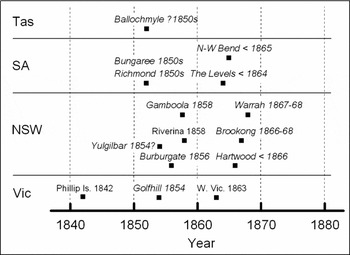
Having reviewed the various published claims, there seems little doubt that John McHaffie erected the first wire fences in Australia, on Phillip Island in 1842 (Figure 10). About a decade passed before the next wire fences are recorded in Victoria. Thereafter, wire was rapidly adopted, although perhaps not widespread, in all eastern colonies by the mid- to late-1850s. There is no information on Western Australia, but it is likely to be about the same time. Few fences were built in the Northern Territory until the mid-twentieth century, but wire was used before 1886.
Timeline of first wire fences in colonial Eastern Australia, 1840–1880.

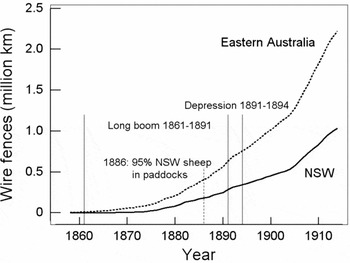
Just as barbed wire production and wire fence erection increased exponentially in the United States, so did the length of wire fencing erected in Australia (Figure 11), at least during the ‘long boom’ from 1861 to 1891. Erection slowed considerably during the devastating depression of the 1890s then recovered slowly to about 1905 when the rate increased to new highs. Overall the speed of the change to paddocking was impressive. By 1886, more than ninety-five per cent of sheep in New South Wales were running loose inside paddocks, mostly bounded by wire fences. Up until 1900, at least 682,562 tons of wire was imported, mostly from Britain, but with increasing competition from Germany and the United States of America until these countries had the lion's share of the market (Fisher and Smith, 1987). Although there were small local wire mills from 1911, imports continued until 1919 when The Broken Hill Proprietary Company built a wire mill at Newcastle (Schedvin, Reference Schedvin1970: pp. 49–50). Unfortunately there is no separation of plain and barbed wire in the import data until 1901 so it is not possible to examine the introduction of barbed wire into the colonies.
Cumulative length of wire fences erected in Eastern Australia and New South Wales, 1860–1914.

The wide geographic spread of the first fences shows that there was no even adoption across expanding pastoral frontiers. Rather, wire was first applied to well-established areas where there were adequate funds to support the high investment costs. However it was not quite as gloomy as squatter Oscar de Satgé (Reference de Satgé1901, p. 217) implied in his patently self-serving statement ‘Fencing and water conservation by huge dams . . . were the order of the day, and this meant thousands of pounds trustingly invested on leasehold security by enterprising men’. Any squatter who could not calculate the amortisation costs of a fence investment till the end of a lease deserved to go bankrupt! Typical of the heavy investment in fencing is Elsinore in western New South Wales where ‘Of £15,802 worth of improvements on Elsinore, 131¼ miles of wire fences accounted for £4,868 or 30.8%’ (Butlin, Reference Butlin and Barnard1962: p. 335).
Many pastoralists were enthusiastic about wire fences, but the more cautious argued that various log and brush fences were more cost-effective in the short term. This was an important point because a beginning settler or pastoralist wanting boundary or paddock fences could build a brush fence for half the cost of post-and-wire. The brush fence would last at least six to ten years, and hopefully by this time, a couple of good harvests or wool clips would give sufficient capital to make a start on wire fences.
Technology transfer and local adaptation
Starting with the wire itself, technology transfer of wire fences from Britain to Australia required four steps.
1. Industrial-scale manufacture of wire in Britain.
2. Progressive replacement of rods and bars in iron fences with thinner and thinner wire in Britain.
3. The transfer of both the information and material of the new technology to Australia.
4. Recognition by pastoralists and farmers that the new technology is economically worthwhile.
A fifth step assisted:
5. Development of better steel wire in Britain and the Continent leading to smaller diameter wires with increased strength
Once these five steps are complete, we see the final step:
6. Progressive and increasingly rapid spread of wire fences across the colonies.
Whether the technology arrived in Australia by someone exporting the idea from Britain, or by someone from Australia importing it, the end result is the same. Raby (Reference Raby1996) makes the important point that information is a form of technical knowledge and was flowing from Britain to the colonies via many informal routes: letters from home, visits by squatters, etc. One of the key sources of information for many colonists was their connections, either family or business, in Britain. Examples are John Lloyd sending wire to his brother Charles at Burburgate, J. and A. Dennistoun providing information to George Russell at Golfhill, and the Court of directors of the Australian Agricultural Company brow-beating their local superintendent (Edward Merewether) at Warrah. Equally important were the British wire manufacturers who sent out catalogues and other material to their local agents. Some information came from the United States as early as 1851, although most Tasmanian farmers would have scoffed at a fence using either ‘twelve horizontal rails or strands of wire, and three perpendicular wire ties to every ten feet, and five feet high’ (Anon, 1851). Out of this plethora of information, Australian pastoralists cherry-picked various items from British fencing technology, and rejected others. There are very few Australian fences with wrought iron posts set into stone blocks, or with cast-iron winding pillars, apparently so popular in Britain. Instead, imported wire was attached to locally-sourced wooden posts, set directly in the ground. As Raby (Reference Raby1996, p. 5) says ‘the farmer who adopted British best-practice techniques in Australia . . . would have surely gone broke in the process’.
Because the date of the first use of wire in Britain is uncertain, it is difficult to determine the lag time before the new technology was transferred to Australia. As we have seen with hedges, not all the transfers were economically appropriate in Australia, and the shepherding system was well-adapted to local conditions. But landholders did see the need for better boundary fencing, and by the 1850s, conditions were right for a massive expansion (Pickard, Reference Pickard2007). McHaffie was building his fence at a time when it was still a novelty in Britain. He was the classic ‘early adopter’, but judging from the published record, he was a decade ahead of his time. Early adopters tend to be closely watched by neighbours to see if the new ideas work and are economically worthwhile. Perhaps because of his relative isolation on Phillip Island, McHaffie had few neighbours to literally and figuratively look over his fences. Without this direct contact, few other landholders would have been aware of his wire fences. But the high cost may have deterred many others anyway.
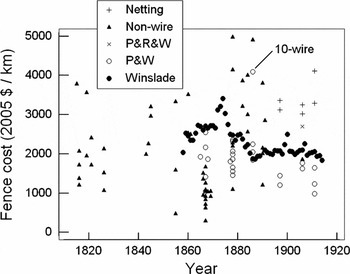
The decade-long hiatus until renewed interest in wire in the early 1850s may have been caused by a combination of a slow recovery from the depression of the early 1840s and either uncertain tenure or short leases. If fencing were necessary, then it would be built using local labour and materials rather than investing expensive capital in imported wire. But from the start of the ‘long boom’ in 1861, until the crippling depression of the 1890s, the rate of fencing was exponential (Figure 11). Recovery from the 1890s depression took until about 1905 when the rate increased to new highs. Although initially expensive, wire fences became cheaper after the mid-1880s as increasing amounts of wire were imported and costs fell to a roughly stable level in the 1890s (Winslade, Reference Winslade1994: Figure 2) (Figure 12).
Real cost of fences (2005 dollars per kilometre) from 1815 to 1915.
Notes: 1. Fence structures are grouped into five classes: netting, non-wire (i.e. wooden fences of various forms), post-and-rail-and-wire (P&R&W), post-and-wire (P&W), and Winslade data on post-and-wire fences (Winslade).
2. Winslade (p. 40, note 28) assumed a ‘standard’ fence of four plain and one barbed wire. Such a fence was not possible until after 1874.
3. Some of the non-Winslade data are for ‘value’ at the time of reporting rather than ‘cost’ at time of erection, and because of depreciation, these are under-estimates of initial cost.
4. An exceptional ten-wire fence is indicated.

Although Australian landholders seem to have been eager to adopt the new technology, some argued that while fences were beneficial, wire was not a paying proposition. ‘Jumbuck’ (1868: p. 7) points to the price differential, and other, perhaps more profitable ways to invest capital in the property:
We have the experience [in New South Wales] that fences, . . . can be erected out of materials growing along the line of fence, and at less than one half the cost. If even these the cheap fences had to be renewed during the time which a more substantial but expensive fence may be expected to last, they would still be more economical than wire or post-and-rail fences; but experience has shown that many of the cheap descriptions of fence are almost, if not quite, as lasting as ordinary wire fences.
It therefore becomes worthy of serious consideration whether the money which the difference in the cost of the two classes of fence represents, might not be more profitably employed in the purchase of live stock, for the purpose of feeding off some of the additional pasture thus made available by means of fencing.
The initial resistance of the local managers of Warrah to wire described above is another example. In other words, as Todd (Reference Todd1995: p. 211) says, pastoralists needed ‘to learn the economic properties of a new technology, not just in some general sense, but in terms of the precise relevance to their own particular circumstances’. Clearly, cost-effectiveness and amortisation periods were key criteria.
The timing and sequence of adoption of barbed wire in Australia is unknown, hindered in part by the lack of official data until 1901. In South Australia, Meinig (Reference Meinig1988: note 15, p. 103) found ‘not a single reference . . . in any of the contemporary source materials through 1884 of Bessemer steel barbed wire’. This suggests perhaps a ten-year lag, considerably longer than with plain wire some four decades earlier.
One of the keys to successful farming is increased profit. This can be achieved by increasing production with better breeds of animals or varieties of crops, or improved management, while simultaneously reducing costs. As fences were a significant component of the capital invested in farm improvements, any savings on them were worth pursuing by a range of means:
1. Omitting the top rail that constrained post spacing.
2. Spacing posts further apart.
3. Adding droppers between the more widely spaced posts.
4. Using thinner wire.
5. Developing new fence structures which combined all of these changes.
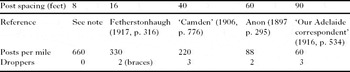
Omitting the top rail and increasing post spacing had immediate benefits of saving labour in splitting rails and posts, and then in setting posts in holes. Doubling post spacing from eight feet to sixteen feet reduced the number of posts per mile by fifty per cent, from 660 to only 330 (Table 2), a considerable saving in labour and transport costs. As spacings increased, droppers were added to maintain the efficacy of fences. Using 8G wire rather than 4G gave double the length per ton (5.8 c.f. 2.8 miles / ton) with little increase in purchase price, but obvious savings in transport. A survey of fencing practice in 1953 showed that the post spacing varied widely between states, with most farmers preferring posts less than twenty-two feet apart. Only ten per cent of fences used sixty-six feet spacings, and these would have been in semi-arid rangelands in New South Wales and South Australia (Wymond, Reference Wymond1954).
Reduction of materials by increasing post spacing

Note: Posts in post-and-rail fences are typically eight feet apart, and this was the starting point for many early wire fences.
Wire was added to post-and-rail fences for repairs, or to make them lamb-proof in Britain from at least 1848 (Charles D. Young and Company [1848], p. 9). Australian pastoralists also used wire in this way to convert cattle fences to sheep fences (see above). Repairs or conversions are one thing, but erecting a new post-and-rail-and-wire fence from scratch was a different proposition. Although it seems like a logical intermediate stage in the technological progression from post-and-rail to post-and-wire, it was not necessary and was actually a dead-end, imposing limits that negated the benefits of wire (Pickard, Reference Pickard2005). Fetherstonhaugh (Reference Fetherstonhaugh1917: p. 74) recognised this in the 1860s and his fences at Brookong were post-and-wire. Despite his example, and the disadvantages, many of the new boundary fences were post-and-rail-and-wire well into the twentieth century.
As colonial fence-builders increased post spacing, they added droppers or battens, vertical components of wood, metal or wire attached to the line wires. Unlike posts, droppers are not set in the ground, and are invariably smaller and lighter than posts. Droppers keep the wires separated and act as a visual warning to stock. The first seem to have been wire ‘braces’, lengths of wire tied vertically, linking the line wires in the fence. Braces were widely used, but as Fetherstonhaugh (Reference Fetherstonhaugh1917: p. 316) says, it was ‘a very bad plan, as we afterwards found out’. But even a decade later, wire braces were being advocated (Anon, 1867: p. 2). The problem was that the braces broke, and if the line wires needed restraining, the braces were a hindrance. Subsequently wooden droppers were used, and although these needed to be bored for the wires, the cost of digging post holes was eliminated. Further development led to metal droppers fixed to the wires by various means. The origins of droppers are currently unknown, but they have been used since the early 1860s. A form of dropper fencing developed in the neighbouring colony of New Zealand was introduced back to Britain in the 1870s where it became known as ‘Corrimony fencing’ (Ogilvie, Reference Ogilvy1875).
Peter Waite's ‘lightning fences’ (Pickard, Reference Pickard2009: pp. 82–3) combined all of these changes: widely-spaced posts, droppers, and thinner wire. He took maximum advantage of the technology, coming close to the practical limits of iron wire, by progressively increasing post spacing (‘Our Adelaide correspondent’, 1916). He used a new form of high tensile steel wire, and further increased post spacing:
The wire used is of a hard steel composition which does not stretch. The fence is thus always taut, but springy, and when anything tries to get through it it gives in a body, rebounds, and rattles for a considerable distance. Many others have erected fencing on similar lines, and Mr. Waite has been much complimented on his invention. (Anon, 1897)
There was no formal science involved in these colonial developments of wire fencing, but it is fitting that the first experiments comparing different structures were by Peter Waite starting at Paratoo (32° 44′S 139° 24′E) and continuing at Urrbrae his Adelaide estate (‘Our Adelaide correspondent’, 1916). Waite bequeathed Urrbrae to the University of Adelaide in 1924, and it became home to the Waite Agricultural Research Institute. On the basis of his experiments, Waite ‘and Elder divided the 894 sq. miles of the Paratoo and Pandappa runs into 20 large paddocks, at a total cost of about £55,000’ (Bowes, Reference Bowes1963: p. 38) by 1878. Waite was both innovative and cautious: he needed the practical demonstration of fence designs on a small-scale before embarking on massive capital investment.
There were no nationally influential champions of wire fences. Several pastoralists shared their fencing experience, usually under pseudonyms, in colonial newspapers, and these articles were frequently reprinted in adjoining colonies. Although both Alexander Bruce (Chief Inspector of Stock, New South Wales) and Patrick R. Gordon were enthusiastic proselytisers, even to the point of exaggerating fencing statistics and the benefits of fencing in general (Winslade, Reference Winslade1994; Pickard, Reference Pickard2007), they did not seem to reach a national audience. Gordon published several letters in the Sydney Mail that were reprinted in the Brisbane Courier (Gordon, Reference Gordon1865), thus extending the potential audience. Writing under the pseudonym ‘Jumbuck’ he contributed articles on fencing to newspapers. He also consolidated and expanded his letters into an instructive booklet (Gordon, Reference Gordon1867). Gordon was not fixated on wire fencing alone, and he wrote a sequence of five articles describing non-wire fences in some detail (‘Jumbuck’, 1868). From the founding of the Pastoral Review (initially The Australasian Pastoralists’ Review), in 1891, ‘practical men’ finally had a national venue for sharing their knowledge and experience. By this stage wire was already the de facto standard, and many letters and articles argued about structural details: post spacing, fence height, and how to keep out dingoes and rabbits. But this was all technological adaptation and innovation by Todd's ‘rule of thumb men’. There was no involvement of government and none by the steel industry. Both had to wait until the twentieth century with the formation of research sections of departments of agriculture, and the Australian steel industry.
Paradoxically, the huge imports of wire for fencing, and the almost limitless demand did not stimulate local industries to establish wire-drawing works. A small-scale factory operated in South Melbourne in 1911, using imported rods, but could not compete with the cheap (possibly dumped) wire from overseas. Given this, industrialists did not see sufficient profit coming from any investment in a large wire mill. It was left to the feral rabbit to trigger the investment of British wire-netting maker John Lysaght in a netting plant in Sydney in 1885 (Schedvin, Reference Schedvin1970). But that is beyond the scope of the present paper.
It is interesting to speculate on what the Australian landscape would look like if wire had not been available. What else could have been used? There are too few trees in many areas for post-and-rail or similar log fences, and stone walls were only an option in very limited and specific areas. Even using wire, it took at least 20.4 million wooden posts to fence the Western Division of New South Wales (Pickard, Reference Pickard, Lunney, Hand, Reed and Butcher1994: p. 71). Australian stock owners were obliged under the centuries-old British common law principle of ‘fencing in’ to constrain their animals to avoid trespass and subsequent damages (Pickard, Reference Pickard1998). Without wire, the Australian colonies might have followed the American colonies in overturning this approach, choosing instead the principle of herd law or ‘fencing out’, requiring landholders to build fences to secure their crops against trespass by wandering stock. But even in the United States, fences eventually became legislatively required on boundaries. It is difficult to see how the millions of kilometres of farm and station property boundaries in Australia could be secured to prevent wandering stock without wire. Although Stephens (Reference Stephens1855: p. 596) had misgivings about the future of wire fences, within four decades he accepted their value: ‘Wire is now more largely employed than any other material in fencing land’ (Stephens, Reference Stephens1891: volume 3, p. 235). Wire fences, using either plain wire or barbed wire or some combination of these, quickly became the de facto standard in the western world. There is no doubt that wire was the right technology at the right time in colonial Australia.
Acknowledgements
This research has been partially supported by the Department of Physical Geography, Macquarie University. Dr Trish Fanning and Dr Damian Gore (Department of Environment and Geography, Macquarie University) provided helpful comments on earlier drafts. Ray Browne (Myall, Yerong Creek, NSW) generously showed me the few remaining panels of one of the original boundary fences of Brookong. Kathryn Pearson and her staff in Document Supply, Macquarie University Library, located many old and rare books for me. It is a pleasure to acknowledge the programme of the Museum of English Rural Life at Reading University in scanning early agricultural catalogues and making them freely available on their web site.