Antibiotics are among the most commonly prescribed medications in nursing homes,Reference Gurwitz, Field, Judge, Rochon, Harrold and Cadoret1 and they are frequently prescribed inappropriately.Reference Lim, Kong and Stuart2, Reference Nicolle, Bentley, Garibaldi, Neuhaus and Smith3 The Centers for Medicare and Medicaid Services requires that all nursing homes have an antibiotic stewardship program and a system for monitoring antibiotic use.4 Antibiotic use can be monitored using different measures to identify potential targets for practice improvement and to track the impact of antibiotic stewardship interventions.Reference Mylotte5 The 2 most commonly used antibiotic use measures in nursing homes are antibiotic days of therapy and antibiotic starts.Reference Mylotte5, 6
Many nursing homes lack the resources, expertise, or infrastructure to track and analyze antibiotic use measures. However, many nursing homes contract with long-term care pharmacies to process prescriptions and dispense medications.7 Pharmacy transaction data from these pharmacies are a readily available data source that may permit assessment of antibiotic use measures.Reference Drinka, Gauerke and Le8 We conducted a descriptive analysis to assess the feasibility of using pharmacy transaction data to measure antibiotic days-of-therapy and antibiotic starts in nursing homes.
Methods
We analyzed antibiotic transactions in pharmacy invoices from 2016 for 12 nursing homes within the same corporation and served by the same pharmacy. The census data were provided by the parent corporation. Each line of data, which represented a single transaction (defined by a discrete antibiotic start), contained the following: a code for each nursing home, transaction (start) date, antibiotic generic name, route of administration (ie, oral or intravenous), and the number of days dispensed, with each day dispensed defined by the administration of at least 1 dose in a calendar day. This de-identified dataset did not include patient record numbers or other protected health information. We estimated the days-of-therapy by determining the total number of days dispensed and antibiotic starts using the number of antibiotic transactions, further characterizing each metric by the antibiotic class, agent, and route of administration. We calculated days dispensed and number of transactions per 1,000 resident days. The proportion, mean duration, and standard deviation (SD) of intravenous and oral transactions were compared.
Results
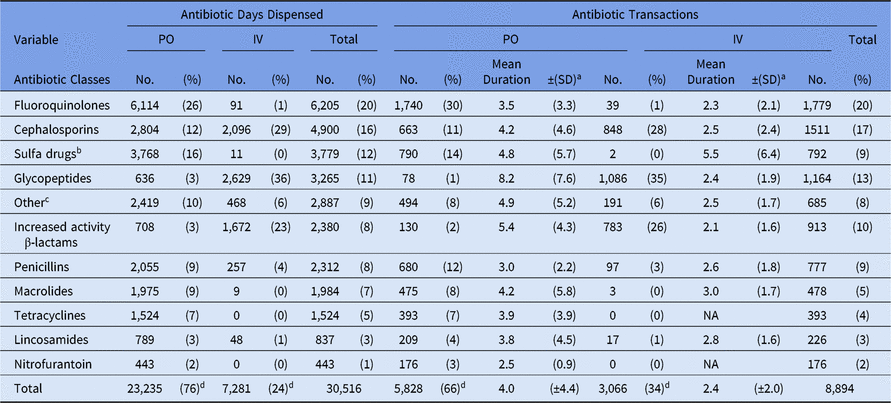
At the 12 nursing homes evaluated, the mean rates of total days dispensed and antibiotic transactions were 54 days dispensed per 1,000 resident days (range, 25–133 per nursing home) and 16 transactions 1,000 resident days (range, 10–30 per nursing home), respectively. The most commonly prescribed antibiotic classes, regardless of the antibiotic use measure, were fluoroquinolones (20% of both days dispensed and transactions) and cephalosporins (16% of days dispensed and 17% of transactions). The third most commonly prescribed antibiotic class depended on the measure used: sulfa drugs (12% of days dispensed) or glycopeptides (13% of transactions) (Table 1).
Antibiotic Prescribing in 12 Nursing Homes According to Antibiotic Class Comparing Antibiotic Days Dispensed and Antibiotic Transactions

Note. PO, oral; IV, intravenous.
a Mean of the duration of single transactions ± standard deviation in days.
b Includes trimethoprim-sulfamethoxazole and sulfamethoxazole.
c Includes metronidazole, linezolid, gentamicin, daptomycin, amikacin, tigecycline, tobramycin, fidaxomicin, polymyxin B, colistin, tinidazole, streptomycin, dalfopristin, quinupristin, tedizolid, and telavancin.
d Percentage for oral and intravenous antibiotic days dispensed and transactions of the total number of antibiotic days dispensed and transactions.
Overall, the proportion of intravenous antibiotics was 24% of days dispensed and 34% of transactions. The mean number of days dispensed was 3.4 days (SD, 1.4) overall. The mean duration of oral and intravenous antibiotics was 4.0 days (SD, 4.4) and 2.4 days (SD, 2.0), respectively.
Discussion
Antibiotic days of therapy can be captured using the number of days dispensed from pharmacy transaction data. Antibiotic starts, on the other hand, may be overestimated by the number of antibiotic transactions. The short duration of individual transactions in this study may indicate that, in some instances, a full treatment course may consist of multiple transactions. This finding is more pronounced with intravenous agents, in which the days of antibiotics dispensed were consistently shorter compared to oral agents. One example was ciprofloxacin prescribing, where the mean duration of a transaction was 3.7 days for oral ciprofloxacin, and 1.8 days for the intravenous formulation. Based on a large cohort in Canada, more than 80% of treatment courses in nursing homes were 7 days or longer.Reference Daneman, Gruneir and Bronskill9 Thus antibiotic transactions may not be a suitable proxy (or a proxy that must be interpreted with caution) to assess antibiotic starts.
The primary limitation of this analysis is that data were not available at the resident level; thus, linking multiple transactions to a single resident was not possible. Another limitation is that transaction data can overestimate antibiotic use because they capture doses that were not administered. Further studies should compare antibiotics ordered and administered to assess this potential discrepancy. Also, because the prescription indications were not available, identifying prophylactic antibiotics, which can have an outsized influence on days of therapy, was not possible. Nonetheless, despite these limitations, pharmacy transaction data may be a readily available data source for some nursing homes to track their antibiotic use, particularly days of therapy.
Overall, antibiotic use rates, measure as days dispensed, varied up to 5-fold between the lowest- and highest-use nursing home. This may reflect variation in prescribing patterns along with resident acuity and comorbidities,Reference Daneman, Campitelli and Giannakeas10 highlighting the potential importance of antibiotic use benchmarks for nursing homes. Pharmacy transaction data can also be explored for antibiotic use tracking at the regional and national level in nursing homes to identify opportunities for improvement, report antibiotic use benchmarks, and measure the impact of antibiotic stewardship implementation and regulatory requirements.
Author ORCIDs
Sarah Kabbani, 0000-0002-1738-6443
Acknowledgments
The findings and conclusions in this report are those of the authors and do not necessarily represent the official position of the Centers for Disease Control and Prevention, the Department of Veterans Affairs or the United States government.
Financial support
This work was supported in part by funds and facilities provided by the Cleveland Department of Veterans Affairs (VA), the Cleveland Geriatric Research Education and Clinical Center (GRECC) and the Specialty Care Center of Innovation (to R.J.).
Conflicts of interest
All authors report no conflicts of interest relevant to this article.