Strawberry is an important horticultural crop in Florida, with a production value of US $306.5 million in 2014, ranking Florida as the second largest producer of strawberries in the United States (USDA 2015). The emergence of broadleaf weeds from the planting holes after transplanting is a major problem in strawberry production. Clopyralid is currently the only registered broadleaf POST herbicide available. The label recommends that strawberries be well established prior to application, to avoid temporary leaf cupping (Anonymous 2011).
The application of clopyralid POST in strawberry only suppresses problematic weed species such as black medic (Medicago lupulina L.) and Carolina geranium (Geranium carolinianum L.). Lack of control is not due to efficacy, as direct application of clopyralid (140 to 280 g ae ha–1) to black medic plants with 0.5- to 1-cm stem length provided adequate control (Sharpe et al. Reference Sharpe, Boyd and Dittmar2016). Crop shielding was suspected to be responsible for surviving black medic plants after clopyralid application in the field (McMurray et al. Reference McMurray, Monks and Leidy1996). Spray penetration through the strawberry canopy was confirmed to be a limiting factor, where coverage at the planting hole was only 8% (Sharpe et al. Reference Sharpe, Boyd, Dittmar, MacDonald, Darnell and Ferrell2017b). Increased spray penetration was achieved with higher application volume (Sharpe et al. Reference Sharpe, Boyd, Dittmar, MacDonald, Darnell and Ferrell2017b), but this solution does not solve other compounding factors such as size-based black medic tolerance to clopyralid (Sharpe et al. Reference Sharpe, Boyd and Dittmar2016) and limited clopyralid translocation out of black medic–treated stems (Sharpe Reference Sharpe2017). Recommendations for clopyralid application based on growing degree day models for black medic growth was late November to early December, more than a month earlier than current spray timings (Sharpe et al. Reference Sharpe, Boyd, Dittmar, MacDonald, Darnell and Ferrell2017a). Strawberry has shown tolerance to early application of clopyralid at the low label rate (140 g ae ha–1), with no reductions in yield and minimal leaf malformations (Sharpe Reference Sharpe2017). Earlier applications overcome crop shielding (as the crop is smaller) and also may allow better control on target weeds when they are at a susceptible growth stage.
With earlier clopyralid application timing, commercial strawberry plants may be subject to warmer temperature fluctuations prior to, during, or after clopyralid application, which may result in crop injury. Application may occur as early as October, where the 7-yr daily average for air temperature in Dover, FL, was 23 C and the daily maximum was 34 C (IFAS 2017). Black medic emergence peaks in December (Sharpe Reference Sharpe2017), when the daily average air temperature was 17 C and reached a maximum of 31 C (IFAS 2017). Clopyralid application typically occurs currently in January, when the daily average was 15 C and reached a maximum of 30 C (IFAS 2017). Warmer temperatures increase absorption and translocation of herbicides in treated plant foliage through a variety of processes, such as increased diffusion rates and an increased rate of photosynthesis and subsequent translocation of assimilates (Currier and Dybing Reference Currier and Dybing1959). Several herbicides have demonstrated increased activity with increasing temperature. Reports of this include increased damage to glyphosate-resistant soybean [Glycine max (L.) Merr.] with glyphosate (Pline et al. Reference Pline, Wu and Hatzois1999), increased swinecress [Coronopus didymus (L.) Sm.] control with aminocyclopyrachlor and fluroxypyr (Reed and McCullough Reference Reed and McCullough2012), and reduced shoot biomass in annual bluegrass (Poa annua L.), bermudagrass [Cynodon dactylon (L.) Pers. × C. transvaalensis Burtt-Davy], and tall fescue (Festuca arundinacea Schreb.) with amicarbazone (Yu et al. Reference Yu, McCullough and Grey2015). Increased activity with higher temperatures may be due to increased absorption and translocation. This has been demonstrated with triclopyr, picloram, and 2,4,5-T translocation in five species (Radosevich and Bayer Reference Radosevich and Bayer1979) and picloram in leafy spurge (Euphorbia esula L.) (Lym and Messersmith Reference Lym and Messersmith1990). Increased herbicide activity has also been demonstrated with lower temperatures, including glufosinate injury on resistant soybean and increased dithiopyr injury on smooth crabgrass [Digitaria ischaemum (Schreb.) Schreb. ex Muhl.] (McCullough et al. Reference McCullough, de Barreda, Sidhu and Yu2014; Pline et al. Reference Pline, Wu and Hatzois1999). The effect of temperature on strawberry tolerance to clopyralid is unknown. The objective of the study was to determine the collective influence of changes in temperature (1) prior to, (2) during, and (3) after clopyralid application on strawberry tolerance.
Materials and Methods
The experiment was established at the Gulf Coast Research and Education Center (27.75°N, 82.22°W) in Balm, FL. Strawberry transplants (‘Festival’) were planted on October 24, 2014 into 3.78-L pots filled with Fafard® 3B Mix potting soil (Sun Gro® Horticulture, Agawam, MA) and fertilized with Plantacote Pluss 14-9-15 controlled-release fertilizer (Plantacote®, Amsterdam-Zuidoost, Netherlands) at 12 g pot–1. Strawberry plants were grown in the greenhouse under drip irrigation.
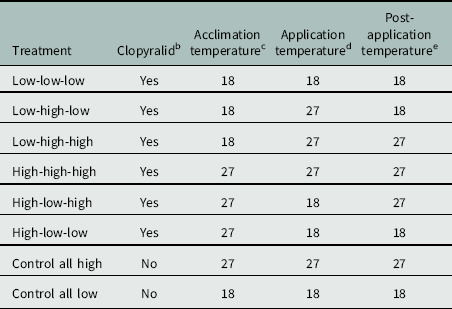
The experimental design was a completely randomized design with eight treatments, four replications; the trial was repeated. The study considered the collective influence of temperature prior to, during, and after clopyralid (Stinger®, Dow AgroSciences LLC, 9330 Zionsville Road, Indianapolis IN 46268) application on strawberry tolerance. Temperature conditions were implemented for three periods: (1) 20 d prior to application (acclimation), (2) 4 h prior to application (pre-treatment), and (3) 29 d after application (post-application). The experimental treatments altered the temperature for each period under three general schemes (Table 1). The first scheme was a constant high (27 C) or low (18 C) temperature. The second was a consistent temperature for the acclimation and post-application periods, but varying the temperature during the application period (27–18–27 C and 18–27–18C). The third was a constant temperature for the application and post-application periods, but varying the temperature during the acclimation period (18–27–27 C and 27–18–18 C). Two controls were included with constant temperatures as above, but no clopyralid was applied.
Experimental treatment regime of temperature combinations used on strawberry plants grown in walk-in chambers before, during, and after application of clopyralid at Balm, FL, in 2015.Footnote a

a Temperatures used in the study were 18 C and 27 C.
b Yes indicates clopyralid applied at 540 g ae ha–1.
c Acclimation refers to the 20-d period before the application of clopyralid.
d Application refers to the temperature the plants were exposed to for 4 h before clopyralid application.
e Post-application refers to the temperature the plants were exposed to after the application of clopyralid until the end of the study.
Plants were moved on December 19, 2014, to growth chambers according to experimental treatment and their location completely randomized. Two walk-in chambers were maintained at 18 and 27 C with an available photosynthetically active radiation photon flux of 158 and 173 µmol m–2 s–1, respectively, with a 12-h day/night light cycle. Chambers were large enough to facilitate conducting both runs of the experiment simultaneously, on separate sides of the chamber. Plants were moved between chambers for the appropriate temperature exposure. Clopyralid was applied on January 8, 2015, at a rate of 560 g ae ha–1 in a carrier volume of 281 L ha–1 using a CO2-pressured sprayer (Bell-spray Inc., Opelousas, LA) equipped with 8002 EVS nozzles (TeeJet®, Glendale Heights, IL) at 241 kPa. The rate (twice the maximum label rate) was chosen to induce damage on the strawberry plants and mimic potential overlap in spray patterns. On the day of spraying, the plants were moved according to their experimental treatment to the appropriate growth chamber for their 4-h acclimation. Plants were then situated outside, clopyralid was applied, and plants were permitted to dry for 3 h. The average air temperature during drying was 14 C. Plants were then returned to the growth chambers and re-randomized.
Response variables comprised plant parts, percentage malformed leaves, above- and belowground biomass, and the root-to-shoot ratio. Plant parts included total number of leaves, reproductive organs (flowers and fruit), and runners. Plant parts were counted at 15 and 29 d after clopyralid application (DAA). Percentages of malformed leaves were calculated from the number of malformed leaves divided by the total number of leaves, expressed as a percentage. Biomass was measured 35 DAA. Plants were divided into aboveground and belowground portions and dried at 42 C until consistently dry by weight. The root-to-shoot ratio (R/S) was calculated as follows:
 $${\rm R}/{\rm S}\,{\equals}\,{{{\rm Root}\,{\rm dry}\,{\rm weight}} \over {{\rm Shoot}\,{\rm dry}\,{\rm weight}}}$$
Predetermined orthogonal contrasts were performed using the MIXED procedure in SAS (SAS Institute Inc., Cary, NC), specifying the ESTIMATE option. The ESTIMATE option was used to produce the estimated difference between the groups being contrasted. The first contrast compared the effect of presence or absence of the herbicide application across all temperature regimes. A negative estimated difference indicated a greater mean for treatments with an herbicide application. This contrast was considered at each rating period (15 and 29 DAA). If this orthogonal contrast was significant, three additional contrasts compared the difference due to (1) the acclimation temperature, (2) the application temperature, and (3) post-application temperature. A negative estimate between the means indicated a greater mean for the treatments containing the high temperature. Contrasts are reported giving the estimate and then the probability in brackets following the point of reference for the comparison.
Data were also subjected to ANOVA utilizing the MIXED procedure in SAS, and significant main effects were further examined specifying ADJUST=TUKEY for Tukey’s honest significant difference means comparison test. Temporal repeated measures were analyzed using the REPEATED statement, specifying the covariance structure as AR(1). Trial run was considered a random variable. Model assumptions of constant variance and normality were verified, and square root transformations were used to correct violations. Means presented are the least square estimates from the MIXED procedure and were back transformed in the case of data transformations; they represent averages across both trial runs. Both orthogonal contrasts and ANOVA were used as analysis procedures, as the orthogonal contrasts allow group comparisons for one of three conditions that composed the experimental treatment, whereas ANOVA and means comparison examine differences between specific means.
Results and Discussion
There was no effect of the herbicide on leaf number at either 15 DAA (6.8, p=0.56) or 29 DAA (13, p=0.29) by orthogonal contrast. The ANOVA revealed an effect of measurement date (p<0.0001) but not experimental treatment (p=0.16). The number of leaves per plant significantly increased from 25 at 15 DAA to 29 at 29 DAA. This was expected, given that the plants continued to grow over time. Safety of clopyralid on leaf production is an important consideration for early applications, as reductions earlier in the production cycle could be detrimental to biomass accumulation and yield. Hunnicutt et al. (Reference Hunnicutt, MacRae, Dittmar, Noling, Ferrell, Alves and Jacoby2013) suggested that increased temperatures led to increased leaf production and therefore increased leaf malformations, but increased leaf production was not observed. Strawberries are naturally tolerant to the application of clopyralid (Boyd and Dittmar Reference Boyd and Dittmar2015; Figueroa and Doohan Reference Figueroa and Doohan2006; McMurray et al. Reference McMurray, Monks and Leidy1996) and have shown no reductions in biomass or plant height with early applications (Sharpe Reference Sharpe2017). Therefore, risk of plant stunting with early clopyralid application at warmer temperatures should be minimal.
Orthogonal contrasts for percentage malformed leaves showed no effect of the herbicide at 15 DAA (−4.8, p=0.46) but indicated a significant effect at 29 DAA (−46, p=0.035). Contrasts further revealed a significant difference based on the acclimation temperature (−21, p=0.031) and the post clopyralid application temperature (−29, p=0.016), but not the temperature prior to clopyralid application (−26, p=0.072). In both the acclimation and post-application periods, the difference in the contrasts was negative, indicating a consistently higher percentage of malformed leaves at 27 C than at 18 C. Strawberry grown in 27 C during acclimation may have developed thicker leaf cuticles (Hull et al. 1975), altering the extensibility and fluidity (Edelmann et al. Reference Edelmann, Neinhuis and Bargel2005), and increased clopyralid uptake (Ramsey et al. Reference Ramsey, Stephenson and Hall2005). Further study is necessary to confirm this hypothesis. Increased injury due to warmer temperatures (27 C) in the acclimation period demonstrates that care should be taken in applying clopyralid if growing conditions have been warm. Clopyralid does not reduce strawberry yield when applied at label rates (Boyd and Dittmar Reference Boyd and Dittmar2015; Figueroa and Doohan Reference Figueroa and Doohan2006). If increased leaf malformation is undesirable to growers, then hand-weeding may be a better alternative (see Sharpe et al. Reference Sharpe, Boyd, Dittmar, MacDonald, Darnell and Ferrell2017a for timing recommendations). Increased injury by warmer temperatures (27 C) in the post-application period may be difficult to predict when making clopyralid application decisions due to the natural variability in weather patterns. The ideal clopyralid application timing (based on black medic emergence, growth, and development) is in late November to early December (Sharpe Reference Sharpe2017, Sharpe et al. Reference Sharpe, Boyd, Dittmar, MacDonald, Darnell and Ferrell2017a). The 7-yr daily average temperature in Balm, FL, declines from 23 C in October to 15 C in January, although the maximum daily temperature remained above 30 C throughout (IFAS 2017). Therefore, applications aligning with a susceptible black medic growth stage may reduce the incidence of injury, as daily temperatures cool compared to earlier timings in the production cycle. Emergence patterns are unknown for other problematic weeds in strawberry production, so scouting is advisable to make informed management decisions.
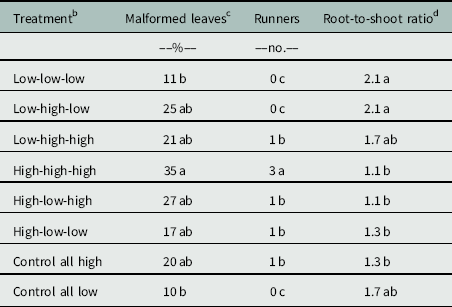
The ANOVA for the malformed-leaf percentage indicated a significant interaction between treatment and the measurement date (p=0.0178). Given the interaction, dates were analyzed separately, and only the treatment effect at 29 DAA (p=0.0025) is shown (Table 2). Nontreated plants grown in the high-temperature regime (control all high) were prone to natural leaf malformations in the growth chamber (~20% malformations) (Table 2). There was no herbicide treatment effect at 29 DAA for consistent low- or high-temperature regimes (e.g., low-low-low versus all-low control or high-high-high versus all-high control) (Table 2). Differences in results between the orthogonal contrasts and the ANOVA for the effect of the herbicide at the later evaluation probably resulted from the power of orthogonal contrasts to compare across groups, increasing the sample size for the test. Plants grown at 18 C post-application tended to show a greater percentage of leaf malformations at 29 DAA (e.g., low-low-low, low-high-low, high-low-low) (Table 2). It may have taken longer at the lower temperature for leaf malformations to manifest, as a result of lower uptake and translocation; such a response has been documented in other species with pyridine herbicides (Lym and Messersmith Reference Lym and Messersmith1990).
Collective influence of temperature before, during, and after clopyralid application on strawberry malformed leaves, runner number, and root-to-shoot ratio for strawberry plants within walk-in growth chambers at Balm, FL, in 2015.Footnote a

a Different letters within a column specify a significant difference (α=0.05) using Tukey’s honest significant difference (HSD) means comparison test. Data were averaged across both trial runs.
b Treatments are the collective influence of a combination of temperature regimes during three stages: (1) acclimation period, (2) application period, and (3) the post-application treatment. High refers to the temperature set to 27 C; low refers to 18 C. Clopyralid was applied at 560 g ae ha–1 for all treatments, excluding control all high and control all low.
c The numbers of malformed leaves were measured at 29 d after clopyralid application.
d Root-to-shoot ratio=(root dry weight biomass)/(shoot dry weight biomass).
In that strawberry damage was induced by applying twice the label rate, concern in a field setting is minimal except in circumstances where clopyralid is accidentally overapplied. These results, combined with earlier research (Boyd and Dittmar Reference Boyd and Dittmar2015), are useful for informing producers that clopyralid activity may extend an additional 2 wk past the 2-wk period associated with clopyralid-induced leaf malformations. Although leaf number was not reduced, leaf malformations were mainly in the new growth at 29 DAA. Growth abnormalities due to the application of auxinic herbicides are distinct from growth cessation, according to Grossman (Reference Grossman2010). Damage manifesting in new leaves was expected, as total translocation of radiolabeled clopyralid within strawberry was 17%, where 6% of the total was found within the new leaves (Sharpe Reference Sharpe2017).
For the number of reproductive organs per plant, orthogonal contrasts showed no effect of the herbicide at 15 DAA (−9.1, p=0.34) or 29 DAA (2.1, p=0.94). The ANOVA showed an effect of measurement date (p < 0.0001) but not of experimental treatment (p=0.26). Not surprisingly, there were more strawberry reproductive organs at 29 DAA (11 per plant) than at 15 DAA (5 per plant). Serce and Hancock (Reference Serçe and Hancock2005) found that fewer flowers were produced at 26 C in ‘Aromas’, but this reduction did not occur at 27 C in the current study. Stress-induced flowering may have resulted from high temperatures, clopyralid application, or lower light levels in the growth chamber.
Orthogonal contrasts showed that clopyralid did not affect runner number at 15 DAA (1, 0.81) or 29 DAA (−3.5, p=0.11). The ANOVA showed an effect of treatment regime on runner number (p<0.0001) but not timing (p=0.19). Differences may be attributed more to temperature than to clopyralid application, as more runners were produced by plants at 27 C than at 18 C (Table 2). A similar increase in runner number in response to temperature has been documented for strawberry, where 20/15 C (day/night) produced 2.2 runners and 30/25 C produced 3.1 (Kadir et al. Reference Kadir, Sidhu and Al-Khatib2006).
Orthogonal contrast showed no effect of the herbicide on shoot dry weight (1.0, p=0.92) or root dry weight (−8.9, p=0.72). The ANOVA results were similar, with no treatment effect on shoot dry weight (p=0.24). There was a significant effect of treatment on root dry weight (p=0.046), but means separation revealed no significant differences (data not shown). Clopyralid typically does not affect these factors in the field (Sharpe Reference Sharpe2017), because strawberries are naturally tolerant to clopyralid and because applications typically occur later in the production cycle when plants are well established, fully grown vegetatively, and producing fruit.
For the root-to-shoot ratio, orthogonal contrast showed no effect of the herbicide (−0.4, p=0.58), but ANOVA did show a significant treatment main effect (p<0.0001). Tukey’s mean separation indicated a significant difference between the low-low-low and low-high-low treatments compared to all temperature treatments that were at 27 C for the acclimation period (Table 2). The low-low-low and low-high-low experimental treatments were not significantly different from the all-low control. Differences in experimental treatments appear to be temperature-mediated responses independent of the herbicide, where lower temperatures induced a higher root-to-shoot ratio. A similar result has been found previously for strawberries (Ganmore-Neumann and Kafkafi Reference Ganmore-Neumann and Kafkafi1983; Kadir et al. Reference Kadir, Sidhu and Al-Khatib2006).
Acclimation temperature affected clopyralid injury in strawberry, with increased leaf malformations at higher temperatures (27 C) compared to lower (18 C). Pre-treatment temperatures did not affect clopyralid injury. Post-application temperatures affected clopyralid injury, with higher temperatures inducing more strawberry leaf malformations. Damage was most pronounced at 29 DAA. There was no effect of the herbicide on the number of leaves, reproductive organs, or runners, nor on shoot or root biomass or the root-to-shoot ratio. High temperatures increased runner production and the root-to-shoot ratio. Clopyralid appeared safe to use under the studied temperature fluctuations, with only increases in leaf malformations occurring at the higher temperature. Further research is required to determine how clopyralid application and temperature may affect strawberry yield in a production setting. Given the tolerance of strawberry to early clopyralid applications (Sharpe Reference Sharpe2017) and no temperature-induced clopyralid injury beyond leaf malformations, clopyralid application earlier in the production cycle appears a feasible solution for gaining control of escaping broadleaf weeds. It is advisable that the emergence, growth, and development of escaping weeds be further studied to develop application timings that match susceptible growth stages, according to best management practices to reduce the risk of herbicide resistance (Norsworthy et al. Reference Norsworthy, Ward, Shaw, Llewellyn, Nichols, Webster, Bradley, Frisvold, Powles, Burgos and Witt2012). See Sharpe (Reference Sharpe2017) and Sharpe et al. (Reference Sharpe, Boyd, Dittmar, MacDonald, Darnell and Ferrell2017a) for recommendations for black medic.
Acknowledgments
The authors would like to acknowledge the Florida Strawberry Festival and the Florida Strawberry Research and Education Foundation for supporting and funding this research.