Introduction
Plant galls are formed by plant tissues that feed and protect the inducing organism as a result of active growth and differentiation (Stone & Schönrogge, Reference Stone and Schönrogge2003). Cynipid galls (Insecta, Hymenoptera) show high diversity in morphological traits including external structures and numbers of larval chambers (locularity). Cynipid galls are good examples of extended phenotypes; the inducers control the whole process of gall formation at the expense of the plant (Crespi et al., Reference Crespi, Carmean and Chapman1997; Stone & Schönrogge, Reference Stone and Schönrogge2003; Bailey et al., Reference Bailey, Schönrogge, Cook, Melika, Csóka, Thuróczy and Stone2009), and gall morphologies are characteristic of the inducer species rather than the host plant (Rohfritsch, Reference Rohfritsch, Shorthouse and Rohfritsch1992; Stone & Cook, Reference Stone and Cook1998; Stone & Schönrogge, Reference Stone and Schönrogge2003). As galls are the extended phenotypes of inducer genes, the adaptive significance of galls can be expressed in terms of inducer fitness (Stone & Schönrogge, Reference Stone and Schönrogge2003).
Galls provide their inducers with nutrition and protection from unfavourable abiotic fluctuations, and reduce the rates of attack by some natural enemies (Askew, Reference Askew and Ananthakrishnan1984; Price et al., Reference Price, Fernandes and Waring1987; Stone & Schönrogge, Reference Stone and Schönrogge2003; Bailey et al., Reference Bailey, Schönrogge, Cook, Melika, Csóka, Thuróczy and Stone2009). Natural enemies cause high mortality in cynipid galls (Askew, Reference Askew1961; Cornell, Reference Cornell1983; Wiebes-Rijks & Shorthouse, Reference Wiebes-Rijks, Shorthouse, Shorthouse and Rohfritsch1992; Kato & Hijii, Reference Kato and Hijii1993; Kaartinen et al., Reference Kaartinen, Stone, Hearn, Lohse and Roslin2010) and because gall tissues act as barriers between natural enemies and cynipid gall inducers, one hypothesis – the ‘enemy hypothesis’ – is that gall characteristics have evolved in response to selection pressure imposed by natural enemies (Stone & Schönrogge, Reference Stone and Schönrogge2003). However, the wide structural diversity of cynipid host galls attacked by the same parasitoid species suggests that gall structures do not completely exclude them, but may reduce the impact on inducers' survival (Bailey et al., Reference Bailey, Schönrogge, Cook, Melika, Csóka, Thuróczy and Stone2009; Stone et al., Reference Stone, Lohse, Nicholls, Fuentes-Utrilla, Sinclair, Schönrogge, Csóka, Melika, Nieves-Aldrey, Pujade-Villar, Tavakoli, Askew and Hickerson2012). Gall traits that have been shown to influence parasitoid attack include gall size, the thickness of the plant tissues surrounding the gall wasp larval chambers (Askew, Reference Askew1961; Schönrogge et al., Reference Schönrogge, Stone and Crawley1996; Plantard & Hochberg, Reference Plantard and Hochberg1998; Bailey et al. Reference Bailey, Schönrogge, Cook, Melika, Csóka, Thuróczy and Stone2009), and the size of the larval chamber (Ito & Hijii, Reference Ito and Hijii2004). These studies show that within species, thicker walled and larger galls containing more or larger larval chambers experience lower parasitoid attack rates. More generally, this supports the hypothesis that parasitoids may play an essential role in shaping gall morphological diversity. A further consequence of the enemy hypothesis is that it predicts that galls showing significant morphological differences should also differ in either the incidence or rate of mortality imposed by natural enemies.
A particularly interesting gall trait in this regard is multilocularity: the presence of many larval chambers in a single gall, which results from one or more females laying several to hundreds of eggs in the same location. This behaviour increases the average distance of larval chambers from the gall surface, which is associated with decreasing parasitoid-induced mortality (Abrahamson & Weis, Reference Abrahamson and Weis1997; Stone et al., Reference Stone, Schönrogge, Atkinson, Bellido and Pujade-Villar2002; Bailey et al., Reference Bailey, Schönrogge, Cook, Melika, Csóka, Thuróczy and Stone2009). Population genetic research on oak cynipid galls has shown that the larvae developing in multilocular galls can be the offspring of multiple females (Atkinson et al., Reference Atkinson, McVean and Stone2002, Reference Atkinson, Brown and Stone2003), suggesting that co-founding of galls to enhance survival probability of their offspring may be adaptive. Although co-founding has not been demonstrated in multilocular rose galls, larger and more multilocular galls are also associated with lower parasitism in Diplolepis cynipid galls on roses (László & Tóthmérész, Reference László and Tóthmérész2008).
Our study focuses on the enemy hypothesis by studying the impact of within-species gall variation on enemy attack rates. Patterns within single species revealed so far support the enemy hypothesis (Stille, Reference Stille1984; Ito & Hijii, Reference Ito and Hijii2002). Here we specifically compare patterns in two closely related species of rose gall wasp, Diplolepis mayri and D. rosae. We analysed gall morphological traits and their effects on the incidence and attack rates of parasitoids. We first set out to demonstrate the relationship between gall chamber number and gall size in each species. We then used individual rearings to sample the parasitoid communities in each species, and to test for correlations between gall morphology (gall diameter, number of chambers, inner and outer gall wall thickness) and parasitoid attack. Our hypotheses are as follows: (i) that gall diameter will increase with the number of chambers, (ii) that rates of parasitoid attack will be negatively correlated with gall size, (iii) that the two gall species will differ in specific morphological traits (chamber wall thickness and chamber diameter) and (iv) that, if different, the two galling species will show differences in their parasitoid community structure.
Materials and methods
Study system: host galls and parasitoid communities
Diplolepis rosae is the most abundant gall inducer on Rosa shrubs in Europe – primarily on Rosa canina, but also on other rose species (Schröder, Reference Schröder1967; Stille, Reference Stille1984; Kohnen et al., Reference Kohnen, Wissemann and Brandl2011). Diplolepis mayri is also widely distributed on Rosa in Europe but is generally less common. Both species induce multilocular galls. Females of D. rosae and D. mayri emerge from galls in early spring and lay their egg clutches in new rose buds within one or two months. New galls complete their development in late summer and pupae overwinter within the gall.
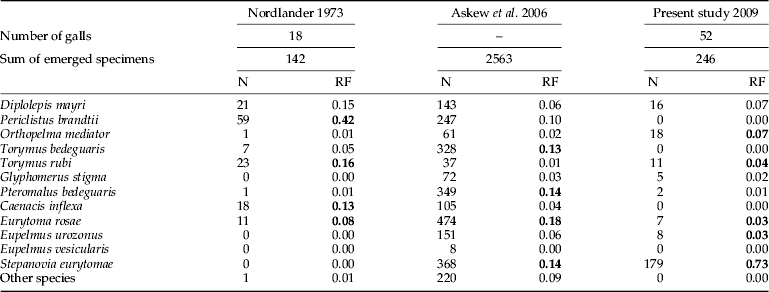
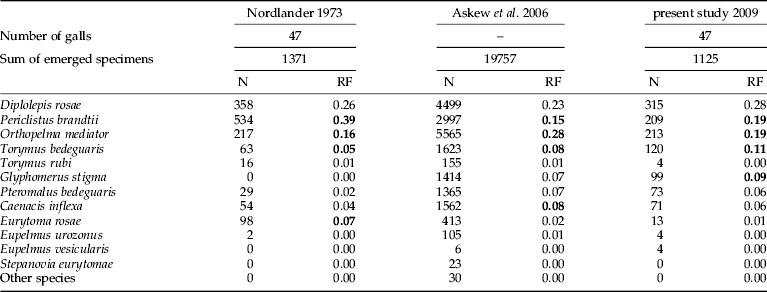
Both species harbour rich and similar parasitoid communities, and are also attacked by the cynipid inquiline Periclistus brandtii (tables 1 and 2; Stille, Reference Stille1984; Askew et al., Reference Askew, Gómez, Hernández Nieves and Nieves-Aldrey2006; László & Tóthmérész, Reference László and Tóthmérész2006). In Western Europe, Askew et al. (Reference Askew, Gómez, Hernández Nieves and Nieves-Aldrey2006) found 18 parasitoid species to be associated with D. rosae galls and 25 with D. mayri galls. The most abundant parasitoid species reported are Eurytoma rosae, Stepanovia eurytomae, Pteromalus bedeguaris and Torymus bedeguaris for D. mayri galls (table 1) and Orthopelma mediator, Torymus bedeguaris, Glyphomerus stigma and Pteromalus bedeguaris for D. rosae galls (table 2) (Askew et al., Reference Askew, Gómez, Hernández Nieves and Nieves-Aldrey2006). The parasitoid Caenacis inflexa exclusively attacks the inquiline Periclistus brandtii, whereas others (such as Torymus rubi, Eupelmus urozonus and Eupelmus vesicularis) can attack both gall inducers and the inquiline (Nordlander, Reference Nordlander1973; Askew et al., Reference Askew, Gómez, Hernández Nieves and Nieves-Aldrey2006). Baryscapus pallidae is present only in the galls of D. mayri. The remaining species are not characteristic of both species, and occur occasionally. According to Askew et al. (Reference Askew, Gómez, Hernández Nieves and Nieves-Aldrey2006), the two gall wasp hosts experience differing attack rates by some parasitoids; for example O. mediator seems to occur more frequently in galls of D. mayri than of D. rosae (tables 1 and 2).
Number of emerged specimens (N) and relative frequencies (RF) of species emerged from galls of Diplolepis mayri in our work and previously published studies. The relative frequencies of the most common species are indicated in bold.

Number of emerged specimens (N) and relative frequencies (RF) of species emerged from galls of Diplolepis rosae in our work and previously published studies. The relative frequencies of the most common species are indicated in bold.

Finally, the parasitoid communities of the two gall species can be divided into groups based on their seasonal phenology. While adults of some species emerge in April and May (e.g. O. mediator, Pteromalus bedeguaris, Periclistus brandtii, C. inflexa) and attack young galls, others emerge from the end of May through June and into July (e.g. T. bedeguaris and G. stigma) (László & Tóthmérész, Reference László and Tóthmérész2011) and attack more mature galls.
Specimen collection
In total 257 galls were collected in February and March of three years (2002, 2004, 2009) from six sites in Eastern Hungary and Transylvania, Romania (table 3). Sample sites were rose bushes in dry pastures or in forested pasture margins. Galls were reared individually indoors at 20–22 °C in plastic cups covered with cellophane to allow airing. Emerging insects were removed from rearings until November of each collecting year and stored in 70% ethanol until identification. Eulophidae were identified following Graham (Reference Graham1987), Pteromalidae following Graham (Reference Graham1969), Eupelmidae and Eurytomidae following Erdős (Reference Erdős1960) and Torymidae following Graham & Gijswijt (Reference Graham and Gijswijt1998). Orthopelma mediator was identified following Gauld & Mitchell (Reference Gauld and Mitchell1977), and gall inducers were identified based on gall structure and following Eady & Quinlan (Reference Eady and Quinlan1963). Periclistus brandtii was identified following Eady & Quinlan (Reference Eady and Quinlan1963). To allow and confirm emergence of all inhabitants, galls were dissected in the second year after collection.
Locations of collecting sites and the numbers of collected galls per species.

Measurements of gall morphology
All gall measurements were obtained after galls had been reared for the same period of time following collection, minimising artefactual differences in morphology associated, for example, with desiccation.
-
(i) Gall size: gall size was measured in terms of volume. Because galls are usually somewhat ellipsoid in shape, we calculated the gall mean diameter (mm) from the three orthogonal maximal diameters for each gall measured with a digital calliper, following Cooper & Rieske (Reference Cooper and Rieske2009, Reference Cooper and Rieske2010) before applying the formula for the volume of a sphere.
-
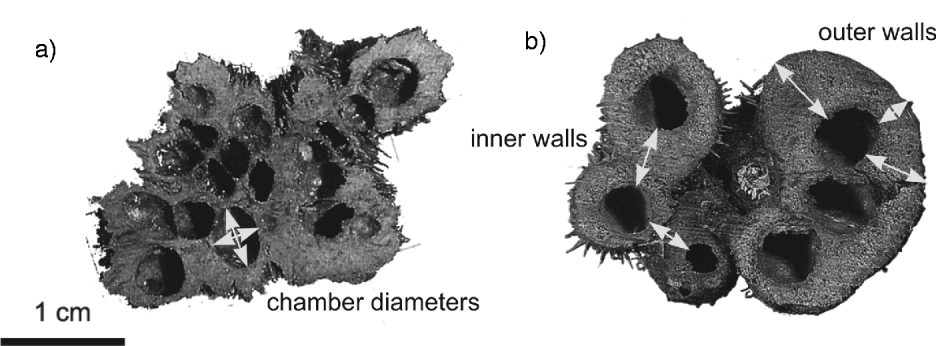
(ii) Gall chamber size and wall thickness: each reared gall was sectioned (width 5 mm) at least twice (depending on size) using a deep-frame fret saw and the number of larval chambers were counted. Each section was photographed on both sides (fig. 1), and the subsequent measurements were made using Winimag Version 1.0 software (Demeter et al., Reference Demeter, Vámosi, Peregovits, Topál, Marcus, Corti, Loy, Naylor and Slice1994). More detailed morphological data were obtained for 99 galls from the Cluj-Napoca site, with mean diameters of 24.8 ± 1.3 mm for D. rosae (mean 42.5 ± 6.3) and of 12.1 ± 0.5 mm for D. mayri (mean 4 ± 0.6).
Sections of galls of the two gall-inducer species, (a) Diplolepis rosae and (b) Diplolepis mayri, indicating key measurements.

Mean chamber size was estimated by obtaining the mean of the two largest orthogonal diameters for each chamber, and averaging these across all chambers in a gall (fig. 1). Mean wall thickness between chambers for a given gall was estimated as follows: for each outer gall chamber (see fig. 1) we measured thickness of the external gall wall for at least three points (fig. 1). Interior wall thickness was measured for at least one point between any two neighbouring chambers (fig. 1). For each gall, we then obtained the average of external and internal wall thicknesses. Overall, we made approximately 10,000 measurements for the 99 galls. We compared the relationship between gall size and chamber number for the Cluj-Napoca sample and the full sample of D. rosae to assess the representativeness of the smaller sample for other morphological measures.
Parasitoid incidence and attack rates
Community structure was quantified in terms of attack rates and the probability of presence/absence (=incidence) for each parasitoid species. Parasitoid attack rate was calculated as the ratio between the number of all emerged parasitoid specimens and the total number of inhabitants from the same gall. When considering the separate phenological groups of early and late emerging species, this was modified as follows: attack rate for the early group was calculated as the ratio between the number of specimens of O. mediator, Pteromalus bedeguaris, Periclistus brandtii, C. inflexa and the total number of inhabitants from the same gall; attack rate for the late group was calculated as the ratio between the number of specimens of T. bedeguaris, G. stigma and the total number of inhabitants from the same gall. Probability of parasitoid attack was defined as one if at least one parasitoid of a given species was present, and zero if no individuals of a given species emerged from a given gall.
Data analysis
Statistical analyses were carried out using R (R Development Core Team, 2011). Normality of data sets was analysed using a Kolmogorov–Smirnov test and by visual examination of normal probability plots. Homogeneity of variances was checked using an F-test. We performed nonparametric tests when assumptions of normality and equal variances did not hold. All descriptive statistics are given as a mean ± standard error.
The relation between the number of chambers in a gall and the gall's diameter was modelled by nonlinear regression. The ‘nls2’ package was used to estimate the parameters, the prediction and confidence intervals for the model. Determination coefficients of these relationships were calculated by linearising using log-log transformation and then performing linear regression. Regression slopes between larger and smaller (Cluj-Napoca) sample sizes were compared used ANCOVA on the log-log transformed data.
Morphological traits (chamber number, gall diameter, chamber diameter, inner wall thickness, outer wall thickness) of the two species were compared using the Welch t-test (or Wilcoxon nonparametric test). Comparison of gall morphological traits within galls (inner and outer wall thickness) was performed using a paired t-test. Correlations between the abovementioned gall morphological traits were examined using Pearson correlation, whereas those between morphological traits and parasitoid attack rates were analysed with Spearman's correlation coefficient.
The effects of gall morphological characteristics (chamber number, gall diameter, chamber diameter, inner wall diameter, outer wall diameter) on rate and probability of parasitoid attack were analysed by logistic regression (binomial generalised linear model (GLM) with ‘logit’ link). In the case of inner and outer wall diameter effect on probability of parasitoid attack we applied a control of galling species. This control was built in a logistic binomial GLM with ‘logit’ link.
Results
Relationship between gall chamber number and gall diameter
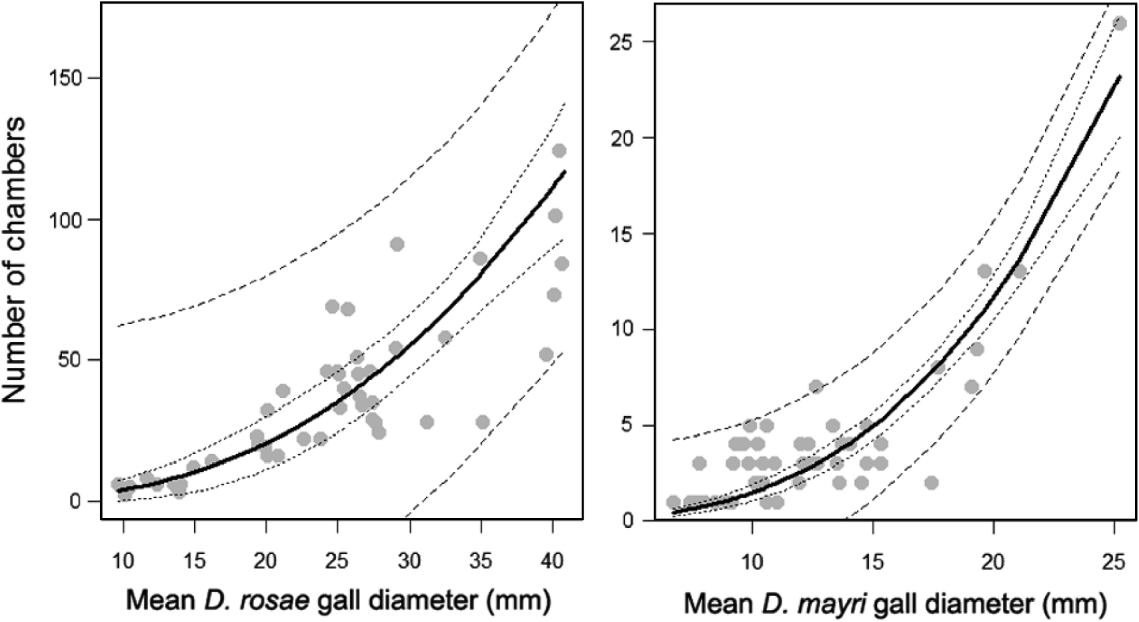
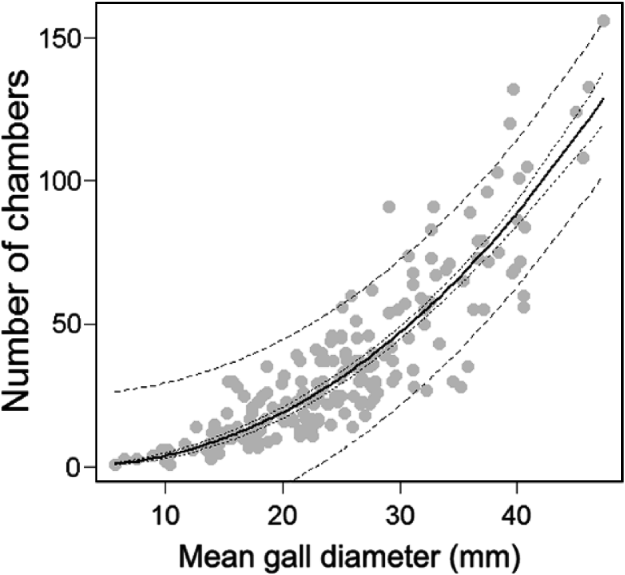
For the smaller (Cluj-Napoca) data set, we found nonlinear power relationships between gall size and the number of chambers (fig. 2) in both D. mayri (y = 0.001x 2.69 nonlinear least squares: β1 = 0.001, t = 1.6, P = 0.101, β2 = 2.969, t = 14.8, P < 0.0001, N = 52) and D. rosae (y = 0.013x 2.44 nonlinear least squares: β1 = 0.013, t = 0.7, P = 0.476, β2 = 2.449, t = 6.2, P < 0.0001, N=47). For D. mayri, mean gall diameter was 55% accurate in predicting gall chamber number (log-log linear regression: F 1,48 = 60.79, P < 0.0001, r 2 = 0.55, N = 52), whereas for D. rosae it was 81% (log-log linear regression: F 1,45 = 200.59, P < 0.0001, r 2 = 0.81, N = 47). The larger data set for D. rosae showed a very similar power relationship between number of chambers and gall size (fig. 3): y = 0.025x 2.21 (nonlinear least squares: β1 = 0.025, t = 3.1, P = 0.001, β2 = 2.214, t = 24.9, P < 0.0001, N = 205). The accuracy of prediction was again 81% (log-log linear regression: F 1,203 = 895.1, P < 0.0001, r 2 = 0.81, N = 205). We found no significant difference between the log-log linear regression slopes of the larger and smaller D. rosae samples (ANCOVA: t = − 0.17, P = 0.86, r 2 = 0.81, N = 205). We therefore consider measurements of other morphological variables for the smaller sample to be representative of the larger sample.
Gall chamber numbers as a function of gall size (mm) for D. rosae (N=47) and D. mayri (N=52). Dashed lines represent the 95% prediction, whereas dotted lines represent the 95% confidence intervals of the predicted values (continuous curve).

Relationship between mean gall diameter (mm) and gall chamber number for D. rosae (N=205). Dashed lines represent the 95% prediction, whereas dotted lines represent the 95% confidence intervals of the predicted values (continuous curve).

Inhabitants of the two gall inducers and diversity of the parasitoid communities
The D. rosae galls yielded a total of 1125 inquiline and parasitoid specimens (table 2), whereas D. mayri galls yielded 246 parasitoids and no inquilines (table 1). Galls of D. rosae yielded 11 species (the gall inducer, the inquiline Periclistus and nine parasitoid species), whereas galls of D. mayri yielded eight (the gall inducer and seven parasitoid species). Galls of D. rosae had a higher Shannon diversity than D. mayri galls (Wilcoxon test: z = 3.82, P < 0.0001, N D. rosae = 47, N D. mayri = 52).
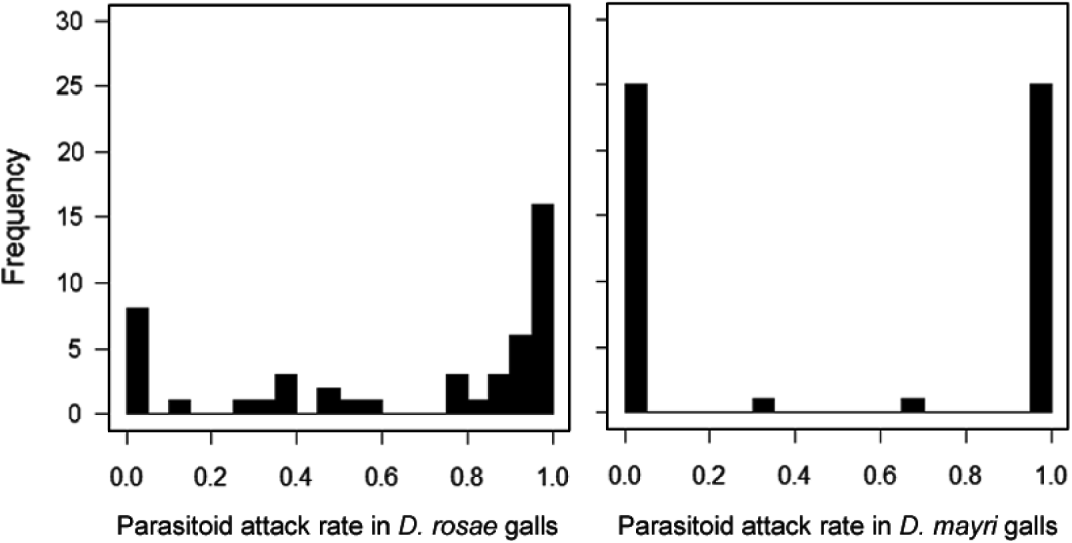
In D. rosae galls the average parasitoid attack rate by all species was 0.66 (SE = 0.05, N = 47), whereas for D. mayri galls the average value was 0.5 (SE = 0.07, N = 52). Rates of parasitoid attack showed a bimodal distribution, with peaks at low and high values: in most cases parasitoids were either absent or attacked almost all inhabitants (fig. 4), particularly in D. mayri galls. The probability of parasitoid attack was significantly higher for D. rosae galls (P(rosae) = 0.83) than for D. mayri galls (P(mayri) = 0.52) (logistic regression: z = 3.159, P = 0.0015, β = 1.50, SE = 0.47, N = 99).
The frequency distributions for parasitoid attack rate in the two Diplolepis species (N rosae = 47; N mayri = 52).

The most frequent parasitoids of D. mayri (table 1) were O. mediator, T. rubi, E. rosae, E. urozonus and Stepanovia eurytomae, with low abundance of G. stigma and Pteromalus bedeguaris and no records of T. bedeguaris, Periclistus brandtii, C. inflexa and Eupelmus vesicularis. In D. rosae galls (table 2), the most frequent parasitoids were O. mediator, T. bedeguaris and Periclistus brandtii, with moderate abundance of G. stigma and low abundance of Pteromalus bedeguaris, C. inflexa, Eupelmus urozonus, Eupelmus vesicularis, T. rubi and S. eurytomae.
Morphological characteristics of galls
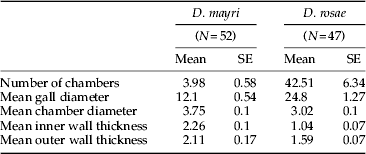
Morphological trait variation in the two galls is summarised in table 4. Diplolepis rosae galls contained significantly more chambers than galls of D. mayri (Wilcoxon-test: z = 7.10, P < 0.001, N D. rosae = 47, N D. mayri = 52) and were significantly larger (Welch t-test: t = 9.17, df = 62.29, P < 0.0001). Mean chamber diameters of D. rosae were significantly smaller than those of D. mayri (Welch t-test: t = − 5.24, df = 94.99, P < 0.0001), and the thickness of walls surrounding chambers was also lower in D. rosae (outer walls: Welch t-test: t = − 5.35, df = 86.91, P < 0.0001; inner walls: Welch t-test: t = − 5.11, df = 47.50, P < 0.0001). In D. rosae galls, inner walls were significantly thinner than outer walls (paired t-test: t = − 6.165, df = 46, P < 0.0001), whereas these showed no significant difference in D. mayri galls (paired t-test: t = 0.664, df = 39, P = 0.510). There was no significant correlation between inner wall thickness and gall diameter in D. mayri (P = 0.84, r = − 0.03, N = 52) or in D. rosae (P = 0.38, r = 0.12, N = 47). However, larger galls have thicker external walls in both species (D. mayri P = 0.01, r = 0.32, N = 52; D. rosae P = 0.0001, r = 0.52, N = 47). We found no correlation between larval chamber diameter and gall diameter in D. mayri galls (P = 0.86, r = 0.02, N = 52), whereas these were positively correlated in D. rosae galls (P = 0.002, r = 0.42, N = 47).
Averages and standard errors of morphological characteristics of the two Diplolepis species. All measurements are in millimetres (mm).

Gall morphology and parasitoid attack rates
In D. rosae, parasitoid attack rate per gall was negatively correlated with both gall diameter (P = 0.0039, Spearman rho = −0.41, N = 47) and the number of gall chambers (P = 0.0055, Spearman rho = −0.39, N = 47). No significant relationships were found for D. mayri galls (gall diameter: P = 0.27, Spearman rho = 0.15, N = 52; number of chambers: P = 0.41, Spearman rho = 0.11, N = 52). No significant relationships were found for either gall species between parasitoid attack rates and chamber diameter (D. rosae: P = 0.06, Spearman rho = −0.26, N = 47; D. mayri: P = 0.61, Spearman rho = −0.07, N = 52), inner chamber wall thickness (D. rosae: P = 0.30, Spearman rho = 0.15, N = 47; D. mayri: P = 0.16, Spearman rho = −0.22, N = 52) or outer chamber wall thickness (D. rosae: P = 0.21, Spearman rho = −0.18, N = 47; D. mayri: P = 0.43, Spearman rho = −0.11, N = 52).
Our division of parasitoids into early and late emerging sets of species revealed differences between these two groups in relationships with gall morphology. In D. rosae galls the attack rate of early emerging parasitoids showed no significant correlation with gall diameter (P = 0.12, Spearman rho = 0.23, N = 47), whreas attack rate of later emerging parasitoids showed a significant negative correlation (P < 0.001, Spearman rho = −0.55, N = 47) that was stronger than the correlation found for all parasitoids combined (Spearman rho = −0.41). The attack rate of earlier emerging parasitoids was also not significantly correlated with the number of gall chambers (P = 0.18, Spearman rho = 0.19, N = 47), whereas there was a significant negative correlation for later emerging parasitoids (P < 0.001, Spearman rho = −0.50, N = 47) that was again stronger than the correlation found in the case of the attack rate of the whole parasitoid community (Spearman rho = −0.39). Other morphologic parameters of the galls showed no significant differences between the attack rates of earlier and later emerging parasitoids.
Gall morphology and parasitoid attack probability
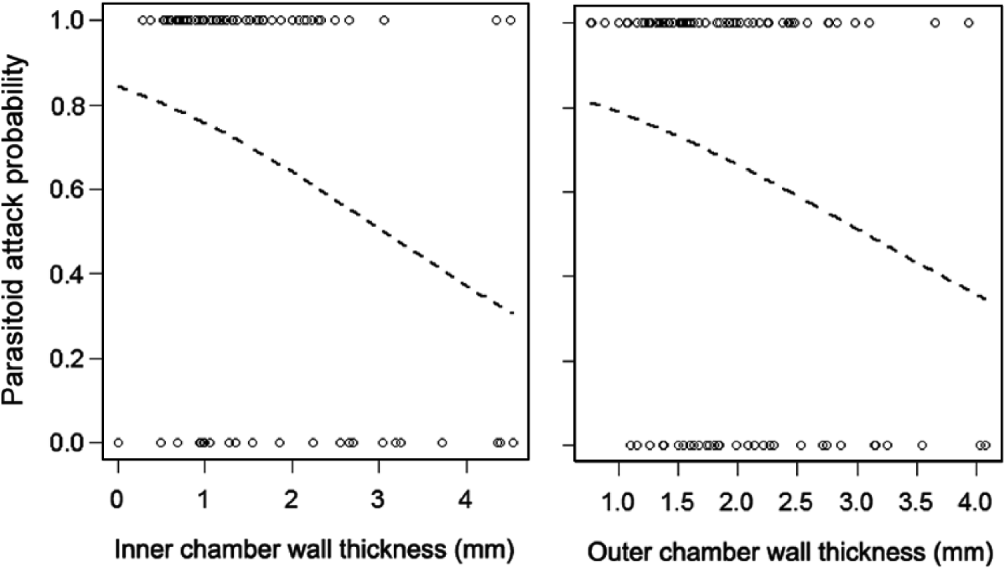
Across both gall species, gall diameter did not explain the probability of parasitoid attack (logistic regression: z = 1.887, P = 0.059, β = 0.05, SE = 0.027, N = 99), and neither did gall chamber number (logistic regression: z = 1.189, P = 0.231, β = 0.011, SE = 0.009, N = 99). Chamber diameter did not explain significant variation in the probability of parasitoid attack (logistic regression: z = − 1.797, P = 0.072, β = −0.546, SE = 0.304, N = 99). Both inner- (logistic regression: z = − 2.339, P = 0.019, β = −0.538, SE = 0.23, N = 99) and outer chamber wall thickness (logistic regression: z = − 2.41, P = 0.015, β = −0.823, SE = 0.341, N = 99) explained even after controlling with galling species significant variation in the probability of parasitoid attack (fig. 5).
The negative correlation between parasitoid attack probability (incidence) and chamber wall thickness across both Diplolepis species (mm) (N=99).

Discussion
A range of host gall traits has been shown to influence parasitoid community characteristics, including morphology (as considered here), phenology, relative abundance and host plant traits (e.g. see Bailey et al., Reference Bailey, Schönrogge, Cook, Melika, Csóka, Thuróczy and Stone2009). We found that increase in chamber number was associated with increased gall size in both D. mayri and D. rosae, and that in D. rosae both gall traits were negatively correlated with parasitoid attack – a fact that may underline a selection towards multiple founding (Atkinson et al., Reference Atkinson, McVean and Stone2002). We also found differences between the parasitoid communities associated with the two gall wasp species. We place these patterns in their broader context below.
Morphological characteristics of galls
Work on cynipid oak galls has demonstrated correlations between gall morphology and parasitoid community structure (Bailey et al., Reference Bailey, Schönrogge, Cook, Melika, Csóka, Thuróczy and Stone2009). Gall hairiness was one significant morphological character. Galls of D. rosae and D. mayri also differ in their outer structures: galls of D. rosae have a dense coating of branched hairs, whereas galls of D. mayri have a sparse coating of stiff spines. The outer hairy cover may be a more effective defence against parasitoids, compatible with the lower community species diversity for D. rosae reported by Askew et al. (Reference Askew, Gómez, Hernández Nieves and Nieves-Aldrey2006). Gall size is another significant morphological character reported by Bailey et al. (Reference Bailey, Schönrogge, Cook, Melika, Csóka, Thuróczy and Stone2009). We found D. rosae galls to be larger, and with more chambers per gall, than D. mayri galls. If increased gall size excludes some parasitoids, this difference could explain the lower parasitoid community species richness observed in D. rosae by Askew et al. (Reference Askew, Gómez, Hernández Nieves and Nieves-Aldrey2006). However, although our study can assess whether the same traits are correlated with enemy attack in closely related species, it does not have statistical power to explain differences between them; this requires a multispecies comparative approach (Bailey et al. Reference Bailey, Schönrogge, Cook, Melika, Csóka, Thuróczy and Stone2009).
Chamber size and wall thickness delivered contrasting results. In D. rosae, but not D. mayri, larval chamber diameter increased with gall size. In the case of the thistle gall fly, Urophora cardui, galls on creeping thistle, Cirsium arvense, mean larval weight increased with gall size and was in turn positively correlated with the survival rate of emerging females (Freese & Zwölfer, Reference Freese and Zwolfer1996). It is interesting that even closely related Diplolepis species differ in another morphological trait relationship that is likely to be related to fitness difference considering a characteristic that is presumably linked with survival rate. Outer wall thickness increased with the increasing gall size and was significantly thicker in D. mayri than D. rosae. This suggests that outer wall thickness rather than overall gall size may be a target of stronger selection in D. mayri – as noted for Eurosta galls on goldenrod, Solidago, under attack by Eurytoma parasitoids (Weis et al., Reference Weis, Abrahamson and McCrea1985).
Species richness and diversity of the two parasitoid communities
Previous data on community diversity found galls of D. mayri to harbour more species than galls of D. rosae (Nieves-Aldrey, Reference Nieves-Aldrey1983; Nieves-Aldrey & Askew, Reference Nieves-Aldrey and Askew2002; Askew et al., Reference Askew, Gómez, Hernández Nieves and Nieves-Aldrey2006; Gómez et al., Reference Gómez, Hernández Nieves, Garrido Torres, Askew and Nieves-Aldrey2006). Although our study also found parasitoid community diversity to differ between the two galling species, our data contrast with previous surveys in finding lower community diversity in D. mayri galls. These data suggest that contrasts in communities among even closely related species can vary across populations sampled, regardless of consistent differences in host traits such as gall morphology. Further examination of the impact of gall phenotype on communities should thus incorporate such variation through larger-scale sampling based on standardised quadrat sampling and collection of host plant data in combination with local subsampling (see methodology in László & Tóthmérész, Reference László and Tóthmérész2011).
Previous studies also found the two galls studied to differ in the relative frequencies of emerging parasitoid and inquiline species (Nordlander, Reference Nordlander1973; Askew et al., Reference Askew, Gómez, Hernández Nieves and Nieves-Aldrey2006). In common with previous work on D. rosae, we found O. mediator and T. bedeguaris to be the most frequent parasitoid species (table 2). The inquiline Periclistus brandtii was relatively frequent. Common species such as Pteromalus bedeguaris, G. stigma, Eurytoma rosae and C. inflexa vary in relative frequency across studies, whereas Eupelmus urozonus, Eupelmus vesicularis, T. rubi and S. eurytomae are generally less abundant (table 2). In the D. mayri community only Eurytoma rosae was consistently abundant (table 1). Askew et al. (Reference Askew, Gómez, Hernández Nieves and Nieves-Aldrey2006) found the commonest species to be Eurytoma rosae, S. eurytomae, Pteromalus bedeguaris and T. bedeguaris, with fewer O. mediator and G. stigma. Nieves-Aldrey (Reference Nieves-Aldrey1983) found the most frequent species to be T. bedeguaris, C. inflexa, Eurytoma rosae and E. urozonus, whereas in Nordlander (Reference Nordlander1973) P. brandtii, T. rubi, Eurytoma rosae and C. inflexa were most frequent. Our results indicate that O. mediator, T. rubi, Eurytoma rosae, Eupelmus urozonus and S. eurytomae were the most frequent species (table 1).
A factor to be considered in addition to gall morphological traits as possible causes of observed differences in community structure between Diplolepis species is the fact that D. mayri in general has a patchier distribution than D. rosae. Such patchiness may provide a metapopulation structure allowing temporal and spatial escape from natural enemies (Washburn & Cornell, Reference Washburn and Cornell1981; Shorthouse, Reference Shorthouse, Shorthouse and Floate2010).
Effects of gall morphology on parasitoid attack rates
A fundamental property of surface area to volume ratios is that as gall size increases, so a decreasing proportion of host larval chambers are present on the outer surface of the gall. For parasitoids whose access to hosts is limited by ovipositor length, this means that with increasing gall size a decreasing proportion of potential hosts are available for attack. Our data suggest that in D. rosae galls this is relevant primarily for those parasitoids that emerge later (Torymus bedeguaris, Glyphomerus stigma) when galls are well developed, and which also attack well-developed galls. These are the enemies most likely to be engaged in arms race coevolution with mature gall morphology. By contrast, the earlier emerging community members that emerge together with the gall inducers (e.g. the parasitoid O. mediator, and the inquiline Periclistus brandtii) lay their eggs in the undeveloped galls. They are thus either unrestricted by ovipositor length or sensitive to early gall size variation, and so decoupled from mature gall size (László & Tóthmérész, Reference László and Tóthmérész2011).
Our data revealed different patterns of correlation between gall traits and parasitoid attack rates in the two Diplolepis species. Although other studies on D. rosae have reported declining rates of parasitoid attack with increasing gall size (Stille, Reference Stille1984; László & Tóthmérész, Reference László and Tóthmérész2008), no previous study had examined D. mayri. Diplolepis rosae had larger galls than D. mayri, and attack rates were negatively correlated with parasitoid attack in D. rosae. Diplolepis mayri had thicker chamber walls than D. rosae, and although there was no significant correlation between attack rates and wall thickness within D. mayri, this species experienced a lower overall attack rate than D. rosae. Similar decline in parasitoid attack rate with increase in gall size and chamber number has been documented in the chestnut gall wasp, Dryocosmus kuriphilus (Cooper & Rieske, Reference Cooper and Rieske2010), a galling tephritid fly, Urophora cardui (Freese & Zwölfer, Reference Freese and Zwolfer1996; Frenzel et al., Reference Frenzel, Eber, Klotz and Brandl2000) and a tenthredinid sawfly, Euura lasiolepis (Price & Clancy, Reference Price and Clancy1986). In a study of the oak gall wasp, Aphelonyx glanduliferae, by Ito and Hijii (Reference Ito and Hijii2004), increasing chamber diameter reduced the rate of parasitoid attack. Our results concerning the reduced probability of attack comply with previous findings for Eurosta solidaginis galls, in which the increase in gall wall thickness reduced the incidence of parasitism by Eurytoma gigantea (Weis et al., Reference Weis, Abrahamson and McCrea1985).
Summary
We have shown that differences in morphology between galls of two species are consistent with the enemy hypothesis: parasitism rates were sensitive to gall size and to chamber wall thickness. Further, early- and late-attacking parasitoids differed in their responses to gall traits in a way that is consistent with the gall phenotypic traits they encounter. Deeper understanding of Diplolepis-centred communities should target generation of compatible quantitative data sets in a phenotypically diverse array of populations and/or species.
Acknowledgements
The authors are indebted to Graham Stone for his extensive and exhaustive review of the manuscript and his valuable comments and suggestions. We also thank an anonymous reviewer for his valuable comments. Authors are grateful to Tamás Varga, László Kereki, Mónika Peleski and Éva Papp for their help during the field and laboratory work. The work of Z. László was supported by CNCSIS-UEFISCSU (project number PN II-RU 413/2010) and by TÁMOP for B. Tóthmérész. The work is supported by the TÁMOP 4.2.1./B-09/1/KONV-2010-0007, and TÁMOP-4.2.2/B-10/1-2010-0024 projects.