


1. Introduction
Countries around the world face the challenge of providing timely access to safe and effective medicines at a price that both individuals and the broader community can afford. Systems for registering and reimbursing medicines have been established in an attempt to strike the balance between facilitating access to medicines while also protecting patients from harm and ensuring the sustainability of health systems. However, in recent years there has been increasing concerns about these processes – particularly with respect to the degree to which they support or hinder access to medicines. In particular, patients with limited life expectancy argue that they should not have time to wait for the generation of evidence of an acceptable standard to regulators and payers and are increasingly demanding the ‘right to try’ experimental therapies. Similarly, patients with rare diseases, or rare subsets of more common diseases, argue that existing requirements for evidence of efficacy and cost-effectiveness are too rigid when research participant populations and markets are unavoidably small (Pace et al., Reference Pace, Ghinea, Kerridge and Lipworth2017a).
A number of mechanisms exist to provide patients with access to medicines that have not yet been registered or approved for public subsidy. These include participation in clinical trials, special consideration from regulatory bodies to use unapproved medicines, personal importation, or travel overseas to seek treatment to gain access to treatments that have not yet received regulatory approval, hospital- or industry-funded compassionate access schemes, and private health insurance for medicines that are not yet publicly funded (Pace et al., Reference Pace, Ghinea, Kerridge and Lipworth2018). In the United States, ‘right to try’ legislation has also been introduced at both the state and federal levels (Bateman-House et al., Reference Bateman-House, Kimberly, Redman, Dubler and Caplan2015; Bateman-House and Robertson, Reference Bateman-House and Robertson2018), although its impact on access to medicines is questionable as the final decision about whether to provide a drug rests with the pharmaceutical manufacturer, regardless of what patients or doctors want.
While all of these mechanisms can facilitate access to medicines, they are not equally accessible to all patients. As a result, there has been a global move towards so-called ‘accelerated access’ pathways, which are formal programmes that speed up access to medicines at the pre-marketing authorisation (or registration) stage, or at the post-marketing authorisation (or reimbursement) stage. There are many different kinds of accelerated access initiatives, with some simply speeding up registration or funding processes (prioritisation initiatives), and others bypassing existing processes and/or change the evidentiary requirements and thresholds for regulatory approval and funding (Pace et al., Reference Pace, Ghinea, Kerridge and Lipworth2018). One approach that is gaining traction internationally is conditional registration and reimbursement [the latter is sometimes referred to as coverage with evidence development (CED), a type of managed entry scheme]. This allows medicines to be registered or funded on the basis of less rigorous standards of evidence – including earlier clinical trial phases or surrogate endpoints – on the condition that further data on safety, efficacy, and/or cost-effectiveness will be gathered once the therapy reaches the market. These data – which may be gathered through clinical trials or, increasingly, through the generation of ‘real world evidence’ – are then used to inform whether the medicine should remain on the market and/or continue to be subsidised and, if so, at what price. Conditional registration mechanisms have been introduced in the United States (Food and Drug Administration, 2016), Canada (Lexchin, Reference Lexchin2015), and the European Union (Boon et al., Reference Boon, Moors, Meijer and Schellekens2010). Similarly, a number of jurisdictions, including the United States (Mohr and Tunis, Reference Mohr and Tunis2010), United Kingdom (Pickin et al., Reference Pickin, Cooper, Chater, O'Hagan, Abrams, Cooper, Boggild, Palace, Ebers, Chilcott, Tappenden and Nicholl2009), Canada (Levin et al., Reference Levin, Goeree, Levine, Krahn, Easty, Brown and Henry2011), Italy (Pauwels et al., Reference Pauwels, Huys, Vogler, Casteels and Simoens2017), Switzerland (Brugger et al., Reference Brugger, Horisberger, Ruckstuhl, Plessow, Eichler and Gratwohl2015), and Australia (Vitry and Roughead, Reference Vitry and Roughead2014) have introduced CED schemes.
Given their increasing reach, there is growing interest among researchers in the uptake of accelerated access mechanisms, in their effects on access to medicines, and in the ways in which data about safety, effectiveness, and cost-effectiveness is (or is not) subsequently collected. Most research in this area has aimed to characterise the existing schemes in terms of the drug classes that have been approved, the types of evidence that have been used to support decisions, the types of agreements that have been reached, the post-approval research that has (or has not) been conducted, and the safety and efficacy of provisionally approved medicines (including Jaroslawski and Toumi, Reference Jaroslawski and Toumi2011, Downing et al., Reference Downing, Aminawung, Shah, Krumholz and Ross2014, Banzi et al., Reference Banzi, Gerardi, Bertele and Garattini2015, Lexchin, Reference Lexchin2015, Lu et al., Reference Lu, Lupton, Rakowsky, Babar, Ross-Degnan and Wagner2015, van de Vooren et al., Reference van de Vooren, Curto, Freemantle and Garattini2015, Downing et al., Reference Downing, Shah, Aminawung, Pease, Zeitoun, Krumholz and Ross2017, Naci et al., Reference Naci, Smalley and Kesselheim2017, Pauwels et al., Reference Pauwels, Huys, Vogler, Casteels and Simoens2017). Conceptual work (such as Hutton et al., Reference Hutton, Trueman and Henshall2007; Garrison et al., Reference Garrison, Towse, Briggs, de Pouvourville, Grueger, Mohr, Severens, Siviero and Sleeper2013) has also begun to explore potential problems and guiding principles when implementing these schemes.
However, to date, there has been minimal research into the beliefs and attitudes of stakeholders regarding these schemes. To the extent that such research has been conducted, it has focused on the views of members of decision-making committees, policymakers, and researchers (Bishop and Lexchin, Reference Bishop and Lexchin2013; Brugger et al., Reference Brugger, Horisberger, Ruckstuhl, Plessow, Eichler and Gratwohl2015); little is known about the views of other stakeholders – including physicians. This is an important lacuna because patients' access to approved medicines is mediated by physicians who act both as gatekeepers and as guides. It is therefore important to know how physicians think about accelerated access to medicines.
To address this gap, we conducted a qualitative study of the attitudes of Australian physicians towards accelerated access initiatives. The research questions we sought to answer are: (1) What are the beliefs and values of Australian physicians with regards to accelerated access schemes and (2) How (if at all) do specific factors (such as disease rarity, innovativeness of the therapy, use of the medicine in children, disease prognosis, and other available treatment options) affect these attitudes?
2. Methods
2.1 Study setting
The Australian health care system is complex, with responsibilities split between state and federal governments and public and private sectors. The main funder of health care in Australia is the federal government through its universal health insurance scheme known as Medicare. This is funded through the taxation system and provides free or subsidised access to both medical services through the Medical Benefits Schedule (MBS) and prescribed medicines through the Pharmaceutical Benefits Scheme (PBS). Voluntary private health insurance is available in Australia but does not cover any PBS-listed medicines.
Australia has a two-stage system to mediate access to pharmaceuticals (Gallego et al., Reference Gallego, Taylor and Brien2007). Before a medicine can be marketed, it must first be evaluated for quality, safety, and efficacy by Australia's regulatory agency, the Therapeutic Goods Administration (TGA). The Advisory Committee on Medicines (ACM) advises the TGA on whether or not a product should be registered for use. Once a medicine has been registered by the TGA, the manufacturer can then apply to have it listed on the PBS in order to facilitate patient access. The Pharmaceutical Benefits Advisory Committee (PBAC) assesses all applications for PBS listing and makes recommendations to the Commonwealth Minister for Health about which medications should be subsidised. In making an assessment, the PBAC considers the safety, efficacy, cost-effectiveness, and estimated budget impact of the medicine, as well as the quality of supporting evidence for each of these factors. If a medicine is PBS-listed, patients pay up to a specified co-payment each time the medicine is dispensed (in 2019 this was $40.30, reduced to $6.50 for people receiving income support payments). If the medicine is registered by the TGA but not listed on the PBS, it can still be prescribed; however, patients need to find other ways to cover the cost of the drug (Gallego et al., Reference Gallego, Taylor and Brien2007).
In recent years, Australia has introduced a number of accelerated access initiatives. In 2018, the country's first formal conditional registration mechanism – the TGA's Provisional Approval Pathway – came into effect (Therapeutic Goods Administration, 2018) and in July 2019 pembrolizumab (Keytruda) became the first medicine to have additional indications (treatment of metastatic bowel cancer and other solid tumours with mismatch repair deficiency mutations) approved under this pathway (Therapeutic Goods Administration, 2019). In early 2011, the PBAC introduced a ‘Framework for the Introduction of a Managed Entry Scheme’, allowing medicines to be funded using CED. A number of medicines – including crizotinib for the treatment of locally advanced or metastatic non-small cell lung cancer and pembrolizumab and trametinib for the treatment of unresectable stage 3 or 4 malignant melanoma – have since been funded using this mechanism (Pace et al., Reference Pace, Ghinea, Kerridge and Lipworth2017a). Additionally, the TGA and PBAC have parallel process mechanisms in place, which allow registration and reimbursement assessment processes for certain medications to be undertaken in parallel, rather than sequentially (Australian Government Department of Health, 2019). There have also been recent changes to the Special Access Scheme (SAS), which allows for the importation and supply of unapproved therapies at the request of the patient's physician. These changes have included the creation of a list of unapproved medicines that have been deemed to have an established history of use and therefore do not require pre-approval before importation and an online approval portal (Therapeutic Goods Administration, 2017) – both of which aim to provide patients with faster access to unapproved medicines.
2.2 Data collection and analysis
We conducted 18 interviews with Australian physicians working primarily in large urban centres in a range of specialties including oncology (8), haematology (1), infectious diseases (3), palliative care (2), general practice (2), psychiatry (1), rheumatology (1), and paediatrics (1) (one participant specialised in both oncology and palliative care). Participants were recruited using a combination of sampling methods, including convenience and snowball sampling and unsolicited emails to experts with relevant professional backgrounds. All participants were emailed participant information statements and consent forms as part of the invitation to participate and provided either signed consent forms or recorded verbal consent prior to commencing the interview. Semi-structured interviews were conducted by JP (either over phone or face-to-face) and lasted between 30 and 75 min. Hypothetical case studies were used to prompt discussion and explore physicians' values and beliefs with regards to accelerated access to medicines, both in terms of the regulatory safety approval and approval for government funding. Additionally, the research team identified a number of potential ethical and political issues (such as the potential for benefit and harm, sustainability of health care systems, opportunity costs, and impacts on current systems of knowledge generation) associated with conditional registration and reimbursement mechanisms, which were used as prompts in the interviews. If participants did not mention these issues spontaneously, they were asked for their opinions about them (see online supplementary material for further details). Interviews were recorded (with the participants' permission) and transcribed verbatim. See online supplement for the full interview guide.
An inductive approach – informed by Morse's outline of the cognitive basis of qualitative research (Morse, Reference Morse and Morse1994) and Charmaz's outline of data analysis in grounded theory (Charmaz, Reference Charmaz2006) – was taken to data analysis. This involved initial coding via line-by-line analysis; synthesis of codes into categories; focused coding using these categories; and abstraction into analytic concepts. A process of constant comparison was used, with continual refinement and enrichment of codes. Data analysis continued until categories were saturated (i.e. all codes appeared to fit under one or more of the existing categories and all concepts were fully described and well-understood). Emergent material was then arranged to answer the research questions. All interviews were analysed, and thematic saturation was reached after approximately 10 interviews. Transcripts were coded by JP and detailed discussion amongst the authors was used to test and refine emergent codes, categories, and concepts.
The study was approved by the University of Sydney's Human Research Ethics Committee (protocol number 2016/528).
3. Results
3.1 Participants' attitudes towards accelerated access
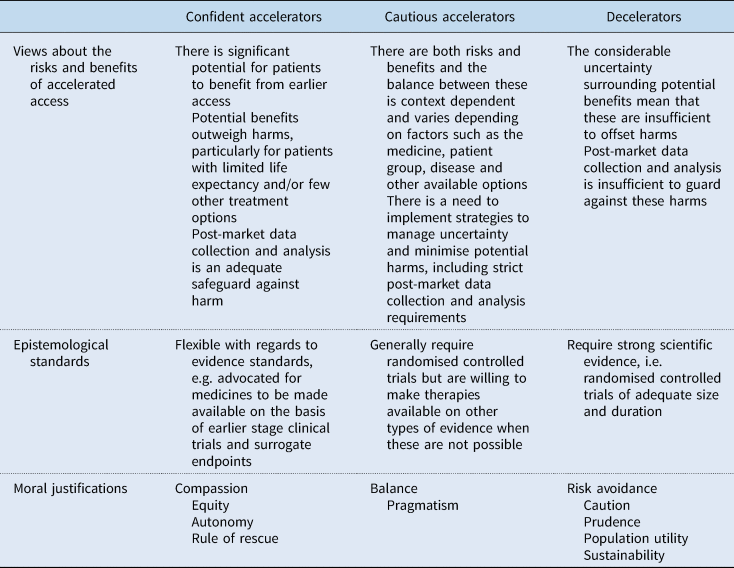
Participants fell into three broad ‘archetypes’ based on their views regarding accelerated access. The first group, who were supportive of accelerated access initiatives and eager for new medicines to be made available earlier, were categorised as ‘confident accelerators’. The second group of participants, who expressed significant concerns about the potential risks of accelerated access and advocated for the existing regulatory and reimbursement standards to be maintained or strengthened, were categorised as ‘decelerators’. The third group of participants – who expressed cautious optimism towards accelerated access, accepting that it may be useful in certain instances but advocating that it should not be the standard approach to medicines regulation and funding – were classified as ‘cautious accelerators’. These positions are outlined in Table 1 and explored in more detail below. Importantly, while most participants were consistent in their views regarding registration and reimbursement, there were a few participants who were ‘confident accelerators’ in terms of market access but ‘cautious accelerators’ in terms of reimbursement.
Overview of the three ‘types’ of accelerators

3.1.1 Confident accelerators
One group of participants was very supportive of accelerated access. They saw this as an important way to facilitate access to medicines – particularly for patients with rare diseases or rare subsets of common diseases, as it is more difficult for them to meet the evidentiary and cost-effectiveness thresholds of regulators and payers. With respect to market access, these participants argued that it is unfair that a patient may have exhausted all available treatment options and not be able to access unregistered options – particularly when a potentially beneficial medicine is available overseas but not yet registered in Australia. With respect to reimbursement, this group of participants emphasised the need for fairness in terms of what subsidised therapies patients can gain access to, irrespective of personal resources:
[I]f you're wealthy you will get that drug. You will get it next week. Not in a month, not in six months, you will get it next week. And if you're not wealthy, you will never get it in Australia and you will die of your metastatic endometrial cancer. And…in two or three years' time it might be okay, but what do we do today? P110117
Confident accelerators acknowledged the increased risk of harm if medicines are allowed onto the market and funded earlier – both for individual patients and the broader community – but argued that this potential risk was outweighed by the potential benefits of earlier access to medicines, particularly for patients with limited life expectancy.
[T]he downside of this new class of medications (is) obviously the longer time safety profile, so all of a sudden everyone just died in year 5 from myelo-leukemia or something and then that's on your mind…But very often the argument is made, well do you worry about the dying of a condition you might not even get in five years’ time or dying next week if you don't get this. This is what happens when you are making those decisions… You don't have it today you are dead, and it doesn't matter what happens in five years’ time. P080317
They also argued that risk was mitigated by the capacity for patients and their treating clinicians to weigh the potential risks and benefits and choose the most appropriate option in a particular situation.
Many confident accelerators expressed the view that current systems – both for registration and reimbursement – place too great an emphasis on protecting patients and society and that there should be an increased focus on facilitating timely access to important new therapies. They emphasised that the needs of current patients should not be sacrificed in order to protect future ones and noted that all patients pay for public insurance through the tax system and should therefore be able to receive subsidised access to treatment that they need.
I believe that the job of the regulator and the reimbursement system…is to find ways of getting important new drugs…to patients with life-threatening illnesses, as soon as possible. Not how do I spend taxpayers’ money wisely. P110117
With regards to the standards of evidence required for registration and reimbursement of medicines, confident accelerators advocated for medicines to be allowed onto the market on the basis of early phase trials (i.e. they did not require large randomised phase 3 trials) or surrogate endpoints, such as progression-free survival, which they regarded as scientifically valid and clinically meaningful.
DFS [disease free survival) is a valid end point in its own regard…[I]f you sit in front of a patient and say your tumour has shrunk by half, it has responded, which is part of progression-free, and you do that again three months later, and you do it again three months later and say the tumour is still small and it hasn't grown, for those patients that's a very important outcome…But the implication is that it's just a surrogate, it doesn't mean anything. P110117
They also advocated for regulators and funders to take a ‘totality of evidence’ approach when making decisions about the availability of new medicines:
I sort of like the way the FDA tend to think about this…the FDA have the attitude of not setting rules for what would be required to get a drug approved with that scenario – what they'd say is you show us the data when you've got it and we'll have a look at it. And that's to bring in all the nuances of what's the safety, how good is the efficacy, and is there long-term durable health benefits, all these factors that all have to come together on a case by case basis. P112317
For confident accelerators, ongoing data collection and analysis was seen to be essential to the success of both accelerated regulatory and funding initiatives and for mitigating potential harms. Most participants expressed the belief that this data collection would provide useful information upon which to base regulatory, subsidy and clinical decisions and could also lead to more efficient health care delivery and savings to the health care system.
Importantly, confident accelerators were satisfied that companies would collect this data in a timely manner, that it would be of sufficient quality, and that regulatory bodies would be willing and able to act swiftly and decisively upon this information if therapies proved to be less safe and/or effective or cost-effective than initially thought.
[T]he drug should be approved] under one condition, and that is that [if] it doesn't meet its survival end point subsequently…the approval for the drug can be withdrawn. And that would be a condition that's non-negotiable. They couldn't appeal, they couldn't do anything. P080917
3.1.2 Decelerators
A second group of participants were very resistant to accelerated access initiatives. They emphasised that the need to protect both patients and health care systems is paramount and expressed concerns about the increased risk of harm from earlier market access – both from medicine-related harms that were not detected in clinical trials and exposure to ineffective therapies.
I think you get into quite difficult territory from giving people promises of extended life and so forth, when we haven't actually got the evidence. You're not always sure what you are going to be exposing people to if you haven't got the full set of evidence, then they will be unpredictable things that are going to happen, the person might be worse off. People never think that, they always think they'll be the 1% that might do better. And there's a potential for doing a lot of harm, and a potential for doing good is probably fairly marginal. P081817
They also expressed concern that accelerated access programmes may diminish the evidence available to clinicians and patients and ultimately increase the risk of harm that may result from inadequate testing.
I actually need to know enough to feel confident that this patient in this circumstance, in this context, actually will benefit from the use of this drug. And if we haven't got enough data for me to confidently make that decision, or at least offer that to the patient, then there's some disadvantage to me as well. So I guess I have concerns not just for the patient but also for me as the prescriber. P083117
In terms of reimbursement, decelerators were very reluctant to spend public money on medicines where there is considerable uncertainty surrounding their risks and benefits. They emphasised the high cost of many new therapies and the associated opportunity costs and threats to system sustainability.
For the PBS this is hugely expensive, it skews their budget in every possible way. And there's a limited resource. So it's hugely disadvantageous for the PBS. Just to pause on that though, the difficulty too is that the PBS is a body that is funded by the community. So in being disadvantageous for the PBS, it's also disadvantageous for the community more broadly. P083117
While this group did acknowledge that there are patients whose needs are not met by current regulatory and reimbursement systems, they felt that the potential benefits of accelerated access do not outweigh the considerable costs and risks.
I don't think it makes sense to introduce more uncertainty and more dangers into the system to try and circumvent those tragedies, when it's not at all clear that you would actually do any good. P081817
With respect to evidentiary standards, decelerators were not comfortable with allowing medicines onto the market on the basis of earlier clinical trials or surrogate endpoints. Instead, they advocated for regulatory agencies to maintain (or in some cases strengthen) their current standards and insisted upon the need for medicines to be approved and funded on the basis of phase 3 randomised controlled trials of adequate size and duration in order to adequately protect patients and health care systems.
For participants in this group, ongoing data collection was not seen to be a sufficient safeguard against potential harms of access to medicines on the basis of lower levels of evidence. This was due both to questions about the willingness of pharmaceutical companies to collect required data once a therapy was on the market and concerns about the ability and willingness of regulatory bodies to police data collection and take decisive action on these data once it is available. Additionally, decelerators questioned the quality of data that would be collected.
I would be reluctant just to leave all the data collection in the hands of the company, because I have lots of examples, particularly with psychiatric drugs that have come into the public domain where the side effects get massaged, harms get massaged and so forth. So I would ideally like the condition to be that the patients are on an independently-run trial so that there's confidence in the data that's collected. P081817
Some decelerators also proposed that patients who do not have access to proven therapies should be a more pressing issue for regulators and funders. In this regard, they were concerned about patients who are socially disadvantaged, patients who rely on older treatments (e.g. therapies for tuberculosis or medicines used in palliative care) and patients who need treatments that are registered overseas but not in Australia or registered but not subsidised.
I just think we get way too many drugs that don't actually work particularly well, and the commercial drivers have really biased the range of treatments that we have on offer, to the detriment of the public health. So I've got quite a degree of scepticism about the need to rush new drugs to market, because I think they often don't deliver. P081817
This group also expressed discomfort about providing further support to pharmaceutical companies by facilitating the registration and reimbursement of their products. They emphasised the high profits enjoyed by pharmaceutical companies and viewed accelerated access schemes as a way for pharmaceutical companies to avoid their research and development responsibilities.
This is simply a way pharmaceutical companies just making their way out of the deal, and that infuriates me. They make a lot of money…they don't need our help. P083117
3.1.3 Cautious accelerators
A third group of participants represented a ‘middle ground’ between the two other positions. Like those opposed to acceleration, they stated that they were generally satisfied with current regulatory and reimbursement systems and accepted that Australian patients may not get access to all new medicines at the same time as patients overseas. They also emphasised that many new medicines have questionable benefits and did not feel that patients are severely disadvantaged by not having immediate access to these. However, unlike those strongly opposed to acceleration they accepted that accelerated access schemes may be warranted to help some patients. This included patients who had exhausted all treatment options, those with rare diseases and people with limited life expectancy who had tried all potential treatments.
Even in these circumstances, however, they advocated for a number of conditions to be imposed on access. First, they emphasised that patients should not be given entirely unrestricted access to new therapies. Instead, there must be ongoing data collection – either through simultaneous clinical trials or post-market collection of real world data – to ensure that we are always adding to the knowledge base available for all patients. They also advocated for prescribing of conditionally approved medicines to be restricted to specialist prescribers who are suitably informed in their use and specialist centres that have the resources to complete any required ongoing data collection and adequately manage any unexpected adverse effects.
It probably needs to be done very much on a person by person basis with the doctor knowing all of the facts and explaining them in detail to the patient rather than just being available for anyone to prescribe. So you would assume it would be a specialist with experience in treating this particular disease, and the patient with an understanding of the limitations and willing to take a risk on the assumption that there will be short term benefits in outcome which may or may not translate into prolonged life. P082417
Cautious accelerators also emphasised that accelerated access schemes should not be used for all new medicines and especially not for medicines from a class that is already well-established in clinical practice (so-called ‘me-too’ drugs) and/or where patients have a number of treatment options available. Instead, they should only be used for medicines which have shown promising early results in trials and meet an unmet need.
This group of participants was generally willing to consider a broader range of outcomes when making regulatory and reimbursement decisions. They noted that clinical experience, opinions of experts in the field, lower levels of evidence such as case series, and decisions of overseas regulators could all provide useful information on therapies. However, they emphasised that if a medicine is to be approved on the basis of a surrogate endpoint, it must be rigorously validated and there must be a clear correlation between the surrogate and longer term, more durable, outcomes such as overall survival.
Finally, cautious accelerators emphasised the need for a clear plan for how medicines that receive early market access and/or conditional reimbursement are to be evaluated and the conditions under which market access or subsidy would be continued or removed. More specifically, this would include definition of the treatment effect needed for it to remain on the market, the level of cost-effectiveness that would be needed in order to justify continued subsidy, the type and amount of data that would be collected, the timeframe for data collection, and the timeframe for withdrawal should this be necessary.
[Y]ou need to be very clear what you're treating and who you're treating. So if you are going to embark on costly or potentially dangerous or high-risk treatments, they need to be quite rigid guidelines as to who and what you are treating, in addition to the kind of attempts to mitigate the iatrogenic harm from the treatment. P082317
While this group acknowledged the potential harms for both patients and the broader community from conditional registration and reimbursement schemes, they argued that the conditions outlined above would largely be sufficient to address these.
3.1.4 Intersections
While most participants could be easily situated within one of the above groups, a few straddled the groups by being confident accelerators in relation to market access and decelerators with respect to reimbursement. Here, cost – and not risk – was the primary factor underpinning their opposition to accelerated reimbursement:
[I]f the pharmaceutical company dropped their price to $1.00 per patient per year, I'd be happy. A bit of experimenting cheaply would be okay. P080317
This distinguished these participants from uniform decelerators for whom reimbursement could not be justified regardless of cost, because of the safety and efficacy issues that it raises.
If it was making the difference for outcomes that were really important to patients, that it was making a difference in terms of overall burdens and benefits on the health care system, as well as on the patient themselves [I would be comfortable funding it]. But you'd want a pretty decent length of trial with some robust end points [to support this]. P081817
3.2 Factors that influence participants' views about accelerated access
In addition to being asked about their views about accelerated access in general, participants were asked how (if at all) various factors such as innovativeness of the new therapy, disease rarity, other available treatment options, the age of the patient and disease prognosis (i.e. a life-limiting vs a chronic disease) would affect the positions they had expressed earlier. Regardless of their original position, participants were generally in agreement about the ways in which evidence standards should or should not shift in different contexts.
Although a number of participants decried a lack of innovative new therapies in the drug development pipeline, participants in all three groups emphasised that novelty alone was not a good reason to rush a medication onto the market and even those who were generally supportive of accelerated access emphasised the need for at least some degree of evidence of safety and efficacy of medicines.
[T]he mechanism of action is sort of irrelevant. What's relevant is how effective it is. So just because it's new and it has a different target than the other drugs, doesn't necessarily mean it's going to be effective. So the mechanism doesn't really change what you do, the efficacy does. P080917
While novelty was not in and of itself a factor that affected requirements for evidence, participants did shift their positions when thinking about different patient populations. For example, participants in all three groups emphasised the need for greater caution when making decisions about medicines used to treat children. They acknowledged the difficulties in developing medicines for children and the lack of therapeutic options that many children have. However, they emphasised the considerable harm that could result if a patient experienced an adverse event during this period of growth and development and argued that this largely outweighed potential benefits from earlier access.
I think you've got to be just as careful with, and some would argue more careful with safety in children. I mean there's an emotional overlay that basically you are trying to find something that's effective and safe, and both of those things have got to be considered. P080917
In contrast, most participants indicated that they would be more willing to tolerate uncertainty when making decisions about medicines used to treat rare diseases and diseases for which there were currently no treatment options. In both cases the need for access to some form of treatment was seen to outweigh the potential risks of earlier access.
[T]here are drugs where the number of patients in rare cancers won't allow you to do a phase 3, so if you are going to approve them you've got to approve them on phase 2. P080917
Finally, most participants indicated that they would not draw a distinction between life-limiting and chronic, debilitating diseases. They emphasised the need for all patients to have access to effective therapies (regardless of their prognosis) and the potential benefits for both the individual patient and the broader community that can come from improving patients' quality of life.
It would be a similar thing…. Even if it's not a life-limiting condition, I think there's a lot of benefit in maintaining function. P092017
4. Discussion
4.1 Limitations
As with all qualitative research, this work is context-specific, which limits the generalisability of our results to other settings. In this regard, it is relevant that this study was carried out in Australia, which has systems for the regulation of both pharmaceuticals and health practitioners that may differ from those in other countries (including a significant degree of public funding for health care and over two decades' worth of cost-effectiveness analysis in reimbursement decisions). Additionally, all of our interviewees worked in large urban areas. The applicability of our results to physicians working in more rural areas, or within health care systems that utilise a greater mix of public and private funders is therefore unknown. Our participants may also have censored themselves to some extent and provided the answers that they thought the researcher wanted to hear. Triangulation with other methods, such as surveys or focus groups, may assist with determining the veracity of these accounts. It is also possible that our sampling strategy resulted in recruitment of a particular ‘type’ of participant – someone who cares enough about this issue to give up a considerable period of time to participate and/or who has a particular vision about what systems should be used for the regulation and reimbursement of medicines. However, the fact that we discovered a rich range of opinion with regards to accelerated access suggests that this was not the case. Finally, our study sought only the views of health professionals. While this, in itself, does not diminish the veracity of our findings, it is important to recognise that policy-making regarding access to medicines should be cognisant of the views and needs of all stakeholders, including patients, members of the general public, pharmaceutical companies, health services, regulators, government, and public and private insurers.
4.2 Interpretation of results
Participants in this study expressed a wide variety of views about accelerated access to medicines. Specifically, they differed with respect to (1) their tendency to focus on harm or benefit (and their corresponding willingness to act in the face of uncertainty), (2) their views about the need for strong scientific evidence, and (3) their confidence in the capacity for companies and regulators to generate and act on data collected subsequent to access.
For ‘confident accelerators’, the ethical principles of compassion, equity, autonomy, and the rule of rescue held sway. There was also a strong focus on beneficence and the potential for accelerated access to help patients. While they obviously did not want patients to be harmed, confident accelerators did not believe that harm would be significant – particularly for patients who had few other options. Epistemologically, this group was lenient with regards to their evidence standards, advocating for medicines to be made available on the basis of data that is considered to be of relatively low quality and utility when judged by the traditional ‘evidence-based medicine’ paradigm.
‘Decelerators’ emphasised ethical principles such as risk avoidance, caution, prudence, population utility, and sustainability. For these participants, avoiding actions which would cause harm to either individual patients or the broader community was the key concern and the considerable uncertainty surrounding the potential benefits of accelerated access meant that benefits are insufficient to offset risk. Epistemologically, this group was strong supporters of the traditional evidence-based medicine hierarchy and emphasised the need for strong scientific evidence – in the form of randomised controlled trials – in order to justify action.
Finally, ‘cautious accelerators’ emphasised the importance of pragmatism, balance, and harm-minimisation. They argued that contextual factors related to the medicine and patient population would change the balance between risks and benefits, and therefore the appropriate action in specific circumstances. Epistemologically, this group expressed a desire for high-level evidence in the form of randomised controlled trials but accepted that this was not always possible. While they did not think that the absence of randomised controlled trials should prevent patients from accessing a therapy, they emphasised the need for strategies to manage this uncertainty and minimise the potential harms of faster access.
To the extent that it is possible to derive detailed patterns from a small qualitative study, there was a clear (and perhaps unsurprising) correlation between ethical principles and epistemic principles: those who emphasised the ethical principle of beneficence were more lenient about epistemic standards and more tolerant of uncertainty, while those who emphasised non-maleficence were most strict about evidence requirements and least tolerant of uncertainty. Furthermore, these correlations appeared to hold when participants were asked about specific drugs or specific populations – i.e. when there was movement in participants' overall positions, this movement appeared to be ‘wholesale’, encompassing both moral and epistemic principles.
There also appeared to be a relationship between values oriented towards individual wellbeing (particularly for small numbers of patients in desperate situations) and those oriented towards populations: those who were more tolerant of risk and uncertainty at the individual level were also more tolerant of risk and uncertainty at the population level (and vice versa). This is in contrast to the many studies that have portrayed people as being either oriented towards individuals or towards communities, such as those of McHugh et al. (Reference McHugh, Baker, Mason, Williamson, Exel, Deogaonkar, Collins and Donaldson2015, Reference McHugh, van Exel, Mason, Godwin, Collins, Donaldson and Baker2018), which examined societal perspectives of funding for medicines at the end of life and identified a clear distinction between those who emphasise the primacy of the individual (and focus on life-extension and patient choice) and those who take a population perspective (emphasising value for money and equal treatment). This difference suggests that while there is an obvious tension between supporting individuals and supporting populations when it comes to tolerance of cost, these two orientations may be more closely aligned when it comes to tolerance of uncertainty about costs. That said, there was some evidence that decoupling can occur. For example, there was a subset of participants who supported accelerated market access but not accelerated reimbursement. In this case, lack of concern about risk to individuals was not associated with lack of concern about population-level cost.
Our examination of whether participants views regarding access to medicines shifted when they were asked about different diseases, medications, and patient groups adds to the extensive literature on community views about whether different valuations should be placed on QALYs gained for people in different circumstances (Linley and Hughes, Reference Linley and Hughes2013a, Reference Linley and Hughes2013b; McHugh et al., Reference McHugh, Baker, Mason, Williamson, Exel, Deogaonkar, Collins and Donaldson2015; Chim et al., Reference Chim, Salkeld, Kelly, Lipworth, Hughes and Stockler2017; McHugh et al., Reference McHugh, van Exel, Mason, Godwin, Collins, Donaldson and Baker2018; Chim et al., Reference Chim, Salkeld, Kelly, Lipworth, Hughes and Stockler2019). Overall, our participants agreed that they were less willing to tolerate uncertainty for medicines for children and more tolerant of uncertainty when making decisions about medicines used to treat rare diseases and diseases for which there are no other treatment options. They also indicated that they would not draw a distinction between medicines used to treat life-limiting, vs chronic conditions, or put weight on the innovativeness of a drug, and would apply the same evidence thresholds to each. This pattern of tolerating uncertainty has some resonance with other studies examining tolerance of cost, including in Australia. For example, our results are consistent with a population-wide study by Chim et al. (Reference Chim, Salkeld, Kelly, Lipworth, Hughes and Stockler2017, Reference Chim, Salkeld, Kelly, Lipworth, Hughes and Stockler2019) that also found a greater willingness to tolerate high costs for medicines used to treat diseases for which there are no available treatment options and severe diseases. But our findings differed from those of Chim et al., in that they found support for medicines used to treat diseases affecting children and cancer and a lack of support for treatments for rare diseases. Although our study population was different from that of Chim et al., this finding might once again, suggest that there will not always be a perfect correlation between a willingness to tolerate costs and a willingness to tolerate uncertainty about costs.
4.3 Clinical and policy implications
Although this is a study of attitudes, not actions, there are two possible ‘real world’ implications of our findings. The first is that clinicians might prescribe any medicine that is listed through an accelerated access, irrespective of their more abstract views regarding accelerated access (possibly because patients might demand access to listed products). If this happens then it suggests that accelerated access programmes are forcing (or at least encouraging) some physicians (the cautious accelerators and decelerators in this study) to prescribe in a manner contrary to their views about what is best for patients. Alternatively, clinicians may remain true to their attitudes regarding accelerated access and prescribe in correspondingly divergent ways. If this happens, then it is likely that different patients will receive profoundly different care depending on which ‘type’ of clinician they happen to encounter. Those cared for by ‘confident accelerators’ will likely be actively steered towards any therapies that are granted conditional approval, while those who are cared for by ‘decelerators’ will be steered away from such therapies (if they are told about them at all) and will only be prescribed treatments that are established and satisfy high levels of epidemiological evidence. The patients of cautious accelerators may or may not have therapies recommended to them, depending upon how their clinician views their particular context.
Whether these outcomes would represent good or bad prescribing practices would, of course, depend on both whether we believe that a supportive, opposed, or cautious approach to accelerated access is most appropriate – beliefs that will likely evolve as we learn more about the efficacy and side effects of medications made available via these pathways. If, for example, it was determined that the ‘confident’ route, was the most morally, epistemically, economically, and politically sound, then we would need to be concerned about patients whose physicians do not have confidence in the medicines made available via accelerated access pathways. Conversely, if we espoused the views put forward by ‘decelerators’, then we would need to worry about patients whose physicians were quick to provide access to medicines registered or reimbursed through accelerated access pathways either because they believed this was right or because of external pressures to do so.
This, in turn, points to the importance of monitoring the clinical outcomes of accelerated access programmes. In this regard, it is noteworthy that evidence is already emerging that drugs that go through accelerated access pathways do not always offer a therapeutic benefit and, in some cases, cause significant harm. For example, in 2015, the independent drug bulletin Prescrire assessed all 22 drugs that had been granted conditional approval in the European Union since 2006, finding that less than 40% of these offered an advantage over current therapies, while there was insufficient data to make a judgement for nearly a third of these (Prescrire, 2015). Similarly, a 2019 study examining cancer drugs receiving accelerated approval between 1992 and 2017 found that only one-fifth demonstrated improvements in overall patient survival (Gyawali et al., Reference Gyawali, Hey and Kesselheim2019). Meanwhile, other studies have shown that medicines approved following the introduction of accelerated approval pathways are more likely to be withdrawn from the market or receive safety warnings than those approved before the changes were introduced (Frank et al., Reference Frank, Himmelstein, Woolhandler, Bor, Wolfe, Heymann, Zallman and Lasser2014; Lexchin, Reference Lexchin2015).
Regardless of what ultimately emerges regarding the appropriateness of accelerated access, policymakers need to focus their attention on ways of ensuring that whatever processes are instituted are perceived to be legitimate by all stakeholders. This could be achieved by greater involvement of stakeholders (including patients and their advocates, physicians, and members of the pharmaceutical industry) in policy decisions (e.g. through membership of decision-making committees or consultative bodies) or by enhancing communication between policymakers and stakeholders to show that their concerns have been considered and addressed by any initiative that is introduced.
Policymakers could also look for areas where all stakeholders agree – for example, that risks and benefits need to be balanced, that unmet needs should be a priority, that treatments should be based on at least some degree of evidence, and that safeguards should be put in place to protect both patients and health systems. Thus, for example, policymakers could turn their attention to developing systems to ensure that patients are adequately informed about the uncertainties and risks associated with accelerated access and that fully informed consent is obtained prior to (any pattern of) prescribing.
Policymakers could also work to promote access to clinical trials to ensure that the highest quality of evidence is generated as quickly as possible to support access to safe and effective therapies and put in place mechanisms to ensure that regulatory and reimbursement agencies are adequately equipped to monitor and enforce post-market commitments. In this regard, it is important to note the difficulty of removing medicines from the market or delisting them from insurance schemes, as such decisions can generate strong emotional responses which can lead to evidence being downplayed or entirely overridden. This is illustrated by the debate surrounding the withdrawal of the breast-cancer indication for bevacizumab (marketed as Avastin). The drug was granted accelerated approval by the FDA in 2008 for the treatment of HER2-negative metastatic breast cancer. However, when further follow-up showed no survival benefit and severe side effects (such as severe hypertension, thromboembolism, and gastrointestinal perforation) a decision was made to remove this indication from the product label in July 2010 (Vitry et al., Reference Vitry, Nguyen, Entwistle and Roughead2015). After the manufacturer appealed the decision, a public hearing was held and the FDA received more than 450 written and electronic submissions, mostly from patients and consumer groups urging the FDA to keep the drug available. When the FDA again voted to revoke this indication, the agency was heavily criticised: for denying women access to potentially life-saving medication, for impinging on the autonomy of patients and doctors and for the impact of the decision on the willingness of insurers to cover the medication and therefore its affordability for patients. Ultimately, the indication was not withdrawn until November 2011. Cases such as this suggest that if policymakers do not take seriously the moral and political challenges associated with the process of market withdrawal and disinvestment, they will not be able to fulfil their promise to mitigate the risks of accelerated access.
Finally, policymakers could consider approaches that provide patients with more timely access to potentially beneficial medicines whilst minimising the (economic) risks identified by our participants. Contemporary reimbursement approaches such as pay-for-performance and indication-specific pricing could be useful here. Under pay-for-performance arrangements, a payer (in Australia, the Department of Health as advised by PBAC) agrees to subsidise a new drug on the proviso that it is only reimbursed for patients for whom the drug was effective (or, alternatively, receives a rebate for such patients) (Malik, Reference Malik2016). Meanwhile, indication-specific pricing allows for different prices for different indications of a drug, depending on the benefit obtained in each indication (Persson and Norlin, Reference Persson and Norlin2018). Such approaches are not without problems (e.g. stakeholder reluctance to engage in such schemes and potential difficulties raised by the costs and complexities in tracking health outcomes and measures in patients in the real world or the changing value of a technology over its life cycle) and their feasibility is the subject of considerable debate. However, they may be particularly useful to address economic concerns (such as the sustainability of health care systems and minimising opportunity costs) raised by participants and could incentivise companies to conduct high-quality research to improve their revenues even after the medicine is on the market. Another option might be to increase support for publicly funded clinical trials (Pace et al., Reference Pace, Ghinea, Kerridge and Lipworth2017b). Such trials – particularly if they allow for crossover and open label extensions – would provide patients with timely access to new therapies and, by providing greater monitoring of safety and efficacy, address concerns about the potential for harm to patients, and impacts on our knowledge-generation systems (and therefore future patients and the broader community), as they allow for further data collection before therapies are used more widely.
5. Conclusions
In this study, we have identified three different ‘archetypes’ of attitudes towards accelerated access; these differed with respect to both moral and epistemological concerns and illustrate the diversity of opinions with regards to accelerated access. We have emphasised the importance of ongoing monitoring of the clinical outcomes that result from accelerated access programmes in order to determine what kind of prescribing is most appropriate. We have also highlighted the need for policymakers to attend to processes that could mitigate some of the risks of accelerated access such as informed consent, robust post-access surveillance, and conditional reimbursement processes. Without such measures, there is a risk that accelerated access programmes will exacerbate inequities, expose patients to unjustifiable harms, and threaten the sustainability of even the most robust health systems.
Supplementary material
The supplementary material for this article can be found at https://doi.org/10.1017/S1744133119000288.