1 Introduction
If we are to believe standard grammatical descriptions, English possesses very few reflexive verbs, i.e. verbs that obligatorily occur with the reflexive marker myself, yourself, himself, etc. Quirk et al. (Reference Quirk, Greenbaum, Leech and Svartvik1985: 357–8), for example, treat the verbs pride, absent, avail, demean, ingratiate, perjure as ‘reflexive verbs’, as these obligatorily take the reflexive pronoun. Besides these, they distinguish ‘semi-reflexive verbs’ (e.g. behave, feel, adjust, prepare) ‘where the reflexive pronoun may be omitted with little or no change of meaning’ (Quirk et al. Reference Quirk, Greenbaum, Leech and Svartvik1985: 358). A similar list of ‘verbs that select mandatory reflexives’ is discussed in Huddleston & Pullum et al. (Reference Huddleston and Pullum2002: 1487–8). Both grammars suggest that the list of obligatorily reflexive verbs in English is not very extensive.
English reflexive verbs are treated in detail in Geniušienė (Reference Geniušienė1987), Peitsara (Reference Peitsara, Rissanen, Kytö and Heikkonen1997) and Siemund (Reference Siemund2010). These are the only studies known to me that approach these verbs systematically based on empirical data. Geniušienė (Reference Geniušienė1987) embeds her analysis in a wider typological discussion of reflexive verbs focusing on Balto-Slavic languages. Peitsara (Reference Peitsara, Rissanen, Kytö and Heikkonen1997) is a corpus-based diachronic study of reflexive marking exploring the change from simple pronouns to complex self-forms as reflexive markers. In Siemund (Reference Siemund2010), I examine English reflexive pronouns in relation to grammaticalization and lexicalization processes in the middle domain. Starting from the widespread assumption that English reflexive pronouns are not used as markers of middle situation types (Kemmer Reference Kemmer1993; König & Siemund Reference König, Siemund, Frajzyngier and Curl2000a) and have produced only a few lexicalizations in the verbal domain, I show that the marking of motion middles and anticausatives with reflexive pronouns is considerably more common than previously assumed and that English reflexive pronouns take part in numerous lexicalization processes.
Geniušienė (Reference Geniušienė1987) and Siemund (Reference Siemund2010) offer extensive lists of verbs (motion middles, anticausatives, lexicalizations) that occur together with reflexive pronouns. Nevertheless, these studies are purely synchronic, analysing a sample of fictional texts and a sample drawn from the British National Corpus (BNC) respectively. Peitsara (Reference Peitsara, Rissanen, Kytö and Heikkonen1997) also offers verb lists, though not differentiating between reflexive and middles uses of the verbs in these lists, as her focus lies on strategies of reflexive marking.
The main aim of the present contribution is to add a diachronic dimension to these studies that traces the history of reflexive-marked verbs in middle functions through time. To that end, the history of the verbs that partake in the aforementioned processes will be scrutinized using the Oxford English Dictionary (OED; Simpson & Weiner Reference Simpson and Weiner1989) as a database. I here explore if and when the relevant verbs begin to occur with reflexive pronouns in essentially non-reflexive functions. The result is a fine-grained survey of the history of reflexive verbs in English that can inform and correct current assumptions, as reflected in grammar books and dictionaries, about grammaticalization and lexicalization processes in this domain, perhaps even in general. Moreover, my study adds a puzzle piece to the numerous changes that have occurred in the English lexicon.
In view of the fact that the OED has not been used extensively in diachronic linguistics beyond the realm of lexical semantics, my study can also be seen as an attempt to explore if the OED can be used for such purposes and what the limitations are. As all dictionary entries are massively illustrated by authentic examples, the OED represents a huge database of historical English and it appears reasonable to use it. Moreover, the collection of authentic examples can be tapped into directly and used as a corpus (quotation base). Following Mair (Reference Mair, Lindquist and Mair2004) and Iyeiri (Reference Iyeiri2010), I argue that the OED represents a fascinating data source, if used with caution.
The present study is organized as follows. As we are here interested in non-reflexive uses of reflexive pronouns, this distinction first needs to be substantiated and operationalized (section 2). The central hypotheses will be laid out in section 3. In a subsequent step, I will introduce some background information on the OED, as this dictionary serves as the primary data source (section 4). The methodology developed and used will be laid out in section 5, followed by the data analysis in section 6. The results will be discussed in section 7. Some conclusions and ideas for future work will be developed in section 8.
2 Reflexivity and reflexive marking
2.1 Some fundamental observations and definitions
Situations with two participants, i.e. transitive events, where the two participants are referentially identical are called ‘reflexive’. Grammatical exponents that are dedicated to the expression of referential identity in such situations are referred to as ‘reflexive markers’.
The levels of form and meaning need to be distinguished carefully, as two-participant events can be understood reflexively without explicit marking. In English, this can be observed with verbs of grooming, as is well known. On the semantic level, the verbs in (1) mean that ‘John washed/shaved/dressed himself’.
(1) John washed/shaved/dressed.
Moreover, reflexive situations can be expressed by items whose main function does not consist in the marking of referential identity, such as full NPs or simple pronouns (2), even though, admittedly, the use of full NPs as in (2a) is highly unusual.
- (2)
(a) John talked about John.
(b) John noticed a snake near him. (him = John)
English has a complete paradigm of expressions, the so-called ‘self-forms’, that are dedicated to the expression of referential identity of two participants in a situation or event. We find different forms for all persons and numbers, and, in addition, three gender distinctions in the third person singular. English reflexive markers are complex expressions consisting of a pronominal form followed by self. We can distinguish two series depending on the pronoun involved (possessive/object case):
- (3)
(a) myself, yourself, ourselves, yourselves
(b) himself, herself, itself, themselvesFootnote 2
Using these reflexive pronouns for the encoding of reflexive situations results in reflexive-marked clauses, as shown in (4). In such transitive clauses, an agent acts on a patient with the reflexive expressing that agent and patient are identical.
- (4)
(a) Mary cut herself with a knife. (x cut y & x = y)
(b) John criticized himself. (x criticize y & x = y)
Reflexive pronouns typically occur in direct object positions, but can also be used as indirect objects or obliques. Reflexives mark referential identity within the confines of a minimal clause and cannot signal referential identity across clause boundaries.Footnote 3 Apart from a few exceptional cases (e.g. John talked to Mary about herself), reflexive pronouns enforce referential identity with the subject. The literature concerning the properties of reflexive markers is extensive, and the interested reader is referred to the relevant contributions (e.g. Faltz Reference Faltz1985; Geniušienė Reference Geniušienė1987; Reinhart & Reuland Reference Reinhart and Reuland1993; Huang Reference Huang2000; van Gelderen Reference Gelderen2000; Büring Reference Büring2005).
2.2 Non-reflexive uses of reflexive pronouns
Reflexive pronouns may also be used without expressing the referential identity of two participants, or, without coindexing the structural positions of subject and object, to use a slightly different terminology.Footnote 4 In English, this is most obvious with so-called ‘obligatorily reflexive verbs’, i.e. verbs that cannot occur without the reflexive pronoun, as in (5). With such verbs, the reflexive pronoun cannot be omitted, cannot be coordinated with a full NP, nor can another NP replace it (see (6)). Evidently, these combinations of verb and reflexive pronoun are lexicalizations, and, more precisely, cases of idiomaticization in the sense of Himmelmann (Reference Himmelmann, Bisang, Himmelmann and Wiemer2004: 27).Footnote 5
(5) absent oneself, content oneself, ingratiate oneself, perjure oneself, pride oneself, etc.
- (6)
(a) John absented *(himself) from the meeting.
(b) John absented himself / *himself and his colleague / *his colleague from the meeting.
Another group of verbs, which also represent lexicalizations, require the reflexive pronoun when they express a particular meaning, though they may occur without the reflexive pronoun in other meanings (this is approximately the group of semi-reflexive verbs distinguished in Quirk et al. Reference Quirk, Greenbaum, Leech and Svartvik1985 above). The sentences in (7) provide some examples. The situations described by the relevant verbs do not involve two participants, but only one. Hence, the reflexive pronouns do not encode the referential identity of two participants and can typically not be coordinated with or replaced by full NPs.
- (7)
(a) They committed themselves to donating a large sum. = ‘pledge’
(b) The children enjoyed themselves. = ‘have fun’
(c) The problem began to manifest itself clearly. = ‘appear’
Dictionaries typically list these reflexive lexicalizations as separate entries.Footnote 6 In addition to these, reflexive pronouns in non-reflexive uses may appear with a wide range of other verbs that broadly fall into two classes (see Geniušienė Reference Geniušienė1987; Siemund Reference Siemund2010). The first class contains transitive verbs that come to be used intransitively in combination with reflexive pronouns. We will refer to these as ‘anticausatives’ in what follows. A diagnostic property of anticausatives is that the object of the transitive variant appears as the subject in the intransitive variant, as shown in (8). Moreover, the subject is typically low in agentivity and often inanimate.Footnote 7
- (8)
(a) The problem solved itself quickly. (cf. Somebody solved the problem.)
(b) This question answers itself. (cf. Somebody answered the question.)
Being semantically intransitive, such anticausative verbs describe situations with one participant only (one-participant events). The event described is construed as happening spontaneously. Hence, the use of the reflexive pronoun is unexpected, as it does not express the referential identity of two participants. We may say that the reflexive pronoun is used to derive anticausatives from otherwise transitive verbs. Reflexive pronouns in such contexts are used non-reflexively.
The second class involves verbs of motion and positional change, as in (9). Such sentences do not correspond to the transitive agent-patient-scheme illustrated in (4) above. Examples like (9) express self-movement, i.e. movement of a body instigated through forces inherent in the body. The reflexive pronoun is unexpected, since there are no distinct semantic roles available in these situations.Footnote 8
- (9)
(a) John positioned himself in the middle of the room.
(b) They separated themselves from the crowd.
As Geniušienė (Reference Geniušienė1987: 199) points out, reflexives found with motion verbs induce zeugmatic effects when coordinated with full NPs. Such observations show that the status of these reflexives is different from those found in the agent-patient-scheme in (4) above.
- (10)
(a) ?The horse dragged itself and its foal to the water.
(b) ?John heaved himself and his son on the truck.
With the exception of obligatorily reflexive verbs, non-reflexive uses of reflexive pronouns have received little attention in English, even though they are recognized as a theoretical problem (Fellbaum Reference Fellbaum1989; Levin Reference Levin1993; Chung Reference Chung2003). Geniušienė (Reference Geniušienė1987), Peitsara (Reference Peitsara, Rissanen, Kytö and Heikkonen1997) and Siemund (Reference Siemund2010) offer reasonably comprehensive treatments based on corpus data. For the class of anticausatives, Siemund (Reference Siemund2010: 812) offers the examples shown in (11) drawn from the British National Corpus.
- (11)
(a) A groove of concern chiseled itself down the middle of Lancaster's forehead.
(b) It [the heap of mail] sorted itself naturally into three piles: junk mail, bills and Ya-Ya letters of condolence.
(c) Agnes peered inside the shapeless felt bag covered in black jet that styled itself a purse.
The examples in (12) provide some illustration of motion verb reflexives from the BNC, again taken from Siemund (Reference Siemund2010: 812, 819).
- (12)
(a) Sometimes she'd turn on her heel, snarling, and lunge at a dog that had gradually edged over and positioned itself expectantly behind her.
(b) The creature flings itself on the nearest character, crazed with pain and the desire to escape.
3 Central hypotheses
Typologies of reflexives distinguish between morphologically simplex (light) and complex (heavy) reflexive markers (Faltz Reference Faltz1985; Geniušienė Reference Geniušienė1987; Kemmer Reference Kemmer1993; Reinhart & Reuland Reference Reinhart and Reuland1993; Huang Reference Huang2000; König & Siemund Reference König, Siemund, Frajzyngier and Curl2000a, Reference König, Siemund, Dryer, Haspelmath, Gil and Comrie2005). Chinese ziji, Dutch zichzelf, English self-reflexives and Finnish itse belong to the complex type, while German sich, Russian -sja, Spanish se and Swedish sig illustrate the simplex type.
According to a widely accepted generalization (König & Siemund Reference König, Siemund, Frajzyngier and Curl2000a: 59, Reference König, Siemund, Dryer, Haspelmath, Gil and Comrie2005: 195; Steinbach Reference Steinbach2002: 307; Kaufmann Reference Kaufmann2004: 191), morphologically complex reflexives do not possess (or develop) the non-reflexive uses introduced in section 2.2 above. In other words, they are not used as markers of middle situation types, whereas simplex reflexives often are. By means of illustration, note that the simplex reflexive markers in examples (13)–(16), which are used in anticausative contexts, do not have translational equivalents in English, as English possesses complex reflexives.
(13)

(14)
(15)
(16)
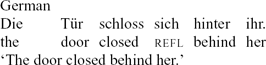


However, Geniušienė (Reference Geniušienė1987), Peitsara (Reference Peitsara, Rissanen, Kytö and Heikkonen1997) and Siemund (Reference Siemund2010) present comprehensive corpus evidence, showing that English self-forms do occur in various non-reflexive functions (i.e. as a marker of middle situation types). Siemund (Reference Siemund2010) concludes that any simple generalization that excludes complex reflexives from entering the middle domain falls short of empirical reality and needs to be corrected.
In view of the overwhelming empirical evidence provided in Geniušienė (Reference Geniušienė1987), Peitsara (Reference Peitsara, Rissanen, Kytö and Heikkonen1997) and Siemund (Reference Siemund2010), I consider it an established fact that English complex reflexives have non-reflexive uses, even though I wish to remain agnostic about the situation in other languages with complex reflexives. The aim of the present study lies in a diachronic investigation of verbs with non-argument reflexives in English. Building on the results of the previous studies mentioned above, I introduce the hypotheses below to guide the subsequent investigation.
– Hypothesis 1: The number of verb types found with non-reflexive (middle-like) uses of reflexive pronouns gradually increases over time.
– Hypothesis 2: In view of the attested lexicalized reflexive verbs, I expect the creation of new reflexive verbs to be mainly driven by lexicalization processes.
– Hypothesis 3: The categories of lexicalizations, motion verbs, and anticausatives show different quantitative profiles.
Kemmer (Reference Kemmer1993) as well as Hopper & Traugott (Reference Hopper and Traugott2006: 159–60) treat middle reflexives as a clear case of grammaticalization. Enger (Reference Enger2002) is more cautious, recognizing lexicalization processes in this domain. I do not expect to see an (abrupt) grammaticalization process in the historical data.
4 The Oxford English Dictionary as a data sourceFootnote 9
Modern dictionaries usually rest on robust empirical foundations. For example, compilers of modern reference works such as the Oxford Advanced Learner's Dictionary or the Longman Dictionary of Contemporary English maintain large corpora of English that reflect current usage. In a similar way, the OED is based on current and especially historical (increasingly digitalized) sources, as it aims to provide a comprehensive history of all English words.
As the OED is a highly dynamic dictionary that is constantly growing, expanding the sources it is based on, and that is also revised and updated at relatively short intervals (at least four times a year), it is difficult to give precise information as to its size or the number of sources it is based on. Moreover, since the OED is maintained and published in electronic form, revisions and updates proceed quickly. According to John Simpson, Chief Editor of the OED (personal communication), the OED used to be based on considerably more than 100,000 sources – but that was before online corpora such as Early English Books Online (EEBO), Google Books or Eighteenth Century Collections Online (ECCO) became available. Given the availability of these online sources, it is now practically impossible to provide even rough figures on the number of sources, the number of words contained in these sources, or their distribution across genres.
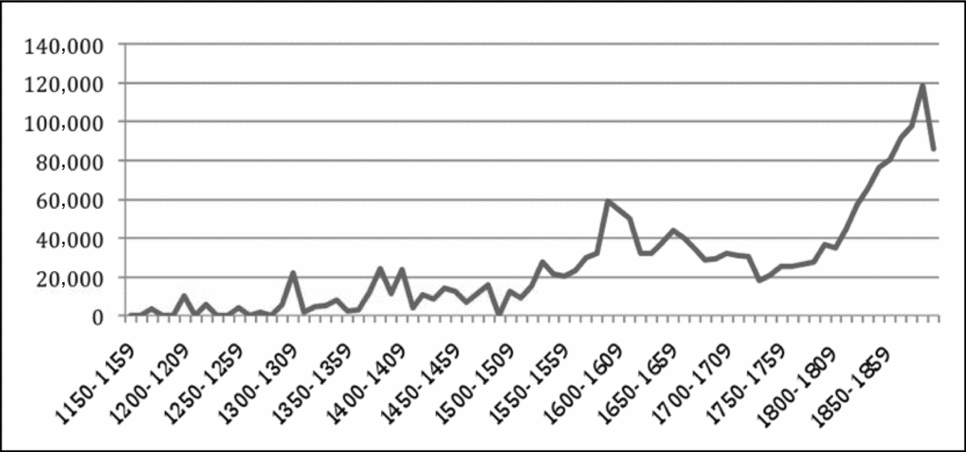
Brewer (Reference Brewer2007, ongoingFootnote 10) offers a very detailed analysis of the OED, especially the basis of quotations – taken from the aforementioned sources – on which it rests. She shows that the distribution of quotations varies greatly over the centuries and that there are strong preferences for some prominent authors (e.g. Shakespeare).Footnote 11 As one would expect in view of the few documents available, Middle English – especially Early Middle English – is underrepresented, whereas more recent sources are highly overrepresented (see figure 1).Footnote 12 These differences have to be borne in mind in the interpretation of the OED data.
OED quotations per decade 1150–1899 (taken from Charlotte Brewer's project website at http://oed.hertford.ox.ac.uk/main/content/view/43/125/; reproduced with permission)

The decision to use the OED as the data source for the present study is based on the results of previous studies, such as Geniušienė (Reference Geniušienė1987) and Siemund (Reference Siemund2010). These studies supply extensive verb lists based on synchronic corpus data, and the OED represents a practical data source for tracing the relevant verbs back in time. In addition, it is one of the explicit aims of the present study to evaluate the OED as a data source for diachronic grammatical studies.Footnote 13
5 Methodology
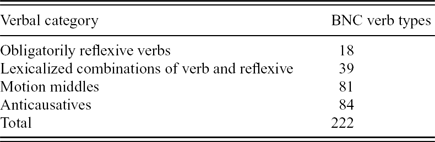
For the present study, I relied on the verb lists culled from the BNC by Siemund (Reference Siemund2010). The verbs in these lists are shown to co-occur with non-reflexive uses of reflexive pronouns.Footnote 14 In this study, I distinguish the verbal categories summarized in table 1. In addition, table 1 gives the number of verb types found in each category in the BNC. To be sure, the relevant token counts are much higher and vary considerably across these categories.
Categories of reflexive verbs distinguished in Siemund (Reference Siemund2010)
The present study provides a snapshot of the OED in 2012, when the data for it were collected. Using the OED online interface, I looked up each of the 222 verbs individually. The OED online interface returns a complete entry of the verb, which was saved as an individual text file in a subsequent step. I used the entries of the second edition, and, where available, of the third edition.Footnote 15
In total, I analysed 222 entries of the OED, i.e. all entries of the verbs identified in Siemund (Reference Siemund2010), but of course, not all of them returned positive results, as not all of the verbs are recorded in reflexive uses in the OED. These results necessarily reflect the perspective of the OED editors and the sources available to them, and not necessarily actual usage – whatever that means in historical terms. For 131 of the 222 verbs, a reflexive usage could be confirmed by the OED entries. These were subjected to further analysis.
Many of the verbs listed in Siemund (Reference Siemund2010) that are attested with a reflexive pronoun in a non-reflexive function in the BNC are also recognized to co-occur with reflexive pronouns in special senses in the OED. For example, Siemund (Reference Siemund2010) analyses the verb commit in combination with a reflexive pronoun as a highly frequent lexicalization. The corresponding entry in the OED explicitly records this verb as ‘reflexive’ in two different senses besides several non-reflexive uses. The first sense of commit oneself means ‘entrust oneself’ (sense 1c in the OED); the second meaning can be paraphrased as ‘enter a commitment’ (sense 10e in the OED). The two senses are illustrated in (17) below, which contains the chronologically first example of each sense in the OED.Footnote 16
- (17)
(a) a1538 T. Starkey Dial. Pole & Lupset (1989) 15 To them, wych in grete tempest wyl commyt themselfe to the daungerys of the see.
(b) 1950 B. Frechtman tr. J.-P. Sartre What is Lit.? p. vii, ‘If you want to commit yourself,’ writes a young imbecile, ‘what are you waiting for? Join the Communist Party.’
In other cases, the OED adds the remark ‘also refl.’ to an entry or a sense distinguished within an entry. In these cases the reflexive use is usually supported by examples, as illustrated in (18) for the verb define.
(18) 1859 ‘G. Eliot’ Lifted Veil ii, in Blackwood's Edinb. Mag. July 41/2, I..saw the light floating vanities of the girl defining themselves into the systematic coquetry, the scheming selfishness, of the woman.
Even though many of the verbs listed as reflexive in Siemund (Reference Siemund2010) are not recognized as such in the OED, i.e. not explicitly described as reflexive, the relevant entries may contain examples of these verbs co-occurring with reflexive pronouns in non-reflexive interpretations, i.e. as an illustration of other properties of the relevant verbs. For instance, Siemund (Reference Siemund2010) analyses demonstrate itself as belonging to the category of anticausatives. The verb is attested in this usage in the OED, but is not explicitly recognized as a reflexive verb. The example in (19) occurs as a general illustration in this entry, but is not meant to illustrate the reflexive usage.
(19) 1599 A. M. tr. O. Gaebelkhover Bk. Physicke 312/1 If..it be the Canker, it will after the third time demonstrate it selfe with a little knobbe or tumor.
During the analysis of the OED entries, I noted down if and when the relevant verbs first occur with a reflexive pronoun in a non-reflexive interpretation. In addition, I recorded whether the OED explicitly mentions the reflexive usage of a verb, or if it merely occurs in the examples illustrating other uses.
In a subsequent step, I tapped directly into the OED quotation base searching for middle-like reflexive uses of all 222 verbs. This procedure added 48 reflexive verbs to my database that are not mentioned in the relevant OED entries. It also allowed me to predate 49 examples of reflexive-marked verbs contained in the OED entries. My search of the quotation base did not distinguish spelling variants or morphosyntactic variants. In my analysis, I keep results from the verb entries and the quotation base as a whole apart. Contrasting the two data sets reveals how closely the OED entries match the quotation base.Footnote 17
In the present study, I analyse the full paradigm of reflexive pronouns, i.e. I include reflexives in all persons, numbers and genders (myself, yourself, himself, herself, itself, ourselves, yourselves, themselves).Footnote 18 This approach contrasts with Siemund's (Reference Siemund2010) study, where the analysis is restricted to itself, as the third-person inanimate reflexive triggers many non-reflexive uses.
6 Data analysis
In this section, I provide a summary of the results of my OED survey, starting with a bird's eye view of the data followed by a closer examination of the verbal categories distinguished (lexicalizations, motion middles, anticausatives).
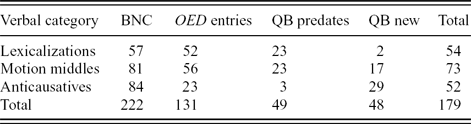
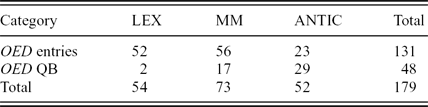
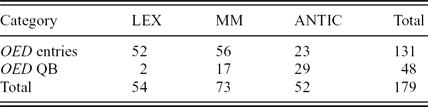
The second column of table 2 shows again the number of verb types in the categories distinguished in Siemund's (Reference Siemund2010) study of the BNC – a total of 222 verb types. For the ensuing analysis, I collapse the two lexicalization categories distinguished in table 1 into one, since the frequencies for the subcategories in the OED are too low to draw meaningful conclusions from. My exploration of the aforementioned verbs in the OED entries was successful in 131 cases, i.e. these verbs are attested with reflexive pronouns in a non-reflexive function. The precise figures for each category are shown in column 3 of table 2. Column 4 gives the number of verbs that could be predated using the quotation base. Column 5 contains the reflexive verbs that only appear in the quotation base. Column 6 shows the aggregate of columns 3 and 5, i.e. the number of hits returned from the entries and the quotation base (a total of 179 verb types). Here, we can make a first observation that is of interest, as the lexicalizations show a much higher success rate than the two remaining categories of motion middles and anticausatives, especially for the OED entries. With 23 out of 84 cases, the latter category in particular returned comparatively few hits from the OED entries. Even though this figure rises to 52 when including the quotation base, anticausatives remain the least represented category in the OED. It is obvious that the quotation base substantially increases the number of hits for motion middles and anticausatives. Moreover, it returns earlier attestations for several reflexive verbs.
Number of BNC verb types and corresponding OED hits
These initial results make a lot of sense since the OED editors, as dictionary compilers, focus on lexemes, and hence look for lexicalizations. Consequently, it is to be expected that the lexicalizations, i.e. those verbs followed by reflexive pronouns that have acquired a special meaning in this combination, are listed in the OED. Reflexive pronouns in combination with motion middles and anticausatives have fewer properties of lexicalizations (e.g. different type/token ratios; see Siemund Reference Siemund2010: 826). Hence, they are less likely to be listed in the OED. In fact, they are less likely to be listed in other dictionaries either.Footnote 19
In what follows, I will deal with the categories distinguished in table 2 one after another, presenting the detailed results of my analysis of the OED.
6.1 Lexicalized combinations of verb and reflexive pronoun (LEX)
We now turn to an analysis of lexicalizations of verb and reflexive marker. This class contains obligatorily reflexive verbs and verbs that have one meaning when they occur with the reflexive marker, but a (slightly) different meaning when they occur without it. The list below identifies the verbs in this category, as returned from the OED entries (52 verb types). Some illustration is provided in (20).Footnote 20
abandon, absent, accommodate, ally, apply, assert, associate, behave, brace, burn out, busy, commend, commit, concern, conduct, confine, content, dedicate, detach, devote, distance, divest, enjoy, express, find, gorge, indulge, ingratiate, insinuate, lay open, lend, manifest, overreach, pass off, pledge, preen, present, pride, pull together, reassert, redeem, relieve, repeat, resign, resolve, reveal, satisfy, see, seed, show, steel, suggest
- (20)
(a) a1275 (1200) Prov. Alfred (Trin. Cambr.) 133 Bute he mote himseluen pruden, he wole maken fule luden. ‘Unless he can pride himself (on sth.), he will make unhappy noises [ = be discontent].’
(b) 1660 R. Boyle New Exper. Physico-mechanicall Digress. 352 The inspired Air..does there associate it self with the Exhalations of the circulating Blood.
(c) 1840 J. S. Mill in London & Westm. Rev. 33 272 The natural tendency..reasserted itself.
In the OED entries, 45 verbs appear in separate reflexive sections, while seven verbs appear with a reflexive pronoun at some other point of the verb entry (dedicate, detach, distance, gorge, lay open, resign, steel). The first attestation in this category may be dated as early as AD 1000 (busy).
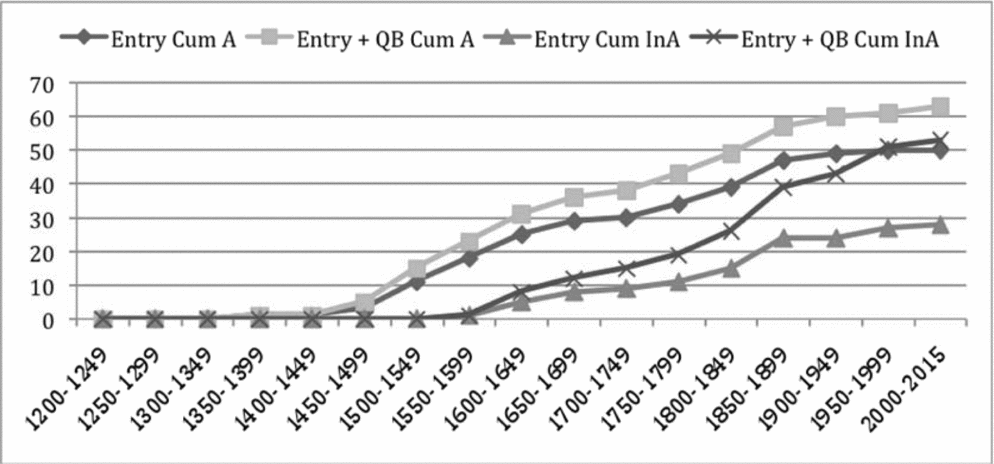
When we add the quotation base, the number of reflexive verbs in the OED rises to 54. Moreover, 23 verbs found in the entries can be predated using the quotation base, on average by approximately 24 years (measured across all verbs that could in principle be predated).
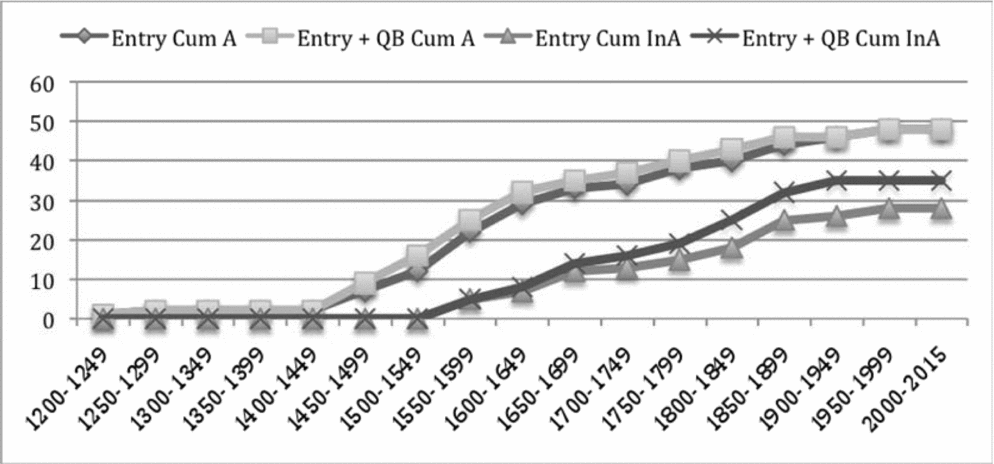
Figure 2 depicts the development of these verbs through time in fifty-year intervals, starting in 1200 and ending in 2015. It shows the accumulation of new types over time. The graph labelled ‘Entry Cum’ represents the cumulative frequency of the verbs taken from the OED entries. The graph ‘Entry + QB Cum’ gives the cumulative frequency of the verbs found in entries and quotation base.Footnote 21
Reflexive verbs (lexicalizations)
I distinguish animate (A) and inanimate (InA) subjects. The numbers add up to more than the 54 verb types contained in this class, as some verbs are attested with both animate and inanimate subjects. Moreover, the difference between entries and quotation base portrayed in figure 2 exceeds that given in table 2, as the figures in table 2 count the verbs types irrespective of subject type.
6.2 Motion middles (MM)
In the category that is here referred to as ‘motion middles’, my exploration of the OED returned 56 verb entries that contain a motion verb followed by a non-reflexively used reflexive pronoun. Despite the fact that this number is considerably lower than the 81 reflexive-marked motion verbs discussed in Siemund (Reference Siemund2010), it still is the category with the highest absolute number of verbs. The first entry in the OED, here given in (21), is from around 1387 (throw + himself).
(21) a1387 J. Trevisa tr. R. Higden Polychron. (St. John's Cambr.) (1871) III. 411 Alisaundre..þrewe hym self into a water þat renneþ þere.
The list below shows the verbs recovered from the OED entries (56 verb types). Example (22) contains some illustration of the verbs in this list.
abstract from, align, anchor, arrange, assemble, attach, bed, bury, cast, convey, dash, discharge, disentangle, drag, draw, embed, entrench, fasten, fling, force, free, get, glue, guide, hunch, hurl, insert, launch, lever, lift, locate, maintain, mould, orientate, pitch, place, plant, position, precipitate, project, propagate, raise, rearrange, relieve, remove, reorient, right, rouse, secrete, separate, steady, strand, throw, thrust, wrap, wreathe
- (22)
(a) 1865 T. Carlyle Hist. Friedrich II of Prussia V. xviii. vii. 178 Friedrich..hastens to arrange himself for the new contingencies.
(b) 1861 R. T. Hulme tr. C. H. Moquin-Tandon Elem. Med. Zool. ii. iii. iv. 147 Leeches..embed themselves in the earth.
(c) 1528 Tyndale Obed. Christen Man f. xlij, They..have separated them selves from the laye men, countinge them viler then dogges.
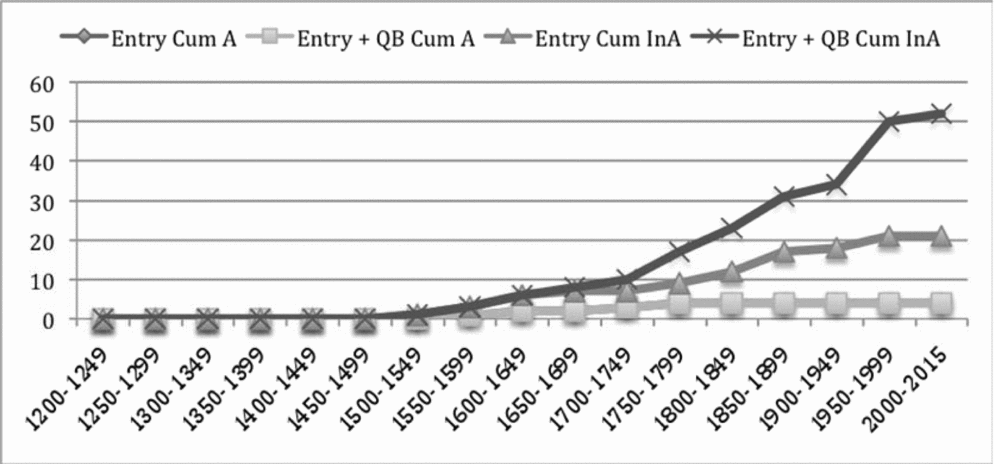
For most verbs in this category, the OED has a special reflexive section, but for 14 verbs it does not, even though the verb appears in the relevant use at some point in the entry. The inclusion of the quotation base allows us to predate 23 verbs by an average of approximately 33 years. In addition, it yields 17 verbs not identified by the OED entries. Adopting the conventions specified in the previous section, figure 3 presents the cumulative frequency of reflexive verbs that occur with animate and inanimate subjects in my database.
Reflexive-marked motion verbs (motion middles)
Again, it is understood that verbs with animate and inanimate subjects overlap, thus, the total outnumbers the 73 verb types found in this category. Due to the distinction between animate and inanimate subjects, the difference between entries and quotation base is greater than in table 2.
6.3 Anticausatives (ANTIC)
As explained in section 2, the category of anticausatives here refers to verbs followed by a reflexive pronoun where the reflexive achieves a change in the argument structure of the verb such that the notional object constituent appears in subject position. In consequence, the verb is detransitivized. Example (23) illustrates the assumed argument structure operation, with the reflexive-marked verb essentially behaving like an intransitive verb.
(23) Somebody solved the problem. -> The problem solved itself.
Defining the class of anticausative verbs in this way essentially restricts the sample to inanimate subjects. Siemund (Reference Siemund2010: 821) found 84 verbs showing this pattern in the BNC; 23 of these are also found in the OED entries. Hence, anticausatives represent the least recognized category in the OED entries. Searching the quotation base yields another 29 verbs expanding the sample to 52 verbs. Moreover, the quotation base produces three predates to the OED entries, though only by one or two years. The list below contains the anticausative verbs recognized by the OED entries (23 verb types). Some examples can be found in (24).
betray, define, demonstrate, found, identify, impress, imprint, link, offer, perpetuate, re-enact, re-establish, recommend, regulate, renew, repay, reproduce, resolve, restore, sell, shape, solve, sort
- (24)
(a) 1867 H. Macmillan Bible Teachings (1870) xiii. 254 A beautiful character impresses itself upon the very features of the body.
(b) 1576 A. Fleming tr. Cicero in Panoplie Epist. 44 Sundrie circumstances which offered them selves to my judgement.
(c) 1766 Compl. Farmer at Drill-rake 3 A 3/2 Yet even this small work of supererogation repays itself.
The OED has special reflexive sections for all verbs except betray, demonstrate, imprint, perpetuate, re-enact and re-establish. Figure 4 depicts the appearance of verbs with animate and inanimate subjects over the centuries in the same way as in the previous sections.
Reflexive-marked anticausative verbs
Again, it is understood that verbs with animate and inanimate subjects overlap. In the category of anticausatives, the number of verbs with inanimate subjects is much higher than the number of verbs with animate subjects.
6.4 Summary of major findings
My analysis of 222 verb entries in the OED returned 131 cases of verbs that occur together with the reflexive pronoun in one of the three categories distinguished here, i.e. lexicalizations in the sense described in section 6.1, motion middles and anticausatives. Table 3 gives a summary of the absolute numbers. As already mentioned, the number of successful lookups strongly varies across these categories, with the first category (LEX) showing near identity to the cases reported from the BNC in Siemund (Reference Siemund2010). The category of anticausatives (ANTIC) contains the fewest members both in absolute terms and in relation to the cases listed in Siemund (Reference Siemund2010). Motion middles (MM) range in between. Consulting the quotation base adds reflexive verbs in all categories, though only two in that of lexicalizations.
OED reflexive verbs across categories
All categories explored demonstrate gradual increases over time. Apart from anticausatives, we find the first attestations in (Early) Middle English. The categories fill up more clearly starting with Early Modern English. The quotation base allowed us to predate 49 entries of the OED.
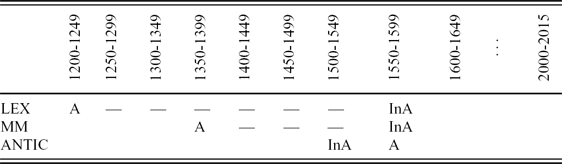
Verbs with animate subjects appear before verbs with inanimate subjects, except for anticausatives. Table 4 gives the first occurrences of the verbs in each category with an animate and an inanimate subject. For lexicalizations, there are approximately 350 years between the first attestation with animate and inanimate subject. The corresponding time span is 200 years for motion middles, and 50 years for anticausatives.
First occurrences of verbs with animate (A) and inanimate (InA) subjects
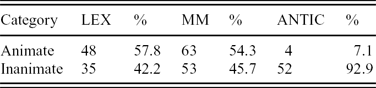
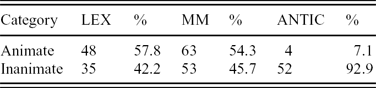
On the whole, the OED lists the verbs investigated here more with animate subjects than with inanimate subjects, apart from anticausatives. Table 5 provides an overview of the relevant figures and also gives the ratios of animate to inanimate subjects as percentages.
Verbal categories in relation to animate and inanimate subjects
7 Discussion of results
We will now turn to an interpretation of the findings presented in the preceding sections. Our discussion will address the increase in reflexive verbs through time, quantitative differences between the categories LEX, MM and ANTIC, the occurrence of complex (heavy) reflexives in middle-like functions, the relationship of lexicalization and grammaticalization, and the adequacy of using OED data for a study of this kind.
7.1 Increase over time
The quantitative data show a clear increase over time in all the categories distinguished, i.e. lexicalizations, motion middles and anticausatives. This increase is real and independent of the skewing of the OED data towards the second half of the period investigated here. The reason is that English complex reflexive pronouns only developed in Middle English (see Peitsara Reference Peitsara, Rissanen, Kytö and Heikkonen1997: 289). Hence, we can assume that the categories were more or less empty in the initial time periods explored here, i.e. 1200–1300. Complex reflexives developed in reflexive functions, and also in intensifying functions (e.g. the king himself), but not in non-reflexive functions (König & Siemund Reference König and Siemund2000b). As a consequence, all non-reflexive functions, including all lexicalizations, cannot have emerged before (Early) Middle English. This conclusion is compatible with Peitsara's (1997) findings, who reports reflexive-marked motion (posture) verbs as well as reflexive-marked verbs of psychological states and social behaviour (approximately corresponding to my lexicalizations) from late Middle English onwards (i.e. marked by complex reflexives).
Compared with the OED entries, the quotation base attests a steeper increase over time. For motion middles and anticausatives, and especially for verbs with inanimate subjects, we can witness a relatively sharp rise in the nineteenth and twentieth centuries. It appears safe to conclude that the quotation base mirrors actual usage more closely than the entry data. Nevertheless, the sharp rise in the nineteenth and twentieth centuries coincides with a major expansion of the quotation base and may thus – to a certain extent at least – be an artifact of the data skewing.
In view of these considerations, I conclude that the number of verb types occurring together with reflexive pronouns in a non-reflexive function has increased and is probably still increasing. There are differences between the categories, though, to which we will turn in the following.Footnote 22
7.2 Differences between categories
In addition to the gradual increase in verb types in all categories, we also find a few noteworthy differences between these categories that are in need of explanation. To begin with, the categories show different overlap rates with synchronic studies such as Siemund (Reference Siemund2010) (see table 2 and section 6.4). As already pointed out at the beginning of section 6, we can expect the category LEX to show a higher overlap rate, as it represents lexicalizations, and dictionary editors can be expected to look for such items very carefully. Motion middles and anticausatives are less easily viewed as lexicalizations since the meaning of the verb is not (very) different in reflexive and non-reflexive uses. The quotation base corrects the entry data and consistently finds additional reflexive verbs, especially for motion middles and anticausatives.
The upward trend of the LEX curve is levelling off in the more recent periods, while motion middles and anticausatives continue to show ascending curves. It is difficult to tell if there are significant (in the non-technical sense) differences between the latter categories. Considering, for example, the development of reflexive verbs with inanimate subjects over the past 300 years, we find 38 additions for motion middles, and 42 for anticausatives (calculated over both entry data and quotation base). Motion middles with animate subjects show 25 additions in this period. These appear to be comparable increase levels. Anticausatives show a steep rise between 1950 and 1999 with 16 additions in this period alone.
The verbs in the three categories differ furthermore as to the number of animate and inanimate subjects they occur with (see table 5 above). Anticausatives contain the highest ratio of inanimate to animate subjects, which is a consequence of defining them in terms of an argument structure change. Motion middles by definition possess agentive subjects and hence the higher ratio of animate subjects is expected. Lexicalizations show the highest percentage of animate subjects, though it is very similar to motion middles.
Anticausatives is the last category to develop, which may be an artifact of defining it in terms of inanimate subjects. Peitsara (Reference Peitsara, Rissanen, Kytö and Heikkonen1997: 335) reports similar findings for this verb type (her ‘pseudo-reflexive verbs’).
7.3 Heavy reflexives in non-reflexive functions
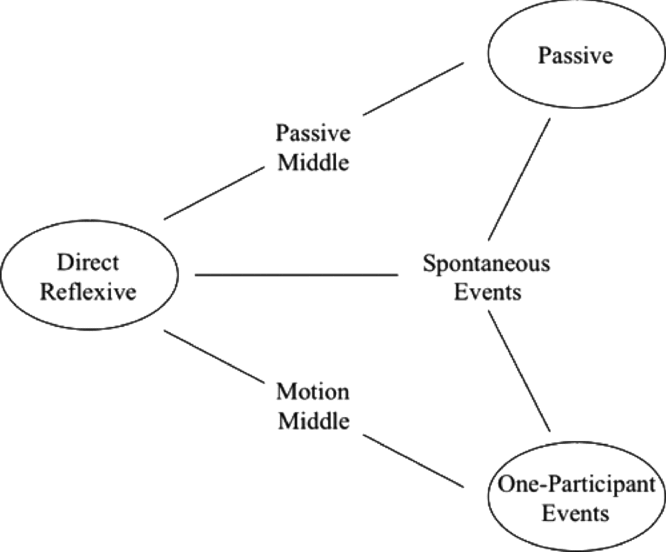
The occurrence of reflexive pronouns as markers of middle situation types is well established (Faltz Reference Faltz1985; Geniušienė Reference Geniušienė1987; Haspelmath Reference Haspelmath1990; Kemmer Reference Kemmer1993; Enger & Nesset Reference Enger and Nesset1999; Enger Reference Enger2002). Moreover, it is widely assumed that such middle uses of reflexive pronouns are the result of grammaticalization processes starting on reflexive pronouns in semantically reflexive uses, i.e. expressing the referential identity of subject and object constituent in simple transitive clauses (see section 2). Kemmer (Reference Kemmer1993) captures the frequent extension of reflexive pronouns into non-reflexive domains of use in terms of the semantic map shown in figure 5, assuming that grammaticalization processes drive reflexive pronouns into new usage domains. Figure 5 explicitly mentions motion middles, a category also distinguished here. The category of anticausatives found in the present study roughly covers Kemmer's ‘one-participant events’, ‘spontaneous events’ and partially even ‘passives’.
Middle situation types according to Kemmer (Reference Kemmer1993: 202)
Most of the studies mentioned above implicitly assume that only simplex or weak reflexive pronouns can be found as markers of middle situation types and partake in the requisite grammaticalization processes. As for English complex reflexives, Kemmer (Reference Kemmer1993: 184), Steinbach (Reference Steinbach2002: 307) and Kaufmann (Reference Kaufmann2004: 191) explicitly deny that they have middle uses. König & Siemund (Reference König, Siemund, Frajzyngier and Curl2000a: 59, Reference König, Siemund, Dryer, Haspelmath, Gil and Comrie2005: 195) claim that reflexive pronouns do not have middle uses if they possess concomitant intensifying uses, as e.g. in English shown in (25). As intensifying uses are typically found with complex reflexives (and not simplex reflexives), König & Siemund's claim amounts to saying that complex reflexives do not have middle uses.Footnote 23
- (25)
(a) The professor himself criticized the student. (intensive)
(b) The professor criticized himself. (reflexive)
The data presented in the current study contradict such assumptions, as English complex reflexives began to appear as markers of middle situation types immediately after complex reflexives had emerged in Middle English and had stabilized. Subsequently, such uses gradually increase over time, as shown in section 7.1 above. Our results here, thus, confirm the findings and conclusions arrived at in Geniušienė (Reference Geniušienė1987) and Siemund (Reference Siemund2010) based on synchronic data.
I conclude that complex or heavy reflexive markers can develop middle-like (i.e. non-reflexive) functions. Moreover, I hypothesize that such developments can also be found in other languages with heavy reflexive markers (Arabic, Chinese, Finnish), but this would have to be confirmed by independent studies.
7.4 Lexicalization and grammaticalization
As mentioned in the previous section, the development of reflexives as markers of middle situation types is typically interpreted as a grammaticalization process. In view of the obvious lexicalizations in our data and also in other languages with middle reflexives (Geniušienė Reference Geniušienė1987; Kunze Reference Kunze1996; Enger Reference Enger2002; Siemund Reference Siemund2010), the question arises whether an analysis in terms of grammaticalization alone can account for the historical developments.
Our data analysis has shown that the number of English reflexive verbs increases over time and that reflexive pronoun and preceding verb fuse syntactically and semantically. Technically speaking, we can witness the coalescence (univerbation) of the two expressions (Brinton & Traugott Reference Brinton and Traugott2005: 110). This coalescence is also visible in synchronic data, as middle-like reflexives cannot be separated from their syntactic host, as shown in (26) and (27).
- (26)
(a) John does not really like himself. (argument reflexive)
(b) Himself, John does not really like.
- (27)
(a) The problem began to manifest itself. (middle-like reflexive)
(b) *Itself, the problem began to manifest.
Coalescence on its own, however, is not a sufficient diagnostic of grammaticalization or lexicalization, as it can be found with either process. In other words, we need additional criteria to decide this question. Contrastive treatments of lexicalization and grammaticalization, such as Lehmann (Reference Lehmann, Wischer and Diewald2002) or Himmelmann (Reference Himmelmann, Bisang, Himmelmann and Wiemer2004), argue that the term ‘lexicalization’ should be reserved for additions to the (mental) lexicon carrying idiosyncratic meanings. In the case of multi-word lexicalizations, their overall meaning is not compositionally relatable to the interacting parts. Lexicalization processes produce lexical rather than grammatical elements. The category LEX of the present study represents such lexicalizations (idiomaticization), as the string of verb and juxtaposed reflexive assumes a special meaning (for example, manifest itself means ‘appear’).
The meaning of the term ‘grammaticalization’ is less clear, as we find competing definitions. Again, following Lehmann (2000) and Himmelmann (Reference Himmelmann, Bisang, Himmelmann and Wiemer2004), grammaticalization may be conceived of as a process yielding grammatical elements, a process leading to greater grammaticity of grammatical elements, or the regular occurrence of an element with an increasingly larger set of other elements (host-class expansion; see also Trousdale & Traugott Reference Trousdale, Traugott, Closs Traugott and Trousdale2010: 2–3). In addition, it is often assumed that grammaticalization processes are accompanied by a rapid increase in type and token frequencies (see the overview in Hoffmann Reference Hoffmann2005: 144–8).
On the assumption that middle-like reflexives possess a greater degree of grammaticity than argument reflexives, we could argue that English reflexives are undergoing a grammaticalization process in the relevant constructions. Moreover, the criterion of host-class expansion is fulfilled, as middle-like reflexives can be found with a growing number of verbs over time. At the same time, however, new verb types are entering this construction only relatively slowly. The current diachronic study found 179 new types over a period of approximately one thousand years. This would appear to be a process with limited productivity in comparison to, say, combinations of article and noun. Moreover, synchronic studies find high token frequencies with relatively few verbs, and these are typically lexicalizations (Siemund Reference Siemund2010: 826–8).
On the whole, the development of reflexive verbs in English is somewhat similar to processes of derivational morphology. It is productive, though yielding only a few new types over time. It is regular, but new types tend to develop idiosyncratic meanings (i.e. they lexicalize). Depending on whether we view derivational morphology as part of the lexicon or grammar, which is a controversial issue (Himmelmann Reference Himmelmann, Bisang, Himmelmann and Wiemer2004: 22), the development of English reflexive verbs can thus be said to fall into the domain of either lexicalization or grammaticalization.
On this view, English complex reflexives have two functions in post-verbal position (besides the intensifying function). On the one hand, there is the clearly grammatical use as a reflexive marker. On the other hand, it is used as derivational morpheme producing lexicalizations. Such a division of labour is not completely unheard of. DeLancey (Reference DeLancey, Booij, Lehmann, Mugdan and Skopeteas2008: 1597), for example, discusses the dialectal use of the a-prefix as a marker of present participles (I'm a-wanting to go) and as a now defunct derivational morpheme producing the well-known class of a-adjectives (awake, asleep, alone, etc.) They have the same source lexeme, reconstructable as a preposition.
7.5 Using the OED as a data source
As for the general adequacy of using the OED as a data source for historical linguistic studies, my overall assessment is a positive one, even though dictionaries remain a special data source.
For the present study, I used both the OED entries and the quotation base. As for the main point of concern, namely the use of complex reflexives for the expression of middle situation types and the concomitant increase in reflexive verbs, we can draw confirmation from both data sources. Strictly speaking, the OED entries would have been sufficient to prove this point, though the quotation base qualifies the entry data by adding more precision. Especially for the more recent periods, the quotation base more adequately reflects usage, as it contains many reflexive verbs not listed in the entries. The farther we go back in time, the more strongly the entries and the quotation base converge. These findings make a lot of sense, as the OED editors can be expected to have sifted older sources more intensely than more recent ones.
The OED entries on the whole correctly identify lexicalizations, i.e. the category LEX in the present study, and given that it is a dictionary, this is precisely what we would expect. Apparently, the OED editors look for recurring uses of lexemes and lexeme combinations in the sources. The OED entries are less suitable for identifying systematic processes that operate across larger sets of different lexemes. They fail to recognize many instances of the more grammatical processes yielding motion middles and anticausatives. To identify these, the quotation base is a more adequate data source, as it can be used as a corpus.
There may be further patterns in the OED data. For example, one of the referees suggests that semantically related verbs may have acquired a reflexive usage at about the same time. This may indeed be the case, as the following pairs illustrate: lift/raise (1450/1513), hurl/fling (1613/1689), perpetuate/reproduce (1711/1842), imprint/impress (1867/1840), expose/display (1813/1750), present/show (1490/1539). Moreover, there seems to be a dominance of Romance verbs in the anticausative group. These points deserve attention, but I will leave them for future studies.
8 Summary and conclusions
My study has demonstrated that middle-like uses of English complex reflexive pronouns have steadily increased since Middle English times, and that they are probably still increasing. It confirms synchronic studies such as Geniušienė (Reference Geniušienė1987) and Siemund (Reference Siemund2010), who amply document English complex reflexive pronouns in these functions. The widespread assumption that only simplex reflexive markers can acquire these functions needs to be corrected, even though it is probably the case that simplex reflexives are more common in them, i.e. occur with more verb types.
I have by and large been able to confirm the hypotheses formulated at the outset of this investigation. In English, non-reflexive (middle-like) uses of reflexive pronouns have been gradually increasing since the time of their first recording. Their development is driven by processes of coalescence and context expansion, frequently leading to the coinage of new dictionary entries. Motion middles and anticausatives are the more productive categories. The diachronic data that my examination of the Oxford English Dictionary furnishes strongly suggests concurrent, and perhaps consecutive, grammaticalization and lexicalization processes in the domain investigated here. A comparison with derivational morphology suggests itself.
As far as the use of the Oxford English Dictionary as a data source for diachronic linguistic studies is concerned, we need to be aware that the OED presents the historical data through the eyes of the dictionary editors. As enormous manpower has gone into the compilation of this dictionary, the main challenge is to find a way to use it as efficiently as possible.