INTRODUCTION
Dating ancient buildings and establishing construction phases is an issue of primary importance for archaeologists when it is not possible or easy to attribute a definite chronology to buildings or the remains of them. Currently, the absolute chronology of archaeological sites relies mostly on stylistic attribution or on the radiocarbon (14C) dating of organic materials uncovered during the excavations (i.e. charcoals, woods, bones). The absolute dating of a building, applied directly to its own materials, represents a great advantage for the study of an archaeological site and a serious improvement for historical reconstructions.
It is well-known that all building materials based on lime (mortar, concrete, plaster, whitewash) absorb atmospheric carbon dioxide as they harden. Once mortar starts setting, 14C starts decaying, similarly to the organic remains of any plant or animal after its death. Thus, if 14C analysis could be applied to mortar, one would be able to estimate more precisely the time when a certain building was built or modified.
This is far from reality, and even though this principle is simple enough, its application proved to be surprisingly difficult, as shown by the variability in results over more than 50 years of experimentation (Delibrias and Labeyrie Reference Delibrias and Labeyrie1964; Stuiver and Smith Reference Stuiver and Smith1965; Baxter and Walton Reference Baxter and Walton1970; Folk and Valastro Reference Folk and Valastro1976; Pachiaudi et al. Reference Pachiaudi, Marechal, Van Strydonck, Dupas and Dauchot-Dehon1986; Van Strydonck et al. Reference Van Strydonck, Dupas, Dauchotdehon, Pachiaudi and Marechal1986, Reference Van Strydonck, Van der Borg, De Jong and Keppens1992; Mathews Reference Mathews2001; Nawrocka et al. Reference Nawrocka, Michniewicz, Pawlyta and Pazdur2005, Reference Nawrocka, Czernik and Goslar2009, Reference Nawrocka and Michniewicz2010; Lindroos et al. Reference Lindroos, Heinemeier, Ringbom, Braskén and Sveinbjörnsdóttir2007; Goslar et al. Reference Goslar, Nawrocka and Czernik2009; Heinemeier et al. Reference Heinemeier, Ringbom, Lindroos and Sveinbjornsdottir2010; Hajdas et al. Reference Hajdas, Trumm, Bonanni, Biechele, Maurer and Wacker2012; Michalska et al. Reference Michalska, Pazdur, Czernik, Szczepaniak and Zurakowska2013, Reference Michalska and Czernik2015; Ringbom et al. Reference Ringbom, Lindroos, Heinemeier and Sonck-Koota2014).
Mortar can be schematically defined as a complex material, mainly composed of a binder and aggregates. The binder represents the most important component of a mortar from the dating point of view. It derives from the calcination of primary carbonate rocks and hydration of the calcium oxide forming a workable mass (lime putty) that hardens if exposed to air. Aggregates are applied in order to increase workability, hydration, and to avoid cracks during the setting phase (Cazalla et al. Reference Cazalla, Rodriguez-Navarro, Sebastian, Cultrone and De la Torre2000; Lawrence et al. Reference Lawrence, Cyr and Ringot2003). The typologies of aggregates along with the nature of the binder can completely change the final behavior of a mortar. It is well assessed how the use of materials with a significant concentration of aluminates and amorphous silicates as aggregates (i.e. pozzolana, volcanic ashes and crushed bricks) provides hydraulic properties to lime mortars (Moropoulou et al. Reference Moropoulou, Cakmak, Biscontin, Bakolas and Zendri2002, Reference Moropoulou, Bakolas and Anagnostopoulou2005). The designation pozzolana derives from one of the primary deposits of volcanic ash used by the Romans in the neighborhood of Pozzuoli in Italy. Nowadays, the definition of pozzolana includes any pyroclastic material predominantly composed of fine volcanic glass (pumice or volcanic ash) that hardens in water when mixed with calcium hydroxide (lime) or with materials that can release calcium hydroxide (Portland cement clinker; Massazza Reference Massazza1993).
Since Roman times, the use of pozzolana as an additive has been a breakthrough in mortar production technology, allowing hardening under harsh (i.e. humid) climatic conditions and increasing the mechanical resistance. The experience and skills of Roman builders led to what is universally known as pozzolana mortars, where the improved hardening properties are based on chemical reactions involving the slaked lime and the amorphous alumina-silicates of volcanic origin. In the fundamental work of De Architectura, which was considered a handbook for Roman builders, Vitruvius described this material as one capable of hardening both in air and underwater, opening the way to the so-called hydraulic mortars (i.e. mortars able to harden under water, Virtruvius 1931). When volcanic ash was not available, finely ground pottery and ceramics were used to induce hydraulic properties at lower rates to the mortar, producing the so-called cocciopesto, a material well-known since the Minoan society (Moropoulou et al. Reference Moropoulou, Bakolas and Anagnostopoulou2005). A successful dating of pozzolana mortars would have an enormous impact in archaeology and a high potential of applications.
Despite their importance, pozzolana mortars have received less attention than non-pozzolana mortars (i.e. aerial mortars) mostly because of the complications connected with their 14C dating (Hale et al. Reference Hale, Heinemeier, Lancaster, Lindroos and Ringbom2003; Lindroos Reference Lindroos2005; Ringbom et al. Reference Ringbom, Hale, Heinemeier, Lindroos and Brock2006, Reference Ringbom, Heinemeier, Lindrooos and Brock2011, Reference Ringbom, Lindroos, Heinemeier and Sonck-Koota2014; Hodgins et al. Reference Hodgins, Lindroos, Ringbom, Heinemeier and Brock2011; Lindroos et al. Reference Lindroos, Heinemeier, Ringbom, Brock, Sonck-Koote, Pehkonen and Suksi2011; Michalska and Czernik Reference Michalska and Czernik2015). In the case of aerial mortars, the method has been experimentally studied and the problems are fairly well understood (Folk and Valastro Reference Folk and Valastro1976; Pachiaudi et al. Reference Pachiaudi, Marechal, Van Strydonck, Dupas and Dauchot-Dehon1986; Ambers Reference Ambers1987; Heinemeier et al. Reference Heinemeier, Jungner, Lindroos, Ringbom, Von Konow and Rud1997; Lindroos et al. Reference Lindroos, Heinemeier, Ringbom, Braskén and Sveinbjörnsdóttir2007; Marzaioli et al. Reference Marzaioli, Lubritto, Nonni, Passariello, Capano and Terrasi2011, Reference Marzaioli, Nonni, Passariello, Capano, Ricci, Lubritto, De Cesare, Eramo, Castillo and Terrasi2013, Reference Marzaioli, Lubritto, Nonni, Passariello, Capano, Ottaviano and Terrasi2014; Al-Bashaireh Reference Al-Bashaireh2013; Nonni et al. Reference Nonni, Marzaioli, Secco, Passariello, Capano, Lubritto, Mignardi, Tonghini and Terrasi2013). In dating aerial mortars, the main issue is related to the presence of dead carbon contamination, introduced as incomplete calcined limestone residues (calcination relics) or carbonate fillers (from very fine sand to gravel).
This paper sets out to prove that one of the obstacles in dating pozzolana mortars is the lower content of carbon in pozzolana mortars compared to that of aerial ones. This is due to the interaction of the binder with pozzolana (i.e. characterized by a high hydraulic index; Callebaut et al. 2001; Lindroos et al. Reference Lindroos, Heinemeier, Ringbom, Brock, Sonck-Koote, Pehkonen and Suksi2011) drastically affecting the relative fraction of 14C available to date and enhancing the effect of any contamination eventually present. Other possible causes of failure when dating pozzolana mortars are the following:
∙ The unpredictability of the moment of hardening. The impermeable nature of pozzolana may retain water into pockets with unreacted Ca(OH)2 that will set a continuous interaction with atmospheric CO2, forming newborn carbonates. Furthermore, their lower permeability to the air (and CO2) compared to that of aerial mortars (Ringbom et al. Reference Ringbom, Heinemeier, Lindrooos and Brock2011; Nonni Reference Nonni2014) may lead to a slower hardening (i.e. thick walls). Both situations increase the risk of rejuvenation, thus resulting in obtaining ages younger than predicted.
∙ The recurring presence of recrystallization phenomena due to weathering (air-exposed structures) or groundwater (deeply buried structures) activities. These effects could lead to aging as well as rejuvenation, depending on the origin of the recrystallization carbonates (Nonni Reference Nonni2014; Michalska and Czernik Reference Michalska and Czernik2015) and may affect aerial and pozzolana mortars.
∙ The presence of carbonate nodules, similar to lime lumps, derived from volcanic activity and found inside volcanic ashes and pozzolana (Miriello et al. Reference Miriello, Barca, Bloise, Ciarallo, Crisci, De Rose, Gattuso, Gazineo and La Russa2010). In addition, the presence of limestone fragments derives from bedrock underlying the volcanic districts and forming the walls of conduits where magma travels during explosive eruptions (Jackson and Marra Reference Jackson and Marra2006). These types of contamination can lead to aging.
∙ The presence of natural fine sand from limestone or marble used as additives (i.e. for surface and finishing wall layers) can increase the risk of aging (Nonni Reference Nonni2014). This contamination can lead to aging and can affect any type of mortars.
When a condition of low content of datable carbonate matches the presence of one or more risks of contamination, the chance of success in 14C dating a pozzolana mortar drops down if compared to an aerial one. To be successful, a selection protocol should provide a fraction to date as much representative as possible of the binder and therefore free of any contaminants. Literature reports that chemical reactions produce colloids that flocculate and grow, generating finer particles while geological particles of mechanical origin have grain size bigger than 1 μm (Davis and Kent Reference Davis and Kent1990; Salama Reference Salama2000; Genestar and Pons Reference Genestar and Pons2003; Stefanidou and Papayianni Reference Stefanidou and Papayianni2005; Marzaioli et al. Reference Marzaioli, Lubritto, Nonni, Passariello, Capano and Terrasi2011). Therefore, particles <1 μm are more likely to derive from crystal nucleation and/or chemical growth. Several experiments simulating mortar production showed that binder carbonates are characterized by 200–400 nm fine grain size (Genestar and Pons Reference Genestar and Pons2003; Stefanidou and Papayianni Reference Stefanidou and Papayianni2005; Marzaioli et al. Reference Marzaioli, Lubritto, Nonni, Passariello, Capano and Terrasi2011) due to the high hardening rates of lime mortar (Moropoulou et al. Reference Moropoulou, Bakolas and Bisbikou2000; Lanas et al. Reference Lanas, Bernal, Bello and Galindo2004; El-Turki et al. Reference El-Turki, Ball and Allen2007; Kosendar-Legenstein et al. Reference Kosednar-Legenstein, Dietzel, Leis and Stingl2008). Therefore, fractions to submit to 14C dating should have a homogeneous and sub-micrometric grain dimension. The present study shows how the use of a selection protocol based on cryo-breaking, ultrasonication, and centrifugation, called Cryo2SoniC (Marzaioli et al. Reference Marzaioli, Nonni, Passariello, Capano, Ricci, Lubritto, De Cesare, Eramo, Castillo and Terrasi2013; Nonni et al. Reference Nonni, Marzaioli, Secco, Passariello, Capano, Lubritto, Mignardi, Tonghini and Terrasi2013) led to promising results within a set of samples collected from three different archaeological sites. Previously the Cryo2SoniC and its first version, CryoSoniC, revealed good accuracy for archaeological and synthetic mortars (Marzaioli et al. Reference Marzaioli, Lubritto, Nonni, Passariello, Capano and Terrasi2011, Reference Marzaioli, Nonni, Passariello, Capano, Ricci, Lubritto, De Cesare, Eramo, Castillo and Terrasi2013, Nonni et al. Reference Nonni, Marzaioli, Secco, Passariello, Capano, Lubritto, Mignardi, Tonghini and Terrasi2013). In the present study, we aimed to evidence the efficiency and reliability of the Cryo2SoniC protocol on pozzolana mortars from three archaeological structures: the Temple of Minerva Medica and the Tower del Fiscale in the city of Rome, and the remains of a Roman pool in the Archaeological Park of Ostia (Italy). Several aspects of the protocol were investigated. To identify the capability of the Cryo2SoniC protocol to efficiently select a sub-micrometric fraction of powder dimensionally similar to the binder, scanning electron microscopy images were collected. To check the yielding of datable carbon in pozzolana mortars, a comparison was run between fractions collected by Cryo2SoniC. To investigate the efficiency of the Cryo2SoniC selection on pozzolana mortars, 14C dating was performed and the obtained 14C ages were compared to the historical attributions for each site. At the present day, no absolute dating was ever performed for any of the described sites and all reference dates are uniquely from archive sources and relative chronologies. 14C results were discussed integrating the evidences collected from the petrographic analysis of the original mortar samples.
MATERIALS AND METHODS
Site Descriptions
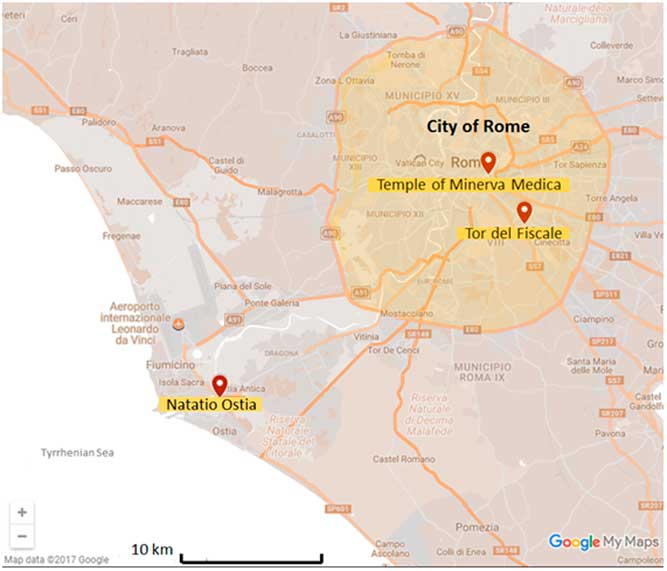
A set of eight samples was collected across three different archaeological sites in Rome (Italy) and its surroundings: the archaeological excavation of Porta Marina in the Archaeological Park of Ostia Antica, the Roman foundations of the medieval tower of Tor del Fiscale in the Aqueducts Park, and the Temple of Minerva Medica in Rome’s city center (Figure 1).
Map of archaeological sites in Rome’s city center and nearby Archaeological Park of Ancient Ostia (modified from © 2017 Google).

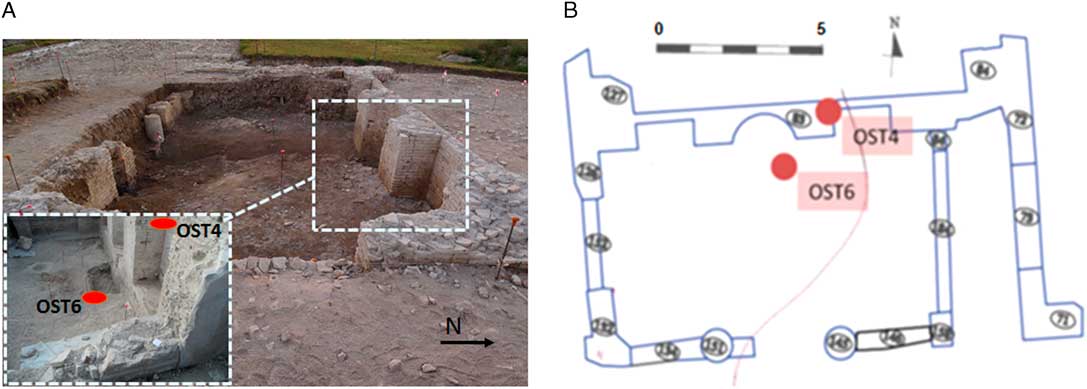
The Roman site of Porta Marina is an ongoing excavation led by the Department of History, Cultures and Civilizations of the University of Bologna as part of the Ostia Marina Project (David et al. Reference David, Pellegrin and Turci2009, Reference David, Carinci, Graziano, De Togni, Pellegrino and Turci2014; David and Gonzales Reference David and Gonzales2011; David and Turci Reference David and Turci2011; Morricone et al. Reference Morricone, Macchia, Campanella, David, De Togni, Turci, Maras, Meucci and Ronca2013; Valeri Reference Valeri2001). Porta Marina is a neighborhood area on the border of the Archaeological Park of the Ostia Antica, once the harbor of ancient Rome. The excavations include a thermal bath complex of 2000 m2, called the Bath of Silenum. The bath complex dates back to Hadrian’s age, as attested by the finding of numerous stamped bricks (David et al. Reference David and Turci2011, Reference David, Carinci, Graziano, De Togni, Pellegrino and Turci2014), connected to consuls Apronianus and Paetinus (123 AD) and Verus and Ambibulus (126 AD). The active life of the baths was characterized by different stages of development up to the 5th century. In particular, the structures involved in our study (ambient 7; David et al. Reference David, Carinci, Graziano, De Togni, Pellegrino and Turci2014) belong to a monumental pool called natatio (an open-air bathing pool; Figure 2), chronologically attributed to the first development of the baths.
(A) Overview of the natatio at Ostia, during and after the excavations; (B) map showing sampling points on the pillar (OST4) and floor (OST6).

The second site is a tower called Tor Del Fiscale, located in the Aqueduct Park along the ancient Via Latina (Figure 1). The well-preserved medieval tower (12th–13th century; Figure 3) was built on Roman ruins to dominate the intersection of the ancient Roman Claudio (38 AD) and Felice (1585 AD) aqueducts on the remains of the Aqua Marcia aqueduct (144 BC; Staccioli Reference Staccioli2002). The medieval attribution of the tower comes from archive sources (Tomassetti Reference Tomassetti1926; Ward-Perkins Reference Ward-Perkins1979; De Rossi Reference De Rossi1981; Esposito Reference Esposito1998) while the pre-existing Roman structure has been archaeologically attributed to a restoration done during the Hadrian era. A further confirmation of such attribution is the presence of an imperial brick stamp dated to 123–126 AD embedded in the wall of the sampling site (Figure 3B).
(A) Torre del Fiscale from a satellite image (modified from © 2017 Google Maps); (B) sampling point at the basement of the tower, close to Hadrian’s brick stamp; (C) macroscopic photo of ToFi1 sample.

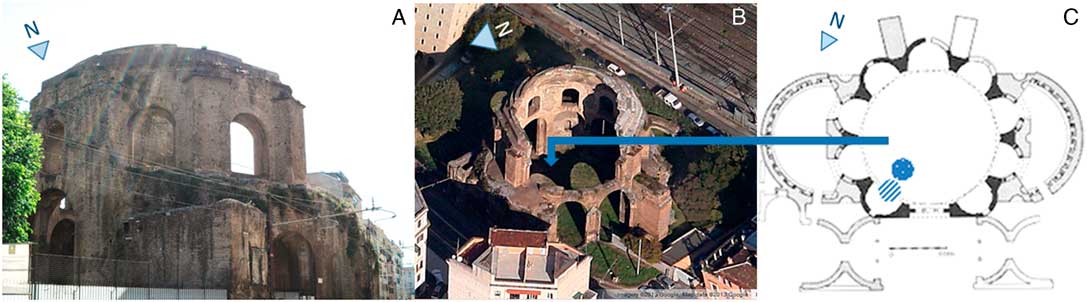
The third site is the Temple of Minerva Medica, a majestic decagonal building located on Esquilino Hill in Rome’s city center (Figures 1 and 4). Its name is related to the discovery, during the 16th century, of a set of statues linked to the cult of medical science, one of which represented the Minerva goddess with a snake. The so-called temple was not always so, as its attributed name suggests, but a monumental hall built during the 4th century, probably under an imperial commission as part of a bigger building complex, now absorbed by the surrounding urban architectures (Biasci Reference Biasci2000). The monumental building, with a massive dome dimensionally comparable to the famous Pantheon, stands on underlying precedent structures attributed to the 1st century (Barbera et at. Reference Barbera, Di Pasquale and Palazzo2007).
(A) Lateral (© 2017 Sara Nonni) and (B) aerial views (© 2017 Google) of the remains of the Temple of Minerva Medica in Rome’s city center; (C) a plan (modified from Ward-Perkins Reference Ward-Perkins1979) showing schematically where the excavation took place on the southwest side of the main floor: the striped dot indicates the position of the buried structure where samples TMM1, TMM2, and TMM3 were collected and the solid dot indicates the same for TMM4 and TMM5.

Sampling
Eight pozzolana mortars used for 14C dating were collected from the joints between bricks and tuffs or within the filling of the Opus Caementitium. All samplings were performed in order to pick up consistent and cohesive pieces of mortar (average dimensions of 6 cm3).
Two samples were collected at Porta Marina: OST4 on the top of a column of the northern wall (USM83) and OST6 (US168) on the floor of the natatio pool (Figure 2). Given the lack of reproducibility tests on pozzolana mortars in the literature, this site was utilized as a preliminary test for Cryo2SoniC’s overall precision. For this scope, a larger portion of mortar was used, ~300 g sampled from the floor (OST6).
Sample ToFi1 was collected from a portion of the Roman masonry of Tor del Fiscale (Figure 3). The mortar was collected from the joint settled between the bricks of the external southwest wall. Close to the sampling point, a brick stamp referring to Hadrian’s age (126 AD) was in place.
Five samples (TMM1, TMM2, TMM3, TMM4, and TMM5) were collected on the southwest side of the foundation walls of the Roman Temple of Minerva Medica (Figure 4). In particular, above 2 m under the main floor of the Temple, from the original structures of the 4th century AD, recently excavated, three samples were collected (TMM1, TMM2, TMM3). Two other samples, TMM4 and TMM5, were collected from the walls of an older structure of the 1st century AD, laying on a deeper archaeological level (over 2.5 m from the main floor).
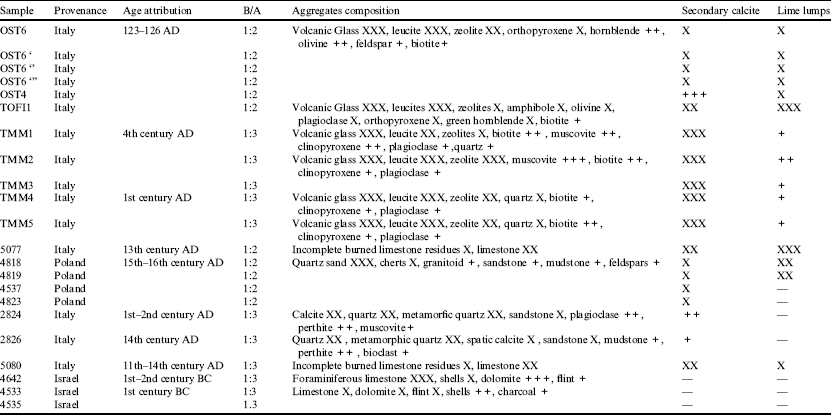
A set of anonymous samples characterized by aggregates different from pozzolana were used to compare the carbon yield from aerial mortars to the carbon yield from the pozzolana ones. Aerial mortars are here represented with numerical lab codes: 2824, 2826, 4533, 4535, 4537, 4642, 4818, 4819, 4823, and 5080. No 14C dating will be performed. Table 1 shows a summary of their different archaeological, geographical, and historical backgrounds and some basic compositional information as well. Samples are from buried and unburied archaeological structures.
For each sample is listed: geographical provenance, age attribution and petrographic features as binder/aggregate ratio (B/A), aggregate composition and presence of secondary calcite or lime lumps. Relative abundance of each mineral phase or component within each sample is given using symbol X to indicate major phases and + for minor ones.

Characterization of the Mortars
Petrographic analysis of the selected mortar samples was carried out in order to gain information on the composition of both aggregate and mortar components. Moreover, petrographic analyses helped to detect possible contaminant sources such as unburned limestone residues (calcinations relicts), calcareous aggregates and recrystallized calcite and/or identifying possible features of mortar degradation. Investigations were performed on mortars in thin sections (30 μm) using a polarizing optical microscope (ZEISS D-7082 Oberkochen) at different magnifications (2×, 10×, 20×) under parallel and crossed nicols.
14C Analysis
The Cryo2SoniC methodology was applied to select the carbon (C) signal from the binder by means of a sequence of physical separations including steps of cryogenic breaking, ultrasonication, and centrifugation according to Marzaioli et al. (Reference Marzaioli, Lubritto, Nonni, Passariello, Capano and Terrasi2011, Reference Marzaioli, Nonni, Passariello, Capano, Ricci, Lubritto, De Cesare, Eramo, Castillo and Terrasi2013) and Nonni et al. (Reference Nonni, Marzaioli, Secco, Passariello, Capano, Lubritto, Mignardi, Tonghini and Terrasi2013). This procedure is based on the experimental observation that binder carbonates are characterized by a more easily breakable structure than one of the aggregates (Marzaioli et al. Reference Marzaioli, Lubritto, Nonni, Passariello, Capano and Terrasi2011, Reference Marzaioli, Nonni, Passariello, Capano, Ricci, Lubritto, De Cesare, Eramo, Castillo and Terrasi2013; Nonni et al. Reference Nonni, Marzaioli, Secco, Passariello, Capano, Lubritto, Mignardi, Tonghini and Terrasi2013). By gently breaking the softer binder structure, originating a suspension of fine particles characterized by a slow sedimentation velocity and collecting suspended particles, mortar purification is achievable. The applied procedure is detailed as follows:
1. Cryogenic breaking. Following the procedure reported by Nawrocka et al. (Reference Nawrocka, Michniewicz, Pawlyta and Pazdur2005) and Marzaioli et al. (Reference Marzaioli, Lubritto, Nonni, Passariello, Capano and Terrasi2011, Reference Marzaioli, Nonni, Passariello, Capano, Ricci, Lubritto, De Cesare, Eramo, Castillo and Terrasi2013), mortar pieces (~5 g) were wrapped in multiple layers of Al foil and submerged in liquid nitrogen until reaching a thermal equilibrium. Samples were immediately transferred into an oven at 80°C and kept at a constant temperature for 1 min. After repeating this freezing/thawing cycle three times, the mortars were crumbled by hand or by applying pressure by a very gentle hammering if strongly cohesive.
2. Size selection. The produced fragments (spanning a wide range of particle sizes) were sieved keeping only material below 800 µm and stored in a 75 mL beaker with ~40 mL of deionized water. The system was left to settle for 12 hr.
3. First ultrasonic selection. The water portion was removed using a micropipette, followed by addition of 40 mL of deionized water to the beaker, and left to settle for 1 hr. An ultrasonic bath was run for 10 min with a Salecta Ultrason-H using high-frequency sound waves (40 kHz, 200W). The watery portion was collected with a micropipette in a centrifuge tube. This first fraction may have been potentially affected by dead carbon contamination, therefore we did not use it for dating (Marzaioli et al. Reference Marzaioli, Nonni, Passariello, Capano, Ricci, Lubritto, De Cesare, Eramo, Castillo and Terrasi2013).
4. Second ultrasonic selection. A new volume of 40 mL of deionized water was added to the beaker, left to settle for 1 hr and a second ultrasonic bath was run again for 30 min. About 30 mL of water suspension was collected in a centrifuge tube (50 mL), avoiding any agitation of the sediments.
5. Centrifugation. A centrifugation of tubes with the aqueous suspension was run at 8.0 krpm, in a rotor of 10 cm mean radius, for 5 min. The watery part removed and the tubes were left oven-dried overnight at a constant temperature of 80°C. Fractions of fine powders were obtained, and a sieving test assured they were < 63 µm. This type of fraction is considered to be representative of the binder, although more or less significant quantities of finely grained aggregates could be found (Bakolas et al. Reference Bakolas, Biscontin, Moropoulou and Zendri1998; Moropoulos et al. Reference Moropoulou, Bakolas and Bisbikou2000). After this point, there was no further selection and we supposed Cryo2SoniC efficiency was enough to discriminate the binder from any unwanted carbon signals different from it.
Each sample of 40 mg of carbonate fractions was kept in a special reaction vessel for isotope analysis, modified from McCrea (Reference McCrea1950), with an excess of frozen H3PO4 (85%). The acid is kept into a portion of the vessel separated from the main chamber, not interacting with the sample (Figure 5). One by one the reaction vessels were first evacuated (<10–3 mbar) to ensure the vacuum then detached from the purification line. The acid was then mixed with the binder fraction by overturning the ampulla, starting the acid digestion. A complete digestion of the carbonates was run in oven for 2 hr at 85°C. The content of the reaction vessels underwent a cryogenic purification from all gases potentially poisonous to the reduction step and from any amount of interfering water, by means of a vacuum line and a liquid nitrogen trap (T = –195.86°C), shown in Figure 5 (Marzaioli et al. Reference Marzaioli, Borriello, Passariello, Lubritto, De Cesare, D’Onofrio and Terrasi2008, Reference Marzaioli, Lubritto, Nonni, Passariello, Capano and Terrasi2011). A double spiral trap cryogenic line isolated the CO2 from the air and water with the 100% efficiency (Bertolini et al. Reference Bertolini, Rubino, Lubritto, D’Onofrio, Marzaioli, Passariello and Terrasi2005; Marzaioli Reference Marzaioli2011). The calibration chamber (fixed volume of the line; Figure 5) was calibrated by means of C% standards by recording produced pressures of different kinds and amount of samples and producing a linear calibration function relating Pvol with the amount of C. Each sample CO2 pressure, measured into the calibration chamber, was finally converted into C mass by inverting the produced linear relationship. The collected CO2 was converted to graphite on iron powder catalyst following the zinc reduction process used at CIRCE as in Marzaioli et al. (Reference Marzaioli, Borriello, Passariello, Lubritto, De Cesare, D’Onofrio and Terrasi2008). With the aim to check accuracy, reproducibility, and induced background of the line, IAEA C1 (background) and IAEA C2 (normalization; Rozanski et al. Reference Rozanski, Stichler, Gonfiantini, Scott, Beukens, Kromer and van der Plicht1992) were digested and reduced to graphite following the same procedure. The reduction line background is estimated to be (0.13±0.08 mean value±standard deviation) pMC leading to an apparent age of 53.0±4.6 kyr for processed blanks of C mass higher than 1 mg C. The contamination of the overall process corresponds to 1.2±0.3 micrograms of modern carbon. We tried indeed also reference IAEA C1 and C2 sample Cryo2SoniC attack, not observing any statistical difference of treated vs untreated carbonaceous samples so it is plausible assuming that no extra contamination was introduced by the Cryo2SoniC procedure.
Scheme of the cryogenic purification line for 14C sample pretreatment (Marzaioli Reference Marzaioli2011) with detailed views of the carbonate reaction vessel used for the digestion of carbonaceous materials (A, B, D) and the moment of the CO2 confinement (C).

Graphite samples were measured by means of the CIRCE-AMS system to obtain the 14C isotopic ratios (Terrasi et al. Reference Terrasi, De Cesare, D’Onofrio, Lubritto, Marzaioli, Passariello, Rogalla, Sabbarese, Borriello, Casa and Palmieri2008). 14C/12C ratios were converted to 14C ages and presented, according to Stuiver and Polach (Reference Stuiver and Polach1977) in calibrated (i.e. calendar) ages. Calibration was performed by means of the OxCal 4.2.4 calibration program (Bronk Ramsey and Lee Reference Bronk Ramsey and Lee2013) using IntCal13 atmospheric calibration data set (Reimer et al. Reference Reimer, Bard, Bayliss, Beck, Blackwell, Bronk Ramsey, Grootes, Guilderson, Haflidason, Hajdas, Hatte, Heaton, Hoffmann, Hogg, Hughen, Kaiser, Kromer, Manning, Niu, Reimer, Richards, Scott, Southon, Staff, Turney and van der Plicht2013). 14C calibrated ages at 1σ and 2σ were compared to the archaeological expectations. Any sample contamination, occurring during the application of Cryo2SoniC and following steps, was contained and avoided by using brand new consumables or glassware cleaned by cycles of hydrochloric acid and distilled water to remove any eventual lime-based residues.
As the main aim of this study was to check the reliability of the Cryo2SoniC when applied to an untouched mortar sample, no lime lump was isolated from the bulk of any mortar sample, even when easily recognizable. A further deterrent for performing a selective sampling of lime lumps was the risk to incur in an erroneous sampling of CaCO3 nodules, derived from volcanic activity (Miriello et al. Reference Miriello, Barca, Bloise, Ciarallo, Crisci, De Rose, Gattuso, Gazineo and La Russa2010).
A reproducibility test was performed independently replicating the Cryo2SoniC selection procedure four times, by repeating the sampling and the Cryo2SoniC on the large sample of OST6. Four different aliquots of selected powder were obtained and dated. The resulting 14C ages allowed the definition of the repetition variability for the Cryo2SoniC procedure by applying the Bayesian outlier analysis (Bronk Ramsey and Lee Reference Bronk Ramsey and Lee2013) onto the weighted average. This procedure ends with an index of agreement corresponding to the χ2 test probability onto the weighted average as a position estimator of the F14C studied distribution.
Characterization of Fractions Obtained by Cryo2SoniC
An ultimate test on isolated fractions was performed by a sieving test and observations via scanning electron microscopy (SEM) to check both the minimum and average size collected, and the morphology of the selected particles.
A sieving test was performed on all fractions using a traditional 63 µm sieving. SEM-EDS analysis was performed with an FEI-Quanta 400 scanning electron microscope, coupled with an energy dispersive X-ray spectroscope operated at 20 kV, on metallized samples. Metallization was carried out with an Emitech K550X thinly layering Au on calcite powder. The magnification was up to 50,000× due to the bad conductivity of the sample’s surface during image acquisition. SEM analysis was performed on fractions OST6 D, TMM4, 4818, 4819, and 4537, isolated by Cryo2SoniC from the original mortar. A lack of material did not allow a systematic test on all fractions.
RESULTS AND DISCUSSION
Mortar Characterization
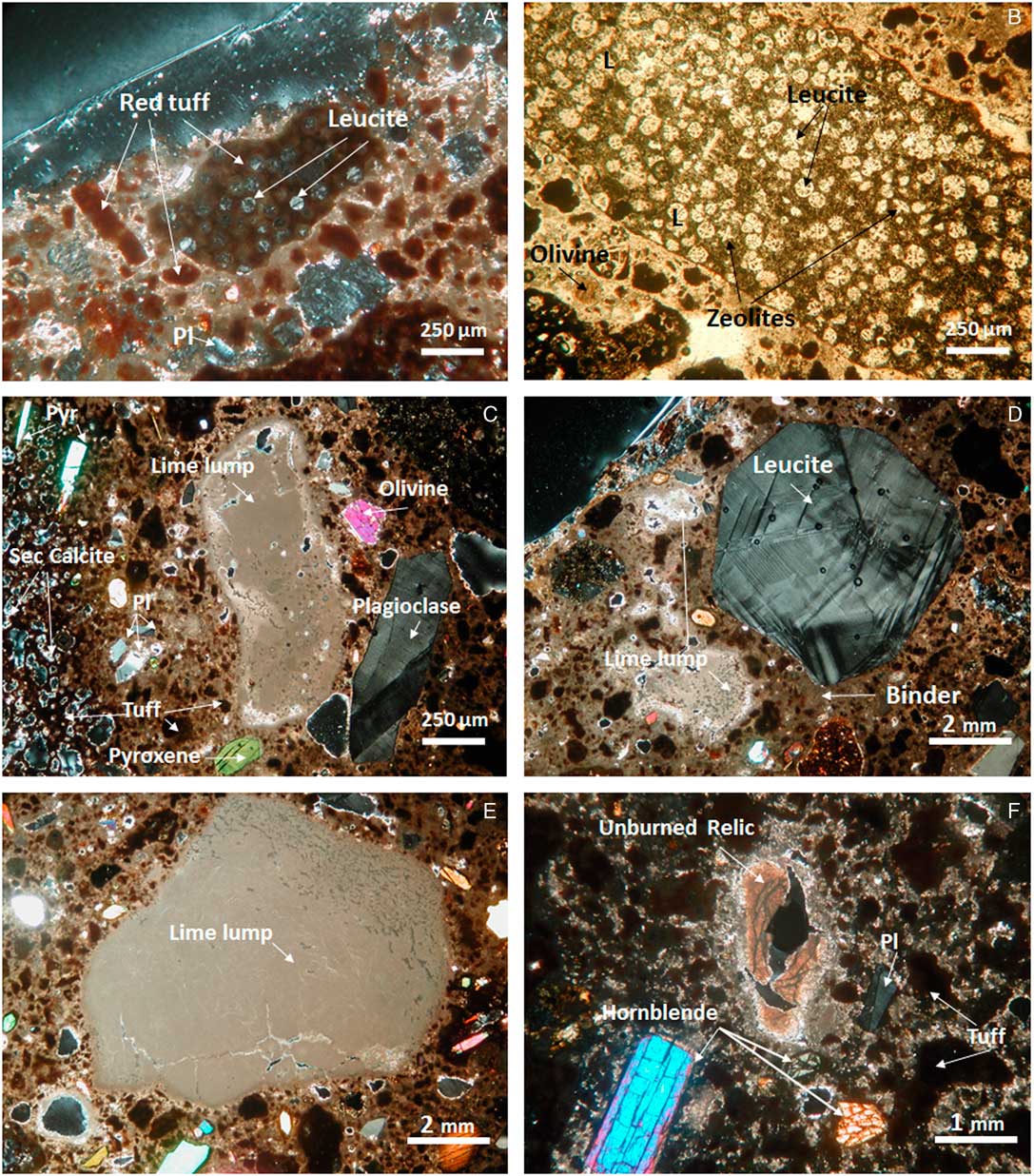
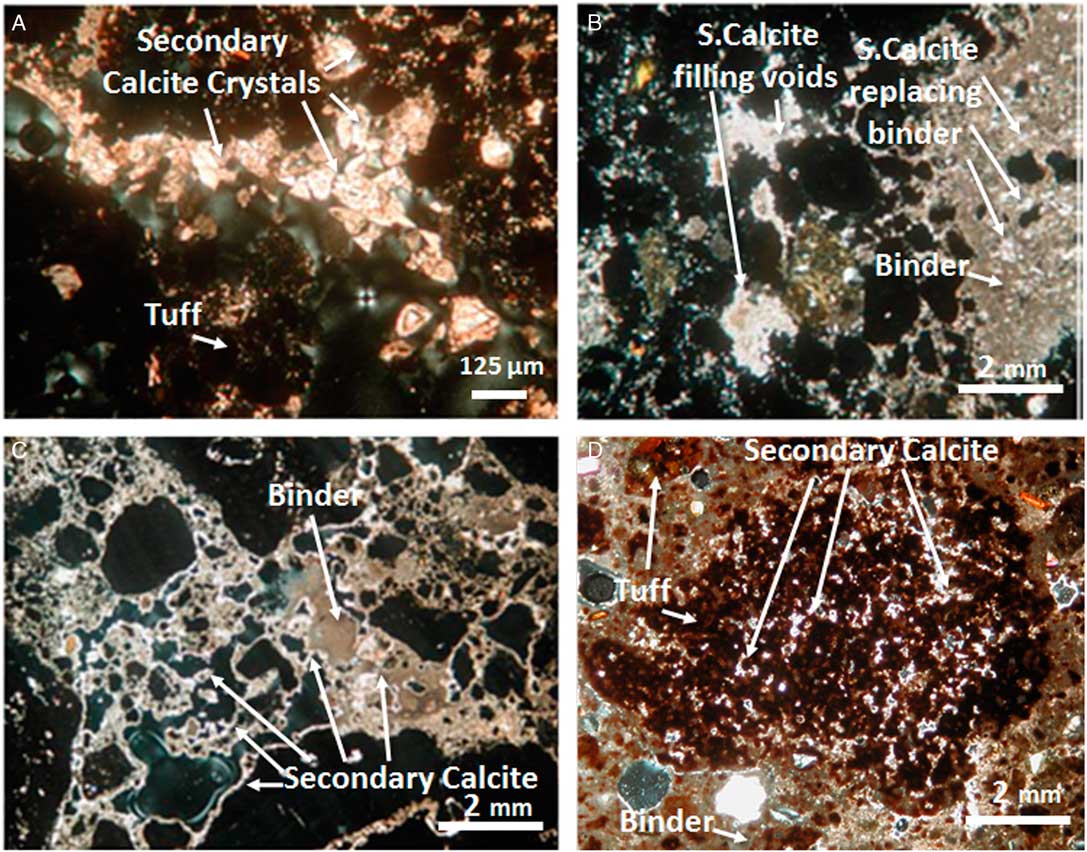
Petrographic observations on thin sections confirmed the presence of volcanic glass and pozzolana aggregates. A copious presence of leucite minerals and a minor presence of zeolites, orthopyroxene, green hornblende, olivine, feldspar, and biotite was identified (Table 1). All samples had highly crystalline pozzolana aggregates full of chart-wheel leucite crystals (Figure 6A, 6B) while ToFi1 had phenocrysts of leucite dispersed into the matrix with diameters up to 8 mm (Figure 6D). It is well known that pyroclastic aggregates tend to chemically react at their interfaces with lime (Sanchez-Moral et al. Reference Sanchez-Moral, Luque, Canaveras, Soler, Garcia-Guinea and Aparicio2005), developing calcium-silicate-hydrate (CSH) gel and alumina, ferric oxide, mono sulphate (AFm) phases, typical components of a hydraulic cement (Femy et al. Reference Femy, Brough and Taylor2003; Richardson Reference Richardson1999). It is possible that the occurring “reaction rims” along the surfaces of the pozzolana fragments towards the binder paste consisted of species of calcium silicate hydrate giving our samples hydraulic properties, but this was undetectable by a petrographic microscope (Idorn and Thaulow Reference Idorn and Thaulow1983; Massazza Reference Massazza1993). On the contrary, the presence of spathic crystals of secondary calcite was easily detectable both inside the tuff fragments and the binder. Different levels of contamination found among all the pozzolana samples (Table 1, Figure 7). Newly formed calcite depositions represent a source of contamination for the final dating, either for rejuvenation or aging, depending on its origin. Specifically, relevant calcite depositions were observed in ToFi1 and in all samples from the Temple of Minerva Medica (Figure 6).
Thin sections of pozzolana mortars under parallel (B) and crossed nicols (A, C, D, E, F) showing main mineralogical components and interesting features like phenocrysts of leucite (D), leucite cartwheel (B), unburned calcination relics (F), and different size of lime lumps (C, D, E); A: OST6; B: TMM 3; C–F: ToFi.

Secondary calcite depositions strongly affecting mortars from Temple of Minerva Medica and Tor del Fiscale: (A) calcite crystals inside tuff voids (TMM4); in (B) and (C) calcite crystals completely filling the pores of the sample (B: TMM5) and substituting binder matrix (TMM1); in (D) calcite crystals grown mainly inside pozzolana voids and porosity (ToFi1; 10× crossed nicols).

In ToFi1 and OST6, the presence of calcareous residues is localized mainly into the aggregate portion (Figures 6C and 7D), and it could be attributable to ascended movements of magmatic fluids through a limestone basement (Rittmann Reference Rittmann1933; Jackson and Marra Reference Jackson and Marra2006) or to atmospheric activity affecting the pozzolana grains before its use as a mortar aggregate (i.e. raw materials stored outdoor). Samples from the Temple of Minerva Medica revealed a different and massive contamination of secondary calcite: the newly formed calcite crystals had either a phenocryst, spatic and micritic shape, massively filling up all voids of the mortar and substituting up to the 80% of the original binder (Figure 7). Bigger crystals of secondary calcite, grown on the cavities’ surfaces, suggest a very slow geological episode involving the interaction of the mortar with a moving source of hard water (Figure 7A). The origin of this deposition is less likely to be attributed to meteoric origins (buried environment) and more likely to be attributed to groundwater interactions. Evidences of rising groundwater activities are attested for many sites in Rome including the area where the Temple of Minerva Medica was built (Ventriglia Reference Ventriglia1971).
A binder/aggregate ratio (B/A) of 1:2 was observed for Ostia and Tor Del Fiscale samples while a lower ratio of 1:3 was observed on Temple of Minerva Medica samples. A significant presence of lime lumps was found in ToFi1, covering a 45% of the whole binder portion. In ToFi1, lime lumps reached up to 10 mm in diameter and some of them carried traces of calcination relics (Figure 6, C–F). A lower presence of lime lumps was attested for OST6 and TMM with respectively a 30% and 10% of the whole binder portion. Although a perfectly formed lime lump is considered free from dead C contamination (Pesce et al. Reference Pesce, Quarta, Calcagnile, D’Elia, Cavaciocchi, Lastrico and Guastella2009, Reference Pesce, Ball, Quarta and Calcagnile2012; Marzaioli et al. Reference Marzaioli, Nonni, Passariello, Capano, Ricci, Lubritto, De Cesare, Eramo, Castillo and Terrasi2013; Ringbom et al. Reference Ringbom, Lindroos, Heinemeier and Sonck-Koota2014; Lubritto et al. Reference Lubritto, Caroselli, Lugli, Marzaioli, Nonni, Marchetti Dori and Terrasi2015), in this study, no lime lump was isolated from the bulk or dated separately.
The samples used for the comparison of yielded carbon can be roughly divided into two groups: mortars with a quartz aggregates (AQ: 4818, 4819, 4823) and mortars with a calcareous aggregate (AC: 2824, 2826, 5077, 5080, 4533, 4535, 4537, 4642). Mortars with quartz aggregates had quartz sands, granitoid, sandstone, chert, mudstone, and feldspars (details in Table 1). Mortars with calcareous aggregates had limestone, dolomite, flint, shell, and foraminiferous limestone. Each of these groups had both mortars with a B/A ratio of 1:3 and 1:2. Samples 4818, 4819, 5077, and 5080 had lime lumps while almost all of them had slight occurrence of secondary calcite (Table 1).
Physical Characterization of Cryo2SoniC Fractions
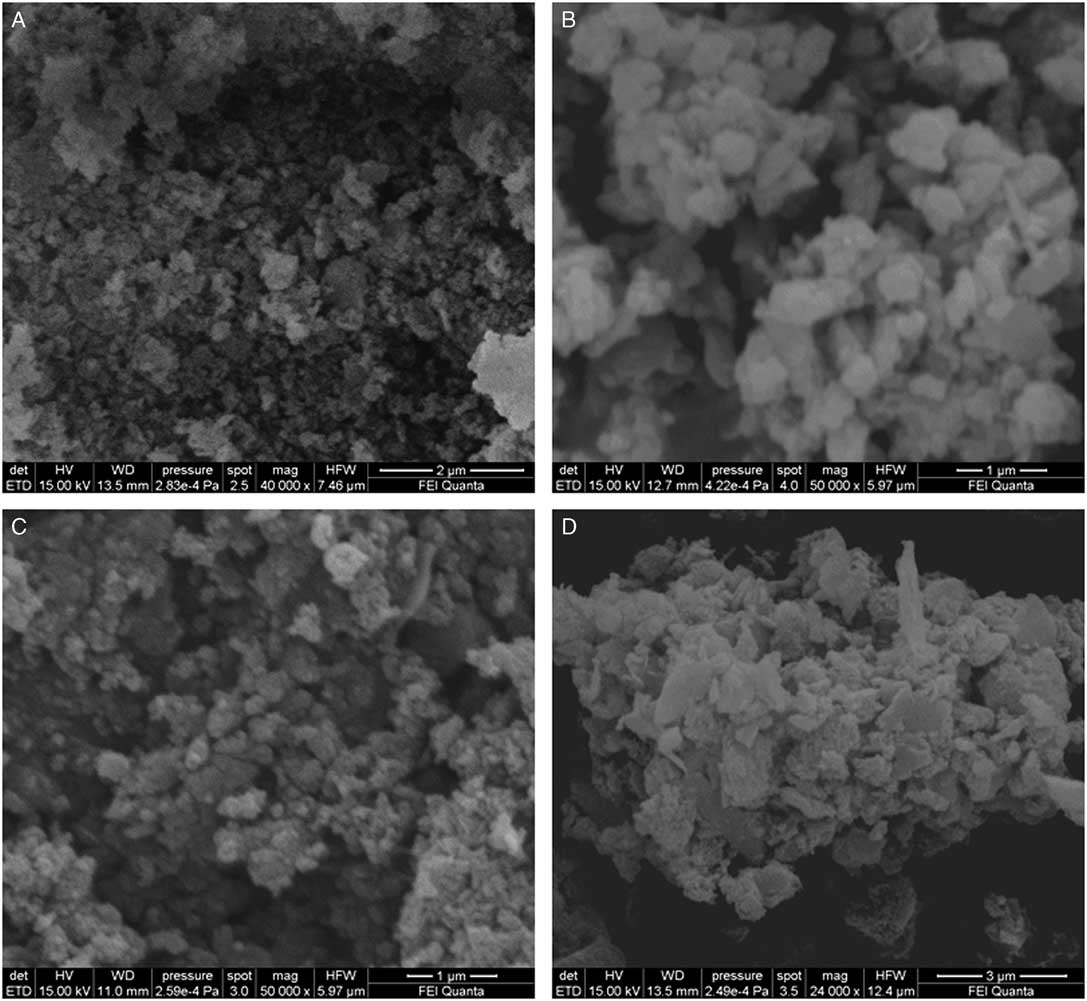
Particle size dimension for all fractions obtained by Cryo2SoniC by traditional sieving was lower than 63 µm. On fractions OST6 D, TMM4, 4818, 4819, 4537 a collection of a series of backscattered electron images by SEM was performed. Images captured at 3, 2, and 1 μm showed particles mean size was above 1 μm and a minimum size below this value (Figure 8). An overall roundness was observed for particles in OST6 (pozzolana aggregate), 4537 (calcareous aggregate), 4818, and 4819 (quartz aggregate). Particle roundness and sub-micrometric dimension suggest a chemical origin (round particles originated from colloids) more than a mechanical one (sharper and pointed shapes). The chemical process of producing colloids, which flocculate and regrow generating finer particles, has been demonstrated for sub-aerial media (Wilson and Spengler Reference Wilson and Spengler1996; Seinfeld and Pandis Reference Seinfield and Pandis2006) and for aqueous media (Davis and Kent Reference Davis and Kent1990; Salama Reference Salama2000; Ortega et al. Reference Ortega, Cruz Zuluaga, Alonso-Olazabal, Inasausti, Murelaga and Ibanez2012; Gal et al. Reference Gal, Habraken, Gur, Fratzl, Weiner and Addali2013).
SEM images of fractions selected by Cryo2SoniC captured at high magnifications, which show an overall average size particle of 1 μm and a minimum size below: (A) sample 4537; (B) sample 4119; (C) sample OST6; (D) sample TMM4. Samples A, B, C have particles with an overall rounded shape, while D shows a mix of particles with different shapes (both rounded and angular) and size (from sub-micrometric up to 3 μm).

On the isolated fraction from TMM4, SEM images disclosed particles with various shapes and sizes. In Figure 8D, the presence of bigger particles (~3 µm diameter) with angular shapes is highlighted for TMM4, probably attributable to micrometric volcanic glass fragments derived from the breakage of the pozzolana aggregate. None of the suspensions excluded the presence of crystals of secondary calcite a priori, when dimensionally similar to the calcite from the binder (~1 µm).
Carbon Yield in Pozzolana Mortars
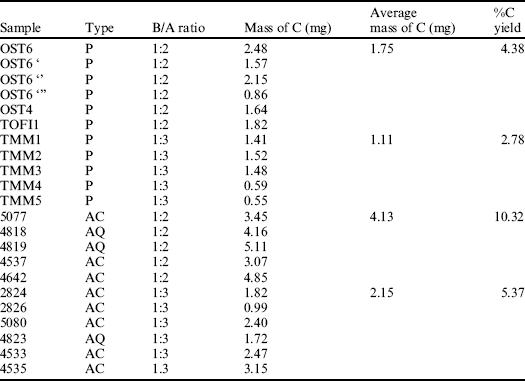
Independently from the type of aggregate, mortars with a similar B/A ratio should give similar amounts of C extracted per unit of mass undergone during pretreatment (Cryo2SoniC). This is true if all the portions of binder are made of the same amount of carbonates, but it cannot be valid for pozzolana mortars, where a variable presence of hydraulic compounds in the binder should lead to a lower availability of carbonate suitable for dating. Portions of binder reacting with its volcanic aggregate form calcium-silicate-hydrate gel and alumina, ferric oxide, mono sulphate phases at the binder/pozzolana interfaces. These types of materials cannot be carriers of the atmospheric signal like the binder itself, even if they look similar both at a macroscopic or microscopic level. As shown in Table 3, from each 40 g of powder isolated by Cryo2SoniC from a pozzolana mortar, was obtained on average, about half of the carbon developed from fractions collected from mortars with similar B/A ratio but different type of aggregate.
Furthermore, it was observed that for same B/A ratios, mortars with quartz aggregates or calcareous aggregates, developed a similar amount of C independently from the type of aggregate (Table 2). The presence of lime lumps, usually an important advantage and a precious resource for 14C dating, did not have the same constant impact on the total amount of C yielded by the bulk of mortar. ToFi1 was, among all pozzolana mortars, the sample with the higher proportion of lime lumps above the binder, however, its yield of carbon did not stand out from the others with similar B/A ratio as it happened instead for samples of aerial mortar 4818, 4819, 5077.
The amount of C (mg) obtained from acid leaching of 40 mg of fractions collected by Cryo2SoniC is shown. For each sample, the binder/aggregate ratio (B/A) and the mortar type is given: P, pozzolana mortars; AC aerial mortars with calcareous aggregates; AQ aerial mortars with quartz aggregates. The value of C (mg) has been rounded off to two decimals. The average amount of the C (mg) from pozzolana mortars and not pozzolana mortars allows an estimate of the %C extracted from each group.

It is good to recall that the percentage of carbon developed from a Cryo2SoniC fraction is highly dependent not only from the original B/A but also from the hardness and chemistry of the aggregate composing a mortar. Highly fragile carbonate aggregates producing sub-particles of micrometric dimensions could be collected into the Cryo2SoniC portion changing the total %C, as well as particles of secondary calcite (see samples 5077 and 4642).
14C Dating
A set of archaeological pozzolana mortars of known age has been dated to test the reliability and efficiency of the Cryo2SoniC protocol on the selection of the binder signal.
14C results are summarized in Table 3, where each value shows the age found dating the fraction collected by Cryo2SoniC protocol. Experimental results were compared to archaeological references: a historical attribution for the mortars from Temple of Minerva Medica (4th century AD), and some Hadrian’s age brick stamps (123–126 AD) found in the proximity of the mortars, for the sites of Ostia Marina and Tor Del Fiscale. The brick stamps were here considered as a terminus post quem or a lower limit for the absolute dating.
14C dates of mortars from Ostia Marina and repetitions (OST4 and OST6 serie), Tor Del Fiscale (ToFi1) and Temple of Minerva Medica (TMM samples). Calendar ages at 1σ (68.2% probability) and 2σ (95.4% probability) with archaeological references are reported following Stuiver and Polach (Reference Stuiver and Polach1977). Bold text highlights the results matching the expected dates (archaeological reference).

As shown in Figure 9, experimental dates were in agreement with the archaeological expectations for mortars from sites of Ostia and Tor Del Fiscale, both successfully dated to the era of Emperor Hadrian. Cryo2SoniC demonstrated to effectively isolate the binder signal from potential sources of aging, like unburned limestone relicts seen in ToFi1, and secondary calcite depositions inside pozzolana grains variably affecting ToFi1 as well as OST4 and OST6.
Calibrated ages for pozzolana mortar samples from Ostia and Tor del Fiscale matching their archaeological attributions (123–126 AD).

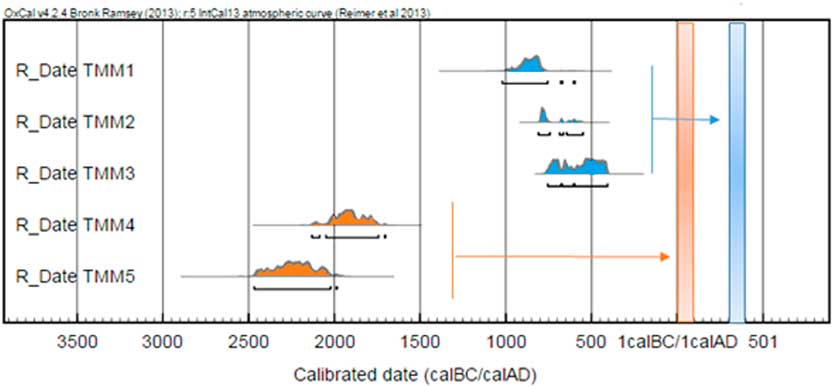
A bias of thousands of years was found for the attributed chronologies for samples from Temple of Minerva Medica (Figure 10). The aging effect from this site appears to be more significant with the increased depth of the mortar from the ground level. TMM1, TMM2, and TMM3 were about 800 years older than the attribution, while for TMM4 and TMM5 the bias was about 2000 years. The cause of this indisputable aging effect could be attributed to a massive presence of secondary calcite deposition filling all porosity of the mortar as well as extensively replacing the original binder matrix (Figure 7). These massive secondary calcite depositions are probably the results of a known groundwater activity (Ventriglia Reference Ventriglia1971). In total amount of carbon extracted from the fraction isolated by Cryo2SoniC, only a minimal part was from the binder, while it was largely from carbonates derived from precipitation secondary calcite crystals of geological limestone diluted in the underground springs during years of variable underground floods. The aging bias observed on samples followed this theory: mortars collected at a lower level of burial (TMM4, TMM5 ~3 m under the main floor), had withstood more or more frequent floods than the three mortars collected at upper levels (TMM1, TMM2, TMM3 ~2 m under the main floor).
Calibrated ages for pozzolana mortars from Temple of Minerva Medica and their relative historical references: 1st century AD for TMM1, TMM2, and TMM3 and 4th century AD for TMM4 and TMM5. The graph shows strong aging effects due to dead carbon contamination of secondary calcite depositions of geological origin (i.e. groundwater).

A further comparison to verify the reproducibility of the pretreatment Cryo2SoniC method for pozzolana mortars was performed and results on OST6 are shown in Table 3. The observed combined variability (i.e. error of the weighted mean) of the 14C age over the four replicates of OST6 led to 1945±20 yr BP (i.e. about 0.3% on the F14C) comparable with the machine repeatability. The agreement index produced by the χ2 test onto the measured F14C values was 91.2%.
CONCLUSIONS
This study allows us to verify that the percentage of C yields from mortars with pozzolana aggregates are less than half of those obtained from mortars with aggregates different from pozzolana. If the same amount of binder extracted from a mortar results in a lower quantity of carbon, a higher amount of original mortar is required to undergo to the Cryo2Sonic or equivalent selection methods.
Moreover, the Cryo2SoniC procedure was demonstrated to be a reliable pretreatment method to select a fraction of calcite suitable for dating pozzolana based mortars, moderately affected by dead carbon contamination: reliable and reproducible results on pozzolana mortars in agreement with the archaeological attributions were obtained on samples from Tor del Fiscale and Ostia. The protocol showed good reproducibility within the same sample, producing consistent dating within four complete independent replicates. The selection of the carbonates from the binder portion was satisfactory, leading to the discriminating of these from carbonates of calcareous components that would potentially affect the final dating, such as unburned limestone residues and secondary calcite of atmospheric origin.
The overall presence of sub-micrometric and rounded particles within the fractions isolated by Croy2SoniC and checked by SEM, suggests that the Cryo2SoniC could be an effective procedure to select calcite grains originated by crystal nucleation and/or chemical growth (slake lime carbonation). As well, a total absence of contaminant particles of equivalent dimensions of those of the binder, cannot be always guaranteed. This happened on samples of Temple of Minerva Medica where a massive contamination of secondary calcite extensively replaced the original CaCO3 and led to older ages. The procedure showed a failure to identify the right portion to date. This failure could be attributed to a scarce content of original binder compared to a massive presence of newly formed calcite crystals, dimensionally comparable to those to select. The binder substitution with secondary calcite was due to prolonged and recurrent ground water interactions, therefore it is strongly suggested to always perform preventive thin sections analysis on samples from buried contexts. Also, performing Cryo2SoniC and 14C dating on mortar with an extensive substitution of the original binder, or from sites with known ground water activity, it is to be avoided.
Acknowledgments
Special thanks to Dr Danuta Michalska from Adam Mickiewicz University of Poznan, Dr Andrea Macchia, Dr Salvo Barrano and Dr Laura Sadori from the University of Rome Sapienza, Dr Alessandro Turci from University of Bologna and Dr Maria Erzilia Loreti from the Archaeological Superintendency for providing samples and, most of all, for believing in this research.