Introduction
Dementia impacts on relationships with others, and most significantly spousal relationships. In this paper, we use the term spousal relationship to describe a committed intimate partnership including heterosexual and same-sex couples who are married, or cohabiting but not married. Most people with dementia receive care from their spouse at home and never enter into care accommodation (Kendig et al., Reference Kendig, Browning, Pedlow, Wells and Thomas2010). An Australian-based study conducted in 2011 found that 30% of people with diagnosed dementia lived in care accommodation while 70% lived in the community (AIHW, 2012). These estimates are consistent with survey findings conducted in developed countries by the Alzheimer's Disease International consortium (WHO, 2012). Governments internationally are increasingly funding programs and services tailored at supporting people with dementia (and their carers) to live in the community for as long as possible (DoHA, 2012). Based on projections of population aging and growth in Australia, the number of people with dementia is projected to reach almost 400,000 by 2020 and around 900,000 by 2050 (AIHW, 2014). Because the general population is aging, living longer and more people with dementia are living in the community, it is therefore anticipated that increasing numbers of spouses will face caregiving responsibilities within their relationship. Living with the reality of dementia implies continuous changes and adjustments to the spousal relational context including the couple's shared identities, rituals, interaction patterns, and life plans. Adapting to these evolving demands and changes can contribute to spousal caregivers becoming vulnerable to chronic stress, depression, and anxiety (Knop et al., Reference Knop, Bergman-Evans and McCabe1998; de Vugt et al., Reference de Vugt2003; Garand et al., Reference Garand, Dew, Urda, Hagerty Lingler, DeKosky and Reynolds2007). Chronic spousal stress and poor health consequences have been found to be critical factors in triggering spousal caregiver decisions to move their partners into care accommodation (Umberson et al., Reference Umberson, Williams, Powers, Liu and Needham2006; AIHW, 2014). Understanding cognitive decline and dementia from the perspective of the spouse is therefore important for maintaining the health and well-being of both individuals as well as supporting their domestic living arrangements for as long as possible.
Providing care and support to a partner takes place within the context of that pre-existing spousal relationship. This mutual familiarity supports established patterns of interaction, including preferred ways of expressing themselves within their relationship, and underpins expectations for how each person will behave and react to one another (Karner and Bobbit-Zeher, Reference Karner and Bobbitt-Zeher2005). Dementia adversely affects this interactional companionship and the quality of the spousal relationship (Wright, Reference Wright1991; Knop et al., Reference Knop, Bergman-Evans and McCabe1998; Eloniemi-Sulkava et al., Reference Eloniemi-Sulkava2002). Understanding how spouses adjust and adapt to these circumstances has gained increasing interest in the literature over the past 30 years. To date, the majority of research with caregivers of people with dementia has been conducted using quantitative methodology involving cross sectional designs using questionnaires and scales. It has also focused primarily on spouses of partners diagnosed with Alzheimer's Disease (AD) and to a lesser extent those with Mild Cognitive Impairment (MCI). High levels of distress and burden are typically associated with caregiving with as many as 80% of caregivers reportedly reaching their upper limits of burden during the dementia disease process (de Vugt and Verhey, Reference de Vugt and Verhey2012). Spousal caregiver burden is generally viewed as a multicomponent construct which is influenced by the behavioral characteristics displayed by the person with dementia, the caregiver's emotional–psychological state as well as the social context of their given situation (de Vugt and Verhey, Reference de Vugt and Verhey2012). The literature also suggests that spouses may experience distress and anxiety long before their partner is diagnosed with dementia. Interestingly, the spouse's first inklings that “a problem” may exist are usually associated with some acknowledgement of behavioral changes in their partner, particularly changes that have a negative impact on the spousal relationship (de Vugt et al., Reference de Vugt2003; Eustace et al., Reference Eustace2007; Garand et al., Reference Garand, Dew, Urda, Hagerty Lingler, DeKosky and Reynolds2007). Adding to the spousal burden is the anticipated long delays from first symptom recognition to diagnosis of dementia, ranging from an average of 3.1 years for later onset dementia (Speechly et al., Reference Speechly, Bridges-Web and Passmore2008) and 4.4 years for younger onset dementia (van Vliet et al., Reference Van Vliet2011). It is often the caregivers’ accumulating anxiety, concern, and speculation about the cause of their partner's behavioral symptoms that drive them to actively seek a formal diagnosis (Morgan et al., Reference Morgan2014).
Spousal caregivers usually experience the behavioral symptoms of dementia as interactional challenges rather than as discrete cognitive dysfunction. Disturbed communication has been described by spousal caregivers as the greatest deterioration and challenge, and has been associated with increased negative perceptions of relationship quality (de Vugt et al., Reference de Vugt2003; Blieszner and Roberto, Reference Blieszner and Roberto2009; Braun et al., Reference Braun, Scholz, Bailey, Hornung and Martin2009; Clare et al., Reference Clare2012; Garand et al., Reference Garand, Dew, Urda, Hagerty Lingler, DeKosky and Reynolds2007). Common problems include apathy and reduced active participation in conversations, which in turn diminish the reciprocity of the relationship and ultimately the mutual enjoyment of each other's companionship. As dementia progresses and communication abilities decline, the spousal relationship is reported to become increasingly imbalanced. This emotionally laden “subjective” caregiver burden is thought to change the spouse's feelings towards their partner (Wright, Reference Wright1991; de Vugt et al., Reference de Vugt2003; van Vliet et al., Reference Van Vliet2011) and result in poorer relationship quality (Garand et al., Reference Garand, Dew, Urda, Hagerty Lingler, DeKosky and Reynolds2007). The process by which this change occurs remains unclear.
Overall, there are considerable limitations in the reporting of quantitative studies leading to largely inconclusive insights into the specific underlying factors that contribute to caregiver burden, especially from the perspective of a caregiver spouse. Some studies have not differentiated the nature of the caregiver relationship between non-spousal familial and spousal relationships (Savundranayagam et al., Reference Savundranayagam, Hummert and Montgomery2005; Mioshi et al., Reference Mioshi, Bristow, Cook and Hodges2009; Nelis et al., Reference Nelis2011; Rosness et al., Reference Rosness, Mjorud and Engedal2011), though the emotional impact for spouses compared to other informal caregivers is likely to be vastly different. Further, while some studies have suggested there is a spousal sex difference in the caregiving experience (DeCaporale et al., Reference DeCaporale, Mensie and Steffen2013; Gibbons et al., Reference Gibbons2014), generally this aspect has been poorly explored. In addition, data collection using scales and questionnaires typically provides research participants only limited opportunity to explain the significance and often-complex nature of their experiences. Despite these limitations, the dominant outcome that emerges from the spousal perspective in the quantitative literature is that the spousal experience of dementia is characterized by diminished marital satisfaction and potentially poorer health (Kaiser and Panegyres, Reference Kaiser and Panegyres2007; Clare et al., Reference Clare2012; Fauth et al., Reference Fauth2012; Gibbons et al., Reference Gibbons2014; Gilden et al., Reference Gilden, Kubisak, Kahle-Wrobleski, Ball and Bowman2014).
Exploring the lived experience of how spouses respond to, manage, and negotiate changes in spousal relationships has gained greater momentum in recent years. Much of this research has been undertaken using qualitative research methodology. Qualitative research is broadly defined as a social enquiry that focuses on understanding the way people interpret their experiences and their “world.” Research using qualitative methodology also seeks to examine the experiences and beliefs of people from their own perspective through various data collection processes including in-depth interviews and focus groups. Data collection methods such as in-depth interviewing allow for the exploration of caregivers’ experiences by giving them an opportunity to provide a more detailed and nuanced description of the everyday and ongoing challenges they face with a partner with dementia. Studies using qualitative methodology have primarily focused on spouses living with partners diagnosed with either AD, Behavioral Variant Frontotemporal Dementia (bvFTD), or prodromal dementia conditions (such as MCI). These studies have specifically explored how cognitive-behavioral deficits influence the nature of the spousal relationship as well as how spouses’ manage changes in the relationship context with their affected partner. Results indicate that spousal caregiving is not always a negative experience (Hellstrom et al., Reference Hellstrom, Nolan and Lundh2005) and that multiple factors are likely to play a role in shaping the spousal experience. The nature and quality of the relationship pre-diagnosis also may have a broad ranging influence on the spouse's response to caregiving (Shim et al., Reference Shim, Barroso and Davis2012). A better understanding of the experiences of spousal caregivers and the factors that influence that experience is important for supporting and sustaining mutually satisfying relationships. Accordingly, the primary aim of this literature review was to synthesize the findings of published qualitative research that has focused on the spousal caregiver's experience of living with a partner diagnosed with either AD or FTD. A secondary aim was to explore how various cognitive-behavioral manifestations commonly exhibited by people with dementia are interpreted and responded to by spousal caregivers.
The methodology
Synthesis methodology
Because the aim of this study was to explore the spousal experience of living with a partner diagnosed with dementia with an additional focus on identifying cognitive-behavioral factors that may influence the dynamics of the relationship, the literature search was narrowed to dementia subtypes known to impact aspects of an individual's behavior or “personality” through the eyes of their spouse. Dementia subtypes that are more likely to have early and progressive manifestations of physical/motoric impairments (such as Lewy Body Dementia (LBD), Progressive Supranuclear Palsy, Vascular Dementia (VaD), Parkinson's Disease) were excluded because it was reasoned that those dementia subtypes might elicit emotional responses from spousal caregivers primarily associated with increased physical caregiving demands rather than interpersonal-interactional challenges. The main dementia diagnostic groups deemed to be most consistent with the aims of this study were AD and FTD. Changes in cognitive-behavioral symptoms are known to present early in these dementia conditions (Cooper and Greene, Reference Cooper and Greene2005).
Given that this synthesis sought to aggregate the findings of previously published qualitative research that explored spousal caregivers’ experiences of living with a partner diagnosed with dementia, data collection was dependent on sufficient reporting of the participant verbatim quotes in the primary research studies that addressed this line of enquiry. There are a number of different methodologies that can be used for the synthesis of qualitative health research (Dixon-Woods et al., Reference Dixon-Woods, Sutton, Shaw, Miller, Smith and Young2007; Barnett-Page and Thomas, Reference Barnett-Page and Thomas2009). Thematic analysis was selected as the most suitable methodological approach because it seeks to uncover new interpretations that go beyond the primary studies (Tong et al., Reference Tong, Flemming, McInnes, Oliver and Craig2012). Thematic analysis is a method used to gain further insights and identify broad patterns of meaning within and across a dataset. Patterns are identified through a rigorous process of data familiarization, data coding, theme development, and revision (Grbich, Reference Grbich2013).
Search sources and strategy
A systematic search of Ovid MEDLINE, CINAHL, EMBASE, and PsychINFO from January 1980 to September 2014 was conducted. Additional manual searches of reference lists of key journal articles and articles from expert authors in the area were also completed. A similar electronic search strategy was tailored for each database. The search strategy was structured around three key concepts:
-
1. People with dementia (such as “dementia” or “Frontotemporal dementia” or “primary progressive aphasia” or “Alzheimer's Disease,” and
-
2. The context of the experience (such as “spousal* caregivers” or “couples” or “martial relationship*” or “carer burden” or “couple hood” or “marital intimacy”) and
-
3. The phenomena of interest (such as “care giver burden” or “relationship*” or “quality of life” or “lived experience*” or “communication” or “psychosocial impact” or “martial satisfaction” or “psychosocial impact”).
Inclusion criteria
Studies were included if the following criteria were met:
-
1. The research was published in English.
-
2. Focused on adult participants with no specific age restrictions.
-
3. The research study focused on spousal caregivers with partners diagnosed with either AD or FTD.
-
4. Persons with dementia resided at home with their spouse and not living in a residential care facility at the time of the study.
-
5. The research explored, described, or considered lifestyle and/or relationship implications for the spouse and the partner with dementia.
-
6. The qualitative research study needed to include direct verbatim quotation data expressed by the spousal research participants, and the spousal caregivers needed to represent the dominant participant group in the study.
The first phase of the systematic search included all forms of research methodology – quantitative, qualitative, and mixed methods. This approach was taken to inform and explore the range of information relating to spousal caregivers of partners diagnosed with either AD or FTD. Study selection was then restricted to research that employed a qualitative methodology because the aim was to integrate study findings from individual qualitative studies in order to develop an in-depth understanding of the emotions, attitudes, and experiences of spousal caregivers. The final criterion reflected this intent and the yield of the literature search was limited to qualitative studies:
-
7. Qualitative research methods were used to describe the spousal caregivers’ experience of living with a partner with AD or FTD (e.g. grounded theory, phenomenological studies, descriptive, focus groups, or interview studies).
Articles that met all of the seven inclusion criteria were then retrieved in full text and reviewed.
The electronic search and screening method
Figure 1 shows the number of records retrieved. The search of all electronic databases identified 4,736 potentially relevant articles with an additional 71 studies identified via hand searches, resulting in a total yield of 4,807 articles. After screening the titles and abstracts using the first six inclusion criteria, 4,620 articles were excluded. Full copies of 187 articles were obtained, and this yield included the quantitative, qualitative and mixed methods research studies. A further 171 articles were then excluded on the basis of not meeting the final eligibility criterion relating to methodology. Sixteen papers were included in the final review. These 16 studies are marked with an asterisk in the reference list.
Flow of information through the different phases of the literature review.

The data extraction, coding, and analysis process
A six-phase thematic analysis process was undertaken to integrate and synthesize findings from the 16 selected studies. Although these phases are sequential and each builds on the previous step, analysis of the data was a recursive process between the different phases. The first phase was conducted by author one and the remaining five phases were undertaken independently and then consensus was reached through discussion between the first two authors. The six-phase process involved the following:
-
1. Data extraction: This phase involves reading each of the 16 papers and collating all verbatim quotes expressed by the study participants into one Microsoft Word Document. There were a total of 307 verbatim quotes extracted from the 16 studies.
-
2. Initial coding: The verbatim quotes were then read several times by both the author one and two to ensure familiarity with the content of each of collated quotes. Each author independently developed initial subject headings (or codes) that identified important themes expressed in the verbatim quotes. The first two authors then discussed the results of their initial coding of the data and reached agreement on a total of 22 codes. The parameters of each of these codes were defined and collated onto a guide-definition sheet.
-
3. Establishing agreement on coding: Authors one and two then independently reviewed the verbatim quotes within the 22 initial coding categorizations. Through a joint discussion, agreement was reached about the rewording of the describer codes.
-
4. Finding generic themes: This phase involved the authors jointly reviewing the generated codes against the dataset to determine if themes emerging from the data addressed aspects of the research question. Sets of data were compared, the themes were refined, resulting in some themes being split, combined, or discarded. A total of 18 different themes were jointly identified.
-
5. Defining descriptive themes: Through regular meetings and discussions, the authors then reached consensus about the overarching descriptive themes embedded in the data. This phase involved developing a detailed analysis of each theme, working out the scope and focus of each theme, and reaching agreement of an informative name for each theme. Analysis stopped when the authors agreed that saturation was reached and no new themes were evident in the data.
-
6. Credibility and trustworthiness: Questions regarding credibility, originality, resonance, and usefulness were applied to interpretations of the data throughout the analysis process (Charmaz, Reference Charmaz2006). Memo writing was used to provide an audit trail through the analysis process from initial coding to theme description. In addition as already indicated, first the codes and then later themes were reviewed and discussed in detail by the first two authors. Where differences occurred, the original quotes and coding memos were considered and the code or theme under consideration was discussed until consensus about meaning was reached. Finally, to show the reader that the analysis is fully grounded in the spousal experience, illustrative quotes from the source studies are presented throughout the text.
Results
Study characteristics
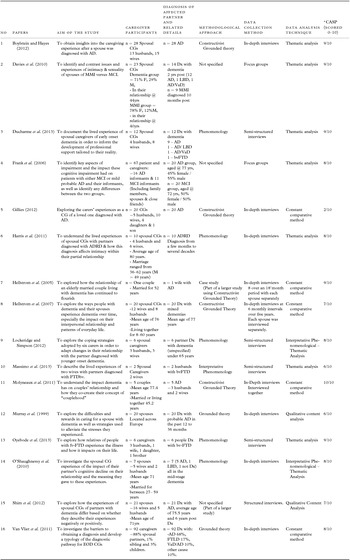
Details of each of the sixteen selected studies are presented in Table 1. Information collated in this table includes the following: aim of the study, demographic details about the spousal participants and their partners, number of participants, diagnosis of affected partners, research methodology, and the Critical Appraisal Skills Program (CASP) score. Fifteen of these qualitative research studies were conducted between 2005 and 2013. The most common method of data collection in these studies was in-depth interviews, while two studies used focus groups as their main method. The sample size ranged from 1 to 92 research participants and collectively these studies represented the views of at least 234 spousal caregivers. Frank et al. (Reference Frank2006) did not specify the number of spousal caregiver participants in their study. Three studies did not include the sex of the caregivers (Murray et al., Reference Murray, Schneider, Banerjee and Mann1999; Frank et al., Reference Frank2006; Van Viet et al., Reference Van Vliet2011). Of the thirteen studies that reported sex, collectively there were a total of 82 wives and 41 husbands. The vast majority of the studies investigated caregivers of partners diagnosed with AD or an unspecified AD-related dementia (ADRD), with six studies including care recipients with a range of additional types of dementia related conditions such as MCI, Mild Memory Impairment (MMI), FTD, LBD, and VaD (Frank et al., Reference Frank2006; Hellstrom et al., Reference Hellstrom, Nolan and Lundh2007; Davies et al., Reference Davies2010; O’Shaughnessy et al., Reference O’Shaughnessy, Lee and Lintern2010; Van Vliet et al., Reference Van Vliet2011; Massimo et al., Reference Massimo, Evans and Benner2013; Oyebode et al., Reference Oyebode, Bradley and Allen2013). Only five of the 16 studies disclosed the average age of the spousal caregivers (range 70–80 years). Six studies disclosed the mean length of the spousal relationship as between 40 and 60 years (Hellstrom et al., Reference Hellstrom, Nolan and Lundh2005; Reference Hellstrom, Nolan and Lundh2007; Davies et al., Reference Davies2010; O’Shaughnessy et al., Reference O’Shaughnessy, Lee and Lintern2010; Harris et al., Reference Harris, Adams, Zubatsky and White2011; Molyneaux et al., Reference Molyneaux, Butchard, Simpson and Murray2011). The time since formal diagnosis of dementia was mentioned in only four studies (Murray et al., Reference Murray, Schneider, Banerjee and Mann1999; Davies et al., Reference Davies2010; Harris et al., Reference Harris, Adams, Zubatsky and White2011; Shim et al., Reference Shim, Barroso and Davis2012); all appeared to be in the earlier phase of the condition and usually between 10 and 36 months post diagnosis. Harris et al. (Reference Harris, Adams, Zubatsky and White2011) included affected partners who were diagnosed with ADRD from a few months to several decades.
Characteristics of included studies

CG – Caregiver(s), PT – patients, N – Number of participants in study, Dx – Diagnosed, @ – median age is around, AD – Alzheimer's Disease, ADRD – Alzheimer's Disease Related Disorders, VaD – Vascular Dementia, FTLD – Fronto Temporal Lobar Dementia, bvFTD – Behaviorial variant Fronto Temporal Dementia, MMI- Mild Memory Impairment, MCI – Mild Cognitive Impairment, LBD – Lewy Body,
*The Critical Appraisal Skills Program (CASP) is a 10 question evaluation tool designed to systematically and critically evaluate the principles and assumptions underpinning the reported qualitative research evidence.
Appraisal of study quality
The CASP, a ten-point qualitative research appraisal tool, was used to evaluate how well the principles and underlying assumptions of qualitative research were reported in each study (Sandelowski et al., Reference Sandelowski, Docherty and Emden1997; CASP, 2013). CASP ratings for the studies were agreed through consensus discussion by the first two authors. Across the 16 studies, the CASP score ranged from 2/10 to 10/10. Given the aim of the study was to synthesize the results of published papers that reflected spousal experiences through sufficient reporting of verbatim quotes from participants, our intention was not to exclude studies based on quality ratings. Thus, no papers were rejected on the grounds of a poor CASP rating. Appraising the quality, strengths, and weaknesses of each of the papers highlighted substantial variability in the methodological quality and rigor of the current literature and the critical need to address the weaknesses in reporting future qualitative research in this area.
Synthesized themes
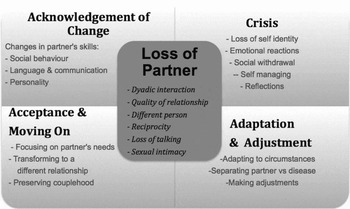
Five key descriptive themes captured the spousal caregivers’ experience of living with dementia, with “loss of partner” emerging as the central theme of the overall spousal caregiver experience (see Figure 2).
The five synthesized themes.

Loss of partner
The most frequently encountered codes in the data set reflected the descriptive theme of “Loss of Partner.” Categories evident within the “Loss of Partner” theme revolved around spouses’ perceptions of change in their dyadic interaction and quality of relationship, feeling that their partner had become a different person, experiencing reduced reciprocity and connectedness, loss of talking to each other, and changes in sexual intimacy. The neurodegenerative process of dementia-related conditions involves changes in cognitive-behavioral abilities for the affected individual. When one spouse demonstrates a change in overt behavior, the couple's dyadic interaction patterns may change. The shifting nature of the couple's relationship can then contribute to feelings of detachment and aloneness. A spouse in one of the studies poignantly expressed this sense of losing their partner:
I never expected to be by myself. . . All these changes in our lives by myself. . . Not having someone to talk to. . . Not having some one to talk things over with. That is the hardest part. (Partner with bvFTD, Massimo et al., Reference Massimo, Evans and Benner2013).
The emotional roller coaster of loss and grief reverberated in the following participant's statement:
It's like, two deaths, he's died a slow death and I know that there's gonna be another one. (Partner with AD, Shim et al., Reference Shim, Barroso and Davis2012).
Diminished satisfaction in the quality of a couple's relationship appeared to be largely associated with changes in the quality, quantity, and reciprocity of the couple's interactions. Statements made by some of the spouses exemplified this perception of reduced emotional connectedness and its association with reduced talking, communication difficulties, and sharing thoughts with the affected partner:
You know I miss conversations. I miss sharing things with him. I mean I can tell him something but it doesn't make any difference. There's just no, just absolutely nothing. And I, what I miss, I guess those are the things I miss. You know, having a conversation (Partner with AD, Boylstein and Hayes, Reference Boylstein and Hayes2012).
In the focus group study conducted by Davies et al. (Reference Davies2010), spouses were asked if they would consider a future intimate relationship with persons other than their partner. Several spousal participants in the MMI focus group acknowledged that they would like more emotional intimacy but were not seeking any relationship in their current situation. A sense of emotional disconnection, aloneness, and sadness around the loss of their previous relationship is reflected in the quote below:
I would be interested in someone else – not sexually – but for communication. It would be for emotional intimacy and talking more than a physical relationship. (Partner with MMI, Davies et al., Reference Davies2010).
Diminished spousal cohesion and loss of partner were also indicated in the terms spouses used when describing the quality of their current relationship with their affected partner: “stranger,” “lost,” “going,” “different,” “finished,” “shrinking,” “away” (Murray et al., Reference Murray, Schneider, Banerjee and Mann1999; Davies et al., Reference Davies2010). Loss of partner was also implicit in comments made about their transition from being a spouse to a day-to-day care provider:
I think what has changed for me is being the caregiver and doing all these things for him. And when he's sick, you know? He had the flu and he had diarrhea and we ended up having to use pampers or diapers or whatever. And I think that's kind of been. . . and then he has accidents and he urinates on the couch or something. You know? And I think for me this is kind of like again, he's a child and he's not Jack my strong husband who was always there to take care of me. And that's where I have trouble with, in bed trying to be intimate because I have this other picture going on in my mind. These emotions I’m fighting with. (Partner with AD, Boylstein and Hayes, Reference Boylstein and Hayes2012)
The comments made by spouses in these quotes also described how the relationship with their partner transformed to another familial-type association, such as parent–child or a brother–sister relationship. These quotes signal a marked shift in emotional intimacy and bond (Davies et al., Reference Davies2010; Gillies, 2012). Changes in a spouse's self-identity as a care provider rather than a shared identity as a spousal partner appeared to coincide with reported loss of libido and sexual intimacy. Challenges with sexuality were mainly raised by female spouses and usually emerged during the middle to later stages of dementia. As their husband required more “hands-on” care, their spousal relationship often transformed from a shared identity as a couple to becoming a “care provider.” Participating in sexual intercourse with their affected partner in these circumstances was emotionally disturbing for some spouses:
I’ve got to keep, going through the act of making love once a week for him, because I know it will upset him if we hit that on the head (give it up) completely . . . .but I can't wait for it to be over as quick as possible, because I get no enjoyment out of it at all. And also I’m a carer, a mother, a nurse. I’m treating him like a child three quarters of the time, and then I’ve got to reverse my roles to be a wife again, and a lover, and one thing and another. (Partner with bvFTD, Oyebode et al., Reference Oyebode, Bradley and Allen2013).
Acknowledgement of change
Thirteen of the sixteen primary studies identified issues related to spouses acknowledging and observing specific changes in their partner's behavior. These “personality” changes were often described and experienced in the context of interactional challenges rather than discrete cognitive dysfunction. For example:
He doesn't say goodbye. And doesn't kiss anybody or hug anyone any more. Even with friends & family. If someone dies or is ill, he has no feelings. It's terrible. You want to tear your hair out. (Partner with bvFTD, Massimo et al., Reference Massimo, Evans and Benner2013).
Dealing with behavioral changes was reported to increase the tension in the spousal relationship. Witnessing “out-of-character” behaviors had more profound effects for spousal caregivers with a partner diagnosed with bvFTD. Changes in their partner's personality traits (particularly diminished insight, lack of empathy and apathy) commonly fuelled a sense of resentment and indifference by the spouse:
He never asks how I’m feeling. You can get resentful, and he doesn't even. . . . Quite uncaring isn't it? (Partner with AD, Gillies, 2012).
The majority of spousal caregivers in these studies gave detailed descriptions of uncharacteristic interpersonal interactions displayed by their partner in various situations. Although they were often cognizant of the partner's dementia-related diagnosis, the everyday reality of seeing their partners talk and behave more and more abnormally over time was perplexing and taxing. Decline in communication-related skills was described in prodromal forms of dementia (i.e. MCI and MMI) and diagnosed dementia. Observed changes in their partners included difficulties understanding instructions and jokes, following conversations, reduced concentration, asking repetitive questions or comments, word-finding difficulties, reduced initiation, and/or maintaining meaningful discussions (Murray et al., Reference Murray, Schneider, Banerjee and Mann1999; Frank et al., Reference Frank2006; Van Vliet et al., Reference Van Vliet2011; Gillies, 2012; Boylstein and Hayes, Reference Boylstein and Hayes2012). The most difficult adjustment in coping with the change in cognitive functioning by the spouse was dealing with reduced intellectual and reciprocal exchanges with their partner in their everyday conversations. These quotes illustrate the association of emotional disconnect with unmet reciprocal communication with their affected partner:
Well, you can discuss but you have to lead the conversation because she very seldom carries on a conversation unless you start it, and then it's more or less question and . . . . She just doesn't respond (Partner with AD, Boylstein and Hayes, Reference Boylstein and Hayes2012).
Because the natural flow and ease of communication was compromised (Boylstein and Hayes, Reference Boylstein and Hayes2012), some spousal caregivers reported the need to “moderate” conversational interactions with their affected partners by either simplifying or “holding back” complex thoughts, usually driven by their desire to avoid frustration:
I find that I get frustrated by trying to explain something to him. I just don't bother but I know it's not a good habit (Partner with AD, Davies et al., Reference Davies2010).
Changes in interpersonal communication skills were also reported to be one of the presenting features signaling a neurodegenerative process, often leaving spouses feeling confused and seeking explanations for these changes. The following excerpt provides a wife's reflections on her earliest impressions of disease onset:
I can remember when we used to have these friends, he stopped taking part in the conversation, that was the first indication, that the rest of us would be talking and he wouldn't contribute to the conversation. The only thing he would say was could he have another drink, that was his contribution to the conversation. Gradually from then he became very withdrawn, and stopped reading the papers. He stopped listening to the radio programme which he always listened to, and he stopped talking to me. So, just complete. . . he just had nothing to say. And he stopped taking interest in any speaking programme on the TV. He couldn't grasp them but he still liked the sport and the nature programmes” (Partner with AD, Gillies, Reference Gillies2012).
In some cases of MCI, MMI, and AD, spouses attributed “personality” changes to other factors (e.g. stress, mid-life crisis, alcohol misuse) and sought marriage counseling prior to the eventual dementia-related diagnosis (Davies et al., Reference Davies2010) and/or the couple were on the verge of separation (Davies et al. Reference Davies2010; Van Vliet et al., Reference Van Vliet2011). Participants in a high proportion of the reviewed studies (12/16) indicated that the quality of companionship with their affected partner was in a continual state of flux and change, giving rise to feelings of ambiguity, and uncertainty about the future of their relationship.
Crisis
For most couples, talking and sharing with their life partner had been a natural and routine way of relating to each other, and a ritual established over a number of years. Dementia often disrupts this interactional harmony, unity, and sharing as a couple. Spouses in many of the primary studies reported experiencing difficulty in maintaining continuity in their identity as a husband or wife. This realization was often described in terms of a crisis in self-identity, often reflecting on the nature of their previously familiar spousal partnership. Massimo et al. (Reference Massimo, Evans and Benner2013) stated that out of necessity, but often with resistance, spouses begin to take on new roles and responsibilities. The distressing transition from being a spouse to her partner's caregiver was revealed in the following quote:
All of a sudden I went from wife to caregiver. And that label was placed on my chest that said ‘caregiver now.’ And then I accepted it for a while and then I realised that ‘I don't want to be your caregiver.’ I really don't want to do that (Partner with bvFTD, Massimo et al., Reference Massimo, Evans and Benner2013).
Similarly, the inner conflict and process of reconstructing self and shared identity as a spouse in a marital partnership is captured in this quote:
I’m not single and I’m not married and trying to associate with single people is difficult, well really associating with married people, so quite a long time now the social aspect of my life has been pretty nil. . . you don't really fit in there and you don't really fit in, so that's a definite problem (Partner with ADRD, Harris et al., Reference Harris, Adams, Zubatsky and White2011).
Some spouses conveyed emotions of despair, sadness, and regret about unfulfilled dreams and future uncertainty. The wife in the following excerpt also conveys her sense of a bleak future and of the implication for her:
There isn't a future. Definitely isn't a future. I’ll be completely lost when he's completely gaga (out of touch with reality) and I can't look after him anymore. . . I can't see life without him, so I can't see a future. . . We always used to plan, you know, together, silly little things like buying a touring caravan. . .and I’ve gone on with his bubble and his dreams for him, and for sometime for us to look forward to, but just lately the realism is sinking in (Partner with bvFTD, Oyebode et al., Reference Oyebode, Bradley and Allen2013)
For spouses, the emotional struggle of dealing with the relationship changes is a personal one. Without a sense of marital closeness, many spouses may feel alone and isolated, potentially leading to higher levels of burden and depression (Boylstein and Hayes, Reference Boylstein and Hayes2012). Some participants felt the need to reconstruct the spousal relationship in ways that continue to provide them with meaning to them as a couple and to their own sense of self (Hayes et al., Reference Hayes, Boylstein and Zimmerman2009). Dealing with the extent of their personal loss and witnessing the ongoing decline of their life partner often meant facing and negotiating an unknown future. Acknowledging the implications of their realities was often painful:
Well you get very hurt about it but then I say, ‘it's your husband,’ and you’ve just got to shut yourself off, and just get on with it. Sitting feeling sorry for yourself doesn't do any good because I wouldn't be any good to him. I’m not saying I don't shed a tear now and again but I always think ‘this is it,’ and shut myself off. . . Your feelings are still there but you feel so sorry. At times you feel, ‘why him, why has it happened to him?’ (Partner with AD, Gillies, 2012).
Feeling “alone” as a spouse appeared multifaceted. Spouses of partners diagnosed with younger onset dementia (YOD), in particular bvFTD, experienced isolation from their previous circle of friends and this was often associated with feelings of shame and embarrassment due to their partner's aberrant behaviors in social situations:
And it got embarrassing when you went out. You didn't want to. I knew people were looking at us but we’d sit somewhere out of view because he got so that he couldn't use a knife and fork properly, or he’d open a pat of butter and instead of putting it on his bread, he would eat it. Things like that, he never would have done before. (Partner with dementia, Lockeridge and Simpson, Reference Lockeridge and Simpson2012).
Withdrawing from social gatherings with friends and family was another theme expressed by some of the spouses. Also contributing to the social isolation of spouses was the tendency towards non-disclosure to family and friends, and this was due to the couple's reluctance to seek help from their immediate social networks who were deemed unable to comprehend the reality of the disease (especially in the case of YOD) as well as from the couple's fear of stigma and bias. Some couples held the view that the diagnosis of their condition was, “A matter that concerned only the two of us” (Ducharme et al., Reference Ducharme, Kergoat, Antoine, Pasquier and Coulombr2013). Some spouses searched the Internet for information before and after the diagnosis rather than seeking these details from health clinicians or dementia care agencies. Disclosure to others often occurred only when their partner's behavior was overtly awkward and avoidance of social situations became unsustainable:
We didn't tell a lot of people at first. . . .Now, I tend to come out with it more because it just shows more (Partner with mixed AD/DLB, Ducharme et al., Reference Ducharme, Kergoat, Antoine, Pasquier and Coulombr2013).
Other participants expressed regret about not having noticed the dementia-related symptoms earlier, because with this knowledge their reactions to and interactions with their partner may have been more compassionate (Frank et al., Reference Frank2006; Van Vliet et al., Reference Van Vliet2011; Gillies, 2012). This was particularly important in the context of YOD because several years may pass before the “personality changes” are attributed to an underlying disease process.
Adaptation and adjustment
Spousal history was commonly reported to play an important role in shaping variation in spouses’ adaptation and adjustment to dementia-related circumstances; whether the spouse can cope with changing events, whether they can focus on their partner's needs, and their motivation to find meaning in their caregiving and companionship (Hellstrom et al., Reference Hellstrom, Nolan and Lundh2005; Reference Hellstrom, Nolan and Lundh2007; O’Shaughnessy et al., Reference O’Shaughnessy, Lee and Lintern2010; Harris et al., Reference Harris, Adams, Zubatsky and White2011; Molyneaux et al., Reference Molyneaux, Butchard, Simpson and Murray2011; Shim et al., Reference Shim, Barroso and Davis2012). Some spouses described how they needed to modify their mind set and natural responses in given situations in order to continue as spousal caregivers, whilst simultaneously maintaining some level of emotional connection to their partners. These spouses adopted a more pragmatic and fatalistic acceptance of their situation, as verbalized in the following comments:
But life deals you a hand and you kind of in the end have go to make the most of it so (O’Shaughnessy et al., Reference O’Shaughnessy, Lee and Lintern2010).
Other spouses expressed a need to separate the current “personality” changes exhibited by their partner (due to the underlying dementia-related condition) and reflect on the qualities they once valued in their partner:
She's become very self centered she never was that sort of person . . .er you could say she is selfish but it is the condition that is causing that but, but. . .umm, she was very outgoing as I was talking to someone that I have known for a few years and she was such a bubbly person, she's lost that. . . (O’Shaughnessy et al., Reference O’Shaughnessy, Lee and Lintern2010).
In the study conducted by Molyneaux et al. (Reference Molyneaux, Butchard, Simpson and Murray2011), one husband resisted the label of “carer.” He associated that label with a paid caring role carrying out care duties void of love and affection. Instead, he viewed his current role of providing care for his wife as an integral part of their spousal relationship:
I don't really think of it in those terms, it's what a husband does in these circumstances. . . (Partner with AD, Molyneaux et al., Reference Molyneaux, Butchard, Simpson and Murray2011)
For couples that were previously very close and emotionally connected, the spousal caregivers often implicitly and sensitively adjusted their responses and behaviors in order to minimize the impact of any presenting challenges (Hellstrom et al., Reference Hellstrom, Nolan and Lundh2007; O’Shaughnessy et al., Reference O’Shaughnessy, Lee and Lintern2010; Harris et al., Reference Harris, Adams, Zubatsky and White2011; Shim et al., Reference Shim, Barroso and Davis2012). These spouses described several creative approaches to preserve a sense of emotional intimacy and promote positive reciprocity with their partner. Spouses in seven of the 16 studies actively chose to perform tasks jointly with their affected partner who previously had completed these particular activities independently. They intuitively devote their energies to developing unique coping strategies to handle potentially difficult situations. Adapting and adjusting to a more accommodating mind-set was well illustrated by the caregiver husband in the single case study presented by Hellstrom et al. (Reference Hellstrom, Nolan and Lundh2005). This husband actively built on his wife's residual strengths, and in the process sustained links with her past. His wife was previously a good cook but increasingly displayed difficulty with baking, especially remembering which ingredients she had used and was not aware of these difficulties. To “scaffold” and support his wife's cooking skills, the husband described how he began to “keep his wife company” in the kitchen, and encouraged her to talk the recipe out loud. By taking this approach the husband was able to recognize if an ingredient was omitted and subsequently provide his wife with subtle reminders to make changes:
She is okay with cooking and so on, but the difficulties come when she is baking, you know. ‘Have I put in the yeast?’ Then I ask her ‘tell me out aloud what you put in,’ because we usually help each other. I whip the eggs, and if we make cakes I make sure I am there. (Partner with AD, Hellstrom et al., Reference Hellstrom, Nolan and Lundh2005).
The husband's constant presence in the cooking/baking activity was not intended as “checking up on his wife” but rather in the spirit of keeping her company (Hellstrom et al., Reference Hellstrom, Nolan and Lundh2005). Promoting a sense of well-being and preservation of self-esteem for the affected partner was the central objective of spouses who worked with or alongside their partners. Four studies described various approaches adopted by spouses to effectively manage day-to-day challenges (Hellstrom et al., Reference Hellstrom, Nolan and Lundh2005; Reference Hellstrom, Nolan and Lundh2007; Molyneaux et al., Reference Molyneaux, Butchard, Simpson and Murray2011; Shim et al., Reference Shim, Barroso and Davis2012). These spousal caregivers made concerted efforts to preserve their sense of “couplehood,” that is, the perception of belonging within the relationship or the extent to which they felt married. Engaging in some social or household activity was often expressed by spouses as an important factor in keeping their partner “there” and for maintaining a sense of closeness as a couple (Boylstein and Hayes, Reference Boylstein and Hayes2012).
Another essential aspect of sustaining “couplehood” was being able to avoid potential conflict. Avoiding potential conflict required spouses to have a realistic appreciation of their partner's residual skills and to adopt a view of “we do things together.” Good channels of interpersonal communication were integral to this approach as well as additional strategies to “keep the peace,” such as “knowing the triggers” and “not responding” and not arguing (Hellstrom et al., Reference Hellstrom, Nolan and Lundh2007). Understanding types of things that might “trigger” a negative reaction from a partner enabled these spousal caregivers to make deliberate efforts to avoid these situations, often by providing some form of reassurance or distraction. This approach was described in the following remark:
. . .But if I tell her (wife with dementia) to take it easy, she tells me I am unkind to her. The worse thing is if I contradict her. When she is very bad you have to comfort her, you know (Partner with AD, Hellstrom et al., Reference Hellstrom, Nolan and Lundh2007).
Use of humor was another approach used by both partners to defuse potential conflict and renew a sense of closeness:
I can never belittle him and put him down, and I can't keep telling him, ‘no’, you’ve done that wrong. I turn it around to a laughing joke. (Partner with bvFTD, Oyebode et al., Reference Oyebode, Bradley and Allen2013).
Some spouses reported acceptance of a shift from sexual intimacy to other forms of affectionate physical contact, such as hand holding, cuddling and kissing (Davies et al., Reference Davies2010; Harris et al., Reference Harris, Adams, Zubatsky and White2011; Gillies, 2012). Changes in intimacy and physical closeness were not always interpreted negatively:
What's changed now is that he wants to give me a back rub and spontaneously hugs me. And he never used to do that. . . . It seems that he is gentler and much more affectionate (Partner with dementia, Davies et al., Reference Davies2010).
Poor pre-morbid spousal relationships were associated with significant difficulty with caregiving (Shim et al., Reference Shim, Barroso and Davis2012). These spouses considered their partner's current behavior as continuous to their previous bad behavior rather than symptomatic of the underlying dementia. The focus of these spouses was on their own individual unmet needs and they did not express empathy towards their partner. For example:
It makes me angry because I don't think it's fair for me to do this, and I tell him that, but it doesn't do any good (Partner with AD, Shim et al., Reference Shim, Barroso and Davis2012).
Acceptance and moving forward
Acceptance of change in their partners and their shared life was associated with emotionally “moving forward” for spouses. For some, this was a conscious choice, seemingly connected with their personal beliefs and their previous positive history as a couple. To keep alive their identity of “being a couple,” spouses helped their partner to reminisced on their shared history and “the good old days” (Hellstrom et al., Reference Hellstrom, Nolan and Lundh2005; Reference Hellstrom, Nolan and Lundh2007; Molyneaux et al., Reference Molyneaux, Butchard, Simpson and Murray2011). Reminiscing about their past helped couples to maintain a sense of shared identity and resilience by reflecting on tough times that they had survived together, as indicated below:
Roy (PWD): “We were always happy weren't we”
Rose: “Yes, we were happy and we didn't have a lot of money to spend, but nobody did in those days but er, we used to, we used to make our own fun didn't we?”
Roy: “Yeah, we were happy and gay when things were bad weren't we?” (Partner with AD, Molyneaux et al., Reference Molyneaux, Butchard, Simpson and Murray2011)
Positive past identity as a couple appeared to help spousal caregivers to cherish the present relationship they had with their partner despite all the challenges. This response required spousal caregivers to look beyond the current image and impaired abilities of their partners. These spouses were sustained by glimpses of their partner's former self (such as a grin or smile) and/or by fond memories of them. They expressed satisfaction with caregiving and accepted their partner unconditionally; expecting nothing in return and valuing their partner for their current self:
We had always talked, that we had something special (voice breaks) God has blessed us in very, a lot of ways, but when I sense that he is hurting uh, I try to get in there with him and let him know that um, we’re a team, and that we’ll always be there for each other [crying] and he just, he has, always been my strength and uh (sobs) he can, tell me I’m beautiful, and still there's a sense of (. . .) Even though there's still love flowing between us, it's in a different way (sobs) (Partner with AD, Shim et al., Reference Shim, Barroso and Davis2012).
For these spouses, reaching a level of acceptance of the partner's situation enabled them to devote their energies to pursue opportunities for maintaining a connection with them. A positive mindset enabled them to focus on preserving whatever remaining aspects of shared companionship they had with their partner. This spouse eloquently expressed this way of thinking:
You always search for the positive to be able to feel happy. You can't go and dig yourself in, but you have to find new angles which make it more positive. (Partner with dementia, Hellstrom et al., Reference Hellstrom, Nolan and Lundh2007).
Discussion
This synthesis of the results of published qualitative studies exploring the spousal experience of partners with dementia revealed five themes. The theme of “loss of partner” appeared to be central to the experience of spouses. Around this central experience of “loss of partner,” spouses described various processes: acknowledging change, being in crisis, adapting and adjusting to the situation, accepting and moving forward. How these identified themes interrelate to each other remains unclear and requires further investigation. However, the narrative excerpts of these research participants shed some light on how various cognitive-behavioral manifestations commonly exhibited by people with dementia are interpreted and responded to by spouses. Provision of efficacious intervention to support spouses of partners diagnosed with dementia requires an understanding of the overall spousal experience and this study has provided valuable insights into many facets of that experience.
The majority of spouses in these qualitative studies commented on changes in the dyadic interaction patterns as contributing to them feeling and becoming increasingly emotionally disconnected from their partner. This finding is also evident in the results of quantitative dementia research linking spousal burden to changes in their partner's verbal communication and behavior (de Vugt et al., Reference de Vugt2003; Clare et al., Reference Clare2012; de Vugt et al., Reference de Vugt and Verhey2012; Garand et al., Reference Garand, Dew, Urda, Hagerty Lingler, DeKosky and Reynolds2007; Hsieh et al., Reference Hsieh, Irish, Daveson, Hodges and Piguet2013). Behavioral manifestations such as reduced talking, sharing of thoughts, and responding to interpersonal situations in an unpredictable way contributed to a diminished sense of the emotional intimacy spouses once shared with their partners. From the perspective of the spouse, dementia and MCI are primarily manifested in behavior and more specifically in talk (Schrauf and Iris, Reference Schrauf, Iris, Schrauf and Muller2014). This finding draws attention to the fact that “meaning” is co-constructed in everyday conversational exchanges and situations (Blumer, Reference Blumer1969). Interpretations of what is meant in interpersonal exchanges are influenced by the past intimate knowledge of the partner, quality of the past spousal relationship and indeed the current context of the interaction. Although in these reviewed qualitative studies, most spouses were aware that their partner had a dementia diagnosis, their understanding about how in relational terms the cognitive-based condition translates into real life circumstances was usually not clear to them. These spouses experienced the dementia as overt changes in their partner's “personality” and in interpersonal communication patterns – rather than discrete impairments of cognitive related abilities (e.g. episodic memory difficulties). Understanding the practical interpersonal-interactional implications that dementia and cognitive decline imposes on spousal relationships is therefore important to best support spouses.
Appreciating “loss of partner” from the perspective of a spouse also entails understanding how intimate relationships are constructed and maintained. Ordinarily, people have a strong desire to be loved and belong to a social network of people (Umberson et al., Reference Umberson, Williams, Powers, Liu and Needham2006), and for many people this may include establishing a long-term relationship with a partner. Sustaining emotional intimacy in healthy spousal relationships relies on dialogue, transparency, vulnerability, and reciprocity (Perlman, Reference Perlman2008). Likewise, cognitive or intellectual intimacy takes place when both parties in a couple exchange thoughts, share ideas, and enjoy similarities and differences between their opinions, including negotiating the “highs and lows” of what presents to them in their shared life together. Two-way conversations are the currency for sustaining emotional and intellectual intimacy in healthy spousal relationships. Communication can thus be regarded as the grout that maintains relationships (Duck, Reference Duck1988). Therefore, changes in communication and “modes” of relating to each other may threaten the spousal bond. In healthy couple-relationships, a spouse is often regarded as the closest confidant and source of emotional support (Tower et al., Reference Tower, Kasl and Darefsky2002). Thus, when there is a problem or issue both individuals ordinarily rely on each other. With this backdrop of information, it becomes easier to appreciate how the equilibrium of finely tuned “couple hood” can be disturbed with even the earliest symptom of cognitive decline often long before a confirmed diagnosis. Although only reported in some studies, the mean length of spousal relationships ranged from 40 to 60 years highlighting the considerable length of time available to these couples to consolidate emotional, intellectual, and physical intimacy bonds with each other. It is therefore not surprising that the spouses were often the first person to detect very subtle alterations in their partner's behavior (or personality) and were overwhelmed by the perplexing and changing circumstances in relating to their partner during the earliest symptoms of cognitive decline.
While each of the five themes could be characterized by specific experiences, interactions between and potential movement through these themes also became apparent. That is, there was a sense that the spouses were travelling a common journey. The common journey usually involved dealing with the massive changes in all aspects of their shared life together. The realization of changed circumstances was often described as a crisis point for them. Gillies (Reference Gillies2012) described this phase as “one of contradiction and inconsistency, akin to riding on a roller coaster of conflicting emotion.” Spouses in these studies expressed feelings and emotions that oscillated regularly between love and despair. During this period, spousal identities transformed and spousal relationships were reconstructed within the changed social contexts that emerged as a result of dementia progression (Karner and Bobbitt-Zeher, Reference Karner and Bobbitt-Zeher2005; Hayes et al., Reference Hayes, Boylstein and Zimmerman2009). Some spouses were able to make critical adjustments to reconcile their changed circumstances, including reconstructing their self-identity and shared identity as a couple. The findings suggest that when a spouse redirects their energies to preserving the personhood of the partner, they also preserve their own identities as husbands and wives’ (Perry and O’Connor, 2002). These individuals had an astute awareness of the value in preserving the partner's abilities as in itself a shared, social activity (Muller and Schrauf, Reference Muller, Schrauf, Schrauf and Muller2014). What remains unclear however is exactly what occurred for them to reach this critical period of self-realization to enable them to implicitly make these mindset changes, as well as how they sustained this compassion-focused philosophy to provide loving companionship with their partner. Other spouses however were unable to journey through this path. They could not tolerate what dementia or the MCI condition imposed upon their partner and their spousal relationship. These spouses’ negative emotions led them to relate to their partner with a constant sense of resentment, frustration, despair, and ultimately emotional withdrawal. If caregiving is an interpretive activity that creates fluid definitions of the spousal relationship (Gubrium, Reference Gubrium1987), we need to understand more about how the quality of the previous spousal relationship influences the spousal experience of living with dementia. This information would inform therapeutic approaches to assist spouses to renegotiate a new means of interrelating with their life partners.
Implications for clinical practice
The findings indicate that cognitive decline in dementia (and MCI) is likely to impose changes on the spousal relationship. The central theme of “loss of partner” specifically revolved around how even subtle changes in their partners’ verbal communication and interpersonal behaviors posed a direct threat on their sense of cohesion and dynamics as a couple. Review of research using quantitative and qualitative methodologies revealed compatible findings indicating that even subtle behavioral changes can lead to spouses feeling distressed, anxious, and lonely. An average of 3–4 years can pass from first symptoms to a confirmed diagnosis of dementia (Speechly et al., Reference Speechly, Bridges-Web and Passmore2008; van Vliet et al., Reference Van Vliet2011), and as few as 20% to 50% of people with dementia are actually diagnosed (Morgan et al., Reference Morgan2014). Furthermore, an estimated 70% of people with a dementia diagnosis live in the community and of these people 53.2% have mild dementia, 11.1% have moderate dementia, and 5.5% have severe dementia (AIHW, 2012). These statistics together with findings obtained through this synthesis have significant clinical implications. Families and especially spouses warrant early and ongoing professional support and practical guidance to assist them to acquire the necessary skills to effectively adjust and adapt to their changing circumstances.
Health professional and community-based care providers need to be informed and aware of how cognitive-based impairments impact on a person's personality, behavior, and everyday life activities. Thus, assessment feedback discussions with spouses and family members need to explicitly outline and exemplify how “the behavior” might be experienced by them and explore the potential reactions “the behavior” may evoke from them as the care provider. Personally relevant examples of situations in the context of the specific individual's everyday life would be most helpful. Many factors need to be considered in tailoring the approach to support individual couples, especially understanding the relationship history, shared interests and lifestyle. Ultimately, spouses need to develop adaptive skills to better cope with the ongoing challenges of living with their partner with dementia, a neurodegenerative and progressive condition that may endure for many years.
Limitations
There are several limitations inherent in this synthesis that require consideration. First, the summary of synthesized themes was drawn from an amalgamation of 16 studies with varying aims and philosophical perspectives. Thus, the results of each of these studies also reflected different data collection and analysis methods, which in turn may have indirectly influenced the synthesized findings. Second, a substantial proportion of the studies had methodological weaknesses. For example, the CASP findings highlighted provision of insufficient information regarding demographic data about the research participants (age, sex, years of marital relationship), details about their partners (age, sex, dementia diagnosis, time since diagnosis), data collection procedures and processes undertaken for data analysis across several of the studies. Omissions and inconsistent reporting of such methodological details make replication of these studies difficult and by default have an impact on the evaluation of the credibility of their findings. Also, several studies identified as meeting the search criteria could not be included in this synthesis because authors did not clarify the relational circumstances of the familial caregiver to the care recipient. The emotional impact and consequences of dementia for spouses are quite different to that of other family members. Therefore, it is possible that some studies that were excluded on these grounds may have included relevant information about the spousal experience. And finally, our analysis was based on quotes published within the original articles. Thus, it is possible that important views or elements of experience may remain unrepresented in the current synthesis because they were interpreted as minor results by the original researchers and therefore were not reported in the source studies.
Past research has also suggested that there are differences in the experiences of male as compared to female carers (Baker and Robertson, Reference Baker and Robertson2008). The majority of the studies in this synthesis recruited female spousal participants, and not all studies disclosed the sex of the participants. Consequently, the findings may not be representative of both female and male spousal caregivers. As previously mentioned, omissions of participant descriptive data in the source studies are also likely to limit the generalizability of these results. Only 6 of the 16 studies included the participants’ age information and fewer still (4 studies) included details about time since onset of the dementia diagnosis. There were also limitations relating to the characteristics of the participants in the sixteen source studies. By far, the majority of these studies reflected the experiences of spouses of partners with AD. Given that each type of dementia brings with it a particular profile of impaired/preserved abilities and associated disease onset and progression, it is acknowledged that experiences of spouses in the context of one type of dementia may not be readily transferrable or relevant to spouses dealing with other dementia-related conditions. This may be particularly significant with respect to late versus early onset dementia, as well as the different subtype variants within AD and FTD conditions.
Notwithstanding the limitations of this synthesis, this study has added richness to our understanding of the experience of dementia in spousal partnerships grounded in the evidence contained within published qualitative inquiries. It points to the importance of considering dementia in a social-relational context.
Conclusion
Through this synthesis, we have highlighted that dementia is experienced in a relational context, most significantly for the individual with a dementia and their spouse. Given that a growing number of spouses will face the reality of becoming a spousal caregiver, it is important that efforts are made to explore options for empowering and enabling couples to live well together in spite of dementia. Because sustaining robust relationships is central to the human experience, efforts need to be invested in “couple sensitive” approaches to prevent or at least reduced caregiver burden. Retaining a sense of closeness is often quite difficult for caregiving spouses. Molyneaux et al. (Reference Molyneaux, Butchard, Simpson and Murray2011) advocate for the need to refocus attention specifically on the quality of relationships and interactions between both spousal partners. In their single case study, Hellstrom et al. (Reference Hellstrom, Nolan and Lundh2005) in particular promoted focusing efforts on sustaining couplehood by adopting a nurturing relational approach in shared social activities. Early therapeutic interventions may assist couples in modifying their day-to-day activities, behaviors, and expectations. This intervention is also very much required as their partners exhibit various changes during the protracted course of the dementia condition.
Targeted and individualized intervention would assist spouses to redefine the intimate traits of their spousal relationship, as well as explore ways to sustain them as a spouse and as an individual. For this to be possible, future research needs to explore how different types of dementia are experienced in the context of close interpersonal relationship, particularly in the spousal context, and how these evolving deficits influence and shape spousal caregiving relationships over time. Such research will make inroads to inform clinicians about how and which customary modes of communication and interaction are likely to require adjustment to meet the evolving needs of both partners. Further research is also warranted to explore how and why some spouses are seemingly able to negotiate the challenging journey imposed on them by the dementia-related disease process while others spouses are not. Supporting mutually satisfying and healthy spousal relationships in the context of living with dementia will help to maintain health, quality of life, and emotional well-being for both, and in the process hopefully sustain domestic living arrangements for as long as possible.
Conflict of interest
None.
Description of authors’ roles
Margaret Pozzebon conducted the literature search, analyzed the results, and wrote the paper. Professor Jacinta Douglas guided the interpretation, and actively participated in the data analysis and structural content of the paper. Both Professor Jacinta Douglas and Professor David Ames assisted with the writing and content of the paper. All authors contributed to and have approved the final manuscript.
Acknowledgments
The authors would like to acknowledge the Mary Elizabeth Watson Fellowship for funding this research project. The authors would also like to thank the Royal Melbourne Hospital and La Trobe University in Melbourne for their support.