Introduction
Since its reclassification in the Diagnostic and Statistical Manual of Mental Disorders, 5th Edition (DSM-V) (American Psychiatric Association, 2013), Attention-Deficit Hyperactivity Disorder (ADHD) is the most commonly diagnosed neurodevelopmental disorder and prevalence continues to be increasing (Thapar, Reference Thapar2018; Ayano et al., Reference Ayano, Demelash, Gizachew, Tsegay and Alati2023). ADHD prevalence is consistent across various backgrounds and socioeconomic groups, unaffected by factors like urbanicity (Thapar, Reference Thapar2018; Ayano et al. Reference Ayano, Demelash, Gizachew, Tsegay and Alati2023), and the core symptoms show remarkable uniformity across diverse cultures (Polanczyk et al. Reference Polanczyk, de Lima, Horta, Biederman and Rohde2007), suggesting an evolutionary basis for this condition. There is a compelling argument that ADHD symptoms exist on a spectrum without a distinct pathological cutoff, with clinical significance arising primarily from the degree of functional impairment. This impairment is often context-dependent, suggesting that in WEIRD (Western, Educated, Industrialized, Rich and Democratic) societies, ADHD may be better understood as a product of evolutionary mismatch rather than intrinsic psychopathology (Swanepoel, Reference Swanepoel2024). Despite its widespread prevalence, ADHD remains stigmatized (Godfrey et al. Reference Godfrey, Fuermaier, Tucha, Butzbach, Weisbrod, Aschenbrenner and Tucha2021) and services in Ireland considered insufficient. An evolutionary perspective that recognizes how the modern environment may be mismatched with children’s natural developmental needs could be a potential solution. Viewed through an evolutionary lens, certain behaviors, such as hyperactivity and impulsivity, may be adaptive responses that seem pathological in modern settings (Swanepoel et al. Reference Swanepoel, Music, Launer and Reiss2017). Explanations such as these may have the power to reduce stigma and diagnostic skepticism (Gavin & McNicholas, Reference Gavin and McNicholas2018), both for psychiatrists and their patients.
From an evolutionary perspective, traits linked to ADHD, such as novelty-seeking, may have been advantageous in certain environments. For instance, in hunter-gatherer societies, individuals inclined to explore could have had better survival prospects. Research supports this by indicating a higher occurrence of the ‘novelty-seeking’ genetic variant, associated with ADHD, in people descended from migratory groups. This suggests that seeking new opportunities or escaping danger might have provided survival benefits, enabling individuals to pass on these traits (Matthews & Butler, Reference Matthews and Butler2011).
However, genetic predisposition does not fully account for ADHD either. The interaction between genetic predispositions and environmental factors plays a significant role. For example, children with the 7-repeat allele of the dopamine D4 receptor gene show a stronger association with ADHD symptoms, especially when exposed to insensitive parenting (Faraone & Doyle, Reference Faraone and Doyle2001). They may struggle more with emotional regulation and exhibit disorganized attachment styles (Pappa et al. Reference Pappa, Mileva-Seitz, Bakermans-Kranenburg, Tiemeier and van IJzendoorn2015). Nevertheless, evidence shows that sensitive parenting can help mitigate hyperactivity even in children genetically predisposed to ADHD (Harold et al. Reference Harold, Leve, Barrett, Elam, Neiderhiser, Natsuaki, Shaw, Reiss and Thapar2013).
The concept of ‘differential susceptibility’ suggests that some children are more sensitive to environmental conditions due to their genes (Windhorst et al. Reference Windhorst, Mileva‐Seitz, Linting, Hofman, Jaddoe, Verhulst, Tiemeier, van IJzendoorn and Bakermans‐Kranenburg2015). This sensitivity could be adaptive, allowing for varying responses among offspring that enhance survival in changing environments. Epigenetic research supports the idea of ‘relative plasticity’, where certain genes increase an individual’s responsiveness to their experiences, rather than solely being ‘vulnerability’ genes linked to ADHD (Belsky & Hartman, Reference Belsky and Hartman2014).
Attachment and parenting quality also affect ADHD symptoms. Children in unstable or threatening environments tend to be more hypervigilant and restless. Those who experience emotional neglect are more active and less focused, while attuned parenting helps regulate their emotional state. Exposure to trauma, high family stress or violence can trigger extreme stress responses, leading to behaviors often associated with ADHD (Roskam et al. Reference Roskam, Stievenart, Tessier, Muntean, Escobar, Santelices, Juffer, Van Ijzendoorn and Pierrehumbert2014). Consequently, children from adverse backgrounds are more likely to struggle with impulsivity and poor executive functioning, including difficulties with planning, emotion regulation and concentration (Ersche et al. Reference Ersche, Turton, Chamberlain, Müller, Bullmore and Robbins2012).
From a life history theory perspective (Belsky et al. Reference Belsky, Schlomer and Ellis2012), growing up in high-stress environments may prompt a ‘fast life’ strategy, which favors immediate survival over long-term health by enhancing vigilance and stress response systems. Such adaptations, while beneficial in dangerous settings, may present as ADHD-like symptoms in structured environments like schools. Children from low-income or violent neighborhoods, for example, show lower self-regulation abilities and early deprivation is linked to enduring ADHD symptoms and impaired brain development, especially in areas governing executive functioning (Noble et al. Reference Noble, Norman and Farah2005; Kim et al. Reference Kim, Evans, Angstadt, Ho, Sripada, Swain, Liberzon and Phan2013; Mischel, Reference Mischel2014; Kennedy et al. Reference Kennedy, Kreppner, Knights, Kumsta, Maughan, Golm, Rutter, Schlotz and Sonuga‐Barke2016). Chronic stress and trauma can exacerbate executive functions such as in planning and emotional control, leading to ADHD-like symptoms and potentially resulting in misdiagnosis (DeJong, Reference DeJong2010).
Males may have evolved to be more risk-taking and exploratory as part of their mating strategy, and since sexual competition is high, this competitive behavior may have fostered traits such as impulsivity and hyperactivity. This is especially evident in males, who are more frequently diagnosed with ADHD in childhood and display more developmental sensitivity as a result than females (Tronick, Reference Tronick2007; Sander et al. Reference Sander, Amadei and Bianchi2012). These issues are compounded by ADHD traits being less suited to the structured expectations of contemporary society, particularly in educational settings that prioritize passive and compliant behavior in contrast to traditional learning environments where children were more inclined to be more explorative and risk-taking (Kretschmer et al. Reference Kretschmer, Dyble, Chaudhary, Bann and Salali2025).
Another more recent hypothesis grounded in evolutionary theory proposes that trait ‘hypercuriosity’ defined as ‘the heightened and impulsive desire to know, is an evolutionary adaptation that has become mismatched under modern environmental conditions’. This may have been adaptive in ancestral resource-scarce environments with high levels of novelty-seeking and exploratory behaviors being appraised as beneficial but now may be manifesting as distractibility and impulsivity in modern environments (Le Cunff, Reference Le Cunff2024).
Evolutionary perspectives on mental disorders have the potential to reformulate and reframe explanations based on ‘ultimate’ questions of causation in addition to existing proximate mechanistic explanations. ADHD is one such disorder that may benefit from a wider explanatory model. Currently, assessments and interventions based on evolutionary principles are largely absent in mainstream psychiatry. Evolutionary psychiatry is a growing field but is lacking in empirical data regarding application (Abed & St John Smith, Reference Abed and St John-Smith2022). Literature suggests an evolutionary informed approach to ADHD and other disorders can have the potential to reduce stigma and produce positive attitudes (Swanepoel et al. Reference Swanepoel, Reiss, Launer, Music, Wren, Abed and St John-Smith2022, Reference Swanepoel, Music, Launer and Reiss2017; Nesse, Reference Nesse, Abed and St John-Smith2022). Particularly when parents report diagnosis as the single most important intervention which can alleviate cycles of blame and guilt (Gavin & McNicholas, Reference Gavin and McNicholas2018). Evolutionary explanations, complementing existing psychoeducation, could lead to improved outcomes for patients and provide better therapeutic relationships (Abed et al. Reference Abed, Ayton, St John-Smith, Swanepoel and Tracy2019). The effects and attitudes of using evolutionary approaches to mental disorders for psychiatrists is relatively unexplored. Indeed the consideration of how biology and environment shape symptoms of ADHD has been called a ‘significant gap in the literature’ (Gavin & McNicholas, Reference Gavin and McNicholas2018). Here, this study forms part of the first step in investigating the perceptions and attitudes of psychiatrists on evolutionary perspectives on ADHD.
Methods
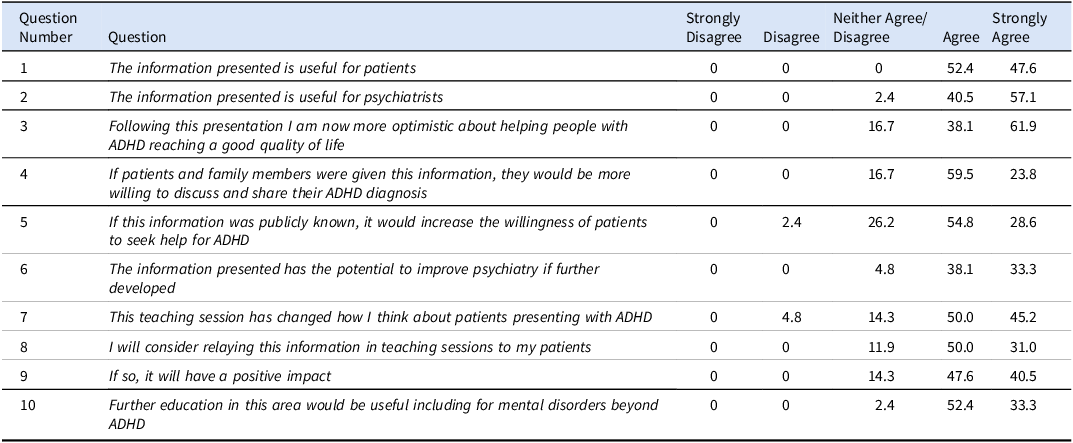
We co-designed a bespoke 10-item questionnaire to ascertain the perceptions and attitudes of psychiatrists in relation to evolutionary perspectives/explanations for ADHD. This was administered following a special presentation on evolutionary perspectives on ADHD given by an expert (AS) at the College of Psychiatrists of Ireland Annual Winter Conference 2023. Prior to the 10-item questionnaire, we asked participants to rate their comprehension using a scale ranging from ‘Very Low, Low, Medium, High and Very High’. We also asked participants about their stage of training/professional experience. This was divided into the following categories: ‘Medical Student’, ‘Non-consultant hospital doctor (NCHD) or Trainee’, ‘Consultant with less than 10 years experience’ and finally ‘Consultant with more than 10 years experience’. The 10-item questionnaire allowed rating in conventional 5-point Likert fashion and was followed by a free text box for qualitative analysis (See Table 1).
Results of the 10-item Questionnaire. 5-point Likert scale (Strongly disagree-disagree-neutral-agree-strongly agree). N = 42

Statistical analyses were performed using SPSS version 26.0 (IBM Corporation, NY, USA). Basic descriptive statistics including box and whisker plots (see Supplementary Information) and a Kruskal–Wallis test (One-way ANOVA for nonparametric data) with pairwise comparisons between groups was used to test for statistical significance. A p value of <0.05 was deemed statistically significant.
Results
Of 42 participants who completed the questionnaire, half were consultants (n = 21) and the remaining majority were NCHDs/Trainees (45.2%, n = 19). Two medical students also completed the questionnaire (4.8%). All participants rated their comprehension of the presentation as ‘high’ or ‘very high’ and the overwhelming majority of participants rated ‘Strongly Agree or Agree’ to all ten questions. Questions 5 and 7 were the only questions any participant had rated ‘Disagree’ and Question 5 was also the most neutral rated question (see Table. 1).
There were no statistically significant differences between stage of qualification/training and level of comprehension. However there were differences between stage of qualification/training for three of the questions. Consultants with more than 10 years of experience were less likely to strongly agree/agree than NCHD/Trainees with: Q3) ‘Following this presentation I am now more optimistic about helping people with ADHD reaching a good quality of life’ (p = 0.012), Q6) ‘The information presented has the potential to improve psychiatry if further developed’ (p = 0.001) and Q7) ‘This teaching session has changed how I think about patients presenting with ADHD’ (p = 0.004). There was also a statistically significant difference between consultants with more than 10 years of experience compared with medical students for Question 6 (p = 0.009), however only two medical students were in the sample.
Those who rated their comprehension as ‘Very high’ compared to ‘High’ were more likely to also ‘Strongly Agree’ for seven out of ten of the questions (1-3, 6-9) (see Supplementary Information).
The qualitative data analyzed was overall positive for the usefulness of the presentation and its impact on psychiatry. Ten comments were received and ranged from short sentences to a paragraph. Many of the comments related to how ‘interesting’ and ‘useful’ the presented information regarding evolutionary perspectives on ADHD was. A particular comment suggested that the presentation had motivated the psychiatrist to ‘reflect on their clinical practice and approach to treatment’. Others commented on their wish to see similar presentations in the future and how service users/patients and their families might respond to these explanations.
Discussion
To our knowledge, this is the first study investigating the attitudes and perceptions of psychiatrists in relation to evolutionary perspectives on ADHD. 42 participants completed the questionnaire with half representing consultants. The questionnaire was completed following a special presentation on evolutionary perspectives on ADHD given by an expert (AS) at the College of Psychiatrists of Ireland Annual Winter Conference 2023. Although the content was familiar to the audience, the evolutionary perspectives were novel. Despite this all participants rated their comprehension of the presentation as ‘high’ or ‘very high’ and the overwhelming majority of participants rated ‘Strongly Agree or Agree’ to all ten questions. As expected psychiatrists found the information useful for their patients and their practice, raised optimism in those treating ADHD, believed if patients and family members were given this information, they would be more willing to discuss and share their ADHD diagnosis and, believed if this information was publicly known, it would increase the willingness of patients to seek help for ADHD. Further, psychiatrists agreed that information presented has the potential to improve psychiatry if further developed, and that the teaching session has changed how they think about patients presenting with ADHD. Interestingly, most psychiatrists agreed that they would consider relaying this information in teaching sessions to my patients, and if so would have a positive impact. Finally, almost all psychiatrists agreed that further education in this area would be useful including for mental disorders beyond ADHD.
Previous work in ascertaining the attitudes and perceptions of psychiatrists to evolutionary perspectives is limited. One Venezuelan study reported on a seminar, involving 109 clinicians and medical students from six groups, which showed that initial knowledge of evolutionary theory was generally low to moderate. Postseminar assessments revealed significant knowledge gains across most groups, except for psychiatrists, whose improvement and perceived relevance ratings were notably lower (Baptista et al. Reference Baptista, Aldana, Angeles and Delgado2012). Additionally, two surveys a decade apart only showed modest increases in the inclusion of evolutionary biology in North American medical schools (Nesse & Schiffman, Reference Nesse and Schiffman2003; Hidaka et al. Reference Hidaka, Asghar, Aktipis, Nesse, Wolpaw, Skursky, Bennett, Beyrouty and Schwartz2015). Nevertheless, curricula have been developed and proposed by expert consensus (Grunspan et al. Reference Grunspan, Nesse, Barnes and Brownell2017) and evolutionary biology has been argued as an essential basic science for the training of the next generation of psychiatrists (Abed et al. Reference Abed, Ayton, St John-Smith, Swanepoel and Tracy2019).
The limitations of our study include our relatively small sample size and observational nature of data collection. However, half of our sample consisted of consultants and the questionnaire was followed by a special presentation on evolutionary perspectives on ADHD given by an expert acting as an intervention. A questionnaire prior to the presentation would have allowed more detailed data but as the authors suspected the audience was relatively unfamiliar with evolutionary psychiatry, it was deemed unnecessary. Similar studies on medical students (Porter-Stransky & Gallimore, Reference Porter-Stransky and Gallimore2022) and psychiatric trainees (Lindell-Innes et al. Reference Lindell-Innes, Phillips-Hughes, Bartsch, Galletly and Ludbrook2023) used a relatively similar sample size and methodology.
This study has formed part of the first step in investigating the perceptions and attitudes of psychiatrists on evolutionary perspectives on ADHD.
Supplementary material
The supplementary material for this article can be found at https://doi.org/10.1017/ipm.2025.10089
Acknowledgements
The authors wish to acknowledge and thank the survey participants and the College of Psychiatrists of Ireland for hosting the session.
Financial support
This research received no specific grant from any funding agency, commercial or not-for-profit sectors.
Competing interests
The authors declare no competing interests.
Ethical standard
The authors assert that all procedures contributing to this work comply with the ethical standards of the relevant national and institutional committee on human experimentation and with the Helsinki Declaration of 1975, as revised in 2008.
The study protocol was approved by the ethics committee of University of Limerick.