Background
Plastic materials are pervasive, universally used, and find applications in all parts of our lives, from agriculture to electronics to medical devices to packaging. From 1.65 million tons in 1950 to 255.5 million tons in 2010 worldwide, plastics usage is expanding and expected to grow at a steady pace of 3–4% per year. In particular, rapid industrialization in populous countries such as India and China has resulted in an accelerated pace of plastic materials growth. This is because plastics are lightweight (energy saving), low-cost, readily processable, and command unique and versatile properties that can be tailored for specific applications. Two major issues that arise from this extensive usage of plastics, especially as they relate to single-use disposable packaging and products, are its carbon footprint and end of life—what happens to the product after use when it enters the waste stream. This article describes how bioplastics can provide a value proposition to address the twin issues of carbon foot printing and end-of-life.
Carbon footprint and value proposition for bioplastics
Material carbon footprintReference Narayan1, Reference Narayan, Graziani and Fornasiero2
Carbon is the major basic element that is the building block of all plastics, fuels, and even life itself. Therefore, discussions on sustainability and environmental responsibility center on the issue of managing carbon (carbon-based materials) in a sustainable and environmentally responsible manner. Indeed, the burning issue of today is concern over increasing human-made CO2 emissions with no offsetting sequestration and removal of the released CO2. Reducing our carbon footprint is a major challenge. Reduced CO2 emissions translate to minimizing global warming-climate change problems.
Switching the manufacturing base (the origins of the carbon) from petro-fossil carbon feedstock to bio-renewable carbon feedstock offers an intrinsic zero material carbon footprint value proposition. This can be seen by reviewing biological carbon cycle. Nature cycles carbon through various environmental compartments with specific rates and time scales, as shown in Figure 1. Carbon is present in the atmosphere as inorganic carbon in the form of CO2. The current level of CO2 in the atmosphere is around 380 ppm (parts per million) and is increasing. CO2 and other greenhouse gases in the atmosphere trap the sun’s heat from radiating back to space, thereby providing a life-sustaining average planet temperature of 7.2°C (45°F). Increasing levels of CO2 and other greenhouse gas emissions to the atmosphere would trap more of the sun’s heat, thereby raising the average temperature of the planet. While one may debate the severity of the effects associated with this or any other target level of CO2, there can be no disagreement that an uncontrolled, continued increase in levels of CO2 in the atmosphere will result in a slow perceptible rise of the earth’s temperature, global warming, and with it an associated severity of effects that will affect life on this planet as we know it. It is therefore prudent and necessary to try and maintain current CO2 levels—the “zero carbon” approach. This can best be done by using renewable biomass crops to manufacture carbon-based products so that the CO2 released at the end-of-life of the product is captured by planting new crops in the next season. Specifically, the rate of CO2 release to the environment at end-of-life equals the rate of photosynthetic CO2 fixation by the next generation of crops planted—a zero material carbon footprint. In the case of fossil feedstock, the rate of carbon fixation is measured in millions of years, while the end-of-life release rate into the environment is in 1–10 years. The math is simple, and this is not sustainable. It causes more CO2 release than fixation, resulting in an increased carbon footprint, and with it attendant global warming and climate change problems.
Biological carbon cycle—value proposition for using biorenewable carbon instead of petro-fossil carbon feedstock.

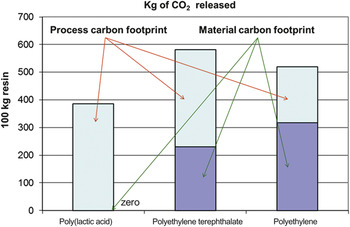
Based on the previous carbon cycle discussion and using basic stoichiometry, we calculate that for every 100 kg of polyolefin (polyethylene, PE; polypropylene, PP) manufactured, a net 314 kg CO2 is released into the environment at its end-of-life (100 kg of PE contains 85.7% kg carbon and upon combustion will yield 314 kg of CO2 (44/12) × 85.7). Similarly, PET (polyethylene terephthalate) contains 62.5% carbon and would result in 229 kg of CO2 released into the environment at end-of-life. However, if the carbon in the polyester or polyolefin comes from a biological feedstock, the net release of CO2 into the environment is zero, because the CO2 released is fixed in a short time period by the next crop or biomass plantation (Figure 2). This is the intrinsic zero material carbon footprint value proposition for using a bio/renewable feedstock.
Material carbon footprint value proposition for bio-based plastics.

Thus, the fundamental driver or switch to bio-based products is the material carbon footprint reduction arising from the “short-term” biogenic carbon cycle—the rate and time scales of CO2 sequestration is in balance with the use and release, resulting in a carbon neutral footprint. This is in contrast to the “long-term” carbon cycle for petro/fossil feedstock; the rate and time scale of CO2 sequestration is in millions of years, and the rate and time scales of use and release is in a 1–10 year time frame.
Process carbon and environmental footprint
An equally important consideration is the impact on the environment in terms of CO2 and other emissions arising from the process of converting the carbon feedstock to product, the impact during product use, and ultimate disposal. LCA methodology and standards3 (ISO 14040 standards) are the accepted tools to compute the process environmental footprint. Unfortunately, LCA focuses almost exclusively on the process (carbon and environmental) footprint. The impact of the carbon present in the product, the material carbon footprint, is treated as feedstock energy or embodied carbon energy for potential use in the next product cycle. For example, compare the case of poly(lactic acid) (PLA), a bio-based product obtained from corn, with fossil-based polyolefin products (PE, PP) and PET. Figure 3 shows the process and material carbon footprint of the products. As can be seen from the figure, the process carbon footprint for PE/PP is 205 kg CO2 emitted per 100 kg plastic manufactured,4 whereas that for PLA is around 385 kg CO2 emitted per 100 kg plastic manufactured,Reference Vink5 a much higher carbon footprint for the bio-based product. However, if one includes the material carbon footprint, then PLA has a lower total carbon footprint—385 kg CO2 emission per 100 kg plastic manufactured versus 519 kg CO2 emission per 100 kg plastic manufactured. This is because the material carbon footprint for the PLA plastic is zero, whereas PE/PP has a material carbon footprint of 314 kg CO2 emissions per 100 kg plastic manufactured. In the case of PLA, the total (net) CO2 released to the environment, taking into account the intrinsic carbon footprint as discussed earlier, is lower and will continue to get even lower as process efficiencies are incorporated and renewable energy is substituted for fossil energy, as shown in Figure 4.Reference Vink, Glassner, Kolstad, Wooley and O’Connor6
Process carbon footprint and material carbon footprint.

Continuing improvements in the carbon footprint of poly(lactic acid) (PLA). Ingeo is the trademark name for NatureWorks LLC’s synthetic fiber made from corn. NatureWorks LLC PLA carbon footprint data.Reference Vink, Glassner, Kolstad, Wooley and O’Connor6

Determining the bio-based carbon content
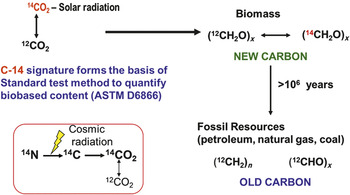
A key requirement to document this material carbon footprint reduction is a transparent and accurate test method to unequivocally determine the amount of biocarbon present in a product. The biocarbon present in a material as a percentage can be readily calculated from the C-14 signature of the product, as shown in Figure 5.Reference Narayan1, Reference Narayan, Graziani and Fornasiero2 The carbon dioxide (CO2) in the atmosphere has Reference Galgali, Varma, Puntambekar and Gokhale12CO2 in equilibrium with radioactive 14CO2. Radioactive carbon is formed in the upper atmosphere through the bombardment of cosmic ray neutrons on Reference Ojeda, Dalmolin, Forte, Jacques, Bento and Camargo14N. It is rapidly oxidized to radioactive 14CO2 and enters the Earth’s plant and animal life through photosynthesis and the food chain. Plants and animals that use carbon in biological food chains take up 14C during their lifetimes. They exist in equilibrium with the 14C concentration in the atmosphere; that is, the numbers of C-14 atoms and non-radioactive carbon atoms stay approximately the same over time. As soon as a plant or animal dies, the metabolic function of carbon uptake ceases; there is no replenishment of radioactive carbon, only decay. Since the half-life of carbon is around 5730 years, the petrochemical feedstock formed over millions of years will have no C-14 signature. The quantity of bio-based carbon content can be readily determined by combusting the test material and analyzing the CO2 gas evolved to provide a measure of its 14C/12C content relative to the modern carbon-based oxalic acid radiocarbon standard reference material (SRM) 4990c (referred to as HOxII). This methodology to determine bio-based carbon content has an accuracy of +/–3% and has been codified into an ASTM standard,7 D6866 titled “Standard Test Methods for Determining the Biobased Content of Solid, Liquid, and Gaseous Samples Using Radiocarbon Analysis.”
Measurement of bio-based (carbon) content using radiocarbon analysis. Note: N, neutron.Reference Narayan1

Terminology—Bio-based plastics
From the previous carbon discussion, definitions and terminology for bio-based materials can be adopted (see Table I). The U.S. Government,8 the European Union’s Lead Market Initiative,9 and Japan10 have programs and regulations in place for promoting and procuring bio-based plastics. All programs adopt the methodology described previously for identifying and quantifying bio-based content and require the use of ASTM D6866 to establish bio-based content of products.
Definitions and terminology for bio-based materials.

Biodegradable-compostable plastic materials
First and foremost, bio-based plastics are not necessarily biodegradable or compostable. Similarly, biodegradable-compostable plastics are not necessarily bio-based. Unfortunately, these terms are erroneously used interchangeably, and one needs to clearly recognize the differing value propositions and requirements.
Traditionally, plastics are designed with limited consideration to the ecological footprint, especially as it relates to its ultimate disposability. Plastics used in single-use, disposable packaging and consumer goods are of particular concern. Designing these materials to be biodegradable and ensuring that they end up in an appropriate disposal system is environmentally and ecologically sound. For example, by composting biodegradable plastic and paper waste along with other “organic” compostable materials such as yard, food, and agricultural wastes, we can generate much-needed carbon-rich compost (humic material). Compost amended soil has beneficial effects by increasing soil organic carbon, increasing water and nutrient retention, reducing chemical inputs, and suppressing plant disease. Composting is increasingly a critical element for maintaining the sustainability of our agriculture system. The food wastes along with other biowastes are separately collected and composted to generate a good, valuable soil amendment that goes back to the farmland to re-initiate the carbon cycle.Reference Narayan, Hoitink and Keener11
Unfortunately, there is much confusion, misunderstanding, misinformation, and even misleading claims made for terms such as biodegradability, compostability, anaerobic digestion, landfill biodegradation, and marine biodegradation. Claims are made without substantiation with hard scientific data, or the data provided have little or nothing to do with substantiating biodegradation.
What is biodegradability?
Biodegradability is an end-of-life option that allows one to harness the power of microorganisms present in the selected disposal environment to completely remove biodegradable plastic products from the environmental compartment in a timely, safe, and efficacious manner.Reference Narayan1, Reference Narayan, Graziani and Fornasiero2, Reference Narayan, Hoitink and Keener11
The “disposal environment” must be clearly identified when discussing or reporting the biodegradability of a product. Some examples include biodegradability in a composting environment (compostable plastic), biodegradability in a soil environment, biodegradability under anaerobic conditions (in an anaerobic digestor environment or landfill environment), or biodegradability in a marine environment.
Reporting the time to complete biodegradation or, more specifically, the time required for the complete microbial assimilation of the plastic in the selected disposal environment is an essential requirement. Stating that it eventually will biodegrade based on data showing an initial 10–20% biodegradability is not acceptable and misleading, especially since the percent of biodegradation levels off and reaches a plateau after some initial rate and level of biodegradation. Drawing a dotted line extrapolation from the initial rate and value to 100% biodegradation is scientifically untenable.
Measuring biodegradability—The scientific basis
Microorganisms utilize carbon substrates to extract chemical energy for their life processes. The carbon substrates become “food” that microorganisms use to sustain themselves. For this to occur, the carbon substrate needs to be transported inside the cell. Molecular weight is important but is not the only criterion for transport across cell membrane. Factors such as hydrophobic-hydrophilic balance and molecular and structural features also govern transport. Under aerobic conditions, the carbon is biologically oxidized to CO2 inside the cell, releasing energy that is harnessed by the microorganism for its life processes. Under anaerobic conditions, CO2+CH4 (landfill gas) are produced. Thus, a measure of the rate and amount of CO2 or CO2+CH4 evolved as a function of total carbon input to the process as a direct measure of the amount of carbon substrate being utilized by the microorganism (percent biodegradation). This is fundamental, basic biology and biochemistry that can be found in any biochemistry textbook. This forms the basis for various national (ASTM, EN, OECD) and international (ISO) standards for measuring biodegradability or microbial utilization of chemicals and biodegradable plastics.
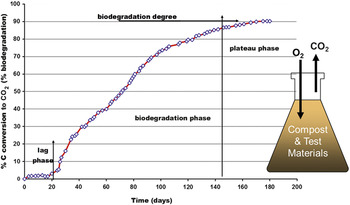
One can measure the rate and extent of biodegradation or microbial utilization of the test materials by using it as the sole carbon source in a test system containing a microbial-rich matrix such as compost in the presence of air and under optimal temperature conditions (preferably at 580°C—representing the thermophilic phase). Figure 6 shows a typical graphical output that would be obtained if one were to plot the percent of carbon in a test material converted to CO2 as a function of time in days. First, there is a lag phase during which the microbial population adapts to the available test C-substrate. Then, the biodegradation/utilization phase occurs, during which the adapted microbial population begins to utilize the carbon substrate for its cellular life processes, as measured by the conversion of the carbon in the test material to CO2. Finally, the output reaches a plateau when the substrate is completely utilized.
Graphical output of a typical composting experiment showing lag, biodegradation, and plateau phase.

Linear or any other form of data exploration for these complex biological systems is not acceptable and is very misleading, because credible scientific substantiation for the extrapolation model does not exist to date; in fact, current biodegradability data for polyolefin + additives (oxo- or other additives) formulations show the percent of biodegradation leveling off and reaching a plateau after some initial level of biodegradation.
Compostable plastics—Standard specifications
To meet the requirements of compostability, a material must satisfy the primary requirement of complete biodegradability under composting conditions, as discussed in an earlier section. In addition, it has to meet the disintegration and safety criteria to make a claim of compostability. ASTM D6400, D6868, ISO 17055, and EN 13432 are specification standards for compostable plastics and require:
• 90%+ of the test material’s carbon conversion to CO2 via microbial assimilation of the test polymer material in powder, film, or granule form in 180 days or less—a laboratory scale test method, as described in the previous section.
• Disintegration of the test material in both shape and thickness of the products intended for use, such that 90% of the test material must pass through a 2 mm sieve using ISO 16929 or ISO 20200 standard test methods.
• Safety considerations where the resultant compost should have no impact on plants, using OECD Guide 208, Terrestrial Plants Growth Test. Furthermore, regulated (heavy) metals content in the polymer material should be 50% or lower than prescribed thresholds in the country of use (e.g., 50% of the U.S, and Canadian Environmental Protection Agency’s prescribed threshold).
Misleading biodegradability claims within the context of the environment
Some studies use the term “biodegradable” to indicate that the plastic samples were subjected to a biotic environment (soil, compost) as part of their experimental procedure. The study goes on to measure weight loss, molecular weight reductions, carbonyl index, and mechanical property loss (films becoming brittle). Additive manufacturers reference these studies and extrapolate, stating that their product is “completely (100%) biodegradable” in the environment based on weight loss and physical, chemical, or mechanical property loss. However, the fundamental biology/biochemistry data showing carbon utilization by the microorganisms, as measured by the evolved CO2 (aerobic) or CO2+CH4 (anaerobic), are missing.
A peer-reviewed paperReference Galgali, Varma, Puntambekar and Gokhale12 reported increasing the rates of biodegradation of polyolefins by anchoring minute quantities of glucose, sucrose, or lactose onto functionalized polystyrene. A mere 2–12% weight loss and formation of carbonyl groups was evidence for biodegradation. There were no data showing microbial utilization evidenced by measuring evolved CO2, as discussed in previous sections.
In another report,Reference Scott13 polyethylene and polypropylene were placed in a composting environment after solvent extraction to remove the antioxidants, and it was reported that polypropylene lost 60% of its mass over six months, whereas low density polyethylene (LDPE) lost only 10%. It is well known that unstabilized polypropylene will degrade in the environment. The report concludes as follows: polypropylene biodegrades more rapidly than LDPE by mass loss in compost, and ethylene-propylene copolymers biodegrade at rates intermediate between polypropylene and ethylene. This implies that 60% of the polypropylene carbon has been utilized by microorganisms present in compost, as measured by evolved CO2; however, no CO2 data are provided to substantiate the claim.
There are many more examples where physical, chemical, and mechanical property losses are used to claim “biodegradability.” In some papers, microbial colonization or biofilm formation is used to make claims of biodegradability. Weight loss, molecular weight reductions, carbonyl index, mechanical property loss, biofilm formation, and microbial colonization do not confirm the microbial utilization of the polymeric carbon substrate, nor do they provide the amount of carbon utilized or the time to complete microbial utilization.
In a recent paper,Reference Ojeda, Dalmolin, Forte, Jacques, Bento and Camargo14 oxo-biodegradable polyethylene samples were abiotically degraded in natural and saturated humidity for one year. The degraded fragments then were biodegraded in a mixture of soil:compost:perlite (1:1:2) at 58°C for three months. The percent biodegradability, as measured by evolved CO2, was 3.61% (abiotic natural humidity) and 5.70% (abiotic saturated humidity). The percent of biodegradability for samples weathered for one year in polypropylene enveloped in compost at 58°C was 12.4%, and after three months, 25°C was 5.4%. Given this kind of almost negligible biodegradability data after one year of weathering and subsequent exposure to an aggressive, biologically active compost environment for three months, it is surprising to note that companies claim that such oxo-biodegradable products will biodegrade 100% in the environment. The previously mentioned study shows that a significantly large amount of the degraded plastics, some of which could be microscopic, would be released into the environment.
Environmental and health consequences
Making hydrophobic polyolefin plastics such as polyethylene unstable and degradable and releasing them into the environment without ensuring that the degraded fragments are completely assimilated by the microbial populations in a short time period has the potential to harm the environment and create human health risks. The fragments, some of which could be microscopic, can be transported through the ecosystem and could have serious environmental and health consequences. In fact, stringent “European community REACH (registration, evaluation, authorization, and restriction of chemical substances) laws” governing the release of almost all chemicals (small molecules) is becoming the norm in Europe and other countries. It requires the chemical to be completely assimilated by microorganisms in the ecosystem if it is to be released into the environment.
ThompsonReference Thompson, Olsen, Mitchell, Davis, Rowland, John, McGonigle and Russell15 reported that plastic debris around the globe can erode (degrade) away and end up as microscopic granular- or fiber-like fragments, and these fragments have been steadily accumulating in the oceans. The experiments show that marine animals consume microscopic bits of plastic, as seen in the digestive tract of an amphipod.Reference Thompson, Olsen, Mitchell, Davis, Rowland, John, McGonigle and Russell15
The U.S.-based Algalita Marine Research Foundation16 reported that degraded plastic residues can attract and hold hydrophobic elements such as polychlorinated biphenyls (PCBs) and dichlorodiphenyltrichloroethane (DDT) up to one million times the background levels. PCBs and DDTs are at background levels in soil and diluted out, so as to not pose significant risk. However, degradable plastic residues with high surface areas concentrate these chemicals, resulting in a toxic legacy in a form that may pose risks in the environment.
Japanese researchersReference Mato, Isobe, Takada, Kahnehiro, Ohtake and Kaminuma17 have similarly reported that PCBs, DDT, and nonylphenols can be detected in high concentrations in degraded polypropylene resin pellets collected from four Japanese coastal areas. This work indicates that plastic residues may act as a transport medium for toxic chemicals in the marine environment. More recently, issues were reported surrounding microscopic plastics being released into the environment and causing environmental and human health problems.Reference Teuten, Saquing, Knappe, Barlaz, Jonsson, Björn, Rowland, Thompson, Galloway and Yamashita18, 19
Summary
The use of biorenewable feedstock for the manufacture of plastic materials and switching from a petro-fossil carbon to a biorenewable carbon offers a strong “value proposition” for reducing the carbon and environmental footprint. The value proposition arises from material carbon footprint reductions and not necessarily from the process of converting the feedstock to product—the process carbon footprint.
Methodology for quantification of “bio-based carbon content” has been developed and codified into the ASTM Standard D6866. Using bio-content calculations, one can calculate the intrinsic CO2 reductions achieved by incorporating bio-content into a plastic or product—the material carbon footprint.
It is important to report on the process carbon footprint (process footprint arising from the conversion of feedstock to product) using life-cycle assessment methodology to ensure that the intrinsic material carbon footprint value proposition is not negated during the conversion, use, and disposal life-cycle phases of the plastic—the process carbon footprint.
Biodegradability is an end-of-life option for single-use disposable plastics and needs to be tied to a disposal environment such as composting. More importantly, if a biodegradable plastic is not completely and rapidly removed (within one year or less) from the target disposal environment (such as composting or soil, anaerobic digestion, or marine environment), the degraded fragments become toxin carriers up the food chain, resulting in serious environmental and health risks.
ASTM, European, and ISO Standards define and specify the requirements for complete biodegradability and must be strictly adhered to so that serious environmental and health consequences can be averted.