The Shahnamah made for Muhammad Juki is one of the great treasures of the Royal Asiatic Society in London.Footnote 1 The manuscript was copied in Herat for the prince Muhammad Juki (1402–1445), fourth son of the Timurid ruler Shah Rukh (r. 1405–1447). Muhammad Juki died before it was completed, and the unfinished manuscript seems to have accompanied Babur, founder of the Mughal dynasty, when he moved to northern India in 1526, as his seal, along with those of successive Mughal rulers, is found on folio 536v. The manuscript contains 31 illustrations that Barbara Brend described as being ‘of strikingly great beauty not only for their colour and design, but also for their narrative verve and range of feeling’.Footnote 2 Barbara Brend, who has devoted much of her life to the study of illustrated Persian manuscripts, made a particular examination of this codex which was published by the Society in 2010.Footnote 3 The monograph contains much insightful information on the history, codicology, and paintings of this Shahnamah, and in writing this tribute to Barbara Brend and her scholarship, I hope to contribute to its study by shedding light on the question of the colours used by the artists as well as the technique of their application. This article interprets the results of chemical and other technical analysis in light of what is known about the historic trade in these colours, as well as discussing other information such as prices and prestige accrued.
A number of methods have been applied to analyse the pigments and dyes used to paint the illustrations in the Juki Shahnamah. Years ago, when I conserved the miniatures in this manuscript, I was permitted to use only non-invasive microscopic methods, as well as the ‘new’ technique of spectral wavelength analysis for identifying the colours.Footnote 4 With these methods, it was possible to identify the various blues (though not the mixes using blue) as well as which of the colours were inorganic pigments (made from rocks and minerals) and which were organic colours (made from plants and animals). These methods, however, did not permit identification of the organic colours nor did they provide much information on the pigments. One exception was the pigment orpiment, the yellow tri-sulphide of arsenic, which can usually be identified using a microscope because it has pronounced striations across even the smallest particle. In addition, we can suppose that any green colour damaging the support is likely to contain copper, although, in fact, a number of copper-containing pigments are used in manuscript painting.
More recently in 2019 and 2020, I worked with Professor Maurizio Aceto to analyse the manuscript once more, using new and highly sensitive analytical machinery and non-invasive techniques such as UV-visible diffuse reflectance spectrophotometry with optic fibres (FORS) and spectrofluorimetry.Footnote 5 The new analysis unexpectedly identified the female insect lac as the main red organic colour used by every ‘hand’ as identified by Barbara Brend in her monograph.Footnote 6 Only recently have researchers been able to distinguish between lac and other insect reds, and as a result we have begun to recognise lac as one of the main red organic colours used for painting in many Persian and Indian manuscripts beginning as early as the fifteenth century. The results of the recent analysis of the Juki Shahnamah were also revealing in identifying the frequent use of indigo, not only for blues but also for many mixtures, including greens, greys, purples, and all shades of each of these colours. Although many other pigments and organic colours have been identified in the Juki Shahnamah, this article examines lac and indigo in more depth as well as the ways in which gold and silver metals have been employed throughout the manuscript.
§1 Lac
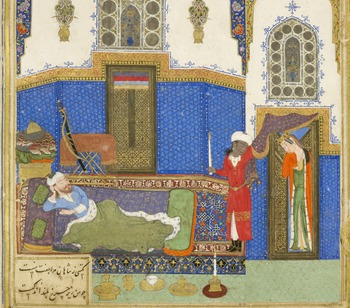
Lac is the distinctive red organic colour used to paint purple, lilac, and red. It features in most of the Juki miniatures and was used by all the different hands for different details. For example, in the miniature ‘Tahminah comes to Rustam’ (Figure 1), the artist used lac to paint the textiles on Rustam's red-purple pillow and his blue-purple mattress. Lac was also used for the red and purple flowers in ‘Firdausi encounters the court poets of Ghazna’ (fol. 7r), for the lilac backgrounds in ‘The fortress of Gang Dizh attacked with mines’ (fol. 223r), and even for the horses’ red and burgundy armour in ‘Gushtasp in battle with Arjasp at Balkh’ (fol. 270r–269v). In such a prestigious Persian manuscript, the red might well have been made from Armenian cochineal (Porphyrophora hamelii) or from the equally expensive and prestigious kermes (Kermes vermilio), imported from the Mediterranean and long traded along the Silk Roads. Analysis proved the contrary: in every case the organic red colour, and all its shades, was made from female insects imported from India and known as ‘lac’.Footnote 7
‘Tahminah comes to Rustam’ (detail), Shahnamah of Muhammad Juki, Royal Asiatic Society, Ms 239, fol. 56v. Source: Courtesy of the Royal Asiatic Society.

Lac is the resinous excrescence developed by the scale insect Coccus lacca. A native of India, it is also found in tropical and subtropical areas of Southeast Asia. The most common species is the Kerria lacca. There are two species of lac in India: Kusumi and Rangini.Footnote 8
For thousands of years, the female lac insect has been used to produce scarlet-red, pink, lilac-purple, and every shade in-between. An ancient dyestuff, it was recorded in the earliest mythological and religious scriptures from India. In the Vedic period (circa 1500–1100 bce), it was known as laksha (Sanskrit: lākṣā), and the collection of hymns known as the Atharvaveda described the lac insect as ‘sister of the gods’ and ‘healer of wounds’.Footnote 9 The Mahabharata, the epic poem compiled between the third century bce and the third century ce, mentioned using lac in building a palace, and the Vinaya Buddhist texts detailed how lac was extracted and how to dye with it.Footnote 10 Later, the Greeks and Romans used it for dyeing and painting.Footnote 11
Lac was also used widely for medical purposes. Ayuvedic texts recommended lac to treat obesity, dropsy, and chronic fevers, especially following childbirth.Footnote 12 Both Arabic and Persian doctors, from Abu Mansur Muwaffaq ibn ʿAli al-Harawi (d. 976) and Avicenna (980–1037) to Ibn al-Baytar (1197–1248), recommended taking lac internally for complaints such as dropsy and liver problems.Footnote 13
Lac was extensively traded from India to the West. The Periplus of the Erythraean Sea, a first-century ce Greek text describing the sea routes from Egypt, noted that traders transported lac dye from India to Adulis (modern Zula) on the African coast of the Red Sea.Footnote 14 Documents from the Cairo Geniza, an archive found in the Ben Ezra synagogue in Fustat (Old Cairo), showed that medieval Jewish traders from Egypt and Libya imported lac from Gujarat and other ports in southwest India. From there, it was shipped either via the Persian Gulf to Persia or via Yemen to Cairo.Footnote 15 From Cairo, lac traders travelled across North Africa to Spain, where lac was considered so precious that in 1267 King Alfonso X ‘the Wise’ decreed that it could be used only by the royal dye works.Footnote 16 The identification of lac in prestigious Spanish and Portuguese textiles and manuscripts dating from the Romanesque period onwards attests to the flourishing Arab and Jewish trade networks during this period. Other medieval maps of trade routes show that goods were also shipped from Gujarat via Muscat, Sohar (a port on Oman's north coast), and the islands of Qeshm, Hormuz, and Qish to Siraf on the south coast of Iran. From there, these imports went overland either to Shiraz or to Basra via al-Ubullah. This shipping route was the most likely way that lac arrived in Persia. Lac imported to Venice from Calicut and Cambay was expensive: in 1409 the price had risen to double that of imported brazilwood.Footnote 17
In addition to its uses as a medicine and a dye for textiles, lac was especially important in various aspects of Islamic book production.Footnote 18 In his section on making coloured ink, the Zirid prince Ibn Badis (d. 1061) recorded that the best one was made by mixing one-and-a-half ounces of powdered lac with gallnut, tamarisk water, and gum arabic.Footnote 19 Writing in 1433, Simi Nishapuri, a librarian at the Timurid court in Mashhad and an expert in the arts of the book, reported that paper dyed with lac was extremely good and could not be faulted.Footnote 20 Gum lac was also used as a floatation additive for marbling paper.Footnote 21
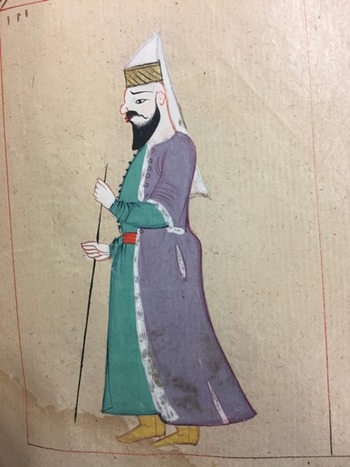
Lac was most valuable in book production as paint, in all of its shades. It was used for both the bright pink and the dark and dense scarlet red in a Qurʾan manuscript copied by Muhammad ibn ʿAbdallah ibn ʿAli ibn Gattus in 1213 at Valencia in Andalusia (Cairo, Dar al-Kutub, Rasid 196).Footnote 22 As in textile dyeing, lac would have been reserved for high-status manuscripts made in the region.Footnote 23 Aceto and I identified lac in a seventeenth-century Ottoman manuscript, where it is used for the beautiful lilac shade of the costumes (Figure 2).
Miniatures of sultans and public officers, Ottoman Empire, circa 1690, John Rylands Turkish Ms 2. Source: Courtesy of John Rylands Library, University of Manchester.

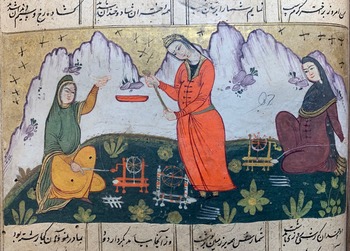
In addition to the fifteenth-century copy of the Shahnamah for Muhammad Juki produced in Herat, we also found lac in several other Persian manuscripts, including a fifteenth-century copy of the Shahnamah from Shiraz (Cambridge University Library, Or. 420); a mid-fifteenth century copy of the Shahnamah with Nizami's Khamsah in the margins, attributed to Western India (Manchester, John Rylands Library, Persian 9); and almost all the miniatures in a copy of the Shahnamah dated 1635 in the University of Iowa (Figure 3).
Shahnamah, University of Iowa, Ms F522sh, detail, fol. 395a. Source: Courtesy of University of Iowa Libraries, Special Collections.

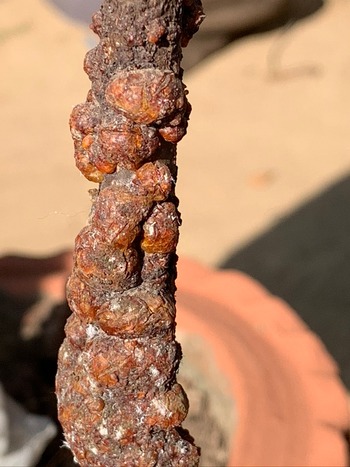
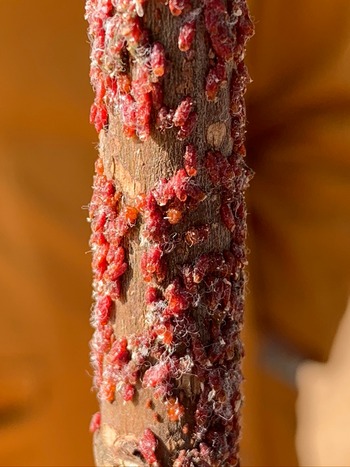
Preparing lac for use in painting is an elaborate process.Footnote 24 About 18 months before the lac insects are born, the new host tree is prepared by pruning it, so that there is abundant fresh sap for food by the time the new-born insects are transferred to it. Cultivation begins when a farmer ties a broodlac (a stick covered in pregnant females whose eggs are ready to hatch; see Figure 4), to a new host tree to be infested (inoculated). The farmers know that the time for transfer is imminent when yellow spots show on the females, indicating they are about to give birth. At this stage, the broodlac is full of liquid that provides food for the young, both male and female, until they exit the mother's body and feed instead on the sap of the new host tree.
Broodlac: eggs about to hatch. Source: Photo by Cheryl Porter.

Twenty-one days later, when all the young have exited the lac cell, the sticklac (the branch with the dead mother's body in the resinous coating) is untied from the new host tree and removed so that the lac (and the dead mothers) can be scraped off. Since each female gives birth to between 300 and 1,000 young (depending on the species), thousands of young lac insects colonize the new host tree. The young insects’ mouthparts pierce and suck the sap from the tree. Once the females begin to suck the sap, they never move again (Figure 5), but during these few days the males continue to move and mate. The males quickly die (within two to three days of emerging from the pupa) and only the (fertilized) females remain on the new branch. A day or so after settling, the females begin to secrete lac resin encasing the insect which increases in size as it matures.
Young ‘crawlers’ mating and feeding on the new host branch. Source: Photo by Cheryl Porter.

After mating, the female produces more resin as the sap is chemically altered in the female insect's body so as to completely envelop the insect while she continues to feed. When exposed to the air, the extruded substance turns into a gradually hardening resinous material that covers the insects and the twig like a sleeve. Inside the protective cover the females provide the bright red fluid that feeds the eggs, which continue to grow under the resinous cover. When the young insect is fully grown, it pierces a hole in the sack, leaving the empty cell and the dead mother in the lac. The cycle then repeats.
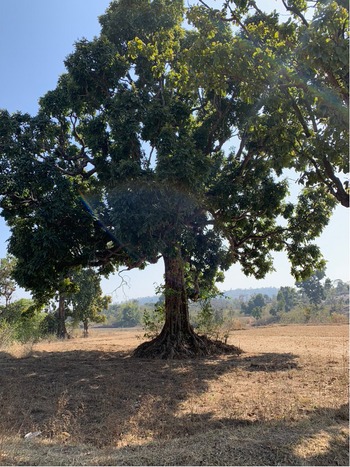
The coated branches of the host trees (Figure 6), with the dead mother and the resin, are cut and taken away to another place where the sticklac is scraped off with a knife. The harvested sticklac, which at this stage contains about 10 per cent of real dyestuff, is crushed and sieved to remove impurities, and the sieved material is then cleaned and purified. A small percentage (about 7 per cent) is usable to make the lac dye. The rest of the product is refined for making waxes and resin.
Kusum tree, the main tree used to host the lac insects throughout the Ranchi-Nankum area, Jharkhand, India. Source: Photo by Cheryl Porter.

§2 Indigo
All three blues used by medieval Persian painters—lapis lazuli, azurite, and indigo—were easily available, as attested by their frequent use in Persian painting, both pure and in mixtures such as indigo and lapis for light and dark blues, and indigo mixed with lac for purples and lilacs. Mixing the various blues with other colours, both organic and inorganic, produced browns, greys, and especially greens, a common feature in Persian manuscript painting. Persian artists much admired pistachio green and used indigo to achieve this favoured colour. There is also a long tradition of indigo-dyed textile production in Persia, and many recipes detail the traditional use of indigo in manuscript production for dyeing paper, colouring leather, book covers, marbling, making inks, and painting borders, as well as miniature painting.Footnote 25
Minerals for the two blue pigments were mined nearby: lapis in Badakhshan (a region comprising parts of what is now northeast Afghanistan, eastern Tajikistan, and the Tashkurgan county in China) and azurite, a basic copper carbonate, in central Iran and elsewhere. The organic blue, indigo from the plant indigofera, was imported but also available locally. Some indigo likely came together with lac and other spices and medicines from India and southeast Asia, shipped from Indian ports such as Cambay in Gujarat (the largest entrepôt for indigo) to the port of Basra.Footnote 26 Although indigo had long been imported from India, where it was known as nil or nila, Persia also produced its own extremely high-quality indigo in Kabul and also in Kirman in southeast Persia.Footnote 27
Indigo is made from the leaves of indigotin-bearing plants. In Europe, this was the woad plant (Isatsis tinctoria), but even before the Greeks and Romans, another blue was known to have existed in Asia. In Europe, the colour was known as indikon or indicum (‘the Indian dyestuff’) and highly regarded (‘the colour of kings and the king of colour’). Although there are numerous plant sources for indigo, the main source in Asia was—and still is—the indigofera spp.
Whatever the source, the blue colour is not obtained by simply crushing the leaves, but by soaking them in water to extract the colourless indoxyl. The leaves are then removed and oxygen added by vigorous beating, until a bright blue foam appears. Indigo pigment subsequently precipitates into a blue, clay-like paste, which dries to the durable (and easily transportable) pigment. To make a fermentation dye vat, powdered indigo pigment is stirred into warm water made alkaline with substances such as lime and added reducing agents Footnote 28 to feed the bacteria unique to indigo. When the vat reduces (becomes anoxic), it loses its blueness and becomes greeny/yellow, with a coppery dark blue scum of oxidised indigo on the surface. The vat is then ready for dyeing—cloth or yarn dipped in an indigo vat emerges as a yellowy green colour and slowly turns blue on contact with air.
For painting, oxidised foam on the vat surface was sometimes used but generally manuscript and other painters used extracted pigment. Ground indigo can be added to a binder (for example, gum Arabic or egg white) and used like other pigments.
A good place to begin the discussion of the use of indigo in the Juki manuscript is the story Barbara Brend recounts of the derisory sum that Firdausi felt his patron Mahmud of Ghazni had paid him for composing the Shahnamah. Later, regretting his lack of generosity, Mahmud sent a camel caravan of indigo ‘which, however, entered the town by one gate as Firdausi's body was carried out another’.Footnote 29 The story is deeply ironic, given how much indigo occurs in the paintings of the Juki Shahnamah. It also serves to demonstrate that indigo, although nowhere near as costly or prestigious as the pigment made from lapis, was nevertheless a relatively expensive material.
Indigo is found throughout the Juki Shahnamah, both as a pure blue and in mixtures in both miniature paintings and borders. It was used for a number of the blues, for the black water, and for a surprising number of the mixtures. Together with lapis, it formed the dark blues. It is combined with red ochre to make a purple-brown, with red lead to make a red-orange for the fruit on trees, and with lac for lilac-purple backgrounds and textiles. It was frequently used for the green colours, combined mostly with orpiment, but also with yellow plant dyes. In mixing it with a number of yellows, both organic and inorganic, the artist has been able to achieve a wide range of green hues. Green pigments are very rare in nature. The medieval artists knew very well that copper greens frequently damaged the support. They were also incompatible with a number of pigments. One advantage of indigo-based greens is that they are completely inert and can be safely painted with no ill effect to the support or surrounding pigments.
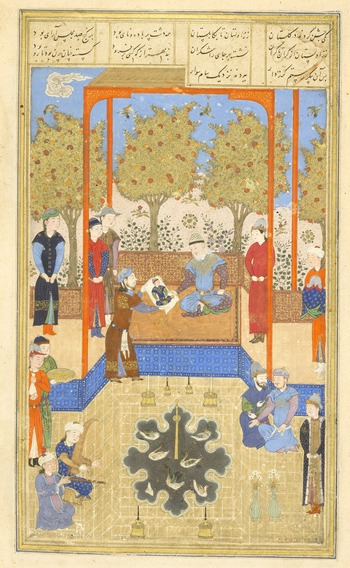
Aceto and I have identified indigo in the Juki Shahnameh in miniatures by hands B and C (as defined by Barbara Brend) as well as those by the later Moghul painter(s).Footnote 30 On the folio depicting the ‘Portrait of the infant Rustam shown to Sam’ (fol. 30v), it has been used to paint the light blue sky (Figure 7). In addition, it has been mixed with lapis to form the paint of the dark blue textile on the same folio. The reddish-brown of the fruit on the trees in the same miniature shows a most unusual combination of red lead and indigo.
‘Portrait of the infant Rustam shown to Sam’, Shahnamah of Muhammad Juki, Royal Asiatic Society, Ms 239, fol. 30v. Source: Courtesy of the Royal Asiatic Society.

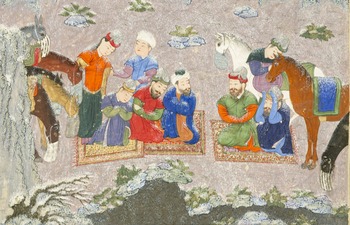
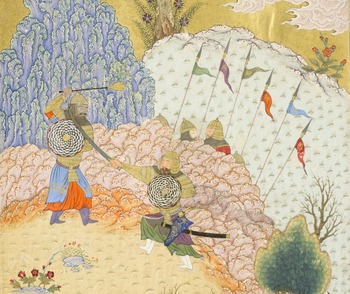
The painting of ‘The paladins in the snow’ (fol. 243r), also attributed to hand B, displays much indigo throughout the surface, including the background, the stream, and the clothing (Figure 8). Indigo blue does not sparkle or shine like a mineral blue, but is flatter and duller. Perhaps it is fitting, then, that the artist chose to use so much of the blue indigo in this beautiful but gently foreboding image, as the colour blue was often associated with mourning. The ninth-century ʿAbbasid litterateur Ibn al-Washshaʾ recorded that blue and black were the colours worn by bereaved women and those in trouble.Footnote 31 Literary and visual sources tell us that this association continued into the Timurid period. The residents of Samarqand wore blue and black garments to mourn Timur's son Jahangir,Footnote 32 and a funeral procession in a manuscript of ʿAttar's Mantiq al-Tayr dated 1487 shows several bereaved onlookers in blue robes who wail and rend their garments as they accompany the coffin.Footnote 33 One of the gravediggers in the scene wears a blue robe as well. The besotted lover Majnun is typically dressed in blue, as the colour of mourning, in Persian manuscript paintings.Footnote 34
Detail from ‘The paladins in the snow’, Shahnamah of Muhammad Juki, Royal Asiatic Society, Ms 239, fol. 243r. Source: Courtesy of the Royal Asiatic Society.

The painting of ‘The paladins in the snow’ (Figure 8) also displays unusual combinations using indigo: indigo and red ochre for the light purple-brown background, and indigo with an organic (plant) yellow for the dark rich green textile of the clothing for the man on the left. Of equal interest is the identification of indigo as the dark grey of the stream at the foot of this miniature. Water is usually painted with silver in Persian manuscripts, but here it is not. It has no reflectance, no light coming from it, but is dark and dead.
§3 Gold and silver
Befitting a courtly manuscript, the artists of the Juki Shahnamah used precious metals to enhance the paintings. Two forms of gold were available to Persian painters: leaf and paint (sometimes called ‘shell gold’). The earliest sources for preparing gold ink and paint described amalgamating gold powder with mercury. Recipes 54 and 71 from the Leyden Papyrus, a document transcribed in the third century ce from earlier copies, mentioned using metal mercury to prepare gold paint.Footnote 35 Another method used in medieval times involved putting gold paste into a cloth or wash-leather and squeezing out the excess mercury so that the amalgam became hard and brittle enough to grind into powder.Footnote 36 The tenth-century Yemeni scholar al-Hamdani also noted the use of mercury for refining gold in his treatise on precious metals.Footnote 37 Analysis also shows that gilding techniques, which had developed in Antiquity, were still frequently used in al-Andalus between the tenth and twelfth centuries, primarily because mercury was available locally.Footnote 38 In later times, however, the mercury amalgam was replaced by grinding the leaf with honey, gum, or salt and then washing away these additions with water, a technique still used in Turkey and the Indian subcontinent.Footnote 39
For such a prestigious manuscript, the Juki Shahnamah displays a rather restrained use of gold, almost exclusively gold paint. Gold is employed for the sky in paintings attributed to three artists: ‘Ruhham attacks the sorcerer Bazur’ (fol. 135r; Figure 9) by hand A; ‘The div Akvan lifts the sleeping Rustam’ (fol. 165v) and ‘Gushtasp plays polo before the Qaysar’ (fol. 252r) by hand C; and ‘Isfandiyar slain by Rustam’ (fol. 296r) by hand D.
Detail from ‘Ruhham attacks the sorcerer Bazur’, Shahnamah of Muhammad Juki, Royal Asiatic Society, Ms 239, fol. 135r. Source: Courtesy of the Royal Asiatic Society.

In general, when gold is used for painting in the Juki Shahnamah, whether for the sky, architectural features, trees, crowns, or even fire, it is a single hue. To paint the metal armour in this manuscript, however, the artists used two shades: one greenish and one more yellow. They juxtaposed different hues to show strips of metal, one joined to the other, and indicate the method of fabricating armour (see Figure 9).
Although many Islamic manuscripts juxtapose gold of different hues (or play off leaf and paint), the shift towards the use of two (or more) contrasting hues of gold became prominent in fifteenth-century Turkoman painting.Footnote 40 The various shades of greenish and reddish gold result from additional elements of silver and copper, respectively. Native gold almost always contains silver in amounts varying between 5 and 50 per cent. The higher the silver content, the greener the hue. When gold is red or rose-coloured, as for example in a late sixteenth-century Mughal Qurʾan manuscript in the Chester Beatty Library (Ms Is 1547), one can be sure that the copper has been added, since natural copper content rarely exceeds 1 per cent.Footnote 41
Another method of enhancing gold paint is by pricking and punching, enabling the flat metal surface to catch and reflect light at different angles and adding depth, definition, and complexity to the surface of the painting. The painters of the Juki added pricking to indicate the riveting of the metals, as in ‘Isfandiyar slain by Rustam’ (fol. 296r). They used the technique not only for soldiers’ armour (‘Rustam rescues Bizhan from the pit’, fol. 180r), but also for the protective covering of the horses (‘Farud shoots Zarasp’, fol. 119v).
The technique of pricking and punching has been identified in manuscripts produced in the 1350s and 1360s at Shiraz in southwest Iran.Footnote 42 The same technique occurs in European manuscripts much earlier, at least from the 1230s, although it did not become common until the early 1400s.Footnote 43 A particularly interesting use of punching occurs in the late sixteenth-century Persian Qurʾan manuscript in the Chester Beatty Library (Ms Is 1547) where the black letters are outlined in gold ink, with tiny punch marks evenly placed in the gold to reflect the light in a subtle but effective way.Footnote 44 The real beauty of the punched letters can be appreciated only when studying the unpunched letters, which seem quite ordinary in comparison.
Silver is found throughout the Juki Shahnamah. Since silver often oxidises to form a dark grey or even a black layer, it is often impossible to tell whether the silver was applied in the form of leaf or paint or even painted in black. In manuscripts made in the Islamic lands, painters frequently used silver to depict armour and metal implements as well as water. It seems strange that artists would choose a metal that they knew would almost certainly blacken over time. How long this process takes depends on various factors, including the metal's reaction to other pigments and dyes around it, how often the book was opened, how polluted the atmosphere was, and the purity of the metal itself. Most certainly, the use of the precious metal to depict specific objects and water was simply accepted as a convention, and the inevitable blackening accepted as part of that convention, since silver would have likely retained its colour at least during the presentation of the manuscript and perhaps for many years afterwards. Nevertheless, when looking at water in rivers, ponds, lakes, and deep sea, it is clear that very often it is not blue (or green) at all. It is almost always dark in colour, sometimes nearly black, and often darkly reflective, exactly the way artists in the Islamic lands had painted it. Moreover, water in these manuscripts is portrayed much more realistically than in medieval European painting, which typically had blue wavy lines.Footnote 45
Insects, plants, stones, minerals, and precious metals, many of them expensive imports, were used to paint the Juki Shahnamah. Thus, in addition to the beauty, narrative verve, and range of feeling that Barbara Brend noted in the manuscript, we can say that the colours are composed of the most precious and expensive pigments, dyes, and valuable metals that display the technical skill of the artists and the wide range of materials accessible at the Timurid court.