Introduction
The Tolosa–Hunt syndrome is a rare, benign condition of painful ophthalmoplegia combined with ipsilateral ocular motor nerve palsies, caused by non-specific granulomatous inflammation in the cavernous sinus, superior orbital fissure or orbit.Reference Kobor, Voros and Deak1–Reference Kline and Hoyt4 The incidence of Tolosa–Hunt syndrome has been estimated as approximately one to two cases per million.Reference Iaconetta, Stella, Esposito and Cappabianca2 The aetiology of the syndrome is still unknown, and it can affect people of virtually any age, with no sex predilection. It is usually unilateral, with no predisposition for right or left side; it has been reported as bilateral in 4.1–5 per cent of cases.Reference Iaconetta, Stella, Esposito and Cappabianca2, Reference Cakirer3
Since otolaryngology is one of the specialties dealing with patients suffering from painful ophthalmoplegia, we would like to report a rare case of Tolosa–Hunt syndrome which was misdiagnosed as sinusitis orbital complication. The clinical features, diagnostic investigation and differential diagnosis of the condition, as well as the importance of magnetic resonance imaging (MRI) studies, are briefly addressed.
Case report
A 40-year-old man was referred to our department with the suspicion of an orbital complication of sinonasal disease. The patient complained of a mild left periorbital pain, which had been diagnosed as sinusitis by his general practitioner five days earlier and treated with oral amoxicillin and clavulanate (625 mg three times daily). On the day of admission to our department, the pain had become more intense, with the development of slight left upper eyelid oedema, left upper eyelid ptosis and horizontal diplopia of left gaze.
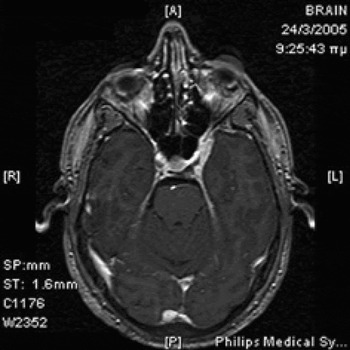
A complete otorhinolaryngologic clinical evaluation, including nasal endoscopy, was normal. Ophthalmological and neurological clinical examinations revealed no abnormality, apart from a left VIth nerve paresis. Complete blood counts, serum electrolytes, erythrocyte sedimentation rate and C-reactive protein tests were normal. The patient did not have any fever. A computed tomography (CT) scan was also normal. A gadolinium-enhanced MRI of the brain and skull was obtained. The T1-weighted images revealed enhancement of the left cavernous sinus (Figure 1). Tests for angiotensin-converting enzyme, thyroid-stimulating hormone, serum electrophoresis, autoimmune antibodies, ANA, ANCA, ENA and AMA, rheumatoid factor and serum complement were also normal. A tuberculin skin test, chest X-ray, cerebrospinal fluid examination, biopsy of the nasopharynx, cerebral angiography, venereal disease research laboratory (VDRL) test and Borrelia burgdorferi serology were all negative. No evidence of viral infection (herpes simplex, Epstein–Barr, cytomegalovirus, rubella or roseola) was found.
T1-weighted gadolinium-enhanced magnetic resonance imaging of the brain and skull, showing enhancement of the left cavernous sinus.

Corticosteroid therapy (methylprednisolone 1 mg/kg) was commenced, and within a three day period all symptoms had disappeared. A diagnosis of Tolosa–Hunt syndrome was made.
Steroids were administered for six weeks. Four months later, MRI scans showed disappearance of the pathological findings. Further MRI studies, performed 12 months after diagnosis of Tolosa–Hunt syndrome, were also normal.
Discussion
In 2004, the International Headache Society established the following diagnostic criteria for Tolosa–Hunt syndrome: one or more episodes of unilateral orbital pain persisting for weeks if untreated; paresis of one or more of the IIIrd, IVth and/or VIth cranial nerves and/or demonstration of granuloma by MRI or biopsy; paresis coinciding with the onset of pain or following it within two weeks; and pain and paresis resolving within 72 hours when treated adequately with corticosteroids (other causes having been excluded).Reference Kobor, Voros and Deak1, Reference Iaconetta, Stella, Esposito and Cappabianca2, 5
The onset of Tolosa–Hunt syndrome is usually acute, and the patient's symptoms last for days to weeks. In 30 per cent of cases, there is sensory loss in the distribution of the ophthalmic division of the trigeminal nerve, while optic nerve dysfunction has also been reported. Rarely, the maxillary and mandibular branches of the trigeminal, facial, acoustic or vestibulocochlear nerves may be affected.Reference Iaconetta, Stella, Esposito and Cappabianca2, Reference Kline and Hoyt4
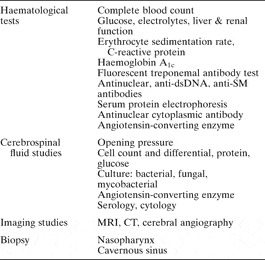
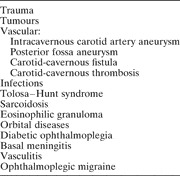
Due to the location and small size of the lesion in the cavernous sinus, surgical biopsy is technically difficult and dangerous. Therefore, imaging results are highly significant in the diagnosis of the syndrome.Reference Haque, Miki, Kashii, Yamamoto, Kanagaki and Takahashi6 High resolution CT can demonstrate soft tissue changes in the region of the cavernous sinus and superior orbital fissure, but this modality is less sensitive than MRI, due to the former's lack of sensitivity in soft tissue imaging. Contrast-enhanced MRI is the examination of choice. The abnormality is seen as intermediate signal intensity on T1 and intermediate weighted images, consistent with an inflammatory process. Intravenous injection of paramagnetic contrast reveals enhancement of the abnormal area. It should be noted that a small number of patients show normal MRI findings.Reference Iaconetta, Stella, Esposito and Cappabianca2, Reference Kline and Hoyt4 The MRI findings before and after systemic corticosteroid therapy are important in the definitive diagnosis of Tolosa–Hunt syndrome.Reference Iaconetta, Stella, Esposito and Cappabianca2, Reference Cakirer7 However, diagnostic MRI findings do not as yet exist, making Tolosa–Hunt syndrome a diagnosis of exclusion. Therefore, careful patient evaluation (Table I) is required, in order to rule out tumours, vascular causes, other forms of infection and other causes of painful ophthalmoplegia (Table II).Reference Iaconetta, Stella, Esposito and Cappabianca2, Reference Kline and Hoyt4
Diagnostic Evaluation of Tolosa–Hunt SyndromeReference Kline and Hoyt4

dsDNA=double stranded deoxyribonucleic acid; MRI=magnetic resonance imaging; CT=computed tomography
Causes of Painful OphthalmoplegiaReference Iaconetta, Stella, Esposito and Cappabianca2

Tolosa–Hunt syndrome is essentially a benign disorder which responds rapidly to the administration of corticosteroids. However, some cases do not respond to corticosteroid therapy.Reference Iaconetta, Stella, Esposito and Cappabianca2, Reference Odabasi, Gokcil, Atilla, Pabuscu, Vural and Yardim8 Tolosa–Hunt syndrome follows an unpredictable course. Before the use of corticosteroids in Tolosa-Hunt syndrome, there was clear evidence that spontaneous remissions occurred. Recurrences are common, occurring in about one-half of reported patients, within months or years of the initial attack. Although Tolosa–Hunt syndrome is a self-limiting illness, it still causes considerable morbidity. Rarely, residual cranial nerve palsies may persist.Reference Kline and Hoyt4 Orbital and periorbital pain and paresis resolve within 72 hours when treated adequately with corticosteroids.Reference Iaconetta, Stella, Esposito and Cappabianca2 The disappearance of symptoms following systemic corticosteroid treatment may precede normalisation of neuroradiological studies by weeks or even several months.Reference Iaconetta, Stella, Esposito and Cappabianca2 On the other hand, the clinical improvement after steroid therapy is not absolute proof of diagnosis, as lymphoma, meningioma and giant cell tumours also respond symptomatically to steroids, albeit with some delay; however, signs do not resolve.Reference Zournas, Trakadas, Kapaki, Doris, Gatzonis and Gouliamos9 Therefore we believe that follow-up MRI studies in these patients are vital, in order to monitor evolution of the lesion and also to avoid an incorrect diagnosis of Tolosa–Hunt syndrome in the presence of other lesions.
• Tolosa–Hunt syndrome is a rare (one to two cases per million), benign condition of painful ophthalmoplegia combined with ipsilateral ocular motor nerve palsies, caused by non-specific granulomatous inflammation in the cavernous sinus, superior orbital fissure or orbit
• A case of Tolosa–Hunt syndrome misdiagnosed as sinusitis orbital complication is reported
• Magnetic resonance imaging studies are essential in the diagnosis and follow up of these patients, in order to avoid a mistaken diagnosis
In conclusion, we believe that, since otolaryngologists deal with patients suffering from painful ophthalmoplegia, Tolosa–Hunt syndrome, although rare, is a nosological entity that we must bear in mind. We would also like to highlight the importance of MRI studies in the diagnosis and follow up of these patients, in order to avoid a mistaken diagnosis.