I. INTRODUCTION
An essential oil is a concentrated, hydrophobic liquid containing volatile aroma compounds from plants. They are also known as volatile or ethereal oils, or simply as the “oil of” the plant material from which they were extracted, such as oil of clove. Oil is “essential” in the sense that it carries a distinctive scent, or essence, of the plant [Reference Wang, Chen, Song, Chen and Liu1, Reference Moudachirou, Gbenou, Chalchat, Chabard and Lartigue2].
Essential oils are generally extracted by distillation. Other processes include expression, or solvent extraction. They are used in perfumes, cosmetics, and bath products, for flavoring food and drink, and for scenting incense, household cleaning products, and as medicine for various treatment ranging from skin treatments to remedies for cancer [Reference Kambouche, Merah, Bellahouel, Bouayed, Dicko and Derdour3, Reference Ferhat, Meklati, Smadja and Chemat4].
Several techniques are currently available for the extraction of essential oils from plants including supercritical fluid extraction, pressurized liquid extraction, pressurized hot water extraction, hydrothermal extraction, water vapor extraction, solvent extraction, membrane-assisted solvent extraction, solid-phase micro extraction, stir bar sorptive extraction, and ultrasounds. Recently, microwave-assisted extraction methods appeared to be particularly attractive due to fast heating of aqueous samples [Reference Gunes and Alma5–Reference Lucchesi, Smadja, Bradshaw, Louw and Chemat12].
Microwave heating gives internal heating based on conduction and dielectric polarization caused by microwave irradiation. Microwave heating has many advantages (such as a non-contact heat source, more effective heating, faster energy transfer, reduced thermal gradients, selective heating, reduced equipment size, faster response to process heating control) over conventional heating including more even distribution of heat and better control over the heating process. Microwave energy, with a frequency of 2.45 GHz, is well known to be used in production and several characterization and purposes [Reference Haala and Wiesbeck13, Reference Huang, Lin and Yang14].
US government has defined frequency bands centered at 2.45 GHz and 915 MHz for industrial, scientific, and medical microwave use. These two frequencies provide a good compromise between penetration depth, absorption, and equipment costs for food processing. Water and other polar molecules couple well with these frequencies [Reference Chamchong and Datta15].
The River Red Gum (Eucalyptus camaldulensis) is a tree of the genus Eucalyptus. It is a plantation species in many parts of the world but is native to Australia where it is widespread especially beside inland water courses. Eucalyptus leaves are a traditional aboriginal herbal remedy. The essential oil found in the leaves is a powerful antiseptic and is used all over the world for relieving coughs and colds, sore throats, and other infections. The essential oil is a common ingredient in many over-the-counter cold remedies. The plant is an aromatic, astringent, tonic herb that sticks to the teeth and turns the saliva red. The report says that the leaves, essential oil, and oleo-resin are used, but does not specify which properties apply to the different parts of the plant. The leaves and the oil will have very similar properties, the oil being much stronger in its effect since it is distilled from the leaves [Reference Gupta and Singh16, Reference Ku, Siores and Ball17].
In the literature, there are few studies on the distillation of essential oil from Eucalyptus species by using hydrodistillation (HD) [Reference Gunes and Alma18]. However, to our knowledge, there is no study on the distillation of essential oil from Eucalyptus species by using microwave irradiation power. Therefore, in this study we have investigated whether the microwave applied in situ distillation method is feasible to extract the essential oil from E. camaldulensis or not.
II. MATERIALS AND METHODS
A) Plant material
In this study, the leaves of E. camaldulensis were collected on September 2008 from Turkish State Forest in Dörtyol district located in Hatay province in the southeast part of Turkey with an altitude of 150 m. The plant was authenticated by Dr. Ahmet Ilcim, Department of Biology, University of Kahramanmaras Sutcu Imam, Turkey. The leaves were air dried and then chopped into small pieces by a mill having six rotary knives.
B) HD method
Fifty grams of leaves of E. camaldulensis was submitted to HD with a Clevenger-type apparatus and extracted with 300 ml of water for 3 h. The essential oil was collected, dried under anhydrous sodium sulfate, and stored at −8°C until used.
C) Microwave applied in situ hydrodistillation (MWHD)
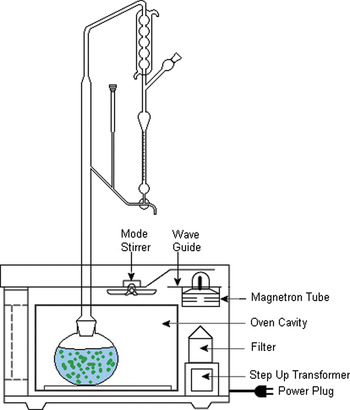
The experimental setup is shown schematically in Fig. 1. For this distillation, 50 g of leaves was mixed with 100 ml tap water. This is a multimode microwave reactor 2455 MHz with a maximum power of 1000 W which is variable in 300 W increments. The dimensions of the PTFE-coated cavity inner are 30L × 27W × 20H cm. During experiments, time and power can manually be controlled. A conventional Clevenger apparatus was linked to round bottom glass placed in a microwave oven. Cooling system outside the microwave oven condensed the distillate continuously. The excess of water was refluxed to the extraction vessel in order to restore water to the plant material. The essential oil from Laurus nobilis was collected at three different powers, e.g., 300, 600, and 900 W, for certain time (20 min), dried under anhydrous sodium sulfate and stored at −8°C until used.
Experimental setup.

D) Electromagnetic power distribution inside the cavity
The problem of electromagnetic field distribution inside a microwave oven is governed by a wave equation obtained from the most general form of Maxwell's equations:
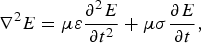 $$\nabla ^2 E=\mu \varepsilon \displaystyle{{\partial ^2 E} \over {\partial t^2 }}+\mu \sigma \displaystyle{{\partial E} \over {\partial t}}\comma \;$$
where E is electric field intensity, σ is material conductivity, and μ and ɛ are the permeability and permittivity of the material, respectively [Reference Jackson19–Reference Kharkovsky and Hasar22].
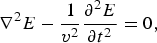
Equation (1) is the electromagnetic wave propagation inside the oven. Using the electromagnetic wave equation
 $$\nabla ^2 E - \displaystyle{1 \over {v^2 }}\displaystyle{{\partial ^2 E} \over {\partial t^2 }}=0\comma \;$$
 $$v=\displaystyle{1 \over {\sqrt {\mu \varepsilon } }}\comma \;$$
we can write the following homogeneous equation:
 $$\left({\nabla ^2+\displaystyle{{\omega ^2 } \over {v^2 }}} \right)E=\lpar \nabla ^2+k^2 \rpar E=0\comma \;$$
where a harmonic wave with the time dependence is implicitly e jwt and where v = ω/k. ω is the angular frequency of the microwave. It reduces in the k → 0 limit to the familiar homogeneous Laplace equation, which is basically a special case of this equation (4).
Observing that
 $$\nabla e^{iknx}=ikne^{iknx}\comma \;$$
we can easily obtain the plane wave as
 $$E\lpar r\comma \; t\rpar =E_0 e^{i\lpar knr - \omega t\rpar }.$$
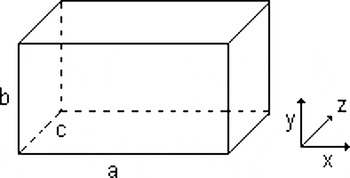
The cavity dimensions used in this study are a, b, and c as shown in Fig. 2.
Cavity shape.

The components of the electric field in the cavity are given by [Reference Jackson19, Reference Cranganu-Cretu, Hantila and Leuca20]
 $$E_x=E_1 \cos \left({\displaystyle{{k\pi } \over a}x} \right)\sin \left({\displaystyle{{l\pi } \over b}y} \right)\sin \left({\displaystyle{{m\pi } \over c}z} \right)e^{j\omega t}\comma \;$$
 $$E_y=E_2 \sin \left({\displaystyle{{k\pi } \over a}x} \right)\cos \left({\displaystyle{{l\pi } \over b}y} \right)\sin \left({\displaystyle{{m\pi } \over c}z} \right)e^{j\omega t}\comma \;$$
 $$E_z=E_3 \sin \left({\displaystyle{{k\pi } \over a}x} \right)\sin \left({\displaystyle{{l\pi } \over b}y} \right)\cos \left({\displaystyle{{m\pi } \over c}z} \right)e^{j\omega t}\comma \;$$
where k, l, and m are wave vectors and a, b, and c are cavity dimensions.
The eigenvalues are given by
 $$\left({\displaystyle{{k\pi } \over a}} \right)^2+\left({\displaystyle{{l\pi } \over b}} \right)^2+\left({\displaystyle{{m\pi } \over c}} \right)^2=\left({\displaystyle{{\omega _{klm} } \over v}} \right)^2\comma \;$$
where ωklm is the angular resonant frequency of different combinations of (k, l, m) and ν is the velocity of light. The electric fields in charge-free space amplitude constants E1, E2, and E3 are constrained by
 $$\displaystyle{{k\pi } \over a}E_1+\displaystyle{{l\pi } \over b}E_2+\displaystyle{{m\pi } \over c}E_3=0.$$
E) Electromagnetic power absorbed by the dielectric material inside the cavity
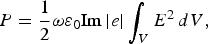
For simplicity, we assume the dielectric material does not perturb the field. The average power dissipated by the dielectric material is [Reference Kharkovsky and Hasar22]
 $$P=\displaystyle{1 \over 2}\omega \varepsilon _0 {\mathop{\rm Im}\nolimits} \left\vert e \right\vert \int_V {E^2 \, dV}\comma \; $$
where Im[ɛ] is the imaginary part of the dielectric constant of the material. If the electric field in the cavity can be assumed constant, then equation (12) yields
 $$P_{avg}=\omega \varepsilon _0 {\mathop{\rm Im}\nolimits} \left\vert \varepsilon \right\vert E_{rms} ^2 V\comma \;$$
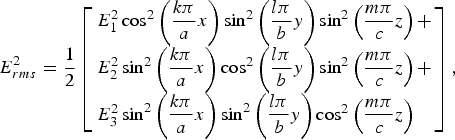
 $$E_{rms}^2={\displaystyle{1 \over 2}}\lpar \left\vert {E_x } \right\vert ^2+\left\vert {E_y } \right\vert ^2+\left\vert {E_z } \right\vert ^2 \rpar \comma \;$$
 $$E_{rms}^2=\displaystyle{1 \over 2}\left[\matrix{E_1^2 \cos ^2 \left({\displaystyle{{k\pi } \over a}x} \right)\sin ^2 \left({\displaystyle{{l\pi } \over b}y} \right)\sin ^2 \left({\displaystyle{{m\pi } \over c}z} \right)+\hfill \cr E_2^2 \sin ^2 \left({\displaystyle{{k\pi } \over a}x} \right)\cos ^2 \left({\displaystyle{{l\pi } \over b}y} \right)\sin ^2 \left({\displaystyle{{m\pi } \over c}z} \right)+\hfill \cr E_3^2 \sin ^2 \left({\displaystyle{{k\pi } \over a}x} \right)\sin ^2 \left({\displaystyle{{l\pi } \over b}y} \right)\cos ^2 \left({\displaystyle{{m\pi } \over c}z} \right)\hfill} \right]\comma \;$$
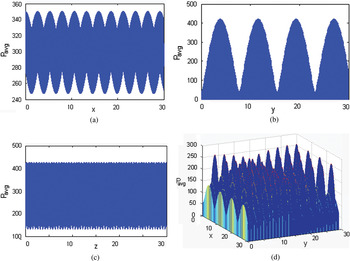
where a = 30 cm, b = 20 cm, and c = 27 cm. Since the microwave frequency is 2455 MHz and the velocity of light is known as the combination of (k, l, m) can be easily determined as (2, 2, 3) from equation (11). Figure 3 shows the electromagnetic power distribution inside the cavity according to the selected (2, 2, 3) mode.
E&M power distributions: (a) on the x direction, (b) on the y direction, (c) on the z direction, and (d) on the x–y direction.

F) Temperature distribution inside the cavity
The temperature distributions within the cavity volume can be derived by accepting that the local power intensity is a good indicator of the relative heating rates at any point within a microwave-heated sample. Volumetric heat generation Q can be expressed in terms of power intensity in three orthogonal directions as shown in
 $$Q=\displaystyle{{\partial P_{av\lpar x\rpar } } \over {\partial V}}+\displaystyle{{\partial P_{av\lpar y\rpar } } \over {\partial V}}+\displaystyle{{\partial P_{av\lpar z\rpar } } \over {\partial V}}\comma \;$$
where the x, y, and z indicate time-average power dissipated in the corresponding directions and V is the volume in which the heat is generated.
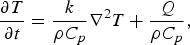
For an incompressible material heated under constant pressure, the thermal energy equation is given by
 $$\displaystyle{{\partial T} \over {\partial t}}=\displaystyle{k \over {\rho C_p }}\nabla ^2 T+\displaystyle{Q \over {\rho C_p }}\comma \;$$
where ρ is the density, C p is the specific heat, K is the thermal conductivity of the material, and T is the absolute temperature in Kelvin [Reference Dev, Gariepy and Raghavan23].
The rate at which heat is delivered to the sample due to microwave absorption is given by
 $$Q={\textstyle{{1} \over {2}}}\omega \varepsilon ^{\prime\prime} EE^{\ast} \comma \;$$
where ω is the angular frequency of the microwaves, E is the electric field strength, and E* its complex conjugate. This equation, derived from the Poynting theorem, shows that microwave heating depends only on the electric field component of the electromagnetic wave [Reference Finegan, Laibinis and Hatton24].
III. ANALYSIS OF ESSENTIAL OIL
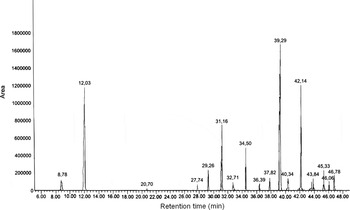
The essential oil (11.5 mg) was diluted with diethyl ether (Et2O) (1 ml) and analyzed on a Finnigan-MAT 8200 Mass Spectrometer coupled with a Hewlett-Packard GC-5890II. An SE-54-fused silica capillary column (30 m × 0.25 mm i.d.; 0.25 µm film thickness) and carrier gas He (at 1.15 ml/min) were used. One microliter of the diluted oil was injected into the column (split 1:10). The gas chromatography (GC) oven temperature was kept at 60°C for 5 min and programmed to 260°C at a rate of 2°C/min and then kept at 260°C. The injector temperature was 250°C. Mass spectra were taken at 70 eV (EI mode). Identification of components in the oil was based on logarithmic retention indices relative to n-alkanes and mass spectra compared with own data collections based on authentic reference substances, NIST library, as well as by comparison with data reported in the literature. The spectra obtained for the oil are given in Fig. 4.
Spectra of the essential oil from E. camaldulensis.

Quantification of the essential oil was conducted by GC with flame ionization detector (GC-FID) on a Hewlett-Packard GC-5890II series GC. The oil (1 µl) was injected into the same column under the same GC conditions as described for GC–mass spectrometry study. However, split ratio was 1:14.
IV. RESULT AND DISCUSSION
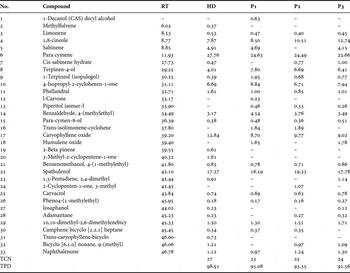
Table 1 lists the chemical composition of the essential oil from the leaves of River Red Gum obtained by using MWHD and HD methods. As is shown in this table, the major components are para cymene, spathulenol, 1, 8-cineole, caryophyllene oxide, terpinen-4-ol, sabinene, 4-isopropyl-2-cyclohexen-1-one and benzaldehyde 4-(methylethyl), respectively, for both conventional MWHD and HD methods regardless of power used here. Almost more than 90% of the oil obtained by both methods was determined.
Composition of essential oil from the leaves of E. camaldulensi s obtained by using MWHD and HD methods.

RT: retention time; HD: hydrodistillation method; P1: 300 W; P2: 600 W; P3: 900 W; TCN: total compound numbers; TPD: total percentage determined.
The essential oil obtained by using both methods contains oxygenated monoterpene, monoterpene hydrocarbons, monoterpene alcohols and carbonyls, monoterpenyl acetates and sesquiterpene hydrocarbons, as well as sesquiterpene alcohols and oxides.
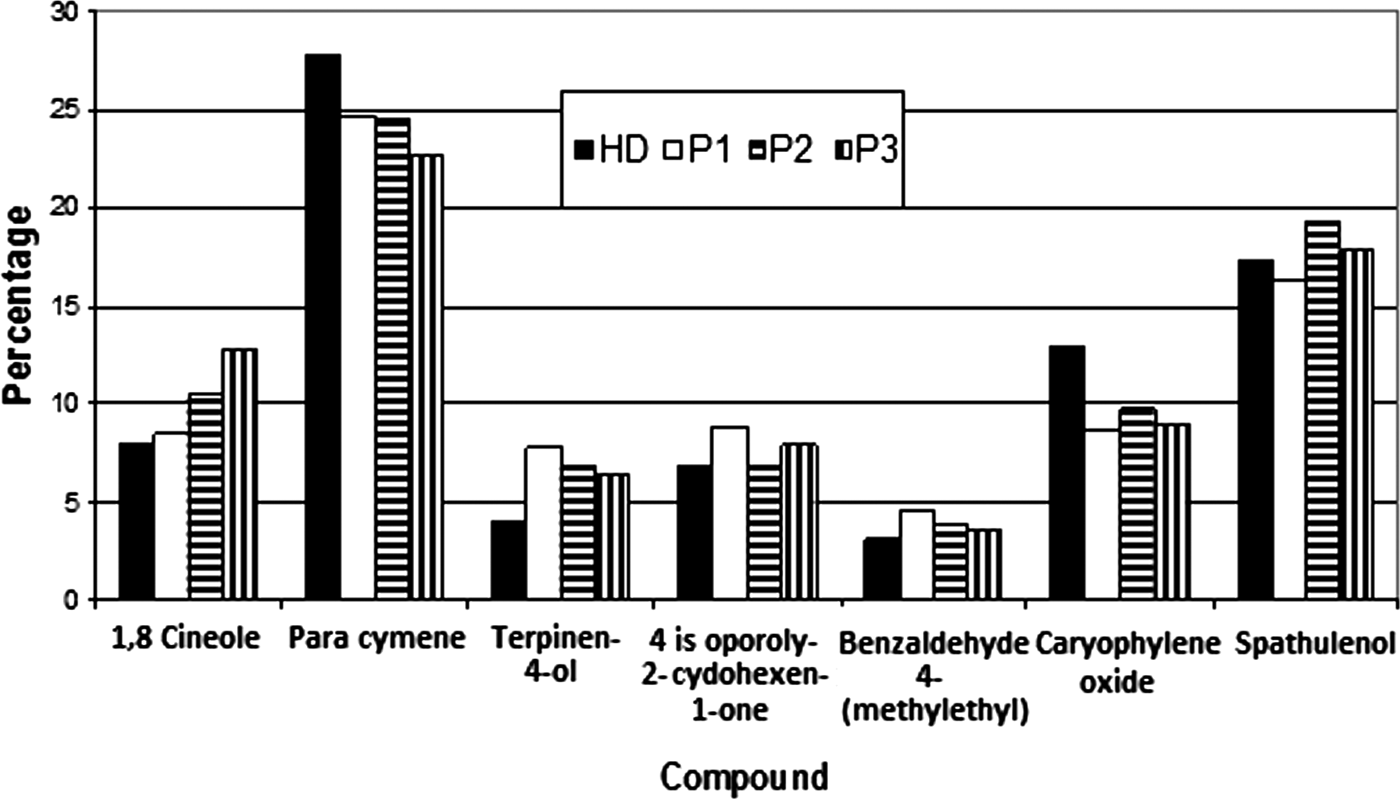
Table 1 depicts the percentage of the compound of essential oil from River Red Gum-obtained MWHD and conventional HD techniques. As can be seen from Table 1 and Fig. 5, there is a remarkable change in the chemical composition of the oil depending upon methods applied as well as microwave power.
The content of typical compound of the essential oil obtained by MWHD and HD methods as a function of microwave irradiation power.
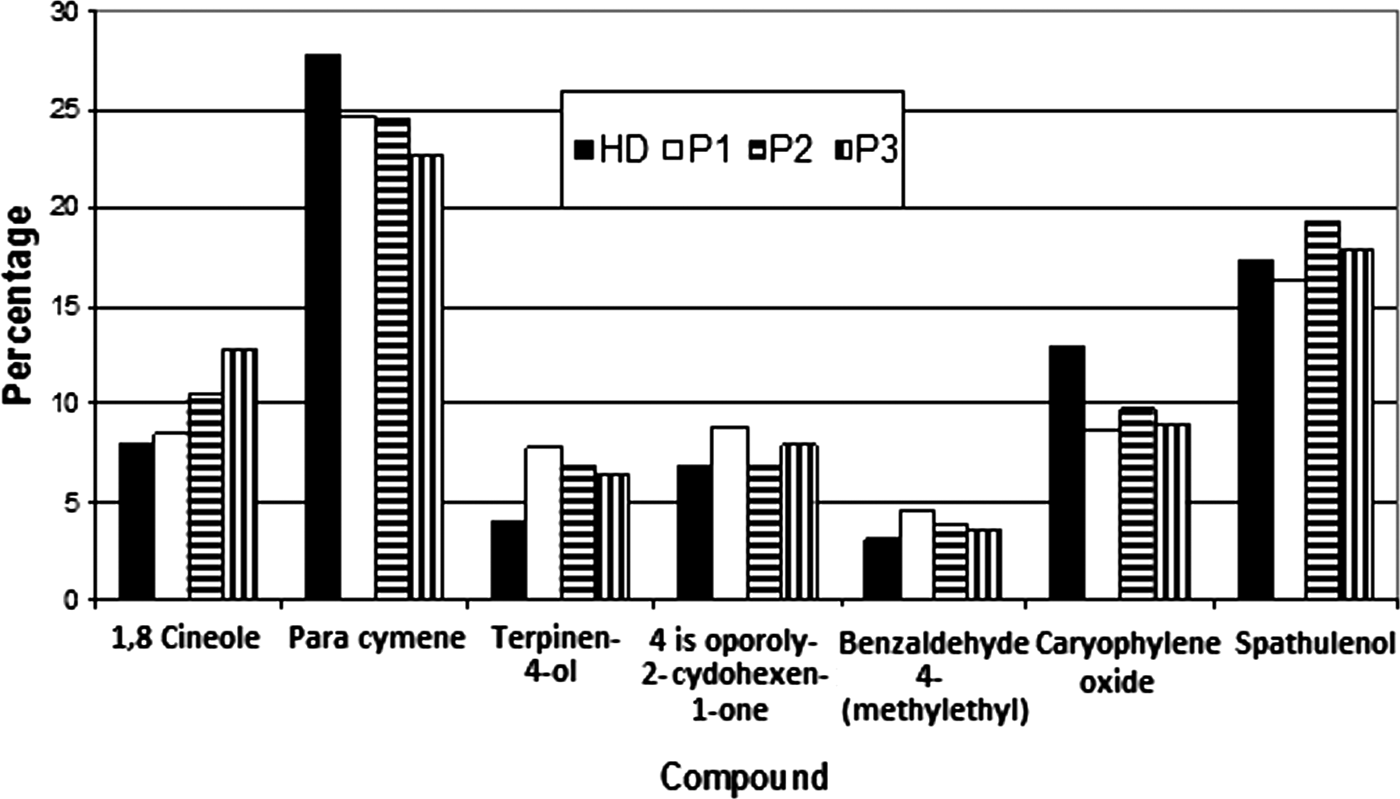
The number of compounds and their contents are greatly affected by changing the power. That is to say, the higher power becomes, the higher number of compounds are obtained.
Moreover, the content of the monoterpenes, such as para cymene, one of the main compounds, decreases with increasing microwave irradiation power. In contrast, the amounts of 1,8-cineole increases by increasing the power.
It is also interesting that the amount of caryophylene oxide, which is a harmful compound, determined by MWHD is lower than that of one obtained by HD method, which results from negative effect of heating and undesired product in essential oil.
Moreover, it is evident to say that the number of compounds determined by conventional MWHD method for all the powers applied are found to be lower than those determined by the HD method.
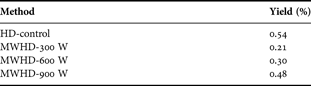
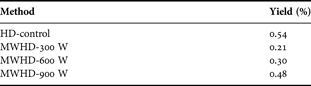
Table 2 indicates the yield of essential oil obtained by using MWHD and HD methods. It is clear from Table 1 that the yield of the oil increases with increasing microwave irradiation power at a residence time of 20 min. It is clear from this table that the yield of essential oil determined by MWHD is somewhat lower than that of the conventional HD method at the present conditions. It can be suggested that somewhat higher power or longer residence time should be used in order to reach maximum the yield.
The percent yield obtained by using MWHD and HD methods.
It is important to say that the oil obtained from Turkish E. camaldulensis does not contain a cryptone compound unlike species E. camaldulensis grown in other regions. The amounts of 1,8-cineole determined by using MWHD in this study is found to be greatly lower than that of the same species grown in other regions [Reference Dethier, Nduwimana, Cordier, Menut and Lamaty25, Reference Zrira, Benjilali, Fechtal and Richard26].
V. CONCLUSION
The results indicated that microwave irradiation applied in situ successfully could be used in the distillation of essential oil from E. camaldulensis and changing its power had an important role on the yield and chemical composition of the E. camaldulensis. The content of monoterpenes such as para cymene determined by microwave irradiation applied in situ was found to be greatly lower than those determined by conventional HD method. The content of oxide compound was greatly reduced by using the microwave irradiation method in comparison with the conventional HD method. Furthermore, the yield of essential oil determined by MWHD was somewhat lower than that of conventional HD method at the conditions studied here.
 Mahit Gunes received the B.S. (1992) degree in Electrical-Electronics Engineering from Anadolu University and the M.S. (1999) degree from the Kahramanmaras Sutcu Imam University in Turkey. He received the Ph.D. (2005) degree in Computer & Control Science from Marmara University in Turkey. He has served as a research engineer in industrial companies from 1992 to 1997. He designed and constructed several automation and control systems in textile and paper mill industry. He developed wireless data acquisition systems and management software for textile companies. These systems are currently used by the 14 big textile companies. He is currently working as an assistant professor at Sutcu Imam University. His current research interests include electromagnetic fields and microwave, SCADA software developments, hardware designs with wireless data acquisition and automatic control systems development for industrial companies.
 Mehmet Hakkı Alma received the B.Sc. (1988) and M.Sc. (1991) degrees in Forest & Industrial Engineering from Karadeniz Technical University in Turkey and the Ph.D. degree in Wood Science and Technology from Kyoto University in 1996, Japan. Currently, He is a professor and head of the department at Forest & Industrial Engineering. He is a member of “Japan Wood Research Society”, editorial board of “Bioresources Journal” and committee of Turkish Science and Technology Institute (TUBITAK-TOVAG).