Introduction
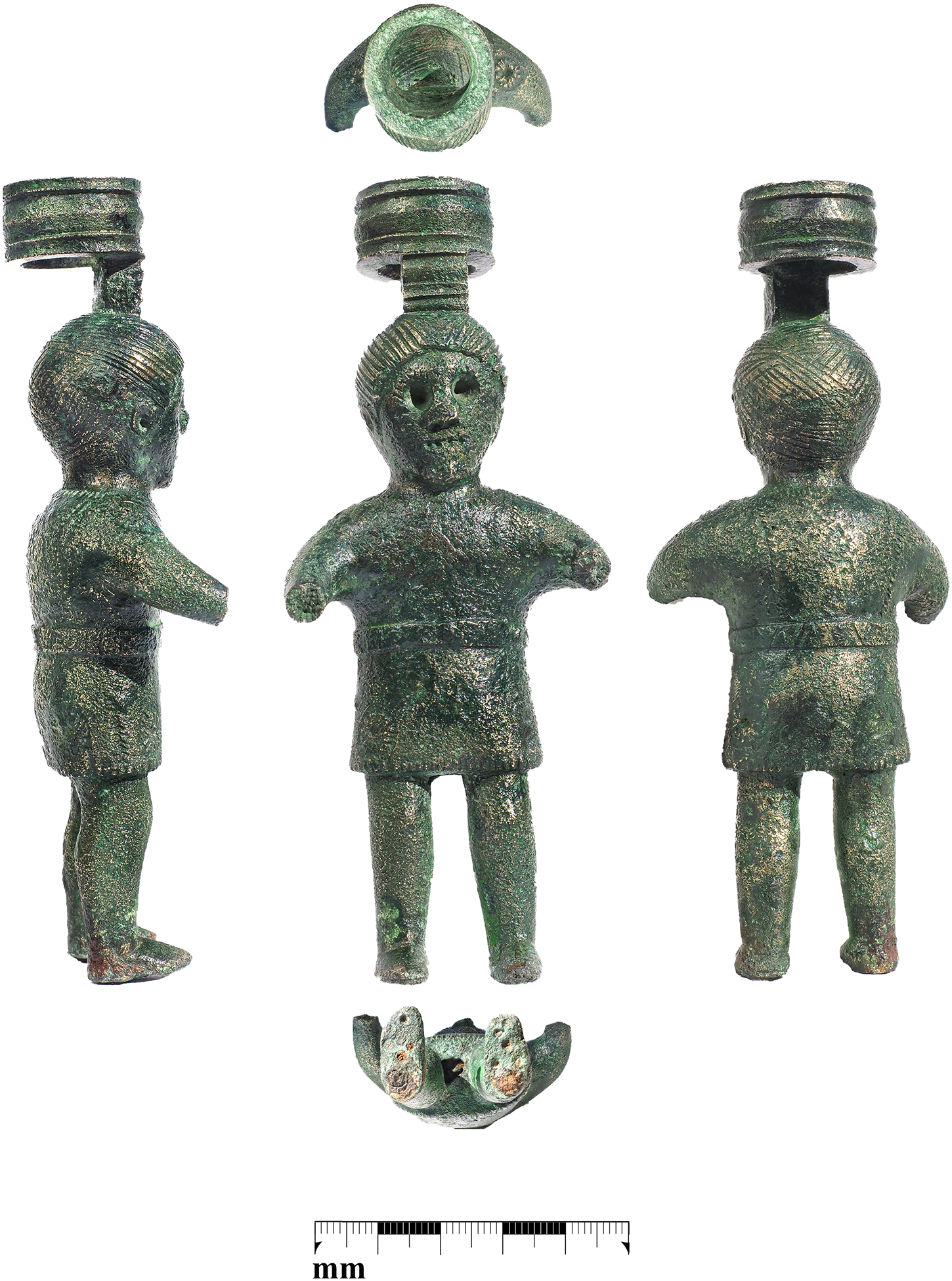
In 2019, Simon Grant, a local metal-detectorist, discovered a Roman figure in West Keal, East Lindsey in Lincolnshire (PAS no. LIN-15CBCC; Fig. 1). This three-dimensional male figure is dressed in a belted tunic that terminates just above the knee, with fine detailing around the hem, collar and belt. The figure appears to be wearing pointed shoes, with small circular holes and traces of iron rivets on the underside. The face is detailed with circular drilled eyes, a nose, sub-oval indentations for the ears and four dots along the mouth-line. The hair is swept backward, delineated by grooves towards the crown, interwoven lines at the back and curvilinear lines at the nape. The figure is depicted in a naturalistic standing posture, with its legs slightly bent at the knees. The arms are stretched outward, though the lower arms and hands are missing, likely due to an old break. Patches of iron corrosion are visible on the front and around the body. A circular socket, decorated with ribs and grooves, protrudes from the top of its head.
West Keal figure, PAS no. LIN-15CBCC (© Lincolnshire County Council).

Function and comparison
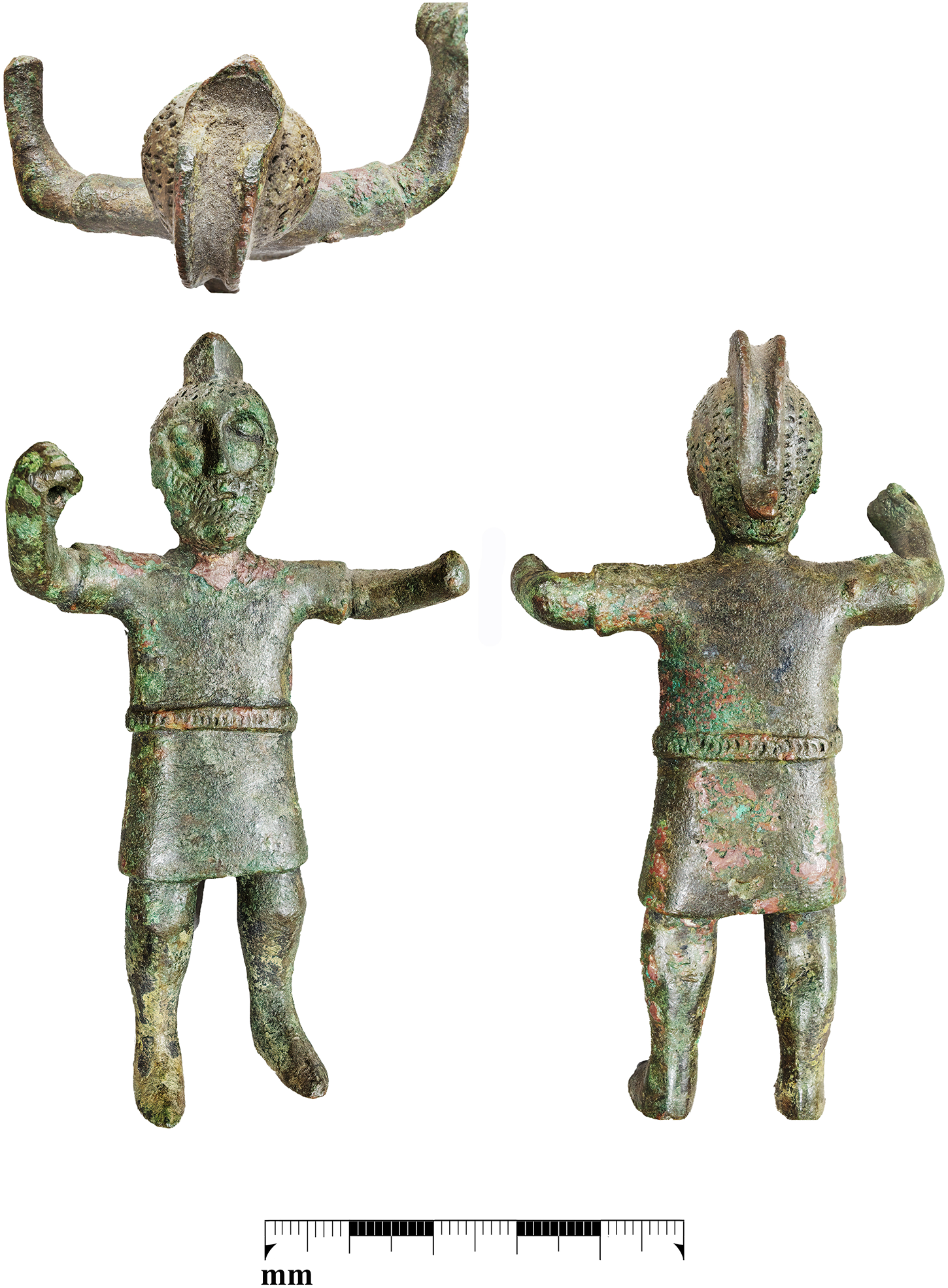
While the object’s exact function remains unclear, it is tentatively considered to be a candlestick, possibly crafted to hold candles produced by dipping a wick into molten tallow or wax.Footnote 1John Pearce and Sally Worrell note broad similarities between the West Keal figure and small copper-alloy objects identified as candlesticks. However, the projection from the West Keal figure’s head has no parallel in known examples, suggesting other possible functions, including that of a handle, although the weight of the object may rule out this interpretation.Footnote 2The object’s dimensions, measuring just under 130 mm in length and weighing 293 g, imply that it necessitated a base attachment to remain upright. The iron rivets on the underside of the shoe and the pattern in the arrangement imitate hobnail designs, known for enhancing traction and grip for the wearer.Footnote 3The right foot displays a quincunx arrangement of rivets, while the left foot, having suffered damage, exhibits three dots positioned around a central dot. At each heel, the remnants of two larger rivets are still visible. The style and costume of the West Keal figure closely resembles the Mars Ultor figurine from Dragonby, north Lincolnshire, with a similar belted tunic and slightly bent knees (Fig. 2).Footnote 4Emma Durham posits that the Dragonby figure may be the creation of an itinerant metalsmith working within a broader artistic tradition associated with figurines from the Southbroom hoard.Footnote 5The similarities observed between the Dragonby and West Keal figurines could indicate the existence of a local workshop in Lincolnshire.Footnote 6However, although the resemblance is suggestive, the hypothesis remains inconclusive owing to significant variations in arm posture, hairstyle and dress. The Dragonby example has short sleeves, while the West Keal figure retains enough of the arm to suggest the possible presence of long sleeves. Additionally, the Dragonby figure wears a helmet with a stylised plume and full beard that covers most of the face, contrasting with the probable clean-shaven face of the West Keal example. The eye details also differ: the Dragonby figure has moulded oval eyes, while the eyes of the West Keal figurine are deeply drilled circular holes — potentially designed to hold gems or glass — accompanied by short, finely incised lines forming the eyebrows.
Mars Ultor figurine, Dragonsby, north Lincolnshire (© Author. Author’s image reproduced with kind permission of North Lincolnshire Museums).

It was previously noted that the hairstyle of the West Keal figure stylistically parallels the Type II bound captive ‘Celtic’ tonsure, characterised by hair brushed back from the forehead.Footnote 7The non-tonsured combed-back locks converging at the centre of the crown and nape are a distinctive feature seen in other broadly contemporary three-dimensional human figures. Notable examples include an Iron Age to Roman bucket escutcheon depicting Europa and the bull from Barnetby Le Wold, north Lincolnshire;Footnote 8an Iron Age figurine from East Garston, west Berkshire;Footnote 9an Iron Age to Roman vessel mount from Ancaster;Footnote 10and the bust of a young individual, thought to be a Roman furniture fitting, from Nantwich, Cheshire.Footnote 11The intricate arrangement of grooves — particularly the diagonal and transverse curvilinear lines at the back of the head — suggests a more complex hairstyle than previously proposed. Perhaps the most striking stylistic parallel can be found in the hairstyles of the figures depicted on the sword scabbard from Late Hallstatt grave 994. The shield-bearing warriors adorning the scabbard are shown as young men with neck-length hair, carefully styled.Footnote 12The front section of the hair is combed back with a distinct parting above the ear line. It resembles a half-ponytail style, where the upper section is pulled back and secured, while the lower section remains loose. Curvilinear strands in the lower section flow down to the neck, culminating in a rounded shape at the nape. This coiffure represents a refined adaptation of the ‘Celtic’ combed-back style, reflected in the intricate hairstyle aesthetic of the West Keal figure.
Conservation and further details
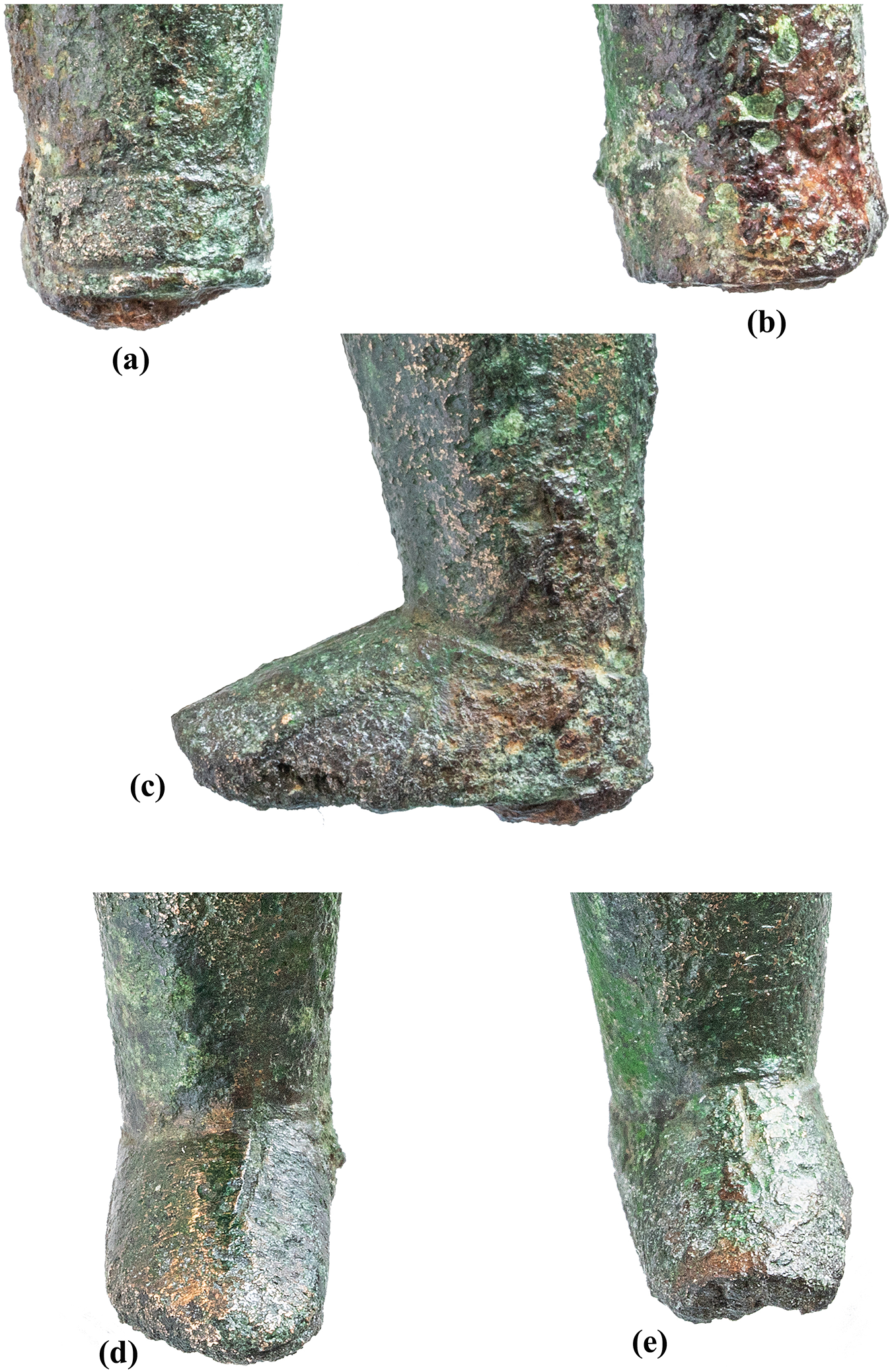
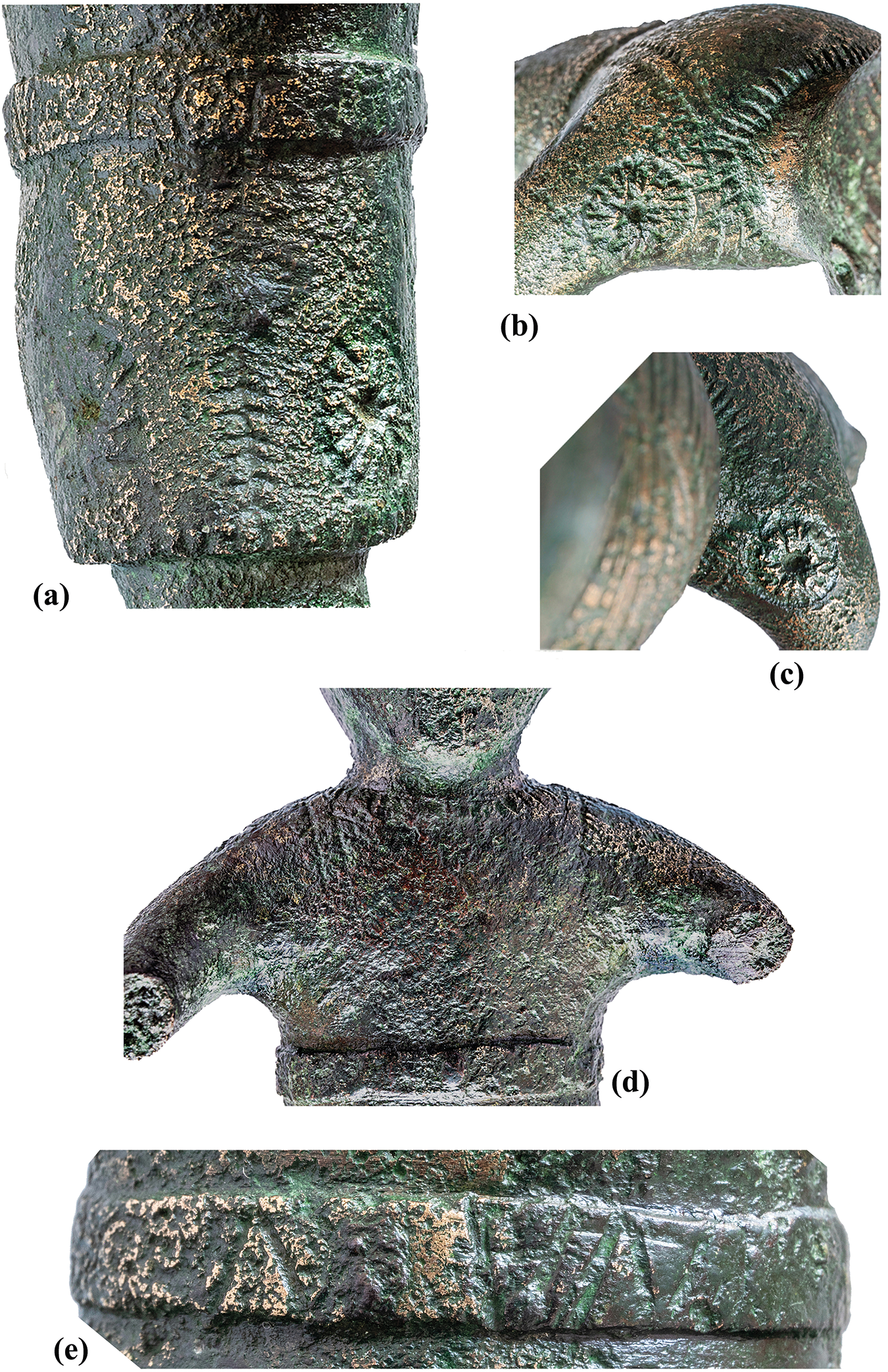
In 2021, the finder of the West Keal figure had the object conserved, revealing greater detail than previously identified and it was kindly resubmitted to the PAS for further analysis. The cleaning revealed fine incised grooves delineating a closed, pointed shoe — or calceus — with a flat heel and sole, a style worn across all levels of society (Fig. 3a–e).Footnote 13A single incised line runs centrally along the front of the shoe, extending approximately three-quarters of its length — possibly indicating a stitch line, fold, or decorative feature that enhanced the impression of a leather shoe. Further decorative elements on the tunic became more apparent and visible on the upper body and below the belt. Down both sides of the tunic below the belt a single longitudinal band of chevron motifs with a central vertical groove is present, perhaps representing embroidered decoration or stitching (Fig. 4a). This is reminiscent of a tunic made from two rectangles of cloth sewn together, as evidenced by Roman stone statues with seamlines.Footnote 14Further decorative stitching or embellishment is visible around the hem, represented by short, regular rectangular notches. Notably, additional tunic ornamentation emerged in the form of roundels (orbiculi) symmetrically arranged at the shoulders and lower hem, accompanied by linear motifs (clavii) positioned above the belt that extended from the shoulders down the back and front, terminating at the waist (Fig. 4a–d). Each roundel features a rosette-style motif, centred on a drilled circular aperture from which trapezoidal lobes radiate symmetrically. The lobes are delineated by finely incised grooves. The motif is enclosed within a grooved circular border measuring approximately 8–9 mm in diameter. The lower left hem roundel is very worn. The shoulder roundels may each contain a central seven-pointed star, with the design appearing more pronounced on the right shoulder — though this may be a result of wear and damage. The stripes on the back and over the shoulders are more apparent, consisting of a longitudinal band delineated by linear grooves with incised chevron borders. Traces of the chevron motif and the band are visible on the front, pausing or wearing away just above the armpit line. The notches on the neckline became clearer comprising short, sub-rectangular grooves and ridges within a curvilinear grooved border and may represent further decorative embellishment of the tunic (Fig. 4d). The motif on the belt was further defined, revealing an incised chevron motif, and a possible raised central oval buckle, belt mount or knot (Fig. 4d–e).
Enclosed shoe detail of the West Keal figure: (a) back left; (b) back right; (c) side view with curved detail; (e) front right with central vertical groove; (f) front left with central vertical groove. Not to scale. (© Author).

Bodily detail of the West Keal figure: (a) side view with vertical chevron motif; (b) right shoulder with roundel and collar detail; (c) left shoulder with roundel and collar detail; (d) upper body with stripes and belt; (f) reverse of belt with chevron motif. Not to scale. (© Author).

Fourth-century mosaics from Britain and the Mediterranean offer valuable visual insights into evolving fashion trends of the period, particularly in the decorative treatment of tunics. During this time, elaborate tapestry-woven stripes and roundels embellished the upper arms as well as the lower front and back panels of the garment. These features reflect a broader uptake in intricate textile ornamentation, adopted across a range of social statuses and roles.Footnote 15Notably, roundels appear to have been especially associated with male fashion.Footnote 16Mosaic fragments from East Coker (Somerset), for instance, depict a pair of huntsmen carrying a deer tied by the feet on a pole; one of them has orbiculi on his tunic.Footnote 17The late-fourth-century mosaic from the Roman villa at Boxford, west Berkshire, carries an ornate scene of Bellerophon and the chimaera, with the hero clad in a fashionable tunic with roundels and stripes.Footnote 18The long sleeves and elaboration on the tunic are akin to the military belts, tunics with roundels and stripes depicted on the soldiers from the Piazza Armerina mosaics also dating to the fourth century.Footnote 19The clavus was used both as a band of plain colour and as embroidered stripes woven into the fabric. In mosaic figurative imagery, roundels appear on the upper and lower sections of the tunic, mirroring the designs found on the West Keal figure. Similar motifs have been identified on surviving garments, where knots, interlace patterns and eight-sided star motifs within roundels may have been believed to hold magical or apotropaic properties, perhaps offering protection to the knees and shoulder joints.Footnote 20It is possible that the star motif within the roundel of the West Keal figure was deliberately incised to convey apotropaic significance. This costume style became widely adopted in the male sphere, transcending social hierarchies. Even servants were depicted wearing elaborate tunics adorned with clavi and orbiculi. One example features servants carrying wine and flasks, as seen in fourth-century paintings at Caelian Hill in Rome.Footnote 21This supports the interpretation that the figure may depict a well-dressed male servant or attendant bearing a prop.Footnote 22The maker devoted careful attention to the rendering of the figure, with particular emphasis on the hair, which may evoke the portrayal of an individual from an indigenous Iron Age cultural milieu. While it remains uncertain whether the subject was depicted as enslaved or freeborn, the absence of the tonsure commonly associated with representations of slaves may suggest the latter. The figure’s representation suggests a deliberate engagement with local cultural traits — potentially indicating the involvement of a smith from an indigenous background working within Roman stylistic conventions.
Landscape context
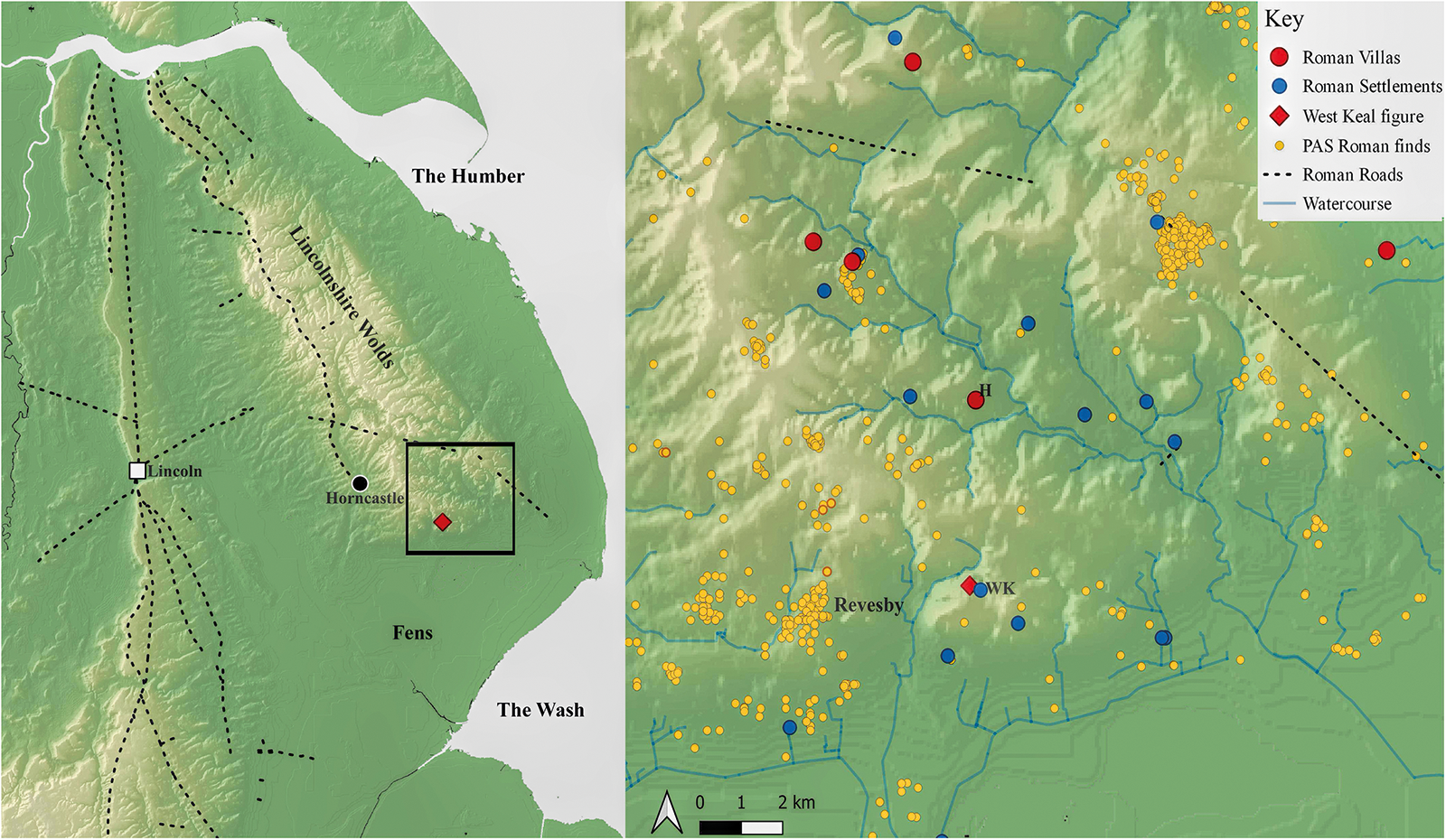
The portrayal of a servant figure likely offering food and/or drink offers valuable insight into the luxurious domestic settings of Roman Lincolnshire, particularly within its high-status settlements and villa estates. The West Keal figure was discovered near an enclosed Roman farmstead, identified through cropmark features and an artefact scatter that includes querns, colour-coated ware and mortaria. Although enclosed settlements are relatively uncommon in this region, the associated artefacts yield limited insight into specific site activities, instead reflecting a broad material signature characteristic of domestic occupation across a diverse range of site types.Footnote 23The distribution of villa sites in Lincolnshire highlights the region’s connection to the broader central England ‘villa zone’, with a dense concentration extending north of Lincoln into north Lincolnshire.Footnote 24South of Lincoln, additional villas are present, with outliers reaching into the Wolds. Among these is the potential villa site at Hagworthingham, tentatively identified through aerial photography and geophysical surveys, located approximately 4 km from the figurine’s findspot. Excavations carried out at the Hagworthingham site in 2017 and 2018 revealed enclosures, a ditch, pits and a timber beam slot, alongside pottery dating from the first to second centuries a.d., including a small quantity of samian ware. The discovery of a gold Roman pendant and a copper-alloy mount depicting a bearded male face within the same parish may further support the presence of a high-status site in the area.Footnote 25The surrounding landscape, as shown in Fig. 5, reveals a notable concentration of Roman artefacts within the wider hinterland of the West Keal figure. These include gold and silver gem-set finger rings recorded in the Lincolnshire Historic Environment Record (HER) along with dense clusters of brooches and coins in the neighbouring Revesby area, as documented through the PAS. The PAS data strongly suggest the presence of previously unknown archaeological site(s) in the Revesby area. A particularly notable find is a gold finger ring set with a jasper intaglio engraved with a gryllos — a composite motif depicting the conjoined heads of an older man and a youth.Footnote 26Other significant finds found within the West Keal area include a second-century carnelian intaglio finger ring depicting Diana and a hunting scene,Footnote 27along with fragments of Flavian samian ware. Dress accessories and personal adornments are not typically associated with farmstead sites but are well represented at roadside settlements and villa contexts in this region.Footnote 28Martyn Allen suggests that settlements located close to major nucleated centres were likely higher-status farmsteads.Footnote 29The wealth and distribution of objects from Revesby may indicate one such centre. The landscape setting of West Keal — situated near a potential centre at Revesby and a villa site at Hagworthingham — alongside the object’s possible function as lighting equipment, an artefact group more commonly associated with roadside settlements and villa sites, suggests that West Keal may have been a higher-status farmstead, potentially linked to a villa estate and/or major centre. A final consideration is the findspot of the figure, just beyond the limits of the identified enclosed settlement and less than half a kilometre from an old waterway. This proximity raises the possibility that the figure may have originated from a shrine associated with the settlement — perhaps a local wayside shrine.Footnote 30However, there is currently no aerial photography and LiDAR evidence, nor artefactual concentration, to support the presence of such a religious site. Alternatively, the object may have migrated from its original context over the course of nearly two millennia due to plough disturbance or human activity. It may, therefore, have more plausibly originated as a domestic cult item — perhaps associated with a household shrine.
Map of Lincolnshire and area of interest. H = Hagworthingham and WK = West Keal. Lisa Brundle (2025). Created using QGIS (Version 3.28.15).

Dating
The West Keal figure was found in the plough zone near a possible Romano-British farmstead site with a broad date range, which does not contribute much to dating of the object. The closest stylistic parallels are Roman figurines. However, dating figurines is notoriously challenging, with only a small percentage of known figures coming from securely dated archaeological contexts — generally fourth-century destruction deposits. Issues arise from objects that may have been used for many years, possibly even passed down as heirlooms. It should be noted that provincial styles do not necessarily deteriorate over time.Footnote 31Durham posits an earlier date in the Roman period for the Southbroom group of figurines.Footnote 32By stylistic association, this would also suggest an earlier date for the Dragonby figurine, which broadly parallels the West Keal figure. Although the exact function remains unknown for the West Keal object, its closest parallels are candlesticks. In Roman Britain, lamps were increasingly replaced by candlesticks in the latter part of the era, with socketed metal candleholders being generally dated to the third and fourth centuries a.d.Footnote 33This object’s possible fourth-century date, based on the fashionable late Roman tunic with long sleeves decorated with roundels and stripes, fits into this timeline.
Conclusion
Further conservation of this enigmatic Roman figure — notably distinguished by its circular socket — has revealed new layers of detail, including defined footwear and decorative circular and stripe motifs on the tunic. The object exhibits a high level of technical skill and refinement, as evidenced by the representation of the hair and costume with the stitching marks, well-defined neckline and hem, detailed footwear depiction, and carefully rendered tunic embellishments. These embellishments, along with the garment’s overall design, align convincingly with late Roman fashion trends, supporting a probable fourth-century or even late fourth-century date. The hypothesis that the figure served as a candlestick or lighting device is persuasive, given its form and parallels with comparable objects. Although the possibility of it representing a deity has been considered, this interpretation is weakened by the absence of identifiable divine attributes, distinctive garments, or gestures typically associated with Roman deities. Instead, the figure’s costume and posture suggest an alternative interpretation — as a servant or attendant — which is strengthened through both stylistic and gestural analysis. Although the precise circumstances of the object’s deposition remain uncertain, its discovery adjacent to a Romano-British farmstead — set within a wider landscape of higher-status sites — offers valuable contextual clues regarding its possible function and significance. The figure stands out as a unique find in Roman Britain, not only due to its unusual, socketed feature but also for its finely detailed attire, for which no direct parallel in metal has yet been identified. Crucially, this object enriches our understanding of Roman-period fashion and artefacts, and offers potential benchmarks for the dating of metallic anthropomorphic figures. It also demonstrates the value of three-dimensional representations, especially in capturing aspects such as hairstyles in the round — elements often omitted in the predominantly frontal format of Roman two-dimensional art. Continued analysis, supported by any future fieldwork, may yield further valuable insights into the figure’s function, iconography and its wider cultural significance.