Introduction
The aging of the population is leading to an increasing burden of dementia and cognitive impairment (Picca et al., Reference Picca2020). A clearer understanding of potentially modifiable determinants to enable the design of effective preventative interventions would be helpful in alleviating this increasing individual and societal burden.
Sleep disorders are very common in older people (Gulia and Kumar, Reference Gulia and Kumar2018), and previous studies have indicated that abnormal sleep durations are associated with some disease conditions, such as stroke, diabetes, and heart disease (Titova et al., Reference Titova, Michaëlsson and Larsson2020; Chew et al., Reference Chew, Tan, Lamoureux, Cheng, Wong and Sabanayagam2020; Lao et al., Reference Lao2018). These conditions are all recognized as risk factors for cognitive impairment. Thus, increasing attention is being directed to the relationship between sleep duration changes and cognitive impairment in older populations. Whether sleep duration is related to the incidence of cognitive impairment remains unclear.
Perhaps due to the small sample size (all <300), some cross-sectional studies have found no link between sleep duration and cognitive impairment in elderly individuals (Saint Martin et al., Reference Saint Martin, Sforza, Barthélémy, Thomas-Anterion and Roche2012; Seelye et al., Reference Seelye, Mattek, Howieson, Riley, Wild and Kaye2015). An increasing number of studies have shown that sleep duration and cognitive impairment are related, but the conclusions have been inconsistent. Some studies have shown that only short sleep duration is associated with worse cognitive function in older adults (Ferrie et al., Reference Ferrie, Shipley, Akbaraly, Marmot, Kivimäki and Singh-Manoux2011; Lo et al., Reference Lo, Loh, Zheng, Sim and Chee2014). Short sleep duration often indicated the presence of depression (Ouyang and Sun, Reference Ouyang and Sun2019), which has been suggested to be a risk factor for dementia (Rubin et al., Reference Rubin2018). Some studies have identified that only long sleep duration was associated with worse cognitive impairment (Cochrane et al., Reference Cochrane, Robertson and Coogan2012; Ramos et al., Reference Ramos2013; Otsuka et al., Reference Otsuka2014; Basta et al., Reference Basta2019), which indicated that the presence of apathy (Leger et al., Reference Leger2017) may increase the incidence of cognitive impairment (Harrison et al., Reference Harrison, Aerts and Brodaty2016). Other studies have pointed out that both short and long sleep durations were associated with cognitive impairment, which meant that sleep duration had a U-shaped relationship with cognitive impairment risk (Gildner et al., Reference Gildner, Liebert, Kowal, Chatterji and Snodgrass2014; Song et al., Reference Song2017; Cheng et al., Reference Cheng2018; Henry et al., Reference Henry2019). In a prospective study, unusual sleep durations were associated with an increased risk of ischemic stroke and other cerebrovascular diseases (Titova et al., Reference Titova, Michaëlsson and Larsson2020).
To further explore the relationships between sleep duration and cognitive impairment, prospective studies have gradually begun to be carried out, but the number of studies remains small, and the results remain inconsistent. A study followed 2238 elderly individuals with normal cognition for 4 years and found that a long sleep duration increased the risk of cognitive impairment (Suh et al., Reference Suh2018). Nakakubo et al. reached similar conclusions in a Japanese population after 4 years of follow-up (Nakakubo et al., Reference Nakakubo2019). Other studies have pointed out that extreme sleep durations (both too short and too long) were associated with cognitive impairment (Potvin et al., Reference Potvin2012; Devore et al., Reference Devore, Grodstein, Duffy, Stampfer, Czeisler and Schernhammer2014; Xu et al., Reference Xu2014).
The inconsistent findings may be related to particular factors. First, ethnicity/race may be a factor; for example, Hispanics (excluding Mexican Americans) have been associated with an increased risk of short sleep durations (Hale and Do, Reference Hale and Do2007). Second, place of residence may be a factor; compared to living in rural areas, living in urban areas was associated with an increased risk of short sleep durations and a reduced risk of long sleeping durations (Tanaka and Shirakawa, Reference Tanaka and Shirakawa2004). In addition, with few exceptions, some studies have modeled sleep duration as a continuous variable (Saint Martin et al., Reference Saint Martin, Sforza, Barthélémy, Thomas-Anterion and Roche2012; Seelye et al., Reference Seelye2014; Seelye et al., Reference Seelye, Mattek, Howieson, Riley, Wild and Kaye2015) but did not examine possible nonlinear associations between sleep duration and cognitive outcomes.
Based on what is stated above, we hypothesized that self-reported short sleep durations and long sleep durations would be associated with cognitive impairment. We used a nationally representative population-based survey data set from mainland China, and multiple potential confounding factors were taken into account.
Methods
Study design and participants
The data used in this study came from the Chinese Longitudinal Healthy Longevity Survey (CLHLS) in 2011, with individuals who were followed up 3 years later. The CLHLS is an ongoing, prospective cohort study of community-dwelling older Chinese individuals (Zeng et al., Reference Zeng2012; Zeng et al., Reference Zeng, Feng, Hesketh, Christensen and Vaupel2017; Lv et al., Reference Lv2018). It covers the majority of the provinces in China and aims to investigate the factors associated with healthy longevity in humans. The CLHLS provides many types of information, including sociodemographic characteristics, health status, and daily activities of older people. Trained interviewers with a structured questionnaire conducted the survey in the participants’ homes. The questions related to the Mini-Mental State Examination (MMSE) were all answered by the participants themselves; other questions were answered by proxy respondents, most often a spouse or other close family members, if the participants were unable to answer them.
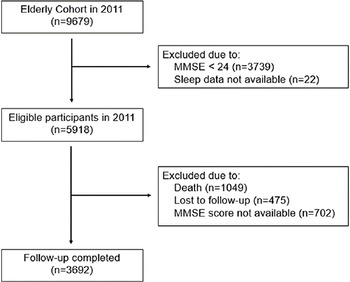
The CLHLS longitudinal data set from 2011 includes data with 9679 respondents older than 65 years. For this study, only those who met the following criteria in the 2011 interview were included in the study: (1) MMSE score of 24 or higher at baseline; (2) sleep data were available at baseline; and (3) completion of the MMSE follow-up in 2014. After these criteria were applied, the final sample size was 3692 (see Figure 1). The CLHLS study was approved by the Research Ethics Committee of Peking University (IRB00001052-13074), and written informed consent was provided by all participants or their proxy respondents. This secondary analysis of CLHLS data did not require ethical approval.
Flow chart of the study sample enrollment.

Outcomes
The incidence of cognitive impairment was defined by study participants scoring below 24 on the MMSE at the 3-year follow-up. The Chinese version of the MMSE was used in the CLHLS as a measure of global cognitive function, whose validity and reliability have been verified (An and Liu, Reference An and Liu2016; Zeng et al., Reference Zeng, Feng, Hesketh, Christensen and Vaupel2017; Lv et al., Reference Lv2019). Based on the literature (Zhang et al., Reference Zhang, Gu and Hayward2008), we treated responses of “unable to answer” as “wrong”. The total scores on the MMSE can range from 0 to 30, with higher scores representing higher cognitive function. Individuals with MMSE scores of 24 or higher were considered to have normal cognitive function.
Exposures
Sleep duration: The individuals were asked to answer “how long do you sleep normally?” Based on previous literature (Blackwell et al., Reference Blackwell2014; Xu et al., Reference Xu2014), the study participants were classified into three duration groups: short (≤5 hours/day), normal (>5 but <10 hours/day) and long (≥10 hours/day). We also treated sleep duration as a continuous variable in the multivariable analysis to calculate ORs for associations with sleep duration.
Covariates
Sociodemographic data, including age, gender, marital status (“married” vs “others”), educational level (“no schooling” vs “primary and above”) (Lv et al., Reference Lv2019), residence (“urban” vs “rural”), main occupation before age 60 (“farmer” vs “others”), co-residence (“living with family member” vs “not”), type of dwelling (“detached house” vs “others”), and economic status (“rich” vs “usual” vs “poor”), were collected.
Living habits: Three main aspects were self-reported: smoking currently, drinking currently, and performing exercises currently.
Health conditions: The body health status variables were body mass index (BMI) (underweight [≤18.5 kg/m2], normal [18.5–23.9 kg/m2], and overweight [≥24 kg/m2]) (Blackwell et al., Reference Blackwell2014), self-reported medical diagnoses of chronic diseases (hypertension, diabetes, heart disease, cerebrovascular disease, respiratory disease), assessments of loneliness (question: “Do you feel lonely and isolated?”) (“always” vs “sometimes” vs “never”), and depression (question: “Have you felt sad, blue, or depressed for two weeks or more in the last 12 months?” and “Have you lost interest in most things like hobbies, work, or similar activities?”; a “yes” to any of these questions was considered depressed).
Statistical analysis
Continuous data are expressed as mean ± standard deviation, and categorical data are expressed as the count and percentage. One-way ANOVA was applied to compare those respondents with different sleep durations.
To determine the relationship between sleep duration and cognitive impairment in respondents, multivariable logistic regression analysis was performed. The associations between sleep duration divided into three groups and outcomes were presented as odds ratios (ORs) and 95% CIs after adjustment for confounders, including age, sex, marital status, education, residence, occupation, co-residence, type of dwelling, economic status, living habits, and health conditions. Four different models were tested when sleep duration was divided into three groups: Model 1 (an unadjusted model), Model 2, Model 3, and Model 4. Model 2 included the most established risk factors for cognitive impairment as covariates: age and sex. Model 3 also included educational level. Model 4 included all of the previously mentioned variables.
Subgroup analyses were conducted in three duration groups, including age, sex, education, level, and residence. To test whether interactions with age, sex, education, or residence had an influence on the associations between sleep duration and the incidence of cognitive impairment, interaction terms were added to Model 4.
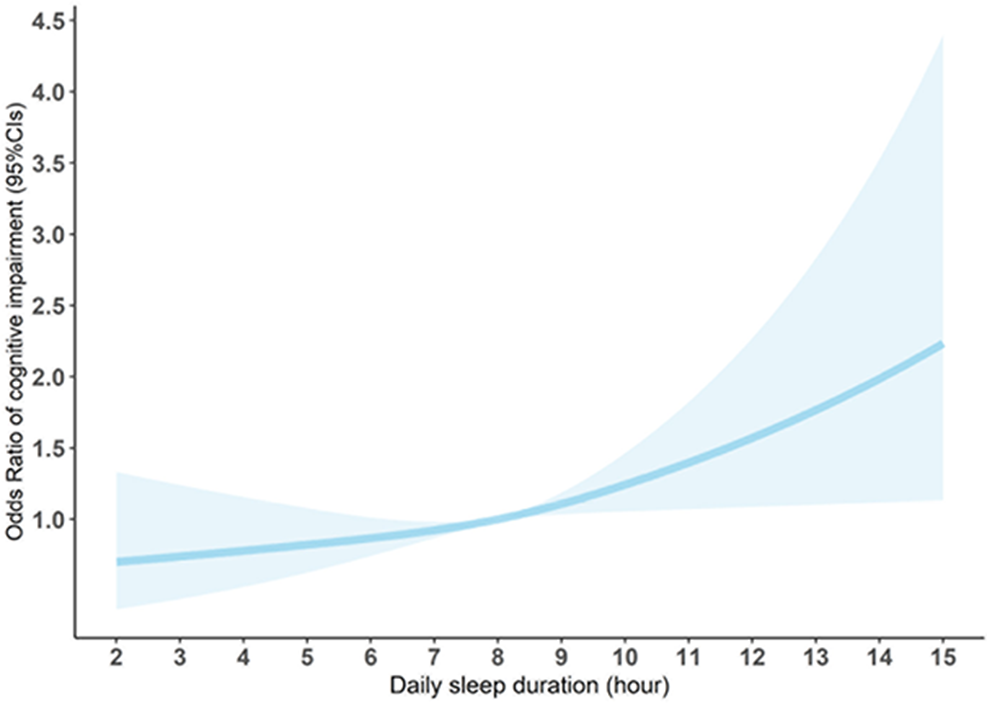
To further explore the relationship between sleep duration and cognitive impairment, instead of dividing sleep duration into three groups, we used sleep duration as a continuous variable to calculate the association between sleep duration and cognitive impairment with logistic regression, adjusting for age, sex, marital status, education, residence, occupation, co-residence, type of dwelling, economic status, living habits, and health conditions. Restricted cubic spline analysis (Croxford, Reference Croxford2016) was conducted to examine the shape of the association between sleep duration (as a continuous variable) and cognitive impairment after adjusting for covariates mentioned above, with knots placed at 10th, 50th, and 90th percentiles and median value of sleep duration (8.0 hours) as a reference point. The Wald chi-square test was performed to test whether there was a linear relationship between the continuous sleep duration and ORs.
A small percentage of the data for most covariates was missing (<4%), with the exception of occupation (9.45%). For these missing values, we used missing indicators.
Data analysis was performed using SPSS statistical software version 24.0 for Windows (IBM Corp) except for the restricted cubic spline analysis, which was performed using R version 3.4.2 (R Foundation for Statistical Computing). The significance level was set at p < 0.05.
Results
Demographic characteristics
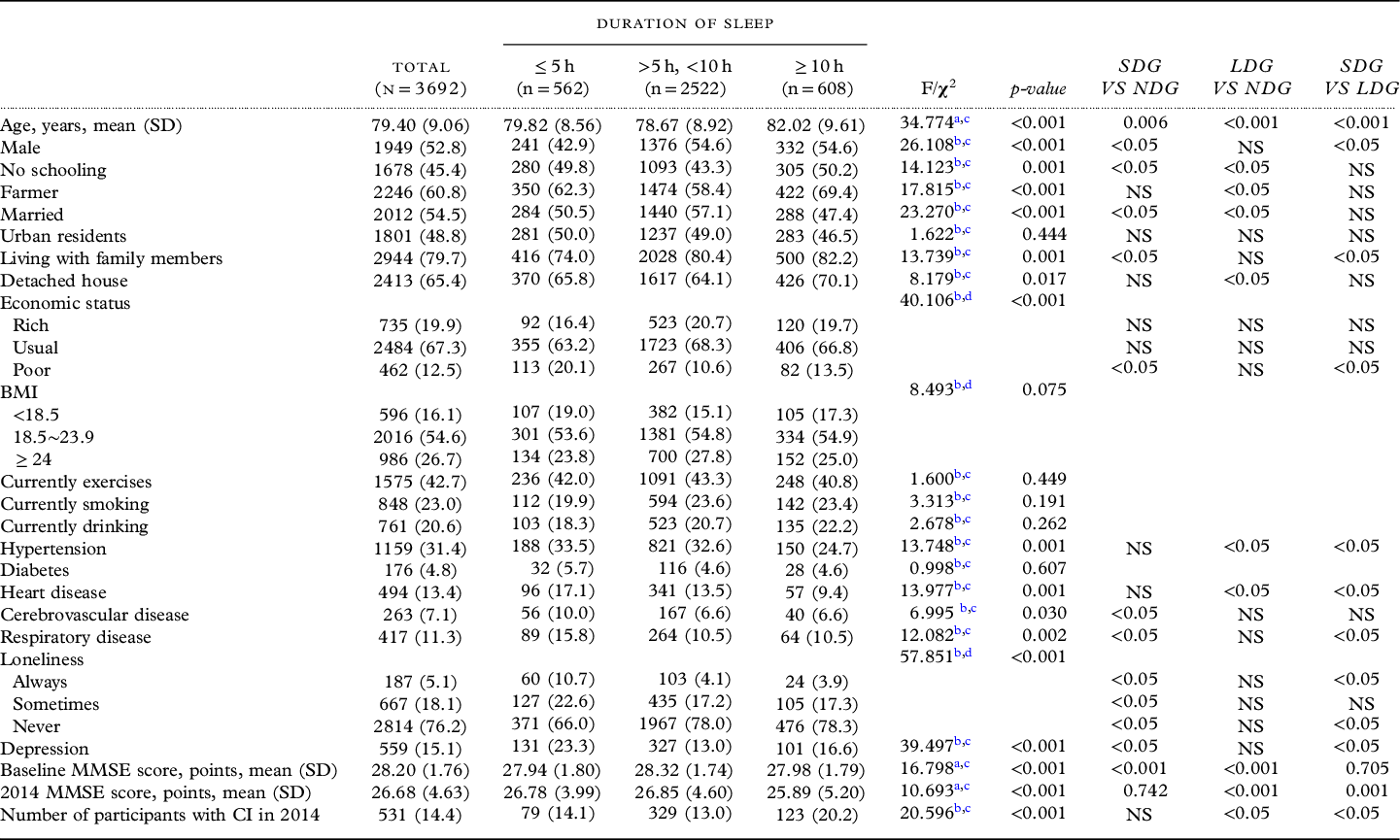
As shown in Table 1, at baseline, the age of the study participants ranged from 65 to 114, with an average of 79.40 years (SD 9.06). More than half of the participants were men, and nearly half had never been to school. More than 60% were farmers, nearly half lived in urban areas, nearly two-thirds lived in detached houses, and nearly 80% lived with their families. More than two-thirds considered themselves in the middle-income bracket. About half had a normal BMI. More than three-quarters of the participants never felt loneliness, but 559 participants (15.1%) felt depression.
Characteristics of the participants (n = 3692)

SDG, short-duration group (≤5 h); NDG, normal duration group (>5 h, <10 h); LDG, long-duration group (≥10 h); NS, non-significant; MMSE, Mini-Mental State Examination; BMI, body mass index; CI, cognitive impairment.
Note: data are expressed as counts (percentages) except when specified otherwise. Missing data: 9 for schooling, 349 for occupation, 9 for marital status, 27 for co-residence, 46 for type of dwelling, 11 for economic status, 96 for BMI, 44 for exercise, 14 for smoking, 34 for drinking, 108 for hypertension, 149 for diabetes, 132 for heart disease, 121 for cerebrovascular disease, 109 for respiratory disease, and 24 for loneliness.
a One-way analysis of variance (one-way ANOVA) was performed, and Bonfferoni test was used to perform post-hoc comparison.
b Chi-Square test was performed, and Bonfferoni test was used to perform multiple comparison.
c df = 2
d df = 4
A total of 562 participants (15.2%) was included in the short-duration group, 2522 participants (68.3%) were included in the normal duration group, and 608 participants (16.5%) were included in the long-duration group. A total of 531 participants (14.4%) had cognitive impairment during follow-up.
As shown in Table 1, age, sex, education, occupation, co-residence, economic status, presence of hypertension, heart disease, cerebrovascular disease, and respiratory disease, loneliness, and depression were significantly different between sleep duration groups at baseline (p < 0.05).
Relationship between baseline sleep duration (divided into three groups) and cognitive impairment
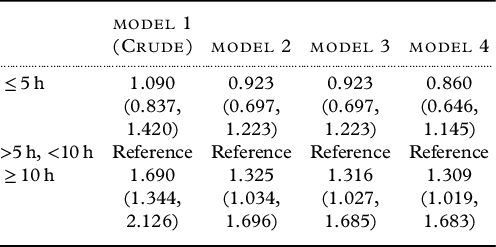
After adjusting for all multiple potential confounders, compared with normal sleep duration, long sleep duration was associated with the incidence of cognitive impairment (OR = 1.309, 95% CI: 1.019–1.683). No significant association was observed between short sleep duration and cognitive impairment (OR = 0.860, 95% CI: 0.646–1.145) (Table 2).
Crude and adjusted odds ratio (OR, 95% CI) for cognitive impairment by baseline sleep duration as divided into three groups

Note: Wald Chi-square test, df = 2. Model 2: adjusted for age, sex. Model 3: adjusted for age, sex, and education. Model 4: adjusted for age, sex, education, marital status, residence, occupation, co-residence, type of dwelling, economic status, living habits, and health conditions.
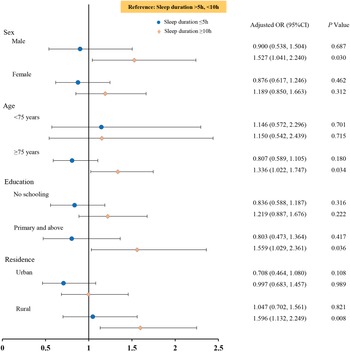
Subgroup analyses of sex, age, education level, and residence were subsequently performed. In the long sleep duration group, being men (OR = 1.527, 95% CI: 1.041–2.240), being aged 75 or over (OR = 1.336, 95% CI: 1.022–1.747), having a primary and above education level (OR = 1.559, 95% CI: 1.029–2.361), and living in a rural area (OR = 1.596, 95% CI: 1.132–2.249) were associated with the incidence of cognitive impairment. In the short sleep duration group, no factor was associated with the incidence of cognitive impairment (Figure 2). Interaction tests showed a significant statistical difference in sex (p < 0.01) and education level (p < 0.01). There was no significant statistical difference showed in age (p = 0.326), or in residence (p = 0.411).
Adjusted odds ratio (OR, 95% CI) for cognitive impairment by baseline sleep duration through sex, age, education level, and residence.

Relationship between baseline sleep duration (continuous variable) and cognitive impairment
As a continuous variable, after adjusting for all multiple potential confounders, sleep duration increased the risk of the incidence of cognitive impairment (OR = 1.085, 95% CI: 1.035–1.136, p = 0.001). There was a significant linear relationship between continuous sleep duration and the incidence of cognitive impairment (p = 0.521) (Figure 3).
Daily sleep duration as continuous variable was modeled using restricted cubic spline function.

Discussion
To the best of our knowledge, this is the largest study to date addressing the association between sleep duration and cognitive impairment among elderly individuals in China. We found that only excessive sleep was associated with cognitive impairment using MMSE score changes, especially among men, those with primary and above education levels. We also found that there may be a linear relationship between continuous sleep duration and the risk of incident cognitive impairment.
In this study, it was found that those who had excessive sleep duration (≥10 hours/day) had a 30.9% increased risk of cognitive impairment, compared to those normal sleep duration people. Faced with the rapid aging of the population, our study could provide important evidence to pay attention to the situation of excessive sleep to reduce the incidence of cognitive impairment. This finding was consistent with some previous research results (Auyeung et al., Reference Auyeung2013; Westwood et al., Reference Westwood2017; Suh et al., Reference Suh2018; Cheng et al., Reference Cheng2018; Nakakubo et al., Reference Nakakubo2019). This may be related to the imbalance of orexin in the central nervous system (Liguori et al., Reference Liguori2014). Orexin is a hypothalamic neurotransmitter directly responsible for the control of sleep and metabolism in healthy individuals (Hwang et al., Reference Hwang, Piguet, Hodges, Grunstein and Burrell2020). Central levels of orexin oscillate with the daily rhythm and peak in the awake phase. Orexin plays a major role in stabilizing the wakefulness state. Orexin deficiency causes sleep/wake-state instability, resulting in narcolepsy (Tsuneki et al., Reference Tsuneki, Wada and Sasaoka2018). Some studies have also indicated that excessive sleep inhibits the metabolism of the brain, resulting in increased amyloid deposition and other harmful factors (Ju et al., Reference Ju, Lucey and Holtzman2014). Early amyloid deposition may predict cognitive decline in elderly individuals (Ciarmiello et al., Reference Ciarmiello2019).
Other studies have pointed out that the central pacemaker of circadian rhythm is located in the suprachiasmatic nucleus of the brain, and circadian rhythm is crucial for optimal sleep patterns and cognitive function (Kyriacou and Hastings, Reference Kyriacou and Hastings2010). However, with age, circadian rhythms tend to weaken and sleep and cognitive abilities may be simultaneously dysregulated in older adults (Kondratova and Kondratov, Reference Kondratova and Kondratov2012). Thus, the observed association between sleep duration and poorer cognitive function in older adults may be at least partly driven by this common factor.
Different from some studies (Gildner et al., Reference Gildner, Liebert, Kowal, Chatterji and Snodgrass2014; Xu et al., Reference Xu2014; Wu et al., Reference Wu, Sun and Tan2018), this study did not find a relationship between short sleep duration and cognitive impairment. Wu et al. conducted a meta-analysis of 9 eligible cohort studies (including a total of 22,187 subjects) and found that short sleep was closely related to cognitive impairment, which may be because most of those studies were conducted in Western countries (Wu et al., Reference Wu, Sun and Tan2018). The sample source of Xu et al.’s study was limited to Guangzhou City, and the outcome was memory impairment (a type of cognitive impairment); therefore, the results may not be representative for cognitive impairment in the elderly population of China as a whole (Xu et al., Reference Xu2014).
Similar to the results of some studies (Blackwell et al., Reference Blackwell2006), this study found that cognitive impairment was significant in men among those in the long sleep duration group but not in women. However, some studies have found the opposite (Gildner et al., Reference Gildner, Liebert, Kowal, Chatterji and Snodgrass2014). In addition, Chen et al found that short sleepers (≤6 hours/night) had an increased risk of MCI and dementia in older women (Chen et al., Reference Chen2016). These conclusions are contradictory. Little is currently known about the reasons for sex differences in sleep behavior. Perhaps, men and women have different sleep patterns, which are regulated by different hormones. Sleep in men was found to be related to testosterone, while sleep in women was found to be affected by estrogen and progesterone (Mong and Cusmano, Reference Mong and Cusmano2016). In addition, it was found that under normal physiological conditions, women needed longer sleep durations than men (Mong and Cusmano, Reference Mong and Cusmano2016). Therefore, the different underlying sleep mechanisms may affect the relationship between sleep duration and cognitive impairment.
Compared to the illiterate population, cognitive function in non-illiterate individuals (primary and above education level) was significantly impaired with excessive sleep duration. People with a higher education level tend to have a certain social status. With increasing age, especially after retirement, the living environment will change greatly and social status may decline to a certain extent (Dziechciaż and Filip, Reference Dziechciaż and Filip2014). The excessive sleep duration could be predicted by weaker social networks (Cheng et al., Reference Cheng2017). If the adjustment is not well adapted to, depression may occur and depression may cause a decline in cognitive function (Paterniti et al., Reference Paterniti, Verdier-Taillefer, Dufouil and Alpérovitch2002). In this study, we did not find any differences in cognitive impairment between different sleep duration groups in age or residence.
This study also found that there may be a linear relationship between continuous sleep duration and the risk of cognitive impairment. This is different from some previous research (Gildner et al., Reference Gildner, Liebert, Kowal, Chatterji and Snodgrass2014; Song et al., Reference Song2017; Henry et al., Reference Henry2019). We found that for each additional hour of sleep, the risk of cognitive impairment increased by 8.5%. This study could provide an important clue to explore the mechanism of increasing sleep duration and cognitive impairment. It might be related to the long-term chronic hypoxia of the brain. Sleep-disordered breathing is typically observed in older populations, with moderate to severe sleep apnea in 30% to 50% of cases and mild sleep apnea in up to 80% of cases (Gaig and Iranzo, Reference Gaig and Iranzo2012). Chronic hypoxia can cause irreversible damage to brain function. Too much sleep can lead to prolonged chronic hypoxia, which can lead to more brain damage and poorer cognitive function, short sleep duration maybe can prevent this, although further research is needed to confirm these relationships. Another possible reason is that elderly individuals with apathy symptoms show significant decreases in activity, lack of motivation, sleepiness, and lethargy and exhibit excessive sleep duration. Apathy symptoms may increase the incidence of cognitive impairment (Harrison et al., Reference Harrison, Aerts and Brodaty2016).
Strengths and limitations
This study has several strengths, including a large nationwide sample of older persons in a developing country and the use of longitudinal data. However, several limitations should be considered when interpreting the results. First, a brief epidemiological screening instrument (MMSE) for cognitive impairment rather than comprehensive clinical evaluations was used to detect cognitive impairment. Second, our measures of sleep duration were based mainly on self-reports, and as with other studies that have used self-reports, there is the potential problem of recall bias. Previous validation studies on the association between self-reported sleep duration and polysomnography, a more objective measurement, found a moderate correlation of 0.6 to 0.7 (Patel et al., Reference Patel2004). However, self-report remains a relatively simple and reliable method. Third, this study included a 3-year follow-up, and perhaps we could follow up for a long time to further clarify whether there are changes in the relationship between sleep duration and cognitive impairment over time. Fourth, CLHLS survey did not collect the participants’ use of medications, such as sedative drugs, that might impact cognitive performance. It was impossible to analyze the effect of medications on the association between sleep duration and incidence of cognitive impairment. It warrants further investigations on this aspect.
Conclusions
In summary, our results have provided the longitudinal evidence to date that long sleep duration at baseline was associated with higher risk of developing cognitive impairment, especially among men, and non-illiterate individuals. It would be interesting to further study the mechanisms. Our results also provide a strong rationale for conducting an intervention study to normalize sleep duration, probably by shortening sleep duration in long sleepers, to establish the potential benefits of reducing cognitive impairment. This would be important to offset the increasing burden of dementia and cognitive impairment that is impacting our rapidly aging population.
Conflict of interest
None.
Source of funding
This work was funded by the National Natural Science Foundation of China (Nos. 71490732, 82003539, 81903392, 81941021), the National Key R&D Program of China (2017YFC1311100), Capital’s Funds for Health Improvement and Research (CFH2020-3-4114), Beijing Social Science Foundation (No.16JYC023), and Science and Technology Planning Project of Guangdong Province (No. 2017A070713010).
Description of authors’ role
MZ and XL contributed to the study design, data analysis, and interpretation and drafted the manuscript. LT, ZF, YC, and YY contributed to data analysis and revision of the manuscript. XY, NG, and HW contributed to the design of this study, interpretation of data, and critical revision of the manuscript. All authors read and approved the final manuscript. HW and NG had primary responsibility for the final content.
Acknowledgments
We thank the staff and the participants of the CLHLS study.
Ethics approval and consent to participate
The CLHLS study was approved by the research ethics committee of Peking University (IRB00001052-13074), and all participants or their proxy respondents provided written informed consent.
Availability of data and material
The questionnaires of CLHLS are available at https://sites.duke.edu/centerforaging/programs/chineselongitudinal-healthy-longevity-survey-clhls/surveydocumentation/questionnaires/. The full data sets used in this analysis are available from the corresponding author on reasonable request.