Introduction
Eurypterids, informally known as sea scorpions, are aquatic carnivorous or sweep-feeding chelicerates that originated in the early Middle Ordovician and went extinct in the late Permian (Tetlie, Reference Tetlie2007; Lamsdell et al., Reference Lamsdell, Briggs, Liu, Witzke and Mckay2015; Lamsdell and Selden, Reference Lamsdell and Selden2017; Hughes and Lamsdell, Reference Hughes and Lamsdell2020). They include some of the largest arthropods known to exist, growing to two meters or more in length (Kjellesvig-Waering, Reference Kjellesvig-Waering1964; Chlupáč, Reference Chlupáč1994; Braddy et al., Reference Braddy, Poschmann and Tetlie2008; Lamsdell and Braddy, Reference Lamsdell and Braddy2010). The family Pterygotidae is the most diverse clade of the order Eurypterida, with ~46 species in five genera (Lamsdell and Selden, Reference Lamsdell and Selden2017). Slimoniidae, comprising four species in the genera Slimonia and Salteropterus, resolving as a sister group to the pterygotids (Lamsdell et al., Reference Lamsdell, Briggs, Liu, Witzke and Mckay2015; McCoy et al., Reference McCoy, Lamsdell, Poschmann, Anderson and Briggs2015; Lamsdell and Selden, Reference Lamsdell and Selden2017). Pterygotidae originated in the Llandovery (early Silurian), went extinct in the Middle Devonian (Tetlie, Reference Tetlie2007; McCoy et al., Reference McCoy, Lamsdell, Poschmann, Anderson and Briggs2015), and were characterized by the possession of a laterally expanded pretelson, with most species having enlarged chelicerae with elongated peduncular podomeres (Tetlie and Briggs, Reference Tetlie and Briggs2009). Pterygotids attained a nearly global distribution (Poschmann and Tetlie, Reference Poschmann and Tetlie2006; Miller, Reference Miller2007; Tetlie and Briggs, Reference Tetlie and Briggs2009; Lamsdell and Legg, Reference Lamsdell and Legg2010; Wang and Gai, Reference Wang and Gai2014) and were ecologically diverse predators with a range of visual acuity and a variety of cheliceral morphologies indicating adaptations for capturing a variety of benthic and actively swimming prey (Anderson et al., Reference Anderson, McCoy, McNamara and Briggs2014; McCoy et al., Reference McCoy, Lamsdell, Poschmann, Anderson and Briggs2015).
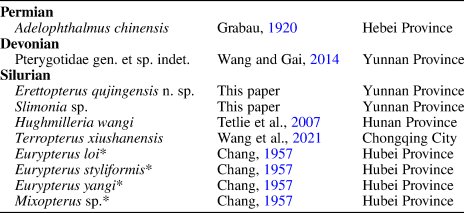
Despite their longevity and wide geographic dispersal, eurypterids are generally rare in the fossil record, especially in China (Tetlie, Reference Tetlie2007). This state has changed in recent years as research intensity increases, with the Chinese record of eurypterids expanding beyond the lower Permian Adelophthalmus chinensis from Hebei Province (Grabau, Reference Grabau1920) to include Hughmilleria wangi Tetlie, Selden, and Ren, Reference Tetlie, Selden and Ren2007, described based on an almost complete specimen from the Silurian (late Llandovery) Xiaoxiyu Formation (Tetlie et al., Reference Tetlie, Selden and Ren2007; Zong et al., Reference Zong, Liu, Wei and Gong2017), and an isolated pterygotid chelicera with its two rami preserved from the Xitun Formation of the Lower Devonian in Yunnan Province (Wang and Gai, Reference Wang and Gai2014). Several putative eurypterid specimens were also described by Chang (Reference Chang1957) from the Silurian of Hubei; however, the eurypterid affinity of this material is dubious, and the three described species are considered invalid (Tetlie et al., Reference Tetlie, Selden and Ren2007). Recently a new eurypterid, Terropterus xiushanensis Wang et al., Reference Wang, Dunlop, Gai, Lei, Jarzembowski and Wang2021, has been reported in the Chongqing area and is the first Mixopteridae to be found in China (Wang et al., Reference Wang, Dunlop, Gai, Lei, Jarzembowski and Wang2021; Table 1). Here, we report eurypterid specimens representing a new species of the pterygotid Erettopterus (Salter in Huxley and Salter, Reference Salter1859) and an occurrence of Slimonia (Page, Reference Page1856) from the upper Silurian (Pridolian) Yulongsi Formation of Yunnan, China.
Eurypterids recorded from China. Asterisks indicate taxa that might be based on dubious material.

Geological setting and stratigraphy
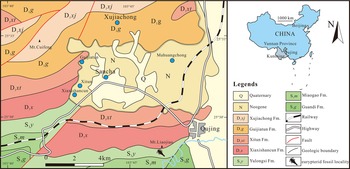
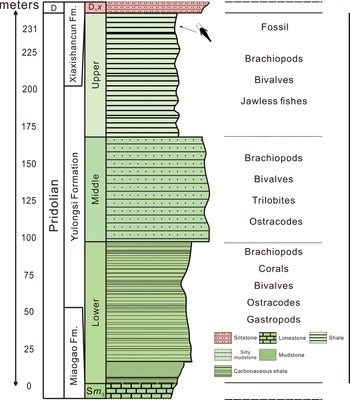
Pridoli–Lower Devonian deposits are well developed in the Qujing area. The Silurian layers are assigned to the Miaogao and Yulongsi formations while the Xiaxishancun, Xitun, Guijiatun, and Xujiachong formations belong to the Devonian. Our study outcrop of the Yulongsi Formation is ~11 km west of Qujing City (coordinates 25.474544°N, 103.696914°E; Fig. 1). The Yulongsi Formation is ~250 m thick and conformable with the underlying Miaogao Formation; its top is also conformable with a yellow-green sandstone of the Xiaxishancun Formation. The Yulongsi Formation can be divided into three parts: the lower part begins with a large amount of black shale known as the “lower weathering shale,” with few fossils, but contains brachiopods, corals, bivalves, ostracodes, and gastropods. The middle part is gray and light gray calcareous shale with a thin gray layer of nodular limestone and limestone lenses containing brachiopods, bivalves, trilobites, and ostracodes. The upper part is black, gray-green and gray-blue shale, also known as the “upper weathering shale,” that contains brachiopods, bivalves, and jawless fishes (Wang, Reference Wang2000, Fig. 2).
Generalized map showing geologic features of the Qujing area and the eurypterid fossil locality (modified from Hao et al., Reference Hao, Xue, Liu and Wang2007, fig. 1).

Schematic stratigraphic column for the Yulongsi Formation showing distribution of eurypterids at localities in the Qujing area.

There were many debates about the age of the Yulongsi Formation. In the twentieth century, some scholars insisted that the whole formation was Devonian in age (Wu, Reference Wu1977; Lin et al., Reference Lin, Guo and Wang1982) or the boundary between Devonian and Silurian should be below the upper black shale of the formation (P'an et al., Reference P'an, Wang, Gao and Hou1978; Yang and Li, Reference Yang and Li1978). However, with further research in the Qujing area—especially recent research in palynology and other microfossils such as conodonts and chitinozoas (Wang, Reference Wang1980; Fang et al., Reference Fang, Cai and Wang1994; Tian et al., Reference Tian, Zhu, Huang and Liu2011; Peng et al., Reference Peng, Liu and Zhu2016)—all evidence indicates that the age of the Yulongsi Formation is Pridolian (Tian et al., Reference Tian, Zhu, Huang and Liu2011; Rong et al., Reference Rong, Wang, Zhan, Fan, Huang, Tang, Li, Zhang, Wu, Wang and Wei2019). All the specimens described in this paper were collected in the upper part of the Yulongsi Formation.
Materials
The specimens (YN-415001–11) described in this paper were collected from the upper part of the Yulongsi Formation. Being preserved in fine shales, the material is flattened and shows some tectonic distortion. The holotype (YN-415005) preserves the free ramus of the chelicera while the prosomal carapace, prosomal appendage VI, metastoma, and several tergites are represented among paratype material.
All photographs were taken with a Sony ILCE-7M3 digital camera with a FE 24-105 mm f/4 G OSS lens. Photographs were processed and arranged into figures using image editing software (Adobe Illustrator CS5 and Adobe Photoshop CS). Morphological terminology follows Tollerton (Reference Tollerton1989) with denticle terminology following Miller (Reference Miller2007).
Repository and institutional abbreviation
All specimens and pictures examined in this study are deposited in the fossil specimen room of Southwest Petroleum University (SWPU), Chengdu, Sichuang Province, China.
Systematic paleontology
Order Eurypterida Burmeister, Reference Burmeister1843
Suborder Eurypterina Burmeister, Reference Burmeister1843
Superfamily Pterygotoidea Clarke and Ruedemann, Reference Clarke and Ruedemann1912
Family Pterygotidae Clarke and Ruedemann, Reference Clarke and Ruedemann1912
Genus Erettopterus Salter in Huxley and Salter, Reference Salter1859
[= Truncatiramus Kjellesvig-Waering, Reference Kjellesvig-Waering1961]
Type species
Pterygotus bilobus Salter, Reference Salter1856.
Remarks
Erettopterus was diagnosed by Ciurca and Tetlie (Reference Ciurca and Tetlie2007) through the possession of a bilobed telson, although previous authors have also considered a deep anterior notch in the metastoma and a lack of enlarged, differentiated denticles in the chelicera to be diagnostic of the genus (Kjellesvig-Waering, Reference Kjellesvig-Waering1964; Waterston, Reference Waterston1964). Although the available material does not preserve the telson, several other characteristics, including the relatively undifferentiated cheliceral denticles and the distribution of cuticular ornamentation of the tergites—with an ornament of dense lunule scales across the tergite anteriorly giving way to a smooth unornamented surface posteriorly (also observed by Ciurca and Tetlie, Reference Ciurca and Tetlie2007)—indicate that the species can be assigned to the genus with some confidence.
Erettopterus qujingensis new species
Figures 3–5, Table 2
Type material
Holotype YN-415005; paratypes YN-415001–4, 6–10.
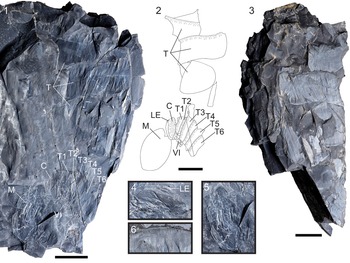
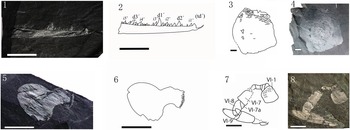
Erettopterus qujingensis n. sp. (1) Part YN-415001; (2) interpretive drawing of YN-415001; (3) counterpart YN-415002; (4) prosomal carapace of small specimen on YN-415001; (5) metastoma on YN-415001; (6) detail of anterior tergite ornamentation on YN-415002. C = carapace, LE = lateral compound eye, M = metastoma, T = tergites, VI = prosomal appendage VI. Scale bars = 50 mm.

Denticle dimensions for holotype YN-415005, free ramus of Erettopterus qujingensis n. sp. All measurements are in millimeters.

Diagnosis
Erettopterus with chelicera bearing three principal denticles and distal (terminal) denticle; cheliceral denticles exhibiting size differentiation, central principal denticle longer and broader than others; proximal denticles of free ramus angled inversely; metastoma broad oval in shape with rounded shoulders and a deep median notch.
Occurrence
Upper part of the Yulongsi Formation (Pridolian); south of Liaojiao Mountain near Qujing City, Yunnan, southwestern China.
Description
SWPU: YN-415005 (Fig. 4.1). An isolated free ramus, total preserved length 33 mm, maximum preserved width of ramus 4.1 mm. Terminal denticle incomplete, however the gentle curvature of the preserved ramus margin suggests the denticle may have been curved rather than angular in morphology. Primary denticle (d1´) is more robust than others, length 3.1 mm, width at base 1.8 mm, upright with posterior curvature. Anterior principal denticle (d2´) length 2.1 mm, width at base 1.1 mm, upright with posterior curvature. Third principal denticle (d3´) length 2.1 mm, width at base 1.2 mm, entire denticle angled towards ramus distal termination. Five intermediate denticles are interspersed between the primary denticles and a multitude of smaller denticles; the first (i1’) occurs just posterior of the terminal denticle and is at least 1.0 mm in height, width at base at least 0.3 mm, upright with little apparent curvature. Second intermediate denticle (i2’) occurs 2 mm anterior of the primary denticle, length 1.5 mm, width at base 0.8 mm, upright with posterior curvature. Third intermediate denticle (i3’) located immediately posterior of primary denticle, length 1.7 mm, width at base 0.9 mm, upright. Fourth intermediate denticle (i4’) located 1.5 mm anterior of third principal denticle, height 1.5 mm, width at base 1.2 mm, entire denticle angled towards ramus distal termination. Fifth intermediate denticle (i5’) located 1.7 mm posterior of third primary denticle, height 1.3 mm, width at base 0.7 mm, denticle slightly angled towards ramus distal termination (Table 2).
Erettopterus qujingensis n. sp. (1, 2) Holotype YN-415005, (1) free ramus of chelicera, (2) interpretive drawing of free ramus of chelicera; (3, 4) YN-415004, (3) interpretive drawing of partial metastoma, (4) partial metastoma; (5, 6) YN-415003, (5) isolated coxa of prosomal appendage VI, (6) interpretive drawing of partial metastoma; (7, 8) YN-415006, (7) interpretive drawing of prosomal appendage VI, (8) isolated pair of prosomal appendage VI. td´ = terminal denticle on free ramus; d1´–d3´ = principal denticles on free ramus; i1’–i5’ = intermediate denticles on free ramus; VI-1, VI-7–VI-9 = prosomal appendage VI podomeres 1, 7–9; VI-7a = modified part of VI-7. Scale bars = 10 mm.

SWPU: YN-415001 and YN-415002 (Fig. 3, part and counterpart). Material comprising at least two individuals. The large individual is represented by a series of three tergites and an isolated metastoma of either the same individual or one of a similar size. The smaller individual, preserved alongside the large metastoma, comprises a crumpled carapace, partial prosomal appendage VI, and seven articulated tergites.
The tergites of the large specimen are laterally incomplete, with the first tergite having a length of 44 mm and a preserved width of 107 mm, the second tergite a length of 50 mm and a preserved width of 108 mm, and the third a length of 72 mm and a preserved width of 72 mm. The last tergite is clearly folded in on itself part-way along its length, likely the result of taphonomic deformation. The anterior 12 mm of each tergite is covered in small scales, getting progressively deeper and more angular posteriorly (Fig. 3.5). The metastoma is rhombiovate (sensu Tollerton, Reference Tollerton1989), 84.3 mm long, with a maximum width at its midline of 55.1 mm giving an L:W ratio of 1.53, a lateral angle of 54°, and an angle of cordation 73°. The anterior shoulders are rounded with an angular anterior 13 mm deep notch.
The prosomal carapace of the smaller specimen is crumpled, with a preserved length of 32 mm and preserved width of 41 mm. The overall shape of the prosomal shield is difficult to determine, but the available undistorted margins suggest it may have been subquadrate. An anterolaterally positioned lateral compound eye is preserved, overlapping the carapace margin and oval in outline (Fig. 3.3), 8 mm long by 2 mm wide. Podomeres of prosomal appendage VI are preserved alongside the first few tergites; although generally fragmentary, it is possible to identify the elongated podomere 7 of a swimming paddle with a length of 18 mm and a distal width of 10 mm. Six tergites are preserved in their entirety; the first is 8 mm long, 43 mm wide; the second 11 mm long, 47 mm wide; the third 12 mm long, 48 mm wide; the fourth 12 mm long, 48 mm wide; the fifth 14 mm long, 47 mm wide; and the sixth is 15 mm long, 45 mm wide. The seventh tergite is also partially preserved, with an observed length of 12 mm and an observed width of 34 mm. The anterior 5 mm of each tergite is covered in dense scales.
SWPU: YN-415004 (Fig. 4.2, 4.3). A partial metastoma was preserved in black shale. The only complete external margins preserved are those of the left side, a small portion of the margin of the lower right, and the center of the anterior notch. The overall shape appears to be rhombiovate; preserved length 81 mm, preserved width 80 mm. The anterior third of the metastoma is ornamented with lunate scales.
SWPU: YN-415003 (Fig. 4.4). An almost completely preserved isolated coxa of appendage VI. The coxa is broad, expanding distally with a marked constriction between the gnathobase and the distal expansion. The length of the coxa is 18.1 mm from the distal portion of the expanded posterior to the gnathobasic edge. The maximum width of the coxa, located towards the posterior of the expanded region, is 14.7 mm; the gnathobasic surface is incomplete with a preserved width of 6.1 mm, and the subsequent constriction is 5.3 mm wide at its narrowest point. The full gnathobasic surface is not preserved, but at least 11 teeth are present, generally uniform in shape and decreasing regularly in size from anterior to posterior. The coxa surface is ornamented with broad lunule scales grading to small tubercles at the coxa midline.
SWPU: YN-415006 (Fig. 4.5, 4.6). A pair of prosomal appendage VI paddles, one comprising nine podomeres (including the coxa) with the other preserving only the five distal podomeres. Paddle of Hughmilleria type (sensu Tollerton, Reference Tollerton1989). The coxa, which preserved only the expanded distal portion, has a preserved length of 10.6 mm, a preserved width of 8.8 mm, and is ornamented with lunule scales. The second podomere is 2.9 mm long, at least 2.9 mm wide, and is broadly triangular in shape; the third podomere is rectangular, being 2.4 mm long and 3.6 mm wide; fourth podomere is incomplete, preserved dimensions 1.5 mm long, 2.1 mm wide; fifth podomere incomplete, preserved dimensions 2.8 mm long, 2.5 mm wide; sixth podomere incomplete, preserved dimensions 4.3 mm long, 2.2 mm wide, expanding to 4.0 mm wide distally, complex articulation visible at proximal podomere joint; seventh podomere 9.8 mm long, 4.5 mm wide proximally, widening evenly to 7.0 mm distally; modified ‘podomere’ 7a located along the inner paddle margin, triangular in shape, 3.1 mm long, 3.2 mm wide at its base; eighth podomere oval, 9.4 mm in length, 5.7 mm in width; ninth podomere small, 0.7 mm long, 1.1 mm wide, slightly recessed into eighth podomere.
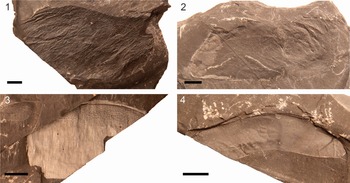
SWPU: YN-415007 (Fig. 5.1). Partial tergite, length 48 mm, preserved width 92.5 mm. Anterior 11 mm ornamented with dense scales.
Erettopterus qujingensis n. sp. (1) Isolated tergite YN-415009; (2) isolated tergite YN-415007; (3) isolated tergite YN-415010; (4) isolated tergite YN-415008. Scale bars = 10 mm.

SWPU: YN-415008 (Fig. 5.2). Partial tergite, length 45.5 mm, preserved width 90 mm.
SWPU: YN-415009 (Fig. 5.3). Partial tergite, length 39 mm, preserved width 53 mm. Smooth articulating facet present across tergite anterior, 2 mm long. Anterior 9 mm of tergite ornamented with dense scales.
SWPU: YN-415010 (Fig. 5.4). Partial tergite, length 15 mm, preserved width 75 mm. Anterior 5 mm of tergite ornamented with dense scales.
Etymology
The specific epithet is named after the type locality, near Qujing City.
Remarks
Erettopterus qujingensis n. sp. shares a number of characteristics with other well-known Erettopterus species, particularly E. osiliensis Schmidt, Reference Schmidt1883, with the anterior slant to the posterior denticles in the chelicera (Kjellesvig-Waering, Reference Kjellesvig-Waering1964). Erettopterus qujingensis n. sp. can be distinguished from all other Erettopterus species by the shape of the metastoma, which is broader and more rounded than in either E. osiliensis or E. bilobus, and through the morphology of the ninth podomere of appendage VI, which is larger than in any other known Erettopterus species (see Woodward, Reference Woodward1866–1878; Ciurca and Tetlie, Reference Ciurca and Tetlie2007; Lomax et al., Reference Lomax, Lamsdell and Ciurca2011). The cheliceral morphology of E. qujingensis n. sp. is distinct from the pterygotid chelicera described by Wang and Gai (Reference Wang and Gai2014) from the Lower Devonian Xitun Formation of Yunnan Province, which exhibits a more robust and highly curved ramus and more differentiation between the cheliceral denticles.
A number of ontogenetic stages of E. qujingensis n. sp. are represented within the described material, with the large tergites and metastoma of SWPU: YN-415001 and YN-415002 and metastoma SWPU: YN-415004 representing the largest individuals. These specimens indicate that E. qujingensis n. sp. could attain lengths >90 cm.
Family Slimoniidae Novojilov, Reference Novojilov1962
Genus Slimonia Page, Reference Page1856
Diagnosis
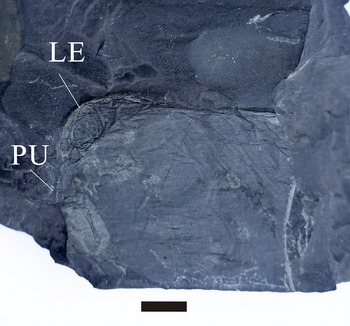
Carapace is long rectangular shape. Oval-shaped lateral eyes are preserved in the anterolateral corners and are elongate. Anterior margin of the carapace is ornamented by two rows of small pustules.
Slimonia sp.; partial carapace YN-415011. LE = lateral eye, PU = pustules. Scale bar = 10 mm.

Occurrence
Upper part of the Yulongsi Formation (Pridolian); south of Liaojiao Mountain, near Qujing City, Yunnan, southwestern China.
Description
Partial carapace specimen, preserving right margin, lateral compound eye, and portions of anterior and posterior margins. Carapace 43.7 mm long, preserved width 34.4 mm. Based on curvature of the anterior and posterior margins, the midline of the carapace is preserved, resulting in an estimated carapace width of 44 mm and suggesting a quadrate shape (Tollerton, Reference Tollerton1989). The anterior margin of the carapace is ornamented by two rows of small pustules. The lateral eye is positioned anterolaterally, abutting the carapace margin, and is oval in shape, with a length of 8 mm.
Material
YN-415011 (Fig. 6).
Remarks
The occurrence of pustules across the anterior carapace margin is diagnostic of Slimonia (Lomax et al., Reference Lomax, Lamsdell and Ciurca2011), an assignment further supported by the shape and position of the lateral eyes. The prosomal carapace is markedly shorter than in Slimonia acuminata; however, because Slimonia boliviana Kjellesvig-Waering, Reference Kjellesvig-Waering1973, is only known from its telson (Kjellesvig-Waering, Reference Kjellesvig-Waering1973) and the prosomal carapace of Slimonia dubia Laurie, Reference Laurie1899, is also quadrate in shape (Laurie, Reference Laurie1899), it is not currently possible to determine whether the specimen described here represents a new species.
Discussion
The co-occurrence of Erettopterus and Slimonia in the Yulongsi Formation is especially interesting given the two genera also co-occur at the famous Wenlock localities of Lesmahagow, Scotland (Lomax et al., Reference Lomax, Lamsdell and Ciurca2011). Finding similar eurypterid faunal compositions across different paleocontinents might suggest that eurypterids formed comparable communities globally. Broadly equivalent Silurian eurypterid faunas already have been documented between the Vernon Formation of New York and the Saaremaa Formation of Estonia (Ciurca and Tetlie, Reference Ciurca and Tetlie2007). Comparison of associated faunas also would give insight into the similarities of ecosystem structures across the Silurian world. Like the Lesmahagow fauna, a few jawless fishes are also present in the Yulongsi Formation. The Erettopterus and Slimonia fossils of Lesmahagow occur in the Patrick Burn and Kip Burn formations of the Priesthill Group in the Jamoytius Horizon and Ceratiocaris and Pterygotus beds, respectively. The Jamoytius Horizon consists predominantly of dark, organic, intensely laminated silt-mudstone (Žigaitė and Goujet, Reference Žigaitė and Goujet2012), indicative of an anoxic environment (Earnest, Reference Earnest1998) as part of a shallow, restricted marginal marine setting or possibly a lake (Žigaitė and Goujet, Reference Žigaitė and Goujet2012; Clarkson and Harper, Reference Clarkson and Harper2016). The Yulongsi Formation shows more similarities to the Kip Burn Formation. For example, in the Qujing region, the dominant lithology of the Yulongsi Formation is a dark gray, laminated mudstone comparable to the dark olive-gray mudstone with laminated siltstone of the Kip Burn Formation. Based on sedimentary and tectonic evidence, the Yulongsi Formation also appears to represent a period of gradual transition from a shallow marine to lagoonal environment (Wang, Reference Wang2000).
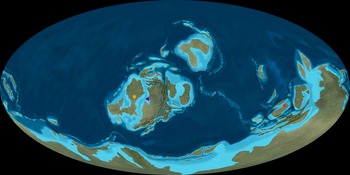
All of the 17 previously known species of Erettopterus are known from Europe and North America (Tetlie, Reference Tetlie2007), as are two of the three Slimonia species—Slimonia boliviana was described from a single telson from Pojo, Bolivia (Kjellesvig-Waering, Reference Kjellesvig-Waering1973). The specimens described here broaden the distribution of Erettopterus and Slimonia and is the first Gondwanan record of Erettopterus. Moreover, the discoveries further support the notion that pterygotoids had superior dispersal abilities, leading to a more cosmopolitan distribution because of substantial swimming abilities (Tetlie, Reference Tetlie2007). These new discoveries from China not only provide a broader picture of the biogeography of the group, but also demonstrate that species in Gondwana occupied similar environments to their Laurentian relatives (Fig. 7).
Paleogeographic distribution of Pridolian Erettopterus and Slimonia. Global paleogeographic reconstruction for the Pridolian (420 Ma) is after Blakey (Reference Blakey2020). Circles represent localities of previously described Pridolian Erettopterus. Triangle represent localities of previously described Pridolian examples of both Erettopterus and Slimonia (Tetlie, Reference Tetlie2007). Star shows location of the Chinese eurypterids.

Acknowledgments
Thanks J.A. Dunlop and two anonymous reviewers for helpful comments on manuscript. ZHM thanks L. Fu for help with figures and D. Wang (NIGPAS) for useful suggestions in the early stages of the manuscript. This work was supported by the National Natural Science Foundation of China (No. 41972120; 42172129), by the State Key Laboratory of Palaeobiology and Stratigraphy (Nanjing Institute of Geology and Palaeontology, CAS) (No. 173131), and China Postdoctoral Science Foundation (No. 2021M702720).