Introduction
Taenia solium is a worldwide neglected zoonotic helminth with considerable impact, in endemic countries, on infected humans, animals and the livelihood of their communities. In 2015, it was identified by the World Health Organization (WHO) as the leading cause of deaths from foodborne diseases caused by parasites (Schmidt et al., Reference Schmidt, O'Hara, Ngowi, Herbinger, Noh, Wilkins, Richter, Kositz, Matuja and Winkler2019), resulting in a considerable total of 2.8 million disability-adjusted life-years (DALYs) (WHO, 2015).
Neurocysticercosis (NC), caused by the presence of T. solium cysticerci in the brain, is the most common neurologic parasitic infection; the total number of people suffering from NC, including symptomatic and asymptomatic cases, is estimated to be between 2.56 and 8.30 million (WHO, 2019). These data place NC among the most devastating parasitic diseases worldwide.
Taeniasis and NC are infections caused by T. solium, involving a complex transmission cycle between the intermediate pig host and the definitive (also accidental intermediate) human host (Thys et al., Reference Thys, Mwape, Lefèvre, Dorny, Marcotty, Phiri, Phiri and Gabriël2015). The characteristics of cysticercosis transmission routes indicate that control of the disease can be obtained by public health measures, diagnosis and treatment of carriers of the adult parasite proper disposal of infested pork meat and development of a potential vaccine (Sotelo, Reference Sotelo2011).
Potential control of T. solium transmission was demonstrated by vaccination trials in experimental animal models such as pigs (Manoutcharian et al., Reference Manoutcharian, Terrazas, Gevorkian, Acero, Petrossian, Rodriguez and Govezensky1999; de Aluja et al., Reference de Aluja, Villalobos, Nava, Toledo, Martinez, Plancarte, Rodarte, Fragoso and Sciutto2005; Morales et al., Reference Morales, Juan Martinez, Manoutcharian, Hernandez, Fleury, Gevorkian, Acero, Blancas, Toledo, Cervantes, Maza, Quet, Bonnabau, de Aluja, Fragoso, Larralde and Sciutto2008; Assana et al. Reference Assana, Kyngdon, Gauci, Geerts, Dorny, De Deken, Anderson, Zoli and Lightowlers2010; Capelli-Peixoto et al., Reference Capelli-Peixoto, Chavez-Olortegui, Chaves-Moreira, Minozzo, Gabardo, Teixeira, Thomaz-Soccol, Alvarenga and de Moura2011; Betancourt et al., Reference Betancourt, de Aluja, Sciutto, Hernández, Bobes, Rosas, Hernández, Fragoso, Hallal-Calleros, Aguilar and Flores-Peréz2012; Gauci et al., Reference Gauci, Jayashi, Gonzalez, Lackenby and Lightowlers2012; Jayashi et al., Reference Jayashi, Kyngdon, Gauci, Gonzalez and Lightowlers2012; Poudel et al., Reference Poudel, Sah, Subedi, Kumar Singh, Kushwaha, Colston, Gauci, Donadeu and Lightowlers2019).
Cross-immunity between the human and murine Taeniidae parasite Taenia crassiceps has enabled murine cysticercosis to become a convenient laboratory model to develop vaccines against T. solium cysticercosis, since T. crassiceps and T. solium are phylogenetically related (Sciutto et al., Reference Sciutto, Fragoso, Trueba, Lemus, Montoya, Diaz, Govezensky, Lomeli, Tapia and Larralde1990). Also, the murine cysticercosis model is easily maintained in the laboratory, allowing the measurement of parasite loads without biohazard risks (Capelli-Peixoto et al., Reference Capelli-Peixoto, Chavez-Olortegui, Chaves-Moreira, Minozzo, Gabardo, Teixeira, Thomaz-Soccol, Alvarenga and de Moura2011). The experimental model T. crassiceps -BALB/c mice was selected because this is a relatively simple laboratory model of cysticercosis (Sciutto et al., Reference Sciutto, Fragoso, Trueba, Lemus, Montoya, Diaz, Govezensky, Lomeli, Tapia and Larralde1990; Silva et al., Reference Silva, Nunes, Sousa, Gonçalves-Pires, Levenhagen and Costa-Cruz2017; Carrara et al., Reference Carrara, Silva, Faria, Nunes, Ribeiro, Lopes, Gonçalves-Pires, Santos, Borges, Ferreira-Junior, Ávila and Costa-Cruz2020). Additionally, T. crassiceps does not readily parasitize humans (Sciutto et al., Reference Sciutto, Fragoso and Larralde2008; Willms and Zurabian, Reference Willms and Zurabian2010). Susceptibility to T. crassiceps infection differs among mouse strains. Mice BALB/c develop high loads of T. crassiceps ORF strain metacestodes (Sciutto et al., Reference Sciutto, Fragoso, Trueba, Lemus, Montoya, Diaz, Govezensky, Lomeli, Tapia and Larralde1990; Fragoso et al., Reference Fragoso, Meneses, Sciutto, Fleury and Larralde2008), and significant susceptibility was observed in a female BALB/cAnN sub-strain (Baig et al., Reference Baig, Damian, Morales-Montor, Ghaleb, Baghdadi and White2006). Taenia solium antigens protected mice against challenge with T. crassiceps (Sciutto et al., Reference Sciutto, Fragoso, Trueba, Lemus, Montoya, Diaz, Govezensky, Lomeli, Tapia and Larralde1990; Vaz et al., Reference Vaz, Nunes, Piazza, Livramento, Silva, Nakamura and Ferreira1997), demonstrating that cross-reaction of antigens between T. solium and T. crassiceps antigens makes murine cysticercosis a successful experimental model to be used in tests of antigens for vaccination against T. solium cysticercosis (Sciutto et al., Reference Sciutto, Fragoso and Larralde2008; Willms and Zurabian, Reference Willms and Zurabian2010).
In our previous study (Manhani et al., Reference Manhani, Ribeiro, Cardoso, Ueira-Vieira, Goulart and Costa-Cruz2011), Cc48 phage display-derived peptide (Cc48) was selected as a biomarker to distinguish inactive from active NC forms; this data raised the question whether Cc48 mimotope would have any protective effect for cysticercosis in animal models. Considering other successful studies that used phage display-derived peptides to induce protection against various diseases (Cui et al., Reference Cui, Ren, Liu, Wang, Zhang and ZQ2013; Li et al., Reference Li, Wang, Han, Zhao, Zhou, Xu and Li2019), our aim was to evaluate the potential of Cc48 mimotope as a vaccine compound to control cysticercosis in an experimental model of murine cysticercosis.
Material and methods
Animals and parasite
Female BALB/c/AnUnib mice from 5- to 7-week-old, weighing 24.6 g (± 0.3 g), were used in this study. Animals were maintained at the Biotery of the Universidade Federal de São João del-Rei (UFSJ-CCO), Brazil. The ORF strain of T. crassiceps was kindly provided by Dr Adelaide J. Vaz (in memoriam) and Dr Cristiane R. Farias and maintained by consecutive passages of cysticerci in the peritoneal cavities of 9 – 12-week-old mice (Sciutto et al., Reference Sciutto, Fragoso, Trueba, Lemus, Montoya, Diaz, Govezensky, Lomeli, Tapia and Larralde1990). Cysticerci of 1 – 2 mm, obtained from mice after 2 to 3 months of infection, were used in the protection evaluation studies.
Antigen preparation
The peptide used in this study (Cc48) was selected from a random peptide phage display library (PhD-12 Phage Display Peptide Library, New England Biolabs, USA), which was screened against hyperimmune IgY serum from chickens immunized with total saline extracts from T. solium metacestodes (Manhani et al., Reference Manhani, Ribeiro, Cardoso, Ueira-Vieira, Goulart and Costa-Cruz2011). The Cc48 has a 12-amino acid (aa) sequence and was expressed on M13 filamentous phage (mCc48) and synthesized (sCc48). The synthetic peptide consisted of 28 amino acids, as follows: the peptide sequence of 12 amino acids, the spacer GGGS (Gly–Gly–Gly–Ser) and the peptide sequence again, with an amide in the carboxy-terminal end to block the negative charge.
The crude antigen of T. crassiceps metacestodes (SE) was obtained as previously described (Vaz et al., Reference Vaz, Nunes, Piazza, Livramento, Silva, Nakamura and Ferreira1997) and used only for antibody detection in G3.
Immunization trial
We used 5–7-week-old female BALB/c mice maintained at our animal facilities. In total, 160 mice were randomly divided into four groups (n = 40 in each group), as follows: Group 1 (G1) – immunized with mCc48 inactivated by ultraviolet (UV) irradiation (Samoylova et al., Reference Samoylova, Norris, Samoylov, Cochran, Wolfe, Petrenko and Cox2012) (2 × 10¹⁰ phage particles animal−1, diluted in 100 μL of sterile phosphate-buffer saline (PBS) and an equal volume of Freund's adjuvant); Group 2 (G2) – immunized with sCc48 (50 μg animal−1, diluted in 100 μL of sterile PBS and an equal volume of Freund's adjuvant); and animals from Groups 3 (G3) and 4 (G4) – receiving 100 μL of sterile PBS and an equal volume of Freund's adjuvant. On day 0 mice were immunized with mCc48, sCc48 or sterile PBS by subcutaneous inoculation using Freund's complete adjuvant (1:1, v: v) and then boosted four times intradermally at 12-day intervals using incomplete Freund's adjuvant (1:1, v: v) with a final volume of 200 μL animal−1.
Twelve days after the last boost, animals from G1, G2 and G3 were challenged intraperitoneally with 10 T. crassiceps cysticerci in 1 mL of sterile PBS. After 15, 30, 45 and 60 days post-infection (dpi), 10 mice from each group were sacrificed after injection of sodium thiopental (30 mg kg−1) by dislocation of the upper cervical spinal column and cysticerci counting and blood collection were performed. Cysticerci in the peritoneal cavity were recovered and counted. Blood was obtained from all mice, and serum was used in enzyme-linked immunosorbent assays (ELISA).
Antibody detection
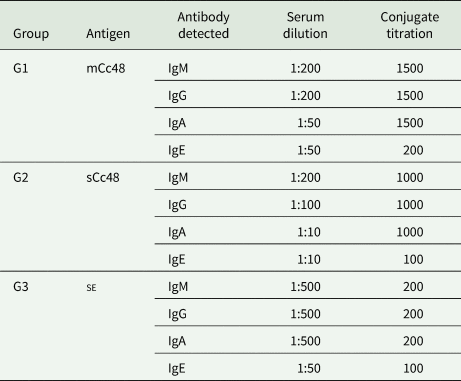
Antibody levels (IgM, IgG, IgA and IgE) were evaluated in serum samples (15, 20, 45 and 60 dpi) from groups G1, G2 and G3 by ELISA. Serum dilution and conjugate titration for each antigen tested are shown in Table 1. Samples from animals of G4 were used in all assays as negative controls. In each step of the ELISA procedure, the final volume/well was 50 μL.
Antigensa, serum dilutions and conjugate titration for IgM, IgG, IgA and IgE detection in serum samples from mice immunized with mCc48 (G1), sCc48 (G2) or PBS (G3) and challenged with T. crassiceps metacestodes.

a Cc48 (1010 particles well−1) was used to detect antibody levels in samples from G1, sCc48 (10 μg well−1) for samples from G2 or SE (10 μg well−1) for samples from G3.
se: crude antigen of T. crassiceps metacestodes.
PBS: sterile phosphate-buffer saline.
Briefly, microtitration plates (96 well; Nunc, Denmark) were coated with mCc48 (2 × 10¹¹ particles mL−1) – to detect antibody levels in samples from G1, sCc48 (200 μg mL−1) – for samples from G2 or SE (200 μg mL−1) – for samples from G3, diluted in 0.2 m carbonate-bicarbonate buffer (pH 9.6) and incubated overnight at 4°C, followed by washing six times with PBS containing 0.05% of Tween 20 (PBS-T) in an automatic plate washer (TP-Washer-Thermoplate, Brazil). Subsequently, the plates were blocked with PBS-T plus 5% skimmed milk (PBS-TM) for 30 min at 37°C, and serum samples were added diluted in PBS and incubated at 37°C for 1 h. After three washes, conjugated anti-mouse IgM (Santacruz Biotechnology, USA), IgG (Sigma, USA), IgA (Sigma, USA) or IgE (Caltag Laboratories, UK) was added, and plates were incubated for 1 h at 37°C. For IgE detection, there was an additional step for streptavidin incubation. All sera and conjugates were diluted in PBS. Subsequently, the specific substrate, ortho-phenylenediamine (OPD) for IgM, IgG and IgA or tetra-methylbenzidine (TMB) for IgE, was added and reactions were stopped by the addition of 2 m H2SO4. Plates were analysed in an automated ELISA reader (TP-Reader-Thermoplate, Brazil) at 490 nm for IgM, IgG and IgA and at 450 nm for IgE.
IgG avidity ELISA
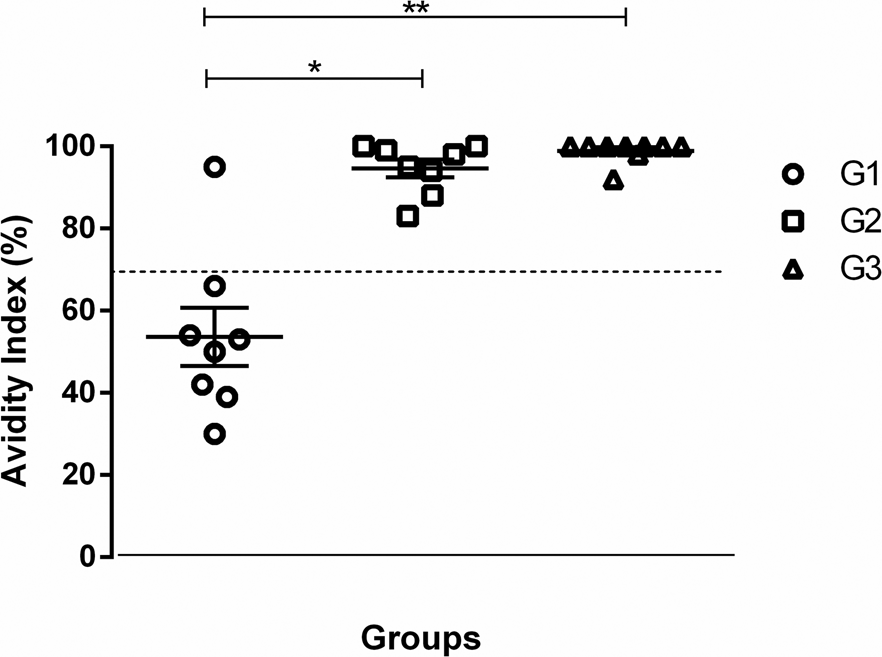
Avidity ELISA was performed with sera from animals of G1 (n = 8), G2 (n = 8) and G3 (n = 9) after 60 dpi, according to Manhani et al. (Reference Manhani, Ribeiro, Silva and Costa-Cruz2009). The IgG avidity was expressed as an avidity index (AI) = (mean OD of urea-treated wells/mean OD urea-untreated wells) × 100. It was arbitrarily established that AI values ⩾70% were ranked as high IgG avidity and AI values <70% as low avidity.
Cytokine quantification
The IFNγ and IL-4 levels were evaluated in serum using commercially available kits according to the manufacturer's instructions (Abcam, USA). Samples from 15, 30, 45 and 60 dpi were randomly selected for G1 and G2 (six samples each) and G3 and G4 (five samples each). Results were expressed as picograms of cytokines mL−1 (pg mL−1), according to the standard values provided by the manufacturer.
Statistical analysis
Comparisons between groups were performed using ANOVA or its corresponding non-parametric test (Prism® version 4.02 for Windows®, GraphPad Software Inc., USA). Probability (P) values < 0.05 were regarded as significant. Protection was determined through two calculations: vaccine protection [(total number of animals−number of infected animals)/total number of animals] and vaccine efficacy [(number of cysticerci in G3−number of cysticerci in an immunized group)/number of cysticerci in G3] (Betancourt et al., Reference Betancourt, de Aluja, Sciutto, Hernández, Bobes, Rosas, Hernández, Fragoso, Hallal-Calleros, Aguilar and Flores-Peréz2012).
Results
Induction of protection
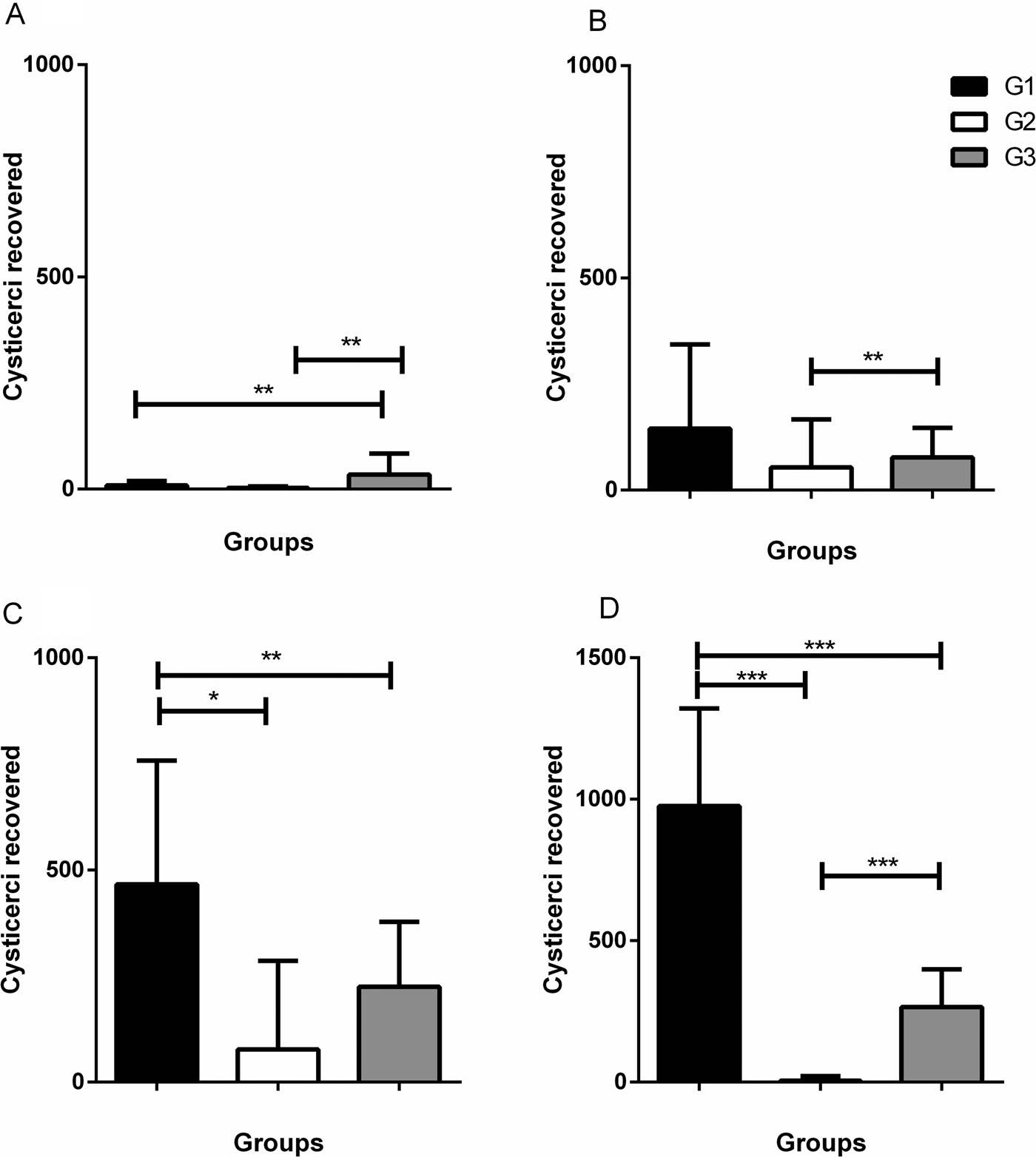
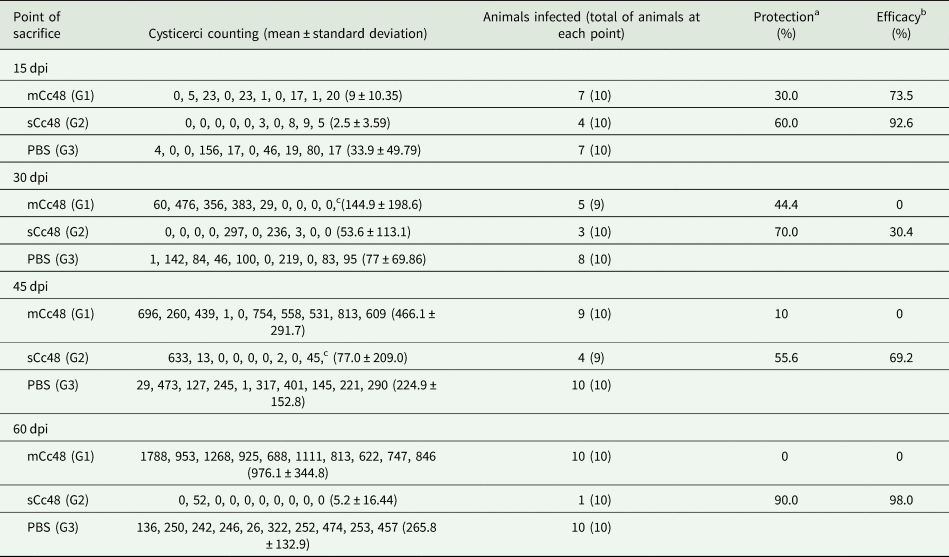
The protection of each peptide was determined by the presence or the absence of infection and the number of parasites in G1 and G2; these data were compared with those from G3. When evaluating cysticerci counting's, sCc48 peptide (G2) led to a decrease in cysticerci numbers for all points evaluated, except at 45 dpi (Fig. 1); mCc48 showed a protective profile only at 15 dpi. The synthetic peptide sCc48 significantly reduced cysticerci recovery, and protection and vaccine efficacy achieved 90.0 and 98.0%, respectively, at 60 dpi (Table 2).
Number of cysticerci recovered from the peritoneal cavity of mice immunized with mCc48 (G1), sCc48 (G2) or PBS (G3) and challenged with T. crassiceps metacestodes. (A) 15 dpi. (B) 30 dpi. (C) 45 dpi. (D) 60 dpi. The lines and cross bars represent the mean and standard deviation, respectively. Statistical analysis by ANOVA. *P < 0.05, **P < 0.001, ***P < 0.0001. dpi, days post-infection.

Protection rates and vaccine efficacy in mice immunized with mCc48 (G1), sCc48 (G2) or PBS (G3) and challenged with T. crassiceps metacestodes.

In each point 10 animals were sacrificed for cysticerci counting.
a Percentage of uninfected animals.
b Reduction of parasitic load compared to the values of the G3 group.
c Represents animals that died, dpi: days post-infection.
Antibody production
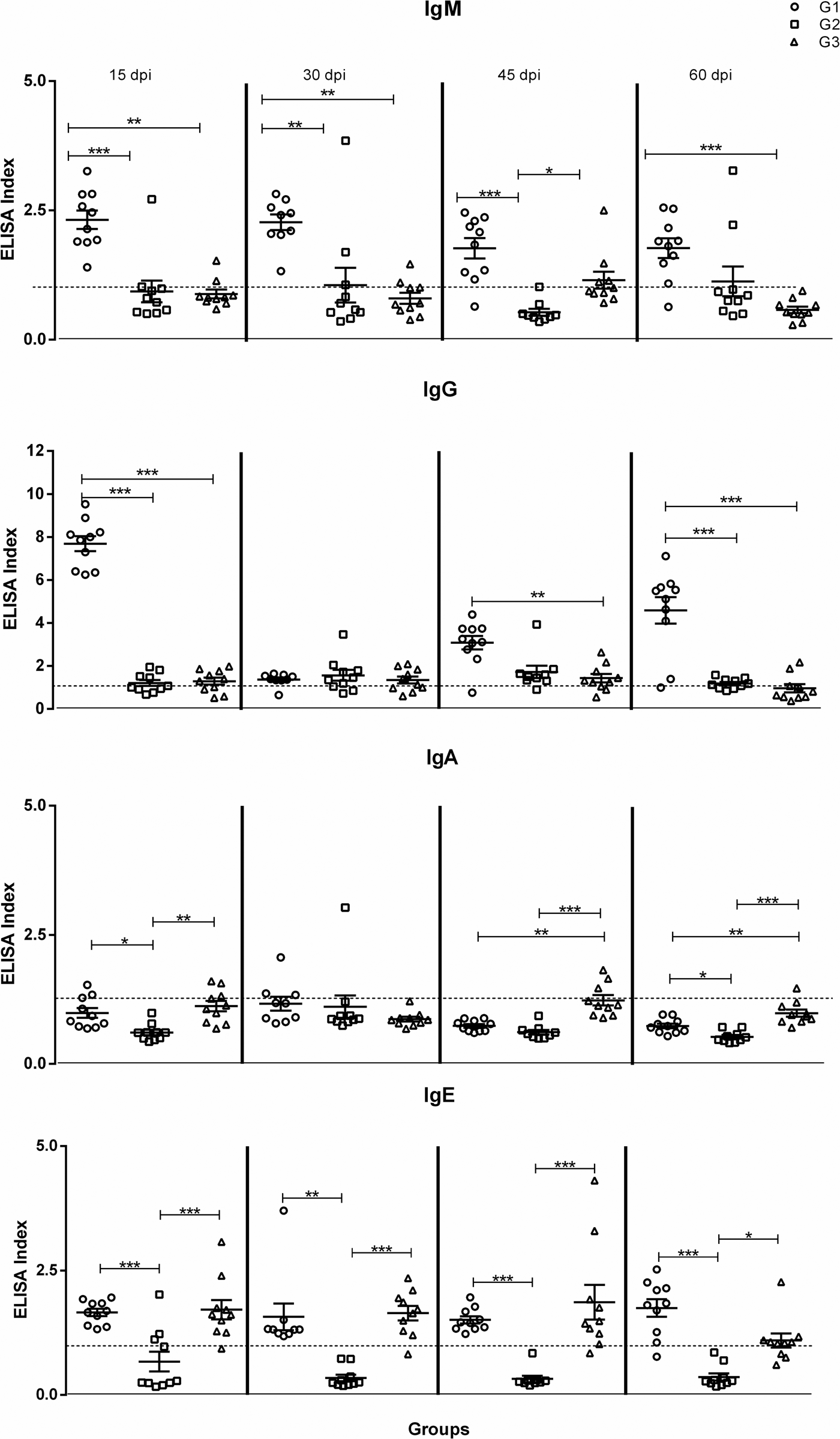
The ELISA results revealed the presence of all antibody classes evaluated for all groups. The G3 was used as positive control regarding the production of antibodies during infection, while the G4 represented the negative control. The G1 showed higher levels of IgG and IgM, while IgE levels were similar to those from G3. The G2 had the lowest IgA and IgE levels and low levels of IgM and IgG if compared to G1 (Fig. 2).
ELISA to detect IgM, IgG, IgA and IgE in serum samples from mice immunized with mCc48 (G1), sCc48 (G2) and PBS (G3), and challenged with T. crassiceps metacestodes. Serum was collected in four points after challenge (15, 30, 45 and 60 dpi). ELISA index was calculated with data from G4 (immunized with PBS and did not received T. crassiceps metacestodes). The lines and cross bars represent the mean plus the standard deviation, respectively. The dotted line represents the ELISA index = 1.0. Statistical analysis by ANOVA or its corresponding non-parametric Kruskal–Wallis test. *P < 0.05, **P < 0.001, ***P < 0.0001. dpi, days post-infection.

IgG avidity ELISA
AIs were low in G1, whereas high avidity was verified in all animals from G2 and G3 (Fig. 3).
IgG avidity in serum samples collected 60 dpi in mice immunized with mCc48 (G1, n = 8), sCc48 (G2, n = 8) and PBS (G3, n = 9). The dotted line represents the AI equal to 70%. Indexes higher or equal to 70% are classified as high avidity. Statistical analysis by Kruskal–Wallis test. *P < 0.05, **P < 0.0001. dpi, days after infection.

Cytokine quantification
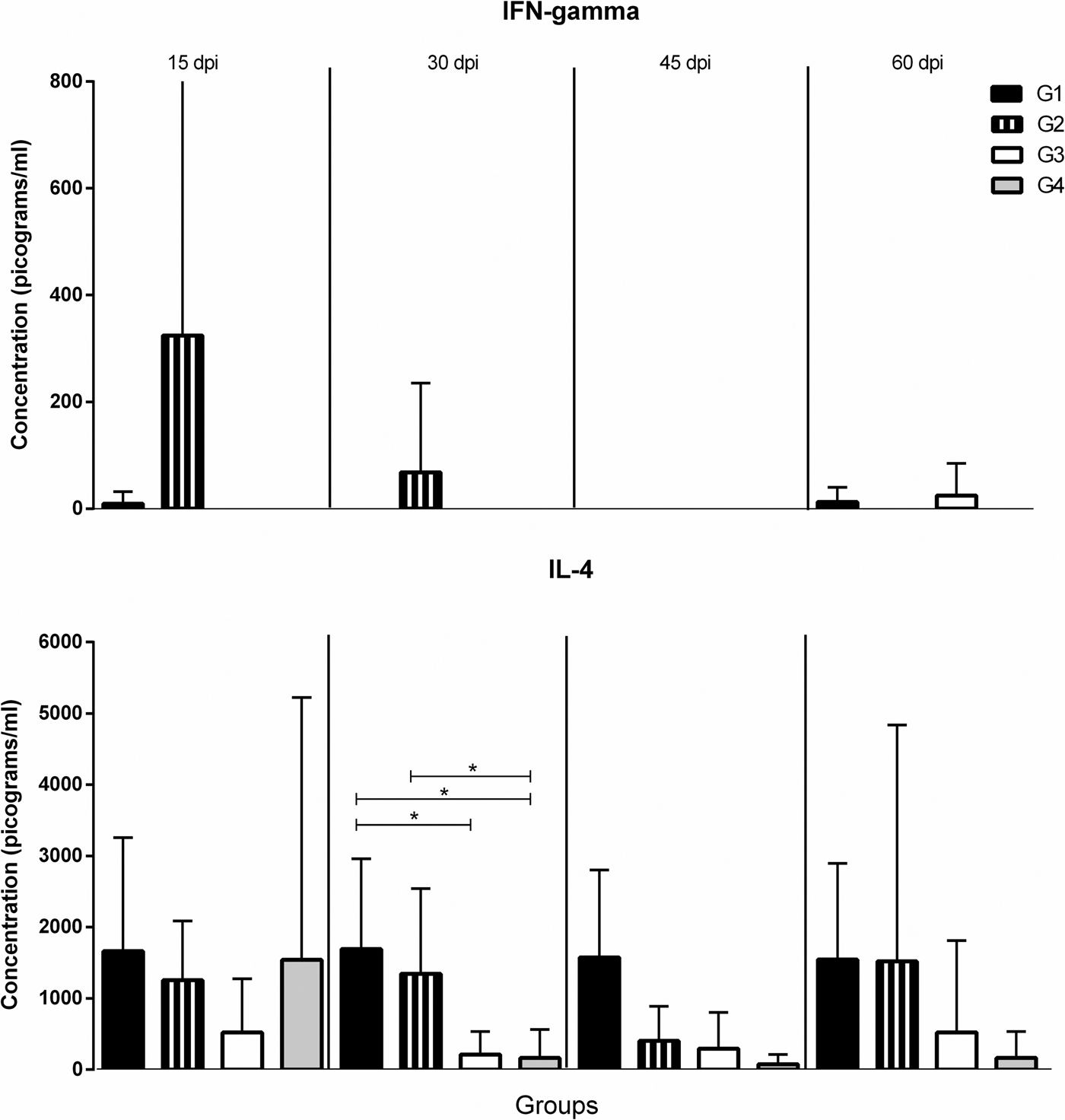
The concentrations (pg mL−1) of cytokines (IFNγ, IL-4) were not significantly different among groups. We did not detect IFNγ in G4, and few animals from G1, G2 and G3 presented IFNγ detectable in serum. The highest levels were detected at 15 dpi in G2. For IL-4, G1 and G2 reached the highest levels throughout the experiment, except at 15 dpi, when G4 presented high detection levels (Fig. 4).
Detection of IFN γ and IL-4 by ELISA in serum samples from mice immunized with mCc48 (G1), sCc48 (G2) and PBS (G3), and challenged with metacestodes of T. crassiceps or immunized with PBS and not challenged with T. crassiceps metacestodes (G4) after 15, 30, 45 or 60 dpi. The bar represents the mean plus the standard deviation. Statistical analysis by ANOVA or its corresponding non-parametric Kruskal–Wallis test. *P < 0.05. dpi, days post-infection.

Discussion
Cysticercosis is a highly prevalent disease, and its neurological form, NC, causes severe illness in humans, making it a significant health problem in Latin American countries, Haiti, sub-Saharan Africa, India, Southeast Asia, China, Indonesia and other regions that are less well categorized, such as New Guinea and Eastern Europe. The WHO has recognized NC with echinococcosis as a ‘major neglected disease’ (WHO, 2010). The successful elimination of cysticercosis will probably require the prevalence of human taeniasis and porcine cysticercosis to reach level zero (Handali and Pawitan, Reference Handali and Pawitan2012). Strategies for the elimination of cysticercosis include social development, mass treatment of taeniasis cases, treatment of infected pigs and the development of an effective, stable and low-cost pig vaccine (Manoutcharian et al., Reference Manoutcharian, Diaz-Orea, Gevorkian, Fragoso, Acero, Gonzalez, De Aluja, Villalobos, Gómez-Conde and Sciutto2004; Garcia et al., Reference Garcia, Gonzalez, Del Brutto, Tsang, Llanos-Zavalaga, Gonzalvez, Romero and Gilman2007).
Previously, Cc48 mimotope, expressed on M13 bacteriophages, was used to discriminate active from inactive cysticercosis (Manhani et al., Reference Manhani, Ribeiro, Cardoso, Ueira-Vieira, Goulart and Costa-Cruz2011). This study demonstrated that the peptide tested as an anti-cysticercosis vaccine compound induced effective protection against the development of murine cysticercosis. The sCc48 reduced the number cysticerci in the peritoneum and significantly increased the percentage of non-infected animals. Several other studies presented vaccine compounds with similar results: NC-1 mimotope from T. solium cysticerci coupled to bovine serum albumin induced 74% protection (Capelli-Peixoto et al., Reference Capelli-Peixoto, Chavez-Olortegui, Chaves-Moreira, Minozzo, Gabardo, Teixeira, Thomaz-Soccol, Alvarenga and de Moura2011), while T. crassiceps peptide GK-1 achieved 64.7% of protection (Fragoso et al., Reference Fragoso, Esquivel-Guadarrama, Santana, Bobes, Hernandez, Cervantes, Segura, Goldbaum, Sciutto and Rosas2011). Baig et al. (Reference Baig, Damian, Morales-Montor, Ghaleb, Baghdadi and White2006) showed that BALB/c mice immunized with purified T. solium cysteine protease reached 72% reduction in parasite burden. Immunization of mice with recombinant full-length paramyosin of T. solium (TPmy) resulted in ~52% reduction in parasite burden after a subsequent challenge with T. crassiceps cysticerci (Vazquez-Talavera et al., Reference Vazquez-Talavera, Solis, Terrazas and Laclette2001). The S3Pvac, composed of three synthetic peptides from T. crassiceps (KETc12, KETc1 and GK1) induced 66.7–100% protection against experimental murine cysticercosis (Toledo et al., Reference Toledo, Larralde, Fragoso, Gevorkian, Manoutcharian, Hernandez, Acero, Rosas, López-Casillas, Garfias, Vázquez, Terrazas and Sciutto1999; Toledo et al., Reference Toledo, Fragoso, Rosas, Hernandez, Gevorkian, Lopez-Casillas, Hernández, Acero, Huerta, Larralde and Sciutto2001; Rassy et al., Reference Rassy, Bobes, Rosas, Anaya, Brehm, Hernandez, Cervantes, Pedraza, Morales, Villalobos, de Aluja, Laclette, Nunes, Biondi, Fragoso, Hernández and Sciutto2010). The PT1 antigen tested to immunize mice against experimental T. crassiceps cysticercosis presented >50% of protection, and the parasite load was dramatically reduced (Betancourt et al., Reference Betancourt, de Aluja, Sciutto, Hernández, Bobes, Rosas, Hernández, Fragoso, Hallal-Calleros, Aguilar and Flores-Peréz2012). In our study, sCc48 achieved the highest protection rate (90.0%) and vaccine efficacy (98.0%) at 60 dpi, being similar to or even better than other peptides, purified or recombinant antigens, with the advantage of being composed of only one peptide (peptide sequence–spacer–peptide sequence) not coupled to any other molecule. Additionally, it was administrated with an accessible adjuvant, making large-scale production economically feasible. Regarding the low protection results reached by mCc48, this may be related to the inactivation process used, namely UV irradiation (Samoylova et al., Reference Samoylova, Norris, Samoylov, Cochran, Wolfe, Petrenko and Cox2012).
The immune mechanisms that underlie resistance and susceptibility to cysticercosis are not completely understood. Infections with parasitic helminths induce strong and polarized Th2-type immune responses (Gause et al., Reference Gause, Urban and Stadecker2003); however, this statement is not always accurate, in particular, when parasites are located on extra-intestinal tissues. The experimental mice model for cysticercosis with T. crassiceps induces a strong Th2-based immune response (Rodriguez-Sosa et al., Reference Rodriguez-Sosa, David, Bojalil, Satoskar and Terrazas2002). Furthermore, observations suggested that resistance to T. crassiceps is associated with the development of Th1 responses (Alonso-Trujillo et al., Reference Alonso-Trujillo, Rivera-Montoya, Rodriguez-Sosa and Terrazas2007). Animals from G2 that had the highest values of protection presented a tendency of mixed Th1/Th2 response. In this group, IgG was the main antibody class detected, with the detection of few or no IgE, associated with IFNγ and IL-4 production. Previous studies have demonstrated that a major host protective immune mechanism stimulated by cestode antigens appears to be antibody-dependent (Charles and Lightowlers, Reference Charles and Lightowlers2013).
Comparing the detection of antibodies and cytokines between groups and within groups on the different days analysed, we found that a high level of protection is probably related to the presence of low levels of IgG together with high levels of IL-4, converging to a hypothesis of a protective mix of Th1/Th2 response. Apparently, the presence of cysticerci caused an increase in the production of IgE, since high levels were found in groups G1 and G3, and there was no detection in group G2. As IgE was linked to the presence of the parasite, its absence was not credited as a protective factor, but as the absence of infection.
The main cytokine of the Th2 profile is IL-4, as it induces activation and effectiveness of T lymphocytes as well; IL-4 suppresses the IFNγ activity of macrophages, resulting in the inhibition of these cells. Therefore, an immune Th2 response is considered protective against intestinal helminthic infections (Rodriguez-Sosa et al., Reference Rodriguez-Sosa, David, Bojalil, Satoskar and Terrazas2002). Although it is widely accepted that a Th2-like response mediates protective immunity against most helminths (Urban et al. Reference Urban, Maliszewski, Madden, Katona and Finkelman1995), its role in mediating protection against murine cysticercosis is still unclear (Toenjes et al. Reference Toenjes, Spolski, Mooney and Kuhn1999). The presence of Th1-associated cytokines, in particular IFNγ and tumour necrosis factor-α (TNFα), is associated to the generation of classically activated macrophages and the production of nitric oxide, essential to control T. crassiceps cysticerci in experimental infections (Alonso-Trujillo et al. Reference Alonso-Trujillo, Rivera-Montoya, Rodriguez-Sosa and Terrazas2007). In contrast, highest IFNγ production was associated with progressing larval T. crassiceps infection in mice and lower levels were detected in the serum of mice that are killing the cysticerci (Mooney et al. Reference Mooney, Spolski, See and Kuhn2000). Toenjes et al. (Reference Toenjes, Spolski, Mooney and Kuhn1999) have shown that IFNγ levels in serum consistently rise over the course of infection.
There is no denying that the infection alters the immune response, even after immunization. Despite without having made the dosages of the immunological components before the challenge with the pathogen, it was possible to deduce if there was an immune response generated against the compounds used (mCc48 and sCc48) during the immunization, according to the data presented. Comparing the results of infection rate and the number of recovered cysticerci, our results verify that immunization had an effect on these parameters, because otherwise, all animals in groups G1, G2 and G3 would have had the same profile. In addition, if the results were simply due to parasitaemia without the influence of immunization, an increase in infection rates in groups G1, G2 and G3 would be expected, as all mice were inoculated with cysticerci. It is probable that the results obtained were related to both immunization and parasitic load, but the parasitic load was influenced by immunization, since there was a difference in the cysticerci count in these three groups. Thus, we believe that the results obtained are due to the protocol and not simply as a result of parasitaemia.
In summary, we show that a mimotope selected with an affinity to circulating antibodies from sera of patients with inactive NC clinical form can be used in its synthetic version (sCc48) as an effective vaccine candidate for NC. The promising findings obtained in the present study encourage pig trials to confirm the effectiveness of a vaccine against cysticercosis.
Financial support
This study was supported by Conselho Nacional de Desenvolvimento Científico e Tecnológico (CNPq − 304414/2009-3 – JMCC), Coordenação de Aperfeiçoamento de Pessoal de Nível Superior (CAPES 3200601004M-8 – MNM) and Fundação de Amparo à Pesquisa do Estado de Minas Gerais (FAPEMIG – CBB-PPM 00396-13 – JMCC).
Conflicts of interest
None.
Ethical standards
All experiments reported here were conducted according to the Guide for the Care and Use of Laboratory Animals, Institute of Laboratory Animal Resources, National Council, Washington, DC, 1996, and were approved by the Animal Ethical Committee of UFSJ, no. 43/2010. All animals were given ad libitum access to food and water.