Introduction
The prenatal (in utero) environment is now recognized as a key driver of non-communicable disease (NCD) risk later in life.Reference Eriksson 1 Through the developmental origins of health and disease (DOHaD) paradigm, studies are increasingly identifying links between diverse stressors during pregnancy and the risk to offspring of a myriad of NCDs, including cardiovascular disease, metabolic disorders (e.g. obesity and diabetes mellitus), neurocognitive problems and others.Reference Eriksson 1 Examples of pregnancy-associated influences on NCD risk include nutritional stress (both under and overnutrition,Reference Chavatte-Palmer, Tarrade and Rousseau-Ralliard 2 , Reference Tarrade, Panchenko, Junien and Gabory 3 metabolic disorders [maternal obesityReference Brenseke, Prater, Bahamonde and Gutierrez 4 and hyperglycemia in pregnancy (HiP)Reference Xiang, Wang and Martinez 5 – Reference Yan and Yang 7 ], exposure to environmental toxicantsReference Bezek, Ujhazy, Mach, Navarova and Dubovicky 8 and maternal immune activation (MIA) provoked by infectious diseases.Reference Howerton and Bale 9 , Reference Monk, Georgieff and Osterholm 10 Because maternal metabolic disorders during pregnancy are a risk factor for metabolic disorders in offspring, who may go on to be pregnant, there is risk of self-reinforcing cycles. Causal mechanisms between gestational exposures of the fetus to adverse health outcomes later in life are now emerging, including pathways related to direct organ or tissue structural changes, accelerated cellular aging (senescence), and epigenetic programming of gene expression.Reference Sutton, Gilmore and Dunger 11
Many studies linking these various types of perinatal stress to developmental origins of disease in offspring have focused on a single type of stress (such metabolic stress or infection for example). Yet, real world experience demonstrates that human populations are routinely subjected to more than one putative DOHaD-impacting stressor at a time. Here, we review studies exploring potential interactions between infections during pregnancy (primary causes of MIA) and metabolic stressors such as obesity and HiP. Infectious diseases pose a persistent threat to human reproductive health and through direct tissue damage or, possibly, epigenetics,Reference Bobetsis, Barros and Lin 12 MIA appears to impact the risk for NCDs in exposed offspring, including the severity of autoimmune disorders.Reference Adams Waldorf and McAdams 13 , Reference Zager, Peron and Mennecier 14 Many low- or middle-income countries (LMIC) are disproportionately affected by highly endemic infections such as tuberculosis, malaria and HIV, but are also challenged by nutritional stressors that impact maternal-child health. Yet, there are few studies examining how MIA and maternal undernutrition combine to influence the life-course of offspring born in these circumstances. Similarly, overnutrition (excess adiposity) is becoming a modern problem in these same LMICs, as societies transition from poor access to nutrition to a western fast food culture.Reference Popkin, Adair and Ng 15 This has created relatively recent problems of maternal overweight/obesity and HiP in settings where MIA is an ongoing threat. The international prevalence of HiP is estimated at 16%; with up to 90% of cases predicted to occur in LMICs.Reference Guariguata, Linnenkamp, Beagley, Whiting and Cho 16 Given the changing landscape of metabolic disease (and nutrient availability) in LMICs, there is a compelling need to think more holistically about the multiple challenges faced by pregnant women in the real world.
The urgency to identify and fill this knowledge gap is underscored by the modern epidemic of obesity affecting LMICs with endemic infectious diseases and, conversely, the periodic pandemic infections sweeping developed countries, such as the 2009 H1N1 virus.
Methods
We performed a scoping review based on the method described by Arksey and O’MalleyReference Arksey and O’Malley 17 with the research question of: What is known from the existing literature about the interaction of co-occurring metabolic/nutritional stressors and infectious diseases during gestation on DOHaD-related health outcomes? To address this question, we reviewed papers with the following inclusion criteria: English language primary studies that examined interactions between the maternal risk factors of metabolic/nutritional stressors and infectious diseases (or models of infection) on the risk for developmental outcomes.
We identified relevant studies by search in PubMed identifying studies that addressed four items (1) pregnancy, (2) a DOHaD-related outcome (3) exposure to metabolic/nutritional stress and (4) an infectious or MIA exposure using the following strategy string:
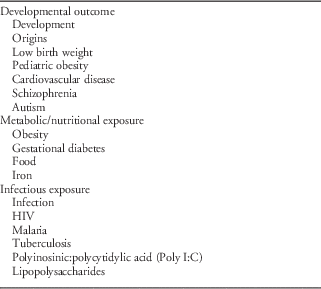
pregnancy[mesh term] and (infant, low birth weight[MeSH Terms] OR autistic disorder[MeSH Terms] OR schizophrenia[MeSH Terms] OR cardiovascular diseases[MeSH Terms] OR pediatric obesity[MeSH Terms] OR origins[all fields] OR development[All fields]) AND (obesity[Mesh terms] OR diabetes, gestational[MeSH Terms] OR food[MeSH terms] OR iron[mesh terms]) AND (infection[MeSH Terms] OR hiv[MeSH Terms] OR malaria[MeSH Terms] OR tuberculosis[MeSH Terms] OR tuberculosis[MeSH Terms] OR poly i-c[MeSH Terms] OR lipopolysaccharides[MeSH Terms])
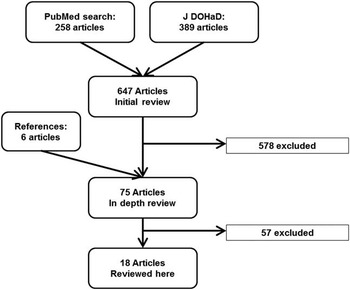
The strategy is summarized by Fig 1. Additional studies were identified through references of reviewed articles and collecting all articles from a key journal, the Journal of Developmental Origins of Health and Disease. Article titles were reviewed and those which appeared related were selected for review. Further review consisted of reading article abstracts for the inclusion criteria. If an article appeared relevant based on title review, but the inclusion criteria could not be established, the full article was reviewed to determine inclusion or exclusion (Table 1).
Article flow: 258 articles were identified from a PubMed search. These and 389 articles in the Journal of Developmental Origins of Health and Disease were combined and the titles were reviewed for relevance. The resulting 69 articles, and six articles identified from references, were reviewed in depth. Of these, 57 were excluded and 18 are included in this article.

Search strategy

We searched for studies that included a developmental outcome, a metabolic/nutritional exposure, and an infectious exposure. Multiple search terms were used for each area. A paper would be identified if it included at least one term from each category, for example a paper that included autism, obesity and Poly I:C.
Findings
Scoping review
A total of 258 articles were identified using the PubMed search. There were 389 articles in the key journal. The titles of the 647 articles were reviewed of which 69 appeared related and were selected for further review. For the in-depth review, article abstracts and, as necessary full articles were read for the inclusion criteria. An additional six articles were identified from references within articles bringing the total to 75 (Fig. 1). Of the 75, 60 reported on a metabolic/nutritional stress exposure, 54 reported on an infectious exposure, and 41 reported on a developmental outcome. In all, 18 met the inclusion criteria and are described below and in Tables 2 through 4. A full listing of briefly reviewed studies is available as Supplementary Table 1 while a listing of studies examined in-depth with assessment of inclusion and exclusion criteria is available as Supplementary Table 2. Quality of studies was reviewed using the Newcastle – Ottawa quality assessment scale (NOS) for cohort and case–control studies and the Cochrane Collaboration’s tool for assessing risk of bias in randomized-controlled trials (RCT), Supplementary Table 3 (Ottawa http://www.ohri.ca/programs/clinical_epidemiology/oxford.asp, Cochrane).
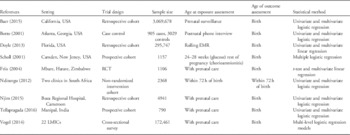
Details of human studies meeting the inclusion criteria
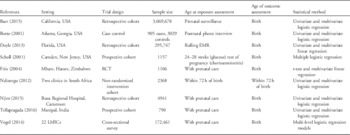
EMR, electronic medical record; LMIC, low- and middle-income countries; RCT, randomized-controlled trial.
Human studies identified as meeting inclusion criteria. This table presents basic information about the studies.
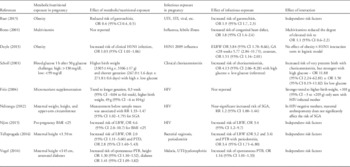
Findings of human studies meeting the inclusion criteria

CI, confidence interval; ELBW, extremely low birth weight; GA, gestational age; HIV, human immunodeficiency virus; LBW, low birth weight; OR, odds ratio; PTB, preterm birth; SGA, small for gestational age; STI, sexually transmitted infection; UTI, urinary tract infection.
Results from human studies meeting criteria.
Animal studies meeting the inclusion criteria

ACTH, adrenocorticotrophic hormone; CFA, complete Freund’s adjuvant; EGF, epidermal growth factor; GM-CSF, granulocyte-monocyte colony stimulating factor; IFNg, interferon-gamma; IGF, insulin-like growth factor; IL, interleukin; LPS, lipopolysaccharide; TNFa, tumor necrosis factor alpha.
Studies identified in model organisms and results.
a Starr (2015) and (2016) reproduce fetal growth deficits from Odiere (2010).
Pregnancy and perinatal outcomes of MIA and metabolism in human pregnancy
We identified nine articles of interest with human participants (Tables 2 and 3).Reference Baer, Chambers and Jones 18 – Reference Vogel, Lee and Souza 26
Study design
There were three retrospective cohorts, two prospective cohorts, and one each of non-randomized intervention cohort, cross-sectional survey, case control and RCT. The cohort studies all received the maximum score of nine points on the NOS quality assessment. The case–control study received six of nine points, with sub-optimal ascertainment of cases and controls, and an unreported non-response rate.Reference Botto, Lynberg and Erickson 19 The RCT received six of seven with a point lost for not detailing how incomplete outcome data was handled.Reference Friis, Gomo and Nyazema 21
Metabolic and nutritional exposures
There were four studies in the United States, three in Sub-Saharan Africa, one in India and one in 22 LMICs including India and several countries in Sub-Saharan Africa. Three of the American studies and the multi-country study examined overnutrition and metabolic disease – obesity, diabetes, or impaired glucose tolerance. One American study, the studies from Africa and India, and the multi-country study examined undernutrition – stunting with low maternal height, low maternal body mass index (BMI), and the salutary effect of micronutrient supplementation.
Infectious exposures
The infectious exposures are less clearly categorized with three studies in HIV, all in Africa, two in influenza, both in the United States, two in gynecologic infection, and several examining febrile illness or a variety of infections. The developmental outcome was birth weight or preterm birth (PTB) in seven studies, including all the studies conducted outside the United States. One study each examined congenital heart disease and gastroschisis.
Statistical approaches
The statistical approaches generally involved the use of univariate regression of the t-test to examine the effect of single risk factors, however all studies ultimately performed multivariate linear or logistic regression to assess for independent risk factors. The individual studies are examined in more detail below.
Individual studies
Baer et al. reported a registry-based retrospective cohort study identifying risk factors for gastroschisis in California, United States.Reference Baer, Chambers and Jones 18 There were 3,069,678 births in the study period, with 1279 cases of gastroschisis. Obesity was associated with a reduced risk of gastroschisis, OR 0.4 (95% CI 0.4, 0.5), while a variety of infections including urinary tract infection, sexually transmitted infectious, upper respiratory tract infections were associated with an increased risk of gastroschisis, OR 1.9 (95% CI 1.7, 2.3). Statistical interaction was not explicitly sought, however both exposures remained significant in multivariate logistic regression. This was the only study performed in California, and the only study to examine gastroschisis.
Botto et al. reported a case–control study conducted in Atlanta, Georgia, United States to identify risk factors for congenital heart disease.Reference Botto, Lynberg and Erickson 19 There were 905 cases and 3029 controls. In univariate and multivariate logistic regression, influenza or febrile illness increased the risk of congenital heart disease, OR 1.8 (95% CI 1.4–2.4), while a reported maternal history of taking multivitamins reduced the degree of elevated risk to a non-significant OR 1.1 (95% CI 0.6–2.2). The effect of multivitamins alone was not examined. This was the only study conducted in Atlanta and the only one to examine congenital heart disease.
The study by Doyle et al. reported a registry-based retrospective cohort conducted in Florida, United States on the effect of pandemic 2009 H1N1 influenza (H1N1) on multiple birth outcomes.Reference Doyle, Goodin and Hamilton 20 H1N1 exposure was associated with an increased risk of extremely low birth weight (<1000 g), OR 3.84 (95% CI 1.70–8.66), extreme prematurity (GA <28 weeks), OR 5.77 (95% CI 2.84–11.71), and increased risk of cesarean delivery, OR 1.51 (95% CI 1.14–2.01). Obesity (BMI>30) was associated with an increased risk of H1N1 infection, OR 1.03 (95% CI 1.01–1.06), however the H1N1×obesity term was not statistically significant in multivariate linear regression. This was the only study performed in Florida and the only one to examine the effect of H1N1 influenza.
Scholl et al. reported on the interaction of glucose tolerance, chorioamnionitis and very preterm birth in 1157 women in Camden, New Jersey, United States.Reference Scholl, Sowers, Chen and Lenders 24 In this study, the metabolic exposure was glucose tolerance as measured by the result of the 50 g oral glucose tolerance test. Blood glucose values 1 h after 50 g glucose challenge were categorized as high: >130 mg/dl, low: <99 mg/dl, or intermediate, between the two. High blood glucose was associated with higher birth weight (3305±44 g v. 3106±17 g for low glucose, and shorter gestation 267.0±1.6 days v. 271.8±0.6 days with low glucose. High glucose was also a risk factor for clinical chorioamnionitis, OR 4.13 (95% CI 2.06–8.28) v. low glucose as a reference. When both high glucose and chorioamnionitis were present, the risk of very preterm birth (<32 weeks of gestation) was extremely high, OR 11.88 (95% CI 2.24–62.81), as compared with a small and non-significant increase, OR 1.50 (95% CI 0.19–11.82) for low glucose. This was the only study in New Jersey, and the only one to examine chorioamnionitis. As in the association of obesity and H1N1,Reference Doyle, Goodin and Hamilton 20 Scholl et al. demonstrated that their metabolic exposure of interest was a risk factor for their infectious exposure. However, unlike the study by Doyle et al., Scholl et al. demonstrated a double effect – women with high glucose were more likely to have chorioamnionitis and have a worse prognosis if they did.
A study conducted by Friis et al., reported the results of a RCT of micronutrient supplementation in 1106 patients Mbare, Harare, Zimbabwe.Reference Friis, Gomo and Nyazema 21 In the main effect analysis, micronutrient supplementation was associated with a near-significant trend to longer gestation, 0.3 week (95% CI –0.04 to 0.6 week) and higher birth weight, 49 g (95% CI −6 to 104 g). In a pre-specified subgroup analysis, the benefit of micronutrient supplementation was largely restricted to the children of HIV-infected mothers. In this subgroup, micronutrient supplementation was associated with an increased in birth weight of 101 g (95% CI −3 to 205 g), while in children of HIV-negative mothers it was only an increase of 26 g (95% CI −38 to 91 g). Curiously, while maternal HIV seemed to exert a strong influence on the effect of micronutrients, the interaction between micronutrient treatment and HIV exposure did not show a statistically significant correlation with birth weight.
Ndirangu et al. reported on a non-randomized cohort study of neviripine and maternal–infant HIV transfer in 2368 women at two clinics in South Africa.Reference Ndirangu, Newell, Bland and Thorne 22 Maternal weight, height and upper-arm circumference below the sample mean were all associated with an increased risk of small for gestational age (SGA) infants, with relative risks of 1.44 (95% CI 1.15–1.79), 1.33 (95% CI 1.02–1.74) and 1.33 (95% CI 1.06–1.67). Low stature in this population is assumed to represent the effect of malnutrition early in life.Reference Batty, Shipley and Gunnell 27 Maternal HIV infection was associated with a near-significant increased risk of SGA, RR 1.2 (95% CI 1.00–1.44). After adjustment for HIV status, maternal anthropometry did not alter the risk of SGA, that is, maternal low weight, short stature, or small upper arms were only associated with an increased risk of SGA in HIV-infected mothers. Similar to the study of Friis et al.Reference Friis, Gomo and Nyazema 21 , this investigation suggested that HIV infection sensitizes mothers to nutritional deprivation in the form of micronutrient deficiency or malnutrition. Low maternal weight was also associated with an increased risk of PTB, with RR 1.35 (95% CI 1.13–1.62). HIV infection was not a risk factor for PTB in this study.
The effect of obesity and HIV infection on low birth weight (LBW) was examined by Nijm et al. in a retrospective cohort study of 4941 infants born at Buea Regional Hospital, Cameroon.Reference Njim, Atashili, Mbu and Choukem 23 Pre-pregnancy BMI <25 was associated with an increased risk of LBW, OR 4.6 (95% CI 2.0–10.7), HIV infection increased the risk of LBW, OR 3.4 (95% CI 1.2–9.7). Both BMI <25 and HIV remained significant predictors of LBW in a multivariate analysis, but no analysis of an interaction was performed. Similarly to Ndirangu et al.,Reference Ndirangu, Newell, Bland and Thorne 22 this study showed that maternal undernutrition, or alternatively the absence of overnutrition, and HIV were both associated with decreased birth weight, although the effects in the present study are more dramatic.
Tellaparagada et al. published the results of a clinic-based prospective cohort study of 790 women in Manipal, India examining risk factors for LBW and PTB.Reference Tellapragada, Eshwara and Bhat 25 Maternal height <1.50 m was associated with an increased risk of LBW, OR 2.0 (95% CI 1.11–3.60) and PTB OR 2.8 (95% CI 1.40–5.43). Bacterial vaginosis was associated with an increased risk of PTB, OR 3.4 (95% CI 1.73–6.93). Periodontitis was associated with an increased risk of LBW, OR 3.2 (95% CI 1.02–10.41) and PTB, OR 3.4 (95% CI 1.71–6.80). The anthropomorphic and infectious exposures were independent risk factors in multivariate analysis, however their interaction was not specifically examined. The results of this study are in keeping with Ndirangu et al. and Njim et al., in that maternal undernutrition and infection were associated with LBW.Reference Ndirangu, Newell, Bland and Thorne 22 , Reference Njim, Atashili, Mbu and Choukem 23
Vogel et al. reported an analysis from the WHO Global Survey on Maternal and Perinatal Health on prenatal risk factors for PTB.Reference Vogel, Lee and Souza 26 This was a cross-sectional, medical record-based survey of 172,461 infants born in 22 LMICs over multiple continents. In the study, maternal height <145 cm was associated with an increased risk of antenatal diabetes, adjusted OR 1.30 (95% CI 1.10–1.52). Antenatal diabetes was associated with an adjusted OR 1.41 (95% CI 1.09–1.82). Urinary tract infection (UTI) or pyelonephritis increased the risk of spontaneous PTB, OR 1.16 (95% CI 1.01–1.3). In regards to provider-initiated PTB, height <145 and diabetes were also linked to increased PTB with adjusted OR 1.47 (95% CI 1.23–1.77) and 2.51 (1.81–3.47), respectively. UTI/pyelonephritis was not associated with an increased risk of provider-initiated PTB, adjusted OR 1.24 (95% CI 0.96–1.59). In Africa, malaria was associated with an increased risk of spontaneous, but not provider-initiated PTB, adjusted OR 1.67 (95% CI 1.32–2.11) and 1.01 (95% CI 0.84–1.21), respectively. The effect of these exposures remained significant in multivariate analysis. In this survey, HIV was not associated with an increased risk of spontaneous or provider-initiated PTB, consistent with Ndirangu et al.Reference Ndirangu, Newell, Bland and Thorne 22 These findings reinforce the trend of PTB associated with small maternal stature and maternal infections demonstrated in the Tellapragada study.Reference Tellapragada, Eshwara and Bhat 25
Outcomes of maternal immune activation and metabolic abnormality in model systems
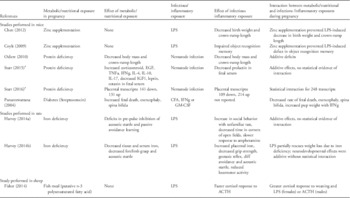
A total of six studies were performed in mice,Reference Chen, Zhao and Chen 28 – Reference Coyle, Tran, Fung, Summers and Rofe 33 two in rats,Reference Harvey and Boksa 34 , Reference Harvey and Boksa 35 and one in sheepReference Fisher, Or’Rashid and Quinton 36 (Table 4). The rat studies both involved nutritional deficiency, while the sheep study and two of the mouse studies involved supplementation. Three linked studies in mouse examined protein deficiency,Reference Odiere, Scott, Weiler and Koski 30 – Reference Starr, Scott and Koski 32 two studies, both in rats, involved iron deficiency,Reference Harvey and Boksa 34 , Reference Harvey and Boksa 35 two in mice involved zinc supplementation,Reference Chen, Zhao and Chen 28 , Reference Coyle, Tran, Fung, Summers and Rofe 33 one in mice used streptozocin-induced diabetes,Reference Punareewattana, Sharova, Li, Ward and Holladay 29 and one in sheep used fish meal as a model of polyunsaturated fatty acid supplementation.Reference Fisher, Or’Rashid and Quinton 36 Five studies, including the three non-mouse studies used LPS as a model of immune activation,Reference Chen, Zhao and Chen 28 , Reference Coyle, Tran, Fung, Summers and Rofe 33 – Reference Fisher, Or’Rashid and Quinton 36 three used nematode infectionReference Odiere, Scott, Weiler and Koski 30 – Reference Starr, Scott and Koski 32 and one used complete Freund’s adjuvant (CFA), an emulsion of water, mineral oil and dried Mycobacterium tuberculosis, interferon-gamma (IFNγ) and granulocyte-monocyte colony stimulating factor (GM-CSF).Reference Punareewattana, Sharova, Li, Ward and Holladay 29 Developmental outcomes included fetal death in two studies,Reference Punareewattana, Sharova, Li, Ward and Holladay 29 , Reference Starr, Scott and Koski 32 weight and length measures in three studies,Reference Chen, Zhao and Chen 28 , Reference Starr, Scott and Koski 32 , Reference Harvey and Boksa 34 performance on neuropsychiatric studies in three studies,Reference Coyle, Tran, Fung, Summers and Rofe 33 – Reference Harvey and Boksa 35 food intake and metabolism in one study,Reference Odiere, Scott, Weiler and Koski 30 gene expression and cytokine profiling in three studies,Reference Starr, Koski and Scott 31 , Reference Starr, Scott and Koski 32 , Reference Harvey and Boksa 34 placental iron in one study,Reference Harvey and Boksa 34 and serum cortisol response to stresses in one study.Reference Fisher, Or’Rashid and Quinton 36 The results of the individual studies are examined in more detail below.
Chen et al. reported on the interaction of zinc supplementation in mice.Reference Chen, Zhao and Chen 28 Zinc supplementation alone had no effect, while maternal LPS injection resulted in decreased birth weight and crown-rump length in the offspring. Zinc supplementation partially reverted the LPS-induced decrease in birth weight and crown-rump length. Several studies examined weight and length as outcomes. Protein deficiency and nematode infection were reported to decrease weight and length in mice, while LPS was reported to reverse the low birth weight induced by low iron in rats.Reference Odiere, Scott, Weiler and Koski 30 , Reference Harvey and Boksa 34 Several studies in humans examined birth weight, with the general trend that maternal immune activation was associated with lower birth weight, in concordance with Chen et al.Reference Doyle, Goodin and Hamilton 20 , Reference Friis, Gomo and Nyazema 21 , Reference Njim, Atashili, Mbu and Choukem 23 , Reference Tellapragada, Eshwara and Bhat 25 There were no studies in humans that examined the interaction between zinc supplementation and maternal immune activation, although. Coyle et al. examined the behavioral effect of combined zinc and LPS in animals.Reference Coyle, Tran, Fung, Summers and Rofe 33
The study by Coyle et al. examined the interaction of combined zinc and LPS on behavioral assays in mice.Reference Coyle, Tran, Fung, Summers and Rofe 33 Zinc supplementation alone had no effect, while LPS was associated with impaired object recognition memory. Zinc supplementation prevented the LPS-induced defect in object recognition memory. No human studies identified examined neuropsychiatric outcomes. Two studies by Harvey et al. examined neuropsychiatric outcomes in rats, demonstrating that iron deficiency resulted in a deficit in passive avoidance learning, with no primary effect of LPS or interaction between iron and LPS.Reference Harvey and Boksa 34 , Reference Harvey and Boksa 35
A series of studies from a single group have examined the interaction of protein deficient diet and nematode infection in mice.Reference Odiere, Scott, Weiler and Koski 30 – Reference Starr, Scott and Koski 32 Protein deficiency and nematode infection in the mother both resulted in decreased body mass and crown-rump length.Reference Odiere, Scott, Weiler and Koski 30 Combined exposures resulted in additive effects. They further investigated this model by examining cytokine levels, showing that protein deficiency was associated with increased corticosteroid, epidermal growth factor, tumor necrosis factor (TNF)α, IFNγ, interleukin (IL)-4, IL-10 and IL-17 levels and decreased insulin-like growth factor (IGF)1, leptin and eotaxin levels in fetal serum.Reference Starr, Scott and Koski 32 Once again, combined exposures resulted in additive effects, and the metabolic×infectious interaction was never statistically significant in multivariate linear regression. In a related study, they examined RNA transcript levels in the placenta by microarray.Reference Starr, Koski and Scott 31 Protein deficiency resulted in decreased expression of 141 transcripts while 131 transcripts were upregulated. Nematode infection resulted in decreased expression of 109 transcripts and increased expression of 214 transcripts. A total of 248 transcripts showed alterations in expression, either increased or decreased, when both infectious and metabolic/nutritional exposures were present. Intriguingly, insulin response substrate 1 showed lower expression only when nematode infection was combined with a protein sufficient diet. Insulin growth factor receptor 1 and prolactin had higher expression with combined infection and protein deficiency but were suppressed with protein deficiency alone. No other study examined the effect or protein deficiency or nematode infection. As already mentioned, birth weight was a common outcome, and the usual effect of infection was to decrease it.
Punareewattana et al. examined the interaction of streptozotocin-induced diabetes mellitus and experimentally induced maternal immune activation on birth defects in mice.Reference Punareewattana, Sharova, Li, Ward and Holladay 29 Experimental diabetes was associated with increased rates of fetal death and fetal malformation including exencephaly and spina bifida. Fetal weight was also decreased. Maternal immune activation by CFA, IFNγ or GM-CSF resulted in decreased rate of fetal death, exencephaly and spina bifida. IFNγ resulted in normalized fetal weight. The effect of maternal immune activation alone was not determined. The between group differences were determined using Dunnet’s multiple comparison test. Unlike the work of Chen et al.,Reference Chen, Zhao and Chen 28 and the human studies discussed above, Punareewattana et al. showed increased birth weight after maternal immune activation. It is also unusual in showing an association between diabetes in gestation and decreased fetal weight. Type 1 and gestational diabetes are both associated with a decreased risk of small for gestational age infants.Reference Anderson, Gutierrez, Kennedy and Hasty 37 Punareewattana et al. is the only animal study we identifying that examined the effect of diabetes and the only study overall using CFA, IFNγ or GM-CSF as maternal immune activators. Vogel et al. showed an increased risk of PTB with antenatal diabetes and additionally with maternal infection.Reference Vogel, Lee and Souza 26 No other study examined exencephaly, spina bifida or fetal death as outcomes.
Harvey et al. published a pair of studies examining the interaction of iron deficiency and LPS in rats.Reference Harvey and Boksa 34 , Reference Harvey and Boksa 35 Iron deficiency was associated with decreased birth weight, decreased tissue and serum iron, decreased forelimb grasp, with deficits in pre-pulse inhibition of acoustic startle and passive avoidance learning. Lipopolysaccharide was associated with increased placental iron, decreased grip strength, an increase in social behavior with unfamiliar rats, decreased time in corners of open fields, slower motor response to amphetamine, abnormal geotaxis reflex, decreased cliff avoidance and acoustic startle, and reduced locomotor activity at P7 and P60. In pups of mothers exposed to both iron deficiency and LPS, birth weight was intermediate between iron deficient and control animals, with statistically significant differences. The neurodevelopmental effects were additive without statistically significant iron deficiency×LPS interaction terms. As mentioned, Coyle et al. showed deficits in learning in mice after maternal exposure to LPS, which was apparently not replicated in this study.Reference Coyle, Tran, Fung, Summers and Rofe 33 However, differences in species, experimental design, and the type of learning – object recognition v. passive avoidance – may well explain the difference in result. There were no human studies examining neuropsychiatric outcomes.
A study conducted by Fisher et al. examined the effect of fish meal, a putative n-3 polyunsaturated fatty acid source and LPS.Reference Fisher, Or’Rashid and Quinton 36 Maternal LPS resulted in a faster rise in cortisol in response to adrenocorticotrophic hormone (ACTH), while maternal exposure to both LPS and fish meal resulted in a greater cortisol response to the stress of weaning or LPS in females and a greater cortisol response to ACTH in males. Fish meal alone had no effect. No other studies were performed in sheep, used fish meal as an exposure or studied cortisol release as an outcome.
Analysis and conclusion
Human study topics
The studies cited and described above are heterogeneous however some trends emerge. The human studies were split between LMICs and the United States. All the metabolic/nutritional exposures in the LMICs and seven of nine animal studies reflect maternal undernutrition. Given the global shift toward diseases of plenty, this represents a significant research gap.
The human studies were overall of moderate to high quality with all cohort studies scoring 9 of 9 points and the case–control study scored 6 of 9. The RCT scored 6 of 7 points. More significantly to this review’s purpose of identifying gaps in the literature, no study was specifically designed to examine the interaction of metabolic/nutritional and infectious exposures during pregnancy. The studies were either designed to examine the effect of a particular exposure with some attention given to covariatesReference Doyle, Goodin and Hamilton 20 – Reference Ndirangu, Newell, Bland and Thorne 22 , Reference Scholl, Sowers, Chen and Lenders 24 or to assess risk factors for particular negative outcomes.Reference Baer, Chambers and Jones 18 , Reference Botto, Lynberg and Erickson 19 , Reference Njim, Atashili, Mbu and Choukem 23 , Reference Tellapragada, Eshwara and Bhat 25 , Reference Vogel, Lee and Souza 26 Therefore, the results should be considered as hypothesis generating, rather than definitive. It could be argued that the RCT by Friis et al., which assessed the impact of HIV on the effect of micronutrient supplementation in a pre-specified subgroup analysis, should be considered the gold standard.Reference Friis, Gomo and Nyazema 21 However, the result was not statistically significant with a 95% CI crossing 0.
By far the most common developmental outcome in human studies was birth weight or PTB, representing seven of nine studies. In truth these are not developmental outcomes, but rather more proximate risk factors for clinically meaningful developmental outcomes including diabetes, cardiovascular disease and neuropsychiatric disorders. The other outcomes were birth defects – gastroschisis and congenital heart disease. Longer term outcomes, including metabolic, autoimmune, or neurhopsychiatric measures, were not reported.
Human study results
In broad terms, exposures associated with increased micro- or macronutrients were associated with increased birth weight and a corresponding decreased risk of SGA and LBW. Extremes of maternal weight on either the heavy or light end were associated with an increased risk of PTB. Broadly, infectious exposures were associated with lower birth weight and/or an increased risk of PTB. Interestingly, HIV infection did not appear to drive PTB, but was associated with SGA. In four studies, metabolic/nutritional and infectious exposures were independent predictive factors for negative outcomes with no direct interaction. In two studies, the salutary effect of micronutrients was only observed in patients with infectious exposure to febrile illness or HIV.Reference Botto, Lynberg and Erickson 19 , Reference Friis, Gomo and Nyazema 21 The reason for this is unclear, but it seems possible that the metabolic stress of responding to infection unmasks otherwise subclinical nutritional deficiencies. In two other studies, the risk of infectious exposure was driven by the presence of obesity or abnormal glucose tolerance.Reference Ndirangu, Newell, Bland and Thorne 22 , Reference Scholl, Sowers, Chen and Lenders 24 In one of the latter studies, abnormal glucose tolerance was not only a risk factor for chorioamnionitis, but also amplified the risk of very preterm birth.Reference Scholl, Sowers, Chen and Lenders 24 This mirrors the known association of diabetes and impaired immune function, and shows its developmental consequences.Reference Graves and Kayal 38
Two studies examined specific congenital anomalies – gastroschisis in Baer et al. and congenital heart disease in Botto et al.Reference Baer, Chambers and Jones 18 , Reference Botto, Lynberg and Erickson 19 The Baer study found that obesity was associated with a decreased risk of gastroschisis – an unusual finding given the association of diabetes with multiple birth defects, but possible given the uncertain pathogenesis of gastroschisis, which may reflect interrupted blood supply later in development, as opposed to body patterning defects seen in pre-pregnancy diabetes.Reference Benjamin and Wilson 39 , Reference Lubinsky 40 A variety of infections resulted in an increased risk of gastroschisis. Similarly, febrile illness and influenza were risk factors for congenital heart disease.Reference Botto, Lynberg and Erickson 19 Prenatal multivitamin use was associated with a decreased risk of congenital heart disease, however these findings were based on a postnatal survey, which may have suffered from recall bias.
Animal study results
The animal studies had more diversity of outcomes and novel exposures, making sweeping characterization difficult. Unlike in the human studies, maternal immune activation was not universally associated with negative outcomes. For example, CFA, IFNγ, and GM-CSF reduced the rate of diabetes-induced birth defectsReference Punareewattana, Sharova, Li, Ward and Holladay 29 and LPS partially reversed the decrease in birth weight caused by iron deficiency.Reference Harvey and Boksa 35 The cause of this distinction is unclear, but may be related to the difference between one-time activation of the maternal immune system by a model stimulus and the ongoing, pleiotropic effects of live infectious diseases. In other studies, LPS and nematode infection were separately associated with LBW and reduced crown-rump length, in keeping with the LBW and SGA seen in human studies.Reference Chen, Zhao and Chen 28 , Reference Odiere, Scott, Weiler and Koski 30 Protein deficiency was also associated with small pups, but feed supplementation with zinc or fish meal had minimal effects, possibly due to the underlying dietary sufficiency of experimental animal chow.Reference Chen, Zhao and Chen 28 , Reference Odiere, Scott, Weiler and Koski 30 , Reference Coyle, Tran, Fung, Summers and Rofe 33 , Reference Fisher, Or’Rashid and Quinton 36 In three studies, the metabolic/nutritional exposure and the infectious exposure had additive effects without synergizing or antagonizing one another.Reference Odiere, Scott, Weiler and Koski 30 , Reference Starr, Scott and Koski 32 , Reference Harvey and Boksa 34 In two studies, zinc supplementation, which had no effect on its own, reversed the effect of LPS.Reference Chen, Zhao and Chen 28 , Reference Coyle, Tran, Fung, Summers and Rofe 33 As already mentioned, two studies showed that maternal immune activation could reverse the effects of diabetes and iron deficiency.Reference Punareewattana, Sharova, Li, Ward and Holladay 29 , Reference Harvey and Boksa 35
The animal studies also point the way toward mechanistic questions – how do the transcriptional changes in the placenta identified by Starr et al. result in changes in pup size?Reference Odiere, Scott, Weiler and Koski 30 , Reference Starr, Koski and Scott 31 Do the cytokine changes seen in protein deficiency and nematode infection by Starr et al. map onto the effect of nutritional deficiency and chronic infection seen in humans?Reference Starr, Scott and Koski 32 They also identify pressing research questions – can we predict which infections will synergize with abnormal glucose tolerance or diabetes to increase the risk of negative perinatal outcomes? What are the combined effects of diseases of overnutrition with communicable disease?
Conclusion
There is sparse and heterogeneous evidence to support biological interaction between nutritional and infectious exposures in DOHaD. There is no lack of completed and ongoing studies of individual metabolic/nutritional and infectious exposures. However, future studies of developmental outcomes should consider both metabolic/nutritional and infectious exposures and explicitly test for interaction. For example, it would be valuable to know the extent to which diabetes and obesity exaggerate or weaken the effects of HIV on developmental outcome. Longer term follow-up, including multigenerational studies in model organisms, are lacking and critically needed.
Supplementary materials
To view supplementary material for this article, please visit https://doi.org/10.1017/S2040174417000010
Acknowledgments
None.
Conflicts of Interest
None.