Implications
The nutritional value of alternative ingredients is difficult to determine, the few available values are often averages and do not take into account for the large variation in chemical composition of ingredient. The results of this study demonstrate that the chemical analysis such as CP, anti-nutritional factors and ADF, may be used to estimate the standardized ileal digestibility of amino acids and digestible amino acid contents in legume seeds (faba bean, lupin, pea and soya bean) to optimize the use of these ingredients in pig feeding.
Introduction
Soya bean meal (SBM) is the main source of amino acids (AA) in pig feeds. This ingredient has a good AA profile and good protein digestibility while containing few anti-nutritional factors (ANFs) (Goebel and Stein, Reference Goebel and Stein2011). However, in a context of cost reduction and diversification of protein sources, several alternatives have been proposed to replace SBM, including legume seeds. The proportion of legume seeds to be incorporated in pig diets is dependent on both the balance and the bioavailability of their essential AA (EAA), and the cost of high rich protein ingredients. In terms of balance of EAA composition (g/kg), legume seed proteins are deficient in many AA such as methionine (Met), cysteine (Cys) and tryptophan (Trp) compared with SBM (Sève, Reference Sève, Marichal, Février and Lechevestrier2004). Nevertheless, faba bean, lupin and pea can partially or even totally replace traditional protein sources such as SBM and other oilseed meals (Jezierny et al., Reference Jezierny, Mosenthin and Bauer2010) when they adequately supplemented with cereal grains and the free industrial AA (Stein et al., Reference Stein, Benzoni, Bohlke and Peters2004). However, legume seeds contain ANFs, such as trypsin inhibitors (TIs) (Huisman and Jansman, Reference Huisman and Jansman1991), which increase the amount of endogenous nitrogen (N) present at the terminal ileum of pigs and then reduce estimated digestible EAA value (Huisman and Jansman., Reference Huisman and Jansman1991). Standardized ileal digestibility (SID) of EAA in pea is slightly lower than estimated values for SBM, for example, Lys 85% v. 88%, Met 78% v. 89%, Thr 76% v. 83%, and Trp 78% v. 90%, respectively ( National Research Council (NRC), 2012). Faba bean has a good AA profile and is also considered as a valuable source of energy due to its high starch content (Gatel, Reference Gatel1994; Grojean et al., Reference Grosjean, Jondreville, Williatte-Hazouard, Skiba and Gâtel2001; NRC, 2012). It also contains a large amount of CP varying between 20% and 40% depending on the variety. However, the inclusion of faba bean in pig diets needs to be limited due to the presence of ANFs, especially the tannins (Gatel, Reference Gatel1994). In growing and finishing pig diets, the maximum recommended inclusion of faba bean reached 20% to 30% (Gatta et al., Reference Gatta, Russo, Giuliotti, Mannari, Picciarelli, Lombardi, Giovannini, Ceccarelli and Mariotti2013). Lupin seeds have high contents of both CP (35%) and oil (6% to 10%). Thereby, it has a potential to become a valuable protein and energy supplement to cereal-based diets (Salgado et al., Reference Salgado, Freire, Mourato, Cabralb, Toulle and Lalles2002). The EAA SID of lupin seeds is as good as that of SBM (Jezierny et al., Reference Jezierny, Mosenthin, Sauer, Roth, Piepho, Rademacher and Eklund2011; NRC, 2012). However, the use of this ingredient in pigs diets remains limited because of its variable nutritional value of AA and the presence of ANFs factors such as non-starch polysaccharides, tannins and protease inhibitors (Jezierny et al., Reference Jezierny, Mosenthin, Sauer, Roth, Piepho, Rademacher and Eklund2011), which reduce the nutrient digestibility and performance (Gatel, Reference Gatel1994).
Finally, whole soya bean is a good protein sources mostly because of its high CP content varying between 34.8% and 37.6% (Sauvant et al., Reference Sauvant, Perez and Tran2004; NRC, 2012). However, raw soya bean contains several ANFs, including TIs. The concentrations of these ANFs are higher in soya bean than in other legume seeds (Jezierny et al., Reference Jezierny, Mosenthin and Bauer2010), and can affect negatively growth performance and digestibility (Huisman and Jansman, Reference Huisman and Jansman1991; Valencia et al., Reference Valencia, Serrano, Lázaro, Latorre and Mateos2008). It should however be noted that TIs of soya bean can be inactivated by a proper thermal processing (Goebel and Stein, Reference Goebel and Stein2011). The in vivo determination of AA digestibility of ingredients and diets is expensive and time consuming. Digestibility values for common feedstuffs used in pig diets are available in reference nutritional tables (e.g. Sauvant et al., Reference Sauvant, Perez and Tran2004; NRC, 2012) but they are fixed average values. Given the known variation in AA digestibility of alternatives feeds, equation to predict dietary AA digestibility are needed. Chemical composition of the ingredients could be used to determine this dietary AA digestibility. In fact, the concentration of dietary compounds (CP, fibre, fat) is known to affect the digestibility or the secretion of endogenous losses of AA (Urbaityte et al., Reference Urbaityte, Mosenthin and Eklund2009a and Reference Urbaityte, Mosenthin, Eklund, Piepho, Sauer and Rademacher2009b). In recent study, meta-analysis approach was used to establish the relation between chemical composition and EAA SID of oilseed meals (Messad et al. Reference Messad, Létourneau-Montminy, Charbonneau, Sauvant and Guay2016); meta-analysis is a relevant method for summarizing and quantifying knowledge acquired through previously published research (Sauvant et al., Reference Sauvant, Schmidely, Daudin and Saint-Pierre2008) and allows the inclusion of a large range of factors that can affect EAA digestibility in the present case. For oilseed meals, NDF value would be a good predictor of SID and digestible EAA (dEAA) content of most EAA (Messad et al., Reference Messad, Létourneau-Montminy, Charbonneau, Sauvant and Guay2016). The objectives of this work were to determine the EAA SID and the dEAA from chemical composition of alternative protein sources, namely legume seeds, using a meta-analysis approach.
Material and methods
Data collection and coding
This study is based on compilation of publications on EAA SID of ingredients in pigs including dietary chemical characteristics namely CP, crude fibre (CF), ADF, NDF, ADL, hemicellulose, EAA and ANFs (protease inhibitors, tannins) of legume seeds. The literature search was conducted between October 2011 and December 2012, and the selection of publications began with research using currently available databases (Web of Science, CAB abstracts, Prod INRA and Science Direct) and keywords such as AA, apparent ileal digestibility (AID), SID, ingredients (faba bean, pea, lupin and soya bean), pig and swine. The references cited in the papers selected were also consulted. The final data set included 178 treatments reported in 41 peer-reviewed articles published between 1981 and 2013. Data involving treatments with exogenous enzymes (i.e. phytase, carbohydrases, proteases, amylases and lipases) and treatments with several protein sources in the same experimental diet were not included. However, the addition of free industrial AAs such as dl-Met, l-lysine, l-threonine and l-Trp was accepted according to the completed (100%) ileal digestibility of these AA supplements. To select relevant observations, codes were used to identify each article and the experiments described (Sauvant et al., Reference Sauvant, Schmidely, Daudin and Saint-Pierre2008). Each observation corresponded to the mean of one treatment group. Other codes have been generated to distinguish, for example, legume seeds (pea (61%), faba bean (14%), lupin (10%) or soya bean (15%)), surgical procedure (e.g. T-cannula (79%), re-entrant cannulas (2%), post valve T-cannula (5%) and ileo-rectal anastomy (14%)), BW ⩽ or ⩾25 kg and processing method (e.g. thermal treatment). But for this study, this factor has not been taken into account because information regarding the technological processing was incomplete and inaccurate in the most publications. When possible, missing data in the publication were estimated from other parameters found in the publication using prediction models. These models were developed to predict the EAA profile from CP and SID of EAA from apparent ileal digestibility and fibre content (Messad et al., Reference Messad, Létourneau-Montminy, Charbonneau, Sauvant and Guay2015; Messad et al., unpublished data). In this study, 5% of EAA profile and EAA SID values were predicted by models developed by Messad et al. (Reference Messad, Létourneau-Montminy, Charbonneau, Sauvant and Guay2015). For missing NDF values, a data set comprising 141 treatments reported in 19 peer-reviewed articles published between 1977 and 2012 was used. The best predictor of NDF in pea, faba bean, lupin and soya bean, was ADF (R 2=0.97). These equations (data not shown) of NDF prediction were used to obtain ten of the 165 NDF values including in the database.
Data investigation and statistical analysis
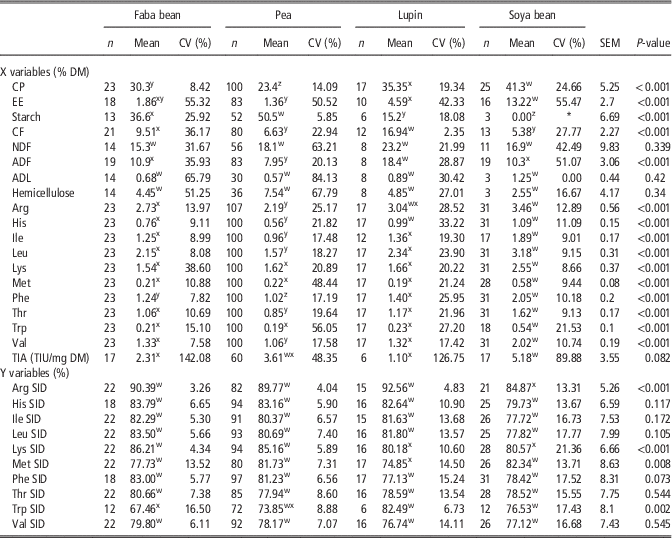
Descriptive statistics (number of observation, mean and standard deviation) were generated for each variable in the selected subgroups (Table 1). A correlation matrix was also performed between all nutritional parameters (data not shown). Particular attention was given to the meta-design, whereas the relationship between the independent variables taken 2 by 2 was examined graphically to assess the extent of variation in each experiment, to identify outliers, and to detect any co-linearity. Statistical analyses were carried out using the GLM model (Minitab, Version 16; Minitab Inc., State College, PA, USA). As suggested by Sauvant et al. (Reference Sauvant, Schmidely, Daudin and Saint-Pierre2008), the study effect was introduced into the model as a fixed effect because the data sets used for the analysis included a small number of studies and specific experimental conditions. It also allows proper prediction of the coefficients of the model and accurate description of the error of prediction (Sauvant et al., Reference Sauvant, Schmidely, Daudin and Saint-Pierre2008). These authors also mention that the statistical effect of the covariate is not dependent on whether the study is considered as a fixed or a random effect. Relationships between EAA SID or dEAA contents and chemical composition (CP, CF, ADF, NDF, ADL, hemicellulose and total EAA contents), legume seed type and surgical procedure were studied using a variance–covariance model as follows:
 $$Y_{{ij}} \,{\equals}\,\mu {\plus}\mu _{i} {\plus}\beta X_{{ij}} {\plus}Z_{i} {\plus}\beta _{i} X_{{ij}} {\plus}e_{{ij}} $$
where Y ij is the value of dependent variable Y in study i with j treatments, X ij the independent variable, μ the overall intercept across all studies (fixed effect), μ i the fixed effect of study i on the intercept of the model,β the linear coefficient of the relationship, β i the fixed effect of study i on the regression coefficient of Y on X, Z i the correction factor for pig category (according to BW < or >25 kg), or type of legume seeds or surgical procedures and e ij the unexplained residual error. Authors of published studies have measured digestibility using mono-ingredient semi-pure diets that sometimes have included other AA and sources of fibre. When ingredient composition or diet nutrient content was not indicated, estimates were produced based on ingredients composition tables (Sauvant et al., Reference Sauvant, Perez and Tran2004; NRC, 2012). Nutrient content data for ingredients and diets were therefore present in all the experiments included in the database. The effects of EAA and fibre content both in ingredients and diets were tested. Normal distribution of the data and homogeneity of variances were tested using respectively the Shapiro–Wilk and Levene tests respectively. To verify the stability of the models, the influence of secondary factors was tested on each model parameters. Individual within-experiment slopes were regressed on interfering factors to check that the model did not need an additional dependant (X) variable. Residuals (inter and intra) and the least square means of the model, representing for each experimental group i the predicted Y i for the co-variable X averaged across all experimental groups (X ij ), were also regressed on the major potentially quantitative interfering factors to ensure that there were no residual effects (Loncke et al., Reference Loncke, Ortigues-Marty, Vernet, Lapierre, Sauvant and Noziere2009) The fit of each relationship was then examined using the ‘studentized’ residuals of the model and normality of the residuals. Outliers were identified first on the basis of residuals and then by h i leverage (h i=1/n+(X i −X mean)2)2/Σ(Σ (X i X mean)2) 2), Cook’s distance and difference between the predicted values calculated with and without the ith observation (Sauvant et al., Reference Sauvant, Schmidely and Daudin2005). Graphical examinations were carried out at each stage of the meta-analysis. In this study, the accuracy of each study was considered, so a specific weight has been assigned to each study using standard deviation intra-experience. Thus, the influential data can be identified and the impact of their elimination on the model was tested. An internal validation was performed for all the models according to the steps described in Messad et al. (Reference Messad, Létourneau-Montminy, Charbonneau, Sauvant and Guay2016).
Description of legume seeds used for the meta-analysesFootnote 1

DM=dry matter; EE=ether extract; CF=crude fibre; Arg=arginine; His=histidine; Ile=isoleucine; Leu=leucine; Lys=lysine; Met=methionine; Phe=phenylalanine; Thr=threonine; Trp=tryptophan; Val=valine; SID=standardized ileal digestibility; TIA=trypsin inhibitor activity; TIU=Trypsin inhibitor unit.
x,y,z Means within a row without a common superscript differ significantly (P<0.05).
*No starch was found in the experiments.
1 In pig studies: the list of references used for the meta-analysis is given in Supplementary Material S3.
Results
Description of the selected data
The CP content was greater in the soya bean compared with faba bean, lupin, and pea (P<0.001; Table 1). The contents of NDF, ADL and hemicellulose were similar in all legume seeds, but the contents of ADF and CF were higher in lupin than faba bean, soya bean and pea (P<0.001). Soya bean had relatively higher EAA content, when compared with other legume seeds such as faba bean, lupin and pea. The content of EAA were similar between faba bean and lupin excepted for arginine (Arg), histidine (His), valine (Val) and phenylalanine (Phe). The lowest values for EAA were obtained with pea. The EAA SID were similar in lupin, faba bean, pea and soya bean excepted for Arg, Lys, Met and Trp. Arginine SID was lower in soya bean compared with other legume seeds (P<0.001). Lysine SID was lower in lupin and soya bean than in faba bean and pea (P<0.001), whereas Trp SID was lowest in faba bean followed by pea and highest in lupin and soya bean (P<0.001). Finally, Met SID was highest in soya bean, pea and faba bean, the lowest value was obtained in lupin (P<0.01).
Prediction standardized ileal digestibility of essential amino acids
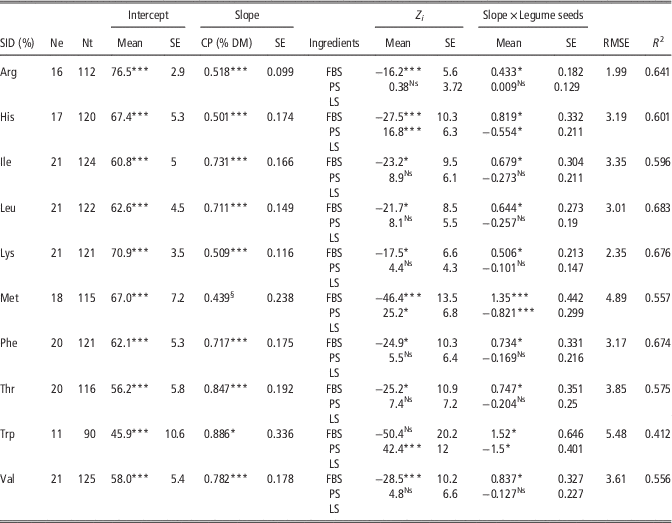
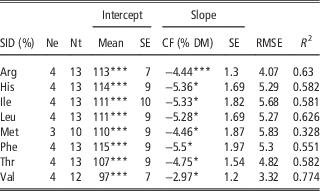
The first approach of this study was to establish specific EAA SID models for each ingredient. A graphical analysis of data from faba bean, pea, lupin and soya bean was first performed (data not shown). This approach allowed visualizing the structure of the population and to select the best ingredients grouping strategy in order to obtain homogeneous categories. Thus, two categories were established: one including faba bean, pea and lupin and other including only soya bean. For faba bean, pea, and lupin, graphical and statistical showed that EAA SID and CP were positively associated, with slopes varying from 0.44 to 0.89 (Table 2) and gave the best relation among the chemical components. Neither, surgical procedure nor BW appeared to affect EAA SID (data not shown). However, type of legume seeds did influence EAA SID estimation significantly (Table 2). The models presented low RMSE (1.99% to 5.48%) and high R 2 explaining 41.2% to 68.3% of the variance. The overall intercept of the models were significantly different from 0 (P<0.05). However, a specific correction factor on the intercept was assigned to each legume seeds. Correction factors were also assigned to the overall slope of models, according to the type of the legume seeds. These adjusted slopes were determined for the faba bean and pea compared with lupin. These adjustments varied from 0.44 to 1.52 and from −1.49 to −0.55 for faba bean and pea, respectively (Table 2). The negative effect of TIs content on SID of EAA was observed for all EAA. Thus EAA SID and TIs were negatively associated, with slopes varying from −10.00 to −2.67 (Supplementary Table S1), then when TIs content and the TIs×CP interaction were included as independent variable in the models, the R 2 of models were improved (R 2=0.59 to 0.83; Supplementary Table S1) and the RMSE decreased from 5.48% to 1.99% and 2.98% to 1.37%. However, it should be noted that the models established with TIs included only 60% of the database according to available TIs data. Concerning the soya bean, several predictors were tested, to predict the EAA SID. The GLM analyses showed that the EAA SID and CF were negatively associated with slopes varying between −5.36 and −2.97 and the intercept of the model was always significantly different from 0 for all models (P<0.001; Table 3). The models presented low RMSE (3.32% to 5.83%) and high R 2 explaining 32.8% to 77.4% of the variance.
Prediction of standardized ileal digestibility (SID) of essential amino acids in faba bean (FBS), pea (PS) and lupin (LS) from CPFootnote 1

DM=dry matter; Z i =correction factor of intercept for different legume seeds; Slope×Legume seeds=correction factor of slope for different legume seeds; RMSE=root mean square error; R 2=coefficient of determination; Ns=not significant; Arg=arginine; His=histidine; Ile=isoleucine; Leu=leucine; Lys=lysine; Met=methionine; Phe=phenylalanine; Thr=threonine; Trp=tryptophan; Val=valine; Ne=Number of experiment; Nt=Number of treatment; Ns=not significant.
1 In pig studies: the list of references used for the meta-analysis is given in Supplementary Material S4.
*P<0.05, ***P<0.001, §Tendency at P<0.10, Ns: P>0.10.
Prediction of standardized ileal digestibility (SID) of essential amino acids of soya bean from crude fibre (CF)Footnote 1

DM=dry matter; RMSE=root mean square error; R 2=coefficient of determination; Arg=arginine; His=histidine; Ile=isoleucine; Leu=leucine; Met=methionine; Phe=phenylalanine; Thr=threonine; Trp=tryptophan; Val=valine; Ns=not significant; Ne=Number of experiment; Nt=number of treatment.
1 In pig studies: the list of references used for the meta-analysis is given in Supplementary Material S5.
*P<0.05, ***P<0.001, Ns: P>0.10.
Prediction of dietary digestible essential amino acid concentration
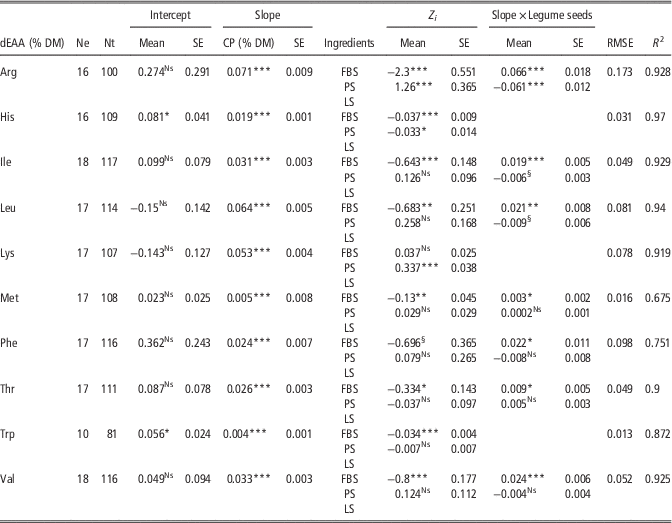
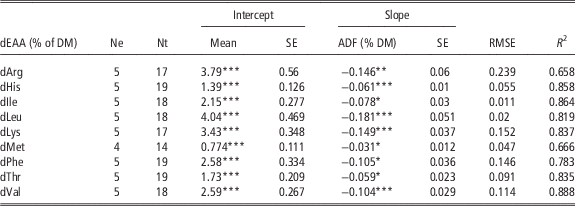
Outliers were eliminated from the original database resulting in a small decrease in the number of observations (Tables 4 and 5); the outliers representing <5% of the initial number of treatments depending on the models. The GLM analyses showed that the dEAA and CP were linearly and positively linked for faba bean, lupin and pea (R 2=0.68 to 0.97) with slopes varying from 0.004 to 0.071 (P<0.001; Table 4). The overall intercept of the dEAA models were not different from 0 except for His and Trp. However, the intercept was affected by the type of legume seeds. Lupin being the reference point, negative correction factors was applied for all EAA except to Lys for faba beans, whereas positive correction factors were applied for Arg and Lys (P<0.05) for pea. Slopes also differed between legume seeds. Concerning the correction of overall slope, positive corrections were assigned to models of dEAA for faba bean, except to His and Lys. Negative slope-correction factors were assigned to dEAA for Arg, Ile and Leu for pea. For soya bean seeds, results show a negative effect of ADF on dEAA (R 2=0.66 to 0.89) with intercept significantly different from 0 and slope varying between −0.03 and −0.18 (P<0.05; Table 5). Finally, BW of animals, surgical procedure, and the basal endogenous N loss estimation method did not affect the accuracy of dEAA estimation from chemical composition of legume seeds. The details of model evaluations are presented in the Supplementary Material S1.
Prediction of digestible essential amino acids (dEAA) of legume seeds (faba bean (FBS), pea (PS) and lupin (LS)) from CP1

DM=dry matter; Z i =correction factor of intercept for different legume seeds; Slope×Legume seeds=correction factor of slope for different legume seeds; Ns=not significant; RMSE=root mean square error; R 2=coefficient of determination; Arg=arginine; His=histidine; Ile=isoleucine; Leu=leucine; Lys=lysine; Met=methionine; Phe=phenylalanine; Thr=threonine; Trp=tryptophan; Val=valine; Ns=not significant; Ne=number of experiment; Nt=number of treatment.
1 In pig studies: the list of references used for the meta-analysis is given in Supplementary Material S4.
*P<0.05, **P<0.01, ***P<0.001, §Tendency at P<0.10, Ns: P>0.10.
Prediction of digestible essential amino acid (dEAA) concentrations of soya bean from ADFFootnote 1

DM=dry matter; RMSE=root mean square error; R 2=coefficient of determination; Ns=not significant; Arg=arginine; His=histidine; Ile=isoleucine; Leu=leucine; Lys=lysine; Met=methionine; Phe=phenylalanine; Thr=threonine; Trp=tryptophan; Val=valine; Ne=number of experiment; Nt=number of treatment.
1 In pig studies: the list of references used for the meta-analysis is given in Supplementary Material S5.
*P<0.05, ***P<0.001.
Discussion
The current meta-analysis combined results of 41 independent published experiments. The average composition of the ingredients included in the database is closed to values reported in reference tables (Sauvant et al., Reference Sauvant, Perez and Tran2004; NRC, 2012). For example, for legume seeds, variations of ±3 points of percentage were observed between the values obtained for EAA SID in the present study compared with values published by Sauvant et al. (Reference Sauvant, Perez and Tran2004). The only exception was for Trp SID with a variation of 8.04 points of percentage.
Prediction of standardized ileal digestibility of amino acids
Legume seeds (pea, faba bean, lupin)
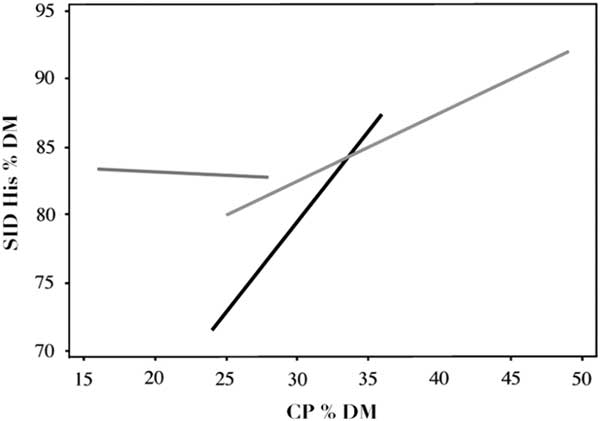
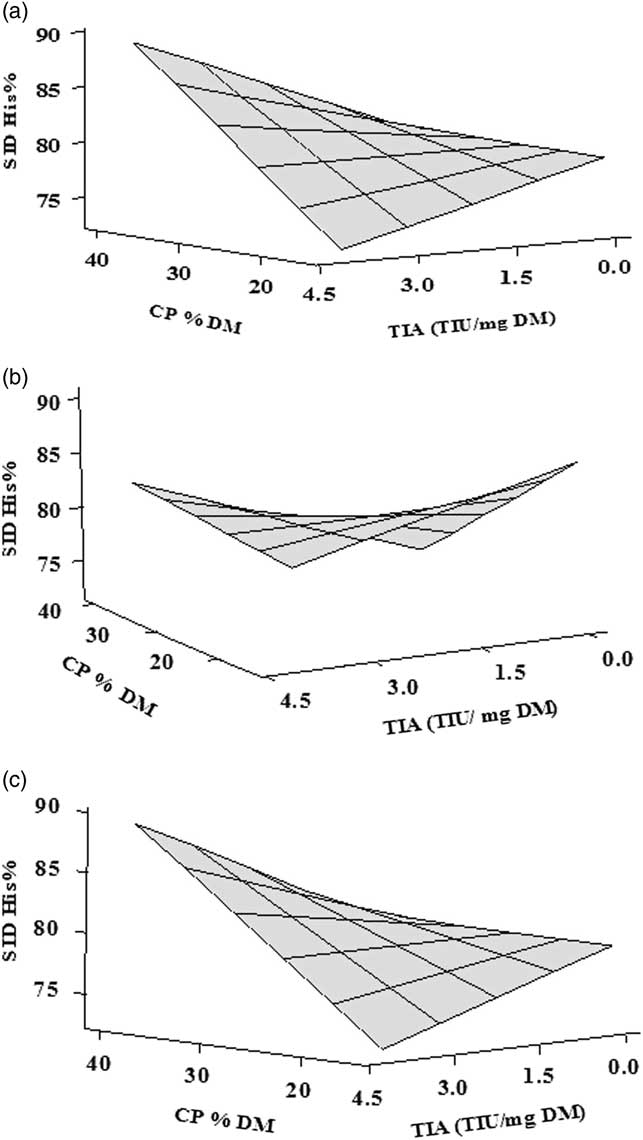
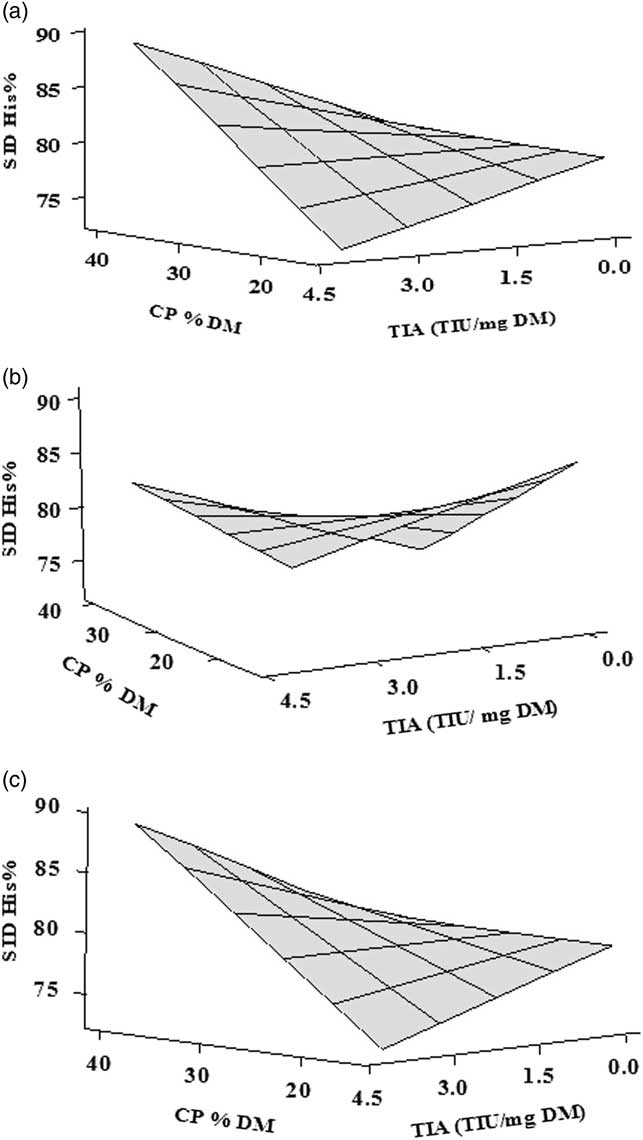
Given the high CP content of legume seeds, it is not surprising that this chemical component was the best predictor of EAA digestibility. In pea, a positive relation between CP content and SID EAA agrees with previous results (Hess et al., Reference Hess, Sève, Langer and Duc2000; Jezierny et al., Reference Jezierny, Mosenthin, Sauer, Roth, Piepho, Rademacher and Eklund2011) where pea varieties with high CP content had higher AID or SID of CP or EAA than low CP varieties. In lupin, higher SID of Lys and Met was found in variety containing 43% CP compared with variety of 34% CP (Chilomer et al., Reference Chilomer, Kasprowicz-Potocka, Gulewicz and Frankiewicz2013). These results can be explained by the maturation of seeds which modifies the chemical composition (e.g. reduction of CP) and decrease the digestibility of Lys and Met (Chilomer et al., Reference Chilomer, Kasprowicz-Potocka, Gulewicz and Frankiewicz2013). Conversely, other studies have found no difference for SID of EAA from different lupin varieties (Mariscal-Landin et al., Reference Mariscal-landin, Lebreton and Sève2002; Jezierny et al., Reference Jezierny, Mosenthin, Sauer, Roth, Piepho, Rademacher and Eklund2011). In faba bean, Mariscal-Landin et al. (Reference Mariscal-landin, Lebreton and Sève2002) and Jezierny et al. (Reference Jezierny, Mosenthin, Sauer, Roth, Piepho, Rademacher and Eklund2011) reported generally higher EAA SID in varieties with high CP concentration compared with those with low CP content. Although a positive correlation between EAA SID and CP was found for each legume seeds, the intercept was generally lower for faba bean, followed lupin and pea respectively (Figure 1). However, the effect of CP on EAA SID changed with ingredients. For faba bean, the slopes of EAA SID on CP were higher than those obtained for lupin. However for pea, the slopes of SID on CP were modified only for His, Met and Trp compared with lupin. In these cases, the slope was reduced and lowers than 0. Thus, an increase of 1% of CP content increase the His SID from 1.32% to 0.501% for faba bean and lupin respectively, but reduces the His SID (−0.053%) for pea. This result can be explained by the existence of another variation factor affecting EAA digestibility to explain the negative relation between His, Met and Trp SID and CP in pea. In this context, the inclusion of dietary TIs as the independent variable in the models improved the accuracy of models. This approach allowed seeing the depressive effect of TIs on EAA SID (Figure 2). This outcome confirms the results published by Leterme et al. (Reference Leterme, Beckers and Thewis1990a) and Grosjean et al. (Reference Grojean, Cerneau, Bourdillon, Bastianelli, Peyronnet and Duc2000) who observed a depressive effect of this ANF on the ileal digestibility of Lys, sulphur AA and Trp of pea. In the current experiment, the negative effect of TIs on EAA SID depends of the CP content considering TIs x CP interaction. Moreover, as shown in relations between CP and SID (Table 2), the relationship between CP and SID including TIs in the equations is always negative for peas for most EAA. Thus, when the content of CP is low, increasing TIs reduced the SID whereas at high levels of CP, TIs had little effect on the SID of EAA no matter the legume seeds. However, this relation was amplified in pea where TIs content was higher than in faba bean and lupin. This result may be also associated to presence of other ANFs in faba bean and lupin. Thus, the presence of tannin and vicine/convicine in legume seeds may have a negative effect on the EAA SID and may be inversely associated to TIs content (Salgado et al., Reference Salgado, Freire, Mourato, Cabralb, Toulle and Lalles2002; Jezierny et al., Reference Jezierny, Mosenthin, Sauer, Roth, Piepho, Rademacher and Eklund2011). The relationship between these other ANFs and the EAA SID did not establish due to lack of available data. However, the results of this study showed that models of prediction from CP predict the EAA SID with good accuracy (root mean square error of prediction (RMSEP)<9.5%; Supplementary Material S1 and Table S1) but this accuracy of prediction of EAA SID was better (RMSEP<6.5%) when the models included the TIs suggesting TIs (or factors associated) explained a part of SID variation in legume seeds.
Impact of dietary concentration of CP on the standardized ileal digestibility of histidine (SID His) for legume seeds. Black=faba bean; dark grey=pea; light grey=lupin; DM=dry matter.

Tree dimension representation between standardized ileal digestibility of histidine (SID His), CP and trypsin inhibitor activity (TIA) for legume seeds: (a) faba bean; (b) pea; (c) lupin. DM=dry matter.
In soya bean, the best predictor of EAA SID was CF except to Lys and Trp, for which no chemical components were associated significantly with the digestibility of these EAA. Unlike other legumes, CP is not a good predictor of SID for soya beans. This result can be due to a low CP variation in soya beans. However, this finding agrees with the negative correlation between CP and fibre content in soya bean and higher EAA SID that was observed in high-protein soya bean compared with conventional soya bean (Cervantes-Pahm and Stein, Reference Cervantes-Pahm and Stein2008). On the contrary, Baker et al. (Reference Baker, Kim and Stein2010) did not observe any relation between fibre concentration and EAA SID of soya bean. However, Ayoade et al. (Reference Ayoade, Kiarie, Woyengo, Slominski and Nyachoti2012) reported that EAA SID of soya bean increased by 3.4% units after enzyme supplementation of carbohydrase mixture suggesting that fibre degradation improve AA digestibility. These results may be explained by the fact than CF tends to stimulate the production and loss of endogenous N (Shah et al., Reference Shah, Atallah, Mahoney and Pellett1982). However, many studies reported that the effect of CF on digestibility of AA remains negligible, because the CF does not form a gel like pectins, and the CF has a limited capacity of peptide and AA adsorption compared with lignin which is not available in our database (Urriola et al., Reference Urriola, Cervantes-Pahm and Stein2013). Unlike other legume seeds, no improvements of the models were observed with the addition of TIs. This result can be explained by the reduced number of study in our database which does not allow observing direct effect of TIs on EAA SID. Moreover, the main TIs in soya bean is the Kunitz inhibitor which is very sensitive to heat (Di Pietro and Liener, Reference Di Pietro and Liener1989). Thus, TIs content in soya bean could have a limited effect considering the heat treatment applied in soya beans. In the present study, it was not possible to establish a relationship between the EAA SID and the processing temperature of soya beans because of the low number of publications (n=4). As well, thermal treatments reported in these publications were over 70°C, which is known to reduce significantly TIs activity (Sathe et al., Reference Sathe, Deshpande and Salunkhe1984).
Prediction of digestible ileal amino acid contents
The digestible nutrient content was calculated using total nutrient content multiplied by the digestibility coefficients. The prediction of dEAA, which represents the standardized ileal absorption of EAA, has also been performed in the current study. Although total essential amino acid (tEAA) were the best predictors for dEAA of legume seeds (Supplementary Material S2), only models with CP and fibre are presented considering that CP and fibre are more usual measurements done by feed manufacturer.
Legume seeds (faba bean, lupin, pea)
For legume seeds (faba bean, lupin and pea), CP and tEAA were the best predictor of dEAA (R 2=0.68 to 0.97; Table 4) and (R 2=0.93 to 0.99; Supplementary Material S2) respectively. The relation between CP and dEAA is in agreement with the prediction of EAA SID from CP. These results can be also explained by the good correlation between tEAA and CP as reported by Messad et al. (Reference Messad, Létourneau-Montminy, Charbonneau, Sauvant and Guay2015) for legume seeds, and suggested that measuring CP can give an overview of the nutritional value of these ingredients. Thus, these models allow more accurate and specific estimations of the dEAA for each legume source from the CP content. Other equations (NRC, 1998; Evonik, 2010) only predict the total EAA content. In this case, the prediction of the dEAA content requires the use of the theoretical and constant SID coefficients from the nutritional tables. In the present models, the intercept represents the endogenous losses. However, the overall dEAA model intercepts were not significantly different from 0 except to His and Trp. Specific correction factor for each ingredient in the overall calculation of the intercept were determined using lupin as the reference point. Thus, for pea, the correction-intercepts were generally not different of lupin, except for Arg, His and Lys. However, for faba bean, the correction-intercepts were generally negative for most EAA and then intercepts were different compared with lupin. These results suggest that endogenous losses would be higher in faba bean than in pea and lupin for a same CP content. These large endogenous losses for faba bean may be associated with higher tannin content in this feed (Jezierny et al., Reference Jezierny, Mosenthin, Sauer, Roth, Piepho, Rademacher and Eklund2011). Yet, Salgado et al. (Reference Salgado, Freire, Mourato, Cabralb, Toulle and Lalles2002) reported no difference in endogenous losses associated to lupin, faba bean and pea in weaning piglets. Positive slope-correction factors were observed for most EAA models of faba bean. These results could be explained by the difference in CP content or EAA profile of CP between lupin and faba bean. In fact, the CP content was higher in lupin than faba bean and the ratio AA/CP was lower in lupin than faba bean for the most EAA.
Soya bean
Concerning the soya bean, negative relationships were established between dEAA and ADF (Table 5). The intercept was significantly different from 0 and represents the endogenous losses when soya bean contains no fibre. The depressive effect of ADF on dEAA was in agreement with other published studies (Sève et al., Reference Sève1994; Lenis et al., Reference Lenis, Bikker, van der Meulen, van Diepen, Bakker and Jongbloed1996; Dilger et al., Reference Dilger, Sands, Ragland and Adeola2004). In fact fibres such as ADF may alter gastric and biliary secretions and increase pancreatic secretions of enzymes (Ikegami et al., Reference Ikegami, Tsuchihashi, Harada, Tsuchihashi, Nishide and Innami1990) and increase sloughing of intestinal epithelium (Shah et al., Reference Shah, Atallah, Mahoney and Pellett1982). These higher secretion or desquamation of the intestinal epithelium may result in an increase of endogenous CP and AA losses and then reduced the dEAA content.
Conclusion
The animal feed industry is looking for simple ways to quickly assess the quality of feedstuff, such as legume seeds (faba bean, lupin pea and soya bean) for pigs. The results of this study showed that it is possible to predict the nutritional value of the feedstuff from easily measurable components in the laboratory as CP and fibres. This approach allows an advance in the estimation of the dEAA contents as it is not based on the use of the average and invariable SID coefficients from the nutritional tables but makes it possible to estimate a specific SID and dEAA contents for the different sources of legumes.
Acknowledgments
This study was supported in part by a grant from Ministère de l’Agriculture, des Pêcheries et de l’Alimentation du Québec, to whom we are grateful.
Supplementary Material
To view supplementary material for this article, please visit https://doi.org/10.1017/S1751731117002427