Introduction
Approximately 73 million ha of agricultural land in the United States are devoted to pastures and haylands (Sanderson et al. Reference Sanderson, Jolley, Dobrowolski and Nelson2012). Forage production on pasturelands accounts for 2.8 million ha in Missouri. Approximately 25% of farmland in Missouri is dedicated to pastures (USDA ERS 2017), and the state has an inventory of 2.1 million beef cattle (USDA 2018). The primary source of feed for these animals is forage from pasture and stored forage from haylands. Fescue is the primary forage species throughout Missouri and much of the midwestern and eastern United States (Glenn et al. Reference Glenn, Glenn, Rieck, Ely and Bush1981). Many pastures throughout these regions consist primarily of a mixture of tall fescue and legume species, primarily clovers (Trifolium spp.), to increase feed quality (Phelan et al. Reference Phelan, Moloney, McGeough, Humphreys, Bertilsson, O’Riordan and O’Kiely2015).
Weed species are the primary pest of pastures and rangelands throughout the United States and account for at least $2 billion in economic losses annually (DiTomaso Reference DiTomaso2000). Weeds compete directly with desired species for resources such as soil nutrients, moisture, light, and space (Green et al. Reference Green, Witt and Martin2006). In grazing systems, animals are likely to consume weeds as well as the forage species (Popay and Field Reference Popay and Field1996). There have been many comparative studies of weed and forage nutritive values that indicate weeds may be comparable to forage species in that regard (Carlisle et al. Reference Carlisle, Watson and Cole1980; Marten and Andersen Reference Marten and Andersen1975; Marten et al. Reference Marten, Sheaffer and Wyse1987; Rosenbaum et al. Reference Rosenbaum, Bradley and Roberts2011; Sleugh Reference Sleugh1999). However, in most of these studies, weed and forage species were compared that were collected at the same time or at a specific growth stage. For example, Marten and Anderson (Reference Marten and Andersen1975) compared the forage nutritive value of 12 weed species harvested at two timings in late June and mid-July with samples of alfalfa harvested at the same time. Carlisle et al. (Reference Carlisle, Watson and Cole1980) tested 11 weed species for chemical composition and crude protein (CP) levels at physiological maturity. Both of these studies examined weeds at few and specific maturities and times.
Annual, biennial, and perennial broadleaf weeds are common in pastures. The annual weeds common ragweed and common cocklebur are two of the most common species in Missouri pastures (Rosenbaum et al. Reference Rosenbaum, Bradley and Roberts2011). Bosworth et al. (Reference Bosworth, Hoveland and Buchanan1986) found that Carolina geranium (Geranium carolinianum L.), cutleaf evening primrose (Oenothera laciniata Hill), curly dock (Rumex crispus L.), and Virginia pepperweed (Lepidium virginicum L.) had similar digestibility and CP levels as the forage species cereal rye (Secale cereale L.), tall fescue, ladino (or white) clover (Trifolium repens L.), and hairy vetch (Vicia villosa Roth) when harvested at the vegetative growth stage. In contrast, CP levels of the total harvested biomass in a tall fescue pasture decreased by 0.2 to 0.4 g kg−1 with each additional increase in common ragweed or common cocklebur plants m−2, respectively (Rosenbaum et al. Reference Rosenbaum, Bradley and Roberts2011). Research by Marten and Anderson (Reference Marten and Andersen1975) indicated that common ragweed has CP and digestibility equivalent to alfalfa when harvested in mid-July. Conversely, Carlisle et al. (Reference Carlisle, Watson and Cole1980) found that common ragweed had CP levels lower than that of tall fescue and below what is required for cattle maintenance requirements. The results of these studies indicate that the nutritive quality of common weed species can vary greatly when grown in the absence of competition and harvested at different maturities.
Little research has been conducted to determine the seasonal change in the nutritive value of common weed species throughout the growing season. The objectives for this study were to examine the seasonal variation in forage nutritive values of common weed species found in Missouri pastures in comparison with the representative weed-free forage found at the same location and time during the growing season.
Materials and Methods
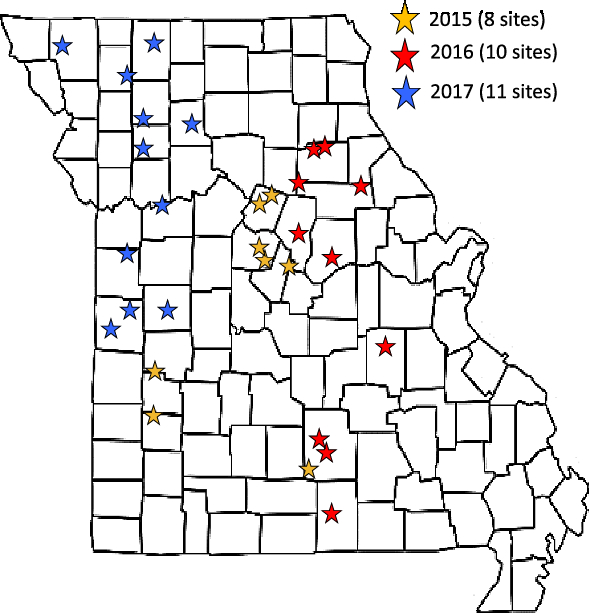
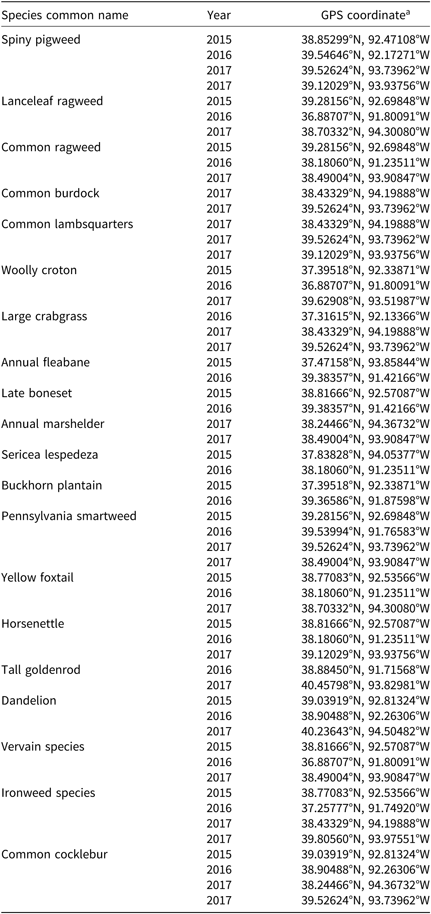
Weed and representative forage samples were collected during a pasture-weed survey conducted at 29 locations throughout Missouri from 2015 to 2017 (Figure 1; Table 1). Sampling of individual weed species began in mid-April or at emergence and continued at 14-d intervals until senescence or the end of September, whichever came first. Weed species were selected on the basis of their prevalence in surveyed pastures. Specific site information pertaining to the locations and years of each weed species collection are listed in Table 1.
Locations of weed and forage collections, 2015–2017.

Locations where weed and forage samples were collected in 2015, 2016, and 2017.

a Abbreviation: GPS, global positioning system.
At each location, pure samples of weed species were hand harvested by clipping weeds at the soil surface. The entire plant was included in the sample, and multiple plants were harvested to equal approximately 300 g of dry biomass. The weed species selected consisted of annual fleabane [Erigeron annuus (L.) Pers.], annual marshelder (Iva annua L.), buckhorn plantain (Plantago lanceolata L.), common burdock, common cocklebur, common lambsquarters (Chenopodium album L.), common ragweed, dandelion, horsenettle, ironweed species (Vernonia spp.), lanceleaf ragweed, large crabgrass, late boneset, Pennsylvania smartweed [Persicaria pensylvanicum (L.) Gómez], sericea lespedeza [Lespedeza cuneata (Dum. Cours.) G. Don], spiny amaranth, vervain species, tall goldenrod (Solidago altissima L.), woolly croton (Croton capitatus Michx.), and yellow foxtail [Setaria pumila (Poir.) Roemer & Schultes]. Species of ironweed and vervain were grouped as such to eliminate the possibility of misidentification during early stages of growth. Ironweed species included Baldwin’s, or western, ironweed (Vernonia baldwinii Torr.) and tall ironweed [V. gigantea (Walter) Trel.]; species of vervain included white vervain (Verbena urticifolia L.) and blue vervain (V. hastata L.). After each survey of a given pasture, an area that best represented the composition of the forage within that pasture was chosen, and a 300-g, weed-free sample of grass forage and legume species present was clipped to a height of 2.5 cm.
After collection, weed and forage samples were stored in a freezer, freeze-dried for 14 d at −10 C, and then ground in a laboratory mill (Thomas Scientific, 1654 High Hill Road, Swedesboro, NJ 08085) and then a by a cyclone mill (Udy Corp., 201 Rome Court, Ft. Collins, CO 80524) to pass through a 1-mm screen.
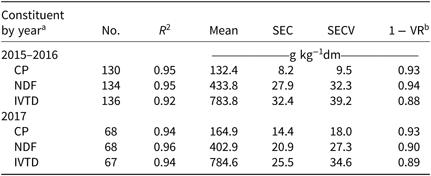
Analysis of forage and weed samples was conducted using near-infrared spectroscopy (NIRSystems 5000 Spectrophotometer; FOSS NIRSystems Inc., 8091 Wallace Road, Eden Prairie, MN 55344) to measure CP, neutral detergent fiber (NDF), and in vitro true digestibility (IVTD) of each sample. Traditional analytical chemistry was performed on a subsample of all collected forages and weeds to determine calibration equations. Chemical analysis consisted of measuring CP, NDF, and IVTD. Crude protein content was determined by using a True Spec N Analyzer (Leco Corp., 3000 Lakeview Avenue, St. Joseph, MI 49085) to determine the total amount of nitrogen in each sample. The total nitrogen concentration of each sample was multiplied by 6.25 to determine the total CP for each sample (National Research Council 1996). NDF levels were measured by washing samples with a NDF solution in a fiber analyzer (ANKOM Technology, 2052 O’Neil Road, Macedon, NY 14502) (Spanghero et al. Reference Spanghero, Boccalon, Gracco and Gruber2003). IVTD was determined by incubating samples for 48 h in rumen fluid collected from a cannulated cow offered a forage-based diet. Optimum calibration equations (Table 2) were based on high coefficients of determination and low SEs calculated during regression and cross-validation. Validation equations were used to predict CP, IVTD, and NDF of the selected weed and forage samples.
Near-infrared reflectance spectroscopy calibration and validation statistics for CP, NDF, and IVTD for 2015, 2016, and 2017 data.

a Abbreviations: CP, crude protein; dm, dry matter; IVTD, in vitro true digestibility; NDF, neutral detergent fiber; SEC, SE of calibration; SECV, SE of cross-validation in modified partial least squares regression; VR, variance ratio.
b Calculated in cross-validation during modified partial least squares regression.
Digestible neutral detergent fiber (dNDF) concentrations were calculated for weed and forage samples to compare the digestible portion of NDF. Digestible neutral detergent fiber is the measure of the portions of NDF that are digested when consumed by animals at a specified feed intake (Ball et al. Reference Ball, Collins, Lacefield, Martin, Mertens, Olson, Putnam, Undersander and Wolf2001). Calculations were made using the formula outlined by Mertens (Reference Mertens2009) using indigestible neutral detergent fiber (iNDF), which is 100 minus the IVTD and NDF levels (N.B., dNDF = NDF – iNDF).
Data Analysis
Nutritive value data for all weed species were analyzed using the PROC GLIMMIX procedure in SAS, version 9.4 (SAS Institute Inc., 100 SAS Campus Drive, Cary, NC 27513). Locations with distinct global positioning system coordinates (Table 1) were treated as replications, and species and date were considered fixed effects. Individual treatment differences were separated using Fisher protected LSD at P ≤ 0.05. Comparisons were made by subtracting the statistical mean of CP, NDF, dNDF, and IVTD of the weed-free forage sample from that of the respective weed species sample.
Results and Discussion
Crude Protein
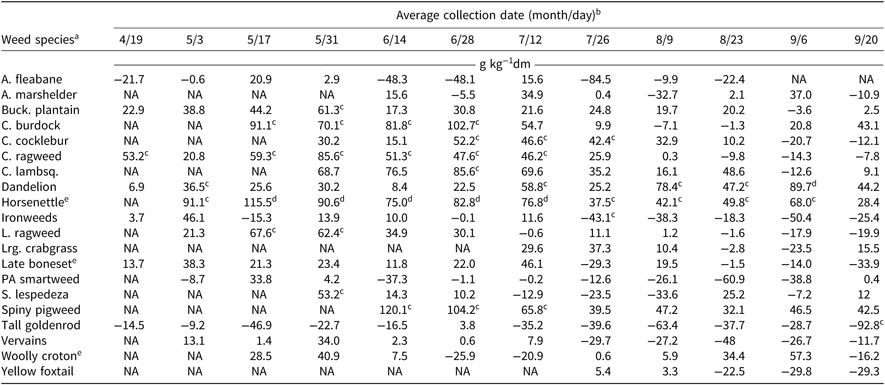
Crude protein is an estimate of the protein content of a plant and is approximately 6.25 times the total nitrogen content (Ball et al. Reference Ball, Collins, Lacefield, Martin, Mertens, Olson, Putnam, Undersander and Wolf2001). The CP content of a forage is composed of nonprotein nitrogen and digestible and indigestible protein nitrogen (Collins and Newman Reference Collins, Newman, Collins, Nelson, Barnes and Moore2018). Forage CP levels are considered adequate for maintaining mature beef cows at a level of 105 g kg−1 (Abaye et al Reference Abaye, Scaglia and Teutsch2009; Bosworth et al., Reference Bosworth, Hoveland and Buchanan1986). The CP content of woolly croton, large crabgrass, annual fleabane, late boneset, annual marshelder, Pennsylvania smartweed, yellow foxtail, and vervains was not different than the representative forage sample at any time throughout the growing season (Table 3). Buckhorn plantain, common burdock, common cocklebur, common lambsquarters, common ragweed, dandelion, horsenettle, lanceleaf ragweed, sericea lespedeza, and spiny amaranth had CP concentrations that were greater than that of the representative weed-free forage collected at the same time and location for at least one time during the season (Table 3). However, common burdock, common cocklebur, common ragweed, dandelion, horsenettle, lanceleaf ragweed, and spiny amaranth had greater CP content than did the representative forage at multiple times throughout the season.
Comparisons in crude protein content among selected weed species and the corresponding weed-free forage sample at each collection timing throughout the season.

a Abbreviations: A., annual; Buck., buckhorn; C., common; dm, dry matter; L., lanceleaf; lambsq., lambsquarters; Lrg., large; NA, not applicable; PA, Pennsylvania; S., sericea.
b Values shown are the product of the average crude protein content of the selected weed species minus the average crude protein content of the respective forage sample taken at the same collection location and time.
C Significant difference between weed species and corresponding weed-free forage samples at P ≤ 0.05.
d Significant difference between weed species and corresponding weed-free forage samples at P ≤ 0.001.
e Potentially toxic to grazing animals when consumed.
The CP content of common burdock was 91.1, 70.1, 81.8, and 102.7 g kg−1 dry matter (dm) greater than the representative forage sample for the May 17 through June 28 collection dates, respectively. Common cocklebur CP content was 52.2, 46.6, and 42.4 g kg−1 dm greater for the late June and July collection timings. Common ragweed had CP content that was greater than the forage sample for six of the 12 collections, and these values ranged from 46.2 to 85.6 g kg−1 dm greater than the representative forage harvested at the same time. These differences equate to actual CP concentrations for common ragweed of 157.6 to 261 g kg−1 dm (data not shown), which is similar to the levels reported by Marten and Anderson (Reference Marten and Andersen1975) of 251 g kg−1 dm. Horsenettle CP concentrations were significantly greater than those of the mixed tall fescue pastures for 10 of the 11 collection timings, with differences ranging from 37.5 to 115.5 g kg−1 dm. Crude protein content of spiny amaranth was significantly greater than that of forage for three of the eight collections. The actual CP content of spiny amaranth was 265 g kg−1 dm at the June 14 timing, which is similar to the results reported for other Amaranth spp. by Sleugh (Reference Sleugh1999).
Crude protein levels of tall goldenrod and ironweed species were significantly lower than that of the representative forage at one and three times, respectively (Table 3). Tall goldenrod CP content at the late September collection was 92.8 g kg−1 dm lower than that of the representative forage. The CP content of the species of ironweed was lower compared with the representative forage sample during the late July, early August, and early September collections, with differences of −43.1, −38.3, and −50.4 g kg−1 dm, respectively.
Neutral Detergent Fiber
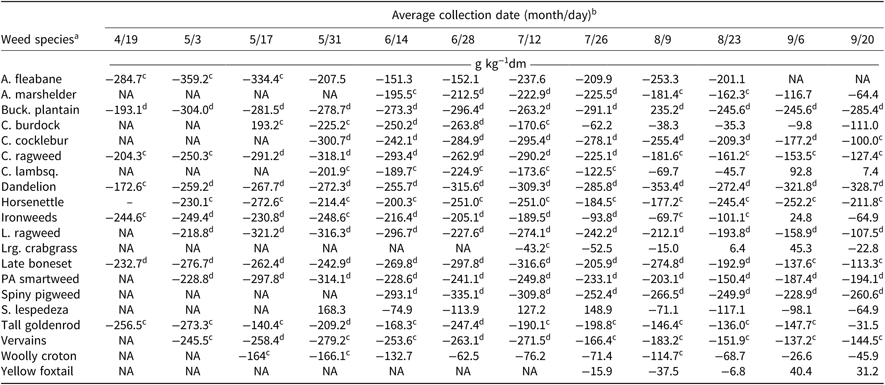
Neutral detergent fiber is the total fiber or cell wall fraction of a forage (Shewmaker Reference Shewmaker2005). This measure is often used as an indicator of forage intake and, in most instances, as NDF levels increase, animal intake of the forage decreases (Ball et al. Reference Ball, Collins, Lacefield, Martin, Mertens, Olson, Putnam, Undersander and Wolf2001; Shewmaker Reference Shewmaker2005). The NDF content of buckhorn plantain, common cocklebur, common ragweed, dandelion, horsenettle, lanceleaf ragweed, Pennsylvania smartweed, spiny amaranth, vervain species, and late boneset was lower than that of the representative mixed tall fescue forage sample for all collection periods for each weed (Table 4). Spiny amaranth had the greatest differences in NDF concentration compared with the forage, ranging from 228.9 to 335.1 g kg−1 dm less than the representative forage samples collected at the same time and in the same locations.
Comparisons in NDF content among selected weed species and the corresponding weed-free forage sample at each collection timing throughout the season.

a Abbreviations: A., annual; Buck., buckhorn; C., common; dm, dry matter; L., lanceleaf; lambsq., lambsquarters; Lrg., large; NA, not applicable; PA, Pennsylvania; S., sericea lespedeza.
b Values shown are the product of the average NDF content of the selected weed species minus the average NDF content of the respective weed-free forage sample taken at the same collection location and time.
c Significant difference between weed species and corresponding weed-free forage samples at P ≤ 0.05.
d Significant difference between weed species and corresponding weed-free forage samples at P ≤ 0.001.
e Potentially toxic to grazing animals when consumed.
Grasses consistently have greater NDF than do forbs (Marten and Andersen Reference Marten and Andersen1975). The results of this research support those of Temme et al. (Reference Temme, Harvey, Fawcett and Young1979), who showed that many dicot species have less NDF than do monocot species. The monocot weed species collected for this study (i.e., large crabgrass and yellow foxtail), contained similar NDF concentrations to that of the predominantly grass-based forage samples for five of the six collection periods for large crabgrass and for all collection timings of yellow foxtail.
Annual fleabane, annual marshelder, common burdock, common lambsquarters, ironweed species, tall goldenrod, and woolly croton had less NDF than did the representative forage sample at numerous collection timings. Neutral detergent fiber levels of sericea lespedeza were not different than that of the mixed forage sample at any given time throughout the growing season. Several weed species, such as common burdock, common lambsquarters, and ironweed species, were consistently lower in NDF content than was the representative forage for much of the growing season until late in the summer and early fall. This trend likely coincides with the maturity of each species and a shift from vegetative to reproductive growth. Lignin levels increase as plants mature (Van Soest Reference Van Soest and Van Soest1994), and the increase in lignified materials at more mature growth stages is associated with an increase in overall NDF content. Lower NDF levels are generally associated with lower digestibility (Ball et al. Reference Ball, Hoveland and Lacefield2018). Therefore, as NDF content of weeds decrease in comparison with the representative forage, the potential for increased intake by grazing animals is greater.
Digestible Neutral Detergent Fiber
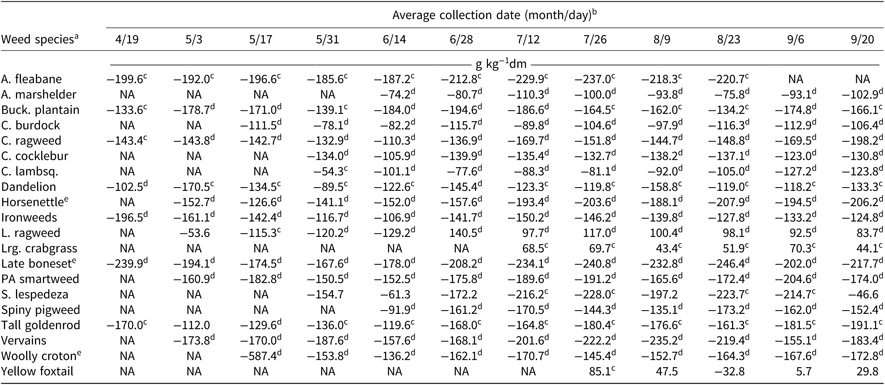
Digestible neutral detergent fiber is used as a measure of the digestible portions of NDF (Ball et al. Reference Ball, Collins, Lacefield, Martin, Mertens, Olson, Putnam, Undersander and Wolf2001). Greater concentrations of dNDF are indicative of a greater quality forage because more NDF is digestible and usable to the animal. Calculated dNDF levels (Table 5) of all species in the study except lanceleaf ragweed, large crabgrass, sericea lespedeza, and yellow foxtail were less than those of the representative mixed tall fescue forage. In fact, late boneset was 239.9 g kg−1 dm lower in dNDF than was the forage sample from the same location and collection period in mid-April, and woolly croton had 587.4 g kg−1 dm less dNDF content than did the representative forage during the mid-May collection timing. The dNDF levels of sericea lespedeza were not different than that of the mixed tall fescue forage sample for any collection date from late May until the conclusion of the study in late September.
Comparisons of digestible neutral detergent fiber content among selected weed species and the corresponding weed-free forage sample at each collection timing throughout the season.

a Abbreviations: A., annual; Buck., buckhorn; C., common; dm, dry matter; L., lanceleaf; lambsq., lambsquarters; Lrg., large; NA, not applicable; PA, Pennsylvania; S., sericea.
b Values shown are the product of the average digestible neutral detergent fiber (dNDF) content of the selected weed species minus the average dNDF content of the respective weed-free forage sample taken at the same collection location and time.
c Significant difference between weed species and corresponding weed-free forage samples at P ≤ 0.05.
d Significant difference between weed species and corresponding weed-free forage samples at P ≤ 0.001.
e Potentially toxic to grazing animals when consumed.
Large crabgrass had a greater dNDF concentration than did the representative mixed tall fescue forage for all collection periods (Table 5). Differences in dNDF ranged from 70.3 g kg−1 dm in early September to 43.4 g kg−1 dm for the collection in early August. Yellow foxtail dNDF content was greater than that of the forage at emergence in late July. Yellow foxtail was not different than the forage for any other collection period from early August to late September. It is expected that grass weed species should have similar or greater dNDF concentrations as compared with the predominantly tall fescue–based forage at each location. The greater dNDF concentrations of large crabgrass may be attributed to the life cycle differences between a warm-season annual and a cool-season perennial. For example, from mid-July to late September, large crabgrass was vegetative and actively growing, while tall fescue was mature and had not initiated fall growth. During this time, tall fescue generally has a low level of digestibility (Brown et al. Reference Brown, Blaser and Tontenot1955). In addition, tall fescue during the late summer typically has greater NDF content that is less digestible due to greater levels of lignification associated with plant maturity (Van Soest Reference Van Soest and Van Soest1994).
Lanceleaf ragweed had lower dNDF concentrations (115.3 to 129.2 g kg−1 dm) as compared with the mixed tall fescue forage for the collection periods from mid-May until mid-June (Table 5). Conversely, for the period from late June until late September, dNDF content for lanceleaf ragweed was greater than that of the forage. During this time, dNDF concentrations of lanceleaf ragweed ranged from 83.7 to 140.5 g kg−1 dm greater than that of the representative mixed tall fescue forage. During this same time, common ragweed was 136.9 to 198.2 g kg−1 dm lower in dNDF than was the representative forage. The differences in ragweed species may be attributed to the shorter stature of lanceleaf compared with common ragweed. With shorter plant heights there should be lower levels of lignified tissues, because of a greater leaf-to-stem ratio. A reduced leaf-to-stem ratio is associated with decreased nutritive values that often occur with maturity (Ball et al. Reference Ball, Collins, Lacefield, Martin, Mertens, Olson, Putnam, Undersander and Wolf2001; Foster et al. Reference Foster, Adesogan, Carter and Sollenberger2009). In Missouri, tall fescue matures and seed is produced in late spring to early summer. Pritchard et al. (Reference Pritchard, Folkins and Pigden1962) found that tall fescue digestibility after reproductive growth in early summer was lower than that of vegetative stage tall fescue in the spring. The late June change from lower dNDF content for lanceleaf ragweed to greater dNDF, as compared with the predominantly tall fescue forage, may be due to the differences in physiological maturity of the weed and forage.
In Vitro True Digestibility
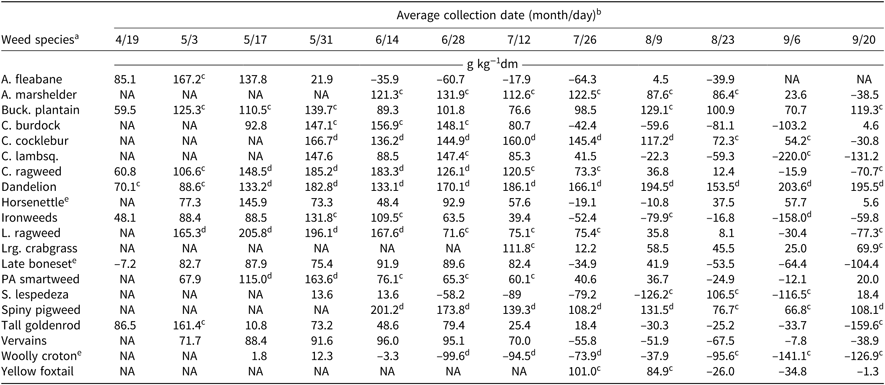
In vitro true digestibility is determined by incubating a ground forage sample in rumen fluid for 24 to 48 h (Ball et al. Reference Ball, Collins, Lacefield, Martin, Mertens, Olson, Putnam, Undersander and Wolf2001). This analysis gives a measure of the actual digestibility of a forage as well as an indication of animal performance. The IVTD concentrations of dandelion and spiny amaranth were greater than that of the mixed tall fescue and legume forage for all collection periods (Table 6). Dandelion ranged from 70.1 to 203.6 g kg−1 dm greater in IVTD as compared with the mixed tall fescue forage, whereas spiny amaranth IVTD concentrations ranged from 66.8 g kg−1 dm greater than that of the mixed tall fescue forage in late summer to a high of 201.2 g kg−1 greater than that of the forage in mid-June at weed emergence. Annual marshelder and common cocklebur had greater IVTD content than did the mixed tall fescue forage from emergence until reproductive growth stages were reached in early and late September, respectively. Common and lanceleaf ragweed also had IVTD levels greater than that of the mixed tall fescue forage for the period from May 3 until July 26, followed by IVTD content similar to that of the forage from early August to early September. This time is associated with the initiation of flower development and reproductive growth in these species (Bianchi et al. Reference Bianchi, Schwemmin and Wagner1959). By late September, the IVTD content of both ragweed species was less than that of the forage, which is likely due to the increasing lignification that occurs during reproductive growth.
Comparisons of in vitro true digestibility content among selected weed species and the corresponding weed-free forage sample at each collection timing throughout the season.

a Abbreviations: A., annual; Buck., buckhorn; C., common; dm, dry matter; L., lanceleaf; lambsq., lambsquarters; Lrg., large; NA, not applicable; PA, Pennsylvania; S., sericea.
b Values shown are the product of the average in vitro true digestibility (IVTD) content of the selected weed species minus the average IVTD content of the respective weed-free forage sample taken at the same collection location and time.
c Significant difference between weed species and corresponding WF forage samples at P ≤ 0.05.
d Significant difference between weed species and corresponding WF forage samples at P ≤ 0.001.
e Potentially toxic to grazing animals when consumed.
Large crabgrass and yellow foxtail had initial IVTD concentrations greater than that of the representative mixed tall fescue forage sample (Table 5), but for much of the season, there were no differences between weeds and the representative forage. Pennsylvania smartweed had greater IVTD content for five of the initial six collection periods, from mid-May until mid-July. Ironweed species were not significantly different than the mixed tall fescue forage for much of the season, but late May to mid-June IVTD levels were greater than that of the representative forage by 131.8 and 109.5 g kg−1 dm, respectively. Although ironweed species may have a comparable or greater IVTD content than the forage from the same location and time, it is generally not used by grazing cattle. Israel and Rhodes (Reference Israel and Rhodes2013) reported that ironweed is generally avoided by grazing cattle because of a lack of palatability, and any potential forage use may decline as a result of avoidance. As ironweed matured, IVTD decreased to the extent that during the early August and early September collection dates, the IVTD levels of mixed tall fescue forage samples were 79.9 and 158 g kg−1 dm greater than those of the ironweed species, respectively. The lack of quality during this period may further explain the lack of cattle use for this species in a pasture setting.
Horsenettle, vervain species, and late boneset did not differ in IVTD levels compared with the representative mixed tall fescue forage available at each location at any point throughout the growing season. Woolly croton IVTD content was lower during six of 10 collection periods. The IVTD content was 141.1 and 126.9 g kg−1 dm less than that of the mixed tall fescue forage for the early and late September collections, respectively. These dates correspond with flowering and early seed fill of woolly croton and the initiation of fall growth and greater digestibility of the tall fescue forage (Pritchard et al. Reference Pritchard, Folkins and Pigden1962).
The results of this research indicate that, from the standpoint of forage nutritive value, not all weeds in a pasture system are detrimental. At certain times during the growing season, many weeds, such as common burdock, common ragweed, lanceleaf ragweed, and spiny amaranth, have greater CP levels than do the available forage from the same location. The IVTD content of many weeds was also greater than that of the representative forage from the same location; annual marshelder, buckhorn plantain, common burdock, common cocklebur, common ragweed, and Pennsylvania smartweed were all greater in digestibility than was the representative forage at numerous time intervals throughout the season. For most summer annual weeds, the trend was toward greater digestibility earlier in the season, with a gradual decline and often lower IVTD by the late summer or early fall. Dandelion and spiny amaranth IVTD concentrations were also greater than that of the forage at every collection period.
Although the results of this research indicate that some weed species may provide needed nutrition to grazing animals, many perennial weeds had poor nutritive values for much of the growing season. For example, ironweed had lower CP content at multiple collection dates in summer and early fall, whereas tall goldenrod and sericea lespedeza had similar CP content for most of the growing season and similar or lower IVTD content as the available mixed tall fescue forage. Horsenettle also had greater CP concentration than did the available mixed tall fescue forage for 10 of 11 collections and had similar IVTD at all collection dates.
The results of this study will enable producers to make educated management decisions based on the potential benefit or detriment a weed may provide to the overall nutritive value of the pasture system. Providing a comparison of weed and forage at different times across the growing season allows a more thorough assessment of the potential of a weed to positively or negatively affect the pasture system seasonally. By comparing weed species with the forage available in the same location at the same time, a better estimate of the forage value of the weed can be made because potential biotic and abiotic stresses were the same for a given collection period. This work also will be useful to understand and compare seasonal changes in nutritive value of annual, biennial, and perennial weed species in mixed tall fescue and legume pasture systems found throughout much of the midwestern and eastern United States.
Acknowledgments
No conflicts of interest have been declared. This research received no specific grant from any funding agency, or commercial or not-for-profit sectors.