1. INTRODUCTION
One of the most remarkable features of Övdalian syntax is the possibility of referential null subjects. The pronouns corresponding to we and you (plural) are in general null, as similarly evidenced in well-known null-subject languages such as Spanish or Turkish. Examples of the phenomenon in Övdalian are given in (1).
(1)


All other pronouns in Övdalian, including the non-referential eð ‘it’, ‘there’ and the generic pronoun an ‘one’, which can also mean ‘he’, must be pronounced, however.Footnote 1 In this respect, Övdalian corresponds to Germanic vernaculars such as Bavarian or Frisian – in these language varieties, certain pronouns, but not all, are regularly omitted. They are thus partial null-subject languages (Platzack Reference Platzack2003, Reference Platzack2004; Holmberg Reference Holmberg2005, Reference Holmberg2010; Koeneman Reference Koeneman2006; Shlonsky Reference Shlonsky2009; Biberauer Reference Biberauer2010).
In this paper, I show that Övdalian is a partial null-subject language, and that the two possible null subject pronouns actually obey different syntactic restrictions. Therefore, I conclude that two different analyses must be provided. The Övdalian data are then used as a background for a general discussion about referential null subjects in wider Germanic and in partial null-subject languages in general.
Section 2 contains a brief introduction to Övdalian, while Section 3 provides evidence that Övdalian is a partial null-subject language as stated above. In Section 4, the syntactic properties of the Övdalian null subjects are further discussed, and in Section 5 I propose an explanation for the syntactic properties of null wįð ‘we’Footnote 2 based on proposals made by Frascarelli (Reference Frascarelli2007) and Sigurðsson (Reference Sigurðsson2010). The topic of Section 6 is null ið ‘you-plural’. In the analysis of null ið presented here, I assume that the corresponding agreement affix (-ið) may have pronominal properties, following work by Koeneman (Reference Koeneman2006). Section 7 contains a brief overview of other Germanic partial null-subject languages. A conclusion and some final comments of a more general character can be found in Section 8.
The main purpose of this paper is to present a new set of relevant data and to discuss these data in the light of recent theories about null subjects (Koeneman Reference Koeneman2006; Frascarelli Reference Frascarelli2007; Sigurðsson Reference Sigurðsson2010), not to develop a new theory for the null-subject phenomenon.
2. NULL SUBJECTS – A BRIEF THEORETICAL BACKGROUND
In most of the world's languages, referential subjects may in general be omitted (Gilligan Reference Gilligan1987). Rizzi (Reference Rizzi1982, Reference Rizzi1986) suggested that the languages of the world can be divided into null-subject languages (NSLs) and languages in which subjects must be overt. In NSLs, the subject role is fulfilled by a null pronoun (pro), which must be licensed and identified. Licensing decides which syntactic configurations allow pro and identification recreates the semantic content of the omitted subject, typically by ‘strong’ or ‘rich’ verb agreement (see Vikner Reference Vikner1995, Reference Vikner1997; Rohrbacher Reference Rohrbacher1999), the idea being that the content of a referential subject cannot be identified unless the specific person/number combination of the subject is reflected by agreement on the finite verb or elsewhere in the clause. In a language with ‘weak’ verb agreement on the other hand, only non-specific (i.e. non-referential) subjects may be omitted. Hence, a strict implication follows from Rizzi's hypothesis: any language which allows referential null subjects (RefNSs) will also allow non-referential null subjects.
A significant factor for the identification of RefNSs is thus verb agreement (Taraldsen Reference Taraldsen1978; Jaeggli & Safir Reference Jaeggli, Safir, Jaeggli and Safir1989:26ff.).Footnote 3 Borer (Reference Borer1986) suggests that agreement affixes on the finite verb actually may function as subjects per se, being ‘I-subjects’. This proposal has become a standard analysis: ‘Indeed, the possibility of null subjects in a given language has been generally attributed to the pronominal character of its agreement morphology’ (Frascarelli Reference Frascarelli2007:692). Similar proposals have been made by Platzack (Reference Platzack2004), Koeneman (Reference Koeneman2006) and Barbosa (Reference Barbosa2009).
Languages with ‘weak’ or no verb agreement which nonetheless allow RefNSs, such as Mandarin (Huang Reference Huang1984), constitute a problem for Rizzi's hypothesis. Furthermore, partial and asymmetrical NSLs have called into question the simple division into NSLs and non-NSLs. In a partial NSL such as Hebrew or Finnish, for instance, RefNSs only appear in certain person/number combinations, and in asymmetric NSLs (e.g. Arabic, see Alexiadou Reference Alexiadou2006), the syntactic distribution of RefNSs is limited to certain positions in the clause. In generative grammar (Chomsky Reference Chomsky1995, Reference Chomsky and Kenstowicz2001), the subject role cannot be fulfilled by an unrealized pronoun (pro) which is identified by agreement on the finite verb, since syntactic ϕ-features only are interpretable on a DP/NP. Hence, ϕ-features on a verb are uninterpretable and must be valued and deleted in the course of the syntactic derivation. Indeed, Holmberg (Reference Holmberg2005:536) emphasizes that
The theory of pro . . . cannot be maintained in a theory making the distinction between interpretable and uninterpretable features that plays a crucial role in Chomsky Reference Chomsky1995: chapter 4 and subsequent work by Chomsky and others.
New analyses have therefore been put forth by Holmberg (Reference Holmberg2005; Finnish), Ackema et al. (Reference Ackema, Brandt, Schoorlemmer and Weerman2006a), Frascarelli (Reference Frascarelli2007; Italian), and Barbosa (Reference Barbosa2009; Portuguese), among others. These analyses depart either from Borer's (Reference Borer1986) pronominal-affix hypothesis (‘I-subject’) or from the assumption that RefNSs may in some way be identified via the discourse, or from a combination of these hypotheses. Frascarelli (Reference Frascarelli2007) proposes that null subjects in Italian are identified in an Agree relation with an Aboutness-shift Topic, and Sigurðsson (Reference Sigurðsson2010) claims that all null arguments, subjects as well as objects, must be successfully Context-Linked in order to be properly identified. Below, after having demonstrated that the two possible null subjects in Övdalian obey different syntactic restrictions, I argue that the properties of null wįð ‘we’ suggest that the latter type of analysis (context-linking) is on the right track, whereas the properties of null ið ‘you’ appear to support the idea that agreement affixes may function as pronouns in some NSLs.
In the Germanic languages, non-referential subjects may be omitted in Icelandic and German (Sigurðsson & Egerland Reference Sigurðsson and Egerland2009), but no standard Germanic language allows RefNSs. This fact led Jaeggli & Safir (Reference Jaeggli, Safir, Jaeggli and Safir1989) and Rohrbacher (Reference Rohrbacher1999) to the conclusion that RefNSs are incompatible with V2 word order. For this reason, the Germanic V2 languages have played a very small role in research on null subjects and hence there are no comprehensive studies or analyses of RefNSs based on Germanic language varieties. However, RefNSs do appear in several non-standard Germanic language varieties, such as Bavarian (Bayer Reference Bayer1984; Weiß Reference Weiß1998), Zürich German (Cooper Reference Cooper and Penner1995), Schwabian (Haag-Merz Reference Haag-Merz1996), Frisian (de Haan Reference de Haan1994; Hoekstra Reference Hoekstra1997), Yiddish (Prince Reference Prince, Bosch and van der Sandt1998; Jacobs Reference Jacobs2005), and Övdalian (Levander Reference Levander1909; Rosenkvist Reference Rosenkvist1994, Reference Rosenkvist2006, Reference Rosenkvist2009). In this paper, the main topic is the syntactic properties of Övdalian null subjects, but in Section 7 the perspective is widened and I expand the discussion to include other Germanic partial NSLs.
3. ÖVDALIAN
3.1 A brief introduction to Övdalian
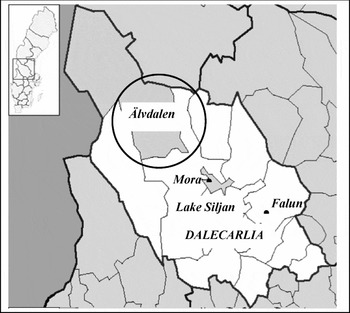
ÖvdalianFootnote 4 is spoken in the north western part of Dalecarlia, Sweden, by 3000–4000 speakers (Steensland Reference Steensland, Vamling and Svantesson2000; see Figure 1). Övdalian and Swedish are mutually incomprehensible, but there are no longer any monolingual speakers of Övdalian. According to Dahl (Reference Dahl2005; see also Dahl Reference Dahl, Sampson, Gil and Trudgill2009), Övdalian is typologically closer to Icelandic and Faroese than it is to Swedish. The linguistic peculiarity of the Upper Siljan region, including Älvdalen, was noted by Swedish linguists in the 17th century, and the first academic dissertation concerning the language varieties of Dalecarlia was written in 1733 (Näsman Reference Näsman1733). Still, this area is remarkably different when compared with surrounding dialects: ‘The archaic and diversified dialects of Dalarna hold an exceptional position’ (Hallberg Reference Hallberg, Bandle, Braunmüller, Jahr, Karker, Naumann and Teleman2005:1697).
The location of Älvdalen. Övdalian is spoken in the southern, encircled part of the municipality.

To mention but a few Övdalian morphosyntactic features which separate Övdalian from Swedish, Övdalian has a three-way gender system and a complex case system (Ringmar Reference Ringmar2005), null referential subjects (Rosenkvist Reference Rosenkvist2006), and negative concord and verb raising (Garbacz Reference Garbacz2006, Reference Garbacz2010), but seems to lack object shift; further syntactic exploration of Övdalian is currently underway within the ScanDiaSyn project.Footnote 5
During the 20th century, several radical social changes have affected the sociolinguistic situation in Älvdalen, none of which have strengthened the position of Övdalian (Björklund Reference Björklund1958; Helgander Reference Helgander1996, Reference Helgander, Melander, Claesson, Josephson, Larsson, Nordberg and Östman2005a, Reference Helganderb). Hence, there is at present a notable variation between generations as older speakers have been forced to learn Swedish at the start of school – now some older speakers avoid Swedish when they can – while younger speakers increasingly use Swedish in all contexts (Helgander Reference Helgander1996).
At present, the organization for the preservation of Övdalian (Ulum Dalska ‘we shall speak Övdalian’/‘let us speak Övdalian’) is striving for minority language status, and to this end they have encouraged the production of a grammar (Åkerberg Reference Åkerberg2000) as well as an Övdalian–Swedish lexicon (Steensland Reference Steensland2006), and they support courses in what is known as ‘classic’ Övdalian (i.e. the Övdalian described by Levander Reference Levander1909). The new orthography, which is utilized in the present paper, is a result of their efforts.
3.2 Övdalian verb agreement and null subjects
In Övdalian, subject pronouns in the 1st and 2nd person plural are regularly omitted, but no other pronouns (with the exception of deletion due to topic drop or deletion in coordination, etc.). Levander (Reference Levander1909:109) remarks:
Personal pronouns in first and second person plural are omitted when they are used as subjects and when the corresponding clause in Swedish would be subject initial. . . When Standard Swedish has inverted word order pronouns may likewise be omitted, but are in general pronounced. (my translation)
Just as in Spanish or any other NSL, the default option in Övdalian is to use covert forms of ‘we’ and ‘you’ – these pronouns are overt in clause-initial position only when the speaker wants to stress the subject. However, all generic and non-referential subjects must be overt – it would be ungrammatical to omit an in (2c) or eð in (2d and e).Footnote 6
(2)
The requirement that non-referential subjects be spelled out in Övdalian, even though some RefNSs are possible, contradicts the generalization that languages with RefNSs always allow non-referential null subjects. Roberts & Holmberg (Reference Roberts and Holmberg2010:8) claim that ‘[t]here is thus an implicational relation between the presence of referential null subjects and the presence of expletive null subjects’, and this generalization is taken as a point of departure in their subsequent categorization of possible null-subject languages.Footnote 7 The Övdalian data suggest, however, that the basic generalization may need to be revised.
Null referential subjects of the type discussed above have occurred in Övdalian at least since the beginning of the 17th century – all of the following examples (which are presented in their original orthography) display a null wįð ‘we’.Footnote 8 Note that in (4b) and (6), the null pronoun functions as a subject in an embedded clause.
(3)
(4)
(5)
(6)
Footnote 9 There are thus reasons to believe that null subject pronouns have been a regular property of Övdalian for at least four centuries.
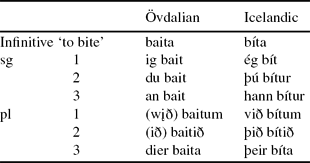
Universally, there seems to be a correlation crosslinguistically between languages with robust subject–verb agreement (see Vikner Reference Vikner1997; Rohrbacher Reference Rohrbacher1999) and languages with null subjects. Weak verbs in the present tense indicative in Övdalian are inflected as in Table 1 (Levander Reference Levander1909:84ff.); Icelandic verbs are shown as a comparison, and the respective personal pronouns are also included.
Verb agreement and personal pronouns in Övdalian and Icelandic.
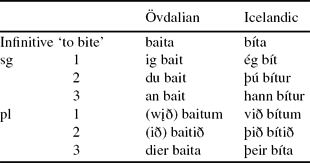
As can be seen, the Övdalian singular verb forms are not inflected for person, and 3pl is identical to the infinitive (as in many Germanic languages):
When it concerns present tense indicative plural it should be noted that the third person is always identical to the infinitive. (Levander Reference Levander1909:85; my translation)
In discourse, the form for 3pl furthermore often coincides with the singular form in Övdalian, since the affix -a is deleted in non-final position due to apocope. Hence, only the forms for 1pl and 2pl are distinctly marked for person, and Övdalian null subjects only appear with these verb forms (in present and past tense). In Icelandic, on the other hand, no referential null subjects are possible.
The forms for 1pl and 2pl indicative are furthermore in general homonymous with the imperative forms, as illustrated in (7).
(7)
In clauses such as the ones above, the pragmatic context and the prosody determine whether the clause should be interpreted as indicative or imperative. This circumstance may have played a vital role for the emergence of null wįð and I return to this matter in Section 7.
Null subjects seem to be an Övdalian innovation – the Old Scandinavian languages did not allow null subjects such as those of Övdalian (Håkansson Reference Håkansson2008; Rosenkvist Reference Rosenkvist2009),Footnote 10 and there are no traces of null subjects of this type (i.e. ‘we’ and ‘you’ are overt only when they are stressed) in the Dalecarlian Law, a provincial law from the 13th century (the oldest preserved text from this general area). However, due to the lack of historical evidence, it is probable that there will be no definitive solution to this matter.
There are however similar null subjects in the nearby Våmhus dialect, but apparently not in the Mora and Orsa dialects, all of which are spoken in the Upper Siljan area.
3.3 Common properties of null subject languages – the case of Övdalian
It is well-known that the Romance null subject languages exhibit a number of syntactic features that have been assumed to go hand-in-hand with the possibility of having null referential subjects (Rizzi Reference Rizzi1982, Reference Rizzi1986; see Roberts Reference Roberts2007:24ff.). Also Greek, for example, appears to display the same cluster of syntactic properties (Roberts Reference Roberts2007:27ff.). In this section, three such features (disjoint subject reference, free subject inversion and that-trace effects) in Övdalian are presented and discussed.Footnote 11
3.3.1 Disjoint subject reference
In Italian, for example, a language which allows referential null subjects, an overt subject pronoun embedded below a subject in matrix clause does not in general refer to the main clause subject as shown in (8).
(8)
In (8), lui cannot refer to il professore unless lui is stressed, modified or coordinated (Rizzi Reference Rizzi1986). In non-null-subject languages such as English or French, ‘he’ in a corresponding position is ambiguous, referring either to the subject of the matrix clause or to an antecedent in the discourse. Övdalian patterns with non-null-subject languages in this respect, as shown in (9).
(9)
In (9), the embedded pronoun an is ambiguous.
3.3.2 Free subject inversion
In the Romance null subject languages, the subject of a regular declarative clause may occur in clause-final position (10a). However, this is not an option in Övdalian, as shown in (10b).
(10)
Again, Övdalian differs from regular null subject languages.
3.3.3 That-trace effects
Another feature that seems to unite the Romance null subject languages is the possibility of retaining the complementizer in embedded clauses with an extracted subject, as shown in the Italian example below in (11a). In non-null-subject languages such as English (11b) and Swedish (11c) on the other hand, ‘that’ must be unpronounced when the subject is extracted as shown in the contrast.
(11)
In Övdalian, there actually seems to be at least three syntactic options for corresponding constructions, but it is not possible to spell out at in a Romance fashion as shown in (12).
(12)
In (12a), we see that the strategy applied in non-null-subject languages is viable also in Övdalian. The complementizer must be covert. However, in (12b) the structure is salvaged by a resumptive pronoun in the embedded clause, and at need not be omitted (it should be pointed out that an is the default generic pronoun in Övdalian). In Northern Norwegian also, resumptive pronouns may obviate the that-trace effect (Taraldsen Reference Taraldsen2005).
In (12c), so is used as a complementizer. So is multifunctional; it may be a relative pronoun, an adverb, or a coordinator. Levander (Reference Levander1909:120) remarks that the Övdalian so very often occurs in contexts where it would be ungrammatical in Swedish, and Vangsnes (Reference Vangsnes2007) has observed that in the Sogn area (Norway), som may be inserted in the very same manner as shown in (12c).
As for the complementizer at, it is well-known that it is generally omitted in Övdalian: ‘At introduces finite embedded clauses, but is omitted in most cases’ (Åkerberg Reference Åkerberg2000:68; my translation; see also Levander Reference Levander1909:119). The syntactic behaviour of Övdalian so and at are at present unknown, and hence the detailed syntactic structure of (12b and c) must be left for future research. Neither of these Övdalian constructions are however grammatical in standard Swedish.
4. THE SYNTACTIC PROPERTIES OF ÖVDALIAN NULL SUBJECT PRONOUNS
Reading Levander (Reference Levander1909:108; see the first quote in Section 3.2 above), one gets the impression that there is no difference between wįð ‘we’ and ið ‘you’ as far as their syntactic distribution is concerned. This, however, is not the case – the following restriction seems to have applied throughout the entire period from which Övdalian data are known:
The two pronouns wįð ‘we’ and ið ‘you’ are omitted when the subject is initial . . . When the word order is inverted, wįð must be overt, but not ið. (Nyström & Sapir Reference Nyström and Sapir2005:25; my translation; see Levander Reference Levander1909:108–109)
Accordingly, wįð may be omitted only from what appears to be the topic position (SpecCP) and must be spelled out when SpecCP is occupied by another constituent – see the examples in (13) – while this restriction does not apply for ið, as shown in (14). In (13c), I assume that there is a question operator in SpecCP, which prohibits null wįð.
(13)
(14)
Both types of subjects may, however, be covert in adverbial embedded clauses, as in (15).
(15)
In contemporary Övdalian, some (mainly younger) speakers seem to prefer the Swedish word order (the finite verb follows sentential adverbs) in embedded clauses, while other speakers prefer the Icelandic word order (the finite verb precedes sentential adverbs) (Garbacz Reference Garbacz2006:177, Reference Garbacz2010: Chapter 6). The latter word order is probably representative of older Övdalian; Levander (Reference Levander1909:123) explicitly remarks that:
The word inte [‘not’] cannot appear between the predicate and the subject in embedded clauses, as in the standard language [i.e. Swedish]; if it does not appear in initial position, it must hence be put after the predicate. (my translation)
However, in present-day Övdalian, both alternatives below are possible:Footnote 12
(16)
The situation changes, though, when the subject of the embedded clause is null. In that case, verb raising appears to be required (see Rosenkvist Reference Rosenkvist1994; Garbacz Reference Garbacz2006, Reference Garbacz2010:112f.). This applies to both of the possible null subjects (wįð and ið). In (17b), it is shown that a pre-verbal adverbial (in this case naug ‘probably’) in the embedded clause is incompatible with a null subject.
(17)
Hence, it is plausible that verb raising (to T°) is a prerequisite for null subjects in Övdalian – younger speakers, who often use Swedish word order in embedded clauses, consequently do not omit subject pronouns as often as older speakers (Rosenkvist Reference Rosenkvist1994; Helgander Reference Helgander2005b:23f.).Footnote 13
So, there seems to be some form of restriction for null wįð, whereas null ið may appear wherever a pronounced subject ið is possible.Footnote 14 In the following sections, I take a closer look at the syntactic properties of these RefNSs. Due to the syntactic differences illustrated above, I suggest one analysis for null wįð, and another for null ið.
5. THE SYNTACTIC PROPERTIES OF NULL WĮ Đ – A DETAILED DESCRIPTION
5.1 Syntactic properties of null wįð
As mentioned above, null wįð appears to be confined to clause-initial position. In main clauses, this position is SpecCP, and the omission of wįð from this position is not in principle to be structurally distinguished from regular cases of topic drop. Therefore I will first establish the non-applicability of the topic-drop hypothesis below.
There are at least two Övdalian clause structures where the null wįð cannot be an instance of topic drop: omission from main clauses with initial kanstji ‘maybe’, as in shown in (18), and omission from embedded clauses, as in (19).Footnote 15 In the Scandinavian languages, some types of embedded clauses may display main clause word order, allowing topicalization (see Julien Reference Julien2007). It is therefore important to point out that wįð can be omitted from all types of embedded clauses, including such clauses that disallow topicalization (such as relative clauses, for example).
(18)
(19)
In (19), the finite verb in the relative clause follows the subordinator (presumably in C°), and in (16) it was shown that null wįð is grammatical in a conditional clause, although SpecCP is not an available position in such clauses (see Platzack Reference Platzack1998:107f.). Thus, the fact that SpecCP is not the sole position for null wįð excludes (regular) topic drop as a possible explanation for null wįð.
Having excluded topic drop as an explanation, a possible generalization concerning null wįð is that the null pronoun must precede the finite verb, in a Spec–Head relation. In main clauses the relation between null wįð and the finite verb is established in CP, and in embedded clauses it is established in TP. When the order is reversed (the verb precedes the subject), a null wįð is disallowed. The relation between null wįð and the finite verb must furthermore be visible in overt syntax. In (13), the finite verb has raised to C° from T°, and as subjects must raise to SpecTP due to an EPP-feature, wįð appears in a Spec–Head relation with the finite verb in T° in covert syntax. Had this structural relation been the only requirement for null wįð, then the sentences in (13) would be grammatical. It can thus be concluded that although verb raising is required, null wįð is not solely licensed by some syntactic device in TP.
Furthermore, null wįð (but not null ið) is ungrammatical in embedded clauses where a non-subject is topicalized (SAG IV:537ff., Julien Reference Julien2007) – in such a case, there is no available position for the subject preceding the finite verb as shown in the contrast between (20b) and (20c), unlike (20a) where no element is topicalized.Footnote 16 The topicalized adverbial i morg  ‘tomorrow’ seems to prevent a null wįð in (20b), whereas the sentence is grammatical when the same adverbial occurs in final position (20a) or when there is an overt subject (20c).
(20)
This fact and the evidence provided by the ungrammatical sentences in (13), where we saw that null wįð requires an empty SpecCP in main clauses, seem to be good arguments for the hypothesis that a requirement for null wįð is a pre-verbal subject (in a visible VP-external position). This would also explain why null wįð is grammatical in regular embedded clauses. As was shown above, Övdalian, like Icelandic, has (optional) verb movement across clause adverbials to a phrase below CP (see Holmberg Reference Holmberg2003:15; Garbacz Reference Garbacz2006, Reference Garbacz2010; Hróarsdottir et al. Reference Hróarsdottir, Wiklund, Bentzen and Hrafnbjargarson2007). Hence, Icelandic and Övdalian subjects are merged in the specifier position of this phrase in embedded clauses, across the finite verb (younger speakers may deviate from this pattern). Here, I assume this phrase to be TP; the main point in the present paper is that TP is above negation in Övdalian. In main clauses, the only possible position in front of the finite verb is SpecCP.
The hypothesis that the essential syntactic condition for null wįð is an available position directly preceding the finite verb implies that the specific syntactic features of the functional head (T° or C°), which the finite verb occupies, are not directly related to the possibility of null wįð. In turn, that might point to the conclusion that wįð disappears at the interface between syntax and phonology; that is, null wįð is a mere PF phenomenon. However, another possibility is the assumption that wįð can only be covert in syntactic configurations that do not exclude the possibility of identifying null wįð through context, in line with analyses of null arguments presented in Frascarelli (Reference Frascarelli2007) and Sigurðsson (Reference Sigurðsson2010). Below, the latter alternative is developed further.
5.2 A context-linking analysis of null wįð
In Övdalian, as in the Scandinavian languages in general, extraction from embedded clauses is blocked if there is a topicalized constituent in the embedded clause, which in this case displays main clause word order.Footnote 17 For example, Holmberg & Platzack (Reference Holmberg and Platzack1995:80ff.) assume that extracted elements are A’-constituents, and hence they cannot cross another A’-constituent (the topicalized element in the embedded clause) due to Relativized Minimality.
Interestingly, the very same syntactic configuration that disallows extraction from an embedded clause also disallows null wįð, and, vice versa; when extraction from an embedded clause is permitted, wįð may be covert. Hence, extraction (21a) as well as null wįð (21b) are ungrammatical when there is a topicalized constituent in the embedded clause, while both extraction and a covert subject are allowed when there is no topicalized constituent (21c).
(21)
In recent work, Sigurðsson (Reference Sigurðsson2010) suggests, building on Frascarelli (Reference Frascarelli2007), that all arguments, overt as well as covert, must be linked to context via a Context Linker in the CP domain.Footnote 18, Footnote 19 To be successfully valued, an argument must enter an Agree relation with the Context Linker. As for null subjects, it is well-known that in the Germanic languages, topic drop is only possible if SpecCP is empty (the Empty Left Edge Condition, see Sigurðsson & Maling Reference Sigurðsson, Maling and Putnam2010) and if an antecedent is present in the discourse context (see Mörnsjö Reference Mörnsjö2002). The examples below are taken from Sigurðsson (Reference Sigurðsson1993:254–255) and show that topic drop only is possible from SpecCP in Germanic languages.
(22)
(22)
Furthermore, subjects that are extracted from an embedded clause may also be dropped from the initial position in the matrix clause.
(24)
Övdalian follows the patterns illustrated in (22)–(24). Topic drop is only possible from SpecCP, and extracted arguments may also be topic-dropped.
In the light of these data, my interpretation of the syntactic restrictions for null wįð is that it obeys the very same set of rules. The subject pronoun wįð can only be null if it has access to the context, presumably through a Context Linker in the CP domain (Frascarelli Reference Frascarelli2007:718, 722; Sigurðsson Reference Sigurðsson2010:17ff.). An intervening constituent (X in (25); a constituent that has been topicalized in the embedded clause) blocks the Agree relation between the Context Linker and the null subject, making null wįð (and extraction) impossible. Sigurðsson (Reference Sigurðsson2010:21) illustrates the operation schematically, repeated here as (25).
(25)
In neither main nor embedded clauses can the syntactic features of a null argument be valued by Agree if a topicalized constituent blocks access to the Context Linker. In V2 clauses, the crucial location is SpecCP (or, following Frascarelli Reference Frascarelli2007, the Spec position of the Aboutness-shift TopicP, the topmost Spec position in the CP domain), which is the edge position of the CP phase: ‘in order to be dropped, a pronoun must sit in an edge position at the moment of Spell-out’ (Frascarelli Reference Frascarelli2007:722).
In embedded clauses that do not allow topicalization and which therefore are not V2 environments, I suggest that the there is a Context Linker in the CP domain in Övdalian, but no structural position for topicalized constituents. Therefore, no topicalized constituent can interfere, and null wįð is always possible. Recall that in all types of clauses in Övdalian, a pre-verbal overt wįð (or ið) receives a contrastive/emphatic interpretation; this indicates that wįð can occupy a higher structural position than pronouns that must be overt (a common assumption, see Ackema et al. Reference Ackema, Brandt, Schoorlemmer and Weerman2006a:16ff.). If this is the case, then wįð always may have access to the edge position of the CP phase in embedded clauses, unlike other pronouns which must be located in SpecTP at the point of Spell-out in embedded non V2 clauses. This hypothesis also explains a crucial difference between null wįð and extracted constituents; the latter, but not the former, requires a landing site in the matrix clause.Footnote 20
Under Sigurðsson's analysis, agreement in those Germanic languages where verbs are inflected for person and number (Icelandic, German, etc.) is uninterpretable (non-pronominal), and its only function is to specify the antecedent of the null argument: ‘the C/Edge-linking relation has to be featurally non-distinct from Agr’ (Sigurðsson Reference Sigurðsson2010:24). In a language without agreement, such as Swedish, the interpretation of arguments that are topic-dropped is on the other hand solely determined by the possibility of locating an antecedent in the discourse – if multiple antecedents are present, multiple interpretations may be possible (see Mörnsjö Reference Mörnsjö2002:70ff.).
If the agreement on the finite verb is not directly involved in the identification of null wįð in Övdalian, as suggested here, the fact that verb raising in the embedded clause is a necessary condition for null wįð must be explained otherwise. The immediate answer is that the subject must receive a value for its D- and ϕ-features before it is Context-Linked. These features are valued in an Agree relation between the subject and the finite verb in TP, where also the uninterpretable features on the finite verb are deleted. It is plausible that these feature checking operations cannot take place when the subject pronoun has been Context Linked, and that, vice versa, unchecked D- and ϕ-features would interfere with the Agree relation between the subject and the Context Linker. Again, extraction offers a parallel. Among the Scandinavian languages, only Icelandic and Faroese allow subjects to be extracted from an embedded clause over an overt ‘that’, and these languages may have (overt) V-to-I raising, where the finite verb establishes a local relation with the subject in SpecTP (see Hrafnbjargarson Reference Hrafnbjargarson2008:120ff.). Hence, it is possible that deletion of subject-related features subsequently enables subject extraction over ‘that’ in these languages.Footnote 21
Frascarelli (Reference Frascarelli2007) and Sigurðsson (Reference Sigurðsson2010) furthermore attribute different properties to subject pronouns depending on their person reference. 1st and 2nd person pronouns are ‘inherently C/Edge-linked’ (Sigurðsson Reference Sigurðsson2010:8), since they are, per definition, always present in the discourse context, while a null argument in the 3rd person must be correlated to a linguistically realized subject in the preceding discourse.Footnote 22 Therefore, an antecedent in the discourse does not constitute a necessary prerequisite for null wįð.
Given the Empty Left Edge Condition, a necessary prerequisite for null wįð is that SpecCP is available in main clauses. As was demonstrated above, however, Övdalian main clauses with an initial kanstji ‘maybe’ nevertheless allow null wįð. I address this apparent problem in the following subsection.
5.3 Topicalized kanstji ‘maybe’ and null wįð
Swedish kanske-initial sentences may violate V2,Footnote 23 and they may be interpreted either as declarative or as interrogative (SAG IV:21f., 418, 676, 695):
(26)
Assuming that Övdalian kanstji may appear in the same positions as kanske above, it may seem unproblematic to explain (18) as a kanstji-clause of the same type as in (26a). Example (27a) is an authentic example of kanstji preceding an overt subject, and hence also null wįð may appear just before the finite verb (as in 27b; see also 18).
(27)
Thus, it seems to be the case that there is a position for kanske and kanstji in front of SpecCP. There is, however, a noteworthy circumstance here: Egerland (Reference Egerland1998:17ff.) shows that in clauses such as (28a), as well as in other non-V2 kanske-clauses, the finite verb may not precede the negation in Swedish:
(28)
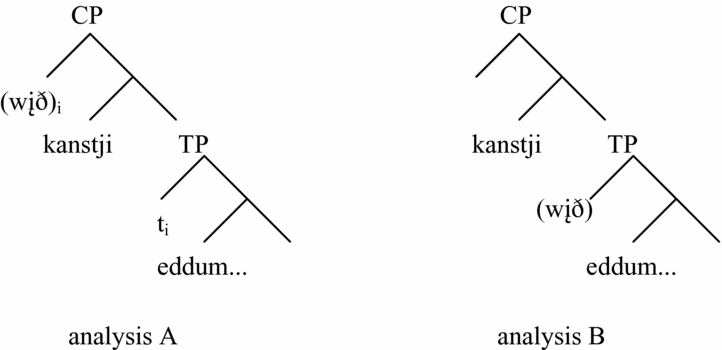
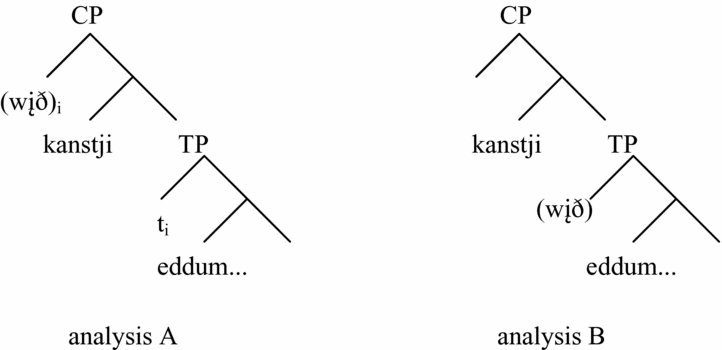
This suggests, according to Egerland (Reference Egerland1998), that kanske actually is situated in C°. Considering the etymology of kanske/kanstji, this analysis is not unexpected – grammaticalized items tend to retain properties from their source constructions, and kanske/kanstji was originally a collocation of two verbs.Footnote 24 Accordingly, the finite verb in kanske-initial clauses may remain in a low position in Swedish, below the negation. In Övdalian, however, the verb optionally raises (as in 27a) to T°, appearing in a position adjacent to the subject, above the negation. As for (18) and (27b), two structural analyses are therefore possible.
As can be seen in Figure 2, in both analyses null wįð directly precedes a verbal element – either kanstji or the finite verb – which explains why it may be covert. I presume that it also has access to a Context Linker, although this is not illustrated in Figure 2.Footnote 25 In the B analysis, the structural conditions for a null wįð are in essence the same as in an embedded clause.
Two analyses of kanstji-initial clauses with null wįð.
However, kanstji is not the only (apparently) topicalized item which allows a null wįð; welest ‘thank God’ also is allowed before null wįð:
(29)
Similarly to kanstji, welest may also trigger V3 word order as shown in example (30).
(30)
Welest is (probably) derived from the adjective/adverbial wel ‘good’, and thus it has no verbal features historically. It is, however, likely that both (29) and (30) should be analysed as welest plus a ‘that’-clause (as the English translations indicate; also Lars Steensland (p. c.) assumes that this is the correct analysis). In Övdalian, at ‘that’ is very often omitted (Åkerberg Reference Åkerberg2000:68). If this is the proper analysis, a null subject is of course perfectly grammatical – the null subject in (29) may be posited in front of the finite verb wartum in the embedded at-clause (Welest (at) (wįð) wartum kwitter ålåellum).
6. THE SYNTACTIC PROPERTIES OF NULL IĐ – A DETAILED DESCRIPTION
6.1 The syntactic properties of null ið
Unlike wįð, ið can be covert in all positions, as has been demonstrated above. The relevant sentences are repeated below.
(31)
(32)
(33)
Null ið thus may appear in all syntactic positions in Övdalian, in sharp contrast with null wįð – null ið does not require an empty SpecCP, and nor is it sensitive to topicalization in embedded clauses. It is hence obvious that the structural conditions for the identification of null wįð and null ið differ from each other, and that each of these null subjects must be given an explanation of its own. In the subsection below, I will argue that null ið is possible because the homonymous agreement affix -ið may provide a D-feature to T°, thereby, in essence, acting as a subject pronoun. This analysis thus agrees with one of the main approaches to null subjects in generative grammar, the pronominal-affix hypothesis (see the theoretical background in Section 2). More specifically, I will utilize a version of this hypothesis presented in a paper by Koeneman (Reference Koeneman2006).
6.2 A pronominal-affix analysis of null ið
In Table 1 above, it was shown that the 2pl pronoun and the 2pl affix are homonymous: ið v. -ið. This circumstance has not gone unnoticed in previous research on Övdalian. Björklund (Reference Björklund1956:98–107) assumes that the Övdalian 2pl verb form originally had the suffix -in (as in Old Swedish), claiming that the present-day suffix developed through successive sound changes and reanalyses, in the following fashion:
(34) farin ið > fari ið > far ið > farið
Accordingly, the suffix -ið may be seen as a merger between the 2pl affix and the 2pl pronoun, Björklund argues, and speakers may thus interpret it as a clitic pronoun. An argument for this is that -ið may appear in isolation in writing (35a) (Lars Steensland, p. c.).Footnote 26 Levander (Reference Levander1928:164: reprinted in Brännström Reference Brännström1933:126) provides an authentic example (35b), and even such an early source as Prytz (Reference Prytz1622) provides a possible example (35c):
(35)
Footnote 27 If -ið is analysed as a clitic pronoun, then it follows that there are no syntactic restrictions on null ið on a par with those that limit the distribution of null wįð.
On the other hand, the presence of an overt ið (which always is interpreted as contrastive/emphatic) would perhaps be surprising, since the clause then would contain two subjects, a possible problem mentioned by Björklund (Reference Björklund1956:106). A similar phenomenon is, however, attested in Bavarian (Fuß Reference Fuß2005:159):
(36)
In the Bavarian example, a 2pl pronoun (either es or ihr) is possible in the same clause as two other markers for 2pl. Only those Bavarian pronouns that can be covert, i.e. 2sg and 2pl, may be doubled in this fashion.
To conclude, a possible explanation for null ið is that the speakers of Övdalian have reanalysed the agreement affix -ið into a clitic form of the pronoun ið, a proposal originally launched by Björklund (Reference Björklund1956). The formal syncretism must of course have facilitated the morphosyntactic change. Hence, it is reasonable to say that the Övdalian ið has a lexically unclear status, balancing between affix, clitic and pronoun. Below, this hypothesis will be developed in more formal terms.
6.2.1 Correspondences between affixes and pronouns in partial NSLs
The process whereby pronouns are reanalysed as clitics and subsequently into affixes (a type of grammaticalization, see Hopper & Traugott Reference Hopper and Traugott2003) is studied in great detail by Fuß (Reference Fuß2005). The morphosyntactic changes in Bavarian are especially relevant to the present paper, considering that Bavarian is a Germanic partial NSL, just like Övdalian. In Bavarian, only 2sg and 2pl may be null, and in both of these cases the present-day verb agreement must be seen as a merger between an older verb ending and the clitic form of a pronoun (Fuß Reference Fuß2005:162ff.). In 2sg, the original ending was -s and the pronoun thu, and in 2pl -t and ēs, respectively.
(37)
Fuß (Reference Fuß2005:168) concludes that ‘the reanalysis of the former subject clitic as an agreement marker forced the learner to assume the presence of a referential pro in the subject position, which is the historical source of the limited pro-drop properties of present-day Bavarian’. In the rest of the inflectional paradigm, no similar fusion between an affix and a clitic pronoun has occurred, and accordingly Bavarian only allows 2sg and 2pl null subjects.
Also in some other partial NSLs there seem to be striking correspondences between the forms of personal pronouns and inflectional affixes, and Koeneman (Reference Koeneman2006) takes this observation as a starting point in an attempt to explain why partial NSLs do not allow RefNSs across the board. In Hebrew and Finnish, the partial NSLs that Koeneman investigates, 1st and 2nd person pronouns may be covert, but not 3rd person pronouns even though the verb agreement is maximally distinct. As for Hebrew, RefNSs are furthermore only possible in the past and future tense (see Shlonsky Reference Shlonsky2009). Crucially, in these cases the Hebrew and Finnish agreement affixes seem to be quite similar to the personal pronouns (Koeneman Reference Koeneman2006:81ff.). The data are reproduced in Tables 2 and 3 – relevant forms are in bold.
Verb agreement and personal pronouns in Standard Finnish.

Verb agreement and personal pronouns in Hebrew.

As in Bavarian, the reason why there is a match between the forms of the pronouns and the agreement affixes is of course that historically, the latter have developed from the former. In some cases, subsequent sound changes, which has affected one category but not the other, have reduced the similarity. However, in none of the languages do the 3p pronouns correlate with the 3p affixes (which have been derived from other sources, historically).
Koeneman suggests that the apparent link between 1p/2p affixes and pronouns in Hebrew and Finnish has led the language users to assume that these categories are lexically related to each other:
The morphological correspondence between agreement and pronoun forms in these languages is not merely a superficial property but triggers this encoding in the lexicon. More concretely, the first/second-person affixes share one property with the third-person agreement affixes – the fact that they are bound morphemes – and one property with the pronouns – their morphological similarity. The fact that first/second-person affixes have these two properties combined in them has a consequence that the paradigms of personal pronouns and agreement affixes are intertwined . . . (Koeneman Reference Koeneman2006:87)
Koeneman's conclusion is that in the lexicon, 1p and 2p affixes are underspecified for the feature +/–pronominal in Hebrew and Finnish (in Koeneman's terms, they are αpronominal), while 3p affixes are non-pronominal. The language acquiring child has two clues that point towards this conclusion: the similarities between affixes and pronouns illustrated above, and the actual presence of RefNSs in the language. For many authors, the lack of null subjects in morphologically ‘rich’ languages (such as German and Icelandic) has been a prevailing problem (see e.g. Holmberg Reference Holmberg2010:112f.). In this respect, the idea that correspondence between pronouns and affixes may facilitate null subjects in a given language is promising, since this hypothesis does not directly relate null subjects to rich inflection.
In Övdalian, only in 2pl is there a clear correspondence between the agreement affix and the personal pronoun. In 1pl, the affix (-um) shows no similarities whatsoever to the 1pl pronoun (wįð). This is, of course, another reason why the two possible RefNSs require different analyses.
Under my syntactic analysis of null ið, I will assume that in Övdalian the language users have also collapsed the 2pl pronoun and the 2pl affix in the lexicon, thereby giving rise to null ið while at the same time retaining the possibility of keeping an overt 2pl subject in combination with 2pl agreement.
6.2.2 A syntactic analysis of null ið
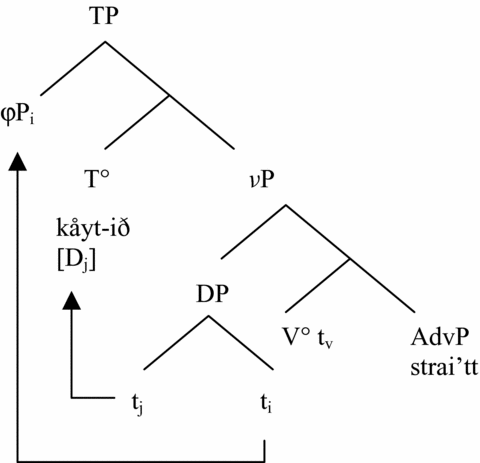
Consider again the explanation for null ið that was presented above: the pronoun and the agreement affix have been reanalysed as one single lexical unit, probably due to the obvious syncretism between the affix and the pronoun. While an overt subject ið can be assumed to be a full DP (see Déchaine & Wiltschko Reference Déchaine and Wiltschko2002), it is probable that the ending -ið has a dual syntactic status in Övdalian (regular affix or pronominal affix). When there is no overt pronoun in the clause, I suggest that the subject DP in SpecvP has been split. The head D, realized as -ið, cliticizes to T°, where it contributes a D-feature to T°, while the remainder of the DP (a ϕP-pronoun without any phonological content) EPP-merges in SpecTP. In the ensuing Agree relation, the D-feature in T° causes the null pronoun to be interpreted as definite, and the ϕ-features are valued. Hence, null ið may be an analogue to null referential subjects in consistent null subject languages (and, according to Déchaine & Wiltschko Reference Déchaine and Wiltschko2002:428ff., to French subject clitics). The crucial aspects of the derivation of (38) are illustrated in Figure 3.
(38)
The derivation of null ið.
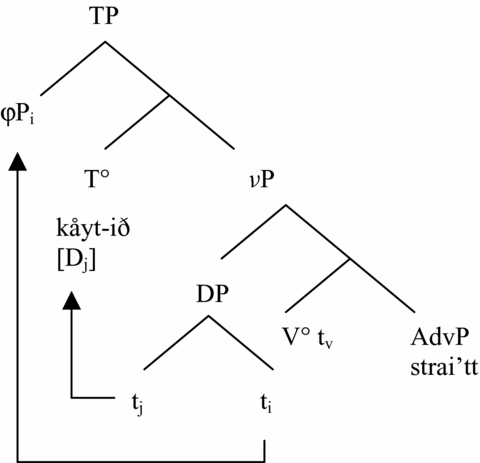
The Övdalian ϕP-pronoun in SpecTP can thus never be interpreted as generic – it must always merge in SpecTP, where the Agree relation with T° (with a D-feature)Footnote 28 always ensures that ϕP is interpreted as definite, as was mentioned above. Holmberg (Reference Holmberg2005) has also suggested that in Finnish, there is a ϕP which appears as a null subject (see also the discussion in Holmberg Reference Holmberg2010). But since this ϕP cannot receive a D-feature from T° (there is no D-feature in that position in Finnish), it is interpreted as generic, unless it is bound by a higher DP subject (Holmberg Reference Holmberg2005:557). Neither is there in general a D-feature in T° in Övdalian, I assume – it is only when null ið appears that there is a D-feature in T°, originating from the DP in SpecvP.
The analysis of the derivation of null ið is similar to the explanation of Dutch clitic doubling presented in van Craenenbroeck & van Koppen (Reference van Craenenbroeck and van Koppen2006). These authors suggest that the doubling element is a ϕP, which has moved out of the subject DP. There are therefore independent arguments which indicate that internal merge of parts of the DP in SpecvP may be a viable syntactic operation.
As soon as an overt 2pl subject is present, I assume that the derivation of Övdalian syntax returns to its regular state of affairs: the DP-pronoun ið functions as a subject, and the affix -ið is non-pronominal, just as all other Övdalian agreement affixes.
7. A POSSIBLE EXPLANATION FOR THE EMERGENCE OF NULL WĮ Đ
In the preceding sections, the syntactic properties of null wįð and ið have been discussed in detail, as well as the emergence of null ið. Here, I turn to the possible historical background of null wįð and the consequences for the syntactic distribution of this null pronoun.
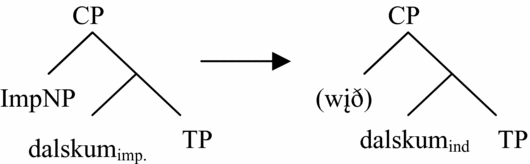
As has been mentioned above (Section 3), the verb affixes for 1pl present tense indicative and 1pl imperative are homonymous (-um). A verb form such as drusum (‘run’ 1pl.imp/ind) is therefore morphosyntactically ambiguous. A possible explanation for the emergence and distribution of null wįð is accordingly that speakers have analysed imperative clauses as indicative, transferring the null subject from one clause type to another (see Figure 4). From a speech act perspective, first person imperatives (hortatives) are often quite close to declaratives, since a request directed to oneself rarely is denied. Furthermore, in Övdalian and Swedish, present tense is often used to express futurity (Åkerberg Reference Åkerberg2000:49). Therefore an Övdalian 1pl imperative clause, which is inherently hypothetical, could be interpreted as a futural, and hence hypothetical, declarative clause, since they are morphosyntactically identical. Givón (2001:320) claims that there is a universal continuum between imperatives and declaratives, and futural declaratives are actually located on the middle of this continuum.Footnote 29 All in all, only intonation may determine whether a clause such as Baiðum dar ien taima should be understood as ‘let us wait there for one hour’ or as ‘we (will) wait there for one hour’, and intonation may of course be blurred in discourse.Footnote 30
Reanalysis from imperative to declarative clause.
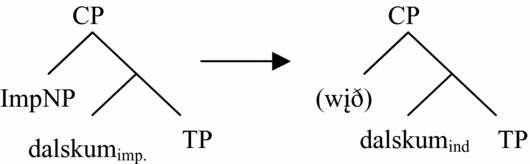
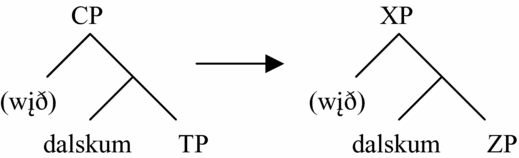
A reanalysis from imperative to indicative cannot explain why null wįð occurs in embedded clauses, however. One must therefore assume a further syntactic change, in which the context that allowed null subjects was widened (as in Figure 5). Below, I suggest how the initial reanalysis as well as the analogical spread may be represented. Platzack & Rosengren (Reference Platzack and Rosengren1998) have argued that imperatives lack a number of functional phrases in the CP and TP domains; however, the exact structural differences between declaratives and imperatives are not relevant in the perspective of reanalysis, the crucial point being that one and the same string of words may be attributed to two distinct structural analyses (see Harris & Campbell Reference Harris and Campbell1995: Chapter 4). Therefore a simple CP structure will be sufficient for my purposes; I have utilized Platzack & Rosengren's notion of ImpNP (the covert imperative subject), though.
(39)
Analogical spread of null wįð.
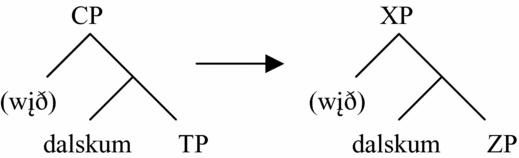
In Figure 4, the reanalysis from imperative to indicative clause is illustrated; the result is the possibility of omitting wįð in indicative clauses when it appears in the same position as the null subject in imperatives, i.e. SpecCP. The latter (analogical) change, illustrated in Figure 5, consists of a generalizing reanalysis in which the possibility of omitting wįð spread to all Spec positions directly preceding a visible finite verb, as in embedded clauses. Perhaps the restrictions for null wįð also can be seen, partially, as a residue from the imperative null subject, which cannot survive in contexts prohibiting access to the discourse (see Platzack & Rosengren Reference Platzack and Rosengren1998).
This explanation for null wįð is a mere hypothesis (like all putative explanations for language changes), but it would be strengthened if similar changes in other languages could be attested. Given the very specific prerequisites for this change, however, it cannot be expected that a reanalysis from imperative to indicative is common in the languages of the world. A somewhat similar change can however be found in English, where the imperative let us has developed into the verb form let's (Hopper & Traugott Reference Hopper and Traugott2003:10ff.), which is not always used as a straightforward imperative verb (Hopper & Traugott (Reference Hopper and Traugott2003:11) provide the non-standard English example Let's you go first. . .).
8. WIDENING THE VIEW – GERMANIC PARTIAL NULL SUBJECT LANGUAGES
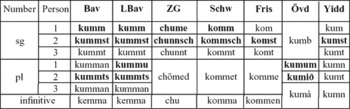
There is no standard Germanic language in which RefNSs of the Övdalian type are grammatical, but a number of non-standard varieties allow such null subjects, to varying degrees (see Bayer Reference Bayer1984, Weiß Reference Weiß1998, and Fuß Reference Fuß2005 for Bavarian and Lower Bavarian; Cooper & Engdahl Reference Cooper and Engdahl1989, and Cooper Reference Cooper and Penner1995 for Zürich German; Haag-Merz Reference Haag-Merz1996 for Schwabian; Prince Reference Prince, Bosch and van der Sandt1998, and Jacobs Reference Jacobs2005 for Yiddish; Hoekstra & Marácz Reference Hoekstra and Marácz1989, de Haan Reference de Haan1994, and Hoekstra Reference Hoekstra1997 for Frisian). In these languages, the null subject property seems to be tightly linked to the existence of specific agreement morphemes on the finite verb. In Table 4 (taken from Rosenkvist Reference Rosenkvist2009:171), the verb forms that allow null subjects are in bold.
Verb inflection and RefNSs in some Germanic non-standard language varieties.

Bav = Bavarian; LBav = Lower Bavarian; ZG = Zürich German; Schw = Schwabian; Fris = Frisian; Övd = Övdalian; Yidd = Yiddish
As can be seen from the table above, null subjects are only allowed in these varieties if the agreement on the finite verb unambiguously identifies the covert subject (but the reverse implication does not hold; a unique verb form does not always license a null subject). Similar connections between agreement and null subjects can be found in Estonian, where negated verbs have lost their person agreement affixes and tend to lose the ability to allow null subjects (Pajusalu & Pajusalu Reference Pajusalu and Pajusalu2004; Pajusalu Reference Pajusalu and Laury2005), in Hebrew (Shlonsky Reference Shlonsky1997:116; see also Platzack Reference Platzack2004:103), in Brazilian Portuguese (Duarte Reference Duarte, Kato and Negrão2000) and also in an acclaimed null subject language such as Italian. Renzi & Vanelli (Reference Renzi and Vanelli1982: footnote 17) point out that a second person singular pronoun is necessary in present and imperfect subjunctive – a part of the Italian verb inflection paradigm that does not differ between the forms in the singular. On the other hand, in Icelandic and German, null subjects are disallowed, in spite of seemingly sufficient verb morphology (as is well-known). Hence, in the Germanic languages verb agreement seems to be a necessary but not sufficient condition for null referential subjects.
Furthermore, it seems that only first and second person pronouns can function as true null subjects (i.e. not including subjects that are omitted due to topic drop and coordination deletion, etc.) in the Germanic languages.
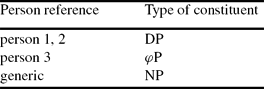
There may actually be tangible syntactic differences between on the one hand 1st and 2nd person pronouns and on the other hand 3rd person pronouns. Above, Holmberg's (Reference Holmberg2005) analysis of Finnish 3rd person pronouns was discussed. He suggests that Finnish 3sg pronouns are ϕPs, i.e. deficient DPs, while 1st and 2nd person pronouns are full DPs. This idea originates from Déchaine & Wiltschko (Reference Déchaine and Wiltschko2002), who propose that English pronouns may be classified as in Table 5.
The syntactic status of English pronouns (Déchaine & Wiltschko Reference Déchaine and Wiltschko2002:426).
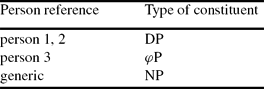
The classification rests, inter alia, on the observation that 1st and 2nd person pronouns may function as determiners (we linguists), while 3rd person pronouns cannot (*they linguists).Footnote 31 Déchaine & Wiltschko (Reference Déchaine and Wiltschko2002:419ff.) proceed to show that the English pronouns also differ with respect to binding properties and compounding, for example. Under the assumption that covert pronouns are also DPs, ϕPs or NPs, we would expect the syntactic qualities of null subjects to vary accordingly, in English and perhaps also in other Germanic languages. The pattern in Table 4 is at least an indication that 1st and 2nd person null subjects have a special status in Germanic, a status which might be a reflex of the fact that these null subjects are DPs (with an inherent D-feature that might facilitate recoverability), while 3rd person null subjects are ϕPs.
However, taking a closer look at the syntax of the Germanic null subjects, one finds that there are quite peculiar restrictions involved in many cases (see Rosenkvist Reference Rosenkvist2009). Övdalian has been discussed above; the two possible null subjects have different syntactic properties. And in Zürich German, for example, covert I (1sg) is only possible in positions preceding pronominal clitics, and, oddly, before the dative masculine marker em, which is homonymous with the clitic for third person dative singular masculine (Cooper Reference Cooper and Penner1995:63). In Yiddish, null subjects are only allowed in the initial position of main clauses, according to Prince (Reference Prince, Bosch and van der Sandt1998), and all null subjects but, crucially, 2sg require some form of embedding in the discourse context. However, Jacobs (Reference Jacobs2005:261) shows that 2sg may also be null in embedded clauses, and I find it probable that only 2sg is a genuine null subject – the examples of other types of RefNSs provided by Prince (Reference Prince, Bosch and van der Sandt1998) strongly remind about instances of topic drop. As shown in Table 4, only the verb form for 2sg is distinctive in Yiddish.
One may conclude that although the Germanic null subject varieties are all dependent on verb agreement for the identification of null subjects, as it would seem, it is obvious that there are also language idiomatic restrictions, which determine the finer syntactic details of the distribution of the null subjects. If these finer details are the result of syntactic innovations, then diachronic studies are probably necessary prerequisites for a satisfactory analysis (see in this respect Axel & Weiß, to appear). Hence, there are definitely opportunities for broad generalizations concerning the possible conditions for null subjects in Germanic, but such generalizations will, of necessity, require language specific adjustments, if the ultimate goal is an understanding of the syntax of null subjects in each specific language.
9. CONCLUSION
In the generative research on the distribution of null subjects, Rizzi's original insights (Reference Rizzi1982, Reference Rizzi1986) have been very influential. However, since then, it has been convincingly demonstrated that a wide variety of languages allow referential null subjects, and that individual languages may have specific restrictions for certain types of null subjects, whereas others occur freely. The rich and varied data, taken in combination with recent theoretical developments, have added significantly to the complexity of the original question: what determines whether a particular language allows RefNSs, and, if it does, in which syntactic configurations RefNSs occur.
In this paper, I have introduced the Övdalian RefNSs into the debate, and it has been demonstrated that Övdalian only allows 1pl and 2pl null subjects. Övdalian is hence a partial null subject language. However, these two null subjects obey different syntactic restrictions; whereas 1pl can only be null if access to the discourse context is not blocked by some intervening constituent, 2pl can be null in every possible syntactic environment. Övdalian is therefore also an asymmetric null subject language (see Alexiadou Reference Alexiadou2006). In order to provide a structural explanation for both of the null subjects, I have suggested that null wįð ‘we’ is to be analysed as a null subject which is identified through the discourse context, following recent proposals by Frascarelli (Reference Frascarelli2007) and Sigurðsson (Reference Sigurðsson2010). Null ið ‘you’, on the other hand, rather seems to behave like a null subject which is tightly related to the agreement affix – an analysis in which affixes may function as subjects, such as Koeneman (Reference Koeneman2006) is therefore to be preferred, I suggest. Historically, it has also been argued that the 2pl affix (-ið) can be seen as a fusion between the original 2pl affix (-in) and the subject, a change which reminds one strongly of the development that gave rise to RefNSs in Bavarian (Fuß Reference Fuß2005).
The Övdalian data thus suggest that a single language does not necessarily have only one distinct strategy for the identification of RefNSs. Furthermore, the hypothesis that languages which allow RefNSs always also allow non-referential null subjects is disconfirmed by Övdalian, a language in which non-referential null subjects are disallowed. And, finally, the idea that V2 word order is incompatible with RefNSs (Jaeggli & Safir Reference Jaeggli, Safir, Jaeggli and Safir1989; Rohrbacher Reference Rohrbacher1999) must be abandoned – in the final section of the paper, it was shown that Övdalian just is one of a handful Germanic V2 partial null-subject languages.
ACKNOWLEDGEMENTS
This paper is a thoroughly revised version of Rosenkvist (Reference Rosenkvist2006). First, I wish to thank all of my Övdalian consultants. I also thank three anonymous reviewers for their excellent comments, and Dianne Jonas for valuable feedback on both content and style. Also Piotr Garbacz, Marit Julien, Christer Platzack, Halldór Sigurðsson, Lars Steensland, and participants in the ScanDiaSyn Grand Meeting 2007 have given me valuable input. However, I alone am responsible for remaining errors.
APPENDIX
A short text In Övdalian
This short text is written in standard Övdalian orthography, as decided upon by Råðdjärum (the Övdalian Language Council) in 2005. It is quoted from their document concerning the new ortography, in which it serves as an example. For convenience, I have set all finite verbs in bold.
Ig wet fel ur ruoli eð brukeð wårå dar g slpåytjin add dugåð riet nån uonngums. Addum ien slaikan uonngums i gslun iessn. Dar påytjin add rietað upp gumsan so an kam uppend og ulld tågå påykan, so kåy'tt påytjin m
 ot ienum sturum tolle og gumsn attånað föstå’ss og ulld tågå påykan. Men m gumsn uppeð til, so uppeð påytjin und
 tollem, so gumsn sluo uonn daiti tolln so eð small. Men skåy'tt allt gumsn atter att og ini smålåuopin og skäkäð skollam. Krytyrwiss fel so wel dar eð byrd laið mot kweldem, so dar dier add ietið stinnan sig, so byrd dier liet att diem-dar smwe
 so kolldum för smålåweer, og byrd drågå sig etter diem mot fläðsweem. Og smålåuopin fygd fel dier og.
Ja, eð war e plåg að gslkallum, dar eð war slaik uondlostjyner i gslun. Ig wet dar addum dugåð pass diem so dier add eldeð sig ini fläð iel da'n, end tast kamum dait fjsbokkan um kweldn, so brukeð dier-dar uondlostjynär pass sig, innaddum uonneð ev in diem i fjseð, og kåyt fr fjsbokkam og að rais. Eð war fel tä iweg og kåyt etter og biuoð til sj um an dugd wend diem.