Introduction
The World Health Organization (WHO; Geneva, Switzerland) Global Burden of Disease Study identifies injury as the tenth leading cause of disability world-wide. 1 - Reference Murray, Vos and Lozano 5 Motor vehicle collisions (MVCs) are the leading mechanism of injury. The overwhelming majority of non-fatal admitting diagnoses associated with this mechanism are acute fractures, sprains, and dislocations.Reference Mock and Cherian 6 Despite considerable past emphasis given to communicable diseases, the global burden of musculoskeletal disease in low and middle-income countries (LMICs) continues to grow and is relatively neglected.Reference Beveridge and Howard 7 Emergency Medicine interventions for traumatic injuries in developing countries have been shown to decrease morbidity and mortality.Reference Kobusingye 8 These interventions require an initial assessment of knowledge and need to appropriately identify and target potential interventions.
Patients living in the remote islands of the Philippines are geographically limited to the medical resources available locally. Orthopedic consultants are rarely available and general practitioners providing emergency care lack formal orthopedic training. Transport to higher care is often unrealistic due to cost constraints and the logistics of physical transportation. 9 , Reference Goldfarb, Havrylyshyn and Mangum 10
Rapid, proper care of orthopedic injuries is necessary to prevent morbidity and mortality. Failure to receive appropriate and timely emergent care for acute fractures with mal-alignment results in permanent deformity for otherwise easily corrected fracture patterns. Understanding gaps in available services is important for developing health care strategies. An assessment of orthopedic knowledge and need was conducted in the remote island province of Romblon as the initial phase of a comprehensive fracture care training initiative in the province.
Methods
Setting
The World Bank (Washington, DC USA) classifies the Philippines as a LMIC. Major metropolitan areas such as Manila offer tertiary care centers with specialty consultants comparable to Europe or the USA. The over two-thousand inhabited islands, however, present unique geographic barriers to specialty care. These islands are served by provincial hospitals with limited or non-existent emergency services.Reference Peralta and Sinon 11 , Reference Jacobs, Ir, Bigdeli, Annear and Van Damme 12 The province of Romblon consists of seven islands with one provincial hospital in the city of Odiongon on the island of Tablas. The physicians who regularly staff the provincial hospital lack specialty training in Emergency Medicine or orthopedic surgery. Although patients are often referred to tertiary care facilities, the majority cannot afford transportation or the advanced payment required for specialty medical care. Accordingly, the resources and staff available at the provincial hospital typically define definitive care. These geographic barriers to care are common throughout the Philippines and developing island countries of South East Asia.Reference Jacobs, Ir, Bigdeli, Annear and Van Damme 12 , Reference Zirkle and Lewis 13
The town of Odiongon is made up of 25 local Barangay or sub-communities, each with its own Barangay Health Unit (BHU) staffed by midwives and nurses. These mid-level providers are most often the first contact of care for indigent patients living in isolated rural or mountainous communities. Barangay mid-level providers are supervised by a Rural Health Official (RHO) who is the physician director of Rural Health Services for all Barangay. The individual Barangay health units have minimal capacity for acute care and often times minimal to no emergency care medical supplies. The RHO staffs the Central Barangay Clinic, which has resources comparable to a public health primary care office. As first contact of care, the mid-level providers often facilitate hospital transfer when recognized as necessary.
At present, there is no cost associated with services at the provincial hospital, but medical supplies are occasionally charged to the patient. In the recent past, all supplies including splinting materials, pain medications, and X-Rays were charged to the patient. Under the leadership of the current Director of the Provincial Hospital, the majority of these medications, supplies, and services are available at no cost, or significantly reduced cost, to indigent patients. Patients may be unaware of the new fee structure, suggesting an additional topic for education. There is no formal Emergency Medical Services activation system. There are two ambulances at the hospital that are activated when a patient calls the hospital general number. Availability of ambulance transport and staff is variable. Although many patients have access to, or know someone with, a cellular phone, many of the Barangay are without cellular service.
Study Design
The study was approved by the Scottsdale (Arizona USA) Healthcare Honor Health Institutional Review Board.
The study design was interview surveys. Surveys were a combination of dichotomous, ordinal, and multiple-choice questions. Two surveys were conducted in June 2015 to describe the local health care system, to identify barriers to orthopedic care, and to assess gaps in knowledge for treating acute orthopedic injuries.
The household assessment of need was conducted June 1-4, 2015. Population proportional random sampling was utilized to assess a total of 100 households from 25 local Barangay communities. Households were randomized utilizing random number generation. The target for the survey was the head of household as defined as the primary household provider or their spouse.
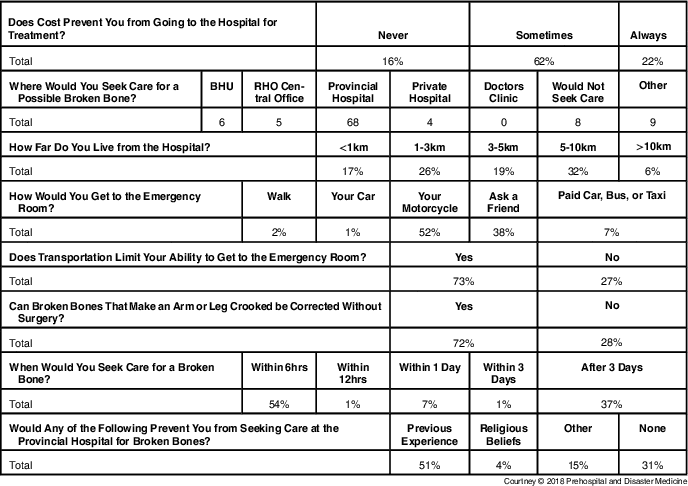
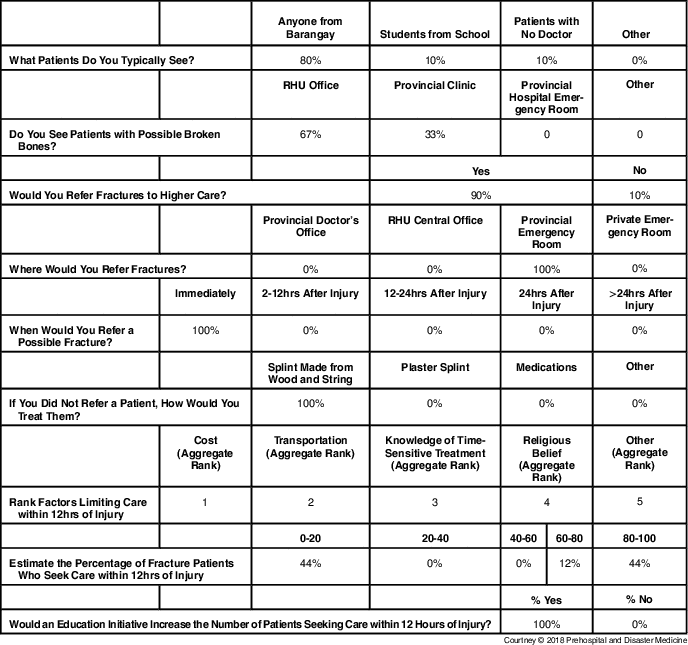
Though no formal cultural or linguistic validation was performed, the construction of the survey was done in partnership with bilingual health care providers and trained public health officials living in the research community. The survey was informally piloted among local nurses and college students for both linguistic and cultural disparity. The questions in Table 1 and Table 2 represent the English translation of the survey questions.
Fracture Care: Population Assessment of Knowledge and Need

Health Care Provider Assessment of Knowledge and Need

Scholars from the Nothing to Lose Foundation (Phoenix, Arizona USA) were trained to conduct the initial survey. The Nothing to Lose Foundation is a nongovernmental organization that has worked in this community for 10 years. Foundation scholars are college students fluent in English and Tagalog. The surveyor-scholars received two days of training in survey and interview techniques conducted by the foundation medical coordinator, a nurse experienced in public health assessment.
The survey was conducted in Tagalog with surveyors functioning as translators. Participants were given a simple and clear explanation regarding the purpose of the study and the option to participate. Pre-written, translated consent was used to obtain verbal consent. If nobody was available in a selected household, an alternate household was selected within the same Barangay. The overall response rate was 98%. Questions were answered by the head of household or their spouse. All respondents were over 18 years of age. Questions focused on level of existing knowledge regarding orthopedic injuries, existing treatment resources, and perceived barriers to care.
The second survey assessed the orthopedic care knowledge and perceived need among health care workers. For this assessment, health care providers were selected from local BHUs and Barangay schools. These Barangay health workers, midwives, and school nurses typically represent the first contact for any acute injury or illness. There were 15 school nurses and midwives representing 25 local Barangay eligible for the survey. Multiple Barangays may share one midwife or school nurse, so population proportional sampling of each Barangay was not possible.
The survey was performed by the Nothing to Lose Foundation medical coordinator on June 8-9, 2015. All participants were fluent in English and Tagalog, as is the foundation medical coordinator. A pre-written, translated consent was read to participants to obtain verbal consent.
Results
Household Survey
Households were primarily composed of nuclear families and immediate relatives. All respondents were over 18 years of age and represented either the primary head of household or their spouse. A total of 100 respondents were surveyed for the population assessment. Only two of the respondents approached refused to take the survey and were substituted by alternate households.
Barriers to care identified by respondents included geographic isolation, transportation, and cost. Respondents living within 1km of the provincial hospital represented 17% of those surveyed. Respondents living between 1-5km represented 44% of those surveyed. Respondents living between 5-10km represented 33% of those surveyed. And six percent responded that they lived greater then 10km from the provincial hospital. A total of 73% reported that transportation was a perceived barrier to care; 90% of respondents stated that if transportation to the provincial hospital was necessary, their method of transport would either be their own motorcycle or a friend’s. Cost was identified as a potential barrier to care among 84% of respondents with 22% percent stating that it is always a barrier to care.
Knowledge about care-seeking needs was also variable. Most respondents (68%) would seek care for an acute fracture at the provincial hospital, staffed by a physician, but 11% would seek care at the rural health office or the local BHU staffed by mid-level providers. The nine percent of respondents who selected “other” all stated that they would seek care with the local tribal “Hilot,” a traditional tribal healer known to perform traditional massage techniques on acute fractures. A private advance fee-for-service hospital does exist on the island and four percent of respondents stated they would seek care at the private hospital.
Obvious gaps in knowledge regarding fractures were also identified as barriers to care. Respondents stating that “crooked” broken bones could not be corrected without surgery represented 28% of those surveyed. When questioned regarding the timing of treatment, only 55% of respondents believed treatment was required within 12 hours, eight percent believed treatment was required between 12 hours and three days, and 37% stated that treatment was not required for three days or more after injury.
Health Care Provider Survey
There were 15 nationally funded midwives and school nurses working in the area. A total of 10 were interviewed for the survey; three were off the island at the time of the survey and two refused participation.
The midwives and school nurses were most likely to be the first contact of care, and 90% stated that they see patients with possible broken bones. None of these health care workers felt that they had sufficient fracture care skills. All of the respondents stated that they would refer patients with a possible broken bone to the provincial emergency department for diagnosis and treatment.
When questioned regarding the timing and urgency of care, all health care providers surveyed stated that they would refer patients to the provincial hospital immediately. When asked what percentage of patients they estimated actually seek care within 12 hours, 44% stated 80%-100%, 11% stated 60%-80%, and 44% stated 0%-20%. This represents a discrepancy between providers’ perception of patient timing to seek care and results reported from the population survey. All of the health care providers surveyed stated that they believed an education initiative to increase awareness would increase the number of patients with acute fractures seeking care within 12 hours of injury.
The health care providers identified logistical barriers to care with the following aggregate ranking from greatest perceived potential barrier to care to least:
1. Cost was ranked first by all respondents;
2. Transportation;
3. Knowledge of time-sensitive treatment;
4. Religious belief; and
5. Other (unspecified).
Discussion
The Global Burden of Disease 2010 estimate identified the greatest change in burden of disease for the preceding two decades as a shift away from communicable, neonatal, maternal, and nutritional disease and toward non-communicable diseases. Among these, injury has been identified as a leading cause of disease. A larger fraction of the overall burden of disease is now caused by disability rather than premature mortality.Reference Murray, Vos and Lozano 5
Recent investigations have also demonstrated that injury-related rates of death and disability in LMICs now exceed that of high-income countries. This is thought to be due to the increased use of, and access to, motorized transportation.Reference Mock, Quansah, Krishnan, Arreola-Risa and Rivara 14
Data from the Global Burden of Musculoskeletal Injuries studies identify orthopedic injuries as the overwhelming majority of non-fatal admitting diagnosis associated with MVCs, which are the leading cause of injury world-wide. Though an impressive assessment, the study also illustrates the need for more detailed assessment of the musculoskeletal burden of disease world-wide. With what little data are available, there has been an increased effort to build on country experiences to identify and lower the burden of musculoskeletal injuries globally.Reference Kobusingye 8
Because injury has been identified as a leading cause of death globally, efforts to address gaps in injury-related musculoskeletal care will be of increasing importance. Emergency care interventions are needed at all levels, from the time of the event to definitive treatment.Reference Kobusingye 8 These interventions must start with a basic assessment of knowledge and need among the patient population, as well as the first contact of care providers. This survey is the foundation for a reproducible assessment to be utilized on a regional or national level, which will identify and ultimately address gaps in knowledge and barriers to acute orthopedic care.
Because orthopedic specialists are rarely available in geographically isolated environments, as with other resource-limited LMICs, the timing of initial care and perceived barriers to care are critical determinants of whether a non-operative attempt at reduction is possible. Without surgical options, and given the financial limitations of most families in these provinces, these non-operative interventions define definitive treatment.Reference Abrahan 15 - Reference Mapa, Albis, Comandante, Cura and Ladao 17
Both surveys conducted suggest potential barriers to acute fracture care and areas for targeted intervention. Both surveys suggest cost and transportation to be perceived barriers to care.
The household study identified an obvious gap in knowledge regarding the need to seek care for acute fractures immediately. Of those surveyed, 45% stated that would seek care 12 hours or more after injury and 37% would wait days or more after injury. The fact that 28% of household respondents believe that “crooked” fractures cannot be treated without surgery suggests that patients are unaware of the possibility for closed reduction as definitive treatment. This represents a potential topic for a focused and targeted education initiative to potentially reduce long-term disability.
The health care providers demonstrated appropriate understanding of the time-sensitive nature of care with all respondents recognizing the need for immediate emergency treatment. All health care providers who responded also correctly identified the provincial hospital emergency room as the appropriate higher level of care. A gap in knowledge of care appears to exist between the mid-level providers and the patients. This finding helps further direct and target potential educational efforts.
It was unexpected that nine percent of household respondents stated that they would seek care from a provider “other” than those at the provincial hospital, private hospital, local BHU, or the Central Barangay health office. These represent all of the resources for allopathic care in the community. Interestingly, all of those nine percent responding “other” specified that they would seek care from the local tribal “Hilot.” For the authors, this was a previously unrecognized treatment resource. This also suggests a knowledge gap which could be addressed with an education initiative. “Hilots” are traditional tribal healers that specialize in musculoskeletal conditions. They perform massage and will occasionally “massage” a deformed fracture as a method of treatment. The outcomes of fractures treated by “Hilots” has never been formally studied, but many of the local care providers anecdotally reported that patients seeking treatment in a delayed fashion initially seek care with the “Hilot,” and when the deformity persists, they then seek care at the hospital, oftentimes days after the injury when closed reduction is no longer possible.
Limitations
The household survey was conducted with complete anonymity and de-identification. This prevents a t-test comparative analysis following any future education initiatives. Although a repeat population proportional sample can be conducted in the same fashion, it will have less statistical viability as a measure of efficacy for any educational initiative.
The small number of health care providers surveyed is the most obvious limitation of the health care provider survey. Because this study focused on barriers to care, only care providers likely to represent the first contact of care were included. The very low number limits any statistical conclusions and suggests only qualitative trends. Expanding this assessment to include more communities or multiple provinces would provide greater statistical viability.
This study is the first attempt to perform an assessment of knowledge and need in emergency orthopedic fracture care in the resource-limited provinces of the Philippines. The isolated island provinces reflect similar barriers to care in other resource-limited LMICs. The complications associated with delays in orthopedic care are well-documented in similar communities with limited or no access to orthopedic specialists.Reference Abrahan 15 - Reference Mapa, Albis, Comandante, Cura and Ladao 17 As a pilot study, it provides direction for targeted local education initiatives, but it also provides a model for assessment of injury-related orthopedic care in other resource-limited LMICs.
Conclusion
The study provides a foundation for potential initiatives to improve barriers to care. Both surveys suggest cost and transportation to be perceived barriers to care. Of particular interest are factors and perceptions affecting the timing of care. Because non-operative reduction represents definitive treatment in most situations, the ability to seek care within 12 hours increases the likelihood of closed reduction and thus decreases the likelihood of permanent long-term deformity.