Child maltreatment is a global public health problem that threatens child well-being and overall health. The Child Abuse Prevention and Treatment Act (CAPTA) defines child maltreatment as “any recent act or failure to act on the part of a parent or caretaker which results in death, serious physical or emotional harm, sexual abuse or exploitation” (CAPTA, 2010). In 2019, about 656,000 victims of child abuse and neglect were identified in the United States, with a victim rate (indicated or substantiated at least one maltreatment type) of 8.9 children per 1,000 children in the population (U.S. Department of Health & Human Services, 2021). Child maltreatment has been associated with adverse physical (e.g., malnutrition, neurological changes), psychological (e.g., poor mental and emotional health, attachment and social difficulties, posttraumatic stress), and behavioral (e.g., substance use and addiction, unhealthy sex behaviors) health consequences, with child fatality being the most severe consequences of maltreatment (Child Welfare Information Gateway, 2019). With regard to psychological health, empirical evidence suggests that youth with maltreatment experience may fail to acquire optimal emotion regulation strategies to cope with stress and challenges, and further develop disengagement or antisocial strategies, such as avoidance, denial, emotional suppression, or violence and crime to cope with stress, compared to their non-maltreated peers (Gruhn & Compas, Reference Gruhn and Compas2020; Kim & Cicchetti, Reference Kim and Cicchetti2010; Milojevich et al., Reference Milojevich, Levine, Cathcart and Quas2018). Prior studies have also revealed that exposure to early life maltreatment and trauma have significant lifelong effects on children’s developing brain (McCrory et al., Reference McCrory, De Brito and Viding2010; Streeck-Fischer & van der Kolk, Reference Streeck-Fischer and van der Kolk2000). For example, studies have consistently found decreased volumes of the corpus callosum in children and adolescents who have experienced child maltreatment (Bücker et al., Reference Bücker, Muralidharan, Torres, Su, Kozicky, Silveira, Bond, Honer, Kauer-Sant’Anna, Lam and Yatham2014; Twardosz & Lutzker, Reference Twardosz and Lutzker2010). Further, adolescents who have experienced child maltreatment are at higher risk for developing various behavioral health problems, including aggression, risky sexual behavior, substance use problems, and suicidal behavior (Miller et al., Reference Miller, Esposito-Smythers, Weismoore and Renshaw2013; Oshri et al., Reference Oshri, Rogosch, Burnette and Cicchetti2011; Thompson et al., Reference Thompson, Lewis, Neilson, English, Litrownik, Margolis, Proctor and Dubowitz2017; Yoon et al., Reference Yoon, Kobulsky, Yoon and Kim2017).
Resilience in the context of child maltreatment
Although youth with a history of child maltreatment are at risk for a range of adverse outcomes, there is still a substantial number of adolescents who do not exhibit such problems despite exposure to maltreatment. That is, some individuals recover from their exposure to trauma and develop resilience (Holmes et al., Reference Holmes, Yoon, Voith, Kobulsky and Steigerwald2015; Howell & Miller-Graff, Reference Howell and Miller-Graff2014; Luthar & Cicchetti, Reference Luthar and Cicchetti2000). Although there is no consensus on the ideal definition of resilience, it is generally understood as the process of achieving positive adaptation in the face of adversity (Masten et al., Reference Masten, Best and Garmezy1990). In a systematic review of the conceptualization of resilience in the context of child maltreatment, Yoon et al. (Reference Yoon, Howell, Dillard, McCarthy, Napier and Pei2019) found that current definitions of resilience are multiple and varied, but usually fall under one of the following three categories: resilience as a personality trait (hardiness, coping efficacy); resilience as an outcome or process related to adaptive functioning; and resilience as one’s capacity to utilize socioecological resources to promote his/her well-being. In the current study, resilience is defined as adaptive functioning across multiple domains of development (social competence, cognitive competence, emotional competence, and behavioral competence) following childhood maltreatment.
While specific definitions and measurements of resilience differed, many studies have provided evidence for resilience in children and adolescents who have experienced child maltreatment. The prevalence estimates of resilience among maltreated children vary greatly based on the operationalization, criteria, and thresholds of resilience employed in research (Walsh et al., Reference Walsh, Dawson and Mattingly2010). For example, focusing on young children involved in the child welfare system (about 5 years old at the time of resilience assessment) and operationalizing resilience as being at or above normative developmental standards, one study found that 38% of the sample showed social resilience, 25% showed cognitive resilience, and 11% showed multi-domain (i.e., both social and cognitive) resilience (Sattler and Font, Reference Sattler and Font2018). Similarly focusing on young children (ages 4–6 years), Dubowitz et al. (Reference Dubowitz, Thompson, Proctor, Metzger, Black, English, Poole and Magder2016) found that about 48% of children who experienced or were at risk of maltreatment exhibited resilience, which was operationalized as being competent (e.g., within the normal range) across social, behavioral, and developmental domains at ages 4 and 6 years. A recent study examined resilience among child welfare-involved adolescents and found that about 63% of the sample exhibited resilience, operationalized as showing competencies in externalizing, internalizing, social, and cognitive domains of functioning (Yoon, Maguire-Jack, et al., Reference Yoon, Maguire-Jack, Knox and Ploss2020).
Despite prior studies that examined resilience in the context of child maltreatment, it remains unclear how the development of resilience unfolds over time in this population. Due to few longitudinal studies that examined developmental trajectories of resilience among adolescents with a history of maltreatment, little is known about the shape or pattern of the developmental trajectories of resilience. Resilience theories suggest that resilience is not a fixed trait and is better represented as a dynamic, mutable process (Cicchetti, Reference Cicchetti2013; Masten, Reference Masten2018). Empirical evidence also supports the idea that resilience is changeable. For instance, a recent study assessed changes in resilient functioning over a period of 18 months and found that about 17.4% of child-welfare system involved youth moved from the more resilient group to the less resilient group and 14.0% moved from the less resilient group to the more resilient group (Yoon, Snyder, et al., Reference Yoon, Snyder and Yoon2020). Although no known studies have examined longitudinal developmental trajectories of resilience to estimate growth or change in resilient functioning over time among child welfare-involved youth, longitudinal studies that have examined developmental trajectories of resilience in a broader context of trauma, stress, and adversity, such as exposure to violence (e.g., community violence), chronic poverty, and terrorist attack, suggest that individuals show increasing levels of competence and resilience over time (Eisman et al., Reference Eisman, Stoddard, Heinze, Caldwell and Zimmerman2015; Norris et al., Reference Norris, Tracy and Galea2009; Werner, Reference Werner1993).
Caregiver–child relationships and deviant peer affiliation as factors influencing resilience among adolescents
To examine key factors that influence resilience following child maltreatment, this study draws from the conjoint intellectual work of Bowlby (Reference Bowlby1969) and Ainsworth et al. (Reference Ainsworth, Blehar, Waters and Wall1978) on Attachment Theory that describes the quality of young children’s relationships with their primary caregiver and subsequent effects of said quality. In particular, John Bowlby laid the theoretical foundation for the theory by conceptualizing the ways in which initial attachment figures can affect one’s concept of self-worth and trust. Mary Ainsworth then expanded upon this work by providing scientific support through a standardized procedure she termed Strange Situation, which assessed attachment behavior. When children experience supportive parenting during distress, they develop a sense of security (Bowlby, Reference Bowlby1988). This security then develops into expectations of trustworthiness from which children internalize and take with them throughout future relationships. On the other hand, negative attachment experiences in the parent-child relationship can lead to mistrust in both it and future relationships (Bolen, Reference Bolen2000). Overall, the theory has been widely used to predict children’s future patterns and behaviors in relationships (Gross et al., Reference Gross, Stern, Brett and Cassidy2017; Twemlow et al., Reference Twemlow, Fonagy, Sacco, Vernberg and Malcom2011) and serves as a basis for understanding the importance of relationships in children’s development.
Though negative familial relationships can damage children’s expectations in future relationships, high quality caregiver–child relationships, such as maternal warmth (Stright & Yeo, Reference Stright and Yeo2014), parental emotional support (Perry et al., Reference Perry, Dollar, Calkins, Keane and Shanahan2020), positive parent-child interactions (Rothenberg et al., Reference Rothenberg, Weinstein, Dandes and Jent2019), and father involvement (Pleck, Reference Pleck2007) are associated with positive developmental outcomes for youth. In the context of child maltreatment, specifically, positive caregiver–child relationships have been identified as a major protective factor that can reduce negative effects of maltreatment and, subsequently, promote resilience (Afifi & MacMillan, Reference Afifi and MacMillan2011). For example, close, high-quality caregiver–child relationships (Guibord et al., Reference Guibord, Bell, Romano and Rouillard2011; Yoon, Maguire-Jack et al., Reference Yoon, Maguire-Jack, Knox and Ploss2020), positive parenting (Meng et al., Reference Meng, Fleury, Xiang, Li and D’arcy2018), and paternal acceptance (Davidson-Arad & Navaro-Bitton, Reference Davidson-Arad and Navaro-Bitton2015) have been related to resilience among adolescents with a history of child maltreatment. Despite the robust amount of literature illustrating high-quality caregiver–child relationships as a protective factor against the effects of child maltreatment, few studies have examined how caregiver–child relationship quality relates to resilience both longitudinally and as a multidimensional construct. Prior research has provided empirical evidence that child maltreatment can impair several domains of functioning in youth, and that resilience is not a static and fixed construct (Nasvytienė et al., Reference Nasvytienė, Lazdauskas and Leonavičienė2012). Taken together, this warrants the need to study how protective factors, such as high-quality caregiver–child relationships, relate to longitudinal, multi-domain resilience.
Peers are another pertinent attachment in children’s lives and can play an important role in youth development and socioemotional functioning (Crosnoe, Reference Crosnoe2011; Parker & Asher, Reference Parker and Asher1993). This is especially true during adolescence, a time when youth spend increasingly more time with their peers than caregivers (De Goede et al., Reference De Goede, Branje, Delsing and Meeus2009). Prior general population studies have found that positive peer relationships are associated with markers for resilience, including higher self-esteem, healthier coping skills, and reduced negative behaviors (Haddow et al., Reference Haddow, Taylor and Schwannauer2020; Mota & Matos, Reference Mota and Matos2013). While positive peer relationships can serve as helpful support in resilient development for adolescents, negative peer relationships such as deviant peer affiliation, provides the opposite. In the general population, affiliation with deviant peers has been associated with less resilient functioning, including antisocial behaviors, delinquent behaviors, substance use, aggression, and poor school outcomes (Cambron et al., Reference Cambron, Kosterman, Catalano, Guttmannova and Hawkins2018; Greenwood et al., Reference Greenwood, Youssef, Letcher, Spry, Thomson, Hagg, Hutchinson, Macdonald, McIntosh, Sanson, Toumbourou and Olsson2021; Price et al., Reference Price, Drabick and Ridenour2019). Fewer studies have examined relationship between peer attachment and resilience in the context of child maltreatment, yet studies that focused on maltreated youth have found that adolescents who experience maltreatment are more likely to have negative peer attachment (e.g., deviant peer affiliation, peer rejection), which in turn is related to less resilient outcomes, such as greater depressive symptoms and higher levels of externalizing problems (Ju & Lee, Reference Ju and Lee2018; Kim & Cicchetti, Reference Kim and Cicchetti2010; Yoon et al., Reference Yoon, Howell, Dillard, McCarthy, Napier and Pei2019; Yoon, Snyder, et al., Reference Yoon, Snyder and Yoon2020).
The current study
To date, few studies have longitudinally examined the trajectory of resilience among adolescents with a history of child maltreatment while conceptualizing resilience as a multidimensional construct. Filling this knowledge gap is particularly important in order to determine best practices for ensuring continued optimal and balanced functioning across multiple domains among adolescents who have experienced maltreatment. Additionally, little is known about the longitudinal impact of two important attachments in children’s lives—caregiver–child relationship and deviant peer affiliation—on resilience development over time. To the best of our knowledge, no research has examined the roles of caregiver–child relationships and deviant peer affiliation simultaneously in the dynamic process of resilience during adolescence, within the context of child maltreatment. Thus, the current study aims to examine the unique roles these two relationships play in shaping resilience across adolescence among child welfare-involved youth. We addressed the following research questions: (1) What is the shape of the developmental trajectory of resilience among adolescents involved with the child welfare system? Based on the existing longitudinal research that shows a pattern of increasing resilience in trauma-exposed individuals (Eisman et al., Reference Eisman, Stoddard, Heinze, Caldwell and Zimmerman2015; Norris et al., Reference Norris, Tracy and Galea2009; Werner, Reference Werner1993), it was hypothesized that the level of resilient functioning in child welfare-involved adolescents would increase over time. (2) Does caregiver–child relationship quality and deviant peer affiliation predict the shape of resilience trajectory? It was hypothesized that better caregiver–child relationships and lower deviant peer affiliation would predict a higher level of initial resilience and a steeper increase in resilience over time, after controlling for maltreatment characteristics (e.g., severity, chronicity), service receipt, and demographics. (3) Does caregiver–child relationship quality and deviant peer affiliation have concurrent and lagged effects on resilience in adolescence? It was hypothesized that caregiver–child relationship quality and deviant peer affiliation would have both concurrent (immediate) and lagged (delayed) effects on youth resilience, after controlling for maltreatment characteristics (e.g., severity, chronicity), service receipt, and demographics.
Methods
Participants
The current study used data from the National Survey of Child and Adolescent Well-Being (NSCAW-II). NSCAW-II is a national longitudinal study that aimed to examine various outcomes of children and families who came in contact with the US child welfare system. The original NSCAW-II sample included 5,873 children between 0 and 17.5 years of age at the time of sampling. These children were sampled from Child Protective Services (CPS) investigations that occurred in 83 counties nationwide. Data collection took place from March 2008 to December 2012. Data were collected longitudinally at three time points, Time 1 (T1): baseline assessment; Time 2 (T2): 18 months after the baseline assessment; Time 3 (T3): 36 months after the baseline assessment. Data were collected through face-to-face interviews or assessments with children/youth, caregivers (e.g., biological parents, foster parents, kin caregivers, group home caregivers), and child welfare caseworkers.
The current study sample included adolescents ages 11 or older at T1, based on our focus of resilience functioning in adolescence. Additionally, the study sample was limited to adolescents who remained in their homes with permanent caregivers after CPS investigation because some study measures were only administered to permanent caregivers. A total of 711 adolescents were included in the study. Compared to the whole NSCAW-II sample, children in the studied cohort were more likely to be female (56.8% vs. 43.2%), χ2(1) = 21.778, p < .001 and White (42.5 % vs. 33.1%), χ2(3) = 56.124, p < .001. There were no other significant differences in sample characteristics, including caregiver education level and employment status, between the complete survey sample and the studied cohort.
Measures
Dependent variables
Resilience (T1–T3)
Consistent with prior work on resilience of children with a history of maltreatment (Cicchetti & Rogosch, Reference Cicchetti and Rogosch2012; Dubowitz et al., Reference Dubowitz, Thompson, Proctor, Metzger, Black, English, Poole and Magder2016), a composite resilience score was derived using multiple measures of child functioning. Resilience was operationalized as a composite of adaptive functioning across multiple developmental domains, including social, cognitive, emotional, and behavioral domains.
For the social competence domain, adolescent prosocial skills and peer relationships were assessed. Caregiver’s perception of the child’s prosocial skills in four domains (cooperation, assertion, responsibility, and self-control) was measured using the Social Skills Rating System (SSRS, 40 items; Gresham & Elliott, Reference Gresham and Elliott1990). Adolescents’ self-reports of satisfaction with their peer relationships was measured using the Loneliness and Social Dissatisfaction Questionnaire (LSDQ, 16 items; Asher & Wheeler, Reference Asher and Wheeler1985). The LSDQ items assessed the adolescent’s social dissatisfaction (e.g., I’m lonely), feelings of social competency (e.g., It’s easy for me to make new friends at school, I am good at working with other children), and subjective estimations of peer status (e.g., I have lots of friends, I have nobody to talk to). Negatively worded items were reverse coded so that higher scores meant better peer relationship quality and greater peer satisfaction. The LSDQ has been shown to be significantly related to other measures of social competence, including parent-reported social skills deficits, teacher-reported teacher-student conflict, and peer status/rejection (Buhs & Ladd, Reference Buhs and Ladd2001; Zeedyk et al., Reference Zeedyk, Cohen, Eisenhower and Blacher2016). Internal consistencies of the scales were acceptable in this sample (SSRS: αs = .87–.91, LSDQ: αs = .89–.91). For each measure, adolescents who scored higher than 1 SD below the mean were considered showing competency in social functioning (Dubowitz et al., Reference Dubowitz, Thompson, Proctor, Metzger, Black, English, Poole and Magder2016).
For the cognitive competence domain, adolescents’ academic achievement was assessed using the Word Identification and Applied Problems subscales of the Woodcock-Johnson III Tests of Achievement (WJ-III; Woodcock et al., Reference Woodcock, McGrew and Mather2001). The WJ-III Letter-Word Identification scale (76 items) assessed adolescents’ reading skills and the Applied Problems scale (63 items) assessed adolescents’ ability to apply their math skills for problem solving. The WJ-III tests have demonstrated strong psychometric properties, including good subtest reliability (split-half reliability), test-retest reliability, inter-scorer reliability, content validity, and construct validity evidence by its strong correlation with other intelligence tests, such as the Wechsler Intelligence Scale (Bradley-Johnson et al., Reference Bradley-Johnson, Morgan and Nutkins2004). For each WJ-III subscale, adolescents who scored higher than 1 SD below the mean were considered showing competency in cognitive functioning (Dubowitz et al., Reference Dubowitz, Thompson, Proctor, Metzger, Black, English, Poole and Magder2016).
For the emotional competence domain, a range of emotional problems were assessed. Internalizing symptoms, including anxiety/depression, somatic symptoms, and social withdrawal, were measured using the internalizing scales of the Child Behavior Checklist (CBCL, 32 times; Achenbach & Rescorla, Reference Achenbach and Rescorla2001a) and Youth Self Report (YSR, 32 items; Achenbach & Rescorla, Reference Achenbach and Rescorla2001b). Additionally, the Children’s Depression Inventory (CDI, 27 items; Kovacs, Reference Kovacs1992) was used to measure various depressive symptoms, including negative mode, negative self-esteem, and anhedonia. Internal consistencies of the scales were acceptable in this sample (CBCL internalizing scale: αs = .87–.90, YSR internalizing scale: αs = .90–.91, CDI: αs = .86–.90). For all emotional competence measures, raw scores were converted into standardized T scores, with higher scores indicating higher levels of emotional problems. Adolescents who had T scores in the normal range (T score < 60 for CBCL and YSR; T score < 65 for CDI) were considered showing emotional competency (Achenbach & Rescorla, Reference Achenbach and Rescorla2001a, Reference Achenbach and Rescorla2001b; Kovacs, Reference Kovacs1992).
For the behavioral competence domain, youth behavioral functioning—including externalizing behavior and school engagement—was assessed. Externalizing symptoms, including aggression and delinquent behavior, were measured using the externalizing scales of the CBCL (35 itmes; Achenbach & Rescorla, Reference Achenbach and Rescorla2001a) and YSR (30 items; Achenbach & Rescorla, Reference Achenbach and Rescorla2001b). School engagement was measured using the School Engagement subscale of the Drug Free Schools Outcome Study Questions (DFSCA; U.S. Department of Education, 1995). The School Engagement scale had 11 items (e.g., get my homework done, try to do my best work in school, listen carefully or pay attention in school) that assessed the level of engagement in school. Internal consistencies of the scales were acceptable in this sample (CBCL externalizing scale: αs = .87–.94, YSR externalizing scale: αs = .88–.90, DFSCA: αs = .78–.90). Adolescents who had T scores in the normal range (< 60; Achenbach & Rescorla, Reference Achenbach and Rescorla2001a, Reference Achenbach and Rescorla2001b) for the CBCL and YSR externalizing scales and scored higher than 1 SD below the mean were considered showing behavioral competency (Dubowitz et al., Reference Dubowitz, Thompson, Proctor, Metzger, Black, English, Poole and Magder2016).
Adolescents meeting the criterion for a certain competency indicator received a score of 1 for the indicator while all other adolescents received 0 for that particular indicator. The same method was applied to each of the 10 competency indicators (i.e., Social: prosocial skills, peer relationship satisfaction; Cognitive: reading skills, problem solving skills; Emotional: caregiver-reported internalizing problems, self-reported internalizing problems, depressive symptoms; Behavioral: caregiver-reported externalizing problems, self-reported externalizing problems, school engagement). A composite resilience score (possible range: 0–10) was created by summing the scores across the ten competency indicators across the social, cognitive, emotional, and behavioral domains. For example, if an adolescent scored 1 SD above the mean on the SSRS and LSDQ, but did not meet the criteria on any other assessments, then they would receive a score of 2.
Key independent variables
Caregiver–child relationships
The quality of caregiver–child relationships was measured at T1–T3, using a short version of the Relatedness Scale of the Research Assessment Package for School–Self-Report (RAPS-S; Wellborn & Connell, Reference Wellborn and Connell1987). The RAPS-S consists of 12 items (e.g., My caregiver enjoys spending time with me; My caregiver trusts me; When I’m with my caregiver, I feel good) that assess children’s perceptions about their relationship with the primary caregiver in four areas: parental emotional security, involvement, autonomy support, and structure. Adolescents rated the extent to which each item was true for them, using a 4-point response scale (1 = not at all true, 2 = not very true, 3 = sort of true, and 4 = very true). Items were summed to create a total caregiver–child relationship score, with higher scores indicating better caregiver–child relationships. Internal consistencies in this sample were acceptable (T1: α = .82, T2: α = .85, T3: α = .84).
Deviant peer affiliation
Adolescent affiliation with deviant peers was measured at T1–T3, using the Deviant Peer Affiliation Scale (Capaldi & Patterson, Reference Capaldi and Patterson1989). The scale includes 6 items (e.g., How many of your friends have ruined or damaged something on purpose that wasn’t theirs? How many of your friends have hit or threatened someone without any real reason?) that assessed the extent to which the youth connected with friends who engage in risky or deviant behaviors in the past year. Adolescents rated each item on a 5-point response scale (1 = none, 2 = very few, 3 = some, 4 = most of them, and 5 = all of them). Items were summed to create a total deviant peer affiliation score, with higher scores indicating greater involvement with deviant peers. Internal consistencies in this sample were acceptable (T1: α = .90, T2: α = .89, T3: α = .91).
Control variables
Sex
Adolescent sex (0 = male, 1 = female) was measured at T1 using youth self-report.
Race/Ethnicity
Adolescent race/ethnicity was measured at T1 using youth self-report and was dummy coded into the following mutually exclusive categories: White Non-Hispanic, Black Non-Hispanic, Hispanic, and Other. For multivariate analyses, White Non-Hispanic was used as the reference group.
Child maltreatment
Child maltreatment characteristics were assessed using CPS records. The co-occurrence of maltreatment was measured as the number of different types (i.e., physical, emotional, sexual abuse, and neglect) of maltreatment experienced at T1 (possible range 0–4). The severity of maltreatment was measured using the caseworker rating of the level of harm from maltreatment on a 4-point response scale (none, mild, moderate, severe). None and mild levels of harm were recoded as less severe harm (= 0) and moderate and severe levels of harm were coded as more severe harm (= 1). The chronicity of maltreatment was measured by new CPS reports at T2 and T3. Adolescents with any new CPS reports at T2 or T3 were considered having ongoing maltreatment (= 1).
Receipt of behavioral health services
Adolescents’ receipt of behavioral health services was measured at T1, T2, and T3 using caregiver report of any behavioral health services the adolescent received during the last year due to their emotional or behavioral health problems.
Caregiver education
Caregiver education was measured at T1 using caregivers self-report and coded as a dichotomous variable (0 = high school or more education, 1 = less than high school education).
Caregiver employment
Caregiver employment was measured at T1 using caregivers self-report of their employment status. The responses were coded 0 = unemployed and 1 = employed (either full-time or part-time).
Data analysis
Study hypotheses were tested using latent growth curve modeling in Mplus v.7.4. First, an unconditional latent growth curve model was estimated to examine the shape, including the initial level and growth, of the resilience trajectory (research question 1). In the unconditional latent growth curve model, only the outcomes collected at T1–T3 were included. Next, a conditional latent growth curve model with time-invariant covariates was estimated to examine the effects of caregiver–child relationships and deviant peer affiliation on the trajectory of resilience (research question 2). In this model, the intercept and slope factors were regressed on time-invariant covariates, including key independent variables and control variables. Finally, a latent growth curve model with time varying covariates (i.e., caregiver–child relationships and deviant peer affiliation at each time point) was estimated to examine the concurrent and lagged effects on resilience (research question 3). In this model, the outcome variables (resilience at T1–T3) were regressed on the two time-varying covariates (i.e., T1, T2, and T3 caregiver–child relationships and peer relationships variables) by specifying concurrent and lagged paths at each time point. Model fit was evaluated using the Comparative Fit Index (CFI), Tucket-Lewis Index (TLI), Root Mean Square Error of Approximation (RMSEA), and Standardized Root Mean Squared Residual (SRMR). CFI and TLI ≥ .90, RMSEA ≤ .06, and SRMR ≤ .08 are indicative of an acceptable model fit (Hu & Bentler, Reference Hu and Bentler1999). Missing data analysis, using Little’s Missing Completely at Random test, indicated that data were missing completely at random, χ2(898) = 846, p = .103. Missing data were handled using full information maximum likelihood (FIML), which is considered to be superior to traditional methods of handling missing data when data are missing at random (Raykov, Reference Raykov2005). FIML has been found to yield less biased and more efficient estimates compared to other methods, such as listwise deletion, pairwise deletion, and response pattern imputation, in SEM (Enders & Bandalos, Reference Enders and Bandalos2001).
Results
Sample characteristics
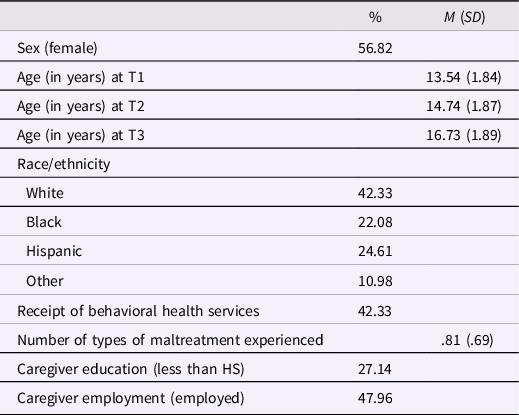
A little over half of the total sample (N = 711) was female (56.8%). At baseline, the adolescents’ age ranged from 11 years to 17.5 years (M = 13.54, SD = 1.84). About 42.3% of adolescents in the sample were White, 22.1% Black, and 24.6% Hispanic. The remaining 11% identified themselves as “other race.” Approximately 27% of the caregivers received less than a high school education, and 48% were employed, either full-time or part-time, at the time of data collection. Sample characteristics and descriptive statistics of key study variables are summarized in Table 1.
Sample Characteristics (N = 711)

The resilience trajectory
The first hypothesis postulated that the level of resilient functioning in child welfare-involved adolescents would increase over time. The unconditional latent growth curve model indicated a good fit: CFI = .95, TLI = .94, RMSEA = .04, 90% CI [.03, .05], SRMR = .03. The results of the model indicated that adolescents’ resilience increased significantly over the 36-month period (unstandardized mean intercept = 7.751, p < .001, unstandardized mean slope = 0.202, p < .001).
Caregiver–child relationships and deviant peer affiliation as predictors
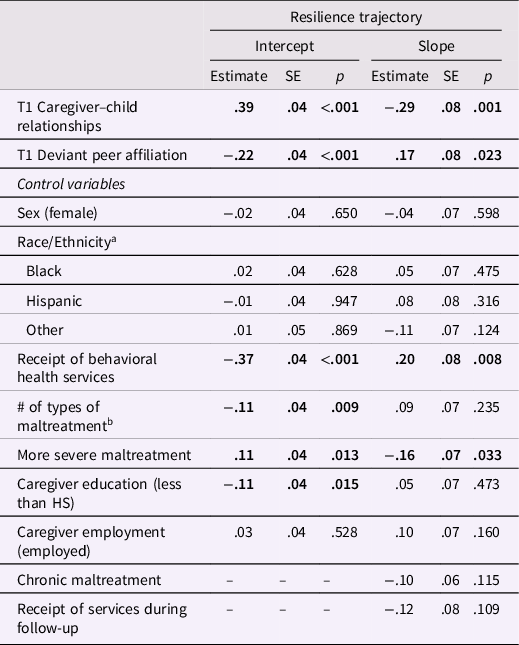
The second hypothesis posited that better caregiver–child relationships and lower deviant peer affiliation would predict a higher level of initial resilience and a steeper increase in resilience over time. Table 2 displays the results of the latent growth curve model with time-invariant covariates. The model showed a good fit: CFI = .91, TLI = .92, RMSEA = .04, 90% CI [.03, .05], SRMR = .04. A better caregiver–child relationship at T1 was associated with a higher initial level of resilience (β = .39, SE = .04, p < .001). Higher deviant peer affiliation at T1 was associated with a lower initial level of resilience (β = −.22, SE = .04, p < .001). Adolescent’s receipt of behavioral health services (β = −.37, SE = .04, p < .001), greater number of maltreatment types (β = −.11, SE = .04, p = .009), and caregiver’s less than high school education (β = −.11, SE = .04, p = .015) were all associated with a lower initial level of resilience. More severe maltreatment was associated with a higher initial level of resilience. In terms of the rate of change of resilience, a better caregiver–child relationship at T1 was associated with a slower increase in resilience over time (β = −.29, SE = .08, p = .001). Conversely, higher deviant peer affiliation at T1 was associated with a steeper increase in resilience over time (β = .17, SE = .08, p = .023). Adolescent’s receipt of behavioral health services was associated with a more rapid increase in resilience over time (β = .20, SE = .08, p = .008), whereas more severe maltreatment was associated with a slower increase in resilience over time (β = −.16, SE = .07, p = .033). Chronic maltreatment (β = −.10, SE = .06, p = .115) and the receipt of behavioral health services during follow-up (β = −.1, SE = .08, p = .109) did not predict the rate of change (i.e., slope) in resilience over time.
Latent Growth Curve Model with Time-Invariant Covariates

Note. Model fit: CFI = .91, TLI = .92, RMSEA = .04, 90% CI [.03, .05], SRMR = .04; Standardized parameter estimates are presented
a Reference group is White
b Sum (total number) of all of the different types of maltreatment at T1; HS = high school; SE = standard error
Concurrent and lagged effects of caregiver–child relationships and deviant peer affiliation
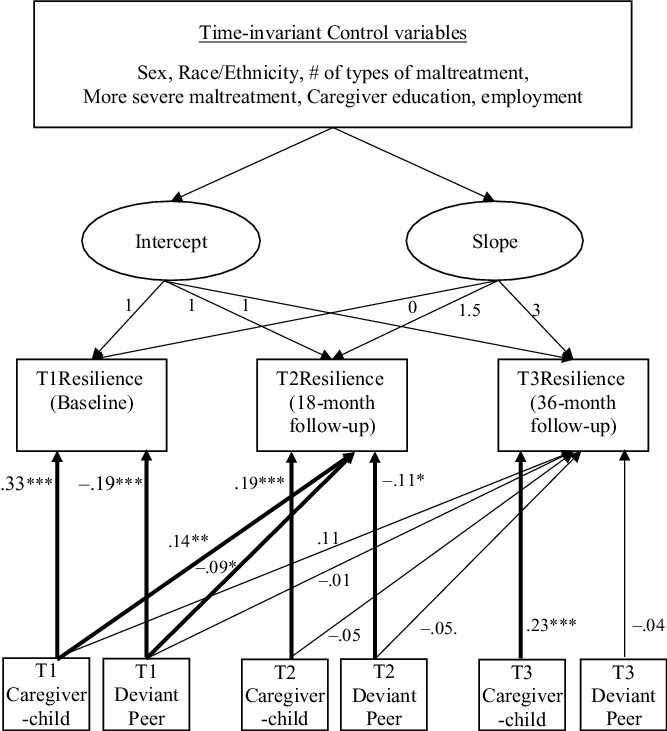
The third hypothesis posited that caregiver–child relationship quality and deviant peer affiliation will have both concurrent (immediate) and lagged (delayed) effects on youth resilience. Figure 1 visually depicts the results of the latent growth curve model with time varying covariates. The model showed a good fit: CFI = .90, TLI = .93, RMSEA = .03, 90% CI [.02, .04], SRMR = .04. At each time point, caregiver–child relationship was concurrently associated with resilience. Better caregiver–child relationships at T1, T2, and T3 were associated with a higher level of resilience at T1, T2, and T3, respectively (T1: β = .33, SE = .03, p < .001; T2: β = .19, SE = .04, p < .001; T3: β = .23, SE = .05, p < .001). At T1 and T2, deviant peer affiliation was concurrently associated with resilience. Higher deviant peer affiliation at T1 and T2 was associated with a lower level of resilience at T1 and T2, respectively (T1: β = −.19, SE = .04, p < .001; T2: β = −.11, SE = .05, p = .013). There was no significant concurrent association between deviant peer affiliation and resilience at T3 (β = −.04, SE = .06, p = .552).
Latent Growth Curve Model with Time Varying Covariates
Note. Model fit: CFI = .90, TLI = .93, RMSEA = .03, 90% CI [.02, .04], SRMR = .04; Standardized parameter estimates are presented; Significant paths are bolded.
**p < .01, ***p < .001

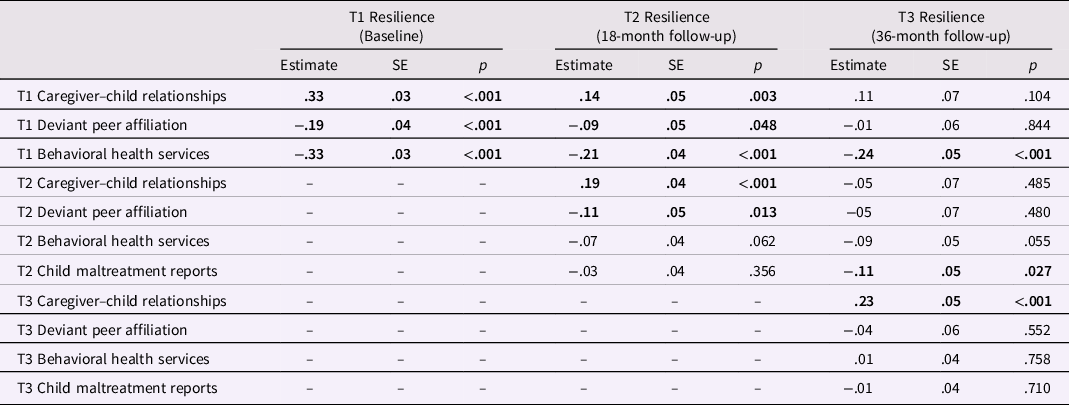
In addition to concurrent associations, significant lagged effects were observed. Better caregiver–child relationships at T1 were associated with a higher level of resilience at T2 (β = .14, SE = .05, p = .003), while higher deviant peer affiliation at T1 was associated with a lower level of resilience at T2 (β = −.09, SE = .05, p = .048). There were no significant lagged effects of T2 caregiver and peer relationships on T3 resilience. Adolescent’s receipt of behavioral health services at T1 was associated with a lower level of resilience at T2 (β = −.21, SE = .04, p = <.001) and T3 (β = −.24, SE = .05, p < .001). Additionally, child maltreatment reports at T2 were associated with a lower level of resilience at T3 (β = −.11, SE = .05, p = .027). Table 3 summarizes concurrent and lagged effects of time varying covariates.
Latent Growth Curve Model with Time-Varying Covariates

Notes. Model fit: CFI = .91, TLI = .92, RMSEA = .04, 90% CI [.03, .05], SRMR = .04; Standardized parameter estimates are presented
aReference group is White
bSum (total number) of all the different types of maltreatment at T1; HS = high school; SE = standard error
Discussion
There remains limited understanding of resilience among children involved in the child welfare system, especially during adolescence. Previous resilience has mostly focused on resilience at one point in time or based on one developmental domain (e.g., behavioral domain: Yoon, Reference Yoon2018; cognitive domain: Holmes et al., Reference Holmes, Yoon, Berg, Cage and Perzynski2018). The current study aims to address this gap in the literature by modeling resilience longitudinally and incorporating multiple domains. Further, we investigated two important attachment relationships during adolescence, specifically caregivers and peers, in predicting resilience across time.
First, our results suggest that resilience increases across time among adolescents involved in the child welfare system. Specifically, we found that when modeled as a multiple domain concept, the trajectory of resilience increased across a 36-month period since initial contact with CPS. Our results are in line with prior resilience literature that conceptualizes resilience as a fluid, dynamic process (Masten, Reference Masten2001; Luthar & Cicchetti, Reference Luthar and Cicchetti2000) and not an individual trait. Our finding that resilience increases across time also aligns with the broader literature on resilience following exposure to different traumas (Eisman et al., Reference Eisman, Stoddard, Heinze, Caldwell and Zimmerman2015; Norris et al., Reference Norris, Tracy and Galea2009; Werner, Reference Werner1993). A possible explanation for resilience increasing over time among adolescents involved in CPS is that adolescents and families might receive services and support following a CPS investigation which in turn may promote resilience. In the current study, receipt of behavioral health services was associated with a steeper incline in resilience over time and therefore, provides preliminary empirical support for this speculation. Future research should investigate how specific services, following contact with CPS, relate to resilience over time among adolescents.
Second, consistent with our hypothesis, a better caregiver–child relationship at the time of CPS involvement was associated with a higher initial level of resilience among adolescents, whereas higher deviant peer affiliation at baseline was associated with a lower initial level of resilience. These results are consistent with prior literature that has found close caregiver–child relationships to be one of the most commonly cited protective factors (Afifi & MacMillan, Reference Afifi and MacMillan2011). Our findings also corroborate previous studies that found deviant peer affiliations as a risk factor that undermines resilience (Cambron et al., Reference Cambron, Kosterman, Catalano, Guttmannova and Hawkins2018; Greenwood et al., Reference Greenwood, Youssef, Letcher, Spry, Thomson, Hagg, Hutchinson, Macdonald, McIntosh, Sanson, Toumbourou and Olsson2021; Price et al., Reference Price, Drabick and Ridenour2019). According to Attachment Theory (Bowlby, Reference Bowlby1969, Reference Bowlby1988), caregivers are the most important relationship when forming attachments and creating the foundation of internal working models for future relationships. Positive attachment relationships with caregivers are linked to a wide variety of optimal outcomes, such as higher levels of self-regulation or social competence and lower levels of behavior problems, which can in turn promote later resilience (Sroufe, Reference Sroufe2005). During adolescence, when peers become especially significant, deviant peers might undermine any previous internal working models and create a new expectation of insecurity or mistrust. Additionally, adolescents affiliated with deviant peers might start to engage in deviant behavior to try to fit in or gain approval. Although beyond the scope of this study, the interplay between caregiver–child relationships and peer relationships would be an important area for future investigation. Building upon this study, future research should examine whether positive caregiver and peer relationships have an additive or multiplicative effect in promoting resilience across adolescence.
Third, we found that better caregiver–child relationships at baseline were associated with a slower increase in resilience over time and higher deviant peer affiliation was associated with a steeper increase in resilience over time, which was contrary to our hypotheses. One potential explanation for the former could be that youth with early positive caregiver–child relationships might already display high levels of resilience and therefore, experience a ceiling effect or have little room for improvement over time. A more rapid growth in resilience over time among adolescents who affiliated with deviant peers at baseline may be due to several reasons. First, it could be that the presence of any friends, even deviant ones, is better for adolescents when compared to having no friends. Prior research has revealed that adolescents with deviant peers show better emotional adjustment compared adolescents with no mutual friends (Brendgen et al., Reference Brendgen, Vitaro and Bukowski2000). One study even found that deviant peer affiliation buffered the negative effects of emotional abuse on adolescent internalizing problems (Yoon et al., Reference Yoon, Yoon, Pei and Ploss2021). Second, adolescents and their peers are situated in the larger school context that might influence the association between deviant peer relationships and adolescent adjustment (Crosnoe, Reference Crosnoe2011). For example, deviant peer behaviors that are normalized in the larger school context may have less negative effects (Crosnoe et al., Reference Crosnoe, Benner and Schneider2012). Further, engagement in moderate risky behavior can improve popularity (Allen et al., Reference Allen, Porter, McFarland, Marsh and McElhaney2005), which may lead to better social adjustment. Future research should continue to explore the associations between deviant peer affiliation and resilience across adolescence, specifically the potential moderators and mediators that may explain under what conditions deviant peers are a risk or protective factor. Alternatively, adolescents affiliated with deviant peers at the time of CPS involvement might start with lower baseline levels of resilience and have more opportunity for growth and development of resilience with time as they receive services and interventions. There is some support for this explanation as we found positive caregiver–child relationships were linked to higher initial levels of resilience and affiliation with deviant peers were related to lower initial levels of resilience. Future research should continue to investigate how different relationships in adolescents’ lives influence their resilience, such as parents, teachers, friends, and extended family. Additionally, looking at the mesosystem of adolescents’ lives, or the intersection between these microsystems, would provide a more holistic view of how to promote resilience following involvement with CPS.
Lastly, we found partial support for our hypothesis that caregiver–child relationship quality and deviant peer affiliation will have immediate and delayed associations with resilience across adolescence. There was no significant concurrent association between deviant peer affiliation and resilience at T3, as well as no significant lagged effects of T1 and T2 caregiver–child relationship quality or deviant peer affiliation on T3 resilience. However, all other concurrent associations were significant; caregiver–child relationship quality and deviant peer affiliation at T1 were associated with resilience at T2. Taken together, it seems that caregiver–child relationship quality and deviant peer affiliation are most consistently influential at the time of CPS involvement in predicting resilience across adolescence. This finding aligns with life course theory, in which earlier experiences influence later developmental trajectories (Elder et al., Reference Elder, Shanahan, Jennings and Lerner2014). Our results provide evidence that timing is an important consideration when evaluating the effects of risk and protective factors. Future work should continue to incorporate multiple assessments of risk and protective factors at the time of CPS involvement to provide insight on mechanisms of promoting resilience among adolescents involved in the child welfare system.
Limitations
It is important to interpret these findings with several limitations in mind. First, our sample included a nationally representative sample of children involved in CPS. This limits the generalizability of our findings to adolescents involved in CPS, and not the broader population. Second, this study included three data collection time points spread across a three-year period. The interval of data collection cannot provide insight on the more day-to-day processes that might promote resilience and the total period of data collection might not be long enough to evaluate complex developmental trajectories of resilience. Third, the conceptualization and operationalization (i.e., measures) of different dimensions of resilience examined in this study had some limitations. For example, normative (i.e., non-clinical) levels of internalizing and externalizing problems were conceptualized to indicate competency in emotional and behavioral functioning. Yet, studies in the resilience literature have pointed out that the lack of psychopathology may not necessarily be the same as showing resilience (Walsh et al., Reference Walsh, Dawson and Mattingly2010). Due to the nature of a secondary data analysis, we were limited by the data available in the NSCAW-II dataset, and unfortunately no other indicators of emotional and behavioral competence were available from the dataset. The use of restricted measures, including the measures of psychopathology for the emotional and behavioral domains, likely have limited our ability to fully observe and capture the complexity and multidimensionality of resilience. Future research should include more comprehensive and pertinent measures to assess resilience across different dimensions of adolescent functioning. Lastly, we focused on a multi-domain, single trajectory of resilience (i.e., composite scores of multi-domain functioning) and did not examine trajectories for each domain of resilience. Different domains of resilience (e.g., social, cognitive, emotional, etc.) may illustrate different developmental trajectories. Future research should examine how developmental trajectories vary across domains of resilience and how close caregiver–child relationships and deviant peer affiliations relate to these different trajectories.
Despite these limitations, this study also has several strengths. First, we incorporated a longitudinal design and therefore were able to model how resilience changes over time. Second, we used an innovative way to assess resilience by considering positive adaptation across multiple developmental domains and creating a composite of adolescents’ overall level of resilience. Third, we examined longitudinal associations between risk and protective factors and resilience to provide insight on processes of resilience.
Future studies and conclusion
This study has a couple of important implications for practitioners and researchers interested in building resilience among child welfare-involved adolescents. First, we found that caregiver and peer relationships were important predictors of later resilience among youth involved in child welfare. Therefore, building positive caregiver–child relationships and preventing deviant peer affiliation through evidence-based interventions may be crucial to promoting positive adaptation and resilience among adolescents with a history of child maltreatment. Furthermore, given that both caregiver–child relationships and deviant peer affiliation showed long-lasting influences on youth resilience, yet in an unexpected direction, ongoing monitoring of functioning in child welfare-involved adolescents may be beneficial. Second, we found that caregiver and peer relationships at initial involvement with CPS had the most salient and enduring impact on resilience across adolescence. Thus, the immediate period following involvement with CPS may be a sensitive period for adolescent resilience and the window of opportunity for intervention. Assessments of interpersonal relationships, as sources of support or risk, after initial contact with CPS and timely intervention might increase the likelihood of successful resilience building among child welfare-involved adolescents. In terms of research implications, our findings of long-lasting and/or delayed effects of interpersonal and family environmental factors (e.g., ongoing child maltreatment) on youth resilience outcomes highlight the value of applying a longitudinal, trajectory-based approach along with time-varying covariates that account for changing context when examining resilience in vulnerable adolescents.
In conclusion, previous research on resilience has focused on one point in time estimates, or a single developmental domain. Our results provide evidence that resilience increases across adolescence following initial contact with CPS. This study can be used as an example of one way to capture the complexity of resilience as an evolving construct. Additionally, the relationships with caregivers and peers at initial contact were important predictors of resilience, illustrating the timing of risk and protective factors is an essential consideration for resilience research. The associations between risk factors, protective factors, and resilience are complex, but using clear operationalization of these constructs, longitudinal design, and advanced analyses, we can better understand the mechanisms and processes to promote resilience among vulnerable populations.
Acknowledgments
This document includes data from the National Survey on Child and Adolescent Well-Being, which was developed under contract with the Administration on Children, Youth, and Families, U.S. Department of Health and Human Services (ACYF/DHHS). The data were provided by the National Data Archive on Child Abuse and Neglect (NDACAN). This research received no specific grant from any funding agency, commercial or not-for-profit sectors.
Conflicts of interest
None.