Among those with mental illness and a history of contact with the criminal justice system (CJS), “forensic patients,” constitute a small but significant subgroup. They typically have severe mental illnesses and have been charged with serious violent offences. As a group, they characteristically have complex mental health and other needs,Reference Segal, Daffern, Thomas and Ferguson 1 and concern about their risk of reoffending is a key consideration for those tasked with oversight of their treatment and detention. As a result, forensic patients often spend long periods in secure mental health facilitiesReference Shah, Waldron, Boast, Coid and Ullrich 2 and are often subject to high levels of supervision once judged to be safe to return to the community.
In many ways, the existence of this group of patients represents a failure of preventative mental health care—a criminalization of those with mental illness that lies at the extreme end of a spectrum of such criminalization. While diversion away from the CJS into mental health care following a serious index offence is a common outcome for those with severe mental illness, it can be seen as an act of diversion that has come late and at great cost, including for the victims of the serious violent offences typically committed. This review will consider the decriminalizing potential of efforts to prevent both initial and repeat contact with the CJS for those with severe mental illness, particularly for the subgroup of forensic patients.
Prevention of Initial CJS Contact for Those with Severe Mental Illness
There is a well-established association between mental illness, particularly severe mental illness, and risk of contact with the CJS. Studies conducted over the last several decades in prison, clinical, and population-based samples have confirmed the increased risk of CJS contact for those with severe mental illness.Reference Fazel and Seewald 3 , Reference Fazel, Gulati, Linsell, Geddes and Grann 4 More recent research has identified a wide range of potential explanatory factors, including the co-occurrence of substance use problems,Reference Short, Thomas, Mullen and Ogloff 5 the consequences of social disadvantage,Reference Sariaslan, Larsson, Lichtenstein and Fazel 6 and the presence of untreated symptoms.Reference Keers, Ullrich, DeStavola and Coid 7 In addition, there is evidence that mental illness is a risk factor for repeated contact with the criminal justice system—for recurrent and cumulative criminalization.Reference Fazel and Yu 8 In this context, decriminalization is likely to necessitate successfully identifying those with mental illness at increased risk of CJS contact as well as intervening to address the factors underlying the increased risk, but there has been limited research focused on testing approaches to the prevention of CJS contact, including initial contact, among those with severe mental illness.
A number of intervention studies intended to improve other clinical and functional outcomes in psychosis have, however, considered violence or other offending behavior as a secondary outcome. For example, trials of intensive or assertive community care,Reference Walsh, Gilvarry and Samele 9 outpatient commitment,Reference Swanson, Swartz, Wagner, Burns, Borum and Hiday 10 and administration of specific psychotropic medicationsReference Swanson, Swartz, Elbogen and Dorn 11 have considered measures of CJS contact and offending outcomes, with varying results. In a systematic review of nonpharmacological interventions for reducing aggression and violence in serious mental illness (with the majority of identified studies focused on forensic patient or other mentally disordered offender samples) the quality of evidence to support any interventions was found to be poor.Reference Rampling, Furtado and Winsper 12 It is also of note that many of these intervention studies have involved participants with chronic psychosis, many of whom have already had CJS contact. While the “early intervention in psychosis” literature is extensive, few studies have focused on preventing violence or CJS contact as an outcome.
Testing early assertive and specialized community care for individuals with first episode psychosis in Denmark, the OPUS trial found evidence of benefits for a range of clinical and social outcomes.Reference Petersen, Nordentoft and Jeppesen 13 Subsequently, trial participants were linked to official criminal records in order to examine the impact of the intervention, and its established benefits, on risk of subsequent contact with the CJS.Reference Stevens, Agerbo, Dean, Mortensen and Nordentoft 14 Unfortunately, no impact on CJS contacts was seen over either the 2 years of the intervention or the subsequent 3 years of follow-up. The results of this study undermines the notion that gold standard early intervention for first episode psychosis reduces CJS contact, perhaps indicating that a targeted rather than universal approach is needed, that intervention needs to be offered even earlier than the first episode of psychosis (in the Danish study, many had already offended prior to recruitment to the study) and/or that the intervention needs to be specifically focused on reducing criminality. In this context, it is important to note that there is evidence that the risk of violence for those with serious illness might well be greatest during the earliest phases of illness,Reference Nielssen, Malhi, McGorry and Large 15 particularly, prior to treatment, and perhaps even in the prodromal or at-risk period.Reference Brucato, Appelbaum and Lieberman 16
While the index offences of forensic patients, being typically serious violent offences, represent a relatively rare outcome that is not ideal as a focus of prevention, it is clear that the clinical and service-contact narratives of individual forensic patients commonly present apparent “missed opportunities” for intervention. In a study of individuals found not guilty by reason of mental illness in NSW over 25 years, over 80% were noted to have had contact with mental health services at some point prior to the index offence.Reference Dean, Singh, Kemp, Johnson and Nielssen 17 In addition, the early phases of psychosis may not only represent a high-risk time for offending behavior and CJS contact, but also for risk of serious violent offending, in particular.Reference Nielssen and Large 18 Whether attempts to identify and intervene as early as possible in the course of emerging psychosis can prevent CJS contact, including for the type of serious violence that defines the forensic patient group, remains unknown.
Reoffending Rates Among Released Forensic Patients
While diversion away from the CJS and into mental health services in order to meet the significant mental health needs of forensic patients is a common approach internationally, the precise manner in which this is done varies considerably between jurisdictions. While the M’Naghten rules that underlie a complete mental health defense against a criminal charge arose from English case law, they are now more commonly applied in jurisdictions outside than inside the United Kingdom. In Australia, for example, modified versions of the M’Naghten rules are still relied upon in several jurisdictions.
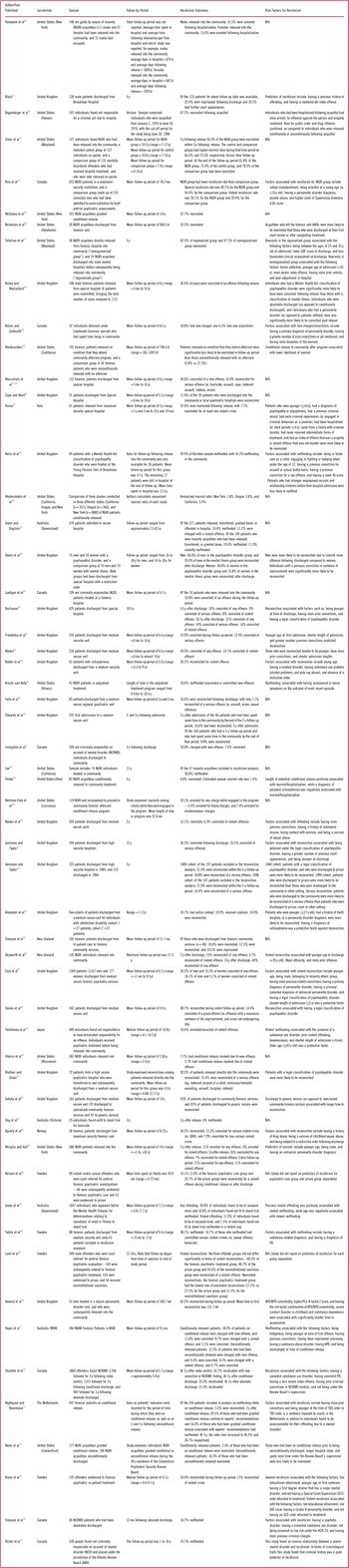
If diversion of forensic patients away from the CJS into mental health services is to be fully realized as a tool of decriminalization, one of the key outcomes must be a reduction in the risk of postrelease reoffending. Beginning in the early 1990s, many studies following forensic patients after release from secure care have now been conducted. A recent systematic review and meta-analysis of such studies,Reference Fazel, Fiminska, Cocks and Coid 19 identified 35 studies from 10 countries (18 from England and Wales). The pooled estimate of postrelease reoffending for the 30 studies providing data on this outcome was 4484 per 100 000 person years (95% confidence intervals [CI] 3679-5287). Substantial heterogeneity across studies was found in relation to reported reoffending rates but the only factor found to provide any explanation was the association between the age of studies and reoffending rate reported. Table 1 provides a summary of the included studies and an update on studies published since the review.
Studies of Postrelease Reoffending in Samples of Forensic Patients

APD, Antisocial Personality Disorder; BPD, Borderline Personality Disorder; PCL-R, Psychopathy Checklist - Revised
Judgments about whether or not the rates of reported recidivism for released forensic patients are low or high rests on the nature of comparison groups. No study to date has undertaken a formal case-control analysis, in part because of the inherent difficulty in identifying a suitable comparison group, but many have made comparisons to local prison-release reoffending rates. In the systematic review described, 10 of the 30 recidivism studies reported rates for comparison populations and in all cases forensic patients were noted to have a lower rate of reoffending.Reference Fazel, Fiminska, Cocks and Coid 19 In one of the Australian studies included in the review, a study of 197 forensic patients in NSW, the reconviction rate for conditionally-released patients (followed up for 8.4 years on average) was 11.8% for any offence and 3.1% for any violent offence.Reference Hayes, Kemp, Large and Nielssen 71 While a comparison group was not included, in a study of 661 nonforensic offenders charged with serious but nonlethal violent offence in the same jurisdiction, over half of those diagnosed with psychotic illness had returned to prison during the follow-up period, suggesting that even compared to a psychotic offender control group, forensic patients may have lower rates of recidivism.Reference Nielssen, Yee, Dean and Large 78 In a follow-up to the NSW forensic patient study, with an increased sample size of 477, 12-month postrelease reconviction rates were reported in order to make a comparison with routinely reported prison-release reoffending rates in the same jurisdiction.Reference Dean, Singh, Kemp, Johnson and Nielssen 17 Only 6.3% of the forensic patient sample were found to have committed “proven” offences in the 12 months following release, compared to 41% reported for released prisoners in NSW for the 12 months of 2015. 79 The explanation for the relatively low rate of reoffending for forensic patients released from secure care is unclear but the consistency of findings on this point arguably support the notion that forensic mental health services, typically supported by formal supervision/monitoring frameworks, are successfully contributing to the decriminalization of forensic patients. The specific ingredients of the complex models of forensic mental health care that give rise to this impact are, however, unknown.
Risk Factors for Reoffending Following Release from Secure Care
While rates of reoffending appear to be relatively low for forensic patients released from secure care, it is important to understand the drivers of reoffending in this group if efforts at further reducing postrelease contact with the CJS are to be successful.
Table 1 summarizes the postrelease reoffending predictors reported in published studies of forensic patient samples (from 1982 to 2018). Factors related to previous CJS contact, such as the number and type of previous charges, as well as age of first offence, were highlighted by many studies. Some studies identified that measures related to service or organizational interventions, such as failures of prior supervision or restriction, were noted by some studies. A few studies found that length of hospital admission was associated with risk of postrelease reoffending but there was no consistency with regard to the direction of the association. Few studies commented on positive factors associated with reduced risks (eg, employment).
With regard to clinical risk factors, two key factors are commonly identified as important predictors of postrelease reoffending. Somewhat related to the importance of measures of prior criminality and supervision failures, a recorded co-morbid diagnosis of personality disorder, particularly of antisocial type has been identified as an important clinical predictor of postrelease reoffending in a number of forensic patient samples. A 36 year study of 6520 patients released from forensic hospitals in Sweden, found that a diagnosis of personality disorder, either as the only diagnosis or co-morbid with a psychotic illness or substance use disorder, was associated with a higher rate of violent reoffending.Reference Fazel, Wolf, Fimińska and Larsson 80 Similarly, in the expanded NSW forensic patient study described earlier, the presence of a recorded clinical diagnosis of co-morbid personality disorder was found to be the only independent predictor of postrelease reoffending.Reference Dean, Singh, Kemp, Johnson and Nielssen 17 The importance of co-morbid antisocial personality disorder in predicting adverse outcomes for forensic patients supports the calls for “criminogenic needs” to be a stronger focus of the interventions provided by forensic mental health services,Reference Skeem, Winter, Kennealy, Louden and Tatar 81 although even in the nonforensic literature, the evidence of benefit for the current approaches to recidivism reduction remains limited.Reference MacKenzie and Farrington 82
Substance use problems have also been identified as clinical targets for intervention in forensic patient studiesReference Monson, Gunnin, Fogel and Kyle 83 but there have been few evaluations of substance use interventions in forensic settings. In one recent study of an inpatient intervention adapted for forensic patients, substance-related knowledge and self-reported relapse prevention skills were increased in completers compared to noncompleters,Reference Milosevic, Ahmed, Adamson, Michel, Rodrigues and Seto 84 but there was no impact on time-to-first substance use or on rates of positive urine screening during follow-up. The impact on reoffending behavior was not examined.
The extent to which identified predictors of postrelease reoffending can be useful targets for intervention depends on their dynamic nature, as well as on the availability of evidence-based and targeted interventions. Beyond treating severe mental illness, the interpersonal and emotion regulation problems characteristic of co-morbid personality disorder, and the persistence of substance use problems appear to be the key targets for forensic mental health services to address if postrelease reoffending is to be further reduced. Developing an evidence base to support such efforts needs to be prioritized.
Conclusions
While they may be a relatively small subgroup, forensic patients should not be neglected in the development of strategies to decriminalize mental illness, particularly in light of the complex and costly nature of their care and the seriousness of their offences. The prevention of CJS contact for individuals with emerging severe mental illnesses may require a targeted approach, challenging the assumption that optimal mental health treatment will inevitably improve the full spectrum of potential outcomes for all. Preventing repeat CJS contact for forensic patients released from secure care is an important outcome for forensic mental health services and should be considered among the range of decriminalization strategies. The relatively low reoffending rates consistently reported for released forensic patients are encouraging but further work is needed to develop the evidence base required to address the factors repeatedly identified as predicting postrelease reoffending.
Disclosures
Kimberlie Dean, Sara Singh, and Yin-Lan Soon do not declare any conflicting interests in relation to this publication.