Introduction
In the United States, increasing malpractice litigation risk and medical liability insurance premiums have caused widespread concern regarding their effects on physicians’ practice behavior. Much of the controversy has concerned the issue of defensive medicine. The question is how often patients are subjected to unnecessary tests and procedures, and to the extent that happens, how much of it is attributable to the medical malpractice system of tort liability. While there have been studies of referrals and there is a substantial literature exploring the effects of malpractice liability on physician practices, little is known about the impact of the medical liability system on physicians’ referral behavior. Because failure to diagnose and failure or delay in referral are among the reasons most cited for medical negligence claims in the United States (Garr and Marsh, Reference Garr and Marsh1986; McLean, Reference McLean2004; Phillips et al., Reference Phillips, Bartholomew, Dovey, Fryer, Miyoshi and Green2004; Kain and Caldwell-Andrews, Reference Kain and Caldwell-Andrews2006), referrals to specialists are likely to be an area of clinical care strongly affected by liability pressure.
The possible role of referrals in defensive medicine may have substantial implications for both the cost and quality of care. In the United States, the probability that an ambulatory visit to a physician resulted in a referral to another physician nearly doubled between 1999 and 2009 (increased from 4.8% to 9.3%), with 105 million visits resulting in a physician referral in 2009 (compared with 41 million in 1999) (Barnett et al., Reference Barnett, Song and Landon2012). Similar referral rates have been observed in other countries. For instance, O'Donnell (Reference O'Donnell2000) reviewed studies of referral rates by general practitioners and found that 2.46–6.6% of the consultation visits resulted in referrals. In Australia, general practitioners referred patients to specialists at a rate of 7.7/100 encounters (Piterman and Koritsas, Reference Piterman and Koritsas2005). Although the rate of referrals seemed to be higher in the United States than other countries when measured by the proportion of patients referred (as opposed to the proportion of total patient visits) (Forrest et al., Reference Forrest, Majeed, Weiner, Carroll and Bindman2002, Reference Forrest, Majeed, Weiner, Carroll and Bindman2003), the financial impact of referral visits can still be substantial for many countries.
Referrals may be appropriate and cost-justified when a physician refers to a specialist a case for which he/she is only marginally qualified. On the other hand, if referrals are unwarranted and done only with a view toward litigation to build a record of care covering every possible contingency, they can add substantially to the cost of medical care. Referrals are expensive both because they involve a transaction cost (e.g., phone calls, making appointment, completion of referral forms) and because care by specialists costs more than care by generalists for comparable health problems (Schneeweiss et al., Reference Schneeweiss, Ellsbury, Hart and Geyman1989; Kues et al., Reference Kues, Sacks, Davis and Smith1991; Greenfield et al., Reference Greenfield, Nelson, Zubkoff, Manning, Rogers, Kravitz, Keller, Tarlov and Ware1992; Carey et al., Reference Carey, Garrett, Jackman, McLaughlin, Fryer and Smucker1995). Moreover, excessive referrals may interrupt continuity of care and cause extra risk for the patient owing to unnecessary invasive procedures and false positives of unnecessary tests (Nutting et al., Reference Nutting, Franks and Clancy1992; Office of the Assistant Secretary for Planning and Evaluation, 2002; Iverson et al., Reference Iverson, Coleridge, Fulda and Licciardone2005; Burt et al., Reference Burt, McCaig and Rechtsteiner2007; Axon et al., Reference Axon, Hassan, Niv, Beglinger and Rokkas2008).
The limited number of studies available so far has focused on how the medical–legal environment affects providers’ referral decisions, which could overestimate the impact of the medical–legal system. This is because not all referrals ‘made’ lead to a completed visit. A referral that is made is basically a recommendation that the patient visit another physician, and that recommendation may or may not be followed by the patient. For patients referred from primary care settings, the compliance rate in the United States has been reported from 63% to 89% (Byrd and Moskowitz, Reference Byrd and Moskowitz1987; Wu et al., Reference Wu, Kao and Chang1996; Hacker et al., Reference Hacker, Weintraub, Fried and Ashba1997; Bourguet et al., Reference Bourguet, Gilchrist and McCord1998; Forrest et al., Reference Forrest, Shadmi, Nutting and Starfield2007). In particular, women were found to be more likely than men to adhere to referral recommendations (Weiner et al., Reference Weiner, Perkins and Callahan2010), while patients who had Medicaid insurance or had to make the appointment themselves were less likely to complete the referral (Pinsker et al., Reference Pinsker, Phillips, Davis and Iezzoni1995; Forrest et al., Reference Forrest, Glade, Baker, Bocian, von Schrader and Starfield2000; Forrest et al., Reference Forrest, Shadmi, Nutting and Starfield2007; Weiner et al., Reference Weiner, Perkins and Callahan2010; Zuckerman et al., Reference Zuckerman, Nelson, Bryant, Hobrecker, Perrin and Donelan2011b). Patients who disagreed with the physician on the need for referral also had lower completion rates (Wu et al., Reference Wu, Kao and Chang1996; Zuckerman et al., Reference Zuckerman, Cai, Perrin and Donelan2011a). Other reasons commonly cited by patients for not completing referrals included the health problem being resolved, lack of time and difficulty in scheduling the appointments or getting appointments quickly (Pinsker et al., Reference Pinsker, Phillips, Davis and Iezzoni1995; Wu et al., Reference Wu, Kao and Chang1996; Forrest et al., Reference Forrest, Glade, Baker, Bocian, von Schrader and Starfield2000, Reference Forrest, Shadmi, Nutting and Starfield2007; Zuckerman et al., Reference Zuckerman, Perrin, Hobrecker and Donelan2013). In addition, specialists may be more reluctant to accept referrals when the risk of medical liability is high (Berenson et al., Reference Berenson, Kuo and May2003). Similar issues of non-attendance at referred visits have been reported in other countries, such as Denmark and the United Kingdom (Glyngdal et al., Reference Glyngdal, Sørensen and Kistrup2002; Hamilton et al., Reference Hamilton, Round and Sharp2002). In the United Kingdom, men, younger patients, patients with lower socioeconomic status and patients who had longer intervals between referral and the appointment were found to be less likely to attend the referred visit, as well as those seeing a general practitioner who was a high referrer (Hamilton et al., Reference Hamilton, Round and Sharp2002).
Therefore, the influence of the medical malpractice environment on actual referral visits is likely smaller than its effect on referrals made. However, no prior studies have tested the hypothesis whether a state's medical liability environment affects actual referral visits. This is a research question of particular relevance with regard to the cost of the medical–legal system. In this paper, we sought to fill this knowledge gap by examining the effect of a state's medical liability environment on completed referrals using nationally representative data from the United States.
Methods
Conceptual framework
Economic theory suggests that the referral process is determined not only by patient and physician characteristics, but is also greatly influenced by variables such as the medical malpractice environment in which the physician practices (Shortell and Anderson, Reference Shortell and Anderson1971; Green, Reference Green1978). According to Green's (Reference Green1978) model of malpractice litigation, the patient and the patient's attorney decide whether to file a malpractice suit to maximize their expected net return from filing a lawsuit, which is influenced by their perceived level of appropriate care. On the other side, the physician chooses a level of care that maximizes the difference between the profitability of care (in the absence of malpractice claims) and the expected costs of malpractice liability. Both are influenced by the standard of care for negligence used by the legal system.
In a more plaintiff-oriented legal environment, the minimum standard of care is higher. Referral is one component of this optimal care level in that the physician considering a referral needs to determine the appropriate ‘referral threshold’ (Schaffer and Holloman, Reference Schaffer and Holloman1985). This perception of the appropriate rate of referrals drives physicians’ referral decisions in clinical practice. Hence, variation in the medical liability environment can shift the rate of referrals made by physicians.
However, it should be noted that only a fraction of the referral recommendations result in a visit (Byrd and Moskowitz, Reference Byrd and Moskowitz1987; Wu et al., Reference Wu, Kao and Chang1996; Hacker et al., Reference Hacker, Weintraub, Fried and Ashba1997; Bourguet et al., Reference Bourguet, Gilchrist and McCord1998; Forrest et al., Reference Forrest, Shadmi, Nutting and Starfield2007). Let R be the event that the specialist receives a referral visit and RM be the event that a referral to a specialist is made by another physician. Assuming that all referrals are made to specialists, then the likelihood of a specialist receiving an actual referral visit, P(R), is
 $$P{\rm{(}}R{\rm{)}}\,{\rm{ = }}\,P{\rm{(}}R{\rm{|}}RM{\rm{)}}\,\times \,P{\rm{(}}RM{\rm{)}}$$
where P(R|RM) is the fraction of referral recommendations that leads to completed visits. P(R|RM) is less than one because referrals made must be pursued by patients and accepted by specialists in order to become visits. Thus, estimation of the additional costs of increased referrals due to differences in state liability environments should be based on completed visits, i.e., P(R), not referrals recommended, i.e., P(RM).
Moreover, referrals induced by physicians’ liability concerns may have lower completion rates (i.e., lower P(R|RM)) as they are more likely to involve health problems that patients believe to be less serious or problems that patients think do not require a referral. Specialists also may decline to accept elective referrals from certain patients for fear of increased likelihood of bad outcomes and malpractice claims (Berenson et al., Reference Berenson, Kuo and May2003). Therefore, a state's medical liability environment may influence the occurrence of actual referral visits by affecting both the rate of referral recommendations and the completion rate. Differences between high pressure and low pressure states in the rate of actual referral visits may be smaller than the differences between these states in the rate of referrals made. For these reasons, it is important to evaluate the effects of a state's medical liability environment on the rate of actual referral visits received by specialists.
In addition to medical liability, receipt of referrals by a specialist may also be attributable to economic or professional incentives within practices, hospitals or managed care organizations. It is essential to separate the possible effects of these factors from the effects of medical malpractice. Hence, our econometric model built on prior studies examining factors that affect physicians’ receipt of referrals and accounted for many other variables that may affect the rate of referrals received by a physician, such as the demographic characteristics of the patient and the physician, the physician's specialty and type of practice, the patient's sources of payment, diagnoses, and the primary reason for the patient visit (Johnson et al., Reference Johnson, Kroeger, Altman, Clark and Sheps1965; Vogt and Amundson, Reference Vogt and Amundson1988; Tabenkin et al., Reference Tabenkin, Oren, Steinmetz, Tamir and Kitai1998; Forrest et al., Reference Forrest, Majeed, Weiner, Carroll and Bindman2002; Fournier and McInnes, Reference Fournier and McInnes2002; Berenson et al., Reference Berenson, Kuo and May2003).
Data sources
This study combined data from multiple sources. Patient visit data came from pooled 2003–2007 National Ambulatory Medical Care Survey (NAMCS), a multistage probability survey of ambulatory medical care visits to the offices of physicians in the United States.Footnote 1 We limited the analysis to 2003–2007 NAMCS because several key variables (e.g., percent practice revenue from managed care contracts) were not available in earlier years. Pooling data across multiple years allowed us to exploit variations in medical liability both across states and over time. Detailed information on characteristics of the patient, as well as the physician and his/her practice, was available for each visit sampled.
We obtained measures of the medical malpractice environment from: (1) the National Practitioner Data Bank (NPDB), (2) Medical Liability Monitor (MLM)'s annual premium survey and (3) the Database of State Tort Law Reforms (DSTLR). The NPDB contains information on paid malpractice claims and adverse actions (e.g., revocation or suspension of licenses) taken against all physicians employed in the private sector in the United States (Health Resources and Services Administration, 2010). MLM's annual survey reports malpractice insurance premiums of major writers of professional liability insurance in the United States for physicians in three specialties (internal medicine, general surgery and obstetrics/gynecology), representing 65–75% of the market (Medical Liability Monitor, 2007). The DSTLR, compiled by Professor Ronen Avraham at the University of Texas at Austin School of Law, provides detailed and comprehensive information on the most prevalent tort reforms in the United States (Avraham, Reference Avraham2010).
Several variables were obtained from the Area Resource File (ARF), a data set containing information on health facilities, health professions, and socioeconomic and environmental characteristics for each of the counties in the United States (National Center for Health Workforce Analysis, 2008). Patient visit data from NAMCS were linked to measures of medical malpractice environment and ARF neighborhood characteristics by geographic variables (state and county) and year.Footnote 2
Study population
Our analytic sample included visits where a physician was actually seen, the physician was in a non-primary care specialty, it is known whether the patient was referred for the visit, and the visit was from a new patient. The last criterion was applied to avoid ambiguity regarding how to define a referred visit (i.e., in NAMCS, it is not clear whether a visit was reported as a referred visit or not referred when patients came for follow-up visits originating from a referral). Because most referral visits were for specialty care, we focused our analysis on visits to physicians in non-primary care specialties. We defined non-primary care specialties as the following: general surgery, orthopedic surgery, obstetrics/gynecology, cardiovascular disease, dermatology, urology, ophthalmology, otolaryngology, psychiatry, neurology and ‘other’ specialties (excluding general internal medicine, family medicine and general pediatrics). After excluding visits with missing data on any of the covariates, our final sample size for analysis was 12,839.
Measures
Our outcome measure was a binary indicator for whether the patient was referred for the visit. For each visit surveyed in the 2003–2007 NAMCS, the provider was first asked ‘Are you the patient's primary care physician/provider?’ and if he/she checked ‘No’ or ‘Unknown’, a subsequent question: ‘Was patient referred for this visit?’ was asked. We coded the outcome variable as 1 if the provider indicated that the patient was referred for this visit and 0 if the provider indicated that he/she was the patient's primary care provider or the patient was not referred for the visit.
The independent variable of primary interest was the state-year specific medical malpractice environment. While earlier research tended to use an aggregate measure of the degree to which a state was hospitable to medical malpractice litigation, such as frequency and severity of claims or the level of malpractice insurance premiums, more recent research has employed variables indicating whether a state has adopted specific malpractice reforms, such as the abolition of joint and several liability, or caps on non-economic damages of a given amount. We used both aggregate measures and variables for specific reforms in our estimation.
Specifically, we measured the malpractice environment in each state-year alternatively by: (1) frequency of paid medical malpractice claims (i.e., number of paid claims per 1000 physicians), (2) severity of paid medical malpractice claims (i.e., median payment of paid claims), (3) medical malpractice insurance premium (for general surgery and obstetrics/gynecology) and (4) caps on non-economic (i.e., ‘pain and suffering’) damages. Malpractice insurance premiums for general surgeons and obstetrician-gynecologists were calculated using the MLM's annual survey data via a two-stage weighting approach (Yang et al., Reference Yang, Studdert, Subramanian and Mello2008).Footnote 3 Severity of malpractice claims and malpractice insurance premiums were adjusted to 2007 US dollars (US Bureau of Labor Statistics, 2010). Caps on non-economic damages are one of the most common liability reforms adopted by states (Mello and Williams, Reference Mello and Williams2006). Prior studies evaluating the efficacy of state liability reforms in constraining the growth of malpractice insurance premiums, claim payouts, or physician supply have generally showed supportive evidence for caps on non-economic damages, whereas the evidence for other tort reforms was mixed (Studdert et al., Reference Studdert, Mello and Brennan2004; Mello and Williams, Reference Mello and Williams2006). Therefore, we used caps on non-economic damages as a marker for the pro- or anti-plaintiff orientation of a state's laws toward malpractice claims and the general attitude of judges and juries toward such claims in a state-year.
Our primary analysis assessed the association between a cap of non-economic damages at $250,000 and the likelihood of a visit being referred. Because the amount of the cap varies widely across state-year (Appendix), we conducted two sensitivity analyses to examine: (1) whether having a cap (defined as 1 if the state had a cap on non-economic damages regardless of the amount, and 0 if the state did not have caps on non-economic damages) had any impact and (2) whether having a cap at $250,000, $250,001–$499,999, $500,000, or >$500,000 had different impact (with no caps on non-economic damages serving as the reference group). This helped to determine the ‘effective’ cap amount that might influence physicians’ referral behavior, and addressed one limitation of prior studies that have often lumped different levels of caps together (Mello and Williams, Reference Mello and Williams2006).
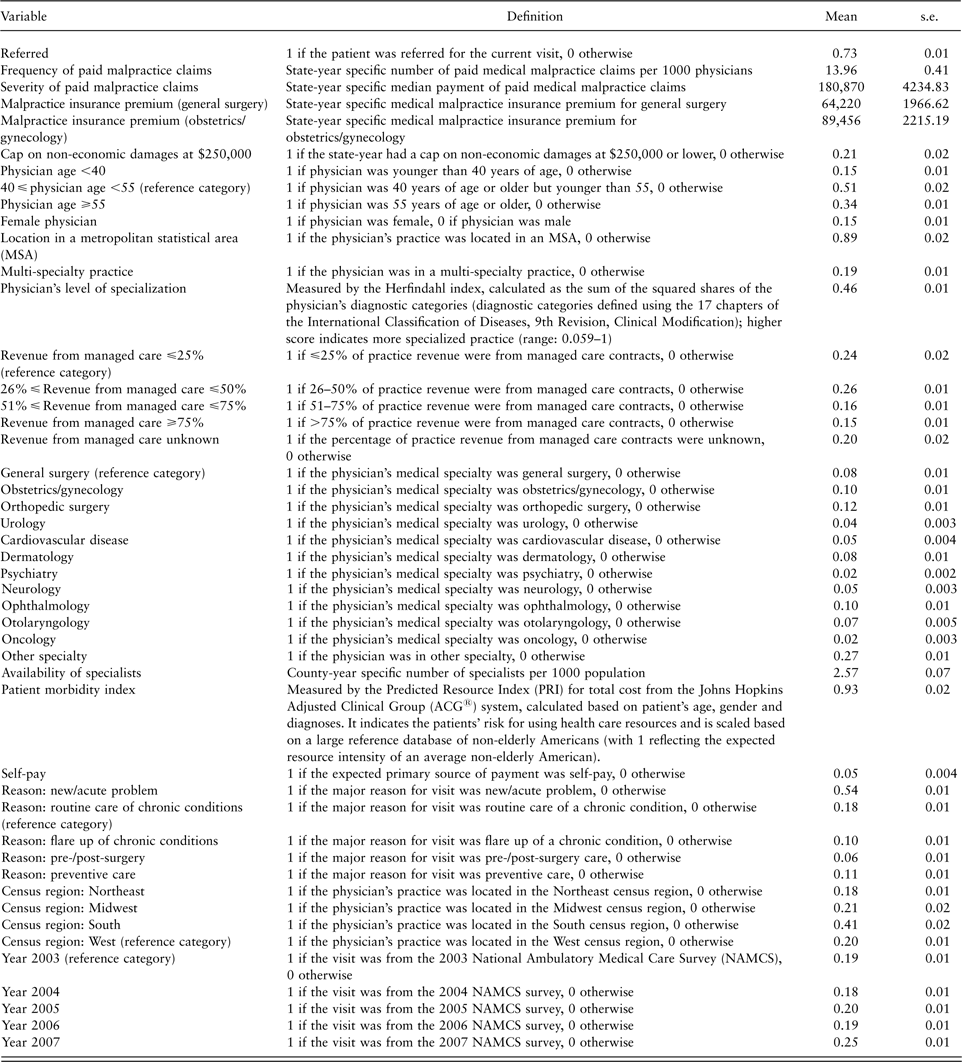
To account for other factors that may also affect the likelihood of a visit being referred, our model incorporated detailed measures on physician, patient and visit characteristics. These include: physician age, physician gender, location in a metropolitan statistical area, multi-specialty practice (vs single-specialty practice), the medical specialty and the level of specialization of the recipient physician, availability of specialists in the geographic area, percentage of the recipient physician's practice revenue from managed care, expected primary source of payment for the visit, census region (Northeast, Midwest, South or West), and survey year. Moreover, to account for the severity of a patient's condition, which can substantially affect his/her likelihood of having a referred visit, our model further adjusted for the major reason for the visit (a new/acute problem, flare up of a chronic condition, pre- or post-surgery care, preventive care, vs routine care of a chronic condition) and a patient morbidity index, which was measured by the Johns Hopkins Adjusted Clinical Groups® (ACG®) case-mix adjustment system using information on a patient's age, gender and diagnosis codes (Forrest and Reid, Reference Forrest and Reid2001; Forrest et al., Reference Forrest, Nutting, von Schrader, Rohde and Starfield2006; The Johns Hopkins ACG® System, 2013). These variables were selected based on evidence from the prior literature and availability of data. Definitions and descriptive statistics of these variables are provided in Table 1.
Variable definitions and descriptive statistics

s.e. = standard error of the mean; unweighted sample size = 12,839; weighted sample size = 302,057,843.
Notes: Statistics reported in table reflect weighted results. Malpractice insurance premiums and severity of paid malpractice claims are reported in 2007 US dollars.
Statistical analysis
We conducted multivariate regression analyses to account for potential confounding factors that may affect the likelihood of the patient being referred for the visit (e.g., patient morbidity). Specifically, we estimated a series of binary logistic regressions as follows:
 $${ {\rm{Ln}}\,({{P}_i}/(1 - {{P}_i}))\, = & \,{{\beta }_{\rm{0}}}\, + \,{{\beta }_{\rm{1}}}\,Liability\,Environmen{{t}_i}\, \cr & + \,{{\beta }_{\rm{2}}}{{X}_i}\, + \,{{\beta }_{\rm{3}}}{{Z}_i}\, + \,{{\beta }_{\rm{4}}}YEA{{R}_i} \cr}$$
where i indexes distinct visits, P represents the probability of the patient being referred for the current visit, X reflects physician and practice characteristics, Z denotes patient characteristics, and YEAR is a vector of dummy variables indicating the year of the NAMCS survey. Our unit of analysis was individual visits. Separate models were analyzed for each of the alternative malpractice environment measures (e.g., frequency of paid claims, indicator for whether the state-year had a cap on non-economic damages). To generate unbiased national estimates and correct variance estimates, all analyses accounted for the complex sample design of NAMCS (i.e., stratum, primary sampling unit and patient visit weight).
Results
As shown in Table 1, 73% of all the visits to specialists in our sample were referred by another physician. The specialists had a moderate level of specialization, as indicated by an average Herfindahl index of 0.46 (Franks et al., Reference Franks, Williams, Zwanziger, Mooney and Sorbero2000; Forrest et al., Reference Forrest, Nutting, von Schrader, Rohde and Starfield2006).Footnote 4 For 15% of the visits, the recipient physician had substantial involvement in managed care (i.e., with 75% or more of their practice revenue from managed care contracts). Nearly one in five visits (19%) was to specialists in multi-specialty practices and over half of the visits (54%) were for new or acute problems.
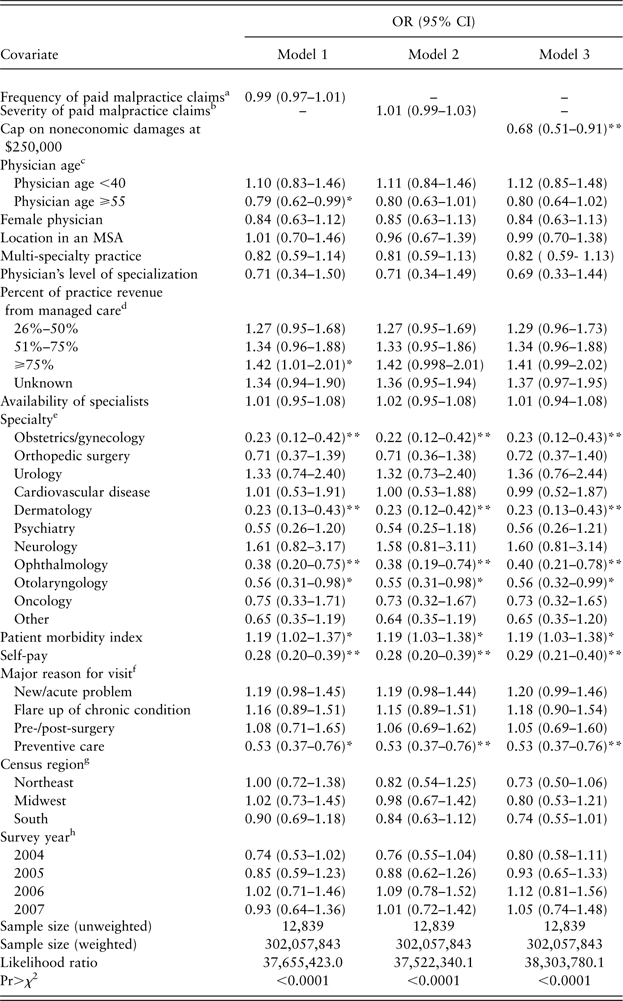
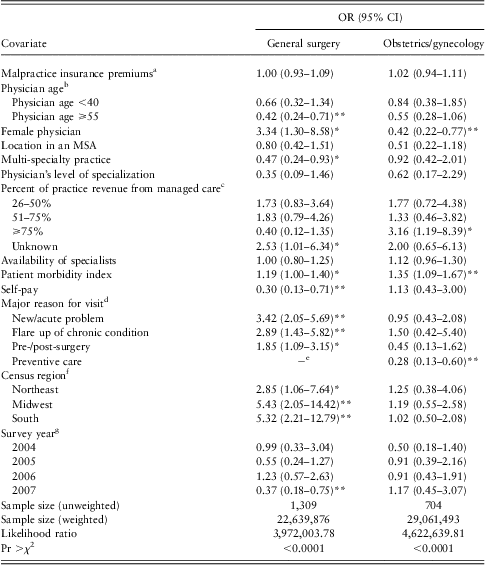
Table 2 presents the estimates from logistic regression analyses in which the dependent variable equals 1 if the visit was a referral and 0 otherwise. The extent to which the malpractice environment was plaintiff-oriented was measured by the frequency of paid malpractice claims in Model 1, by the severity of paid malpractice claims in Model 2 and by whether the state-year had a cap on non-economic damages in Model 3. Table 3 summarizes key findings from logistic regression analyses similar to those reported in Table 2 except that the models used the average amount of malpractice premiums for general surgery and obstetrics/gynecology to measure the medical malpractice environment. Accordingly, the two models in Table 3 included only visits to general surgeons (n = 1309 observations), and obstetrician-gynecologists (n = 704 observations), respectively. Regression coefficients are reported in odds ratios (OR) and 95% confidence intervals (CI).
Multivariate regression analyses of the impact of state medical liability pressure on specialists’ receipt of referrals
OR = odds ratio; CI = confidence interval; MSA = metropolitan statistical area.
Notes: Model 1 used frequency of paid malpractice claims as the indicator for medical malpractice environment. Model 2 used severity of paid malpractice claims as the indicator for medical malpractice environment. Model 3 used caps on non-economic damages at $250,000 as the indicator for medical malpractice environment.
aMeasured by number of paid medical malpractice claims per 1000 physicians.
bMeasured in $10,000s in inflation adjusted 2007 US dollars.
cReference category is: 40⩽physician age <55.
dReference category is: Revenue from managed care ⩽25%.
eReference category is: General surgery.
fReference category is: Routine care of chronic conditions.
gReference category is: West.
hReference category is: Year 2003.
*p < 0.05; **p < 0.01.
Multivariate regression analyses of the impact of state medical malpractice insurance premium on specialists’ receipt of referrals
OR = odds ratio; CI = confidence interval; MSA = metropolitan statistical area.
a.Measured in $10,000s in inflation adjusted 2007 US dollars.
bReference category is: 40 ⩽physician age <55.
cReference category is: Revenue from managed care ⩽25%.
dReference category is: Routine care of chronic conditions.
eNo visits to general surgeons were for preventive care.
fReference category is: West.
gReference category is: Year 2003.
*p < 0.05; **p < 0.01.
These results indicated that when all the variables that may affect referrals received by specialists were taken into account, there was no evidence that referrals were affected by the frequency or severity of malpractice claims in the state, or that the rate of referrals received by general surgeons and obstetrician-gynecologists was affected by their malpractice premiums. However, a statutory cap on non-economic damages of $250,000 had a significant and negative effect on referrals.
Sensitivity analysis using a broader definition for caps on non-economic damages (i.e., a cap on non-economic damages regardless of the amount) found no significant impact on the likelihood of the visit being a referral (adjusted OR = 0.79, 95% CI: 0.63–1.01). Further comparison of the effects of non-economic damage caps of different amounts suggested that compared with visits in states without caps on non-economic damages, only caps at $250,000 were associated with a significantly lower likelihood of the visit being a referral (adjusted OR = 0.65, 95% CI: 0.47–0.90), while caps at higher amounts were not significant (adjusted OR = 0.91, 95% CI: 0.65–1.26; adjusted OR = 0.87, 95% CI: 0.63–1.22; and adjusted OR = 0.99, 95% CI: 0.61–1.61; for caps at $250,001–$499,999, $500,000, or >$500,000, respectively) (data not shown in table; results available from authors upon request).
With regard to the effects of other variables, there is some evidence that physicians aged 55 or older got a smaller share of referrals (Tables 2 and 3). Certain specialties, namely obstetrician-gynecologists, dermatologists, ophthalmologists and otolaryngologists, received a smaller share of referrals than general surgeons. In addition, visits that were primarily self-paid were significantly less likely to be referrals. As expected, patients whose condition was more serious, as indicated by a higher morbidity index, were more likely to be referred; whereas patients being seen for preventative care were less likely to have been referred than those who were visiting for routine care for a chronic condition. There is also evidence that a physician was more likely to receive referrals when 75% or more of the revenues of his/her practice were from managed care.
Discussion
Using nationally representative data from the United States, this study extends the current literature on defensive medicine by analyzing the role of the liability system in influencing physicians’ referral practices. By focusing on actual referral visits completed, findings from this study provide a better account for the consequences of the medical–legal environment on the health care system. Our results showed that while the frequency and severity of malpractice claims as well as malpractice insurance premiums were not associated with the likelihood of receiving a referral visit by the specialist, statutory caps on non-economic damages of $250,000 were associated with lower likelihood of a specialist care visit being a referral. This finding suggests a potential impact of a state's medical malpractice environment on physicians’ referral practices.
There has been a dearth of research on how the liability system may affect physicians’ referrals, and the studies available have reported mixed findings and have exclusively focused on referrals made (as opposed to referrals received). Several surveys of primary care physicians and psychologists in the United States showed that fear of a malpractice lawsuit was strongly associated with their tendency to refer (Hartz et al., Reference Hartz, Deber, Bartholomew and Midtling1993; Wilbert and Fulero, Reference Wilbert and Fulero1988; Franks et al., Reference Franks, Williams, Zwanziger, Mooney and Sorbero2000). Sixty-three percent of American physicians responding to a 1993 national survey reported increased rate of referrals for consultation because of malpractice concerns (Kessler and McClellan, Reference Kessler and McClellan1997). More recent data from Pennsylvania showed that 52% of physicians in high-risk specialties (e.g., obstetrics/gynecology, neurosurgery) reported often referring patients to specialists in unnecessary circumstances for fear of malpractice liability (‘unnecessary’ was self-defined by the respondent) (Studdert et al., Reference Studdert, Mello, Sage, DesRoches, Peugh, Zapert and Brennan2005). Baicker et al. (Reference Baicker, Fisher and Chandra2007) further demonstrated that Medicare spending on physician visits and consultations increased somewhat when a state experienced increases in malpractice payments and premium rates.
In contrast, Baldwin et al. (Reference Baldwin, Hart, Lloyd, Fordyce and Rosenblatt1995) found no difference in the average number of referrals or consultations per patient requested by obstetrician-gynecologists and family physicians who had been named in an obstetrics malpractice suit vs those who had not. Likewise, Sloan et al. (Reference Sloan, Hickson and Zhang1997) found no evidence that personal or county-level claim experiences affected obstetricians’ decisions to refer patients to a specialist during their pregnancy; and Koil et al. (Reference Koil, Everett, Hoechstetter, Ricer and Huelsman2003) showed that physicians in Ohio ranked malpractice concern as one of the least important factors influencing their referrals for hereditary breast cancer.
Our study adds to this literature by focusing on referrals that led to an actual patient visit. Because only a fraction of the referral recommendations actually result in a visit, findings from this study provide important data to inform future research on potential cost consequences of defensive medicine related to referrals.
The negative association of a $250,000 cap on non-economic damages with rate of referrals received by specialists may be because of reduced liability risk perceived by physicians in states with such reforms. This finding is consistent with previous research that has examined a number of state tort reforms and found damage caps (particularly non-economic damage caps) to be effective in containing medical liability premium rates, reducing claim severity or improving physician supply (Kinney, Reference Kinney1995; Studdert et al., Reference Studdert, Mello and Brennan2004; Thorpe, Reference Thorpe2004; Mello and Williams, Reference Mello and Williams2006).
Our findings also point to the importance of setting an appropriate amount for caps on non-economic damages. The results showed that not all caps on non-economic damages are effective in influencing physicians’ referral behavior. Only caps of $250,000 were found to be significantly associated a lower rate of referrals received by specialists. Higher levels of non-economic damage caps, such as $500,000, did not affect the likelihood that the patient was referred for the visit. This is in line with prior studies that documented lower growth in malpractice insurance premiums in states with tighter caps on non-economic damages (Danzon et al., Reference Danzon, Epstein and Johnson2004).
With regard to other factors significantly associated with receipt of referrals, the findings are largely consistent with our expectations or previous research. For instance, a physician is more likely to receive referrals when 75% or more of the revenues of the physician's practice are from managed care, suggesting that there are more referrals in a managed care environment. This could be because of the difficulty of self-referrals in managed care plans and the perception (by both physicians and patients) that health maintenance organization insurance reduces the cost of specialty care to patients (Forrest and Reid, Reference Forrest and Reid1997; Franks and Clancy, Reference Franks and Clancy1997; Iversen and Luras, Reference Iversen and Luras2000; Forrest et al., Reference Forrest, Nutting, von Schrader, Rohde and Starfield2006). Future studies incorporating better measures of incentive arrangements faced by physicians in managed care organizations that may encourage or discourage referrals would provide additional insights (e.g., to what extent the referrals came from physicians within the same managed care organization or from an outside source).
In addition, the lower likelihood of referrals to older physicians is in line with the theory of human capital, in that older physicians closer to retirement age would have less incentive to learn the latest developments in their specialty or to master the most recent technological advances, and hence are less likely to be candidates for referrals. Self-pay patients were significantly less likely to have come by referrals, presumably because of affordability concerns by both the physicians and patients, as well as a lack of financial incentive for uninsured patients to obtain referrals (i.e., unlike many insured patients who are required to obtain referrals in order to have the service covered by insurance).
Certain specialties (e.g., obstetrics/gynecology, dermatology, ophthalmology and otolaryngology) had a lower percentage of visits being referred than general surgery, likely because it is obvious to patients when they should have the medical condition treated by these physicians (i.e., higher rate of self-referrals) and hence lower need for referrals by physicians. In addition, during the time of this study, many states in the United States had mandates requiring health plans to allow women to have direct access to obstetric and gynecologic care providers without a referral (Durrance and Hankins, Reference Durrance and Hankins2011), which might have contributed to the lower proportion of visits being referred in obstetrics/gynecology. Studies from other countries also showed differences across specialties in the likelihood of receiving referrals. Moore and Roland (Reference Moore and Roland1989), analyzing data from the United Kingdom on referrals to 17 areas of specialization, found that general surgery received the highest share of referrals. Rosemann et al. (Reference Rosemann, Wensing, Rueter and Szecsenyi2006) studied referrals of 26 general practitioners from 25 practices in southern Germany and reported that general practitioners most often referred patients to orthopedics, cardiologists, surgeons and radiologists. Likewise, orthopedic surgeons, ophthalmologists, general surgeons and gynecologists were shown to be most often receiving referrals from general practitioners in Australia (Piterman and Koritsas, Reference Piterman and Koritsas2005).
Several limitations of the study should be acknowledged. First, because our data were cross-sectional in nature (i.e., the data only reveal whether a particular visit to a specialist came by referrals from another physician), we were not able to track which patient complied with the referring physician's recommendation and hence could not separately assess how the state medical malpractice environment affects the completion rate of referral recommendations, i.e., P(R|RM). However, by estimating the overall impact of malpractice environment on P(R), we hope to make a useful first step toward understanding the complex relationship between the medical–legal system and physicians’ referral behavior. Future research on referral compliance rates and factors influencing referral completion may help to improve patient compliance and increase the value of the initial visit. Second, our findings may not be applicable to specialists practicing in hospital settings in the United States as the NAMCS survey is limited to ambulatory medical care visits to doctors in office-based settings. Third, information on whether the patient was referred for the current visit was missing for some visits in the NAMCS (e.g., 7.3% in 2007) (Hsiao et al., Reference Hsiao, Cherry, Beatty and Rechtsteiner2010). However, its impact on the generalizability of our findings should be minimal because there is no significant difference in the principal variables of interest between visits with missing data and those without.
In addition, there have been some controversies regarding the reliability of NPDB data, such as lack of information on non-physician clinicians, delayed submissions and potential underreporting (United States General Accounting Office, 2000). However, because our study focused on malpractice payments by physicians, lack of information on non-physician clinicians should not affect our study. Also, because we analyzed malpractice claims up until 2007 using data released in 2010, there should be sufficient time allowing information on those claims to be reported and included into the data bank. The NPDB data set is still the most complete source of malpractice payment data currently available in the United States (Guirguis-Blake et al., Reference Guirguis-Blake, Fryer, Phillips, Szabat and Green2006), and is the only data source for claim payments that includes all states.
Finally, we recognize that the medical malpractice environment may affect referral rates in many countries with different health care and welfare systems and legal institutions. There is enormous variation across countries in the systems for reporting medical mistakes, the types of sanctions imposed on physicians, and the costs and benefits of medical malpractice litigation for plaintiffs, that restrict the ability to generalize from our findings. Because our analysis was based on data from the United States, the findings may not be applicable to other countries. However, our study enriches the current literature by demonstrating how the medical–legal system may interact with clinical practice via changes in physicians’ behavior. The findings may help inform discussions in countries with or considering similar liability-based remedies for patient harm. For example, one study found that New Zealand doctors who had recently received malpractice complaints also reported changes in practice, such as referral patterns, to either reduce their risks of receiving complaints or increase their ability to defend one (Cunningham and Dovey, Reference Cunningham and Dovey2006). While New Zealand now has a comprehensive ‘no fault’ public injury insurance system which is quite different from the United States, a compensation system based on medical mishap and medical error was in effect at the time of the study, and doctors appeared to have adopted tactics similar to those observed in our study (Bismark and Paterson, Reference Bismark and Paterson2006; Cunningham and Dovey, Reference Cunningham and Dovey2006).
In summary, using recent, nationally representative data on actual referrals completed, we examined the impact of a state's medical malpractice environment on the rate of referrals received by specialists in the United States. We found that statutory caps on non-economic damages of $250,000 were associated with significantly lower rates of referrals received by specialists. While this research extends existing empirical work regarding the impact of medical malpractice environment on defensive practice, the relationship between the medical–legal system and physicians’ referral behavior remains an understudied area and requires further research in order to better inform policy discussion.
Acknowledgment
This study was supported by grant 1456.RFP.me7 from the Blue Cross Blue Shield of Michigan Foundation. The Michigan Institute for Clinical and Health Research (UL1RR024986) provided consultation for the design of the grant proposal. Disclaimer: The findings and conclusions in this paper are those of the authors and do not necessarily represent the views of the Research Data Center, the National Center for Health Statistics, or the Centers for Disease Control and Prevention. Conflicts of interest declaration: Dr A. Mark Fendrick serves as a consultant for Abbott, ActiveHealth Management/Aetna, AstraZeneca, Avalere Health, BlueCross BlueShield Association, Blue Shield of California, Center for Medicare and Medicaid Services (CMS), GlaxoSmithKline, Health Alliance Plan, Hewitt Associates, Highmark BlueCross BlueShield, Integrated Benefits Institute, MedImpact Healthcare Systems Inc., Merck and Co., National Business Coalition on Health, National Pharmaceutical Council, Perrigo, Pfizer Inc., Regence BlueCross BlueShield of Oregon, Sanofi-Aventis Pharmaceuticals, State of Indiana, Thomson Reuters, TriZetto, UCB, WebMD, and zanzors. Dr A. Mark Fendrick serves on the Speaker's Bureau for Merck and Co., and receives research support from Abbott, AstraZeneca, Eli Lilly, Genentech, GlaxoSmithKline, Merck and Co., Novartis, Pfizer Inc., and Sanofi-Aventis Pharmaceuticals. No other author has relevant financial disclosures.
Distribution of the amount of caps on non-economic damages.
Notes: Because each state's status of whether having a cap on non-economic damages and the amount of the cap could change over time, distribution shown in this figure was based on state-year data, including all 50 states and the District of Columbia during the 2003–2007 study period. Statistics presented were based on authors’ analysis of the Database of State Tort Law Reforms (DSTLR).