Introduction
Asia's young democracies seem to be in trouble. The 2006 coup d'état in Thailand, violent protest on the streets of Mongolia's capital Ulan Bator after the parliamentary election of July 2008, the constitutional crisis and a decline of political freedom and civil liberties in the Philippines, and a President who is under continuous attack for violating human rights in South Korea seem to testify a deepening crisis of democracy in the region.
Although there is an ongoing debate in political science about the explanatory power of institutional factors vis-à-vis socioeconomic, or cultural variables, when it comes to explain the different quality of democratic governance in new democracies, few scholars would deny that political institutions do matter for the consolidation of newly democratized political regimes. Formal political institutions such as the form of government, the electoral system, federalism, and formal provisions for judicial review have been assigned two roles in democratization theorizing: as contingent effects of strategic interaction and as predictable bases for democratic consolidation (Alexander, Reference Alexander2001). In this regard, it is often assumed that ‘institutions that place limits on pro-majoritarian policies in democracy are likely to help consolidation’ (Acemoglu and Robinson, Reference Acemoglu and Robinson2005: 34). Since the elites in democracies whose institutional design includes effective counter-majoritarian devices can plausibly expect that they will be able to gain protection against the most excessively majoriarian policies, the elites will be more willing to tolerate the ‘organized uncertainty’ (Przeworski, Reference Przeworski1991: 13) of the democratic game. Hence, they will be less willing to undertake actions against democracy.
In his famous analysis of the patterns of democracy in 36 countries and their impact on the political, economic and social performance of democratic regimes, the Anglo-Dutch comparativist Arend Lijphart has also reached the conclusion that, ceteris paribus, majoritarian democracies are at a higher risk of political failure. His advice to new democracies is that ‘The consensus option is the more attractive option for countries designing their first democratic constitutions or contemplating democratic reforms’ (1999: 302).
This analysis extends Arend Lijphart's study to eight new democracies in Asia. At the core of this article are three questions: (1) How well does Lijphart's pattern fit Asian realities? (2) What explains the Asian anomalies to Lijphart's distinction between consensus and majoritarian democracies? (3) What are the consequences for the consolidation of new democracies in the region? The article proceeds as follows. We first outline Lijphart's approach in measuring the patterns of democracy. We then apply his research method to Asia and measure the degree to which Asian democracies fit into the majoritarian−consensus dichotomy by looking at nine variables. The section that follows explores possible explanations for anomalies found in the region. Finally, we discuss the relationship between majoritarian and consensus institutions, and the consolidation of democracy in Asia.
Lijphart's Patterns of Democracy
In his studies Democracies (1984) and Patterns of Democracy (1999), Lijphart developed two ideal types of democracy: the majoritarian (or Westminster) democracy and the consensus democracy. The main difference between the two types concerns the degree of concentration of political power among political institutions. In majoritarian institutions, power is concentrated, which allows the majority to control political decision making. By contrast, consensus democracy diffuses political powers and maximizes the number of actors involved in decision-making. Majoritarian democracy is characterized by exclusiveness and a winner-take-all competition, whereas consensus democracy facilitates inclusiveness, and power sharing among different levels of government, political institutions, and political actors (Lijphart, Reference Lijphart1999).
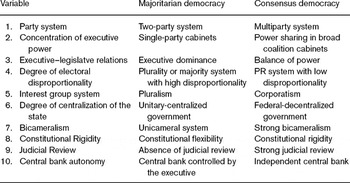
Lijphart measures the degree to which democracies fit into the majoritarian or consensus model by observing ten variables (Table 1).
Variables of majoritarian and consensus democracy

Source: Lijphart (Reference Lijphart1999).
A correlation analysis shows that these ten variables cluster in two separate dimensions (1999: 243–6). The first dimension, the executive–parties dimension, refers to whether power is dispersed within the central government; it is composed of variables one to five. The second dimension, the federal–unitary dimension, refers to whether power is dispersed among different political institutions, and it is composed of the remaining five variables. Lijphart observes that the correlation of the variables within the dimensions is statistically significant, while the correlation between the two dimensions is not significant. Factor analysis confirms that the variables can be divided into two encompassing and exclusive factors. According to the strength of majoritarian or consensus elements in both dimensions, Lijphart classifies democracies into four different categories: unitary majoritarian democracy, federal majoritarian democracy, unitary consensus democracy, and federal consensus democracy (1999: 243–57).
Furthermore, Lijphart examines the relationship between democracy patterns, public policies, and the quality of democracy. Based on the findings, Lijphart claims that the consensus democracy is the ‘kinder and gentler’ form of democracy (1999: 275). In contrast to majoritarian democracies, consensus democracies are more egalitarian, participative, and they allow for a better representation of women and minorities. Lijphart attests to their better performance in social and environmental policies, development cooperation, and combating inflation (1999: 258–300).
In addition, Lijphart discusses the appropriateness of both models for different societies. According to Lijphart (Reference Lijphart1999: 32), the majoritarian model is suitable for countries with relatively homogenous social structures and without deep class conflicts or cultural cleavages. However, for countries with weak social integration, the consensus model is more appropriate. This is especially the case in plural societies, where a majoritarian democracy runs the risk of turning majority rule into the tyranny of the majority. Given the propensity towards political exclusion of minorities, majoritarian democracy is only viable if political majorities alternate, and if the separation between majority and minority does not lead to political polarization (1999: 32–4). Based on his findings, Lijphart's advice to new democracies is that ‘The consensus option is the more attractive option for countries designing their first democratic constitutions or contemplating democratic reforms’ (1999: 302).
Some scholars have called Lijphart's framework a groundbreaking concept, ‘perhaps the most influential institutional text in political science during the post-war period’ (Lane and Ersson, Reference Lane and Ersson2000: 207). Nevertheless, in recent years, studies have challenged some of Lijphart's theoretical prepositions, the operationalization of the theoretical concept, his methodology, as well as some of the empirical findings on the political performance and effectiveness of the types of democracy (Nagel, Reference Nagel, Crepez, Koelble and Wilsford2000; Bogaards, Reference Bogaards2000; van der Kolk, Reference Van Der Kolk2000; Taagepera, Reference Taagepera2003; Roller, Reference Roller2005). Some of those challenges will be further discussed in the sections below.
Case selection and operationalization
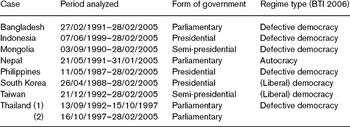
This analysis examines institutional patterns in eight newly democratic countries in East, Southeast, and Southern Asia (see Table 2). These eight democracies emerged during the third wave of democratization that began in 1974 (Huntington, Reference Huntington1991). All countries have experienced a minimum of two competitive multi-party elections and were classified as (defective) democracies in the Bertelsmann Transformation Index, 2006 (BTI) (Bertelsmann Stiftung, 2005).Footnote 2

The period analyzed extends from the founding elections of democracy up to the end of the review period of the BTI, 2006 on 28 February 2005.Footnote 3 The only exception is Nepal, where democracy lapsed on 1 February 2005 as a result of a royalist coup against the government of Prime Minister Sher Deuba. Mass protests in April 2006 against the King's rule marked the beginning of a second transition to democracy, which has led to general elections (2007) and the abolition of the monarchy (2008). Therefore, in the case of Nepal, the period analyzed ends on 31 January 2005.
In recent years, other Asian nations have also experienced setbacks to democracy. In Thailand, a military coup d'état occurred in September 2006 against the elected Prime Minister Thaksin Shinawatra. However, the legislative elections that took place in December 2007 restored Thailand's fragile democracy. Bangladesh's elected government was ousted in January 2007 through a military-dominated provisional government. Whether or not the December 2008 election will restore parliamentary democracy has yet to be seen. Furthermore, the Philippines has experienced a pronounced erosion of the democratic quality of its political system in the past couple of years (Shin and Tusalem, Reference Shin, Tusalem, Haerpfer, Bernhagen, Inglehart and Welzel2009: 357–60).
Although these fragile democracies show upsetting backward trends in their democratization paths, they are included in this analysis for two reasons. First, their inclusion allows for a maximum number of cases, which is necessary to achieve meaningful results in the statistical analysis. Second, including all eight cases in the sample increases the variance of levels and outcomes of democratization, which is a prerequisite for discussing the implications of institutional patterns for the consolidation of democracies in the region.
The eight countries considered here have been democracies for only a short time. For example, Indonesia has only six years of democratic history (1999–2005). For the remaining seven countries, the period of observation is between 14 and 17 years, which is still considerably shorter than the average country period in Lijphart's analysis. In this sense, this study is more of a preliminary evaluation than the final assessment. Given the stickiness of institutions, it is likely that the findings here will have some durability.
In some countries, constitutional amendments occurred during the period of study. In Mongolia, Taiwan, and Indonesia, the institutional changes were to a moderate extent, which allows us to employ an average measure for the entire period for certain indicators. However, in Thailand, a new constitution was adopted in October 1997. This was considered by many observers to be the turning point of the nation's transition to a liberal democracy (McCargo, Reference McCargo and McCargo2002). The 1997 constitution introduced, among other things, a new electoral system, altered the structure of bicameralism, strengthened the position of the prime minister vis-à-vis parliament, and established a constitutional court. Therefore, we split the analysis of Thailand into two separate periods (see Table 2).
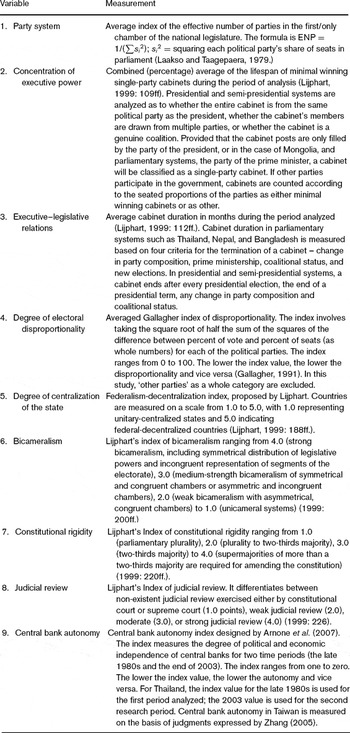
Finally, this study slightly modifies Lijphart's approach because of data availability for the interest groups system variable. Lijphart's measure of the degree of pluralism or corporatism is based on Alan Siaroff's index of interest group pluralism (Siaroff, Reference Siaroff1998). For democracies that are not included in Siaroff's study, Lijphart measures pluralism on the basis of judgments expressed by country and area experts (Lijphart, Reference Lijphart1999: 178). In contrast to the well-established democracies in Lijphart's study, for most of the Asian democracies, reliable data to measure interest group pluralism are not available. Therefore, this variable is excluded from this study. The remaining nine variables are operationalized as shown in Table 3.
Variables and measurement

Institutional patterns in Asia
In the following section, we measure nine of Lijphart's variables as they pertain to Asia. First, we analyze the variables in the executive–parties dimension. Next we measure the five variables of the federal–unitary dimension. Finally, we determine whether Lijphart's pattern of democracy fits the reality of new democracies in Asia.
Executive–parties dimension
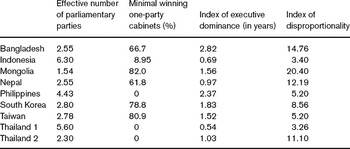
(1) Effective number of parliamentary parties. On this first variable, Asia tends to be highly diverse (Table 4). As measured by Laakso and Taagepera's effective number of parties index, Indonesia, Thailand (1992–7), and the Philippines have greater numbers of parties in their parliaments than the other Asian democracies. Although there is a declining trend over time, these party systems are highly fragmented with a two party dominance (Indonesia) or a power balance between the major political parties (Thailand). The party system in the Philippines evolved from an extremely fragmented (1987) into a moderately fragmented multiparty system with two dominant party alliances (2004) (cf. Ufen, Reference Ufen2008).
Executive–parties dimension

Sources: Data for the effective number of parties and the index of disproportionality are taken from Croissant (Reference Croissant2008) and Croissant and Schächter (Reference Croissant and Schächter2008). Percentage of minimal winning one-party cabinets and the index of executive dominance are authors’ calculation based on data from Keesing's World Archive (various issues); Korea Annual (various issues); Dormels (Reference Dormels2006); Chambers (Reference Chambers2008); nepalresearch (2009), and national newspapers.
Bangladesh, Nepal, South Korea, and Taiwan have moderately fragmented multiparty systems with an average of between two-and-a-half and three parties. These party systems are characterized by the competition between two main parties or party blocks. The smallest number of effective parties is found in Mongolia and Thailand (since 2001). In Thailand, the rise of the Thai Rak Thai (TRT) party of Prime Minister Thaksin Shinawatra to a level of political hegemony in the late 1990s caused a sharp decline in the number of parliamentary parties (Hicken, Reference Hicken2009). Despite the very low number of effective parties in Mongolia, the country's party system is not a predominant-party system as discussed by Sartori (Reference Sartori1976: 192f.), since no particular party consistently wins a winning majority of parliamentary seats (Moestrup and Ganzorig, Reference Moestrup, Ganzorig, Elgie and Moestrup2007).
(2) Concentration of executive power. On measures of cabinet type, Taiwan, South Korea, and Mongolia are on the majoritarian end of the scale with a high degree of concentration of executive power in the form of single-party cabinets. Since it is common for Nepal and Bangladesh to have minimal winning cabinets, those nations are roughly in the middle of the table, while the Philippines, Thailand, and Indonesia tend to disperse power within the executive. These countries consistently have oversized multiparty coalitions or grand coalition cabinets. In Indonesia, the National Unity cabinet of President Wahid (1999–2001), the Rainbow Coalition of President Megawati (2001–4), and the United Indonesia Cabinet of President Susilo Bambang Yudhoyono (since 2004) all belonged to this type of oversized cabinet. The Philippines also had instances of presidents forming oversized cabinets. Unlike in Indonesia, in the Philippines these coalitions are formed as election alliances of political groupings before national elections (Ufen, Reference Ufen2008: 334). Until 2001, Thai cabinets were almost always oversized, and they were composed of more than five parties. Although the number of parties declined with the 2001 election, oversized coalitions continued to govern until February 2005 (Chambers, Reference Chambers, Croissant and Martin2006).
(3) Index of executive dominance. In his analysis, Lijphart (Reference Lijphart1999: 12ff.) employs the length of the average cabinet duration in months as an indicator of executive dominance. Some scholars criticize this measure, claiming that cabinet duration is not an appropriate indicator for measuring the patterns of dominance and balance of power between both institutions (Taagepera, Reference Taagepera2003; Fortin, Reference Fortin2008). Although Lijphart agrees that his indicator can give ‘a completely wrong impression of the degree of executive dominance’ (1999: 134), we use it because of the lack of a satisfactory alternative measurement.
Compared to other Asian nations, Bangladesh and the Philippines experience a high degree of cabinet durability. For Bangladesh, the index value correctly indicates a strong degree of executive dominance (Mollah, Reference Mollah2008), whereas executive power in the Philippines is much weaker than the index value suggests. In fact, presidents in the Philippines face numerous constitutional and de facto limitations which considerably constrain the executive power (Rüland et al., Reference Rüland, Jürgenmeyer, Nelson and Ziegenhain2005: 226–42).
The parliamentary systems in Thailand and Nepal, as well as presidentialism in Indonesia, are characterized by rather transient cabinets, which indicate a rough balance of power between parliament and the executive. In Nepal and Thailand (until 1997), the cabinet's weakness vis-à-vis parliament is, to a certain extent, a consequence of intraparty factionalism and the weak cohesion of the political parties (Lawoti, Reference Lawoti2007; Chambers, Reference Chambers2008). However, after the 1997 constitutional amendment, and the 2001 legislative election in particular, the balance of power between the executive and the legislative branches in Thailand changed in favor of the executive, which meant that the administration of Prime Minister Thaksin (2001–6) can be classified as a case of strong executive dominance (Chambers, Reference Chambers, Croissant and Martin2006).
Among other things, the low index of executive dominance in Indonesia reflects the enormous political instability in the years 1999 to 2001. Nevertheless, the indicator value still reflects the existing balance of power between parliament and the government. Since the transition to democracy, the submissive legislature of the authoritarian New Order regime of President Suharto (1966–98) has evolved into a competitive parliament, which actively constrains the decision-making authority of the president, and forces him to adopt an inclusive style of governance (Ziegenhain, Reference Ziegenhain2008). In view of the weakness of the presidents’ parties vis-à-vis their coalition partners, as well as the very low degree of aggregation of the party system in the ‘hung parliaments’, neither stable cabinets nor executive dominance are on the cards (Croissant, Reference Croissant, Croissant and Martin2006: 350).
Higher levels of cabinet durability correlate with volatile forms of executive–legislative relations in Taiwan, South Korea, and Mongolia. In all three democracies, the political system is characterized by two distinct scenarios. In the case of a divided government, when the presidents of South Korea and Taiwan do not enjoy support from the parliament's majority, mutual blockades and legislative gridlocks are frequent. When this occurs, both systems are characterized by the inability to ‘cohabitate’ (Wu, Reference Wu, Elgie and Moestrup2007; Croissant, Reference Croissant2003). If, however, symmetric political majorities fill the presidency and the majority of seats in parliament, the government dominates vis-à-vis the legislature. In Mongolia, both scenarios correspond with the single-party cabinets of the Mongolian People's Revolutionary Party, the former ruling communist party (executive dominance), and fragile multiparty or grand coalition cabinets, in which the weak coherence of the coalition reinforces problems of legislative coordination among the ruling majority in parliament (Moestrup and Ganzorig, Reference Moestrup, Ganzorig, Elgie and Moestrup2007: 192).
(4) Electoral disproportionality. Most Asian countries have plurality or mixed-member majoritarian electoral systems. Indonesia is the only country that uses proportional representation (closed list PR system in 1999, and open list PR in 2004). South Korea, the Philippines, and Thailand (1997–2007) have mixed-member majoritarian systems, which combine a party list component with single-member constituency (SMC) plurality. From 1992 until 2004, Taiwan had a plurality system composed of SMCs and single non-transferable vote in multi-member constituencies, with an additional national constituency. Nepal, Bangladesh, and Mongolia have applied the plurality system in SMCs (Reilly, Reference Reilly2006). As demonstrated in Table 4, Thailand (1992–7), Indonesia, Taiwan, and the Philippines have election systems with relatively low vote−seat deviation. The electoral systems in South Korea, Thailand (2001–5), and Nepal exhibit a moderate degree of disproportionality, while the SMC plurality systems in Bangladesh and Mongolia are the least proportional systems.
Federal–unitary dimension
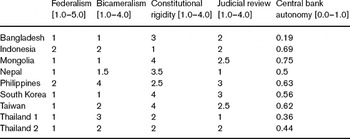
(5) The degree of centralization. With regard to the fifth variable, all of the Asian countries fall on the majoritarian end of the scale (see Table 5). All are unitary systems and most are quite centralized. Although most have retreated from authoritarian centralization by introducing decentralization schemes in the past two decades, only the Philippines and Indonesia have devolved real decision-making authority (Nickson et al., Reference Nickson, Devas, Brillantes, Cabo and Celestino2008).
Federal–unitary dimension

Sources: Data were gathered from each country's constitution and Ahmed (Reference Ahmed2006), Arnone et al. (Reference Arnone, Laurens, Segalotto and Sommer2007), Croissant (Reference Croissant2009), Ginsburg (Reference Ginsburg2003), Klein (Reference Klein2003), Nickson et al. (Reference Nickson, Devas, Brillantes, Cabo and Celestino2008), Reilly (Reference Reilly2006), Rüland et al. (Reference Rüland, Jürgenmeyer, Nelson and Ziegenhain2005), Schubert (Reference Schubert, Heberer and Derichs2008), Stith (Reference Stith1996), Stockmann (Reference Stockmann2007), and Zhang (Reference Zhang2005).
(6) Bicameralism. South Korea, Bangladesh, and Mongolia (since 1992) have a unicameral system, while the other countries have a second chamber. The Senate in the Philippines has powers equal to the House of Representatives, where members of both houses are directly elected. The 24 senators are elected in a nationwide constituency by plurality. In Thailand, before 1997, the appointed Senate functioned as a powerful instrument for the civil bureaucracy and the military to check the political process in the directly elected House of Representatives. The constitutional reform of 1997 introduced direct elections for the upper house. At the same time, the Senate's influence was significantly reduced, although it retained some control and nomination powers.
In the remaining three countries, the second chamber is quite weak. Until the 2000 constitutional amendment, the Taiwanese legislature consisted of two constitutional organs: the Legislative Yuan and the National Assembly. However, the powers of the National Assembly were already weakened in the 1990s, and in June 2005 it was dissolved. In Indonesia, the People's Consultative Assembly elected the president and had the right to amend the constitution, but it did not participate in the legislative process. With the introduction of the popular election of the president in 2004, the Assembly lost most of its relevance. In the same year, a second regional chamber, the Dewan Perwakilan Daerah (DPD), was established to represent the provinces in national politics. The DPD, however, can only advise the first chamber on regional matters, but it does not have any power in other policy areas. Until 2007, the bicameral system in Nepal consisted of a directly elected lower house and the National Assembly. Due to its weak legislative powers, as well as the fact that representatives of political parties in the upper house were nominated in proportion to the parties’ share of seats in the lower house, the National Assembly only had a marginal role in the parliamentary arena.
(7) Constitutional rigidity. Most Asian countries have opted for constitutions that are difficult to amend. Out of the nine cases studied, no country allows a plurality of parliament to amend the constitution, but four countries require supermajorities greater than two-thirds majorities of parliament. In Mongolia and Taiwan (until 2005), amending the constitution requires a three-fourths majority of all members of parliament and the National Assembly, respectively. In South Korea the approval of two-thirds of the members of parliament and a plurality of the popular vote in a referendum are required. In Nepal, constitutional amendments must be approved by two-thirds majorities of the members in both houses of parliament. Rules for constitutional amendments in Bangladesh and in the Philippines are more complex. In Bangladesh, a two-thirds parliamentary majority can, in most cases, amend the constitution. In some cases, approval by a plurality of the popular vote in a referendum is also required. In the Philippines, a three-fourths majority is required in congress as well as an ordinary majority in a referendum, or provided a constitutional convention is called, a plurality of votes in a referendum. In Indonesia, an ordinary majority in the MPR can amend the constitution, while in Thailand the plurality of the members of both houses of parliament is required.
(8) Judicial review. All countries in the region have judicial review to oversee legislative majorities. South Korea (since 1988), Taiwan (1947), Mongolia (1992), Thailand (1997/2007), and Indonesia (2003) have constitutional courts designed specifically to resolve constitutional questions. Bangladesh, Nepal, and the Philippines have adopted a system of decentralized judicial review with a Supreme Court at the top of the judicial system. Formal provisions of review and the actual performance of the courts indicate that South Korea, Nepal, and the Philippines have strong judicial review. For example, between February 1989 and February 2005 the Constitutional Court of South Korea declared 142 parliamentary laws to be fully or partially unconstitutional (Constitutional Court of Korea, 2009). Furthermore, the Supreme Court of the Philippines has frequently overruled parliamentary legislation and executive orders (Bakker, Reference Bakker1997). In addition, Nepal's Supreme Court is one of the strongest courts in the region in terms of formal provisions and has often placed limits on the other branches of government (Stith, Reference Stith1996; Lawoti, Reference Lawoti2007). Although not as strong, Taiwan and Mongolia also have courts that are not hesitant to overrule parliamentary majorities or executive decisions (Ginsburg, Reference Ginsburg2003; Moestrup and Ganzorig, Reference Moestrup, Ganzorig, Elgie and Moestrup2007). Whether Indonesia's relatively young but active constitutional court can play a similar role in the future has yet to be seen (Croissant, Reference Croissant2009). By contrast, the courts in Thailand and Bangladesh appear to be more subservient to the legislative and the executive bodies. Initially, Thailand's new constitutional court appeared to be determined to actively review administration and parliament following its introduction in 1998. Within a couple of years, however, the government of Prime Minister Thaksin successfully managed to place limits on judicial review and bring the court in line with its own policies (Leyland, Reference Leyland2007).
(9) Finally, regarding central bank independence, there is a wide variation among the cases. Central bank autonomy is the weakest in Bangladesh, Thailand, and Nepal. In South Korea, the Philippines, and Taiwan, the degree of central bank independence is higher, whereas Indonesia and Mongolia are the nations where the central banks have the greatest level of independence (see Table 5).
Patterns of democracy in Asia?
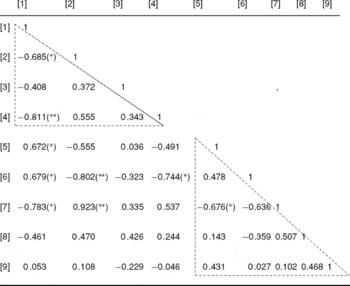
One of Lijphart's core conclusions is that these variables cluster on two separate dimensions. To test this conclusion, we repeat Lijphart's correlation analysis for the set of eight Asian countries and nine ‘cases’ (since Thailand is treated as two cases). By looking at the correlation matrix above, the first striking result is the absence of a clear pattern of correlation between the variables in the Asian democracies included in this study (Table 6).
Correlation between the nine variables of democracy in Asia

Notes: [1]: effective number of parties; [2]: concentration of executive power; [3]: executive dominance; [4]: electoral disproportionality; [5]: federalism-decentralization; [6]: bicameralism; [7]: constitutional rigidity; [8]: judicial review; [9]: central bank independence.
*Statistically significant at the 5% level (two-tailed test); **statistically significant at the 1% level (two-tailed test).
The only significant correlation within the executive−parties dimension exists between the effective number of parties and the concentration of executive power (a higher number of parties corresponds to a lower percentage of minimal winning one-party cabinets), as well as electoral disproportionality and the number of parties (a higher disproportionality correlates with a smaller number of parties). In the federal−unitary dimension, the degree of decentralization is negatively correlated with constitutional rigidity, whereas, in his analysis, Lijphart found a positive correlation between the two variables.
Another interesting finding is the association between some indicators of the first and the second dimensions, although according to Lijphart they should be independent. The number of parties correlates with the degree of decentralization and the strength of bicameralism, which indicates an impact of the degree of decentralization and bicameral structures on the fragmentation of party systems (the more decentralized a state and the stronger the bicameralism, respectively, the more fragmented is the party system). Furthermore, a smaller number of parties tend to correspond with more rigid provisions for amending the constitution. Moreover, the concentration of executive power positively correlates with constitutional rigidity. There also is a strong negative correlation between minimal winning one-party cabinets and bicameralism. This strongly suggests that institutional arrangements, which provide strong incentives for broad consensus building, influence the probability of the formation of broad coalition cabinets. In addition, there is a negative correlation between electoral disproportionality and bicameral structures.
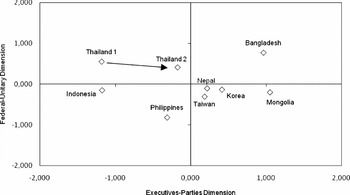
Clearly at this point, it must be concluded that there is neither an executive−parties nor a federal−unitary dimension in post-authoritarian Asia. Consequently, when we cluster in scales the elements from each dimension in order to determine the position of individual democracies on Lijphart's two-dimensional map of democracy, it does not mean that we propose the existence of a two-dimensional pattern of democracy in Asia. As previously mentioned, Lijphart places each of the democracies in his study on a two-dimensional conceptual map of democracy. By doing this, their indicator values are averaged on each of the two sets of variables, so as to form two summary factors. In order for the variables in each of the two dimensions to be averaged, they first had to be standardized, because they were originally measured on different scales. Moreover, their signs had to be adjusted so that high values on each variable represent either majoritarianism or consensus, while low values indicate the opposite characteristic (Lijphart, Reference Lijphart1999: 248). The executive−parties factor is an average of the respective standardized original value of the first four indicators in Table 4. The federal−unitary factor is the average of the standardized original value of the remaining five variables in Table 5. To standardize the data, the values of the variables are converted, so that all variables have a mean of 0 and a standard deviation of 1 As is the case in Lijphart's analysis, the direction of the variable values corresponds, which means that the low value represents consensus, while the high value represents majoritarianism. The position of individual countries on the two-dimensional map is shown in Figure 1.
The position of the Asian cases in Lijphart's democracy matrix

Bangladesh is in the first quadrant of the graph (unitary democracy with strong majoritarianism on the executives−parties dimension). The Philippines and Indonesia are in the third quadrant, illustrating predominantly consensus-oriented elements in both dimensions of democracy. Thailand represents the combination of consensus elements on the executives−parties dimension (in particular, oversized coalition cabinets, multipartyism, and low cabinet durability, especially from 1992 to 1997), but majoritarianism on the federal−unitary dimension (not difficult-to-amend constitution, weak bicameralism, and weak or absent judicial review). The figure also shows the shift that took place in Thailand from the pre-1997 period to the post-1997 period. The direction of the arrow points to a shift toward greater majoritarianism in Thailand, which reflects the impact of constitutional reform on the executives−parties dimension.
Taiwan, South Korea, Nepal, and Mongolia are all placed in the fourth quadrant. To varying degrees, they combine majoritarian traits in the executive–parties dimensions with ‘consensus’ elements on the federal–unitary dimension (in particular, judicial review, and constitutional rigidity). Due to the fact that the division of power between separate institutions in this dimension does not have much to do with federalism (all four countries are unitary-centralized states), perhaps it is more accurate to label this second dimension the ‘divided-power dimension’ (Lijphart, Reference Lijphart1999: 5).
Furthermore, at this point it can also be concluded that there is no alternative ‘Asian model’ of democracy. This finding contradicts Benjamin Reilly's (2006: 194–5) observation of an emerging majoritarian ‘democracy model’ in the region. Although Nepal, Taiwan, and South Korea are grouped in close proximity to each other, this does not provide enough evidence to conclude the convergence of the Asian democracy structures in the majoritarian democracy model. In addition, only Bangladesh, the Philippines, and Indonesia can be categorized as distinctive types, while the patterns in the remaining nations are hybrids.
This conclusion should be taken with a grain of salt because of the small size of the sample, which emphasizes the differences between the Asian democracies. Analyzing the entire set of 45 cases (nine from this data set and 36 from Lijphart's study) could possibly show that there is an Asian sub-pattern. To test this assumption, we repeat the calculation of factor values in both dimensions for 45 democracies (excluding the variable of interest group pluralism). The position of individual Asian cases on the two-dimensional map (not shown here) changes slightly. However, not a single case moves from one corner of the matrix to another. Still, the Asian democracies do not cluster into a single coherent pattern but are dispersed throughout all four quadrants of the democracy map.
The origins of institutional anomalies in Asia
Taken together, these findings suggest that young democracies in Asia follow different dynamics than Lijphart's established democracies. Why is Asia distinctive? One factor could be the small sample size which limits the statistical power of the exercise. Another factor is the relatively brief democratic history of most countries in this study. The hybrid patterns in most Asian nations could indicate that not enough time has elapsed for coherent structures to emerge. It is also true that Lijphart has more variety along his index of federalism variable in the 36 countries he chose, whereas all states included in this study are unitary. Nevertheless, there are other explanations worth exploring, which question the plausibility of some of Lijphart's assumptions and findings.
First, Lijphart is not entirely clear as to why he finds his pattern. At times he explains the coherence of the indicators in both dimensions with the fact that democratic constitutions are designed by rational actors, who have a choice between two philosophies of governing and share a clear and coherent conception of how much political power actors and institutions should have, and which actors should be allowed to have that political power (2008 [1991], 1999).Footnote 4
The assumption that countries choose between coherent patterns of consensus and majoritarian institutions, however, is not persuasive for constitution-drafting processes in democratizing countries (van der Kolk, Reference Van Der Kolk2000). Rather, constitution-making is often dominated by historical experiences, short-term interests of the designers, and the voluntary imitation and emulation of successful institutional models in other parts of the world rather than the long-term interests of the citizenry (Colomer, Reference Colomer1995; Merkel et al., Reference Merkel, Sandschneider, Segert, Merkel, Sandschneider and Segert1996; Elster, Reference Elster1995). A quick glance at the Asian realities supports this view. Everywhere in Asia, historical experiences and institutional traditions have been enormously important. For example, all countries kept the existing unitary state model. Except for Mongolia, all new democracies in the region adopted a type of legislature, a form of government, and an election method that was firmly rooted in each country's constitutional heritage often by amending the existing constitution instead of drafting an entirely new basic law (e.g., Taiwan, Indonesia, Bangladesh, and Thailand in 1992). While there was a clear break in legal continuity with the previous socialist constitution in Mongolia, the drafting of the 1990 constitution followed a similar pattern as in other post-socialist countries (cf. Elster, Reference Elster1996; Roberts, Reference Roberts2006).Footnote 5 Furthermore, several studies show the importance of the distribution of bargaining power between competing political elites for the construction of new democratic institutions. As a rule, political struggles between political elites with often conflicting preferences did lead to the introduction of less-than-coherent, often self-contradictory constitutional systems (Merkel, Reference Merkel1999: 326–38; Moestrup and Ganzorig, Reference Moestrup, Ganzorig, Elgie and Moestrup2007: 185), which led to unintended consequences for the distribution of power between political forces.
Second, Taagepera (Reference Taagepera2003: 10) notes that on the second dimension, the association between the variables is not as close as Lijphart suggests. A pronounced federalism logically implies bicameralism, a rigid constitution, and strong judicial review. This is not the case in unitary systems, where a large variety of institutional combinations are possible. For example, Korea, Nepal, and Mongolia combine a strong degree of power concentration in the executives–parties dimension, with rigid constitutions and strong judicial review. The function of these constitutional provisions is not to protect federalism from centralism or ethnic minorities from discrimination, but rather the function is to constrain the uncertainty of the political outcomes of democratic competition (Ginsburg, Reference Ginsburg2003). Lawoti (Reference Lawoti2007: 69–70) makes a similar point for Nepal, where constitutional rigidity and a strong Supreme Court helped to protect the privileges of higher Hindu and Newar castes against reformist policies.
Third, not all of Lijphart's institutional criteria are consequences of deliberate institutional engineering. For example, the type of party system is a consequence of institutional factors such as the election system, the cleavage structure, and the political mobilization of existing cleavages and sub-national identities by party elites (Croissant, Reference Croissant2008: 112–13). Cabinet types, cabinet durability, and the degree of disproportionality of the election system are also subject to extra-institutional factors. For example, in Thailand and the Philippines the constitution does not require the formation of oversized cabinets. Similarly, in Indonesia the formation of oversized or grand coalitions is a result of informal bargaining and compromising between party elites (Reilly, Reference Reilly2006: 159). Lijphart's criteria, which mostly focus on formal institutions and constitutionally codified political rules, do not adequately capture this ‘informal’ dimension of the political process.
The consequences of majoritarian and consensus institutions
Another question pertains to the consequences of democratic institutions and constitutional choices. As mentioned at the beginning of this article, considerable differences exist among the eight Asian cases regarding the dynamics and the state of consolidation of their democratic systems. Most observers agree that only South Korea and Taiwan can be regarded as consolidated democracies. The other countries in the region face various challenges of democratic consolidation that are hard to overcome (e.g., in the Philippines and Mongolia) and which have contributed to a breakdown of democracy in Nepal, Bangladesh, and Thailand (Diamond, Reference Diamond2008: 220–7; Shin and Tusalem, Reference Shin, Tusalem, Haerpfer, Bernhagen, Inglehart and Welzel2009).
The debate in political science about the virtues and perils of consensus and majoritarian democracy for the consolidation of new democracies concentrates on two major issues. First, the issue of political inclusion of ethnic or other structural minorities in heterogeneous societies; and, second, the consequences of the degree of dispersion or concentration of political power in the executives–parties dimension for the ‘horizontal accountability’ of elected governments (O'Donnell, Reference O'Donnell1994).
With regard to the first issue, scholars argue that consensus institutions have the advantage over majoritarian institutions that they are more inclusive, and therefore that they are more conducive to the integration of different segments of society into the democracy system. This is especially important in ethnically heterogeneous societies, where the higher degree of inclusiveness of the democratic system provides better incentives for political elites to develop a sense of restrained partisanship and an underlying consensus on political game rules, and it contributes to broader support for and legitimacy of the democratic system among the mass citizenry (Merkel, Reference Merkel2004; Rüland et al., Reference Rüland, Jürgenmeyer, Nelson and Ziegenhain2005: 11; Norris, Reference Norris2008: 210).
Another main advantage of consensus government is that it subjects elected governments and legislative majorities to formal and informal checks and balances which ensure that the democracy is not becoming an ‘elected dictatorship’ (Hailsham, Reference Hailsham1976). On the other hand, majoritarian systems lack such mechanisms of checks and balances. Lijphart and others (Linz, Reference Linz, Linz and Valenzuela1994; Ackerman, Reference Ackerman2000) note that ‘majoritarian’ presidentialism runs the risk of turning the democratic system into a ‘delegative democracy’ in which whoever wins the election to the presidency is entitled to govern as he sees fit, constrained only by the hard facts of existing power relations and by a constitutionally limited term of office (O'Donnell, Reference O'Donnell1994: 59; Lijphart, Reference Lijphart1999: 12–13).Footnote 6 Other authors, point to how Westminster-style parliamentary systems are more likely to produce ‘elective dictatorships’, because, in these majoritarian systems, parliamentary supremacy can easily be abused by governments, especially when the rule of law, the media, and civil society is weak (Sajó, Reference Sajó1999: 160; Cameron et al., Reference Cameron, Blanaru and Burns2006: 11).
Despite its theoretical plausibility, the Asian countries are only partially congruent with Lijphart's view about the difficult combination of presidentialism and majoritarianism. For example, it does not apply to Indonesia and the Philippines, where the presidency is embedded in an extensive system of ‘veto players’ (Tsebelis, Reference Tsebelis2002) who can counterbalance delegative tendencies of the executive. South Korea is a prime example for Lijphart's assumption of majoritarian presidentialism. Since transitioning to democracy, the South Korean presidentialism has alternated between the two scenarios of delegative democracy and institutional gridlock. For approximately 70% of the time analyzed in this article, the president's party controlled a majority of seats in the National Assembly. In this situation, South Korean presidentialism is characterized by the rigid logic of winner-takes-all politics, exclusion of parliamentary opposition, and weak horizontal accountability (Croissant, Reference Croissant2003). On the other hand, when the president's party was in a minority position in parliament, permanent gridlock was the norm, to the point of paralysis of the entire democratic system. But it seems that South Korean democracy has learned to live with the perils of its majoritarian presidentialism. This can be attributed to the strong Constitutional Court, although it is also a result of the willingness of political elites to accept the idea of temporary government, even if this means the loss of their own governmental power (Kim, Reference Kim2008).
In contrast, Bangladesh and post-1997 Thailand provide examples of parliamentary systems where majoritarianism has given rise to ‘elected dictatorships’. In Bangladesh, this occurred in the immediate post-transition period. The transformation of the constitution from a system of unpartisan rules to an instrument of political power by the elected government in the early 1990s reinforced the prevalence of winner-take-all competition among the political parties: ‘Bangladesh's democratic politics are unstable . . . not because of disagreements over constitutional rules, nor because powerful politicians seek to alter the separation of powers. Bangladeshi parliamentary governments have given rise to elective dictatorships because the actions of government and opposition politicians have undermined the ability of parliament to function effectively as a restraint on executive power’ (Cameron et al., Reference Cameron, Blanaru and Burns2006: 18).
Thailand's transformation into ‘elected authoritarianism’ (Thitinan, Reference Thitinan2008) during the government of Prime Minister Thaksin Shinawatra (2001–6) was closely associated with the institutional reforms of 1997. The new constitution weakened the existing institutional arrangements in favor of stronger power concentration within parliament, the cabinet, and among political parties. The aim of constitutional engineering was to provide incentives for the emergence of more stable and effective governance, and a stable, well-institutionalized, and truly representative party system. At the same time, new constitutional organs, such as the constitutional court, were established, which were expected to provide effective constraints on the elected parliament, the political parties, and the executive (McCargo, Reference McCargo and McCargo2002). The emergence of an ‘elected dictatorship’ of Prime Minister Thaksin was an unintended consequence of this failed attempt to regulate the democracy's development. By 2005, Thaksin and his TRT party had established firm control over parliament, government, and most of the other constitutional organs. The concentration of political power in the hand of the Prime Minister, which was made possible by the introduction of majoritarian institutional arrangements in 1997, threatened the informal network of monarchy, bureaucracy, military, and civilian elites, which had previously informally formed a counterbalance to the elected politicians (McCargo, Reference McCargo2005).
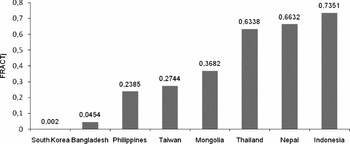
Furthermore, newly democratic countries in Asia only partially fit the assumption that majoritarian institutions are less conducive to democratic consolidation because they are less inclusive than consensus institutions. With regard to the effect of majoritarian institutions on political exclusion, it is worth mentioning that the risk of turning majoritarian democracy into the tyranny of the majority is a particular problem in emerging multicultural democracies. Holding periodic elections may not be sufficient in multicultural societies to accommodate different groups. Rather, accommodative political institutions are required to address the cultural cleavages and to consolidate democracy (Norris, Reference Norris2008). However, a glance at Alesina's index of ethnic fractionalization (Alesina et al., Reference Alesina, Devleeschauwer, Easterly, Kurlat and Wacziarg2002) shows that there are enormous differences between the societies in the sample of this study in terms of their ethno-linguistic and ethno-religious heterogeneity (Figure 2).
Ethnic fractionalization in Asia
Note:  si = the proportion of a particular ethnic group i in a country; the higher the value, the larger the fractionalization.
Source: Alesina et al. (Reference Alesina, Devleeschauwer, Easterly, Kurlat and Wacziarg2002).

The data in Figure 2 show that Indonesia, Nepal, and Thailand are plural societies characterized by a high extent of ethnic fractionalization. Mongolia, Taiwan, and the Philippines are ‘semi-plural societies’ (Lijphart, Reference Lijphart1999), while Bangladesh and South Korea and ethnically homogenous. From a theoretical perspective, the institutional arrangements of the Indonesian democracy, which emphasize political inclusion and power sharing, are especially appropriate for the consolidation of democracy in ethnically fragmented societies. On the other hand, the socio-culturally homogeneous South Korean society can afford majoritarian institutions because neither socio-cultural cleavages nor issues of economic and wealth distribution are salient for party competition.
Although ethnically more heterogeneous, the same conclusion can be drawn in the case of Taiwan. Until the late 1980s, the sub-ethnic cleavage between the Taiwanese and Mainlanders formed the decisive political cleavage in party politics and society. Since the 1990s, this cleavage has gradually been replaced by the issue of the national identity and the island's political status (independence/unification). In addition, most political parties claim to be ‘Taiwanese’ parties. Although other socio-economic cleavages have emerged, the national identity issue and other more recent cleavages are cutting across the traditional ‘Taiwanese vs. Mainlander’ cleavage (Chu and Lin, Reference Chu and Lin1999).
In Bangladesh and the Philippines, the issue of political exclusion of ethnic minorities is also of minor relevance for the consolidation of democracy because of a rather low extent of ethnic fractionalization in the two nations, and because the politically salient divisions run along the socioeconomic cleavage (the Philippines), and between secular nationalism, moderate Islam, and radical Islam (Bangladesh).Footnote 7
For ethnically heterogeneous Nepal, the exclusionary nature of its political institutions is a major source of political conflict and instability throughout the nation's period of democracy. The existing ethnic cleavages were reinforced by social inequalities and economic conflicts (Hutt, Reference Hutt2004). The exclusionary institutions further reinforced the exclusionary effect of the socio-historical and economic factors (Lawoti, Reference Lawoti2007: 72). Furthermore, some ‘consensus elements’, such as judicial review and a rigid constitution further weakened the capacity of the democratic system to accommodate conflict between different socio-cultural groups in society, as they protracted socio-economic reforms and protected the vested interests of particular minority groups (ibid.). The prolonged discrimination and exclusion of socio-cultural minorities and economically disadvantaged groups from political participation and representation is reflected by the exclusive composition of political parties, parliament, and cabinet; the state administration and the judiciary, which are all dominated by the cultural, and resource-wise dominant group, the Caste Hill Hindu Elite (Lawoti, Reference Lawoti2005, Reference Lawoti2007; Pradhan and Shrestha, Reference Pradhan and Shrestha2005: 25).
Conclusion
Three conclusions can be drawn from the analysis. First, Lijphart's patterns of democracy do not fit well in Asia. This finding is similar to the results obtained by recent research on new democracies in Eastern Europe, which were unable to find empirical evidence for Lijphart's two-dimensional pattern of democracy (Robert, Reference Roberts2006; Fortin, Reference Fortin2008). Second, the majority of Asian democracies (six out of nine cases), appear to be hybrids, mixing Lijphart's consensus and majoritian categories. Only the Philippines, Indonesia, and Bangladesh can be categorized as either ‘consensus’ or ‘majoritarian’ democracy, whereas the other democracies combine elements from both types. Although the framework of this article does not allow the causes for the hybrid elements of Asian democracies to be established with certainty, they appear to have much to do with the specific historical circumstances under which institutions were made in the democratizing countries in Asia. Moreover, our analysis supports the skepticism about the plausibility and appropriateness of some of Lijphart's assumptions, which has been referred to in previous studies. Third, although there are good theoretical reasons to assume that consensus institutions are more conducive to the consolidation of democracy, the association between the type of democratic structures, and the dynamics and status of democracy in Asia is clearly ambiguous. The lack of clarity is especially true since not all of Lijphart's criteria are relevant to the same degree for the consolidation of a democratic system (e.g. the degree of independence of the central bank). Some institutions’ indices misrepresent their actual effect on political exclusion or inclusion. Judicial review and the rigidity in the constitutional amendment process in Nepal are specific examples (Lawoti, Reference Lawoti2007: 69). This suggests that institutional structures must be re-coupled to the contextual conditions in which they operate.
Finally, institutional arrangements, which appear to be functional in one case, can prove to be dysfunctional in another case. For example, the experiences of Indonesia and the Philippines indicate that presidentialism can be part of a power dispersing institutional arrangement, and that it does not necessarily contribute to political exclusion or the emergence of a ‘delegative democracy’, whereas Westminster parliamentary systems can turn into ‘elective dictatorships’. Bangladesh and Thailand are specific examples. In addition, theoretically plausible arguments regarding the problems of political exclusion of structural minorities in majoritarian institutions only partially fit Asian realities. While the exclusion of minorities helped to destabilize democracy in Nepal, the persisting social and economic exclusion of broad segments of society has become the most threatening factor for democracy in the Philippines, and also increasingly in Thailand. This form of social exclusion is substantially more problematic than the countries’ ethno-nationlist conflicts in its effect on the democratic systems at large. This is all the more important, as this form of political and social exclusion cannot be solved by the ‘consensualization’ of democratic institutions. Thus, if there is a general quintessence as to the relationship between majoritarian and consensus institutions, and democratic consolidation, then it is that the context matters. Lijphart's apodictic preference for the consensus option as ‘the attractive option for countries designing their first democratic constitutions or contemplating democratic reforms’ (1999: 302) may fall short for the realities of the new democracies in Asia and other regions.
About the authors
Professor Aurel Croissant is Director of the Institute of Political Science at the Ruprecht-Karls-University, Heidelberg (Germany). He teaches comparative politics and political theory. His main research focus is on democratization, political institutions, interest intermediation, and civil-military relations in Asia-Pacific.
Teresa Schächter is doctoral candidate and research assistant at the Ruprecht-Karls University, Heidelberg.