

1. INTRODUCTION
Traditionally, international law is defined by the sovereign equality of states, which aims to guarantee that all states have equal rights and obligations.Footnote 1 Yet, states differ significantly. Based on the concepts of cooperation, effectiveness and solidarity,Footnote 2 those differences must be taken into account in order to create a fair international legal order.Footnote 3 Differential treatment – or differentiation between states – has therefore become an important feature of international law.Footnote 4 The idea is to bring about practical, rather than formal, equality among de facto unequal states and to increase participation in and the effectiveness of international agreements.Footnote 5
In international environmental law, differentiation has assumed pivotal, almost defining characteristics, placing heavier burdens on developed countries while providing for differential (and preferential) treatment of developing countries. This has been expressed – for example, in Principle 7 of the 1992 Rio Declaration – as ‘common but differentiated responsibilities’, which establishes an obligation on all states to cooperate towards environmental integrity, while acknowledging that developed countries have a greater responsibility as a result of the pressure their societies have placed on the global environment and of their assumed greater economic and technological capabilities.Footnote 6 In this sense, differentiation is expected to bridge the gap between the formal equality of states under international law and the deep inequalities in wealth, power and responsibility that divide them.Footnote 7
These factors have led to procedurally more demanding and substantively stronger obligations on developed countries, with developing countries having more flexible or fewer obligations. They have also led to obligations of developed countries to provide implementation assistance, finance, technology and know-how to developing countries. In this way, ‘positive discrimination’ in favour of developing countries has led to asymmetric environmental obligations coupled with arrangements and mechanisms which institutionalize this categorization.
As a growing number of developing countries become industrialized and increase their pressure on the global environment along with their capabilities, the expectation grows that they also assume greater responsibilities in international environmental law. The question is thus how to design legal instruments that can reflect the different ‘situations’ of states in an equitable and dynamic fashion, as they develop over time. The experience from 1992 to 2016 tells us that such differentiation cannot be static; it needs to allow the structure and content of international agreements to evolve dynamically.Footnote 8
2. CLIMATE CHANGE AS A GLOBAL COMMONS PROBLEM
In order to understand the complexity of differentiation in the climate context, it is important to recall that climate change has the characteristics of a ‘global commons problem’. Greenhouse gases (GHGs) accumulate over time and mix globally in the atmosphere. Emissions by any state contribute to the problem and can affect all other states. No individual state has the capacity to single-handedly achieve effective mitigation; nor does it have incentives to act unless other states also take action – otherwise it would bear a larger relative cost. As in a ‘prisoner’s dilemma’ involving 197 prisoners, therefore, participation of all states is necessary for effective and fair cooperation.
Furthermore, climate change results from the stock of accumulated concentrations of GHGs in the atmosphere. The largest contribution to observed warming and positive radiative forcing is caused by the increase in the atmospheric concentration of GHGs, in particular carbon dioxide (CO2), since 1750.Footnote 9 CO2 emissions can remain in the atmosphere for hundreds or even thousands of years and have a cumulative effect on temperature increase. However, the past and future contributions of countries to the accumulation of GHGs in the atmosphere are different; countries also face varying challenges and circumstances, and have different capacities to address mitigation and adaptation. Climate change therefore raises issues of equity, justice and fairness on a global scale.Footnote 10
As with any commons problem, the solution lies in collective action.Footnote 11 Effective international cooperation relies on workable notions of equitable burden and effort sharing. In the context of climate change, these notions are even more important given that states are not equal, and significant asymmetries and inequalities exist. The Intergovernmental Panel on Climate Change (IPCC) identifies four categories of inequality: (i) asymmetry in contribution to climate change (past and present); (ii) vulnerability to the impacts of climate change; (iii) capacity to mitigate the problem; and (iv) power to decide on solutions.Footnote 12 Scholarship suggests that outcomes seen as equitable can lead to more effective cooperation.Footnote 13 With respect to climate change, it has long been noted that a regime that many members find inequitable or unfair will face severe challenges to its adoption or be vulnerable to festering tensions that jeopardize its effectiveness.Footnote 14
Different principles could come into play to address these issues.Footnote 15 Some of them relate to theoretical notions of distributive justice, such as causal and moral responsibility. The former refers to the responsibility for contributing to climate change via emissions of GHGs, the latter to the responsibility for solving the problem – noting that these two aspects are not always connected. Other principles invoke compensatory justice, such as the polluter-pays principle, the community-pays principle or the beneficiary-pays principle; and a third set involves procedural justice based on the way in which outcomes are brought about. Applied ethics hold persons (or states) responsible for harm or risks they knowingly impose or could have reasonably foreseen and, in certain cases, regardless of whether they could have been foreseen. However, there is no scientific or ethical foundation for prioritizing one equity principle over another.Footnote 16
What can be concluded from all this is that, while effectiveness depends on participation, participation in turn depends on states’ own perception of fairness and equity with regard to other states’ contributions towards addressing the problem – and therein lies the fundamental importance of finding a workable solution for differentiation in the climate regime.
3. DIFFERENTIATION IN THE UNFCCC AND THE KYOTO PROTOCOL
In the United Nations Framework Convention on Climate Change (UNFCCC),Footnote 17 differentiation between the parties is based on the principle of ‘common but differentiated responsibilities and respective capabilities’ (CBDR-RC), along with an acknowledgement that developed countries should take the lead in the joint effort to combat climate change and its adverse effects.Footnote 18 Based on the premise that climate change is a common concern of humankind which requires the widest possible cooperation by all countries, the UNFCCC recognizes different contributions to environmental harm (‘causality’), as well as different capacities to take mitigation measures (‘capability’). Accordingly, the UNFCCC has addressed differentiation not only by enshrining CBDR-RC in its principles, but also by establishing more demanding and substantively stronger obligations for those parties explicitly listed in its Annexes.Footnote 19
All parties, taking into account their common but differentiated responsibilities and their specific national and regional development priorities, objectives and circumstances, have the common obligation under Article 4.1 UNFCCC to, inter alia, take measures to address GHG emissions and facilitate adaptation, conserve sinks and reservoirs, as well as prepare and update national GHG inventories. Article 4.2 commits parties included in Annex I (developed country parties and those with economies in transition) to adopt policies and measures to limit emissions and protect and enhance sinks and reservoirs. It is further understood that these policies and measures will demonstrate that developed countries are taking the lead in modifying emissions trends consistent with the objective of the UNFCCC. In a similar manner, Article 12 further elaborates on the reporting obligations assumed by all parties and establishes more specific and detailed obligations for developed countries, as well as additional time for developing countries’ initial national communication.
Under Article 4.3 UNFCCC, those developed countries listed in Annex II have further assumed the obligation to provide finance and technology to developing countries. This is complemented by Article 4.7, which establishes a relationship between the fulfilment of developing countries’ commitments and the obligations of developed countries to provide finance and technology. Several parties have narrowly interpreted this relationship as a conditionality (developing countries would take action only if provided with means of implementation), whereas other parties understand ‘the extent to which’ as creating a degree of effectiveness (developing countries would be able to be more effective in the context of support).
Throughout the implementation of the Convention, this ‘positive discrimination’ in favour of developing countries has led to what has been referred to as ‘bifurcated’ obligations and processes, coupled with several institutional arrangements for capacity building, transfer of financial resources and technology, and assistance to developing countries.Footnote 20
The Kyoto Protocol to the UNFCCCFootnote 21 took this approach even further. Based on an interpretation of the UNFCCC that relied almost exclusively on the historical and then (in 1997) current responsibility of developed countries,Footnote 22 the Berlin Mandate for negotiating the Kyoto Protocol stated explicitly that the instrument would ‘not introduce any new commitments for Parties not included in Annex I’. Its priority would be to ‘strengthen the commitments’ of Annex I Parties.Footnote 23 Accordingly, the Kyoto Protocol established quantified emissions limitation and reduction obligations only for those Annex I Parties listed in its Annex B.Footnote 24 It created a strict ‘binary’Footnote 25 differentiation system, where only developed country parties and countries with economies in transition assumed legally binding, quantified, absolute economy-wide mitigation commitments, while developing country parties were exempted from doing so. In this sense, the Kyoto Protocol is mainly and foremost an operationalization of Article 4.2 UNFCCC. Its focus is the establishment of individual quantified obligations of result (QELROs) only for those parties who, under the UNFCCC, had an obligation to limit their emissions, that is, Annex I Parties.
Between 2007 and 2012, the decisions adopted under the Ad-Hoc Working Group for Long-Term Cooperative Action (AWG-LCA) significantly raised the level of climate action. In parallel with the Kyoto Protocol, the AWG-LCA offered a political space for developing countries and non-Kyoto parties to negotiate their participation in the global response to climate change. This process generated several developments in the implementation of the UNFCCC and its institutional framework – most notably the creation of the Green Climate Fund.Footnote 26 The approach to differentiation under the AWG-LCA, nevertheless, followed strictly the approach under the UNFCCC and its Annexes.
4. DIFFERENTIATION IN THE NEGOTIATION HISTORY OF THE PARIS AGREEMENT
The negotiating mandate for the Paris AgreementFootnote 27 was to ‘develop a protocol, another legal instrument or an agreed outcome with legal force under the Convention applicable to all Parties’.Footnote 28 While the Durban mandate of the Ad Hoc Working Group on the Durban Platform for Enhanced Action (ADP) itself did not contain any references to developed or developing countries, the phrase ‘under the Convention’ made clear that the new agreement had to be seen in the context and against the normative background of the UNFCCC, including its basis for differentiation: the CBDR-RC principle. At the same time, the phrase ‘applicable to all’ indicated the need to increase the collective level of ambition and ensure the highest possible mitigation efforts by all parties.Footnote 29
‘Bifurcated’ or ‘binary’ differentiation, however, proved to be a contentious issue in the negotiations for the Paris Agreement. On the one hand, there was a general understanding that the immense climate challenges can be tackled only by global, cooperative large-scale remedial action to include key agents, most notably the United States (US) and China. The former was not a party to the Kyoto Protocol; the latter did not have mitigation obligations under the Protocol. The characteristic of climate change as a global commons problem necessarily requires the participation of key actors in the global response in order to ensure participation by other relevant states.
On the other hand, the responsibilities of states, their development stages and factual circumstances differ considerably. Country categories such as ‘developed’ and ‘developing’ are no longer homogeneous, but marked by stark internal differences as well as dynamic changes.
By the time parties started negotiating under the ADP mandate, the strict antagonistic dividing line between developed and developing countries had, in effect, resulted in a stalemate that prevented meaningful mitigation action. Developing countries invoked CBDR-RC as a ‘firewall’, while developed countries demanded that developing countries assume mitigation targets as a precondition to further mitigation actions of their own.Footnote 30
To resolve this challenge, differentiation in the context of the Paris Agreement needed not only to build on the existing approach, but also to reform by adopting a more nuanced, diversified way of differential treatment.Footnote 31 The Paris Agreement, therefore, had to strike a very careful balance between raising ambition and ensuring universal participation on the one hand, and equitable differentiation on the other.Footnote 32 It had to address the tension of being guided by the principles of the UNFCCC, while reflecting those very principles in a constructive and dynamic fashion that not only leads to broader but also to deeper participation (that is, higher ambition).
The tension between ‘under the Convention’ and ‘applicable to all’ remained unresolved until the very end of the negotiations. It manifested itself mainly as two distinct and antagonistic positions: those who argued for a diverse ‘spectrum’ of ‘self-differentiated’ commitments, and those who defended strict abidance with the principles, provisions and the structure (the Annexes) of the UNFCCC.
It is possible to point to some specific moments that marked the evolution of the differentiation debate in the ADP. The nationally determined contributions (NDCs) approach that was agreed at the 19th Conference of the Parties (COP-19) in Warsaw (Poland) in 2013, as a result of the ‘self-determined’ approach already initiated by the Copenhagen pledges,Footnote 33 established that parties would choose their level of effort, providing comfort that no country would be required to do more than it was ready to do. However, this failed to address the matter of equitable effort sharing. Several parties feared that other countries could backtrack from previously assumed commitments, while others were concerned that the overall level of ambition would be neither adequate nor fair. In the light of the ascendance of a bottom-up approach to international cooperation through NDCs and the increased fluidity of commitments, differentiation was therefore seen as a vital corrective concept to ensure that distributive fairness remained part of the international climate change agenda.
In the run-up to COP-20 in Lima (Peru) in 2014, differentiation became a central issue of the negotiations. Brazil was one of the most vocal countries in this debate, eventually making a submission based on the so-called ‘concentric circles’ approach to differentiation.Footnote 34 The proposal called for a set of more stringent obligations for developed countries, particularly by assuming economy-wide, absolute mitigation targets, while ensuring that developing country parties also move in the same direction over time and with flexibility. Brazil was neither the only nor the first country to call for different types of mitigation commitment for developed and developing countries; it had already been a practice under the AWG-LCA.Footnote 35
The Brazilian proposal, however, had at least two innovative aspects. It associated the type of target in the NDCs with the idea of progression at each regular review of the Agreement. This added a dynamic aspect to differentiation. More importantly, while building on the categories of ‘developed’ and ‘developing’ countries that characterize the climate change regime, the proposal provided a visual image of differentiation that moved away from a bifurcated or binary approach and could eventually lead to common types of mitigation efforts for all parties.Footnote 36
Decision 1/CP.20, adopted in Lima (Peru) in December 2014,Footnote 37 is key to understanding how differentiation came to be treated in the Paris Agreement. Its paragraph 3 underscored the parties’ ‘commitment to reaching an ambitious agreement in 2015 that reflects the principle of CBDR-RC, in light of different national circumstances’. The language drew from the US–China joint announcement of November 2014, which represented an unprecedented approximation between the world’s top two emitters.Footnote 38 It was the first time that a decision under the ADP mentioned CBDR-RC. The qualifier ‘in light of different national circumstances’, which was the way that the principle would be reflected in the Paris Agreement, had broad implications, including a change of course from a strict, explicit differentiation expressed in annexes.
In Lima, another relevant development in respect of differentiation emerged in the context of finance. Less recalled, but almost equally important, is the last sentence of paragraph 4 of Decision 1/CP.20, recognizing ‘complementary support by other Parties’ – that is, those that are not developed countries. It indicated then that developing countries could have a role to play in the provision of support and mobilization of climate finance.
The negotiation meetings that preceded COP-21 in Paris (France), in 2015, slowly consolidated the notion that differentiation would be addressed in a context-specific manner appropriate to each element of the Agreement, rather than by a dichotomy that cuts across all sections.Footnote 39 The understanding evolved that certain differentiating parameters (or ‘modulators’, as they were referred to by negotiators) could inform the implementation of the provisions of the Agreement.Footnote 40 Finally, during the second week of COP-21, when parties assembled no longer under the ADP but as the Comité de Paris, the Agreement took form under the authority and diplomatic craftsmanship of the French presidency after week-long minister-led informal consultations.
5. THE PARIS AGREEMENT
5.1. Reflecting the Principle of CBDR-RC in the Light of Different National Circumstances
The Paris Agreement clearly recognizes the normative legacy of the UNFCCC. It is guided by principles of the Convention, including equity and CBDR-RC,Footnote 41 and will reflect them throughout its implementation in the light of different national circumstances.Footnote 42 The approach to differentiation under the Paris Agreement is far more diversified than it is under the UNFCCC. While categories of countries, such as ‘developed’ and ‘developing’, are still relevant, these categories are nowhere defined; nor does the Agreement make any reference to the Annexes of the UNFCCC. This is a big shift. The Paris Agreement aims to reflect the responsibilities, capacities, and circumstances of all parties.Footnote 43 As will be shown, differentiation is operationalized in several ways, some explicit, some more implicit, balancing different considerations for each element of the Agreement.
From the outset, Article 2.2 restated the Lima language that the Agreement ‘will be implemented to reflect equity and the principle of CBDR-RC, in the light of different national circumstances’.Footnote 44 The overall approach to differentiation, therefore, is not premised on ‘causality’ alone, but on an amalgamation of country-specific responsibilities, capabilities and circumstances – and serving the purpose of the Agreement to keep temperature increases well below 2 degrees Celsius (2ºC).
The qualifier ‘in the light of different national circumstances’ introduces a dynamic and flexible element to interpreting both responsibilities and capabilities, broadening the parameters for differentiation.Footnote 45 It allows for a much more complex approach, taking into account not only a wider array of criteria – such as past and current, as well as projected, future emissions – but also financial and technical capabilities, human capacity, population size and other demographic criteria, abatement costs, opportunity costs, skills, etc.Footnote 46
In this way, the principled-based approach to differentiation in the Paris Agreement is more nuanced, while building upon the UNFCCC.Footnote 47 The Agreement allows for the creation of an evolutionary ‘policy space’ under the Convention in various ways. Firstly, the references to the principle of CBDR-RC are general in character and are not explicitly linked to any article of the UNFCCC, nor its Annexes. The references in the Preamble and Articles 2.2 and 4.3 signal that the CBDR-RC principle of the UNFCCC applies in a manner that is not static, but open to change. The general, principled character is a means to adjust and adapt the parties’ obligations to be responsive to an evolutionary understanding of accountability for temperature increases and also to changing political, social and economic circumstances.Footnote 48 Because responsibilities, capabilities and national circumstances not only differ significantly but are in a flux, they will have to be taken into account in a dynamic fashion.
There is, arguably, another important implication. While Article 3.1 UNFCCC expands on CBDR-RC by stating that ‘[a]ccordingly, the developed country Parties should take the lead in combating climate change and the adverse effects thereof’, to ‘take the lead’ now relates specifically to the type of mitigation target (that is, economy-wide and absolute, in Article 4.4 of the Paris Agreement) and to the commitment of developed countries to mobilize finance (Article 9.3 of the Paris Agreement).
Secondly, the Paris Agreement does not operate with a single, across-the-board approach to differentiation based on explicit pre-set categories of countries. Many of the obligations which will become legally binding once the Agreement enters into force will apply to all parties.Footnote 49 Where references to ‘developed’ and ‘developing’ countries occur, they do not lead to a static placement of countries. Rather, the absence of annexes and of definitions of ‘developed’ and ‘developing’ allow countries to move towards greater ambition over time without the need to ‘graduate’ from one category to the other.
This allows for a further observation. The Kyoto Protocol operated on a stringent type of differentiation where only developed country parties included in Annex I of the UNFCCC had quantified emissions limitation and reduction commitments. The Paris Agreement leaves this track of strict, ‘binary’ differentiation on mitigation commitments and builds differentiation on the more open, principled-based approach of the UNFCCC. If the Kyoto Protocol can be seen as the operationalization of Article 4.2 UNFCCC, as argued above, the Paris Agreement, at least in part, could be seen to build on Article 4.1 of the Convention, which includes commitments by all parties.
5.2. The Principles of Highest Possible Ambition and Progression as Means to Differentiate over Time
The Paris Agreement also contains two new principles, highest possible ambition and progression to inform the level of ambition of the parties’ efforts and, implicitly, the differentiated placement of countries in the overall heterogenic and diverse picture. The balance between sheer self-determination of effort and equitable effort sharing is, inter alia, struck by having each party commit to undertaking ambitious efforts, as defined in the provisions of the Agreement. With respect to mitigation, this is expanded to having an NDC which reflects its ‘highest possible ambition, reflecting CBDR-RC, in the light of different national circumstances’ (Article 4.3).
While this language seems unassuming at first glance, it is, in fact, a potent and powerful tool. This provision reflects an expectation that all parties will deploy their best efforts in setting their national mitigation targets and in pursuing domestic measures to achieve them. Article 4.3 is reflective of a standard of care that states now need to exercise: to strive for their highest possible ambition in a manner that their efforts reflect their common responsibilities, respective capabilities and national circumstances.Footnote 50 It is reminiscent of a due diligence standard in international law which requires governments to act in proportion to the risk at stake and to the extent of the capacity they employ.Footnote 51 With that, each and every party (once the Agreement enters into force) has committed to take all appropriate and adequate climate measures according to its responsibility and its best capabilities in order to progressively achieve the objective of the Agreement – to keep the increase in global temperature well below 2ºC in order to avoid dangerous anthropogenic interference with the climate system. Highest possible ambition is responsive to states’ differing responsibilities, capabilities and circumstances, while at the same time striving to match ambition with the overall aim. It thereby combines effectiveness and fairness.
This concept represents both a formal departure from the strict and equal treatment of states, and a departure from the strict two-fold differentiation model contained in the UNFCCC and its Kyoto Protocol. Importantly, the concept is a flexible and dynamic means of differentiation which allows for the determination of what constitutes an equitable and proportionate contribution in any given case and at any given point of time.
What constitutes an equitable and proportionate effort is a (yet to be settled) debate under the UNFCCC. It is, however, worth noting that the ‘nationally determined’ approach of the Paris Agreement has already led to a research agenda and several tools developed by civil society to assess, assist and/or to inform countries’ NDCs with regard to fairness and ambition.Footnote 52 The locus of this debate has potentially moved to the national level, during the preparation of each successive contribution. At the international level, this nationally informed understanding of ‘highest possible ambition’ may provide relevant inputs to the consideration of the collective level of ambition through the global stocktake which will take place every five years.
Articles 3, 4.3 and 4.4 of the Paris Agreement further establish a requirement that the efforts of all parties will represent a progression over time, meaning that every new effort will go beyond previous efforts. This is connected with another central aspect of the Agreement: the logic of regularly preparing successive contributions, informed by the outcomes of a collective assessment of progress towards the goal of the Agreement – the global stocktake defined in Article 14.
Inherent in these parameters is the understanding that both ambition and progression are reflective of and responsive to the parties’ national responsibilities, capabilities and circumstances, allowing for a more diversified way of differentiation over time. This makes the due diligence-based standard of care referred to above a continuum. Parties will be required, on a regular basis through iterative processes, to revisit their actions and support and to assess their levels of ambition in accordance with their CBDR-RC, in the light of different national circumstances. This encourages an unprecedented dynamism in differentiation, which preserves the commitments of developed countries, while allowing for developing countries to assume more responsibilities – without the need to ‘graduate’ to another category.
5.3. Differentiation as Reflected in the Elements of the Paris Agreement
Mitigation
The nuanced approach to differentiation is most evident in the mitigation provisions. Article 4 of the Paris Agreement sets common, general provisions and specifies parameters to guide developed and developing countries in their implementation, allowing more flexibility to the latter and, within these, additional flexibility to least developed countries and small island developing states.
For instance, Article 4.1 defines the global trajectory: all parties have committed to contribute to the global peaking of GHG emissions as soon as possible, reducing emissions rapidly thereafter, and achieving a balance of emissions and removals in the second half of this century. While this global trajectory applies to all parties in a joint effort, it recognizes that developing countries will take longer to peak their emissions.
Similarly, the legally binding obligation to ‘prepare, communicate and maintain successive NDCs’, in Article 4.2, applies to all parties. Yet, it is followed by several modulators that allow for differentiation in the content (level of ambition) and form (type of target) of NDCs. The self-determined aspect of the parties’ level of effort is accompanied by obligations of conduct in Article 4, paragraphs 3 and 4.Footnote 53 All parties’ NDCs will reflect their ‘highest possible ambition’, but such level of ambition should also reflect their respective responsibilities, capabilities and circumstances, as well as represent a progression in relation to the previous contribution. In terms of types of mitigation target, Article 4.4 stipulates that developed countries should continue to take the lead by undertaking economy-wide absolute targets. Developing countries should enhance their efforts and are expected to assume economy-wide targets when their circumstances allow. This is a significant evolution from the UNFCCC, which did not contain prescriptive guidance for the type of mitigation effort on the part of developing countries.
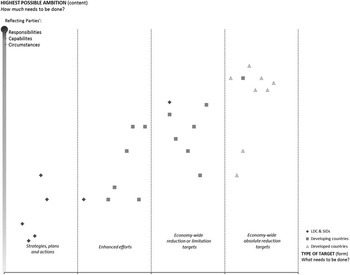
In fact, only when Article 4, paragraphs 3 and 4, are seen in conjunction, does a comprehensive picture of differentiation in the context of mitigation commitments emerge. Differentiation applies both to the content (‘how much’) and the form (‘what’) of the parties’ level of effort. These two elements can be represented as axes in a Cartesian coordinate system which allows for the equitable determination of each party’s contribution at any point in time (see Figure 1). Together, they provide the flexibility and fluidity necessary to capture the parties’ diverse and changing realities, while aiming for an effective response to the climate challenge.
Differentiation in Mitigation Efforts
Note: Each party’s NDC will reflect its highest possible ambition, in light of its responsibility, capability and circumstances (y-axis) and correspond with one of diverse types of target (x-axis). Developed countries should start at the upper right side of the diagram. Each time a successive NDC is communicated, it will progress beyond previous versions. Such a parameter-based determination of mitigation efforts leads to more diversified and dynamic differentiation.

The basis for differentiation in the mitigation provisions, therefore, is a complex balance between the parties’ responsibilities, capabilities and circumstances rather than any particular definition of ‘developed’ or ‘developing’ country. Consequently, this approach is fully consistent with the agreed global mitigation trajectory: all parties have an obligation to continuously contribute to achieving the temperature goal, but they should do so with their highest possible ambition, in a diversified and equitable manner, and reflecting their responsibilities, capabilities and circumstances.
Adaptation
Adaptation provisions under Article 7, on the other hand, have more general, common characteristics; there is actually no specific obligation for, or even an explicit reference to ‘developed countries’ in this article.Footnote 54 Nonetheless, Article 7 gives preferential treatment to developing countries and, within this group, to the most vulnerable. It establishes that the implementation of the Agreement should take into account the needs of developing countries that are particularly vulnerable (Article 7.2); provide recognition and assistance to the adaptation efforts of developing countries (Articles 7.3, 7.7 and 7.13), while avoiding the creation of additional reporting burdens on developing countries (Article 7.10). The basis for differentiation under Article 7 relies mostly on parties’ vulnerabilities and capabilities. The Agreement, however, does not specify which developing countries are particularly vulnerable. As any attempt to list them under the Paris Agreement has proven unfruitful, one can only assume, by way of reference, the types listed in Article 4.8 UNFCCC.
Finance
The provisions on financial support are arguably how the Paris Agreement addresses differentiation between developed and developing countries most directly and explicitly. Article 3 recognizes the need to support developing countries for the effective implementation of the Agreement. Articles 4.5 and 7.13 state that ‘support shall be provided’ to developing countries for their mitigation and adaptation actions, respectively. On the receiving end, therefore, the Paris Agreement clearly entitles developing countries to support. It does not, however, condition developing countries’ actions on support. Rather, as Article 4.5 makes clear, enhanced support for developing countries will allow for higher ambition in their actions. Read in conjunction, Articles 3, 4.5 and 7.13 establish a strong link between support and the degree of effectiveness and ambition in the actions of developing countries. Yet, this does not exempt them from fulfilling their obligations under the Agreement.
On the giving end, Article 9 offers the most clear-cut, bifurcated version of differentiation in the Paris Agreement. Article 9.1 reaffirms developed countries’ legally binding commitments under the Convention to provide financial resources to developing countries. Support from other parties is voluntary, as per Article 9.2. Proposals to commit those developing countries ‘in a position to do so’ or even ‘willing to do so’ to provide finance were flatly rejected. This, nevertheless, represents a considerable increment to previous practice under the Convention, in which developing countries simply had no formal role in climate finance or in supporting other countries; nor did they receive any recognition for doing so.
Mobilization of climate finance – a concept that is considerably broader than the provision of financial resources and includes ‘a wide variety of sources, instruments and channels’ – is described in Article 9.3 as a ‘global effort’. It can therefore be interpreted as a common commitment of all parties. In this effort, however, developed countries should continue to take the lead.
Article 9, therefore, differentiates financial obligations under the Paris Agreement in distinctive ways. It is quite explicit and strict with regard to the provision of support, attributing a strong normative weight to developed countries’ obligations, while other parties are encouraged to provide support on a voluntary basis only. However, Article 9 approaches the mobilization of climate finance in a more nuanced way, mirroring to some extent the approach used for mitigation: a provision applicable to all, accompanied by an obligation of conduct for developed countries to continue taking the lead.
Transparency
If finance is where differentiation is expressed more explicitly, transparency provisions under Article 13 are arguably where provisions for developed and developing countries converge most significantly. Since the purpose of transparency provisions is to increase trust and confidence among countries, it is arguably harder to legitimize any partner being entitled to less stringent obligations. Differentiated mitigation and financial commitments based on considerations of equity and responsibilities, capacities and circumstances may be perfectly justifiable, but all parties should report on these commitments as transparently and comprehensively as possible.
Accordingly, the ‘enhanced transparency framework for action and support’ established in Article 13 of the Paris Agreement sets parties’ capacities as the basis for differentiation. Different types of commitment and obligation under the other provisions of the Agreement have distinct transparency requirements – for instance, as a reflection of Article 9, developed countries have mandatory reporting obligations with regard to the provision of support, while other parties only ‘should’ do the same (see Article 13.9). Accordingly, the technical expert review as well as the multilateral consideration of progress with respect to providing support is compulsory only for developed countries (Article 9.11). Over time, however, these remaining elements of differentiation in the transparency framework will become less pronounced as all parties will be subject to common modalities, procedures and guidelines, as stated in Article 13.13.
In what promises to be one of the most difficult negotiations prior to the entry into force of the Agreement, these yet to be agreed common rules will express differentiation mainly by providing flexibility to those developing countries that need it in the light of their capacities.Footnote 55 An interesting feature of this particular approach is that it recognizes a preferential treatment of developing countries, but at the same time softens the strict categorization by limiting flexibility only to those developing countries that lack the capacity to implement common modalities on reporting, including those regarding the scope, frequency and level of detail.Footnote 56 In doing so, the Agreement recognizes that within the group of developing countries differences exist that lend themselves to a more heterogeneous (internal) treatment of developing countries in accordance with their capacities.
Other Provisions
The references above do not exhaust the examples of how the Paris Agreement differentiates among parties.
Differentiation can also be found in the context of the legal implications of the Agreement. For example, the mandate of the compliance and implementation committee (Article 15) states that the committee ‘shall pay particular attention to the respective national capabilities and circumstances of Parties’.
The Agreement further allows implicit differentiation by using norms which accommodate a large degree of discretion. Such norms may, for example, permit the consideration of criteria, characteristics or circumstances that differ from country to country. Implicit differentiation can occur where the Agreement permits flexibility and/or discretion in the implementation, when using terms such as ‘as far as possible’, ‘highest possible’, ‘best possible’, ‘as soon as possible’ or ‘where/as appropriate’. Of importance in this context is that ‘appropriateness’ or ‘possibility’ or ‘flexibility’ are in constant flux and allow both dynamic as well as temporary differentiation.
6. SUMMARY AND REFLECTIONS
This article provides an analysis of the careful balance struck in the Paris Agreement between differentiation among parties and the need to raise collective ambition. This balance is reflected in five systemically interconnected features of the Agreement.
Firstly, the Paris Agreement adopts a more diversified way of differential treatment, allowing a wider array of parameters to be taken into account when parties determine their national contributions, while being set against the normative background of the UNFCCC. The Agreement does not define differentiation in a singular way. Rather, it approaches it in at least three complementary ways:
-
1. It builds upon the principled approach to differentiation as contained in the CBDR-RC principle of the UNFCCC in a more nuanced and dynamic fashion by recognizing that the (application of the) principle is responsive to differing national circumstances – that is, not tied to the Annexes.
-
2. Each article of the Agreement reflects differentiation in context-specific ways, ranging from universal, non-differentiated obligations, to provisions that provide for implicit differentiation through norms the application of which permits consideration of characteristics that vary from country to country, to starkly contrasted and explicit differentiation between developed and developing countries.
-
3. The Agreement sets out parameters that will inform parties’ choices of ambition of both action and support, including the principles of progression and highest possible ambition, which consequentially also contribute to determining the differentiated commitments of parties.
Secondly, the principle of highest possible ambition establishes the standard of care now to be exercised in climate affairs. It implies a due diligence standard which requires each government to act in proportion to the risk at stake, and reflects its common but differentiated responsibilities and capabilities. Each single party has committed to taking all appropriate and adequate climate measures in order to progressively achieve the objective of the Agreement: to keep global temperature increases well below 2ºC in order to avoid dangerous anthropogenic interference with the climate system. ‘Highest possible ambition’ implies recognizing states’ differing national circumstances while at the same time aiming to match ambition with the overall aim, thereby combining effectiveness and fairness. The principle represents both a formal departure from the strict and equal treatment of states, and a departure from the historical, binary or bifurcated differentiation model. Importantly, the concept offers a flexible and dynamic means of differentiation by allowing the determination of what constitutes a proportionate measure in any given case and at each successive cycle of NDCs.
Thirdly, the principled-based approach to differentiation is combined with iterative processes (those presenting a successive contribution every five years, after a global stock-take), and with the establishment of an enhanced transparency framework. This, in turn, is an important ingredient to establish mutual trust. Not only will parties’ NDCs change over time the ‘differentiated placement’ of parties, but they will do so with repetitiveness and an unprecedented degree of transparency and openness.
Fourthly, the characteristics above enable the Paris Agreement to create a collective learning environment. Collective learning might be a way to overcome the ‘prisoner’s dilemma’ that characterizes climate change as a collective action problem. In fact, iterative, cooperative and facilitative processes have been identified as a way to address the risk of ‘free riding’.Footnote 57
The Paris Agreement has set up an architecture that promotes the evolution of voluntary, cooperative behaviour. Conditions for such evolution include transparency, trust and credibility that parties actually do what they said they would (‘pledge’). According to game theory, three elements are necessary to fulfil such conditions:
-
1. The pledging process needs to be broken down to a series of small steps. Such a succession of pledges will increase the acceptance by parties of cooperative strategies, as they can adjust the content of their pledges in subsequent rounds.
-
2. Common timelines need to be established for parties to individually communicate new pledges, but also to assess collective progress towards the overall aim.
-
3. The international regime should have a long, perhaps indefinite, time horizon, creating the conditions to ‘trust, but verify’ the actions of other parties over time.Footnote 58
The Paris Agreement meets all of these conditions. The pledging of an NDC every five years, informed by the outcome of the stocktake of collective progress, allows subsequent upward enhancement of ambition in a gradual manner. There is a robust transparency system consisting of reporting and review of actions and support, which adds credibility to parties’ pledges.
Fifth and finally, the Agreement creates a reflexive approach to parties’ determination of their climate action by establishing the duty of parties to revisit their actions and periodically assess whether their levels of ambition indeed correspond with their best possible effort, reflecting their responsibilities, capabilities and circumstances. This stimulates parties to improve their response to climate change by learning about their actions and the global effort, using this information to make appropriate changes. Perhaps in these aspects lies the greatest strength of the Agreement – enabling greater political relevance and durability, as well as fairness.
In sum, this article argued that differentiation under the Paris Agreement is much more diversified and less categorical than it is under the UNFCCC’s Annexes and the Kyoto Protocol. References to ‘developed’ and ‘developing’ countries are still relevant, but in a context-specific manner, rather than a ‘two fold’ approach. While the Agreement echoes the principle of CBDR-RC, it adds that it will be reflected ‘in the light of different national circumstances’. Along with the principles of progression and highest possible ambition, this allows a dynamic upward adjustment of parties’ efforts in a manner that is recognizant of the unique and changing responsibilities, capacities and circumstances of 197 diverse states at each successive cycle of NDCs. The articulation of the principles of CBDR-RC, progression and highest possible ambition at each successive NDC provides an innovative, comprehensive and dynamic way to match ambition with the overall aim of the Agreement, in a practical framework for combining effectiveness and fairness.
Differentiation under the Paris Agreement has the potential to function as a catalyst for a race to the top on climate action, rather than merely a burden-sharing concept. It must lend itself to strengthening collective action to hold temperature increases to well below 2°C. This requires ambitious mitigation action by all parties, as well as due consideration of the issues of equity, justice and fairness that arise from the global response to climate change. Given the important role that differentiation has to play, it can be stated safely that the Paris Agreement has succeeded in using differentiation as a means for enhancing ambition, as opposed to stalemating it. Rather than setting countries apart, differentiation could become a tool for bringing countries closer together in serving the purpose of the Agreement.