Introduction
We interact with each other all the time, in ways sensitive to whom we are interacting with and the context of the interaction. We are also able to describe what we think are the beliefs and desires of other people, to recognise and categorise their emotions, attitudes and thoughts. That is, besides capacities for social interaction, we have capacities for social cognition. These refer to rather sophisticated conceptual capacities for interpreting minds in terms of beliefs and desires.
In the last few decades, it has been a leading assumption within psychiatry research that our capacities for social interaction depend on such capacities for social cognition, or some understanding of minds with reference to beliefs and desires (Brune, Reference Brune2005b; Green et al., Reference Green, Bearden, Cannon, Fiske, Hellemann, Horan, Kee, Kern, Lee, Sergi, Subotnik, Sugar, Ventura, Yee and Nuechterlein2012; Barbato et al., Reference Barbato, Liu, Cadenhead, Cannon, Cornblatt, McGlashan, Perkins, Seidman, Tsuang, Walker, Woods, Bearden, Mathalon, Heinssen and Addington2015; Happe and Conway, Reference Happe and Conway2016). According to this Social Cognition First (SCF) thesis, there is an identifiable cognitive capacity for interpreting other minds in terms of beliefs and desires, that drives the capacity for social interaction (Carruthers, Reference Carruthers2009; Schönherr, Reference Schönherr2017). Theorists subscribing to SCF generally hold that theory of mind (ToM) is one of the main components of social cognition and can be measured using false belief tests. In such tests, situations in which a protagonist acquires a false belief are presented. The ability of the participant to infer false beliefs and to correctly predict how others might act on the basis of these beliefs is then tested. Autism has been cited as providing strong support for SCF, as weak scores on both ToM tests and measures of social interactions were reported in this population (Baron-Cohen, Reference Baron-Cohen1995). However, showing decreased scores on both measures provides only weak evidence for SCF. In particular, this does not establish that there is an association between ToM and social interaction, let alone that ToM is a pre-condition for social interactions. A more demanding test for SCF is to examine this association directly. If SCF is correct, then one could not find successful social interactions without ToM. One would thus expect a significant and strong positive correlation between ToM and social interaction. If, on the other hand, no association could be shown, this would disprove SCF.
Although several studies reported a significant association between ToM and social functioning in psychosis (e.g. Pijnenborg et al., Reference Pijnenborg, Withaar, Evans, van den Bosch, Timmerman and Brouwer2009), evidence is not univocally in favour of the SCF thesis. First, a meta-analysis based on 52 studies and over 2600 patients with psychosis found social cognition (a combined measure of several dimensions) to be more strongly associated with functional outcome (combining measures of community functioning, social behaviour in the milieu, social problem solving, and social skills) than neurocognition (Fett et al., Reference Fett, Viechtbauer, Dominguez, Penn, van Os and Krabbendam2011). However, social cognition as a whole explained only 23.3% of variance in functioning, thus challenging the assumption that impairment in this domain has a strong predictive value. Furthermore, several studies either observed no significant association between ToM and social functioning (Simons et al., Reference Simons, Bartels-Velthuis and Pijnenborg2016), or this association was no longer significant once potential confounding variables were taken into account, such as neurocognition (Bora et al., Reference Bora, Eryavuz, Kayahan, Sungu and Veznedaroglu2006; Pinkham and Penn, Reference Pinkham and Penn2006; Mancuso et al., Reference Mancuso, Horan, Kern and Green2011; Robertson et al., Reference Robertson, Hargreaves, Kelleher, Morris, Gill, Corvin and Donohoe2013), or symptom severity (Mancuso et al., Reference Mancuso, Horan, Kern and Green2011; Horan et al., Reference Horan, Green, DeGroot, Fiske, Hellemann, Kee, Kern, Lee, Sergi, Subotnik, Sugar, Ventura and Nuechterlein2012; Robertson et al., Reference Robertson, Hargreaves, Kelleher, Morris, Gill, Corvin and Donohoe2013). Finally, even if some studies observed significant associations between ToM and social functioning after correcting for potential confounding factors, these associations typically became less consistent (i.e. one specific variable extracted from a ToM task with one specific dimension of an instrument assessing social functioning) and harder to interpret. For example, Brune (Reference Brune2005a) examined the association between ToM, as measured with a picture sequencing task (PST) (ToM task) and followed by questions about the mental states of the characters depicted in the pictures (ToM questionnaire), and social functioning, as measured using the Social Behaviour Scale (SBS; Wykes and Sturt, Reference Wykes and Sturt1986) in a sample of participants with schizophrenia. Whereas the SBS total score was not significantly associated with any of the ToM variables, severe social behavioural problems (a subscore derived from the SBS total score) were significantly related to performance on the ToM questionnaire (even after correcting for illness duration and intellectual functioning).
The choice of instruments for measuring ToM and social functioning might contribute to the mixed findings described above. One of the most classical measures of ToM is the Hinting Task (Corcoran et al., Reference Corcoran, Mercer and Frith1995). Despite its wide use, it suffers from several limitations, such as relying on verbal comprehension abilities and eliciting a strong ceiling effect in adults. For this reason, we chose to use the Hinting Task in only one of the studies presented here, to increase comparability with previous findings, and to use the PST (Langdon and Coltheart, Reference Langdon and Coltheart1999) in the remaining studies. The PST generally elicits less ceiling effect, involves visual material, and includes a series of items that control for general abilities (Langdon and Coltheart, Reference Langdon and Coltheart1999). With regard to social functioning, most studies used self-reported or informant-based questionnaires. However, it should not be taken for granted that these questionnaires accurately assess social interactions (Schneider et al., Reference Schneider, Reininghaus, van Nierop, Janssens and Myin-Germeys2017). Sometimes, they inquire general functioning rather than social functioning per se. They also use retrospective reports, which are often biased and do not capture actual social interactions but a retrospective reflection of it. An alternative approach is to collect information prospectively in the daily-life using the experience sampling methodology (ESM; Myin-Germeys et al., Reference Myin-Germeys, Kasanova, Vaessen, Vachon, Kirtley, Viechtbauer and Reininghaus2018), a structured diary technique that allows participants to report their current social interactions as they occur in real-time. As ESM collects multiple reports in the moment over a short period of time, the use of this technique may lead to a more powerful test for the assumption that social cognition is a prerequisite for social functioning.
In this paper, we will describe the results of our investigations into the relations between ToM and social interaction and show the implications for SCF and alternative proposals. We present three studies investigating the association between ToM and social functioning in psychosis, using different measures of both ToM and social functioning (Fig. 1). Based on previous findings questioning the validity of SCF, we expect to observe no significant association or inconsistent associations (e.g. significant association with one ESM item but not the others) between the two constructs.
Graphical representation of the studies.

Study 1
Methods
Participants
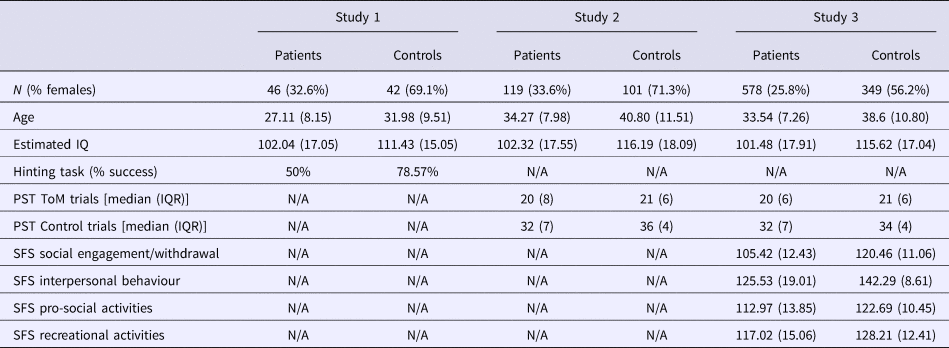
In the first study, 88 participants (Table 1) were recruited from the first assessment of the multi-centric Genetic Risk and Outcome of Psychosis (GROUP) study (official data release 4.0; Korver et al., Reference Korver, Quee, Boos, Simons and de Haan2012). Patients with psychosis were recruited from mental health services and patient organisations in representative geographical areas in The Netherlands and Belgium. A DSM-IV diagnosis of a non-affective psychotic disorder was confirmed in all patients with the Comprehensive Assessment of Symptoms and History Interview (CASH; Andreasen et al., Reference Andreasen, Flaum and Arndt1992). Additional inclusion criteria for patients were: age between 16 and 60 years and sufficient command of Dutch. Controls were recruited through a system of random mailings in the same areas and were also screened with the CASH. A history of common mental disorders (e.g. depressive disorder) was not an exclusion criterion. Local medical ethics committee approved the study and written informed consent was obtained from all participants.
Descriptive characteristics of participants included in the three studies

Mean (sd) are provided unless otherwise specified. IQR: interquartile range.
Materials and procedure
ToM was measured using the Hinting Task (Corcoran et al., Reference Corcoran, Mercer and Frith1995). This test is composed of 10 short stories that all contain a veiled speech act. Participants have to make social judgements about the intentions of a protagonist. Two points are attributed if the correct interpretation is given spontaneously and one point if the examiner provides additional information (range 0–20).
Daily-life social functioning was assessed using a 6-day ESM protocol. Participants were carrying a booklet and wristwatch, which was programmed to beep 10 times a day randomly between 7:30 and 22:30. After each beep, participants were instructed to immediately complete a report assessing current mood, context (e.g. social situation, activity), and an appraisal of the context (e.g. current company, current activity). Only the reports that were completed within a 15-min interval after the beep were considered valid. All participants received an initial briefing to review the understanding of the general procedure and the content of the items. Several items were used as indicators of real-life social functioning. First, participants had to report whether they were in the company of other persons and the nature of this company (i.e. social context). Based on this information, three scores were computed for each participant: percentage of time spent alone, percentage of time spent with familiar persons (i.e. partner, housemate, friends or family members), and percentage of time spent with less familiar persons (i.e. healthcare professionals, acquaintances, or strangers). When participants were accompanied by other persons, they had to report their current appraisal of this company using three items rated on a 7-point Likert scale (0 = not at all to 7 = extremely): I like this company, I would prefer being alone, and We are interacting.
A short version of the Wechsler Adult Intelligence Scale – version 3 (WAIS-III) was administered to obtain an estimation of intellectual functioning (Blyler et al., Reference Blyler, Gold, Iannone and Buchanan2000).
Statistical analyses
A ceiling effect was observed in both groups of participants on the Hinting Task, with a significant proportion of the sample obtaining the maximum number of points (see Table 1). For this reason, a binary score was computed representing failure (0) v. success (1) on the task. Group difference in the Hinting Task was examined using a logistic regression analysis.
To test the associations between the performance on the Hinting Task and daily-life social functioning (ESM variables), binomial regression models were used when the dependent variables were time-invariant (e.g. % time spent alone). Binomial regressions were chosen to account for the fact that dependent variables are proportions. Multilevel regressions with random intercepts (i.e. a random intercept was specified for each individual) were used when the dependent variables were time-varying (e.g. appraisal of the pleasantness of the company) in order to take into account the multilevel structure of the data. ToM, group, and the ToM × group interaction were entered as independent variables and age and gender as covariates. All the analyses were performed with and without intelligence quotient (IQ) as an additional covariate, to control for general intellectual functioning. All the analyses were performed with STATA 12.1 (StataCorp, 2014).
Results
A logistic regression analysis revealed that patients had significantly more failures compared to controls on the task when controlled for age and gender (b = −1.01 [95% confidence interval (CI) −2.00 to −0.02], p = 0.045). However, this effect was no longer significant when full-scale IQ was entered as an additional covariate [b = −0.78 (95% CI −1.82 to 0.27), p = 0.144].
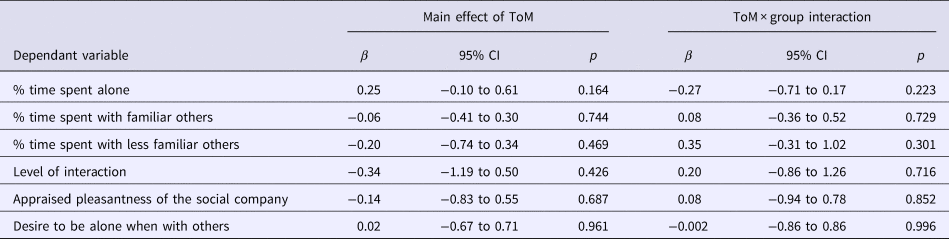
Using binomial regressions, no main effect of ToM and no ToM × group interaction was found on the percentage of time spent in various social contexts, independent of age or gender (Table 2). Multilevel regression analyses revealed no main effect of ToM and ToM × group interaction on the appraisal of social situations, again independent of age and gender (see Table 2). Including IQ as an additional covariate did not change the results (data not shown).
Summary of main effect of ToM and ToM × group interaction on social functioning in Study 1

Age and gender were included as covariates in the model.
Study 2
Methods
Participants
In Study 2, 220 participants (Table 1) were recruited from the third assessment of GROUP (data release version: 17.02.2017). Among those, 34 participants (16 patients with psychosis and 18 controls) were also involved in Study 1, but 6.56 years earlier on average. Inclusion and exclusion criteria were the same as those reported in Study 1.
Materials and procedure
ToM abilities were measured using a shortened version of the PST (Langdon and Coltheart, Reference Langdon and Coltheart1999). In this task, participants have to arrange 10 series of pictures to create stories that make sense. Four stories require the ability to infer false beliefs and hence involve ToM. In addition, six stories not requiring ToM but involving other cognitive processes that may interfere with this ability (e.g. sequencing abilities) are used as control trials. A maximum of six points can be attributed for each story, leading to a total of 24 points for the false-belief stories, and 36 points for the control stories. In addition, daily-life social functioning was assessed using a 6-day ESM protocol. The general methodology was similar to Study 1, except that participants were carrying a digital apparatus, the PsyMate (Myin-Germeys et al., Reference Myin-Germeys, Birchwood and Kwapil2011), instead of a booklet and wristwatch. Several ESM items were used as indicators of real-life social functioning. First, participants had to report whether they were in the company of other persons and the nature of this company (i.e. social context). Based on this information, three scores were computed for each participant: percentage of time spent alone, percentage of time spent with familiar persons (i.e. partner, housemate, friends, or family members), and percentage of time spent with less familiar persons (i.e. healthcare professionals, acquaintances, or strangers). Depending on the participants’ social context (i.e. alone v. in company of other persons), they had to report their current appraisal of the situation. When participants were alone, they had to complete the following items: I like being alone, and I would rather be in the company of other persons on a 7-point Likert scale (0 = not at all to 7 = extremely). When participants were in the company of other persons, they had to complete the following items: I like this company, I would rather be alone, I feel at ease in this company, and I feel threatened by this company. The last two items were assessed only in participants recruited through one of the medical centres (Maastricht) (N = 177; 85 patients with psychosis and 92 controls). Intellectual functioning was assessed with the same short version of the WAIS-III as described in Study 1 (Velthorst et al., Reference Velthorst, Levine, Henquet, de Haan, van Os, Myin-Germeys and Reichenberg2013).
Statistical analyses
Group difference in the false-belief trials of the PST was examined using a Tobit regression analysis. Tobit regression, which is specifically designed to estimate linear associations between variables when there is either left- or right-censoring in the dependent variable, was chosen because of a negative skewness of PST scores in both groups. Indeed, 32 (26.89%) patients with psychosis and 32 (31.68%) controls obtained the maximum number of points on the false-belief trials; 36 (30.25%) patients with psychosis and 52 (51.49%) controls obtained the maximum number of points on the control trials. Ceiling effects are typically described when false-belief tasks are used in adult samples (Turner and Felisberti, Reference Turner and Felisberti2017). Similar to Study 1, the associations between PST false-belief trials and daily-life social functioning were analysed using binomial regressions (time-invariant ESM variables) and multilevel regression analyses with random intercepts (time-varying ESM variables) with ToM, group, and the ToM × group interaction as independent variables and age and gender as covariates. All analyses were run again with IQ or the score on the control trials of the PST as additional covariates to control for general cognitive difficulties.
Results
A Tobit regression analysis revealed that patients had a significantly lower score on the false-belief trials compared to controls when controlled for age and gender [b = −2.26 (95% CI −4.04 to −0.47), p = 0.013]. However, this effect was no longer significant when full-scale IQ [b = −0.92 (95% CI −2.77 to 0.93), p = 0.329] or the score on the control trials [b = −1.05 (95% CI −2.74 to 0.64), p = 0.223] were entered as additional covariates.
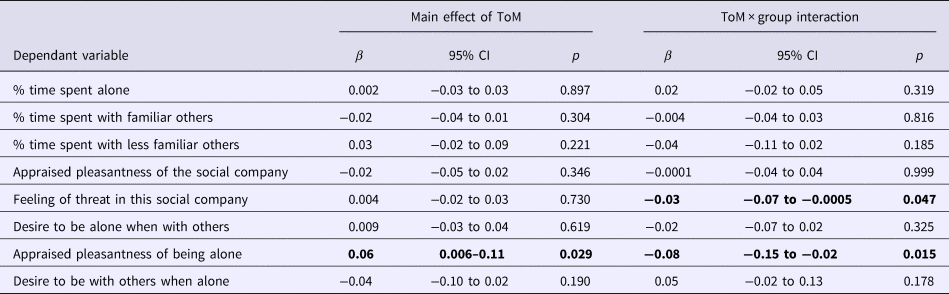
Using binomial regressions, no main effect of ToM and no ToM × group interaction were found on the percentage of time spent in various social contexts, independent of age and gender (see Table 3). Multilevel regression analyses revealed a significant effect of ToM and a significant ToM × group interaction on the appraised pleasantness of being alone (Table 3). A significant ToM × group interaction on the appraised feeling of threat during social company was also detected. To better understand these interaction effects, the same analysis was performed in each group separately. Higher ToM abilities were significantly associated with increased preference for being alone in controls [b = 0.07 (95% CI 0.02 to 0.13), p = 0.006] but not in patients with psychosis [b = −0.03 (95% CI −0.08 to 0.02), p = 0.192]. Conversely, higher ToM abilities were significantly associated with decreased feeling of threat during social company in patients [b = −0.03 (95% CI −0.07 to −0.0003, p = 0.048] but not in controls [b = 0.004 (95% CI −0.009 to 0.02, p = 0.538]. Multilevel regression analyses examining the associations between ToM and time-varying ESM items all yielded non-significant results (Table 3). Results remained similar when IQ or the score on the PST control trials were entered as additional covariates (data not shown).
Summary of main effect of ToM and ToM × group interaction on social functioning in Study 2

Age and gender were included as covariates in the model. Significant effects are highlighted in bold.
Study 3
Methods
Participants
For Study 3, 682 participants (including all participants from Study 2) (Table 1), all recruited from the third assessment of GROUP, as described in Study 2, were included.
Materials and procedure
ToM was again assessed using the PST (see Study 2). Social functioning was assessed using the self-report version of the Social Functioning Scale (SFS; Birchwood et al., Reference Birchwood, Smith, Cochrane, Wetton and Copestake1990). The SFS independence/competence, independence/performance, and employment/occupation dimensions were not examined in the scope of this paper because they do not strictly reflect social functioning.
Statistical analyses
Similar to Study 2, group difference in the PST was examined using a Tobit regression analysis. The associations between ToM and the SFS dimensions were tested using robust regression models, given that some SFS dimensions violated the normality assumption (due to the presence of outliers). In these models, main effects of ToM, group, and the ToM × group interaction were entered as independent variables, and age and gender as covariates. All the analyses were also run with IQ or the score on the control trials of the PST as additional covariates to control for general cognitive difficulties.
Results
Using robust regressions, we observed no significant effect of ToM or ToM × group interaction on any of the SFS subscales, except for the pro-social activities dimension (Table 4). For this dimension, a significant main effect of ToM was observed when age and gender were entered as covariates. However, this association was no longer significant when estimated full-scale IQ [b = 0.22 (95% CI −0.07 to 0.51), p = 0.141] or the score on Control trials [b = 0.27 (95% CI −0.02 to 0.57), p = 0.070] were entered as additional covariates.
Summary of main effect of ToM and Tom × group interaction on social functioning in Study 3

Age and gender were included as covariates in the model. Significant effects are highlighted in bold.
Discussion
Findings were highly consistent across the three studies and do not confirm the conventional SCF reasoning, namely that ToM is strongly associated with social functioning. Although patients with psychosis showed decreased scores on the false-belief tasks and impaired social functioning (either measured using ESM or the SFS), evidence for an association between these two constructs is very weak. Only two exceptions were noted in Study 2, with higher scores on false-belief trials being associated with increased preference for being alone in controls and with decreased feeling of threat during social company in patients. Whereas the first result goes in the opposite direction to the SCF hypothesis, the second is likely a false positive result given the number of statistical tests that were performed in this study. The strength of the current study is the use of several approaches to measure both ToM and social functioning. In particular, the use of ESM in Studies 1 and 2 allowed an investigation of social interaction in daily-life, which bypasses some of the limitations inherently associated with the use of retrospective measures.
The obtained results add new evidence to the existing body of literature and reinforce the doubts against the SCF raised by earlier findings in the field of psychosis (e.g. Mancuso et al., Reference Mancuso, Horan, Kern and Green2011; Horan et al., Reference Horan, Green, DeGroot, Fiske, Hellemann, Kee, Kern, Lee, Sergi, Subotnik, Sugar, Ventura and Nuechterlein2012; Robertson et al., Reference Robertson, Hargreaves, Kelleher, Morris, Gill, Corvin and Donohoe2013; Simons et al., Reference Simons, Bartels-Velthuis and Pijnenborg2016). Studies using different measures of social cognition (i.e. emotion recognition) also reported similar findings. For example, Janssens et al. (Reference Janssens, Lataster, Simons, Oorschot, Lardinois, van Os and Myin-Germeys2012) examined the link between a classical measure of emotion recognition and ESM measures of functioning in patients with psychosis and found no significant association. Similarly, empirical findings in various populations do not seem to support the assumption that interventions targeting social cognition deficits lead to an improvement in social functioning. Several studies have examined whether social cognitive treatments – that usually involve multiple components (e.g. psychoeducation) and not only target social cognition – can improve social functioning. The quality of evidence remains low at this stage in the field of psychosis and results suggest little generalisation to distal measures of functioning (Fiszdon and Reddy, Reference Fiszdon and Reddy2012). A review of interventions focusing on ToM itself or its precursors in patients with autism also concluded that ‘it may be possible to teach both Theory of Mind (ToM) and the precursor skills associated with the construct. However, this teaching rarely or never generalises to novel contexts, and it is unclear whether there is long-term maintenance of learnt skills, or developmental progression in learning’ (p. 27 in Fletcher-Watson et al., Reference Fletcher-Watson, McConnell, Manola and McConachie2014).
We believe that the results of the current study raise a number of important questions about social cognition. Note that the SCF hypothesis could still be correct if the lack of significant association between ToM and social functioning would be driven by an incorrect operationalisation of ToM. In the current study, we used two tasks that have been widely used in research and are considered classical measures of ToM. However, several criticisms have been raised against these classical measures, notably the fact that they involve ‘off-line’ processing (Gallagher and Varga, Reference Gallagher and Varga2015). In standard experimental settings, participants are asked to provide a third-person judgement about another person's beliefs, while there is no direct interaction between the participant and the characters in the story. In real-life situations, judgements about the beliefs of the people happen ‘online’, they are part of the ongoing development of the interaction. In fact Keysar et al. (Reference Keysar, Lin and Barr2003) have shown that in direct online interactions, the adult participants often take an egocentric perspective that is not what would be predicted if they would rely on ToM. The authors propose that this perspective is directly corrected by the dynamics of the interaction itself. Recently, some tasks have been designed to measure ‘online’ perspective-taking (Dumontheil et al., Reference Dumontheil, Apperly and Blakemore2010) but their value in predicting social impairments in clinical populations has never been examined. However, such operationalising of ToM is difficult to reconcile with the SCF thesis. Indeed, in this ‘online’ operationalisation of ToM, interactions play an important role in the bringing about of ToM abilities.
Besides these concerns about measuring social cognition, the very idea that social interaction is based on some kind of theoretical or sophisticated conceptual understanding has been challenged for being built on unrealistic and untenable assumptions. One major point of criticism is that taking part in a social interaction is a matter of participating from an engaged perspective within the interaction, rather than of theorising, from an observer's perspective, outside of the interaction (Hutto, Reference Hutto2004; Reddy, Reference Reddy2008; Fuchs and De Jaegher, Reference Fuchs and De Jaegher2009). Reddy and Morris (Reference Reddy and Morris2004) reviewed a series of empirical results showing that sophisticated social interactive skills, for example involving deceiving, occur long before children pass classical ToM tests. In addition, Hutto (Reference Hutto2008) argues that assuming that theory precedes practice creates the problem of accounting for where theory comes from. Moreover, these authors have proposed that there are forms of social engagement and participation that are adaptive, flexible, and intelligent, without being based on theoretical or conceptual understanding, and that such forms of social engagement are the basis of abilities for conceptual understanding in the social sphere.
In line with the results of our studies and with this emerging way of thinking about social cognition, one can then formulate an alternative to SCF: the Social Interaction First (SIF) thesis. According to SIF, social cognition is not a prerequisite for, but rather a result of, more basic interactive abilities. SIF is compatible with our results, because it allows for social interaction both without and with ToM. Further empirical support for SIF derives from, for example, studies showing that others’ intention can be understood simply by looking at the kinematic features of their movements (Becchio et al., Reference Becchio, Manera, Sartori, Cavallo and Castiello2012; Cavallo et al., Reference Cavallo, Koul, Ansuini, Capozzi and Becchio2016), or that automatic interpersonal synchrony between two or more individuals is linked with higher social functioning (Keller et al., Reference Keller, Novembre and Hove2014). SIF holds theoretical advantage over SCF by explaining what's apparently more complex – namely ToM abilities – in terms of what's more simple – namely basic social interactions. Though more research is needed, our studies add weight and force to the growing conviction that SCF should no longer be considered to be the only serious game in town. SIF is a serious contender, and should be further explored.
Author ORCIDs
Maude Schneider, 0000-0001-7147-8915
Acknowledgements
We would like to thank all the participants who took part in the GROUP study. In addition, thanks go to Ulrich Reininghaus, Martine van Nierop and Mayke Janssens for their help in data collection and management. Furthermore, we would like to thank all research personnel involved in the GROUP project, in particular Joyce van Baaren, Erwin Veermans, Ger Driessen, Truda Driesen, Karin Pos, Erna van ’t Hag, Jessica de Nijs, Atiqul Islam, Wendy Beuken and Debora Op ’t Eijnde.
Author contributions
GROUP authors were responsible for setting up the GROUP study and for data collection. M. Schneider and I. Myin-Germeys developed the concept of this study. M. Schneider performed data analysis and drafted the manuscript. I. Myin-Germeys and E. Myin provided theoretical content and critical revisions. All authors approved the final version of the manuscript for submission.
Financial support
Inez Myin-Germeys was supported by an ERC consolidator grant (ERC-2012-StG, grant number 309767-INTERACT) and a FWO Odysseus grant (grant number G0F8416N). Erik Myin is supported by the projects ‘Getting Real about Words and Numbers’ and ‘Facing the interface’ of the FWO (grant numbers G0C7315N and G049619N). Data analysis was supported by personal fellowships from the Swiss National Science Foundation (grant numbers 162006 and PZ00P1_174206 to MS).
The infrastructure for the GROUP study is funded by the Geestkracht programme of the Dutch Health Research Council (ZON-MW, grant number 10-000-1002) and matching funds from participating pharmaceutical companies (Lundbeck, AstraZeneca, Eli Lilly, Janssen Cilag) and universities and mental health care organisations (Amsterdam: Academic Psychiatric Centre of the Academic Medical Center and the mental health institutions: GGZ Ingeest, Arkin, Dijk en Duin, GGZ Rivierduinen, Erasmus Medical Centre, GGZ Noord Holland Noord. Groningen: University Medical Center Groningen and the mental health institutions: Lentis, GGZ Friesland, GGZ Drenthe, Dimence, Mediant, GGNet Warnsveld, Yulius Dordrecht and Parnassia Psycho-Medical Center, The Hague. Maastricht: Maastricht University Medical Centre and the mental health institutions: GGZ Eindhoven en De Kempen, GGZ Breburg, GGZ Oost-Brabant, Vincent van Gogh voor Geestelijke Gezondheid, Mondriaan, Virenze riagg, Zuyderland GGZ, MET ggz, Universitair Centrum Sint-Jozef Kortenberg, CAPRI University of Antwerp, PC Ziekeren Sint-Truiden, PZ Sancta Maria Sint-Truiden, GGZ Overpelt, OPZ Rekem. Utrecht: University Medical Center Utrecht and the mental health institutions Altrecht, GGZ Centraal and Delta).
Conflict of interest
The authors have declared that there are no conflicts of interest in relation to the subject of this study.