INTRODUCTION
Writing in the seventeenth century, the Spanish friar Burgoa (Reference Burgoa1934) compiled his Geográfica descripción of what is now the modern Mexican state of Oaxaca, in which he recounted not only the proselytizing efforts of himself and his fellow clerics in the region, but also the landscapes and indigenous cultures he encountered, including events said to have had occurred in pre-Hispanic history, as related to him by native informants. Among the latter is an account of a conflict purported to have occurred between the coastal empire of Tututepec (known in the Mixtec—or, more properly, Ñuu Dzahui—language of the region as Yucu Dzaa) and the highland kingdom of Achiutla (Ñuu Ndecu). According to Burgoa, the conflict began when the rulers of Tututepec urged their counterparts in Achiutla to bring their crafts to the community of Putla (Ñuu Caa)—located between the two kingdoms—where they would jointly host a grand market. In part because doing so would have required a journey of at least 57 kilometers through extremely mountainous terrain, Achiutla attempted to decline the “invitation” from Tututepec. Burgoa then describes the ensuing events as follows:
When the people of Achiutla did not arrive, the king of Tututepec first sent ambassadors to threaten them. Then he sent valiant captains accompanied by a great number of people, which made it necessary for the citizens of Achiutla to climb to the impregnable castle with sufficient supplies, and enough easily rolled stones and rocks so that they could defend themselves from assault by flinging the enemy off the mountain. The enemy arrived and besieged the mountain, and looked for a route by which to scale it and come within fighting distance; and the battle was so bloody that afterward they counted the dead of both sides, and more than 22,000 bodies were found. (Burgoa Reference Burgoa1934:352–353; translation from Smith Reference Smith1973:85).
The above figures may very well be exaggerated; it is even possible that the whole account was fabricated. Nevertheless, there is likely still something important to be gleaned from this passage. Namely, given that native informants ostensibly relayed the account to Burgoa, the implication is that such a scenario was at least considered plausible by indigenous persons of Oaxaca in the seventeenth century. This suggests a significant social memory of the power of the Tututepec state that endured into the colonial period. Similarly to other Mesoamerican polities at the time of European contact, as best evidenced by accounts of the Conquest (e.g., Cortés Reference Cortés1986; Díaz del Castillo Reference Díaz del Castillo1963; Durán Reference Durán and Heyden1994), Tututepec was able to enlist vast numbers of its subjects in warfare and other state projects. Thus, as a point of departure, I would like to begin this article by asking—How was this possible? How did Tututepec's elites compel their subjects to participate in such imperial projects? Given the unlikelihood that a handful of the site's ruling elites could simply “hoodwink” or physically coerce such large groups of people to participate in these activities (Ringle Reference Ringle, Grove and Joyce1999:187), I offer an alternative explanation—that aspects of political and ritual ideology were shared among both elites and commoners at Tututepec, fostering a social cohesion that crosscut inequalities in wealth and status, contributing to the growth and success of the empire. As Mesoamerican scholars have increasingly pointed out, such cohesion would have been tenuous, contingent upon the negotiation of power relationships in daily practice (e.g., Ashmore et al. Reference Ashmore, Yeager, Robin, Demarest, Rice and Rice2004; Brumfiel Reference Brumfiel, Hendon and Joyce2004; Gonlin and Lohse Reference Gonlin and Lohse2007; Hutson Reference Hutson2010; A. Joyce Reference Joyce, Dobres and Robb2000, Reference Joyce and Blomster2008, Reference Joyce2010; Joyce and Lopiparo Reference Joyce and Lopiparo2005; Levine Reference Levine2011; Rodríguez Alegría Reference Rodríguez Alegría2005). To examine how this negotiation took place in daily life and symbolic discourse at Tututepec, I focus on one particular type of evidence—polychrome ceramics recovered from excavations of commoner residences at the site, whose painted symbols provide windows into some of the salient themes of this ideology.
In this article, I first provide background on the site of Tututepec, as well as on Postclassic codex-style polychrome ceramics from Mesoamerica in general. The discussion then moves on to an outline of the theoretical perspective brought to the analysis, informed by semiotic theory, and explanations of basic operational concepts that are employed in this study. I then describe the data set and the findings of the ceramic and iconographic analysis. Lastly, these findings are contextualized within a discussion of commoner life at Tututepec and the role of these ceramics in social discourse, as well as the implications of that discourse for ideology and relations of power within the polity.
TUTUTEPEC OF THE LATE POSTCLASSIC
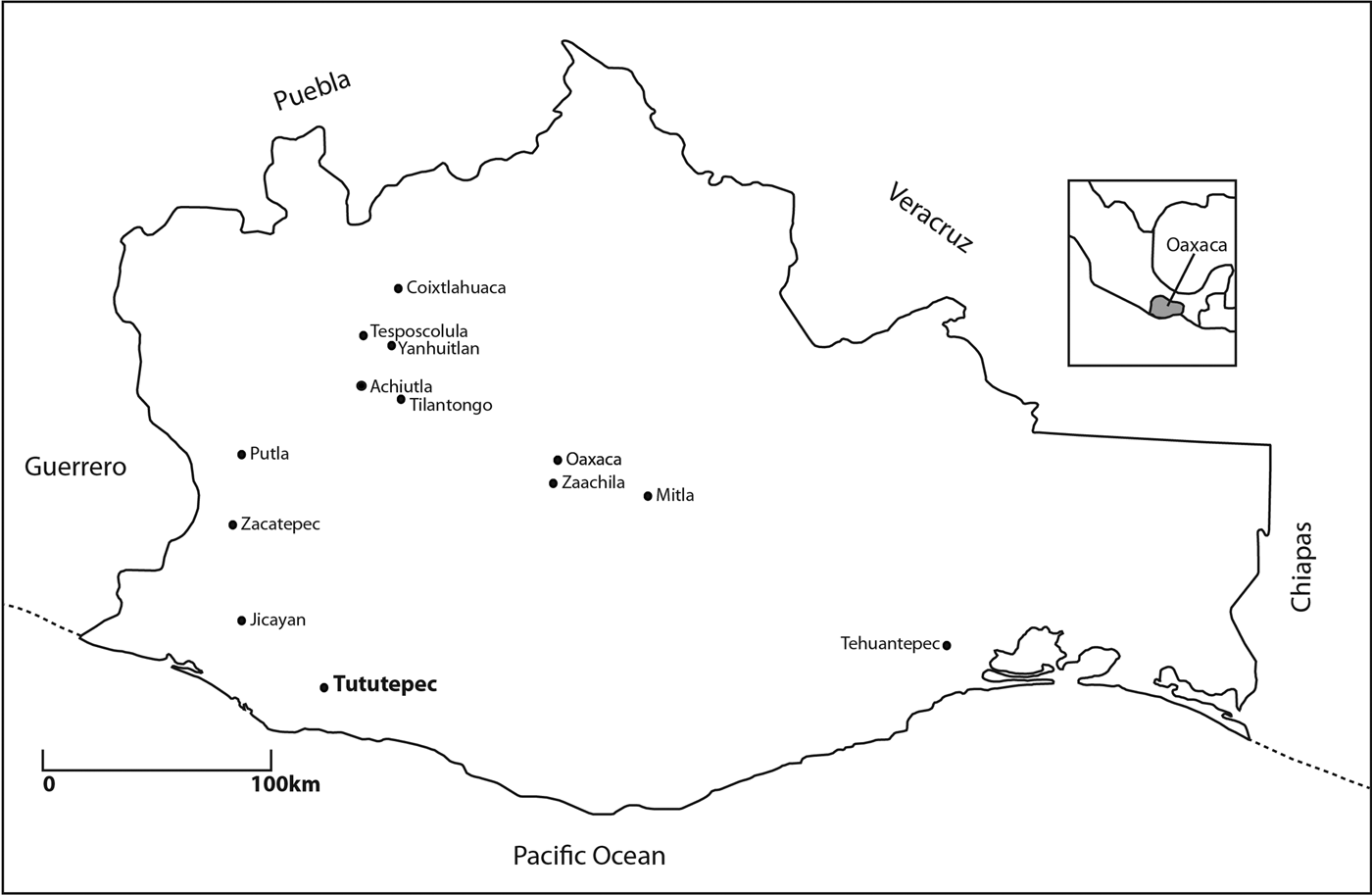
Tututepec is located in the piedmont of the lower Rio Verde valley, in the Mixtec-speaking region of the Oaxaca coast (Figure 1). Based on information found in pre-Hispanic codices and colonial ethnohistorical sources, scholars have long understood the site to have been the center of an important Postclassic Mixtec kingdom but it has only more recently become the focus of intensive archaeological investigations. Combined, these multiple lines of evidence paint a rich picture of Postclassic Tututepec, which was the capital of a territorial empire that stretched along the Pacific coast, and remained independent of the central Mexican Triple Alliance headed by Tenochtitlan over the course of its history (Joyce et al. Reference Joyce, Workinger, Hamann, Kroefges, Oland and King2004; Levine Reference Levine2007; Spores 1993).
Map of Oaxaca, showing location of Tututepec and other important Postclassic sites in the region. Drawing by the author.

The names Tututepec and Yucudzaa translate as “Hill of the Bird” in both Nahuatl and Mixtec respectively, and the site is represented as such in the Mixtec codices (Smith Reference Smith1973:67). Three of the codices show Tututepec being founded as a new polity in the year a.d. 1083 by a warrior-priest from the highland Mixtec region known as Lord 8 Deer “Jaguar Claw” (Joyce et al. Reference Joyce, Workinger, Hamann, Kroefges, Oland and King2004:282). That Mixtec speakers from the highlands colonized this area of the Oaxaca coast around this time is supported by both glottochronological (Josserand Reference Josserand, Jansen, Romero, Josserand, Winter and Hopkins1984:154) and archaeological data (Joyce et al. Reference Joyce, Workinger, Hamann, Kroefges, Oland and King2004:280).
The codices depict Lord 8 Deer conquering numerous other polities surrounding Tututepec, presumably consolidating a coastal empire centered at Tututepec (Joyce et al. Reference Joyce, Workinger, Hamann, Kroefges, Oland and King2004; Smith Reference Smith1973). This is corroborated by ethnohistorical evidence, including 1570's Relaciones geográficas that document tribute paid to Tututepec by its vassal kingdoms (Acuña Reference Acuña1984; Levine Reference Levine2011:27). At the time of Spanish contact, Spores' (Reference Spores1993) analysis of ethnohistorical documents indicates that Tututepec controlled an area of approximately 25,000 km2 along the coast, consisting of numerous conquered polities and populated by various ethnolinguistic groups that paid tribute to the capital.
Despite Tututepec's notoriety in codices and ethnohistorical sources, the site was only visited briefly by a handful of archaeologists and historians prior to the 1980's (e.g., Berlin Reference Berlin1947; DeCicco and Brockington Reference DeCicco and Brockington1956; Maler Reference Maler1883; Martínez Gracida Reference Martínez Gracida1907; Piña Chan Reference Piña Chan1960). O'Mack (Reference O'Mack1990) conducted the first formal archaeological survey of the site, though the project was limited in scope. Workinger (Reference Workinger2002) carried out excavations at the nearby site of San Francisco de Arriba, though occupations at this site date principally to the Late Formative through Late Classic periods. Building on the previous research, Joyce and colleagues (Reference Joyce, Workinger, Hamann, Kroefges, Oland and King2004) conducted a comprehensive full-coverage survey of Tututepec. Their work demonstrated that Late Postclassic Tututepec was indeed a large population center, spanning approximately 22 square kilometers (Joyce et al. Reference Joyce, Workinger, Hamann, Kroefges, Oland and King2004: 273), although settlement was significantly less dense than contemporary centers such as Tenochtitlan. While cognizant of the problems inherent to population estimates based solely on surface survey, the authors give a rough estimate of between 10,925 and 21,850 inhabitants (Joyce et al. Reference Joyce, Workinger, Hamann, Kroefges, Oland and King2004:273, 288).
Most recently, intensive excavations of commoner households and analyses of domestic artifact assemblages were carried out at Tututepec in a project directed by Levine (Forde Reference Forde2006; Heijting Reference Heijting2006; Levine Reference Levine2007, Reference Levine2011; Levine et al. Reference Levine, Joyce and Glascock2011). This research has demonstrated that residents of Tututepec participated in a dynamic regional economy—domestic crafting largely focused on surplus production of cotton cloth (Levine Reference Levine2011:31–32), which likely afforded families access to imported goods such as obsidian (Levine et al. Reference Levine, Joyce and Glascock2011), and more locally produced goods, including ceramics, acquired at markets (Levine et al. Reference Levine, Fargher, Cecil and Forde2015). The analysis presented here is based on data from these excavations. Polychrome ceramic vessels, specifically, were richly decorated with powerful symbols and used in important social contexts such as ritual feasts, thus constituting an important medium through which notions of identity and ideology were produced and disseminated at Late Postclassic Tututepec (Forde Reference Forde2006).
MIXTECA-PUEBLA POLYCHROME CERAMICS
Mixteca-Puebla polychrome vessels of Postclassic Mesoamerica have garnered attention from archaeologists and art historians for years, in large part due to the fact that painted designs on these ceramics bear great affinity to iconography found in the Mixtec and Borgia group codices, which have long captivated many scholars. This phenomenon has also led various researchers to dub the ceramics “codex style.” Both labels—“Mixteca-Puebla,” and “codex style,” which have been extended to other media such as mural paintings—have their advocates and critics, though these issues are beyond the scope of the present discussion (for reviews, see Keber Reference Keber, Nicholson and Keber1994; Nicholson and Keber Reference Nicholson, Keber, Nicholson and Keber1994; Smith and Heath-Smith Reference Smith and Heath-Smith1980). Suffice to say, I employ the term Mixteca-Puebla while cognizant of the fact that materials classified as such are found in regions as diverse as West Mexico and Costa Rica (e.g., Boone and Smith Reference Boone, Smith, Smith and Berdan2003:189; Day Reference Day, Nicholson and Keber1994; Hernández Reference Hernández Sánchez2010:254; McCafferty and Steinbrenner Reference McCafferty, Steinbrenner, Waters-Rist, Cluny, McNamee and Steinbrenner2005; Meighan Reference Meighan, Ekholm and Bernal1971), owing to complex networks of interaction that existed in Mesoamerica during the Postclassic, and hence rather variable. With regard to “codex style,” Keber's (Reference Keber, Nicholson and Keber1994:148) point that this term perhaps unfairly gives primacy to manuscripts over other media is well taken. At the same time, however, given that in this study I use the codices as an interpretive base for drawing inferences as to the meanings of various design motifs, I do not object to at least making a linkage between the two forms of media.
As early as the beginning of the twentieth century, Seler (Reference Seler, Thompson and Richardson1990) discussed several elaborate polychrome vessels from the Mixteca and related their imagery to depictions of deities found in the codices. More detailed reporting and analyses of Mixteca-Puebla style ceramics were carried out by a number of archaeologists during the middle of the twentieth century (e.g., Caso et al. Reference Caso, Bernal and Acosta1967; Castillo Reference Castillo1968; Noguera Reference Noguera1954). A systematic analysis of excavated polychromes from known archaeological contexts, however, was not carried out until Lind's (Reference Lind1987) study of materials from the sites of Chachoapan and Yucuita. Lind (Reference Lind, Nicholson and Keber1994) also discerned regional differences in polychrome ceramics from Oaxaca and Cholula, through a comparative analysis including both archaeological collections and museum pieces with general provenience data. Lind (Reference Lind, Nicholson and Keber1994:97) argues that vessels from both regions were used in forms of ritual, though variation in forms and design motifs suggest such rituals may have been different in nature, with varying points of emphasis. McCafferty (Reference McCafferty, Nicholson and Keber1994, Reference McCafferty2001), meanwhile, has refined the chronology of polychrome ceramics at the site of Cholula and provided functional analysis. Pohl (Reference Pohl, Smith and Berdan2003) has examined museum pieces from a variety of regions and discussed iconographic variability and ideological themes. At the same time Pohl (Reference Pohl2007a, Reference Pohl2007b) has discussed select pieces that exemplify what can termed “narrative pottery,” and argues such pieces may have been used to supplement the recitation of stories from the Mixtec codices during elite feasting events. Recently, Hernández Sánchez (Reference Hernández Sánchez2005, Reference Hernández Sánchez2008, Reference Hernández Sánchez2010) has carried out an extensive and in-depth analysis of the iconography of polychrome vessels from museum collections extending from Oaxaca to Veracruz, and has focused on how different combinations of design motifs formed iconographic themes related to ritual uses of the vessels.
These last points regarding the ritual uses of Mixteca-Puebla polychromes are key to the present study. While certain vessel forms such as ladle censers and braziers were quite obviously used for ritual burning of incense (Lind Reference Lind1987:67–74; Smith Reference Smith, Carrión and Cook2007:160), scholars largely agree that drinking vessels were also frequently used in ritual feasts, marriages, and other events for the imbibing of chocolate and pulque, as depicted in the Mixtec codices (Forde Reference Forde2006:87–88; Hernández Reference Hernández Sánchez2008, Reference Hernández Sánchez2010:266–267; Levine Reference Levine2007:369–377, Reference Levine2011:32; Lind Reference Lind1987:17; Pohl Reference Pohl2007a:41). Though a number of researchers have argued that polychromes were largely restricted to elites (Hernández Reference Hernández Sánchez2010:265; Lind Reference Lind1987:93; Perez Rodriguez Reference Perez Rodriguez2003:146–147)—and, in some cases, they likely were—our data from Tututepec demonstrate that, for this polity, commoners had considerable access to these ceramics (Forde Reference Forde2006:40–41; Levine Reference Levine2011:33). Both Levine (Reference Levine2007:369–377) and I (Forde Reference Forde2006:144–148) have argued that polychromes at Tututepec were used in small-scale feasting events, held within commoner households. Following scholars such as Dietler (Reference Dietler, Dietler and Hayden2001:67) and Brumfiel (Reference Brumfiel, Hendon and Joyce2004:242), I view these feasts as symbolically charged events, during which commensal activities—and the actions, discourses, and material culture bound up with them—served to produce and reproduce shared notions of worldview.
Brumfiel (Reference Brumfiel, Hendon and Joyce2004), in discussing decorated ceramics of Postclassic central Mexico, and ritual feasting, describes these objects as operating within the contexts of what social scientists Holland and colleagues (Reference Holland, Lachicotte, Skinner and Cain1998) define as “figured worlds.” For these authors, figured worlds are essentially smaller social collectivities within broader societies that are organized around relatively distinct and formalized practices, activities, roles, etc. In one of various case studies, the authors provide the example of Alcoholics Anonymous meetings in the contemporary United States. Of particular relevance for our purposes, Holland and colleagues (Reference Holland, Lachicotte, Skinner and Cain1998:63) cite “artifacts” as playing key roles within these spheres of social interaction. For them, “artifacts” are material objects that may function to provide cues that provoke specific types of activities and interactions, or evoke ideas and meanings, such as the kinds of chips, coins, or tokens used in the aforementioned Alcoholics Anonymous meetings. Following Brumfiel, I argue that ritual feasts similarly constituted “figured worlds,” and that polychrome ceramics played key roles in facilitating activities and generating ideas and meanings within these contexts. In household ritual rituals such as marriages and religious observances, painted designs on these ceramics would have produced and reinforced notions of identity and worldview, providing us insight into commoner ideology at Postclassic Tututepec.
SEMIOTIC THEORY—SOME OPERATIONAL CONCEPTS
How do we move from painted images on pots to salient themes of ideology? It is here that I would like to turn to semiotic theory, as it provides a rigorous and explicit framework for drawing inferences from iconographic data, explaining how we arrive at those inferences, and more generally thinking through how visual media create meaning within various social contexts. Semiotics can be most simply defined as “the study of signs;” a “sign” in this case referring to virtually anything that stands in for, or represents, something else, or is believed to function as such. Indeed, a number of archaeologists have engaged this arena of theory recently, particularly semiotics as informed by the work of Peirce (e.g., Hodder Reference Hodder1989; Hodder and Hutson Reference Hodder and Hutson2003; Preucel Reference Preucel2006; Preucel and Bauer Reference Preucel and Bauer2001). While space here is not sufficient for an extended discussion of this topic (see Carballo 2014; Chandler Reference Chandler2002; Hutson et al. Reference Hutson, Magnoni and Stanton2012; Keane Reference Keane2003; Preucel Reference Preucel2006; Preucel and Bauer Reference Preucel and Bauer2001; Silverman Reference Silverman1983 for fuller treatments), in this section I briefly review several concepts that are especially germane to the present study.
In contrast to the version of semiotics proposed by the seminal theorist Saussure (Reference Saussure2011), who largely restricted his analysis to language and conceived of the relations between signs and meanings as arbitrary, archaeologists have tended to embrace the Peircian alternative largely due to its inclusiveness of different modes of signification, and the groundedness of these modes of signification in material reality. Peirce viewed signs as principally falling into one of three categories; namely symbols, indices, and icons. For symbols, the relationship between signifier (the sign) and its signified (its understood meaning), as well as its referent (the “thing” external to cognition that it represents) is entirely arbitrary, a la the Saussurian model: these include linguistic signs, various other forms of writing, numeric code, etc. The index is at times a somewhat trickier concept (for example, see different treatments in Gell Reference Gell1998), though Hutson and colleagues (Reference Hutson, Magnoni and Stanton2012:298), drawing from Parmentier (Reference Parmentier1994: 6), succinctly describe the index as a sign that shares spatiotemporal contiguity with its referent. Peirce's classic example is the weather vane, which indexes the direction of the wind, only possible due to the co-presence of wind and the signifying weathervane. Lastly, icons are signs that bear visual resemblance to their referents or objects, obvious examples including cartoons and photographs.
Mixteca-Puebla iconography is largely iconic, in that the signs it deploys often simply resemble their referents. This simplicity can be deceptive, however. When we look at icons at the level of the signified, we see that meaning can extend well beyond the referent. Hodder (Reference Hodder1989:258), for instance, points out how an icon as seemingly simple as that of a tree can come to signify something as complex as an environmentalist movement. As Herzfeld (Reference Herzfeld, Gardin and Peebles1992:68; see also R. Joyce Reference Joyce, Dobres and Robb2000:16) argues in contrasting icons with symbols, “because they either ‘look natural’ or can be ‘naturalized,’ [icons] are, ironically a good deal more labile, and lend themselves with particular ease to totalizing cultural ideologies.” These meanings, however, though labile, are not arbitrary—they are instead bound up with the material world, social discourse, and history. An icon of a chainsaw would hardly serve the ecology movement as well as that of a tree, for example.
In thinking about the kinds of meanings or signifieds that icons can produce, a useful distinction is that drawn by Barthes (Reference Barthes1977) between denotation and connotation. These can roughly be equated with “literal” and “figurative” meanings, respectively (Barthes Reference Barthes1977:42; Chandler Reference Chandler2002:141–142). A denoted meaning might be one that is “obvious” or overt (Chandler Reference Chandler2002:140), involving broad consensus, but such a meaning is most often not evoked naturally, rather instead, through a variety of kinds of social labor and formalized codes within a given society. For example, we produce dictionaries to affix literal meanings to linguistic signs. Other kinds of denoted meanings may result from social convention and the enforcement of rules—for instance, a red light at an intersection denoting “stop.” On the other hand, connotation refers to the kinds of “secondary” meanings that signs can evoke—a prime example in language being the double entendre. Connoted meanings may be idiosyncratic and vary from person to person, but most often arise through less formalized social discourse and the kinds of cultural associations groups make with various signs. Thus both denotation and connotation involve ideology, but while denotation arises through attempts to restrict the meanings of otherwise polysemous signs, connotation results from the multiple meanings and associations signs may generate due through social practice and discourse.
Because meanings of icons may seem relatively obvious and taken for granted, they are less prone to have formalized or denoted meanings, and thus carry the potential to evoke a variety of connotations. However, there are mechanisms by which meanings of icons can be restrained and hence denoted. Barthes (Reference Barthes1977) illustrates two principal means of this—namely anchorage and relay—concepts engaged in archaeology by Joyce (R. Joyce Reference Joyce2000). Anchorage entails the addition of other visual elements to an iconic image so as to direct its meaning, such as with captions added to photographs. Relay, meanwhile, refers to the spatiotemporal ordering of icons, which serves to help fix the meanings of icons and their relations to one another, as in a comic strip or film. Both of these phenomena can be observed in the Mixtec codices, as calendrical and personal names serve to anchor the identities of individuals, and red painted guidelines serve to direct the reading order. Calendrical dates reinforce temporal relay, ordering events chronologically.
In moving now to the ceramics of Tututepec, I use the Mixteca-Puebla codices as an aid in interpreting the ceramic iconography in a twofold manner. First, the codices are used as a means in which we can see various icons within broader narrative contexts, and make inferences as to their meanings by examining their associations. Second, I look at the codices and ceramics contrastively, as distinct types of media that, while often employing many of the same icons, differed considerably in how they enabled and constrained meaning.
ARCHAEOLOGICAL CONTEXT, CERAMIC SAMPLE, AND VESSEL FORMS
The ceramic materials considered in this study came from midden deposits associated with two commoner households at Tututepec, labeled Residences A and B, excavated by Levine (Reference Levine2007, Reference Levine2011). These households were found relatively near to one another, located approximately 1.25 kilometers to the northwest of the site's civic-ceremonial core (Levine Reference Levine2011:29). Calibrated radiocarbon dates indicate both residences were occupied during the later portion of the Late Postclassic Yucudzaa phase (a.d. 1100–1522), during the fourteenth and fifteenth centuries (Levine Reference Levine2011:31). These residences have been identified as occupied by families of commoner status due to a multitude of factors. In addition to being located at a considerable remove from Tututepec's civic-ceremonial core, the households exhibit relatively little architectural investment, as remains of buildings consisted of low foundations of stone and adobe, with unpreserved superstructures that were likely comprised of wattle and daub (Levine Reference Levine2011:29). These structures entirely lacked stucco floors, stone friezes, and other elaborate features characteristic of high status residences excavated elsewhere in the Mixtec region (e.g., Forde Reference Forde2015; Lind Reference Lind1979; Spores and Robles Reference Spores and Garcia2007). Furthermore, excavations of these residences yielded virtually no sumptuary goods such as ornamentation and jewelry that would be associated with displays of wealth and status (Levine Reference Levine2011:31). Nevertheless, for both households, polychromes comprised a significantly larger percentage of the total ceramic assemblage than is typical of commoner residences elsewhere in Postclassic Oaxaca, likely due to a relative degree of affluence enjoyed by urban commoners of Tututepec (Levine Reference Levine2011). For Residences A and B, polychromes accounted for 3.7 percent and 2.1 percent of total frequencies of ceramics recovered, respectively (figures based only on rim sherds).
Because Residences A and B are roughly contemporaneous in occupation and do not differ significantly in status, I treat the polychrome ceramics here as a single assemblage, as a means to discuss commoner ideology more generally. A total of 1,780 polychrome sherds were included in the analysis, the vast majority (n = 1,581) coming from Residence A, as midden deposits here were far denser than at Residence B. For the iconographic study, both rim and body sherds were included, and exhaustive attempts at refitting materials were initially made. Thus all pieces that could either be refit, or otherwise clearly assigned to the same vessel, were tabulated as a single “sherd.” Unfortunately, it was not possible to generate reliable frequencies for minimum numbers of vessels due to both the fragmentary nature of the materials, and the fact that surface decoration can often vary considerably on a single vessel. Presence of design motifs was then documented systematically, following an adapted version of Lind's (Reference Lind1987, Reference Lind, Nicholson and Keber1994) methodology. As Lind (Reference Lind, Nicholson and Keber1994:92) notes, the tendency for certain motifs to repeat numerous times on individual vessels makes recording all instances unwieldy if not impossible. Thus Lind, working with complete or nearly complete vessels, records categories of motifs as having occurred once for each piece, even if they repeated on a given vessel. In this study, I follow suit, though with a more fragmentary sample, and hence occurrences of motifs are recorded per sherd, rather than per vessel as in the case in Lind's study.
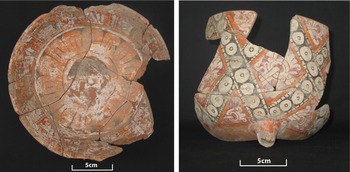
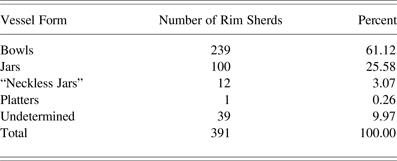
Before moving on to design motifs themselves, a few words on the formal characteristics of the Tututepec polychrome sample. Vessel form was recorded for all rim sherds large enough for form to be inferred. The assemblage is dominated by open bowls, or cajetes, and composite silhouette jars, or ollas, both of which functioned as drinking vessels (Figure 2, Figure 3a–b, Table 1). As demonstrated by Lind (Reference Lind, Nicholson and Keber1994:87), this is a pattern that is also common in the Mixtec highlands and is distinct from polychromes of Cholula. Far less frequent are very shallow bowls with everted rims that Lind dubs “platters” (Figure 3c) and globular forms with restricted orifices, here termed “neck-less jars” (Figure 3d), the latter of which are not observed in other studies of Mixteca-Puebla polychromes, and may present a regional variation particular to the Oaxaca coast. Another feature distinctive of the Tututepec assemblage is the preponderance of blue paint, found on 49.87 percent of all rim sherds in the sample, while present on just 1.67 percent of vessels from the Mixteca Alta studied by Lind (Reference Lind1987:15). Presence of blue paint is not noted in studies of polychromes from Cholula (Hernández Reference Hernández Sánchez2005; McCafferty Reference McCafferty2001). The blue paint seen in the Tututepec polychromes is distinct from “Maya blue,” and exhibits a sheen from a mineral, perhaps graphite, as suggested by Winter (Reference Winter1989:82) and O'Mack (Reference O'Mack1990:31).
Reconstructed polychrome bowl (left) and jar (right) from the Tututepec ceramic assemblage. Photographs by the author.

Polychrome vessel forms from Tututepec, including (a) bowls, (b) jars, (c) platters, and (d) “neckless jars.” Line drawings by the author.

Vessel Form Frequencies for Tututepec Polychromes

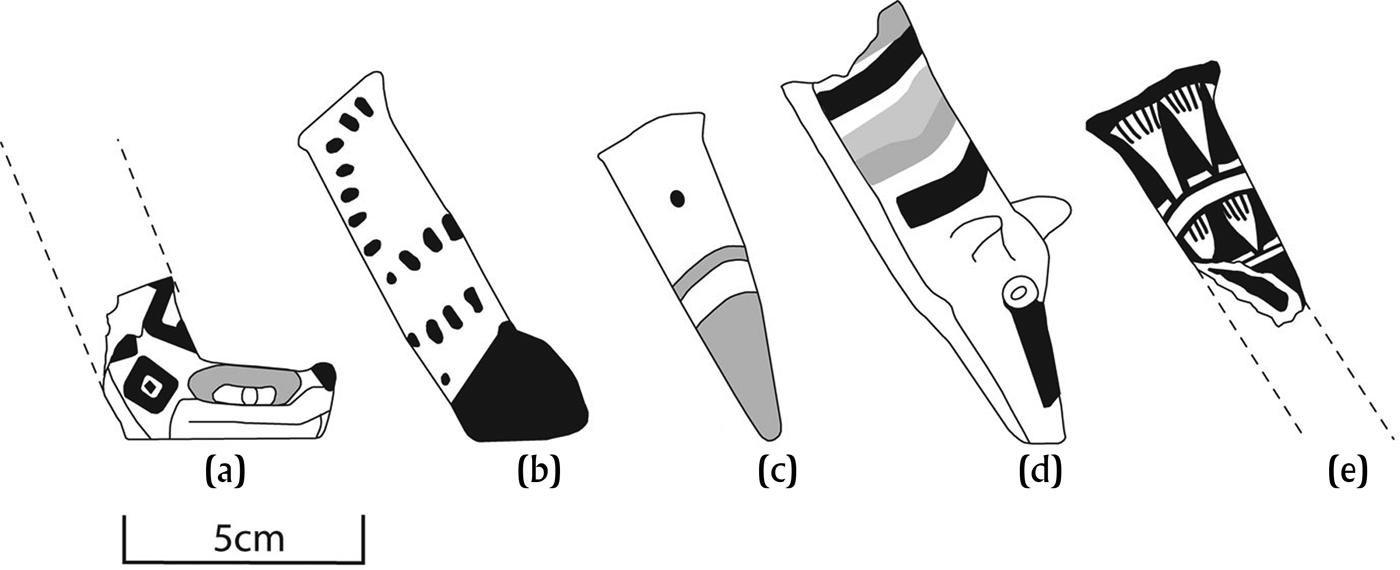
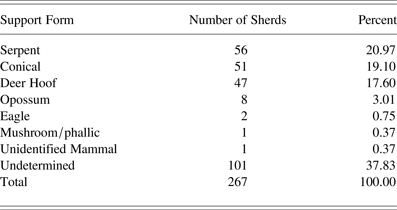
Lastly, virtually all vessels likely had tripod supports (Figure 4). The ceramic sample included 267 support fragments, accounting for 14.88 percent of the total assemblage. When identifiable, these are most frequently zoomorphic in form, though simple conical supports (Figure 4c) are also common (Table 2). Frequencies largely resemble the pattern seen in the Mixteca Alta, as nearly all support forms identified at Tututepec are found only in Oaxaca and not in Puebla, according to Lind's (Reference Lind, Nicholson and Keber1994:92) comparative study of polychromes from the two regions. Curiously, the lone exception to this is the opossum head form (Figure 4d), which is seen in nearly 5 percent of identifiable support fragments at Tututepec. In Lind's study, opossum head supports are seen in 50 percent of vessels from Cholula, and not at all present in the Mixteca. Seler (Reference Seler, Thompson and Richardson1990:vol. 5, p. 194) notes that ceramic opossum supports are also found in Michoacán. Though the Tututepec examples are not identical to those seen in Cholula and Michoacán, presence of this opossum form may suggest an interregional influence from beyond the Mixteca Alta.
Forms of tripod supports from the Tututepec polychrome assemblage, including a) serpents, b) deer hooves, c) conical support, d) opossums and e) eagles. Line drawings by the author.

Support Form Frequencies for Tututepec Polychromes
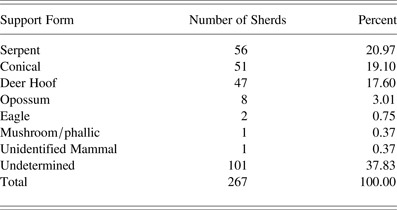
Of the zoomorphic forms, those representing rattlesnakes and deer hooves (Figure 4a–b) are by far the most common. Specific significance of the deer is somewhat difficult to infer for the Postclassic Mixteca, though as Lind (Reference Lind, Nicholson and Keber1994:92) points out, both the codices and an Early Colonial account from the region make reference to a creator couple, each of which was named One Deer. At the same time, in the codices Borgia (Anders et al. Reference Anders, Jansen and García1993), Tudela (Batalla Reference Batalla2002), and Vaticanus B (Anders and Jansen Reference Anders and Jansen1993), deer imagery is associated with the structuring of the day signs of the ritual calendar (Boone Reference Boone2007). Thus the motif may connote notions of creation as well as the structure of time. Serpents in general, and rattlesnakes in particular, were powerful images often associated with rain and fertility. A striking representation is found in the Codex Vaticanus B (Anders and Jansen Reference Anders and Jansen1993:44), in which a Tlaloc figure clutches a rattlesnake and looks upward to a band of clouds and water pours from the sky (Figure 5). This association is still seen at times in Mixtec worldview today, as ethnographer Monaghan (Reference Monaghan1995:105–106) describes beliefs among the people of Santiago Nuyoo in koo savi, or “rain serpents,” that fly through the air and manifest themselves as powerful storms. Less frequent are opossum, eagle, and mushroom supports, which also had important cosmological associations. Thus these vessels were often held up by powerful images tied up with ritual and ideological concerns. Similar images were painted over their surfaces, to which we now turn.
Tlaloc clutching a serpent beneath a band of rain clouds. Line drawing by the author after Anders and Jansen Reference Anders and Jansen1993:44.

DESIGN MOTIFS
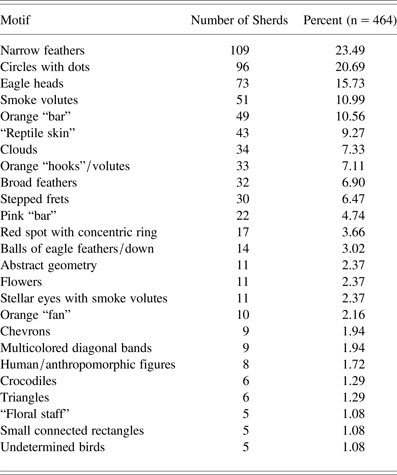
Apart from supports, 464 sherds exhibited one or more identifiable design motifs (Table 3). Due to spatial constraints, here I review only the most frequent motifs for which something substantive can be said about their possible significances (Figure 6). Omitted from discussion are motifs whose identifications remain rather nebulous. More exhaustive treatment can be found in Forde (Reference Forde2006:90–141). Table 3 summarizes frequencies for all motifs that occur at least five times within the ceramic sample.
Common design motifs in the Tututepec polychrome assemblage, including a) narrow feathers, b) eagle heads, c) smoke volutes, d) clouds, e) broad feathers, f) stepped frets, g) balls of feathers, h) stellar eyes with volutes, i) flowers, and j) chevrons. Line drawings by the author.

Frequencies of Most Common Motifs from the Tututepec Polychrome Sample

Narrow Feathers
The most frequently occurring motifs in the sample are what I have termed “narrow feathers” (distinct from “broad feathers,” discussed later) (Figure 6a). These distinct icons are typically bundled together in groups of three or four, alternating between pink and blue in color, one of them normally “curling” into a volute at the end. These groups then typically repeat several times around a given vessel, co-occurring with the unidentified motifs termed “orange bars.” Images very similar to the feathers seen here are found in the Mixtec codices, including the Vienna (Anders et al. Reference Anders, Jansen and Jiménez1992), Colombino Becker (Caso and Smith Reference Caso and Smith1966), and Nuttall (Nuttall Reference Nuttall1975), typically adorning the headdresses of important personages and deities, but also other objects such as toponyms and even rubber balls (Figure 7). Brightly colored feathers of tropical birds are widely understood to have been rare materials of great value in pre-Hispanic Mesoamerica, and would have connoted notions of prestige and preciousness for the persons and objects that such feathers adorned (Sahagún Reference Sahagún, Anderson and Dibble1959:bk. 11; Hernández Reference Hernández Sánchez2005:75). In the Tututepec ceramics we do not find narrow feathers affixed to any particular persons or objects, instead simply adorning the vessels themselves. I interpret this as possibly conferring prestige and preciousness not only upon the ceramics, but perhaps also their contents and the acts of ritual drinking for which they were used, and by further extension, the vessels’ users.
Depictions of narrow feathers seen on headdresses (left), and toponyms and rubber balls (right) from the Codex Vienna. Line drawings by the author after Anders et al. Reference Anders, Jansen and Jiménez1992:41, 50.

Eagle Heads
Also very frequent, occurring on 15.7 percent of sherds with identifiable motifs, are eagle heads (Figure 6b). These icons are always depicted with crests of pointed white feathers, striped with blue. The use of blue is curious here, as in the Mixtec and central Mexican codices these stripes are normally black, evoking central Mexican myths in which both the eagle and the jaguar were believed to have followed the gods into a great fire in order to give rise to the sun and moon, the scorching fire thus producing the black spots on the jaguar and the stripes on the eagle (Seler Reference Seler, Thompson and Richardson1990:vol. 5, p. 241). Given that, apart from the blue color, the images seen in the Tututepec iconography are virtually identical to representations of eagles seen elsewhere, I argue that blue was used here as a substitute for black/grey, rather than to represent a different type of bird.
Along with jaguars, eagles were seen as especially brave animals and came to be patrons of warrior guilds in Postclassic central Mexico, figuring prominently in ideals related to warfare and sacrifice. This appears to be the case for the Mixtec as well, perhaps best encapsulated in a scene from the Codex Selden (Caso Reference Caso1964:12; see Figure 8). In it, we see an individual identified as Lord 9 House capturing an enemy named Lord 13 Deer, and extracting his heart over a sacrificial stone. Immediately above, we then see an eagle, along with a yahui priest, transporting hearts to the sky and feeding them to a solar deity that emerges from a celestial band. As such, we see the eagle here as a primary intermediary, in which warfare and sacrifice function to sustain the cosmos. Thus, in the ceramics, eagles likely connoted both militaristic themes, as well as broader views regarding the cosmological importance of sacrifice.
Heart of sacrificial victim transported to the solar deity by an eagle in Codex Selden. Line drawing by the author after Caso Reference Caso1964:12.

Smoke Volutes
These simple volute motifs are also very common, normally occurring in pairs, one atop the other, extending upward with respect to the ceramic vessel, the straight portions colored blue and the curled portions colored white (Figure 6c). Similar motifs have been identified as smoke by Lind (Reference Lind, Nicholson and Keber1994:94) and Hernández (Reference Hernández Sánchez2005:64). While volutes are employed to depict a variety of things in Postclassic iconography, I argue that smoke is the most plausible identification here, given that these motifs are depicted as ostensibly “rising,” and as argued above, that blue appears to at times have been used as a substitute for grey/black. The burning of offerings and creation of smoke was an important act of sacrifice for Postclassic Mixtecs. Similar volutes are seen in the codices wafting from incense burners at various shrines, and ethnohistoric information similarly suggests the creation of smoke as highly important in Mixtec ritual (Spores Reference Spores1984:88; Terraciano Reference Terraciano2001:271).
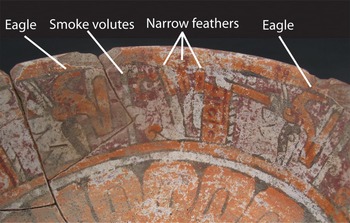
Before moving on to other motifs, it is important to note that narrow feathers, eagle heads, and smoke volutes are most often seen depicted together and repeating around various vessels, perhaps in part accounting for their high occurrences within the sample (Figure 9). This pattern also suggests that themes of prestige, militarism, and sacrifice, were bound together and their associations reinforced through the bundling of these different icons.
Repeating eagle, smoke volute, and narrow feather motifs along the interior wall of a bowl from the Tututepec polychrome assemblage. Photograph by the author.

Clouds
These icons, typically seen repeating around the exteriors of cajetes or the necks of ollas, have been identified by Lind (Reference Lind, Nicholson and Keber1994:95) as “flower glyphs,” but here I favor Hernández's (Reference Hernández Sánchez2005:78) identification of such images as clouds (Figure 6d). Most similar images can be found, as Hernández points out, in central Mexican codices, particularly in the scene from the Vaticanus B described earlier in reference to serpent imagery, in which Tlaloc brings rain from a band of clouds in the sky (Figure 5). The Oaxaca coast was known to Mixtecs of the Early Colonial period as Ñundehui, or “land of the sky” (Joyce et al. Reference Joyce, Workinger, Hamann, Kroefges, Oland and King2004:274; Smith Reference Smith1973:97), and, not unlike other Mesoamerican groups, Mixtecs viewed sky and rain as essential in sustaining agricultural fertility, and hence life itself. Such fertility was contingent upon sacrifice—via the maintenance of sacred covenants with the earth (Monaghan Reference Monaghan1990,Reference Monaghan1995). Icons depicting clouds thus likely connoted aspects of this worldview.
Broad Feathers
Distinct from the narrow feathers described above, these motifs are common in Mixteca-Puebla polychromes have been identified as feathers by both Lind (Reference Lind, Nicholson and Keber1994:94) and Hernández (Reference Hernández Sánchez2005:75) (Figure 6e). They are characterized by oblong half-oval shapes with quills depicted in their centers, and are typically found repeating side by side on a given vessel. Colors are variable—most often solid colors of orange, red, and pink; but occasionally striped with black, likely representing eagle feathers in the latter case. Similarly to narrow feathers, these motifs most often likely connoted notions of wealth, preciousness, and prestige.
Stepped Frets (or grecas, or xicalcoliuquis)
This motif, an abstract geometric symbol, is widely distributed and known throughout Mesoamerica, from Formative through Postclassic periods (Beyer Reference Beyer1965:53) seen in ceramics, architecture, and other media (Figure 6f). It has received considerable attention from scholars (e.g., Beyer Reference Beyer1965; Zahller Reference Zahller1977), and while a number of theories regarding its significance have been proposed over the years (see review in Zahller Reference Zahller1977), a specific meaning of this symbol remains elusive. Caso and colleagues (Reference Caso, Bernal and Acosta1967) as well as Brzezinski (Reference Brzezinski2011:94) associate it with lightning for Classic period iconography of Oaxaca. Meanwhile, Markens (Reference Markens2013:78), in a thorough analysis, associates stepped frets primarily with water, sacred mountains, and serpents, arguing that they are polysemic signs. Given that water and serpents may be difficult to uncouple from clouds and lightning, it is possible that both these proposals have merit. While acknowledging a degree of ambiguity here, I agree with Hernández (Reference Hernández Sánchez2005:85) in tentatively interpreting these motifs as at least connoting general ideas surrounding prestige, given that they also adorn elite palaces at Postclassic Oaxacan centers such as Mitla and Teposcolula, but such prestige was likely bound up with the sacred concepts outlined by Markens (Reference Markens2013:79).
Balls of Eagle Feathers/Down
These icons appear frequently in the Mixtec and Borgia group codices, and both Lind (Reference Lind, Nicholson and Keber1994:94) and Hernández (Reference Hernández Sánchez2005:71) report them occurring in polychrome ceramics from other regions. In the Tututepec sample, these balls of feathers are invariably striped with blue, indicating they are eagle feathers, thus perhaps connoting militaristic themes (Figure 6g). Indeed, in her study, Hernández notes that these motifs are most often found with other icons related to warfare as well (Reference Hernández Sánchez2005:75). This is not so clear in the Tututepec example, however, and in the codices we also see this motif adorning headdresses and ritual objects such as sticks used to create fires. Meanwhile, for the Nahuas of central Mexico, Dupey García (Reference Dupey García2010:388–405) points out that feather down formed an important part of the bodily adornment of deities associated with the sky, as well as warriors who died in battle and women who died in childbirth, the latter of whom were destined to enter the celestial realm upon their deaths. Hence, balls of feather down may have connoted both celestial and martial themes.
Stellar Eyes with Volutes
“Stellar eyes” are widely known to codex scholars, depicted as bisected circles with additional half-circles in their centers, at times used to represent they eyes of persons, deities, and animals, as well as stars of the night sky (Figure 6h). The motifs seen in the Tututepec ceramics normally have two volutes extending from the tops of these icons, a pattern seen in the Mixtec codices as well, particularly in sky bands, such as in the Codex Nuttall (Nuttall Reference Nuttall1975:75). In the latter example, the motif repeats, alternating with representations of Venus. The reason the volutes are added is unclear, but this motif likely refers to the night sky, connoting the sacredness of the celestial realm.
Flowers
Icons of flowers are highly abundant in Mesoamerican iconography, the Postclassic Mixteca-Puebla corpus being no exception (Figure 6i). Flowers were valued for both their appearance and odors, and used to adorn a whole host of media in a variety of festivals and rituals (Sahagún Reference Sahagún, Anderson and Dibble1959:bk. 11). Scholars have argued cogently that flowers can be associated with an upper realm of the universe in Mesoamerican cosmology, a home of sacred warriors, at times related specifically to the sun (Alcántara Reference Alcántara Rojas, Wolf and Conners2012; Brumfiel Reference Brumfiel, Hendon and Joyce2004; Burkhart Reference Burkhart1992; Peterson Reference Peterson1993; Vega SosaReference Vega Sosa1984). As such, flowers connoted the sacred realm and at times tied this to themes of militarism and sacrifice.
Chevrons
These abstract symbols are widely understood to represent warfare in the Mixtec codices, most commonly in the form of “war paths” that depict direction of movement when two persons or polities go to war (Figure 6j). Chevrons are occasionally divorced from this context however, and adorn the clothing of persons particularly successful in warfare, most famously, Lady 6 Monkey in the Mixtec manuscripts. Chevrons are occasionally found repeating on Tututepec polychromes in similar fashion and thus also likely connoted militaristic themes.
DESIGN MOTIFS: SUMMARY
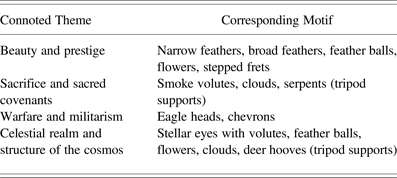
In reviewing the most frequently occurring motifs in the ceramic assemblage, some recurring themes emerge, as I attempt to summarize in Table 4. Images associated with beauty and prestige, such as feathers, are common, as are motifs associated with warfare, most notably eagle heads. We also see images associated with sacrifice and sacred covenants, including smoke volutes, clouds, and serpents (typically in the form of vessel supports). Further, we find a number of motifs related to the celestial realm and the structure of the cosmos, such as the aforementioned clouds as well as stellar eyes and flowers. These concepts, bundled together through motifs painted on ceramics, were closely related in Mesoamerican worldview. Sacrifice was necessary in order to ensure fertility, sustenance, and the proper functioning of the cosmic order. Warfare was a principal means through which this was achieved—not only were persons captured for purposes of sacrifice in battle, but participation in warfare for a conquering polity such as Tututepec was a form of tribute and sacrifice itself. Further, prestige was conferred upon the persons who performed such acts.
Summary of Ideological Themes in Tututepec Polychrome Iconography

On the whole, the repeated co-occurrence of these specific motifs and themes at Tututepec stands out as a pattern distinct from that observed in the polychrome ceramics of Cholula and other regions of Oaxaca, where Hernández (Reference Hernández Sánchez2008, Reference Hernández Sánchez2010) has identified different suites of designs and points of ideological emphasis as being more prevalent. The particular iconographic themes common at Tututepec, taken together, suggest aspects of an ideology quite compatible with that of a conquest empire. On the ceramics used in rituals by commoners here, we see themes of sacrifice and warfare bound up with notions of cosmological order and prestige, ideals that likely could have encouraged participation in the state's imperial program. So were these materials then a form of elite-distributed propaganda, or were commoners otherwise ideologically “duped” into compliance with the state? In the following section, I argue there is considerable evidence to suggest that this was not the case.
DISCUSSION
Both archaeological and ethnohistorical data strongly indicate that commoners of Tututepec principally acquired polychrome ceramics via market exchange. Instrumental Neutron Activation Analysis (INAA) and petrographic analysis of the materials demonstrate that polychrome pottery at Tututepec was composed from several different clay sources, likely from within the lower Rio Verde region, suggesting multiple local producers (Levine Reference Levine2007:379–385; Levine et al. Reference Levine, Fargher, Cecil and Forde2015). This pattern is consistent with analyses of Postclassic polychromes carried out elsewhere (e.g., Neff et al. Reference Neff, Bishop, Sisson, Glascock, Sisson, Nicholson and Keber1994; Nichols Reference Nichols, Hendon and Joyce2004). Ethnohistorical data further suggest that market exchange was common throughout the Mixtec region (Spores Reference Spores1984; Pohl et al. Reference Pohl, Monaghan, Stiver, Smithers and Sosa1997; Terraciano Reference Terraciano2001), and specifically at Tututepec (Cortés Reference Cortés1986:276; Woensdregt Reference Woensdregt1996), during both the Late Postclassic and Early Colonial periods. As such, it is quite probable that commoners had a diverse array of polychrome ceramics available to them at markets, and thus a considerable degree of choice in selecting vessels that they found most attractive. Concomitantly, producers likely would have in part selected the motifs with which they decorated the vessels in accord with what they anticipated being most appealing to their clientele.
It is clear in certain cases within the Mixtec region generally that polychrome ceramic vessels were designed as “narrative pottery,” whose painted scenes functioned similarly to the codices in aggrandizing elite genealogies (Pohl Reference Pohl2007a:41). A striking feature of the materials from the Tututepec sample is that we see virtually no evidence of this phenomenon. For the limited depictions of anthropomorphic figures found in the sample, none bear calendrical names or other distinguishing features that might allow for their identification as specific individuals, for example. Indeed, in semiotic terms, meanings of the icons and symbols depicted on the Tututepec ceramics are largely unconstrained, in that we see no elements of anchorage or relay deployed that might allow them to be subjected to narrowly specific “readings.” At the same time, because they were largely iconic, rather than arbitrary symbols, they could not simply be interpreted in any way one chose. Meanings for these icons, while clearly constrained to a degree, would have inevitably been connoted rather than denoted, evoking general concepts and aspects of worldview via broader associations persons had with such signifiers and their referents. While codices were relatively esoteric media that, according to ethnohistorical sources, children of Mixtec nobles were trained to interpret beginning at a rather young age (Burgoa Reference Burgoa1934:288), the Tututepec polychromes were much more widely accessible medium that evoked basic and central elements of ideology and cosmology.
This accessibility likely in part explains the appeal such goods held for Tututepec commoners. They were able to choose those vessels decorated with images that they most closely identified with, or which resonated most strongly with their own worldviews. Such worldviews were continuously produced and reproduced, these ideas reinforced, within the “figured worlds” of domestic feasting and ritual events. Persons would have constantly been confronted with images evoking these ideas as they sipped chocolate or pulque from bowls and jars during marriage celebrations, religious observances, life cycle rituals, and other events. Recent focus in Mesoamerican archaeology on this phenomenon has shown these kinds of social contexts to be of critical importance in understanding both belief systems and power relations of the past (e.g., Blackmore Reference Blackmore2011; Brumfiel Reference Brumfiel, Hendon and Joyce2004, Reference Brumfiel2011; Gonlin and Lohse Reference Gonlin and Lohse2007; Joyce and Weller Reference Joyce, Weller, Gonlin and Lohse2007; Lohse and Valdez Reference Lohse and Valdez2004; Plunket Reference Plunket2002). As McAnany (Reference McAnany and Plunket2002:119) states, “the so-called popular religion of domestic ritual often coexists, either in cooperation or conflict, with institutionalized religions that serve the interest of the state, resulting in multiple ideologies.” Further, as we compare and contrast these ideologies, we stand to learn a great deal regarding the reach of state power, or lack thereof.
Elites at Tututepec had little control over domestic rituals carried out in commoner households and they had little control over the ceramics used in these rituals. Nevertheless, as argued above, I believe the iconography of the materials presented here evidences a concordance between commoner and state ideologies. The themes emphasized on the pottery used in domestic rituals intertwined notions of warfare, sacrifice, prestige, and cosmological order. Why should this be the case? As Levine (Reference Levine2011:35) argues, commoners likely experienced material benefits from Tututepec's imperial program, as it heightened their participation in market exchange and provided greater access to goods acquired via long-distance trade, such as obsidian and copper. As such, they appear to have experienced a level of affluence atypical of commoners of other contemporary polities. Further, engaged in this manner, persons may have seen the prestige garnered by the empire through conquest as reflecting upon themselves as individuals or families as well, by way of their participation. Lastly, a more speculative point that I would like to raise is that ruling elites may have crafted ideological discourse in part such that it was likely to resonate with the beliefs and concerns of the broader populace. While the themes connoted by the polychrome iconography articulate with a ruling ideology of a conquest empire, they connect more closely with general aspects of Mesoamerican belief and cosmology that were likely held by peoples of Oaxaca and beyond well before the formation of the Tututepec polity (A. Joyce Reference Joyce, Dobres and Robb2000, Reference Joyce2010). Elites may have intended for the ideals they promoted to appeal these long-held and broadly-shared sensibilities.
Despite relatively recent attention to concepts of agency in Mesoamerican archaeology (e.g., Brumfiel Reference Brumfiel and Wright1996; Cowgill Reference Cowgill, Dobres and Robb2000; Hutson Reference Hutson2002; A. Joyce Reference Joyce, Dobres and Robb2000; Joyce et al. Reference Joyce, Bustamante and Levine2001; Joyce and Lopiparo Reference Joyce and Lopiparo2005; Sheets Reference Sheets2000) we still frequently tend envision dominant ideologies and statecraft as being driven by elites, with commoners merely being “along for the ride,” or, conversely, resistant to state ideologies. An unfortunate consequence of such a tendency to frame power relations in the dichotomous terms of domination and resistance is that it casts critical attention away from how and why state ideologies become successful, and the roles commoners play in such processes (Forde Reference Forde2006:165; Levine Reference Levine2011:23). Fortunately this trend is abetting, as Mesoamerican scholars increasingly problematize the means by which all members of society play roles in the construction of dominant ideologies, even if such ideologies are only successful for limited amounts of time (e.g., Ashmore et al. Reference Ashmore, Yeager, Robin, Demarest, Rice and Rice2004; Brumfiel Reference Brumfiel2011; Clark Reference Clark, Hendon and Joyce2004; Joyce Reference Joyce and Blomster2008; Ringle Reference Ringle, Grove and Joyce1999). Through this study, I have sought to contribute to these discussions in examining how Mixteca-Puebla symbols and icons circulated through social discourse, in elite media such as codices, and on the ceramic vessels used by Tututepec commoners within the relatively intimate confines of domestic ritual. In finding an articulation of salient themes in both elite and commoner ideologies, I argue that it is far more plausible to hypothesize that such a state of affairs arose, not through passive commoner acceptance, but through continuous social negotiation and dialogue; in part a semiotic process, in which polychrome ceramics played a role.
CONCLUSION
The goals of this article have been threefold. The first has simply been to provide more data on Mixteca-Puebla polychrome ceramics, expanding the known corpus of these materials. In particular, because the data here come from a region that has not been well studied until relatively recently, and from archaeological contexts that are well controlled for both spatially and chronologically, this study will hopefully contribute to interregional comparisons of Mixteca-Puebla polychromes in the future. Second, in building upon the important work of previous scholars working with these types of materials, I have sought to introduce some operational concepts from semiotic theory that potentially allow us to further probe the meanings of Mixteca-Puebla iconography, and how such meanings are produced in different contexts. Lastly, in situating these meanings within the contexts of commoner ritual at Tututepec, I have aimed to shed light on how these data can contribute to understandings of ideology and power relationships at the site. The arguments presented here must be considered provisional given that they are based upon a dataset that is relatively small, coming from only two commoner households near the center of Tututepec. Particularly for a large multiethnic empire, our current understandings undoubtedly do not capture the diversity of commoner life throughout the site and other territories controlled by the polity. Future research will be necessary to evaluate and expand upon many of the ideas posed here. I hope, however, to have presented some avenues through which we might interrogate iconographic data from controlled archaeological contexts to address anthropological questions regarding social dynamics and state power. Ruling elites at Tututepec did not have significant control over the production of polychrome ceramics, over the consumption of these ceramics by commoners in market exchange, or over the spheres of the domestic rituals in which they were used. Nevertheless, the data suggest that the salient themes of ideology expressed in this pottery were compatible with those of the Tututepec state. I argue that this is suggestive of an inclusive ideology that crosscut social status which may have helped facilitate the participation of commoners in state projects, contributing to the success of the empire. As such, various commoners would not have necessarily been coerced or duped in participating in the imperial program of the Tututepec, but instead were actively engaged and invested in that success.
RESUMEN
En este artículo, presento el análisis de cerámicas policromadas de estilo códice extraídas de las excavaciones de dos casas plebeyas del posclásico tardío en Tututepec (Yucu Dzaa), Oaxaca, México. Tututepec era la capital de un imperio territorial poderoso que se extendía a lo largo de la costa de Oaxaca durante el postclásico. Comienzo el artículo con una síntesis, en términos generales, del sitio arqueológico de Tututepec como también de estudios de la cerámica policromada de estilo Mixteca-Puebla. Después, resumo algunos conceptos básicos de teoría semiótica que van a ser centrales para mi investigación de las imágenes que aparecen en la cerámica, como también para las inferencias acerca de los temas sobresalientes que estas expresan. En este análisis, describo el contexto y las características formales de esta colección de cerámica, examino los motivos que aparecen más frecuentemente y finalmente como estos se relacionan con aspectos más amplios de la ideología de Tututepec. Los temas más sobresalientes en esta cerámica se relacionan con la guerra, el sacrificio, el prestigio y la estructura del cosmos; ideales que muy posiblemente hubiesen sido promovidos por los elites de Tututepec en apoyo de sus ambiciones imperiales. No quiero sugerir que esto era propaganda, ya que los elites seguramente no tenían mucho control sobre la producción y el consumo de cerámicas policromadas usadas por los plebeyos. Más bien, propongo que la articulación entre los idea populares de los plebeyos y los ideales fomentados por las elites surgió a través de un proceso social dialógico, no a través de coerción o una falsa conciencia. Una ideología así de inclusiva, pudo haber estimulado la participación de plebeyos en proyectos del estado de Tututepec e incrementado la inversión de los éstos en el éxito de tales proyectos. Como tal, la ideología inclusiva evidenciada en la cerámica policromada habría contribuido al éxito del imperio.
ACKNOWLEDGEMENTS
Financial support for this research was provided by the Graduate School of University of Colorado (Beverly Sears Grant) and University of Colorado's Museum of Natural History (Walker Van Ryper Award). I am greatly indebted to Marc Levine for inviting me to participate in the Tututepec Archaeological Project and carry out this study. This paper was much improved by feedback from Arthur Joyce, Marc Levine, Alejandra Rojas, Franco Rossi, and an anonymous reviewer. Any errors are solely my own. Preparation of the manuscript was aided by a junior fellowship at Dumbarton Oaks Research Library and Collection.