INTRODUCTION
No one disputes in the field of second language (L2) acquisition that individual learner factors can explain the variability of L2 performance and outcomes. Dörnyei (Reference Dörnyei2006) characterized individual differences (IDs) as “dimensions of enduring personal characteristics that are assumed to apply to everybody and on which people differ by degree” (p. 42). Adopting an information-processing approach to additional language learning, we endorse the claim that an interaction of internal (e.g., motivation) and external (e.g., quantity of input) factors can account for variation in adult L2 acquisition (e.g., Sanz, Reference Sanz and Sanz2005). That is, L2 learners’ IDs (internal factors) largely contribute to the variability that is often observed in adult L2 outcomes (e.g., Dörnyei, Reference Dörnyei2006; Gass & Mackey, Reference Gass and Mackey2012). In this study, we extend this theoretical framework to examine a population of heritage language (HL) learners who have opted to (re)learn their family/community language in an instructed setting. While this theoretical claim concerns adult L2 learners, due to the infancy of the HL field, it has traditionally adopted theoretical frameworks from sister fields in language science and applied studies (Montrul, Reference Montrul2016).
With regards to HL speakers’ linguistic knowledge, cross-linguistic studies have demonstrated that HL speakers’ linguistic knowledge is different to certain degrees vis-à-vis monolingual native speakers; further, this is also contingent on the linguistic domain, with morphosyntax being one of the most vulnerable areas in comparison to other domains like phonology (Benmamoun, Montrul, & Polinsky, Reference Benmamoun, Montrul and Polinsky2013; Montrul, Reference Montrul2016). Importantly, though, HL speakers’ linguistic knowledge is not uniform among and within individuals to the same extent as their monolingual native peers. Researchers concur that HL bilinguals exhibit a wide range of proficiency levels and variable knowledge of the HL, which can range from receptive to monolingual nativelike abilities (e.g., Benmamoun et al., Reference Benmamoun, Montrul and Polinsky2013; Putnam & Sánchez, Reference Putnam and Sánchez2013; Rothman, Tsimpli, & Pascual y Cabo, 2016; Silva-Corvalán, Reference Silva-Corvalán1994; Zyzik, Reference Zyzik, Fairclough and Beaudrie2016). Evidence also exists that HL speakers’ knowledge of the HL is seemingly modulated by the explicitness and the modality of the experimental task (e.g., Bowles, Reference Bowles2011; Montrul, Davidson, de la Fuente, & Foote, 2014), with these findings implying that more explicit and written experimental tasks pose a greater level of difficulty for HL speakers. That is, HL speakers can access more easily their linguistic knowledge in experimental tasks that are less explicit and oral. This observation is most likely linked to HL speakers’ prior language experience, which entails being exposed to more aural input in a naturalistic bilingual environment at an early age (Montrul, Reference Montrul2008; Sanz & Torres, Reference Sanz, Torres, Malovrh and Benati2018). As such, these arguments and findings support the observation that “the outcome of heritage language acquisition is variable” (Montrul, Reference Montrul2016, p. 150). Therefore, as Montrul (Reference Montrul2008) has previously argued, adult L2 and HL acquisition are both characterized by variable learning outcomes.
To account for variable outcomes in HL acquisition, scholars have also proposed that internal and external factors seemingly determine linguistic attainment among HL bilingual children and adults (e.g., Montrul, Reference Montrul2016; Silva-Corvalán, Reference Silva-Corvalán2014). Some research efforts have been devoted to examining IDs along the lines of psychosocial variables such as motivation (e.g., Ducar, Reference Ducar, Beaudrie and Fairclough2012) and language attitudes (e.g., Allard & Landry, Reference Allard, Landry and Fase1992). But, furthermore, biographical variables such as generation (e.g., Rivera-Mills, Reference Rivera-Mills, Beaudrie and Fairclough2012) and years of formal study in the HL (e.g., Swender, Martin, Rivera-Martínez, & Kagan, Reference Swender, Martin, Rivera-Martínez and Kagan2014) have also been examined in the field. Biographical factors can be related to external variables, as they are indicative of amount of exposure to the HL, which can have an impact on HL speakers’ linguistic attainment (Montrul, Reference Montrul2016). However, these studies have examined psychosocial and biographical factors in isolation and they have only reported on their potential correlation with learning outcomes. As such, we first must understand better which IDs and biographical variables play a more substantive role in learning outcomes, which requires testing these variables together. Second, examining only correlations between IDs and learning outcomes is problematic for theory development, as we ought to be able to make predictions of what learning outcomes we will find when considering different internal and external variables. To advance the theoretical claim that internal and external variables can serve as explanatory factors to the variability observed in HL outcomes, we need empirical evidence to elucidate on the predictive nature of IDs and biographical factors on HL speakers’ linguistic attainment.
Therefore, to address these issues, the current study seeks to provide empirical evidence on the contributions of IDs and biographical factors to HL learners’ knowledge of the HL. Specifically, we examined how three psychosocial variables (motivation, willingness to communicate [WTC], and language attitudes) and four biographical factors (simultaneous/sequential bilingual status, generation, frequency of language use, and years of formal study) predicted HL learners’ access and display of linguistic knowledge through experimental tasks. These experimental tasks were manipulated for explicitness and modality (i.e., oral vs. written), as measured by a spoken elicited imitation task (EIT) and a written untimed grammaticality judgment task (UGJT).
BACKGROUND
MEASURING LINGUISTIC KNOWLEDGE
Understanding the dynamics involved in the attainment of linguistic knowledge has led to research efforts to design valid tests that provide distinct measurements of L2 learners’ implicit and explicit knowledge (e.g., Bowles, Reference Bowles2011; Ellis, Reference Ellis2005; Gutiérrez, Reference Gutiérrez2013; Suzuki & DeKeyser, Reference Suzuki and DeKeyser2015; Vafaee, Suzuki, & Kachisnke, Reference Vafaee, Suzuki and Kachisnke2017). Implicit knowledge is characterized as the ability to produce learned language without an awareness of the rules that govern the use of such language; whereas, explicit knowledge indicates that learners are aware and can verbalize the rules of target language forms (Ellis, Reference Ellis2005). Importantly, implicit and explicit knowledge ought to be viewed as a continuum; that is, learners access both types of knowledge during performance on linguistic tasks (DeKeyser, Reference Dörnyei, Dörnyei and Ushioda2009).
Ellis (Reference Ellis2005) first reported that EITs can be used as a measurement of implicit knowledge and UGJTs for explicit knowledge. Further, grammatical and ungrammatical items in these tasks can potentially tap into participants’ more or less explicit knowledge (Ellis, Reference Ellis2005; Gutiérrez, Reference Gutiérrez2013). For EITs, participants are instructed to listen to sentences, and first determine whether they agree with the statements. The goal of this first part is to direct participants’ attention to the meaning of the sentence so that they are not focused on form and, thereby, do not have time to monitor carefully the accuracy of the statement. Then, participants repeat the sentences correctly, whether that involves repeating grammatical sentences without changing them or reconstructing ungrammatical sentences in a more targeted way. To ensure that learners are indeed reconstructing ungrammatical sentences and not merely repeating sentences, researchers have tested the relationship between participants’ scores on grammatical and ungrammatical items (e.g., Erlam, Reference Erlam2006). A correlation between grammatical and ungrammatical items indicates that learners were relying on linguistic knowledge to accept grammatical items and reconstruct ungrammatical sentences; conversely, no correlation signals that participants mostly used short-term memory to repeat both grammatical and ungrammatical items. More recently, though, Suzuki and DeKeyser (Reference Suzuki and DeKeyser2015) found that a word-monitoring task was a more valid measure of implicit knowledge, and that their EIT tapped more into automatized explicit knowledge.
Unlike the EIT, according to Ellis (Reference Ellis2005), the UGJT allows time for participants to access their metalinguistic knowledge to correct ungrammatical sentences. As such, participants are exhibiting more explicit knowledge of the language. More recently, Vafaee and colleagues (2017) showed that ungrammatical items of timed and untimed GJTs tapped into explicit knowledge, but grammatical items from both tests did not load onto implicit knowledge, albeit that the grammatical items correlated with each other. While more research is needed to replicate the preceding findings to shed light on these mixed results, these studies do imply that learners access their implicit and explicit knowledge to varying degrees during linguistic knowledge tests.
LINGUISTIC KNOWLEDGE AND HERITAGE SPEAKERS
Bowles (Reference Bowles2011) was the first study to test implicit and explicit linguistic knowledge with a group of heritage bilinguals. Given HL speakers’ prior language experience, Bowles predicted that her HL participants, who had less than two years of classroom Spanish instruction, ought to perform better on the tests designed to tap into implicit knowledge (timed GJT, oral EIT, and oral narrative test), whereas they should demonstrate suboptimal performance on the ones measuring explicit knowledge (untimed GJT and metalinguistic knowledge test) in comparison to the L2 learners. Indeed, her results indicated that HL learners scored higher on the tests measuring implicit knowledge while scoring lower on the untimed GJT and metalinguistic tests that tapped into explicit knowledge. The opposite was true for the L2 learners who scored higher on the tests intended to measure explicit knowledge. As such, these results indicated that these tests can also be useful tools in measuring HL learners’ linguistic knowledge.
Montrul and colleagues (2014) argued that previous studies confounded modality with explicit/implicit tasks and, thus, the researchers sought to minimize the impact of modality by using all aural tasks. This is in light of how previous findings have shown that HL speakers tend to demonstrate greater accuracy on oral or speaking experimental tasks than on written ones (Montrul, Foote, & Perpiñán, Reference Montrul, Foote and Perpiñán2008). The authors tested both HL and L2 learners’ knowledge of Spanish gender agreement of inanimate nouns. They administered three experimental tasks: a gender monitoring task (GMT), a word repetition task (WRT), and a GJT. The three experimental tasks were online spoken tasks (i.e., not written) that required auditory comprehension. Their findings indicated no differences in performance between the HL and L2 groups regarding the more explicit experimental tasks (GMT, GJT), whereas the HL participants showed an advantage over the L2 learners on the WRT designed to tap into implicit knowledge. These results indicate that, in addition to the explicitness of an experimental linguistic task, modality ought to be considered as well, given the differences in prior language experience of HL bilinguals.
INDIVIDUAL DIFFERENCES
Motivation
A number of theoretical approaches have made claims on the relationship between motivation and L2 learning (Dörnyei & Ryan, Reference Dörnyei and Ryan2015; Ushioda & Dörnyei, Reference Ushioda, Dörnyei, Gass and Mackey2012). A more recent approach to the study of L2 motivation is Dörnyei’s (Reference Dörnyei, Dörnyei and Ushioda2009) L2 motivational self-system model that is based on emerging theories in the field of motivational psychology. The premise of the model is centered around recent conceptualizations of self; that is, an interest “in the active, dynamic nature of the self-system, gradually replacing the traditionally static concept of self-representations with a self-system” (Dörnyei, Reference Dörnyei, Dörnyei and Ushioda2009, p.10). Inspired by this trend in psychology, Dörnyei created a L2 motivational model that consists of three key components—ideal L2 self, ought-to L2 self, and L2 learning experience. Ideal L2 self refers to learners’ desires and vision of themselves as L2 speakers in the future while ought-to L2 self is concerned with learners’ expectations associated with being a proficient L2 speaker. L2 learning experience captures learners’ current experiences with learning the L2 as it relates specifically to factors such as instructor and curriculum. The goal of the model is to capture learners’ desire to bridge the discrepancy between their current and future views of themselves as L2 speakers. As such, learners’ motivation to become more proficient in the L2 is predicated upon their desire to bridge the gap between current and future selves. Serafini (Reference Serafini2013) found empirical support for the model in that ideal L2 self accounted for 7% of the variance of her L2 Spanish participants’ performance on a test measuring implicit knowledge.
As of now, one study has investigated learners’ motivation for studying their HL using Dörnyei’s L2 motivational self-system. Kurata (Reference Kurata2015) gathered qualitative data through focus group discussions from seven Japanese HL learners residing in Australia. Overall, Kurata found that participants’ motivational selves fluctuated as a result of social experiences across different settings, which included Japanese-speaking communities in Australia and Japan and classroom environments. Participants perceived their ideal selves in association with developing literacy skills in Japanese, career opportunities using Japanese, and social acceptance in Japanese communities. Furthermore, their linguistic self-perceptions in and outside the classroom also contributed to the discrepancy between their current and ideal selves as Japanese speakers. What remains unknown is whether differences among HL learners’ motivation levels as a result of their future and ideal selves contribute to their (re)learning of the HL.
Willingness to communicate
A related component of motivation that is closely linked to communicative competence is individuals’ WTC in their L2 (MacIntyre, Baker, Clément, & Donovan, Reference MacIntyre, Baker, Clément and Donovan2002). For example, Dörnyei (Reference Dörnyei and Robinson2002) found that WTC significantly contributed to L2 learners’ motivation during collaborative task-based interaction. As such, WTC seems to be a worthwhile variable to examine in relation to language performance and development. WTC can be defined as an individual’s personality trait that relates to the degree to which a person voluntarily interacts with others across different communicative scenarios (McCroskey & Baer, Reference McCroskey and Baer1985; McCroskey & Richmond, Reference McCroskey, Richmond and Booth-Butterfield1991). MacIntyre, Clément, Dörnyei, and Noels (Reference MacIntyre, Clément, Dörnyei and Noels1998) postulated that WTC fluctuations will be based on L2 speakers’ probability to engage in specific situations (e.g., classroom vs. naturalistic environments) as well as in different modes of communication (i.e., writing, speaking). Evidence suggests that L2 speakers’ self-perceived communicative competence and anxiety levels about L2 communication are the major contributors to the variability observed in L2 WTC behavior (MacIntyre, Reference MacIntyre1994; Yashima, Reference Yashima2002). In addition, WTC in L2 contexts can be affected by the number of opportunities learners have to communicate in the L2 as well as by learners’ attitudes toward interacting with members of the target international community (Yashima, Reference Yashima2002). To the best of our knowledge, no study has examined whether WTC can contribute to HL learners’ linguistic development. Yet, arguably, HL learners have more opportunities to interact in the HL because they tend to use it outside the classroom, whether that would be at home and/or in their communities. Given that WTC can be related to motivation and HL learners are oftentimes immersed in authentic communicative scenarios, we investigated whether HL learners’ propensity to engage in Spanish communication is a significant predictor of their linguistic knowledge.
Language attitudes
Scholars have been interested in tapping into HL learners’ language attitudes as a component in understanding learners’ psychosocial relationship with their home language and culture (He, Reference He2006). Language attitudes can contribute to HL learners’ identity formation and how they perceive and interact in their ethnolinguistic communities. Of relevance is to examine whether and how shifts in HL learners’ language attitudes can shape their linguistic development and maintenance of the HL (Allard & Landry, Reference Allard, Landry and Fase1992). In a large-scale survey of 1,732 HL learners, Carreira and Kagan (Reference Carreira and Kagan2011) found that respondents reported positive attitudes toward the HL, especially in relation to their interactions with family and community members. This positive association with the HL has also been reported in other studies with beginning-level (Beaudrie & Ducar, Reference Beaudrie and Ducar2005) and junior high school level HL learners of Spanish (Beckstead & Toribio, Reference Beckstead, Toribio, Roca and Colombi2003). However, a positive view toward the HL can diminish as a function of a longer length of residence in the United States (Bell-Corales, Reference Bell-Corales2006). Also, HL learners may exhibit positive attitudes toward their HL language, but hold negative views of their dialect (Beaudrie, Reference Beaudrie2009). Cho (Reference Cho2000) reported that Korean HL speakers’ proficiency level was a contributing factor to their language attitudes as demonstrated by survey and interview data. Overall, HL learners hold positive attitudes toward their HL, which appear to be related to their linguistic competence in the HL. While Allard and Landry (Reference Allard, Landry and Fase1992) claimed that language attitudes will have bearing on HL learners’ language development, it remains unclear empirically whether language attitudes are a significant contributor to HL learners’ linguistic knowledge.
BIOGRAPHICAL FACTORS
Generation
Fishman’s (Reference Fishman1964) seminal article established the relevance of examining immigrant communities’ language shift to the majority language of their new country of residence. This work by Fishman has led to the formation of the intergenerational hypothesis, which claims, at least in the U.S. context, that third- to fourth-generation immigrants lose their HL. While scholars have challenged this strict claim because of potential variability in language shift patterns such as type of ethnolinguistic community, geographical area, and reversing language shift efforts (e.g., Villa & Rivera-Mills, Reference Villa and Rivera-Mills2009), the general pattern is a gradual loss of the immigrant language from one generation to the next. Therefore, HL learners’ differences along the lines of generation is a worthwhile variable to examine as it can explain their level of HL maintenance.
Bilingual status
Montrul (Reference Montrul2008) noted a distinction between simultaneous and sequential HL bilinguals and their exposure to quantity of input. Simultaneous bilinguals acquire the HL and the majority language at the same time; whereas, sequential bilinguals grow up speaking almost exclusively the HL at home, and begin learning the majority language at school. This distinction is relevant as it pertains to the quantity of input that each type of HL bilingual receives during childhood, with sequential bilinguals receiving more input than their simultaneous bilingual peers during the first five years of childhood. Researchers have shown that sequential bilinguals exhibit fewer signs of deviations in their grammars when compared to monolingual native speakers (Anderson, Reference Anderson1999, Reference Anderson2001; Montrul & Sánchez-Walker, Reference Montrul and Sánchez-Walker2013; Silva-Corvalán, Reference Silva-Corvalán, Montrul and Ordóñez2003). However, whether a HL learners’ bilingual status (simultaneous or sequential) during childhood can significantly contribute to learning outcomes in early adulthood needs to be further explored.
Years of formal study and language use
Scholars have argued that schooling in the HL can have an impact on HL speakers’ linguistic attainment (Kupisch, Reference Kupisch2013). Swender and colleagues (2014) gauged the proficiency levels of HL learners of Russian and Spanish using ACTFL’s oral proficiency interview delivered through a computer program that is referred to as OPIc. As part of the study, they also investigated whether participants’ years of formal education in Russian or Spanish was associated with the ratings they received. Their results did indicate a relationship between formal education in the HL and ratings for each proficiency level, particularly at the advanced and superior levels. This study suggests that years of formal education in the HL can potentially contribute to HL learners’ overall proficiency.
With regard to language use, Montrul (Reference Montrul2016) characterized it as a component of quantity of input, that is, the amount of input with which HL speakers interact in their environment. It is well accepted that bilingual children need to engage with input to develop their native language(s) (e.g., Mueller Gathercole, Reference Mueller Gathercole2007). As such, Montrul (Reference Montrul2016) claimed “that quantity of input and frequency of use of the heritage language throughout the language development period is primarily responsible for many adult heritage speakers not developing mastery of several properties of the heritage language in different grammatical areas” (pp. 217–218). The exposure and use of the HL can affect the proficiency of heritage speakers, which, in turn, can be associated with the maintenance of vulnerable structures in HL acquisition.
In sum, both psychosocial (e.g., motivation) as well as biographical variables (e.g., generation) can potentially explain the variability often observed in HL speakers’ linguistic knowledge. This is in light of how studies have found relationships between these variables and HL speakers’ level of proficiency and/or knowledge of certain grammatical structures. Moreover, IDs such as WTC are worthwhile investigating as they can contribute to an understanding of HL learners’ motivation to communicate in the HL across different situations. While correlations exist between these variables and HL speakers’ linguistic knowledge, we still need to understand better the significant contribution of these internal and external factors in predicting HL speakers’ variable outcomes in the HL. Also of importance is to analyze these factors together to shed light on which factors play a more crucial role to HL linguistic attainment and maintenance. Therefore, a more nuanced analysis of IDs and biographical variables in relation to type of linguistic knowledge is warranted to gain a better understanding of how intragroup differences among HL speakers can contribute to their development in the HL.
THE PRESENT STUDY
Based on the literature previously mentioned, studies have investigated the design of different tests to provide distinct measurements of implicit and explicit knowledge. First, when using EITs, it is important to establish that learners are using linguistic knowledge to reconstruct ungrammatical sentences. Second, given the mixed results in using EITs and UGJTs as measures of implicit and explicit knowledge, we checked whether the measures of both tasks loaded on two factors. If participants’ scores on the EIT and UGJT load on two factors, this implies that they were accessing different types of knowledge. Lastly, a number of psychosocial and biographical variables have been examined in relation to the prior language experience of HL learners. In addition, studies have investigated the types of linguistic knowledge HL speakers/learners exhibit in experimental tasks according to explicitness and modality. However, a need exists to understand further whether and how IDs along the lines of psychosocial variables as well as biographical factors contribute to the type of linguistic knowledge HL learners develop. To shed light on these issues, the current study posited the following research questions:
RQ 1: Is there a relationship between grammatical and ungrammatical items on the spoken EIT?
RQ 2: Do the scores on the grammatical and ungrammatical items of the EIT and UGJT load on two factors?
RQ 3: What is the contribution of psychosocial variables (motivation, WTC, language attitudes) as well as biographical factors (bilingual status, frequency of language use, years of formal Spanish study, generation) to HL learners’ performance on a spoken EIT and a written UGJT?
PARTICIPANTS
The current study tested 103 HL learners of Spanish recruited from two mid-size public universities in the northeast and southwest regions of the United States. Our participants reported countries of origin that included Mexico, Puerto Rico, Dominican Republic, Guatemala, Colombia, Honduras, and El Salvador. Through a Language Background Questionnaire (LBQ), 70 participants identified as female and the mean age among the participants was 20.7 (SD = 2.4). We also calculated participants’ average age of onset (AO) for learning Spanish, which was .4 years (SD = .8) and average AO for English was 4.1 years (SD = 2.2). Based on AO information, we classified 57 participants as simultaneous bilinguals, that is, they began to learn English and Spanish before the age of 4; whereas, 46 participants were sequential bilinguals because they reported learning English at 5 years old or later. The mean for years of formal classroom Spanish study in this population was 3.8 (SD = 2.9), which included high school and college courses. At the time of this study, all participants were enrolled in a Spanish course. Participants were also required to select the generation in the United States to which they belonged, and 36 participants selected generation 1.5 (they were born in a Spanish-speaking country and arrived to the United States during elementary school years); 63 participants selected generation 2.0 (they were born and have been raised in the United States); and, 4 participants selected generation 3.0 (their caretakers were born and raised in the United States).
In addition, participants reported on their daily language use in Spanish and English through a Likert-scale questionnaire. The daily language use questionnaire was comprised of 40 questions that elicited information on the frequency (i.e., never, rarely, sometimes, frequently, always) of their daily activities, which included speaking, listening, and reading. Out of a possible 100 points, a composite score was tallied for each participant, and the mean score calculated for frequency of language use in Spanish was 54.9 (SD = 10.3) and in English was 75.0 (SD = 4.5).
TARGET STRUCTURES
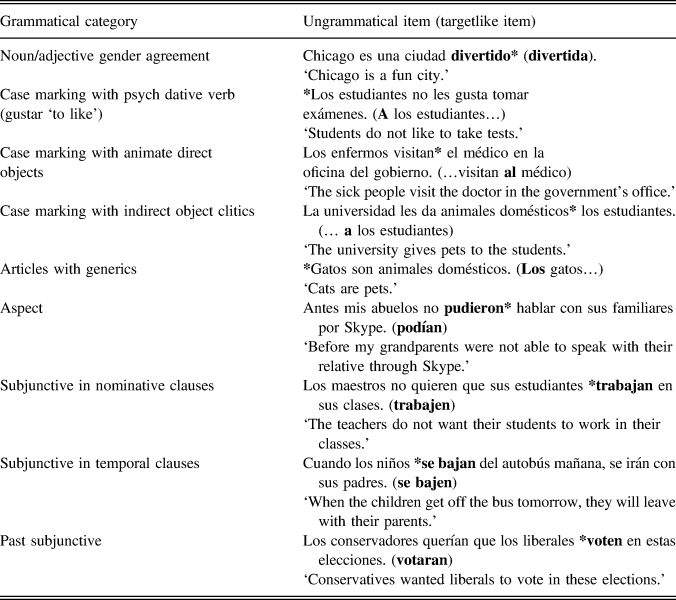
We included Bowles’s (Reference Bowles2011) grammatical categories and items from her oral elicited imitation test, and we also created additional items for each grammatical category to improve the test design for both linguistic knowledge tasks. For the additional items, we carefully followed the same length of the sentences in Bowles (Reference Bowles2011). To further check the items, we piloted the items with a group of monolingual native and heritage speakers of Spanish, and made any necessary edits to improve the quality of the items. The target structures for the linguistic knowledge tests consisted of vulnerable structures in HL acquisition that have been documented in the literature (e.g., Alarcón, Reference Alarcón2011; Montrul, Reference Montrul, Potowski and Cameron2007; Montrul & Bowles, Reference Montrul and Bowles2009; Montrul & Ionin, Reference Montrul and Ionin2010; Montrul & Perpiñán, Reference Montrul and Perpiñán2011; Pascual y Cabo, 2016; Potowski, Jegerski, & Morgan-Short, Reference Potowski, Jegerski and Morgan-Short2009; Silva-Corvalán, 1994). The linguistic tests contained nine different target structures in Spanish. These included noun and adjective gender agreement in Spanish (Alarcón, Reference Alarcón2011), case marking with dative psych verbs, animate direct objects, and double object clitics (Bowles, Reference Bowles2011; Montrul & Bowles, Reference Montrul and Bowles2009; Pascual y Cabo, Reference Pascual y Cabo2016), articles with generics (Montrul & Ionin, Reference Montrul and Ionin2010), and aspect (Montrul & Perpiñán, Reference Montrul and Perpiñán2011). Furthermore, given the vulnerability of the subjunctive mood among HL speakers of Spanish, we tested three different contexts in which the subjunctive mood is used, which included present subjunctive in nominative and temporal clauses and the past subjunctive (Montrul, Reference Montrul, Potowski and Cameron2007; Montrul & Perpiñán, Reference Montrul and Perpiñán2011; Potowski et al., Reference Potowski, Jegerski and Morgan-Short2009; Silva-Corvalán, Reference Silva-Corvalán1994). See Table 1 for an example of ungrammatical items along with its targetlike equivalent for each grammatical category. Importantly, these target structures are generally taught in instructed settings.
Target structures

LINGUISTIC KNOWLEDGE TASKS
Spoken elicited imitation task
The EIT was designed to measure participants’ less explicit and aural knowledge of the HL. It consisted of a total of 72 sentences, of which half of the sentences (N = 36) were grammatical and the other half were ungrammatical. The sentences were recorded by a male native speaker of Spanish and were randomly presented through SuperLab 5.0 to avoid ordering effects. Participants were instructed to listen to the sentence and immediately judge whether the sentence was logical. For example, if the sentence they heard was “The White House is in New York City,” they needed to click on the “/” key to indicate “no” for not logical; conversely, if the sentence was logical (“The White House is in Washington, DC”), they clicked on the “z” key to indicate “yes.” The sentences were carefully piloted with a group of age-matched university students to ensure accurate (il)logical interpretation of the sentences. In addition, the (il)logical judgment responses were submitted to a Cronbach’s alpha analysis, yielding α = .96, indicating high internal consistency among the responses. After participants judged each statement, they immediately saw a series of asterisks that indicated that they needed to repeat the sentence out loud the way in which they would say it in Spanish. All the responses were recorded with Audacity 2.0 and a digital recorder, and were subsequently analyzed for correct (il)logical interpretation of the sentence as well as for use of the target form.
To code the data, we first analyzed the (il)logical responses to the sentences to ensure that the participants were paying attention to meaning during the EIT, especially as we wanted this task to be a measurement of less explicit knowledge. As such, incorrect responses to the meaning of the sentences were given a “0” and were not further coded for the target form. We first checked that none of our participants had 15% or more of incorrect interpretation responses. After checking participants’ responses, no participant was eliminated from the final analysis, which implies that they followed task instructions. After the coding of the (il)logical interpretation of the sentences, we followed Ortega’s (Reference Ortega2000) coding scheme for her EIT to code for the production of the target form. We adopted this coding scheme because it takes into account participants’ production of the target form and the repetition of idea units of the sentence. In scoring the items, four points were given for production of correct target form and repetition of more than half of the sentence; three points were given for correct target form and repetition of half of the sentence; two points for incorrect form and repetition of more than half of the sentence; one point for incorrect form and repetition of a quarter to half of the sentence; and zero points for incorrect form and repetition for little to no part of the sentence.Footnote 1 Each participant could receive a total of 288 points. Two of the researchers coded 15% of the same data and discussed any discrepancies until they reached an agreement. An analysis of interrater reliability yielded K= .91, which was calculated after consensus between both researchers. Both researchers coded a separate portion of the remaining data.
Untimed grammaticality judgment task
The UGJT also consisted of 72 items testing the same grammatical categories as in the EIT with the goal of measuring participants’ more explicit and written knowledge of the HL. The items on the UGJT were different from those in the EIT, but followed a similar format in that half of the sentences were grammatical items (i.e., sentences with the correct target form) and the other half were ungrammatical items. All the items were presented randomly and in written form through SuperLab 5.0. Participants were instructed to read each sentence and decide whether the sentence was grammatical or ungrammatical with no time limit. Each item was coded for correct or incorrect response, with a score of 1 for correct responses and a 0 for incorrect responses for a possible total of 72 points.
QUESTIONNAIRES
Possible selves questionnaire
To measure participants’ motivation based on Dörnyei’s (Reference Dörnyei, Dörnyei and Ushioda2009) L2 motivational self-system framework, we used a Likert-scale Possible Selves Questionnaire (PSQ) adapted for learners of Spanish (Serafini, Reference Serafini2013). The questionnaire was comprised of 30 statements (e.g., I can imagine myself living abroad and having a discussion in Spanish) divided into three categories with 10 statements. Participants had to indicate how strongly they agreed or disagreed with the statement. The questionnaire was administered through the online platform survey monkey. A composite score was calculated based on participants’ ratings for all 30 statements (1 = Strongly Disagree to 7 = Strongly Agree) for a possible total of 210 points.
Willingness to communicate questionnaire
MacIntyre, Baker, Clément, and Conrod’s (Reference MacIntyre, Baker, Clément and Conrod2001) Willingness to Communicate Questionnaire (WTC-Q) was adopted and modified to investigate participants’ propensity to engage in Spanish communication across speaking, reading, listening, and writing scenarios (e.g., Have a conversation in Spanish with a stranger if she/he talks to you first; Write an e-mail/letter to a friend in Spanish). Participants were instructed to indicate their degree of WTC in Spanish for 27 different scenarios based on their gut reaction. Each item was assigned a score according to the degree of WTC (1 = Almost Never Willing to 5 = Always Willing), and then, a total score was tallied for each participant for a possible 135 points.
Language attitudes questionnaire
To investigate our participants’ language attitudes, we utilized and adapted a portion of Carreira and Kagan’s (Reference Carreira and Kagan2011) survey questions on language attitudes (e.g., Knowing Spanish is a valuable skill). Participants read and responded to a total of 11 statements for which they needed to rate how strongly they agreed or disagreed with each statement. The questionnaire was electronically administered through survey monkey. Participants could get a possible 44 points, a composite score that was calculated based on the sum of all the items in the questionnaire (1 = Strongly Disagree to 4 = Strongly Agree).
Frequency of language use questionnaire
Given that we also included in this study frequency of language use in Spanish as a biographical variable, we administered a Frequency of Language Use Questionnaire (FLU-Q) through survey monkey as well. This questionnaire has been piloted and used with age-matched heritage and L2 learners in other studies (Torres, Reference Torres2018). The FLU-Q consisted of 20 statements about participants’ daily use of Spanish at home, work, and school (e.g., I speak with my parents or caretakers in Spanish; I read Spanish at home; I write in Spanish at work). Participants responded to each statement by indicating the frequency with which they use Spanish across the 20 scenarios. We scored the responses based on how frequently they used Spanish in each case, with 5 = Always to 1 = Never, and as with the preceding questionnaires, we tallied the responses to compute a composite score for each participant. Participants could get a possible 100 points for language use.
PROCEDURE
Each participant who gave consent to participate in the study was tested individually in a lab. Participation in the study took place during one session that lasted about 1 hour and 15 minutes. The participants were allowed to take breaks and were provided with water bottles. To avoid ordering effects, participants were randomly assigned to complete first the EIT or UGJT linguistic knowledge task. While the usual process for L2 speakers is to complete the less explicit task first, we decided to counterbalance the two experimental tasks with our HL learner population. One reason is that instructions for both experimental tasks prompted learners to detect sentences with errors, which heightened their awareness to language forms. Second, due to HL learners’ superior performance on aural experimental tasks, one could argue that some participants could figure out target structures on the EIT as well, especially for the shorter sentences, which were not a burden on working memory. Following the first linguistic knowledge task, they completed the IDs questionnaires that included the PSQ, the WTC-Q, Language Attitudes Questionnaire (LAQ), FLU-Q, and the LBQ. They completed the session with the second linguistic knowledge task (EIT or UGJT). Participants were compensated for their participation in the current study.
RESULTS
INSTRUMENT RELIABILITY AND DESCRIPTIVE STATISTICS
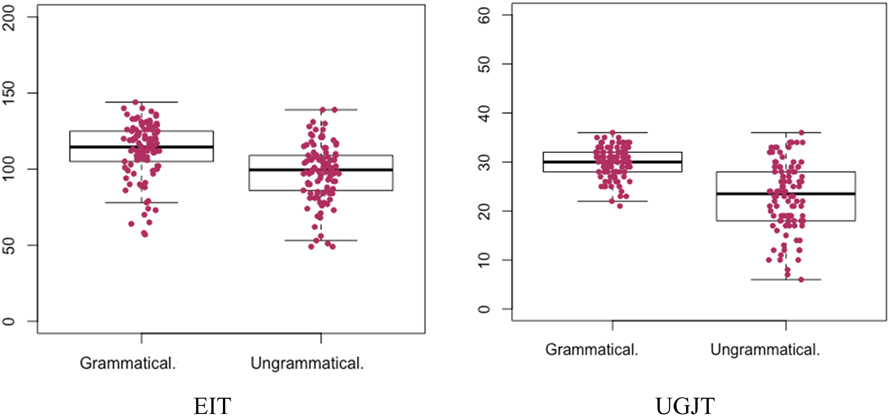
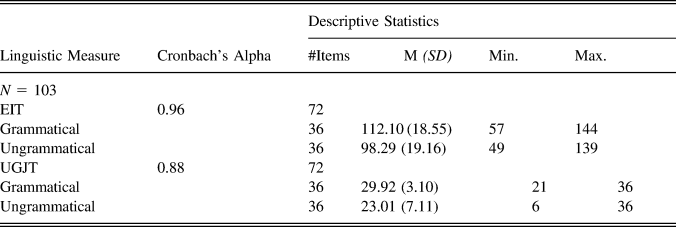
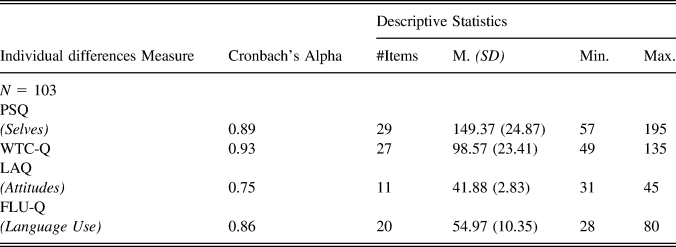
Instrument reliability and descriptive statistics for the linguistic knowledge tasks (i.e., EIT and UGJT), which includes Cronbach’s alpha, mean, standard deviation, and minimum and maximum scores, are available in Appendix S1 in the online supplementary materials. Figure 1 displays boxplots of the raw scores for grammatical and ungrammatical items on the EIT and UGJT for all 103 participants. Lastly, Appendix S2 in the online supplementary materials, has the instrument reliability and descriptive statistics information for all the questionnaires.
Boxplots of raw scores for grammatical and ungrammatical items on both linguistic knowledge tasks (EIT and UGJT) for all participants.

RESULTS FOR RESEARCH QUESTIONS 1 AND 2
RQ 1 posited whether a relationship exists between the scores on grammatical and ungrammatical items of the spoken EIT. According to an analysis of Pearson’s r correlation with 2-tailed p-values, a significant correlation emerged between grammatical and ungrammatical items on the spoken EIT (r = .840, p = .01, 95% CI [.77; .88]), with R 2 = .705, which is a large effect size. This finding suggests a strong relationship between grammatical and ungrammatical items on the EIT and, thus, implying that participants were indeed reconstructing the ungrammatical items on the EIT, and not merely repeating the sentences (e.g., Erlam, Reference Erlam2006).
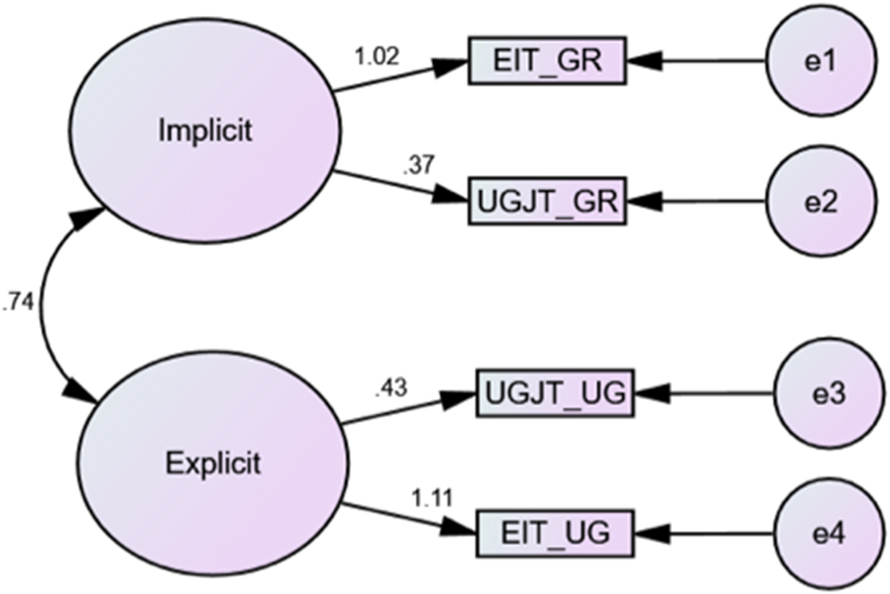
RQ 2 addressed whether the scores on the grammatical and ungrammatical items of the EIT and UGJT loaded on two factors. To address this RQ, we conducted a confirmatory factor analysis using AMOS 25.0 based on two-factor models reported in previous research in which the EIT loaded onto implicit knowledge and the UGJT onto explicit knowledge (e.g., Bowles, Reference Bowles2011). We followed Brown’s (Reference Brown2006) guidelines to calculate and interpret goodness-to-fit indices.Footnote 2 The summary statistics for the two-factor model were χ Footnote 2 = 8.1, df = 1, p = .04, CFI = .957, TLI = .741, and RMSEA = .265, which indicates that this model was not a good fit. Therefore, we ran an alternative model based on previous research that grammatical and ungrammatical items loaded onto implicit and explicit knowledge respectively (e.g., Gutiérrez, Reference Gutiérrez2013). This alternative model was a better fit for the data yielding χ Footnote 2 = .64, df = 1, p = .42, CFI = 1.00, TLI = 1.01, and RMSEA = .000. For this model, a significant correlation was found between the two latent variables or implicit and explicit knowledge (r = .74). The loadings for the two observed variables on implicit knowledge were .37 for UGJT_GR and 1.02 for EIT_GR; whereas .43 for UGJT_UG and 1.11 for EIT_UG were the loadings for the variables on explicit knowledge. The loadings were all significant (p < .05).
CFA model.
Notes: EIT_GR = grammatical sentences of the elicited imitation task; UGJT_GR = grammatical items of the untimed grammaticality judgment task; UGJT_UG = ungrammatical items of the untimed grammaticality judgment task; and EIT_UG = ungrammatical items of the elicited imitation task. Model fit indices: χ 2 = .64, df = 1, p = .42, CFI = 1.00, TLI = 1.01, and RMSEA = .000.

RESULTS FOR RESEARCH QUESTION 3
RQ 3 seeks to address the contribution of psychosocial and biographical variables to HL learners’ performance on linguistic tasks that were more or less explicit and oral or written. To answer this research question, and given the heterogenous profiles of HL learners, we conducted mixed-effects regression analyses. To estimate power and precision, a priori sample size analysis with seven predictors, effect size (ƒFootnote 2) at .15, power at .80, and significance level at .05 recommended a minimum sample size of 103 (Soper, Reference Soper2015). We followed Jeon’s (2015) data-screening steps for multivariate statistical analysis to check assumptions on our statistical models (e.g., Mahalanobis distances, multicollinearity).
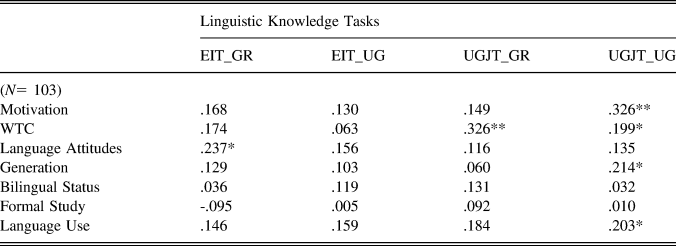
A correlation matrix is presented in Table 2 with results of Pearson’s r correlation coefficients and 2-tailed p-values. Overall findings indicated significant correlations between linguistic knowledge tasks and language attitudes, WTC, motivation, and generation, with r values ranging from .203 to. 326. Specifically, language attitudes significantly correlated with grammatical items on the EIT (r = .23, p < .05, 95% CI [.04; .41]) and WTC correlated with scores on the grammatical items of the UGJT (r = .32, p = .01; 95% CI [.14; .49]). Most of the relationships emerged with participants’ performance on the ungrammatical items on the UGJT, and these included motivation (r = .32, p = .01; 95% CI [.14; .49]), WTC (r = .9, p < .05; 95% CI [.01; .38]), generation (r = .214, p < .05; 95% CI [.02; .39]), and language use (r = .203, p < .05; 95% CI [.01; .38]). The magnitude of the effect sizes for the preceding correlations was small (.03 ≤ |r| ≤ .10) and, thus, suggesting a weak relationship between these variables and the scores on the linguistic knowledge tasks.
Correlation matrix

Note: EIT: elicited imitation task; UGJT: untimed grammaticality judgment task; GR: grammatical items; UG: ungrammatical items
* Correlation is significant at the .05 level (2-tailed)
** Correlation is significant at the .01 level (2-tailed)
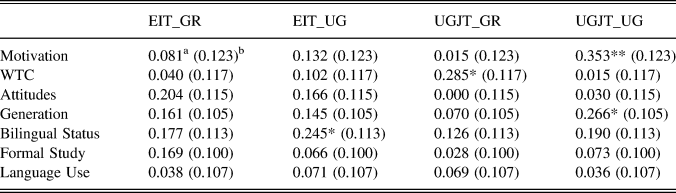
We fitted two mixed-effects regression models in R using the nlme package in which subjects were treated as random effects. Fixed effects included the seven predictor variables (i.e., the psychosocial and biographical variables) as well as the scores on the grammatical and ungrammatical items on the linguistic knowledge tests (i.e., EIT and UGJT) as the dependent variables. Statistical significance was calculated with p-values from the t distribution. According to the results of our two models, as shown in Table 3, total adjusted R 2 = .06, which indicates that the psychosocial and biographical variables accounted for 6% of the variance in the scores for grammatical and ungrammatical items on the EIT and UGJT. The models also revealed that four variables had significant positive regression weights. This indicates that participants’ scores on these scales were expected to have a positive impact on their performance on each linguistic knowledge task according to grammatical or ungrammatical items, after controlling for the other variables in the models. Specifically, the findings showed that sequential bilingual status significantly contributed to participants’ scores on the ungrammatical items of the EIT (b = .245, SE = .123, t = 2.16, p = .03); that is, participants’ sequential bilingual status determined that scores on the ungrammatical items of the EIT would increase by .245 points. WTC significantly contributed to grammatical items on the UGJT (b = .285, SE = .117, t = 2.44, p = .02); for every one unit of WTC, the scores on the grammatical items of the UGJT increased by .285. As far as the scores on the ungrammatical items of the UGJT, motivation (b = .353, SE = .123, t = 2.86, p < .01) and generation (b = .266, SE = .105, t = 2.53, p = .01) significantly contributed to participants’ performance. In other words, a 1-point increase in motivation led to a higher score of .353 points on the ungrammatical items of the UGJT. Also for the ungrammatical items on the UGJT, participants of generation 1.5 scored .266 points higher than generation 2.0 and 3.0. In sum, bilingual status, WTC, motivation, and generation were the significant contributors to learners’ scores, and these contributions were contingent on the type of linguistic knowledge task.
Results from mixed-effects regression models

Note: a= b value b= Standard error
Total R2 = .13, ⊿ R2 = .06
** p < .001;
* p < .05
DISCUSSION
GENERAL OVERVIEW
The goal of our first research question was to establish that our participants were indeed reconstructing ungrammatical sentences on the EIT, as per task instructions. To confirm participants’ behavior on reconstructing ungrammatical items, based on previous studies (e.g., Erlam, Reference Erlam2006), we conducted a correlation analysis between the grammatical and ungrammatical items of the EIT. Our results yielded a significant correlation between grammatical and ungrammatical items, with a large effect size. This strong relationship indicates that participants were engaged in reconstructing ungrammatical sentences of the EIT, which increases the validity of our EIT scores.
Due to the current issue on the validity of assessment tools that measure implicit and explicit knowledge (e.g., Suzuki & DeKeyser, Reference Suzuki and DeKeyser2015), our second research question posited whether the measures on the EIT and UGJT would load on two factors. A confirmatory factor analysis revealed that the data were a good fit for a two-factor model in which grammatical items of the EIT and UGJT loaded onto implicit knowledge, and the ungrammatical items of the EIT and UGJT onto explicit knowledge. However, we also found a significant correlation between the two latent variables (r = .74), which reveals that the discriminant validity of the two latent variables is not good (see Brown, Reference Brown2006). This finding suggests that both latent variables are essentially measuring the same construct. Our results support the observations and argument in Vafaee and colleagues (2017) that grammatical and ungrammatical items measure different types of explicit knowledge. As such, this implies that our participants were tapping into different levels of explicit knowledge, especially in light of how these variables ought to be viewed along a continuum (DeKeyser, 2009). But, further, our results also revealed that psychosocial and biographical variables predicted participants’ performance differentially across both linguistic knowledge tasks. Therefore, the difference in performance may be more related to the modality of the experimental tasks, as previous research has shown that HL speakers perform better in oral experimental tasks (Montrul et al., Reference Montrul, Davidson, de la Fuente and Foote2014).
Our third research question was concerned with the contribution of psychosocial and biographical variables to participants’ performance on the spoken EIT and written UGJT. Correlations were first carried out to determine the relationship between the predictor variables (i.e., psychosocial and biographical) and scores on (un)grammatical items across the EIT and UGJT, with small effect sizes being found for all significant correlations (Table 2). Subsequent mixed-effects regression analyses that treated participants as random effects and independent and dependent variables as fixed effects were applied to the results to understand the contribution of the predictor variables to scores on the EIT and UGJT. Our models indicated that the predictor variables accounted for 6% of the variance in scores on the EIT and UGJT, which aligns with the range of 3% to 16% explanatory power of psychosocial factors on L2 outcomes (e.g., Masgoret & Gardner, Reference Masgoret and Gardner2003; Serafini, Reference Serafini2013). A closer examination of the results demonstrates that sequential bilingual status contributed significantly to the scores on ungrammatical items of the EIT; WTC significantly contributed to the grammatical items on the UGJT; and, motivation and generation were the significant predictors of participants’ performance on the ungrammatical items of the UGJT (Table 3).
PSYCHOSOCIAL/BIOGRAPHICAL VARIABLES AND HL LEARNERS’ KNOWLEDGE
Previous studies have shown that HL bilinguals show variability in their performance on linguistic tasks that measure vulnerable morphosyntactic structures in HL acquisition, particularly when the design of the tasks elicit more explicit and written knowledge of the HL (e.g., Benmamoun et al., Reference Benmamoun, Montrul and Polinsky2013; Bowles, Reference Bowles2011; Montrul et al., Reference Montrul, Davidson, de la Fuente and Foote2014). Additionally, scholars in the field of HL studies have also investigated the role of IDs, namely psychosocial factors, and their potential relationship to adult HL learners’ knowledge of the HL (e.g., Kurata, Reference Kurata2015). Of equal importance, due to the relevance that exposure to the HL can have on HL speakers’ proficiency such as frequency of language use (e.g., Montrul, Reference Montrul2016), examining the impact of biographical variables on HL learners’ linguistic attainment warrants further research. However, the current study is the first to examine together the contribution of psychosocial and biographical variables in predicting HL learners’ variable linguistic knowledge as measured by a spoken EIT and written UGJT.
With regard to the spoken EIT, sequential bilingual status was the only significant contributor to their performance on the EIT when controlling for all other predictor variables in the mixed-effects regression model and, more specifically, to the ungrammatical items. As such, participants’ sequential bilingual experience, which can be indicative of the quantity of HL input they receive during childhood, played at least a minimal role in their ability to rephrase ungrammatical sentences in a more targetlike way. This finding supports claims that early amount of exposure in the HL can make a significant difference to their linguistic knowledge as adults (e.g., Montrul, Reference Montrul2016). As aforementioned, whether this is indicative of HL learners’ more explicit or implicit knowledge remains unclear in this study based on the factor analysis results. In Bowles (Reference Bowles2011), her HL participants who had studied Spanish for less than two years, demonstrated significant superior performance on her EIT. Arguably, then, Bowles’s HL learners had not developed extensive explicit knowledge, and this suggests that HL learners may rely more on their intuitions, which they most likely acquired during childhood, to correct ungrammatical items in an aural mode. In our study, however, it seems that modality may have played a more substantive role into how our HL learners accessed their linguistic knowledge. Future research needs to further address this issue of the explicitness and modality of linguistic tasks with HL speakers, especially in light of the mixed results in the L2 literature with designing tasks that tap into implicit and explicit knowledge (e.g., Suzuki & DeKeyser, Reference Suzuki and DeKeyser2015).
Nevertheless, it can be expected that early quantity of HL input can contribute uniquely to the development of adult HL learners’ less explicit and aural knowledge of the HL, which was required to reconstruct ungrammatical sentences on the spoken EIT. Also of relevance, though, quantity of input during childhood seems to be insufficient for eliciting more explicit and written knowledge, as sequential bilingual status did not contribute significantly to participants’ performance on the UGJT. It is most likely the case that literacy development in the HL is a requirement for developing more explicit and written knowledge (see following text).
Unlike for the EIT, IDs played a significant role on participants’ performance on the written UGJT, particularly with the ungrammatical items, as demonstrated by the significant number of correlations and mixed-effects regression analysis. The written UGJT most likely required more explicit knowledge, which presents a major challenge for HL learners. It is no surprise, therefore, that the role of IDs was critical for a more difficult linguistic task. While WTC has not been directly studied in the HL literature, it has been related to learners’ motivation for studying an L2 (e.g., Dörnyei, Reference Dörnyei and Robinson2002). In the current study, WTC was found to be the only significant ID that contributed to the scores on the grammatical items of the UGJT. That is, HL learners’ propensity to interact in the HL in their classroom and community contexts is favorable to develop written knowledge along a continuum of explicitness, especially in light of how the WTC questionnaire included skills related to literacy (e.g., Read a Spanish article in a paper). It has been documented that self-perceived competence and anxiety levels predict L2 learners’ WTC (MacIntyre, Reference MacIntyre1994; Yashima, Reference Yashima2002). According to our results, these factors can also be extended to HL learners, as their communicative experiences in the HL across instructed and naturalistic settings alter the perception of their linguistic competence as well as their levels of anxiety, which, in turn, predicts their confidence to interact willingly in the HL. In fact, in a recent study, Sevinç and Dewaele (Reference Sevinç and Dewaele2018) found that second- and third-generation HL speakers of Turkish in the Netherlands demonstrated HL anxiety in social settings with family, friends, and monolingual native speakers. In classroom settings, HL learners’ anxiety levels can increase when penalized for not using a “standard” or prescriptive variety of the HL (Clark & Coryell, Reference Clark and Coryell2009). These interactions in both naturalistic and classroom settings can contribute to their perceived communicative competence in the HL. For L2 learners, interactions in naturalistic environments are seemingly more significant to their perceived communicative competence than in a classroom environment (Baker & MacIntyre, 2000). Whether this is the same case for HL learners remains unclear, as WTC was a significant contributor to scores on the UGJT, which tested knowledge that they are most likely developing in an instructed environment. Given this novel finding, future research ought to gain a clearer picture on how instructed and naturalistic environments equally (or not) shape HL learners’ self-perceived communicative competence in the HL.
Our findings also indicate that motivation and generation were the relevant variables for the scores of the ungrammatical items on the UGJT, which most likely elicited the most metalinguistic knowledge from the participants. We measured motivation following Dörnyei’s (Reference Dörnyei, Dörnyei and Ushioda2009) L2 motivational self-system and, based on this significant result, this model is also promising for studying HL learners’ motivation. In the current study, then, we can infer that HL learners’ drive to become more proficient speakers can make at least a minimal impact on their attainment of metalinguistic knowledge. Therefore, HL learners’ motivational differences in linking their future proficiency levels in the HL with personal and professional goals (Kurata, Reference Kurata2015) seemingly determines the extent to which they will develop more explicit and written knowledge of vulnerable morphosyntactic structures. The differences in generation were also a significant predictor of their performance on the ungrammatical items of the UGJT. Most of our participants categorized their generation as 1.5 or 2.0. Participants selected 1.5 to indicate that they were born in a Spanish-speaking country and arrived to the United States during their school years; whereas, our generation 2.0 participants were born and mostly schooled in the United States. The differences between both generations lies in that our generation 1.5 participants were exposed to early schooling in Spanish while attending schools in their Spanish-speaking country whereby they acquired some early literacy skills. As argued in Kupisch (Reference Kupisch2013), schooling in the HL during childhood may lead to more linguistic outcomes that mirror those of monolingual natives. Thus, this exposure to early literacy provides an advantage for the development and retention of written explicit knowledge in the HL.
Finally, our results also demonstrated that IDs along language attitudes did not significantly predict our HL learners’ performance on the EIT or UGJT. As pointed out by one of our anonymous reviewers, while adult HL learners’ positive attitudes toward the HL can correlate with HL maintenance (see also our results, Table 2), holding positive (or negative) attitudes of the HL does not necessarily reflect HL learners’ own perceived abilities in the HL, which can have a bigger impact on linguistic outcomes. That is, it is possible to have positive attitudes toward the HL but to have low confidence in one’s linguistic abilities. In fact, as argued in the preceding text, we found that learners’ WTC, which is partly attributed by learners’ perceived competence in the HL significantly predicted language outcomes. Therefore, this can explain why language attitudes may not be as critical as the other psychosocial IDs in our study.
Likewise, we also found that the biographical factors of frequency of language use and years of formal Spanish study did not contribute to our participants’ results on the linguistic knowledge tests. Given that we tested vulnerable morphosyntactic structures in HL bilingual acquisition, frequency of language use may not be relevant here because HL learners can function in their local bilingual environments without using these target structures. For example, in the case of the subjunctive, Collentine (Reference Collentine, Lafford and Salaberry2003) argued that L2 learners are understood by native speakers without using the subjunctive correctly. The same is true for our HL learners as bilingual natives. That is, they can use their Spanish frequently in their daily lives without the need to use the subjunctive to communicate. Lastly, years of formal Spanish study was also not a key predictor in this study. This can be attributed to the fact that HL learners’ experiences differ as far as their exposure to teaching methods, especially as HL learners may enroll in a variety of courses, which can range from specialized HL courses to mixed HL-L2 classes (Carreira, Reference Carreira2017). Therefore, depending on individual HL learners’ classroom learning trajectory, it is reasonable to expect that all HL learners are not exposed to these vulnerable linguistic structures to the same extent.
LIMITATIONS AND CONCLUSION
The current study is not without its limitations, and these should be addressed in future studies. First, while the language attitudes and frequency of language use questionnaires were reliable, the number of questions and scales used may have reduced the amount of variation in our group. This is particularly true for the language attitudes questionnaire given the small range of scores among participants (see Appendix S2). Second, most of our participants reported being generation 1.5 or 2.0; as such, this hampers any generalizable conclusions of a broader sample of HL learners across generations. Third, we did not collect more information about our participants’ classroom learning experiences to gain a more nuanced understanding of how years of formal language study could contribute to their performance.
To conclude, this study sought to understand the significant psychosocial and biographical variables that can predict HL learners’ performance on linguistic knowledge tasks that tapped into degrees of explicit knowledge in the HL. The findings demonstrated that sequential bilingual status, motivation, WTC, and generation contributed differentially to their performance. Assessing HL learners’ knowledge through explicitness and modality are not only critical to access the degrees of their linguistic knowledge but also to understand the differential contributions of IDs and biographical factors to their development of the HL. Lastly, as in L2 acquisition studies, these variables contributed only a small percentage to the variance in scores, leaving open the question whether the field needs to consider other variables. For instance, future research ought to additionally examine IDs along the lines of cognitive variables (e.g., working memory) to gain a more comprehensive picture of the impact of intragroup differences among HL learners and their language development and maintenance.
SUPPLEMENTARY MATERIAL
To view supplementary material for this article, please visit https://doi.org/10.1017/S0272263119000184
Linguistic Knowledge Tasks

Individual Differences Questionnaires