1 Introduction
This article looks at a word order phenomenon in Middle English (ME, 1100–1500) and Early Modern English (EMODE, 1500–1700) that is well known from Present-Day English (PDE): the alternation between verb–object–particle (V–Obj–Prt) order and verb–particle–object (V–Prt–Obj) order. ME examples are given in (1) and (2).
(1) and smote the lyffte arme off, . . .
‘and (he) struck the left arm off, . . .’ (M4; CMMALORY, 645.4122)
(2) and wolde have smytten off hys hede.
‘and (he) would have struck off his head.’ (M4; CMMALORY, 40.1321)
This word order alternation dates back to Early ME (EME) and was established in its present form by the end of the EMODE period. As in PDE, there is no semantic difference between the two word orders, raising the question of why both word orders (continue to) exist. This article examines a number of possible motivations for the choice between the two word orders in ME and EMODE.Footnote 2
Motivations for word order phenomena (including synchronic variation and diachronic change) may be semantic, (morpho)syntactic and/or pragmatic in nature. An example of a semantic factor influencing word order is the relation between the aspectual semantics of the verb and its position in the clause (e.g. Hopper Reference Hopper and Givón1979 on Old English). An example of a (morpho)syntactic factor is the heaviness of the object (cf. heavy NP shift, Arnold et al. Reference Arnold, Wasow, Losongco and Ginstrom2000). Accounts of word order variation and change also increasingly pay attention to pragmatic motivations. For example, some studies on the PDE dative alternation (e.g. Collins Reference Collins1995; Bresnan & Hay Reference Bresnan and Hay2008; Bresnan et al. Reference Bresnan, Cueni, Nikitina, Baayen, Bouma, Krämer and Zwarts2007) have shown that the choice between the two options offered by the dative alternation (John gave Mary a flower versus John gave a flower to Mary) is influenced by, among other factors, the givenness of the direct object (a flower). The influence of information structure has also been observed in the choice between (long) passives and actives in PDE (Mary was given a flower (by John) versus John gave Mary a flower) (e.g. Biber et al. Reference Biber, Johansson, Leech, Conrad and Finegan1999: 940–2; Seoane Reference Seoane2009). In diachronic studies, too, there is a growing interest in the role of information structure, particularly in accounting for word order changes (e.g. Bech Reference Bech2001; Seoane Reference Seoane, van Kemenade and Los2006; van Kemenade & Milicev Reference van Kemenade, Milicev, Jonas, Whitman and Garrett2012; Meurman-Solin et al. Reference Meurman-Solin, López-Couso and Los2012). Such studies are especially concerned with the interaction between word order and ‘the arrangement of information in a given-new sequence’ (Seoane Reference Seoane, van Kemenade and Los2006: 365).
Several studies of PDE particle verbs have found that the choice between the two particle verb word orders is influenced by morphosyntactic and discourse factors (see especially Gries Reference Gries1999, who offers a multifactorial analysis of the role of a wide range of linguistic factors in PDE particle placement). With respect to the influence of information structure, it has often been observed that, as in the case of the dative alternation, the choice between the two word orders of PDE particle verbs is influenced by the givenness of the object (e.g. Erades Reference Elenbaas and van Kemenade1961; Bolinger Reference Bolinger1971; Chen Reference Chen1986; Olsen Reference Olsen, Lang and Zifonun1996; Gries Reference Gries1999, Reference Gries2003; Dehé Reference Dehé2002). New objects prefer the V–Prt–Obj order, which can be linked to the generalisation that given information precedes new information (see, e.g., Arnold et al. Reference Arnold, Wasow, Losongco and Ginstrom2000: 30 and references cited there). This, in turn, is related to stress/focus: new objects typically receive focus and therefore prefer the object position following the verb and the particle, which is a focus position (e.g. Bolinger Reference Bolinger1971; Gries Reference Gries1999; Dehé Reference Dehé2002). The relation with focus straightforwardly explains the restricted positional options of pronominal objects, which (if unstressed) occur exclusively in the V–Obj–Prt order. Since pronouns are given by definition, they are expected to occur in a non-focus position (except when they are contrastively stressed).
Finding out about the motivations for the choice between the two word orders is crucial for understanding why both word orders have survived. Typically, when there are competing forms in a language, one form ousts the other after a period of (synchronic) competition, resulting in language change (e.g. Kroch Reference Kroch1989). In the case of particle verbs, the V–Prt–Obj order is more frequent than the V–Obj–Prt order (see Dehé Reference Dehé2002: 88ff.) and has been since EME (see Hiltunen Reference Hiltunen1983; Elenbaas Reference Elenbaas2007; Los et al. Reference Los, Blom, Booij, Elenbaas and van Kemenade2012). Nevertheless, despite the long-time numerical advantage of the V–Prt–Obj order over the V–Obj–Prt order, the latter order continues to exist. I will argue below that this may be due in part to the fact that both word orders were increasingly employed in information-packaging strategies (i.e. the organisation of given and new information).
In the syntactic literature on PDE, particle verbs have received many different analyses. They are variously treated as words (see e.g. Johnson's Reference Johnson1991 complex verb analysis) or as phrases (see, e.g., small clause analyses: Kayne Reference Kayne, Guéron, Obenauer and Pollock1985; den Dikken Reference Dikken1995). There are also treatments of particle verbs that make use of the notion of optional projection (e.g. Neeleman Reference Neeleman, Dehé, Jackendoff, McIntyre and Urban2002; Toivonen Reference Toivonen2003). The analysis I adopt here, proposed in Elenbaas (Reference Elenbaas2007) and Los et al. (Reference Los, Blom, Booij, Elenbaas and van Kemenade2012), builds on the latter idea. The basic structure of the VP is presented in (3).
(3)

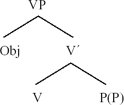
When the particle projects a phrase (PP), the verb head-moves to v on its own, yielding the word order V–Obj–Prt, illustrated in (4a).Footnote 3 When the particle does not project (P), it forms a complex head with V and this complex moves to v, yielding the word order V–Prt–Obj, illustrated in (4b). Since the complex V is created by merging two heads (the verb and the non-projecting particle), rather than by head-movement of the particle into the V head, the resulting order is V–Prt, not Prt–V.
(4)
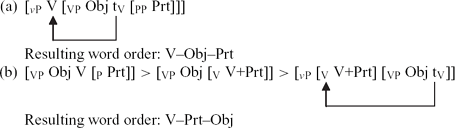
Following Elenbaas (Reference Elenbaas2007) and Los et al. (Reference Los, Blom, Booij, Elenbaas and van Kemenade2012), I will assume that non-projection is the default by economy, and that the particle projects only in a restricted number of linguistic contexts, such as modification of the particle (syntactic trigger for projection) and information-packaging (discourse trigger for projection). The analysis proposed here provides a straightforward account for the ambivalent morphosyntactic behaviour of particle verbs.
The organisation of this article is as follows: section 2 provides information on the data and method used for this study. Section 3 discusses the emergence of the word order alternation in ME and its continuation in EMODE. Section 4 examines the influence of several morphosyntactic factors and of the discourse factor givenness of the object on the choice between the two particle verb word orders in ME and EMODE. Section 5 presents the conclusions.
2 Data and method
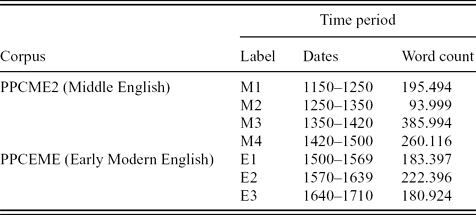
The data for this study were collected from two diachronic corpora: the second edition of the Penn–Helsinki Parsed Corpus of Middle English (PPCME2; Kroch & Taylor Reference Kroch and Taylor2000b) and the Penn–Helsinki Parsed Corpus of Early Modern English (PPCEME; Kroch et al. Reference Kroch, Santorini and Diertani2004). These corpora were searched using CorpusSearch (Randall Reference Randall2003) and data were retrieved from all time periods included in the corpora, which are presented in table 1.Footnote 4
PPCME2 and PPCEME time periods and word countsFootnote 5

The data search yielded all examples of transitive particle verbs (with a nominal or pronominal direct object). The data set includes V–Prt–Obj and V–Obj–Prt examples, where V stands for finite and non-finite verbs, but also examples with Vf–X–Prt–Obj, Vf–X–Obj–Prt and Vf–Obj–X–Prt order, where the finite verb has moved across X (e.g. a subject, negator or adverbial phrase). Unlike PDE, ME and EMODE had finite verb-movement, albeit in decline. Verb-movement was lost by the end of the EMODE period, after which the syntactic behaviour of finite and non-finite particle verbs became identical.
3 The word order alternation in Middle and Early Modern English: quantitative patterns
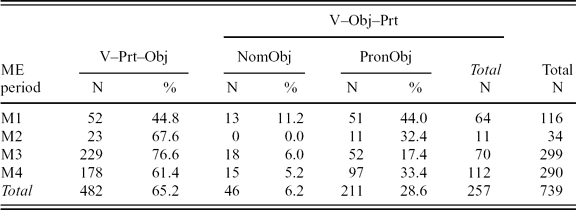
The word order alternation of English particle verbs is firmly established when ME gets underway after the transition from Old English (OE, 500–1100) and the V–Prt–Obj order is predominant from EME onwards (see Hiltunen Reference Hiltunen1983; Elenbaas Reference Elenbaas2007). This is shown by the figures in table 2.
The distribution of the word order alternation in Middle English
Table 2 shows that nominal objects predominantly occur in the V–Prt–Obj order in all subperiods of ME. In total, 482 out of 528 examples with a nominal object display the V–Prt–Obj order (91.3%). The two word order patterns are illustrated in (5).
(5)
As in PDE, pronominal objects occur in between the verb and the particle, as illustrated in (6a). I found one instance of a pronominal object in the V–Prt–Obj order, which is presented in (6b).
(6)
The marked position of the pronominal object hem ‘them’ in (6b) does not appear to be due to contrastive stress. However, the text from which the example is taken, the Wycliffite version of the Old Testament, is a translation from the Latin Vulgate (according to the Helsinki Corpus information; Kytö Reference Kytö1991). (7) gives the example as it is found in the Latin original.
(7)

(6b) has the same word order as the Latin original in (7) and the position of the pronominal object hem ‘them’ may have been influenced by Latin, whether directly or indirectly (see Warner Reference Warner1982: 17).
Two finite verb-movement examples displaying the two particle verb word orders are given in (8).
(8)
In (8a), which has the order Vf–X–Prt–Obj, the finite verb caste has moved across the subject we. In (8b), which has the order Vf–X–Obj–Prt, the finite verb bereth ‘bears’ has moved across the subject lightnesse.
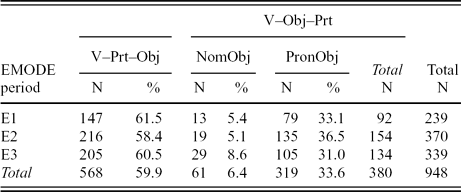
The overall distribution of the word order alternation of particle verbs in EMODE deviates very little from that in ME, as the figures in table 3 show.
The distribution of the word order alternation in Early Modern English
Nominal objects of particle verbs overwhelmingly occur in the V–Prt–Obj order: 568 out of 629 examples (90.3%). Examples of the two word order patterns are given in (9).
- (9)
(a) If they be mixed with garleke / they take away the sharpnes.
‘If they be mixed with garlic, they take away the sharpness.’ (TURNERHERB-E1-P2, 71.30)
(b) . . . I perswaded her that shee would permit mee to take her Strumous swellings away by Incision, . . .
‘. . . I persuaded her that she would permit me to take her strumous swellings away by incision, . . .’ (CLOWES-E2-P2, 62.162)
As in ME, in the great majority of cases pronominal objects occur in between the verb and the particle in EMODE, as illustrated in (10a). The data set includes only one instance where the pronominal object follows the verb and the particle, which is presented in (10b).
- (10)
(a) . . . how the earth opened her mouth and swallowed them vp . . .
‘. . . how the earth opened her mouth and swallowed them up . . .’ (AUTHOLD-E2-P2, XI,1D.869)
(b) . . . I say he that agaynst my wyll taketh out him, breaketh the sanctuary.
‘. . . I say he who takes him out against my will breaks the sanctuary.’
(MORERIC-E1-P2, 38.14)
The marked position of the pronominal object him in (10b) is possibly due to contrastive stress, or may be a stylistic device. The sentence, from Sir Thomas Malory's History of King Richard III, is uttered by an enraged Queen and the marked word order may reflect the Queen's emotional state (see Kincaid Reference Kincaid1972: 233–4).
Finite verb-movement declined further in EMODE, before its final loss at the end of this period. Some EMODE verb-movement examples are given in (11).
- (11)
(a) yet put they vp a byll of artycles vnto the temporall lordes in the parlyamentseason mouynge them to slee theyr aduersaryes that resysted agaynst theym.
‘yet they put up a bill of articles to the temporary lords in the parliament season, moving them to slay their adversaries who resisted them’ (FISHER-E1-P2, 344.177)
(b) Take not your saddle off sodainly but at leasure, . . .
‘Do not take your saddle off suddenly but at leisure, . . .’ (MARKHAM-E2-P2,1,85.101)
In (11a), displaying the order Vf–X–Prt–Obj, the finite verb put has moved past the subject they. In (11b), which has the order Vf–X–Obj–Prt, the verb take precedes the negator not.
In sum, the ME and EMODE data show that both particle verb word orders were equally available and that the particle order is clearly preferred in both periods. In ME, the rise of VO word order masked the effects of finite verb-movement, as particles became postverbal in all contexts, whether induced by verb-movement or not. Finite and non-finite particle verb patterns became increasingly identical as finite verb-movement waned in EMODE and as the regularisation of word order (towards strict VO syntax) progressed. The outcome of these developments for particle verbs was the fixation of the word order alternation as it is found in PDE.
4 Morphosyntactic and information structural motivations
This section investigates motivations for the choice of particle verb word order in ME and EMODE, with a focus on information structure. Section 4.1 examines the influence of several morphosyntactic factors. Section 4.2 will look in detail at the impact of the discourse factor ‘givenness of the object’. Note that this part of the study excludes pronominal objects, because (as given objects) they only occur in the V–Obj–Prt order.
4.1 Morphosyntactic motivations
A first morphosyntactic factor which may be expected to drive the choice of word order is heaviness of the object.Footnote 6 The notion ‘heavy object’ is notoriously difficult to define, and various characterisations are found in the literature discussing the role of heavy objects in particle placement (e.g. van Dongen Reference Dongen1919; Fraser Reference Fraser1976: 19; Chen Reference Chen1986; Kayne Reference Kayne, Guéron, Obenauer and Pollock1985; Gries Reference Gries1999). Several studies point out that the length of the object alone is not a sufficient indicator of heaviness and that the syntactic complexity of the object also plays a role (e.g. Fraser Reference Fraser1976: 19; Chen Reference Chen1986; Gries Reference Gries1999; Diessel & Tomasello Reference Diessel and Tomasello2005). Though definitions vary, all studies agree that heavy objects strongly favour the V–Prt–Obj order. In this case study, heavy objects are defined in terms of syntactic complexity. Direct objects are counted as heavy when they contain a relative clause, a complement clause or coordination.
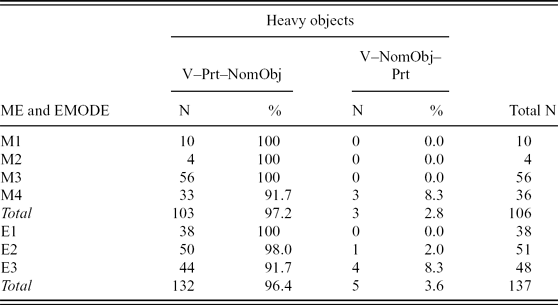
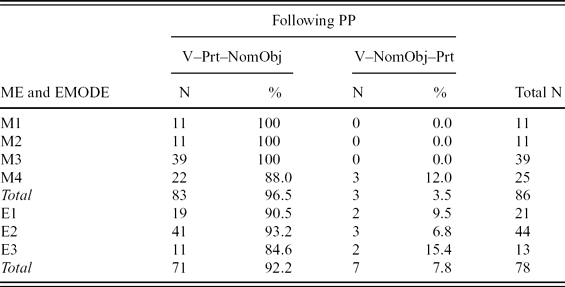
Heavy objects in ME and EMODE almost exclusively occur in the V–Prt–Obj order, as the figures in table 4 show.
Heavy objects in relation to the position of the particle in Middle English and Early Modern English
In ME, only 3 out of a total of 106 heavy objects (2.8%) occur in the V–Obj–Prt order (all three in the M4 period). All three examples occur in the same text, Malory's fifteenth-century Morte Darthur, and have the same verb–(heavy) object–particle combination, presented in (12).
(12)

The object horse and man appears to have a collocational character in the Morte Darthur: it occurs 22 times (without modification) and the reverse order (man and horse) is found only 3 times. Although it counts as a heavy object because it is a coordinated structure, the phrase appears to function as a single semantic unit.
In EMODE, only 5 out of a total of 137 heavy objects (3.6%) occur in the V–Obj–Prt order in EMODE: all five objects are coordinations of short noun phrases.
Examples of heavy objects occurring in the V–Prt–Obj order in ME and EMODE are given in (13).
(13)
The direct objects in these examples both count as heavy objects: the head soules ‘souls’ of the direct object in (13a) is modified by the relative clause þat hedden in heore lyf don his will ‘that had done his will during their lives’; the direct object in (13b) is a coordinated structure. On the analysis of particle verbs adopted here, there is no trigger for particle projection and the particle merges with the verb to form a complex syntactic head. This shows that the analysis is able to account for the particle syntax of earlier stages of English as well as that of PDE.
Because of the robust effect observed in ME and EMODE, examples of particle verbs with heavy objects have been excluded from the data set that is further analysed in what follows, in order to avoid skewing of the data in favour of the V–Prt–Obj order.
Besides the heaviness of the object, the weight of other elements of the clause may be relevant as well (cf. Wasow Reference Wasow1997). Particles, for example, while morphologically light (most are monosyllabic), carry prosodic weight because they bear stress (Elenbaas & van Kemenade forthcoming; for an opposing view see, e.g., Kroch & Taylor Reference Kroch, Taylor, Pintzuk, Tsoulas and Warner2000a). Particles may also be syntactically heavy, for example when they are modified by a PP, as in She scared the dog away from the door (see also later on in this section). Examples such as (14) below show that heavy objects ‘overrule’ heavy particles.
(14) for the truth is, that time seemeth to be of the nature of a Riuer, or streame, which carryeth downe to vs that which is light and blowne vp; . . .
‘because the truth is that time seems to be of the nature of a river or stream, which carries down to us that which is light and blown up; . . .’ (BACON-E2-P2, 1,24V_misnumbered_as_34V.86)
In this example, the particle downe is syntactically heavy because it is modified by the directional PP to us. Despite its syntactic weight, the particle appears before the object, which is heavy too.
The presence of a directional PP as in (14) is in fact a second morphosyntactic motivation that could drive the choice of particle verb order in ME and EMODE. Fraser (Reference Fraser1976: 17) observes for PDE that the presence of a directional PP modifier yields a preference for the V–Obj–Prt order, with the PP immediately following the particle. Examples from PDE are given in (15), from Gries (Reference Gries1999: 110).
- (15)
(a) He put the junk down onto the floor.
(b) ?He put down the junk onto the floor.
Gries (Reference Gries1999: 125) points out that directional PPs ‘further specify the path along which the direct object of the verb is moved’ and that their occurrence depends on the concreteness of the direct object: concrete objects are more likely to be moved along a path than abstract objects for example. In (15), the particle down specifies the direction of the path of the concrete object the junk, while the PP onto the floor specifies its endpoint. The ME and EMODE data show a fair number of examples with a directional PP and it is therefore worthwhile to examine the influence of directional PPs in these periods.
The figures in table 5 show the distribution of examples with a directional PP across the two word orders in ME and EMODE.
Particle position in clauses with a directional PP modifier in Middle English and Early Modern English
As table 5 shows, an overwhelming majority of the examples with a directional PP have a preference for the V–Prt–Obj order. Examples are presented in (16).
(16)
Much as in (15), the particle doun ‘down’ in (16a) conveys the general path travelled by the object þe emperour and the PP to þe erþe specifies its endpoint. Similarly, the directional PP from the Branches in (16b) further specifies the path denoted by the particle out.
Interestingly, the findings for ME and EMODE presented in table 5 contrast with the findings for PDE (e.g. Fraser Reference Fraser1976: 17; Gries Reference Gries1999, Reference Gries2003: 58–60) in that directional PPs show a different word order preference in these periods: V–Prt–Obj–PP order in ME and EMODE versus V–Obj–Prt–PP order in PDE. This is all the more surprising since in several of the ME and EMODE examples, the directional PPs appear to form a (semantic) constituent with the particle, as in down to the earth in (16a) and out from the branches in (16b). Gries (Reference Gries2003: 59) notes that particle and directional PP are less likely to be split up by the direct object when they form a (semantic) constituent, yet this is precisely what we find in ME and EMODE. The reason for this striking difference is not immediately obvious, but I will examine two possibilities. The first is that the observed contrast may be related to different preferences with respect to the position of various semantic types of directional PP. Hasselgård (Reference Hasselgård2010) distinguishes goal, source and path directional PPs for PDE, illustrated in (17) (from Hasselgård Reference Hasselgård2010: 188–9).
- (17)
(a) Goal
I'll try to persuade her to come here to Sharptor to live.
(b) Source
He turned away from Roddy and pressed his hands over his ears.
(c) Path
It really was a simple goal in the end as it just <,> rolled across the England line to give the Soviet Union the lead after just nine minutes . . .
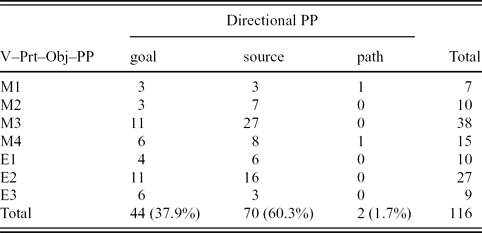
The distribution of these three types of directional PP in the ME and EMODE V–Prt–Obj–PP examples is presented in table 6.
The distribution of goal, source and path directional PPs in Middle English and Early Modern English
The figures in table 6 show that 60.3% of the directional PPs in the V–Prt–Obj–PP order encode source, followed by 37.9% goal directional PPs, and only 1.7% path directional PPs. While a syntactic and semantic asymmetry between goal and source directional PPs has been observed for PDE (see, e.g., Nam Reference Nam, Ettlinger, Fleisher and Park-Doob2004), it is not clear that goal and source directional PPs prefer a different position with respect to the particle.
Another possibility is that there is a syntactic difference between directional PPs in earlier English and PDE. Gries's observation that, in PDE, directional PPs typically form a (semantic) constituent with the particle would explain why the particle–directional PP string is not easily interrupted by the object of the particle verb. The fact that this latter option is the preferred option in earlier stages of English could suggest that, at that time, directional PPs in fact did not form a (semantic) constituent with the particle. Instead of post-modifying the particle, they could function as independent VP-adverbials. Evidence for this comes not only from the ME and EMODE data, which show a preponderance of V–Prt–Obj–PP orders, but also from OE, where the string ‘preverbal particle–verb’ is never interrupted. Directional PPs are never attested in *Prt–PP–V order, but instead typically follow the verb (Prt–V–PP), as illustrated in (18).
(18) & hie ða fixas uptugon of þære ea, . . .
and he the fish up-drew from their water
‘and he drew the fish up from their water, . . .’ (coverhom, LS 17.2 [MartinVerc 18]: 230.2381)
This suggests that, instead of forming a constituent with the particle, directional PPs are VP-adjoined. This state of affairs is straightforwardly accounted for by the syntactic analysis adopted here, in which the V–Prt–Obj order is derived by merging the verb and the non-projecting particle into a complex head. If the directional PP formed a constituent with the particle, the particle would be interpreted as maximal (i.e. the particle projects a phrase), as shown in (19a). In this scenario, the particle could not merge into a complex syntactic head with the verb, and the V–Prt–Obj–PP order could not be derived. However, if directional PPs were VP-adverbials in earlier English, they would be adjoined to V'. This is illustrated in (19b).
(19)

The structure in (19b) allows for the V–Prt–Obj–PP order: the particle does not necessarily project a phrase when a directional PP is present (because the latter does not modify the particle) and can therefore merge with the verb to form a complex head. The observed difference in word order preference of directional PPs in ME and EMODE on the one hand and PDE on the other hand can therefore be explained as being the result of a syntactic difference: directional PPs underwent a change from VP-adverbial to particle post-modifier.
Since directional PPs strongly favour the V–Prt–Obj order in both ME and EMODE, examples of transitive particle verbs with a following directional PP were excluded from the rest of the study, to prevent skewing of the results.
A third possible morphosyntactic motivation I will discuss here is definiteness of the object. A number of studies on PDE particle verbs have pointed out the influence of the definiteness of the object on the word order distribution of particle verbs (e.g. Bolinger Reference Bolinger1971: 61–6; Chen Reference Chen1986: 87–8; Gries Reference Gries1999: 119–20). The typical function of definite NPs is to refer back to an NP earlier in the discourse, rather than introducing a new referent (see e.g. Bolinger Reference Bolinger1971: 64–5). Since given items have a tendency to occur in the V–Obj–Prt order, definite objects are expected to favour this order, whereas indefinite objects are expected to favour the V–Prt–Obj order. As Prince (Reference Prince, Mann and Thompson1992: 299–300) notes, the notion of definiteness ‘has been subject to a good deal of confusion’, in that it has been variously defined as a formal property of NPs and as a conceptual category. For this study, I used Huddleston & Pullum et al.'s (Reference Huddleston and Pullum2002: 356–7) definition of definiteness, which includes a comprehensive list of determiners, marking them as definite or indefinite markers of NPs on the basis of formal criteria.Footnote 7
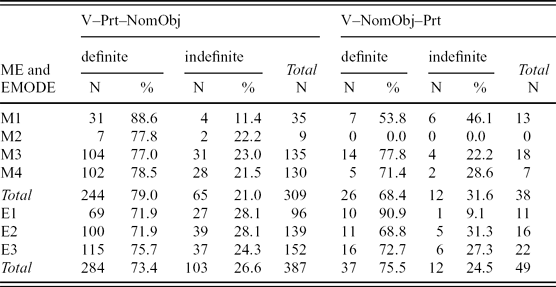
Table 7 shows the distribution of definite and indefinite objects across the two word orders in ME and EMODE.
The relation between definiteness of the object and particle position in Middle English and Early Modern English
Comparing the overall figures for ME and EMODE, we see that the number of indefinite objects in the V–Prt–Obj order increases (from 21.0% to 26.6%) and that the number of definite objects in the V–Obj–Prt order increases (from 68.4% to 75.5%). These figures suggest a tendency towards a correlation between definiteness of the object and particle verb word order.
Some examples of definite particle verb objects are presented in (20).
(20)
The possessive determiner (Iacob ‘Jacob's’) in (20a) marks the object Iacob sones ‘Jacob's sons’ as definite (‘the sons of Jacob’; cf. Huddleston & Pullum et al. Reference Huddleston and Pullum2002: 467). In (20b) it is the possessive determiner his which does the same for the object his sleeues ‘his sleeves’.
Some examples of indefinite particle verb objects are presented in (21).
- (21)
(a) Also ȝif I caste owȝt a feend in vertew of Belsebub, . . .
also if I cast out an enemy in virtue of Beelzebub, . . .
‘Also, if I cast out an enemy in virtue of Beelzebub, . . .’ (M3; CMWYCSER, 408.3275)
(b) By this tale ye may se that anger oftymys puttyth away bodely payne.
‘By this tale you may see that anger often puts away bodily pain.’
(MERRYTAL-E1-P2, 67.106)
In both (21a) and (21b), the indefinite object (a feend ‘an enemy’ and bodely payne ‘bodily pain’ respectively) comes after the particle.
In sum, while the ME and EMODE data do not reveal a clear correlation between definiteness of the object and particle verb word order, they do show an increase in definite objects favouring the V–Obj–Prt order and indefinite objects favouring the V–Prt–Obj order. This development seems to have continued after the EMODE period, with the result that PDE shows a rather strong correlation between definiteness and word order (e.g. Bolinger Reference Bolinger1971: 61–6; Chen Reference Chen1986: 87–8; Gries Reference Gries1999: 119–20). The increase may be due to the increasing role of information structure (see section 4.2). Definiteness and givenness are linked in terms of referentiality in that definiteness ‘constitutes an important grammatical correlate of the distinction between identifiable and unidentifiable referents’ (Seoane Reference Seoane, van Kemenade and Los2006: 380). The increasing role of definiteness of the object may thus reflect the general increase in the role of information-arranging strategies.
4.2 Information-structural motivation
4.2.1 Defining given and new information
The given/new dichotomy is a familiar one in the literature on information structure, but, as Kruijff-Korbayová & Steedman (Reference Kruijff-Korbayová and Steedman2003: 250) point out, terminologies in the area of information structure proliferate, and other dichotomies, such as topic/comment, theme/rheme, background/focus, are also used (see Kruijff-Korbayová & Steedman Reference Kruijff-Korbayová and Steedman2003: 254 for a diagrammatic summary of information structure terminologies). This no doubt reflects the fact that a precise characterisation of the given/new dichotomy continues to be a matter of debate (see also Prince Reference Prince and Cole1981; Petrova & Solf Reference Petrova, Solf, Hinterhölzl and Petrova2009, among others). Indeed, information-structural phenomena are ‘complex and not yet fully understood’ (Kruijff-Korbayová & Steedman Reference Kruijff-Korbayová and Steedman2003: 250), and studies focusing on the interaction between information structure and syntax may contribute to a better understanding.
For this study I adopt Prince's (Reference Prince and Cole1981) widely used ‘assumed familiarity’ scale, which has three values: (i) new, (ii) inferrable and (iii) evoked. At one end of this scale are the new items, which may either be brand-new or unused items that are known to the hearer but not activated, as illustrated in (22). In this example, the word malencolye ‘melancholy’ does not occur in the (immediate) preceding context.
(22)

At the other end of the scale are evoked items, which may either be evoked textually or situationally (e.g. items referring to a referent that is salient in the immediate physical or spiritual surroundings), as illustrated in (23).
- (23)
(a) textually evoked
shee answered and said it was by reason of the bad sent and ill fauours of the Askers, and of the filty corrupt matter, which did run from the foresaid Cauterized Strumous swellings, that greatly offended her stomacke, and by reason of the sensibilitie of the grieued partes, which were sharpe, mordant and byting . . . So after, I appointed her to bee drest twise a day with conuenient remedies, and then by the vse of some metalline instruments, onely to apprehend and to pull out part of the foresaid Strumous swellings
‘she answered and said it was because of the bad smell and ill help of the oppressors, and of the filthy corrupt matter, which ran from the aforementioned seared strumous swellings that greatly upset her stomach, and because of the sensitivity of the afflicted parts, which were sharp, incisive and biting . . . So afterwards, I appointed her to be dressed twice a day with convenient remedies, and then by means of the use of some metallic instruments, only to apprehend and to pull out part of the aforementioned strumous swellings.’ (CLOWES-E2-P2,63.176–181)
(b) situationally evoked
Then desired he all the people thereaboute to pray for him, and to beare witnes with him that he should nowe there suffer death in and for the faith of the holy chatholik churche. Whiche done, he kneled downe, and after his prayers said, turned to thexecutioner, and with a cheerefull countenaunce spake thus to him: ‘Plucke vpp thy spirites, man, and be not afrayde to do thine office;’
‘Then he desired all the people thereabouts to pray for him, and to bear witness with him that he should then suffer death in and for the faith of the holy Catholic church, which done, he kneeled down, and after having said his prayers, turned to the executioner, and with a cheerful countenance spoke to him thus: “Pluck up your courage, man, and do not be afraid to do your office;”’ (ROPER-E1-P2,103.151–152)
Inferrable items are items that ‘may logically be assumed by the listener according to the entities already evoked in the context’ (Petrova & Solf Reference Petrova, Solf, Hinterhölzl and Petrova2009: 135), for example when there is a containing relationship (set–member, e.g. eggs–one of these eggs; Prince Reference Prince and Cole1981: 236) or an analogy relation (e.g. bus–driver; Prince Reference Prince and Cole1981: 236), as illustrated in (24).
(24)
I will use the term ‘given object’ for inferrable and evoked objects, and the term ‘new object’ for brand-new objects and unused objects. Thus, the notions ‘given’ and ‘new’ are not just bound to textual pre-establishment.Footnote 8
Section 4.2.2 will examine the influence of given/new objects on particle placement in ME and EMODE.
4.2.2 The influence of givenness of the object in Middle and Early Modern English
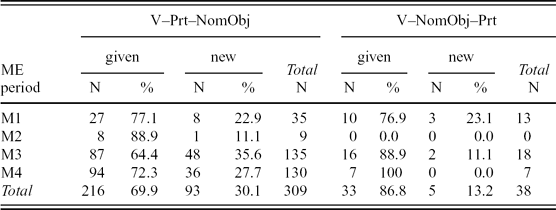
The distribution of given and new objects in V–Prt–Obj examples and in V–Obj–Prt examples in ME is presented in table 8. Pronouns and heavy objects are excluded.
The distribution of given and new objects across the two word orders in Middle English
The figures for V–Prt–Obj show an increase in the number of new objects occurring in this order (with a slight drop in the M4 period).Footnote 9 The figures for V–Obj–Prt show an increasing predominance of given objects (there are no examples of V–Obj–Prt in M2).Footnote 10
The examples in (25) have given objects, in V–Prt–Obj order in (20a), and in V–Obj–Prt order in (25b).
(25)
In both examples, the object of the particle verb is mentioned in the preceding discourse (‘textually evoked’). Although the object þe quyture ‘the pus’ in (25b) is not mentioned literally in the preceding context, it counts as given because it is co-referential with þe gaderynge ‘the suppurated swelling’.
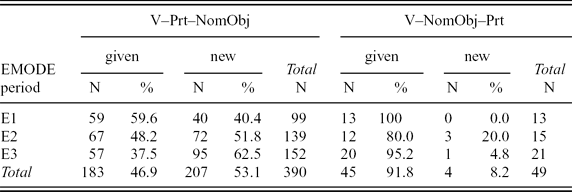
The distribution of given and new objects across the two word orders in EMODE is presented in table 9.
The distribution of given and new objects across the two word orders in Early Modern English
Table 9 clearly shows that the increase of new objects in the V–Prt–Obj order, observed for ME, continues in EMODE. Likewise, the increase of given objects in the V–Obj–Prt order observed for ME continues into the EMODE period: the percentages for subperiods E1 and E3 are higher than those for each of the ME subperiods (though the percentage for the E2 subperiod shows a drop below 90%).
The EMODE examples in (26) have given objects, in V–Prt–Obj order in (26a) and in V–Obj–Prt order in (26b).
- (26)
(a) . . . and pulleth it to hym and cutteth the wede fast by the erthe and with his hoke he taketh up the wede . . .
‘. . . and pulls it towards him and cuts the weed close to the earth and with his hook he picks up the weed . . .’ (FITZH-E1-P2, 31.157–159)
(b) For his dissimulacion onelye, kepte all that mischyefe vppe.
‘Because of his dissimulation alone, (he) kept all that mischief up.’ (MORERIC-E1-P2, 46.77)
The object the wede ‘the weed’ in (26a) is mentioned in the preceding discourse. The object all that mischyefe ‘all that mischief’ in (26b) is also given, as reflected in the presence of the demonstrative determiner that.
This section showed that there was a rise in the role of information structure in ME and EMODE. Given objects are increasingly found in the V–Obj–Prt order and new objects increasingly appear in the V–Prt–Obj order. The fact that the choice between the two word orders, which are semantically identical, became increasingly regulated by information structural considerations (V–Prt–Obj order for new objects, V–Obj–Prt order for given objects), may have contributed to the survival of both word orders into PDE. After the loss of finite verb-movement and the regularisation of word order, completed by the end of the EMODE period, the word order alternation of particle verbs became a fixed morphosyntactic pattern. The structures for the two word orders are given in (27) (repeated from (4) above).
(27)

The particle is an optionally projecting word which only projects a phrase when triggered by syntactic factors (e.g. presence of a modifier) and/or pragmatic factors (e.g. givenness of the object). This section showed that the latter became increasingly important as a triggering factor in the course of the ME and EMODE periods.Footnote 12
5 Concluding remarks
This article has demonstrated that a number of linguistic motivations underlie the choice of particle verb word order in ME and EMODE. Morphosyntactic motivations have the greatest impact, especially the heaviness (i.e. syntactic complexity) of the object. Heavy objects strongly favour the V–Prt–Obj order in both ME and EMODE, as they do in PDE. The presence of a PP modifier also influences particle placement in ME and EMODE, as it does in PDE. However, the ME and EMODE examples show a different word order preference (V–Prt–Obj–PP) than PDE examples (V–Obj–Prt–PP). It was argued that this is due to a difference in the syntactic status of directional PPs: VP-adverbials in earlier English, modifiers of the particle in PDE. The correlation between definiteness of the object and particle verb word order was weaker in ME and EMODE than in PDE, but the ME and EMODE data do show an increase in the role of definiteness of the object. It was suggested that this increase may reflect a general increase in the role of information-arranging strategies.
This article has also demonstrated that the impact of the informational factor ‘givenness of the object’ increases in the course of ME and EMODE: there is an increasing correlation between V–Obj–Prt order and given objects on the one hand, and between V–Prt–Obj order and new objects on the other hand.
In his study on PDE particle verbs, Gries (Reference Gries2003: 150) finds that ‘the correlation between particle placement and morphosyntactic variables is higher than the one between particle placement and discourse-functional variables’. The same conclusion can be drawn for the ME and EMODE data examined in this article: the morphosyntactic variables heaviness of the object and presence of a PP modifier have a strong impact on particle verb word order, while the discourse variable givenness of the object has a lesser – though increasing – effect (the latter also holds for the morphosyntactic variable definiteness of the object).
The possible reason for the survival of both particle verb word orders was also addressed. The fact that the V–Prt–Obj order was predominant from EME onwards (see Hiltunen Reference Hiltunen1983; Elenbaas Reference Elenbaas2007) raises the question of why the alternative V–Obj–Prt order has survived. This is especially surprising given the semantic identicalness of the two word orders, a situation which often leads to the loss of one of the two (competing) forms. The results presented here for ME and EMODE suggest that the V–Obj–Prt order has undergone functional specialisation. Thus, the V–Obj–Prt order has come to provide the appropriate (morpho)syntactic context for pronominal objects and for various modifiers, including modifiers of the particle (e.g. right) and post-modifying PPs. In addition, it provides an appropriate discourse context for given objects (and for focused particles). This could explain the survival of the two word orders into PDE, and underpins the view that the word order alternation of English particle verbs is not, and never was, an instance of free variation. The proposed syntactic analysis, in which the particle optionally projects a phrase depending on the linguistic context, offers an explanation for the interaction between structure (the particle verb word orders) and usage (i.e. the motivations underlying the choice for one order or the other) and how this interaction may change over time.
The ME and EMODE findings presented in this article and the findings for PDE lead us to expect a further increase in the role of information structure and definiteness in particle verb word order in Late Modern English (LMODE, roughly from 1700 to 1900). In addition, we expect heaviness of the object and presence of a PP modifier to show strong effects on particle verb word order in LMODE, just as in ME, EMODE and PDE. I leave this for future research.