Introduction
Policy issues regarding pension design are at the forefront of public debates. Not only are the dynamics of population ageing gaining momentum, but numerous studies also suggest that a generation of soon-to-retire workers will be poorly prepared to meet their financial obligations. Studies by Bernheim (Reference Bernheim1993, Reference Bernheim and Wise1997) suggest that American baby boomers are saving just one-third of what they need in order to retire comfortably. A more recent study by Munnell, Webb and Golub-Sass (Reference Munnell, Webb and Golub-Sass2007) revealed that 43 per cent of American households are at risk of a substantial income decline upon entering retirement. To prepare the American pension system for the future consequences of an ageing population, reforms have been implemented in which the responsibility for retirement saving is shifted from employers and the government to the individual worker. Pension funds in the United States of America (USA) are in the process of undergoing finance reforms, as witnessed by the massive shift over the past two decades from defined benefit (DB) to defined contribution (DC) plans. This shift has not gone unnoticed by American workers, however, for according to Helman et al. (Reference Helman, Greenwald, Copeland and Van Derhei2006), nearly half of the people they surveyed indicated that the shift from DB to DC plans had left them less confident in their level of future benefits.
In the present study, we analyse perceptions of the pension savings adequacy of American and Dutch workers, as well as the institutional, social and psychological forces that affect them. For quite some time, economists have relied on the standard neoclassical models of lifetime consumption to derive lessons and judgements on the current state of saving. Three implicit assumptions in these models are: (1) that institutions do not matter; (2) that individuals have the cognitive ability to solve the problem of financing a steady stream of consumption over their lifetime independently; and (3) they have sufficient willpower and skills to carry out optimal plans. Thaler has provided clear evidence that many people lack the ability to delay gratification and exercise self-control, both of which are important determinants of saving behaviour, and stated that ‘if we are to understand why people are saving so little and are to make helpful recommendations as to how to get people to save more, then we have to incorporate more of the psychology of savings into our economic models’ (1994: 186).
In this paper we take the position that retirement savings decisions and perceptions of savings adequacy are linked to: (a) the institutional setting in which one lives and works, (b) social forces that may or may not stimulate one to save, and (c) psychological dispositions that may predispose one to plan and save for retirement. Many studies have documented the importance of psychological forces in relation to retirement savings: for an overview of the burgeoning literature, seeCamerer, Loewenstein and Rabin (Reference Camerer, Loewenstein and Rabin2003), Mitchell and Utkus (Reference Mitchell and Utkus2004), Thaler (Reference Thaler2005) and Benartzi and Thaler (Reference Benartzi and Thaler2007). Few studies, however, have examined the impact of social forces on private saving, and even fewer have considered the role of people's trust in the financial and governing institutions that play a major role in pension savings.
An international perspective on perceptions of savings adequacy should be particularly helpful in terms of understanding how different pension institutions affect private savings practices. Pension experts sometimes look with envy to the Dutch pension system, in which enrolment is automatic, pension replacement rates are high (cf. Organisation for Economic Cooperation and Development (OECD) 2007), and pension funds offer low transaction costs in providing an adequate pension. One way such low pension financing transaction costs can be attained is by generating economies of scale. This is achieved by making pension savings mandatory. Ambachtsheer even claimed that ‘Holland is currently the number one pension country in the world’ (2007: 43), but it is unclear how reforms toward mandatory retirement savings would interact with (or conflict with) individual dispositions to plan and save for retirement. It is also unclear how reforms aimed at increasing individual saving responsibility would interact with the social and psychological forces that shape workers' savings decisions, as well as their perceptions of savings adequacy.
This article describes differences in perceived savings adequacy among Dutch and American workers using comparable samples of individuals drawn from the two countries. For the purposes of this investigation, savings adequacy was conceptualised in two qualitatively different ways. First, we measured perceived savings adequacy using a set of questions designed to elicit individuals' subjective perceptions of the construct. Perceived savings adequacy, in this instance, is assumed to be the outcome of an evaluation that compares one's expected retirement income with the income level believed to be required in order to live comfortably. Binswanger and Schunk (Reference Binswanger and Schunk2008) recently showed that people have a fairly good idea of the level of pension benefits needed to live comfortably in retirement. As a second measure of savings adequacy, we used individuals' best estimate of their expected retirement income replacement rate. Examining individuals' perceptions of savings adequacy represents an important extension of previous work, which has generally relied on objective measures of retirement saving. Most economic studies have used either the gap between actual wealth holdings and an optimal wealth path in order to measure the adequacy of one's savings (cf. Engen, Gale and Uccello Reference Engen, Gale and Uccello1999; Scholz, Seshadri and Khitatrakun Reference Scholz, Seshadri and Khitatrakun2006), or the divergence between actual pension income levels and some benchmark income standard. The present study is designed to complement these other types of studies and is, to the best of our knowledge, the first to investigate simultaneously perceived savings adequacy and self-reported replacement rates. Examining both types of measures should enable us to assess the extent to which perceptions of savings adequacy are linked to more objective indicators, such as one's anticipated replacement rate. Simply stated, our goal is to explore the extent to which perceptions of savings adequacy mirror actual future resource needs, with the latter being based on an estimate of one's expected replacement rate.
Institutional background: two pension cultures
Before examining the determinants of perceptions of retirement savings adequacy, we first provide background information on the two pension cultures that are featured. Old-age pension programmes traditionally have two main objectives: an insurance function, to help workers maintain an adequate standard of living during retirement by replacing income lost from the cessation of work; and to prevent destitution in old age, by redistributing income towards low-income pensioners. Pension programmes in countries around the world differ widely with respect to the balance of these two objectives (OECD 2007; Whitehouse Reference Whitehouse2007), which can clearly be seen by comparing the pension and retirement systems in the USA and The Netherlands.
The Dutch pension system has two main tiers. First of all, a flat-rate public pension scheme (the so-called old-age pension law or Algemene Ouderdoms Wet [AOW: Old Age Security Law], comparable to what is commonly referred to as ‘social security’ in the USA). Secondly, to supplement the public pension there are earnings-related occupational plans (often referred to in the USA as ‘employer pensions’). Although Dutch employers are not required to offer pension schemes to their employees, the force of collective wage agreements is strong and 91 per cent of employees are covered by at least some form of occupational pension. The overwhelming majority of occupational pension contracts – 96 per cent of all employees in 2006 – are of the DB type. With DB plans, employees can count on a defined level of retirement income based on a computation that uses their salary and years of service (often up to a maximum of 70 per cent of their average gross salary). After-tax replacement rates are usually substantially higher due to lower marginal tax rates in retirement. For example, a pre-tax replacement rate of 70 per cent is tantamount to an after-tax replacement rate that exceeds 85 per cent (Alessie and Kapteyn Reference Alessie and Kapteyn2001). Nearly 80 per cent of occupational pension premiums are paid for by the employer; the remainder by the employee. Post-retirement indexing of benefits is the rule, as virtually all DB pension contracts offer conditional indexation for cost-of-living increases, but in times of crisis or high inflation, pension funds have the discretionary power to refrain from indexing benefit entitlements and pension entitlement can even be lowered if the pension reserves drop below a certain threshold. The pension regulators, that is, the Dutch Central Bank and under extreme circumstances the Minister for Social Affairs, have the power to make pension funds take corrective measures when the value of pension assets becomes clearly smaller than the value of future pension liabilities. With the credit crisis of 2008–09, the majority of Dutch pension funds encountered major asset losses and a decrease in interest rates. As a result, pension fund boards had to make plans that involved a combination of raising pension premiums, refraining from indexation, and in some exceptional cases lowering pension benefits. The credit crisis brought to the fore the notion that although the second tier may be envisioned as a defined-benefit system in which employers bear the investment risk. In practice, it can be interpreted as a collective defined-contribution system in which this risk is shifted to employees and retirees (see also Ponds and Van Riel Reference Ponds and Van Riel2009).Footnote 1
The third tier, namely voluntary retirement savings, until the 1990s played a negligible role in Dutch households, but recently voluntary arrangements have begun to emerge in which individuals can enter into private pension arrangements with an insurance company to ‘top up’ their retirement income. These private savings plans are subsidised by the state to cover income shortfalls in old age (i.e. for those with an income replacement rate of less than 70 per cent). The role of retirement annuities is also becoming more popular among those who seek early retirement. Given the mandatory character of the Dutch pension system, relatively few older people are poorly supported in retirement, and in 2003 only six per cent were living at or below the poverty level. Among Dutch citizens, low-income older people are over-represented by single women who worked in part-time jobs, and by first-generation immigrants who failed to accumulate sufficient public pension rights before leaving the workforce.
The structure of the American retirement financing system also has three tiers. First, there is the social security programme (also known as the Old Age, Survivors, and Disability Insurance or OASDI), which is a means-tested scheme designed to provide an income ‘safety net’ for retirees. For approximately 20 per cent of Americans aged 65 or more years, social security represents their only stream of income (US Department of Labor 2005). The second tier is employer-sponsored occupational pensions. In contrast to their Dutch counterparts, American employers are not required to provide pension benefits for their employees. Among those employers that do offer pension contracts, they are not required to cover all of their employees (e.g. low-income and part-time workers can be excluded). Employers often require a minimum tenure period before an employee can participate in a pension plan, and a vesting period is routinely applied that limits an employee's access to funds for a specified period (e.g. ten years). In the past, most Americans were covered by DB pension plans, but since 1997 the number of individuals in DC programmes has outnumbered those in DB plans.
The third pillar of the US pension system, voluntary saving arrangements, take the form of private saving instruments such as annuities and other forms of personal investments. This pillar is far more important in the USA than in The Netherlands. According to Börsch-Supan (Reference Börsch-Supan1998), 21 per cent of Americans' pension income comes from private savings and accumulated wealth, whereas in The Netherlands the corresponding figure is only four per cent (see also OECD 2001). To highlight the main differences across countries, in The Netherlands a host of individual risks and responsibilities are carried and organised at a collective level. Public pensions are organised through the AOW, and financed by a payroll tax on income up to a certain level. Thus, public pension premiums are de facto income taxes. Moreover, supplementary pension premiums are mandatory. In the USA, the burden of risk and responsibility for retirement saving is shouldered by the individual worker. Many pension plans are voluntary although many employers make significant contributions to employee pensions, and outcomes are highly uncertain as most pensions rely on DC contracts. Besides pensions and personal savings, older Americans can rely on social-security benefits, but this safety net is insufficient to provide for an adequate standard of living for all. Although the recommended income replacement rate is 70 per cent of one's final salary, as in The Netherlands, most workers attain a retirement income that is below this level. VanDerhei (Reference VanDerhei2007) estimated that even if employers who currently offer 401(k) plans were to make enrolment into those plans automatic, the median replacement rates would range from 52 per cent for the lowest-income quartile to 67 per cent for the highest.Footnote 2
Theoretical background
The most common framework used to explain and assess the development of public and private savings is the lifecycle consumption model, a stylised model of how consumers make inter-temporal choices with respect to savings and consumption (seeBlanchard and Fischer Reference Blanchard and Fischer1989). Three tacit assumptions made in these standard neoclassical models of lifetime consumption are that: (1) people have the cognitive ability to solve inter-temporal maximisation problems independently; (2) people have sufficient willpower and skills to carry out optimal plans; and (3) at a very basic level, institutions do not matter. The characteristics of public and privately-designed savings plans are inherently transparent, which effectively neutralises fiscal policy choices or other collective savings choices. In short, the lifecycle model of savings offers a good starting point to conceptualise retirement savings, but tends to neglect three inextricable elements of private savings decisions:
• Institutional forces: the fact that individual saving decisions are shaped by the quality and design of pension institutions.
• Social forces: the fact that individual saving decisions are shaped by the social context in which they are made.
• Psychological dispositions: the fact that individual saving decisions are affected by one's cognitive capabilities, the ability to plan over time, and the perseverance required to carry out those long-range plans.
Each of these three elements is discussed in turn.
Pension institutions
At the most basic level, anyone who saves for the future puts their trust in a system that will serve as an insurance function by protecting property rights over time. Or as Hyde, Dixon and Drover (Reference Hyde, Dixon and Drover2007: 457) stated: ‘trust reduces complexity, because it enables people to transfer responsibilities for activities that they themselves are not sufficiently competent to undertake’. The most rational decision, if one lacks pension knowledge or the willpower to see a plan through to its completion, is to outsource one's investment and management decisions to a financial intermediary. Evaluating the adequacy of one's savings under these circumstances boils down to the level of trust individuals have in their financial intermediaries, or in the institutions that govern retirement savings. This issue of trust comes into play for all three pillars of the retirement financing system. First, there needs to be a level of trust in the state, not only as the provider of public pensions, but also as the guardian of the public interest that regulates the pension and insurance industry. Second, there needs to be a level of trust in the pension funds that offer insurance contracts, and in those who manage them; and finally, with respect to personal savings, there needs to be trust in private intermediaries like banks and insurance companies that offer savings accounts and pension insurance products. What determines the level of trust in each of these institutions is difficult to determine, but it is generally accepted that expectations of future conduct will be in accordance with the institutions' acquired reputation and their past performance. Appropriate regulatory guidelines, prudent oversight and a track record of no bankruptcies or bank failures are all elements of an institutional setting that generates trust. Returning to the present investigation, this brings us to formulate the institutional trust hypothesis. Simply stated, this posits that higher levels of trust in the prevailing pension institutions will be associated with higher levels of perceived savings adequacy.
Social forces
With regard to the social forces that influence savings decisions, we distinguish between two related forms of social support. First, individuals' decisions are often influenced by the members of one's social network (spouse, colleagues and friends) who provide social norm cues regarding the ‘right’ course of action. It is widely acknowledged that retirement decision-making is a household affair, and among older adults, spousal support for retirement increases the likelihood of an early exit from the workforce (Henkens Reference Henkens1999). Spousal influences may also be apparent much earlier in the lifecourse, as with retirement savings' decisions. For example, one spouse may encourage the other to participate in a programme of retirement savings in order to ensure a comfortable standard of living in old age. Duflo and Saez (Reference Duflo and Saez2002) recently showed that peer effects also have an important influence on workers' savings decisions. As such, we propose the social support hypothesis. That is, the stronger the support from spouses, friends and colleagues for saving for retirement, the more likely workers will be to save, thereby increasing the likelihood that workers will perceive their pension savings as adequate.
Early parental socialisation processes constitute a second social mechanism by which workers are believed to be influenced to save. This complex form of intergenerational socialisation involves parents modelling adaptive behaviours for their children to observe (Bandura and Mischel Reference Bandura and Mischel1965), thereby providing not only guidance but also the foundation of adopted habits. In short, parents who have conscientiously saved for their own retirement serve as role models for their children. In fact, Bernheim, Garrett and Maki (Reference Bernheim, Garrett and Maki2001) found that those who were encouraged to save as children saved more as adults than individuals who had not received similar encouragement. Furthermore, a recent study by Webley and Nyhus (Reference Webley and Nyhus2006) showed that features of economic socialisation (such as discussing financial matters with parents) not only had an impact on children's economic behaviour, but also on their economic behaviour in adulthood. Accordingly, in the present study we propose the socialisation hypothesis. Specifically, exposure to positive role models and adaptive financial learning experiences during childhood will have a positive effect on retirement savings, thereby increasing the likelihood that an individual will perceive high levels of savings adequacy.
Psychological dispositions
The third group of factors believed to influence retirement savings decisions and perceptions of savings adequacy involve an individual's psychological disposition to save. Within the same institutional or household context, individual saving practices vary partly as a result of differences in the skills, attitudes and abilities required for successful financial planning. Three different psychological dispositions are assumed to be particularly important when it comes to an individual's retirement savings: future time perspective, level of financial knowledge, and the extent to which he or she engages in financial planning. We elaborate on these factors below.
Future time perspective is a psychological dimension that indicates the extent to which individuals focus on the future as opposed to the past or the present. Conceived of by psychologists as a personality trait, several studies have shown that time orientation has a direct or indirect influence on retirement planning and saving (cf. Burtless Reference Burtless, Schaie and Carstensen2006; Hershey, Henkens and Van Dalen Reference Hershey, Henkens and Van Dalen2007; Howlett, Kees and Kemp Reference Howlett, Kees and Kemp2008; Lusardi Reference Lusardi and Aaron1999). Although orientation to time has been conceptualised in various ways (Seijts Reference Seijts1998), in the present study a person's forward perspective is indicated by how far into the future an individual looks when making decisions about his or her lifecourse. There is some evidence that this form of future orientation may increase over the course of the adult lifespan (Padawer et al. Reference Padawer, Jacobs-Lawson, Hershey and Thomas2007). We predict that individuals with a stronger future time perspective will report higher levels of perceived savings adequacy (i.e. the future time hypothesis).
The second psychological dimension involves one's self-reported level of financial knowledge. A frequently identified cognitive predictor of planning and saving is a person's level of financial knowledge. High-knowledge individuals have consistently been shown to plan and save more than those with low knowledge (Banks and Oldfield Reference Banks and Oldfield2007; Chan and Stevens Reference Chan and Stevens2003; Ekerdt and Hackney Reference Ekerdt and Hackney2002; Grable and Lytton Reference Grable and Lytton1997; Hershey et al. Reference Hershey, Henkens and Van Dalen2007). Mitchell and Moore (Reference Mitchell and Moore1998) concluded that many people fail to plan for retirement because they lack sufficient domain-specific knowledge. Financial knowledge, which has been demonstrated to increase as a function of both formal interventions and hands-on investment experience, has been shown to be an excellent predictor of asset accumulation (Bernheim, Garrett and Maki Reference Bernheim, Garrett and Maki2001). Findings on the relationship between financial literacy and age in adulthood have been equivocal, with some studies showing a positive relationship (e.g. Lusardi and Mitchell Reference Lusardi and Mitchell2007) and others reporting non-significant associations (e.g. Bernheim Reference Bernheim, Mitchell and Schieber1998). We predict that financial knowledge will be positively related to perceived savings adequacy (i.e. the knowledge hypothesis).
Finally, in the present investigation one's level of engagement in financial planning activities has been included as a predictor of savings adequacy. Financial planning activities span diverse behaviours, including information-seeking activities such as reading books or visiting websites, meeting with a financial investment counsellor, attending seminars, or participating in a workplace retirement preparation programme. They may also involve instrumental activities such as gathering, organising and reviewing one's financial and investment records, calculating how much will be needed to attain a desired standard of living, or ascertaining one's projected level of pension and social-security benefits. Lusardi (Reference Lusardi and Aaron1999) found that heads of households who had not engaged in planning activities had accumulated significantly less wealth than households in which the head had done some planning, and Ameriks, Caplin and Leahy (Reference Ameriks, Caplin and Leahy2003) reached similar findings. We predict that one's level of financial planning activities will be found to be positively related to perceived savings adequacy (i.e. the planning hypothesis). In other words, the more one plans for the future, the higher the perceived savings adequacy.
In sum, it is believed that three groups of factors (institutional, social and psychological) are influential when it comes to individuals' retirement saving decisions and perceptions of savings adequacy. We expect a priori that the individual and social forces are more important in cultures that stress individual responsibility in matters of retirement. Institutional-level factors, in contrast, are expected to be of greater importance in societies where many retirement savings decisions are made at the collective level; that is, in societies in which trust in the institution is paramount.
Methods and data
The data
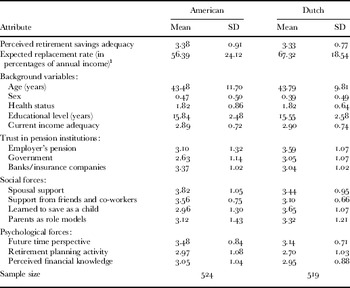
The data were collected in the USA and The Netherlands using a core set of identical questions that had been back-translated to ensure conceptual equivalence. The Dutch participants were a subset of working individuals aged 25–64 years drawn from a large national panel survey conducted in March 2007 by CentERdata at the University of Tilburg. CentERdata maintains a representative internet-based panel of 2,000 households in The Netherlands. The panel is representative of the Dutch population with respect to sex, age, education, religion and regional distribution. The initial recruitment of panel members was based on a random sample of the population register (seeToepoel, Das and van Soest Reference Toepoel, Das and van Soest2008). The respondents were interviewed through the internet, and for those without internet access, the data were collected through a television Netbox system.Footnote 3 As such, there is no selectivity with regard to whether people have access to internet or not. Most respondents participate for around four years in the panel, during which time they are regularly interviewed on several topics. When a respondent leaves the panel, a replacement respondent is selected on the basis of socio-demographic characteristics to maintain representativeness. For the present analyses, only one member per household was eligible to avoid over-representation at the household level, and only panel members who had a spouse or partner at the time of questioning were sampled. This latter inclusion criterion was to enable examination of the household and social contexts that affect perceived savings adequacy. The American respondents were also married or had partners and were working adults aged 25–64 years, and they were surveyed in North Central Oklahoma during March 2007. Beside the use of different sampling methodologies in the two countries, the demographic structure of the Dutch and American groups differed primarily in terms of gender (see Table 1). Relative to the American sample, the Dutch sample slightly under-represented females, which reflects the relatively low labour-market participation rate of women in The Netherlands.
Socio-demographic and financial experience profiles of the Dutch and American samples

Note: 1. The sample sizes for the replacement rate variables are 515 (American) and 517 (Dutch). SD: standard deviation.
Variables and measures
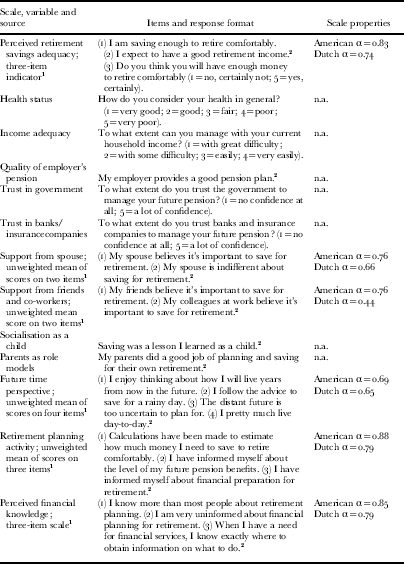
Five social-demographic indicators were also included in this study: age, gender, self-reported health status, level of education and perceived income adequacy. Each was measured along conventional lines. To ensure that educational levels were roughly comparable across nations, level of education was measured in 11 categories and the values transformed into effective years of education. Health status was included, as some experts have predicted the cost of out-of-pocket health-care expenses will outstrip the growth in (pension) income. Being in good health in old age seems to generate a double dividend; not only does it save on health-care costs, but it may also help people engage in the home production of goods and services (e.g. home-cooked meals instead of dining out) (Skinner Reference Skinner2007). Table 1 also shows the mean scores for a number of the scales that measure psychological and retirement constructs, and Table 2 provides a full description of each of those constructs. Table 2 also includes a description of scale items and characteristics. For the multi-item scales we present the Cronbach's alpha values that indicate the internal consistency (cf. Nunnally Reference Nunnally1978). Items for all five scales used the same five-point Likert-type response format. One of the central dependent measures in this study, namely retirement savings adequacy, was based on a three-item scale that included the following questions and assertions:
1. Do you think you will have enough money to retire comfortably?
2. I expect to have a good retirement income.
3. I am saving enough to retire comfortably.
Scale characteristics, psychometric properties, and wording of survey items for the psychological and retirement variables
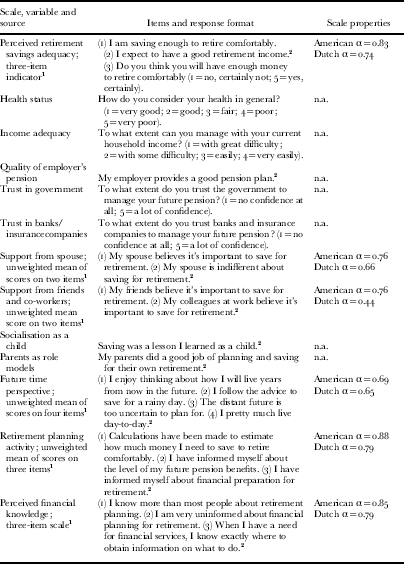
Notes: 1. Higher scores correspond to higher values of the attribute. 2. ‘1’ for ‘strongly disagree’ to ‘5’ for ‘strongly agree’. n.a.: not applicable. α: Cronbach's alpha.
Data sources: For The Netherlands, CentERdata survey; for the USA, authors' survey. For details see text.
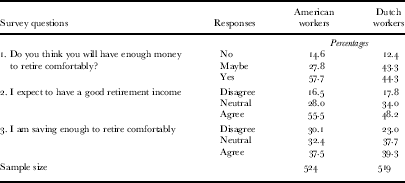
To facilitate the interpretation of the results, a breakdown of scores for each of the three savings adequacy items is presented (Table 3). The levels of disagreement by respondents give an impression of the level of under-saving for retirement, whereas the levels of agreement signal that retirement savings are perceived to be either adequate or more than adequate. As indicated by the first two items (questions 1 and 2 in Table 3), comparable proportions of American and Dutch employees had similar feelings about their retirement savings being inadequate. What is surprising, given the two different pension cultures, is that the first two questions suggest American workers were more satisfied with their savings than the Dutch. Dutch workers were more equivocal about the assessment of their retirement savings. This picture is to some extent corrected by the responses to the third question, which give the impression that American and Dutch workers were more or less equally satisfied that they had saved enough to retire comfortably (as judged by the percentage agreeing with that statement), and far more Americans were dissatisfied (30% disagreement level versus 23% among the Dutch). In that respect, the full-scale savings adequacy scores used in this study provide a more balanced view (see the top row of Table 1), showing that Dutch and American workers were more or less equally satisfied with their savings.
Perceived retirement savings adequacy among American and Dutch workers, 2007
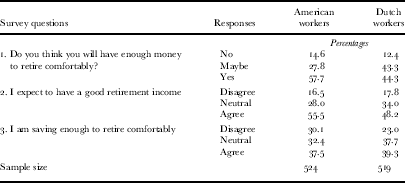
Data sources: For The Netherlands, CentERdata survey; for the USA, authors' survey. For details see text.
Multivariate analyses
The two dependent variables, perceived retirement savings adequacy and the expected replacement rate, were treated as continuous variables. To estimate the effects of the predictors we used ordinary least-squares regression. In the estimated models, institutional, social and psychological predictor variables were included together with a set of background variables to control for socio-demographic differences. These background variables included age, sex, health status, years of education and income adequacy. Unstandardised regression coefficients are presented. Given our use of a linear model and the consistent use of five-point rating scales (except income adequacy on a four-point scale), the coefficients are readily interpreted. Specifically, a coefficient of 0.2 on a five-point scale means that the difference between high and low scores for a given predictor will result in a full one point difference in retirement savings adequacy.
Results
Perceived savings adequacy
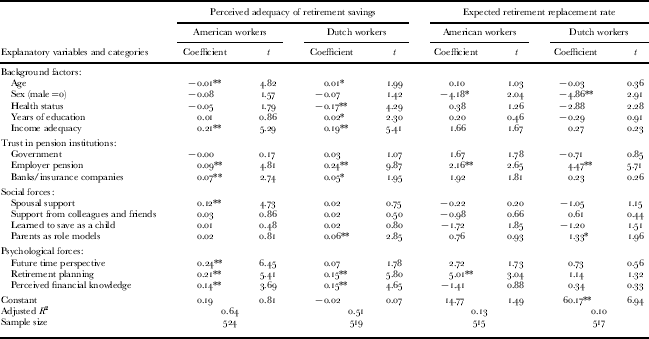
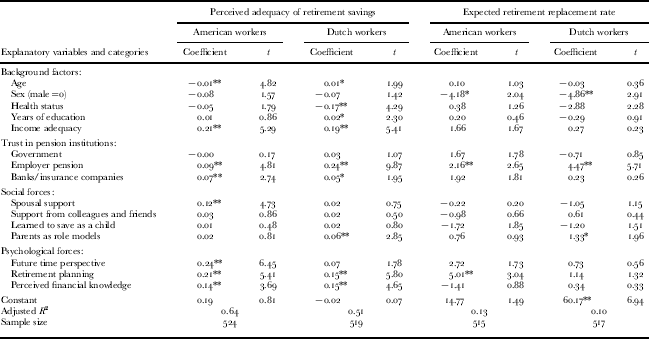
Table 4 shows the results of the regression analyses. Before we interpret the effects of most interest, the influence of the background variables warrants discussion. Perceptions of income adequacy exert more or less the same strong influence on the perceived retirement savings adequacy scores of both groups. More telling, however, are the differences across the groups. Health status had a strong and negative effect on savings adequacy among Dutch workers, and among the American group it also had a negative effect, but it was weaker and not statistically significant. Another telling difference was the effect that chronological age had on perceived savings adequacy. Among Americans, older workers were more negative than younger workers regarding the adequacy of their retirement savings, whereas in The Netherlands exactly the opposite applied. In The Netherlands, these age effects may represent the fact that older people are better protected than younger adults from pension reforms, and they can still count on relatively high replacement rates (generally based on final salaries or pay). Finally, educational level did not seem to matter much in terms of accounting for levels of perceived savings adequacy in either country, after controlling for the other sets of predictors in the model.
Ordinary least-squares regressions of perceived retirement savings adequacy and expected retirement replacement rates of American and Dutch workers
Significance levels: * p<0.05; ** p<0.01.
Turning to the main effects, it is apparent from the regression estimates that trust in pension funds had a far greater effect on savings adequacy among the Dutch than the American workers. As explained in the introduction, this difference is understandable, given that the Dutch pension system is highly regulated, has one of the highest capital funding ratios in the world (OECD Reference Padawer, Jacobs-Lawson, Hershey and Thomas2008: 12), and comprises mainly defined-benefit schemes. The picture is not so clear-cut with respect to the impact of social forces on saving adequacy. Among American workers, support from spouses was found to have a significant effect on savings adequacy, whereas among the Dutch such an effect was not significant. The effects of parental socialisation, however, were small if not absent. Being socialised to learn about saving appeared to be of no importance in the USA, whereas in The Netherlands, having parents who were role models was at least to a small extent related to retirement savings evaluations. The fact that social forces played a small role in both countries may be because they come into play only when it comes to actual savings behaviour. In the present study, we examined the influence of social forces on the evaluation of one's savings adequacy, which taps both saving behaviour as well as one's subjective impressions of the adequacy of that behaviour.
Finally, the effects regarding the set of dispositional variables were perhaps the most interesting findings and revealed the most telling differences between the American and Dutch pension cultures. Future time perspective had a very large effect on perceptions of retirement savings adequacy among American workers, whereas the comparable effect for the Dutch added nothing to the model's explanation. The effect of planning activities and financial knowledge were of more or less equal importance across the two groups. In short, what appeared to matter most in the American setting was the individual pensioner's mindset; in particular, one's level of future orientation and financial planning capabilities. What mattered most in the Dutch setting was trust in the pension fund that managed the worker's retirement assets. Interestingly, in The Netherlands one's level of future orientation played virtually no role in structuring perceptions of savings adequacy.
Expected replacement rates
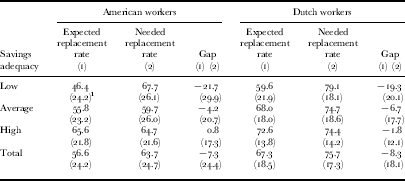
Perceived savings adequacy is assumed to be the outcome of an evaluation that compares one's expected retirement income with the income that is believed necessary to live comfortably. In the Dutch and American surveys, we asked the respondents not only what level of replacement rate they expected to receive in retirement, but also the level of replacement rate they needed in order to have a ‘good’ retirement. The ‘needed’ replacement question was formulated as follows: ‘Imagine your annual income just before you retire. What percentage of that annual amount do you think you would need in order to have a good retirement income?’ The expected replacement rate question was formulated as follows: ‘What percentage of your annual income just prior to retirement do you expect to receive after you retire?’ In Table 5, we present an overview of the differences across the two countries on these dimensions. It shows a cross-tabulation of employees who report different degrees of savings adequacy, their expected and needed replacement rates, and the gap between expected and needed replacement rates.Footnote 4 As seen in the table, the mean needed replacement rate was 75.7 per cent in The Netherlands, and 63.7 per cent in the USA.
Other differences across countries are clearly visible when one looks at the replacement rate levels in combination with their variance estimates (as measured by the standard deviation). Relative to Americans, Dutch workers at all levels generated higher expected replacement rates, accompanied by considerably less variability. Presumably, the higher variability among the Americans stemmed from the uncertainty that surrounded their expected retirement income. Another contributing factor is that the American system relies to a great extent on individual decision-making, whereas the Dutch pension system is highly centralised. Thus, it is not inconceivable that the former would generate a wider spread of replacement rates, and accordingly higher variability. The most surprising result, however, was that the gaps in replacement rates were more or less identical in both countries. In general, workers in the USA and The Netherlands with a high level of perceived savings adequacy saw a close connection between their expected and needed retirement income (note the very small replacement rate gap). This is in strong contrast to those who perceived their savings to be inadequate; among them the replacement rate gap in both countries was roughly 20 per cent.
We next examined the extent to which the expected replacement rate values were related to the main determinants of perceived savings adequacy (see Table 4). If the same factors that explain perceptions of savings adequacy also explain expected replacement rates, this may indicate that the perceptions are related to the accumulation of wealth. In this analysis, the most striking difference between the two samples was again that American workers who were active in retirement planning expected far higher replacement rates than those who were less involved. To give the reader an impression of the force of this effect, note that the difference in the expected replacement rate between those who exercised little planning (with score ‘1’) and those who were very actively involved in planning (score ‘5’), was 20 percentage points. In The Netherlands, in contrast, engaging in retirement planning activities did not lead participants to expect a higher replacement rate. What did appear to matter in The Netherlands was the level of trust in the employer's pension fund. The effect of a one-unit change in trust in the employer's pension fund increased the expected replacement rate by 4.5 percentage points. Trust in one's employer pension scheme also mattered among Americans, but much less (marginal effect of 2.2 percentage points). This may reflect the fact that in the USA, accumulated savings in pension funds are not as extensive as in The Netherlands. An important observation is that in both countries women expected lower replacement rates than men. To be more precise: the relative decrease in expected replacement rates was 4.2 percentage points for American women and 4.9 points for Dutch women.
Savings adequacy and mean replacement rates: American and Dutch samples
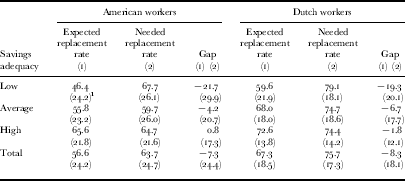
Notes: 1. Standard deviations are given in parentheses. The expected replacement rate value was based on the question: ‘What percentage of your annual income just prior to retirement do you expect to receive after you retire?’ The needed replacement rate was based on the question: ‘Imagine your annual income just before you retire. What percentage of that annual amount do you think you would need in order to have a good retirement income?’
Conclusions and discussion
This paper has studied perceptions of pension savings adequacy among samples of Dutch and American workers, as well as the institutional, social and psychological forces that affect those perceptions. We collected data in 2007 using equivalent forms of a retirement pension survey. In the past, these two countries have made markedly different choices and decisions about their pension systems. The American system relies to a large extent on individual responsibility and self-determination, whereas the highly centralised Dutch system, with its mandatory enrolment policy, effectively circumvents the problems of procrastination and lack of willpower. The analyses revealed that despite large differences in pension benefit levels and institutional settings between the two countries, in both about one-half of the respondents were confident they had amassed sufficient retirement savings. Additional analyses demonstrated that the gaps between needed and expected replacement rates were more or less equivalent, although the levels of replacement rates differed. The mean value of expected and needed replacement rates were 67 and 76 per cent of individuals' pre-retirement income in The Netherlands, respectively, and 57 and 64 per cent in the USA.
We also found that individuals' perceived savings adequacy was influenced by three different groups of factors: institutional forces, psychological dispositions and social forces. Social interactions at the micro level proved to be significant predictors of the perception of savings adequacy, but the overall impact of the social force dimensions was limited. Spousal support for retirement saving was of some importance among Americans, whereas for the Dutch, the perception of savings adequacy was influenced by the socialising influence of parents as role models. The primary determinants of perceived savings adequacy were a combination of institutional characteristics and psychological forces. The extent to which individuals expressed confidence in various pension institutions, such as employer pension funds, banks and insurance companies, was clearly related to perceived savings adequacy. Trust in the government to provide an adequate public pension, in contrast, was not found to be significantly related to this outcome variable. The respondents' mean level of trust in employers' pension funds and the government was found to differ, with the Dutch reporting a higher level of confidence in these institutions than Americans. Moreover, the positive relationship found between trust in one's employer pension and perceived savings adequacy was also much stronger among the Dutch. It is unclear, however, whether these levels of institutional trust are stable over time, and the extent to which future policy changes might cause them to wax or wane. The subprime mortgage crisis, which has clearly affected financial institutions around the world, is a case in point. To understand the consequences of a crisis in trust, one needs to have an idea of the determinants of trust (cf. Pirson and Malhotra Reference Pirson and Malhotra2008).
The incorporation of psychological factors into the models clearly helped explain why some individuals plan and save for retirement, while others do not. In both countries, financial knowledge was found to be positively related to perceptions of retirement savings adequacy. Individual differences in the mindset of American workers, however, played a far larger role in explaining differences in savings adequacy than among Dutch workers. Perhaps the most interesting psychological outcome involved the future orientation dimension. The average level of future orientation was not only stronger in the USA than in The Netherlands, but it was also more strongly related to Americans' perceptions of savings adequacy than among the Dutch. These two findings underscore the important role of psychological forces when it comes to saving patterns in the American system. For the Dutch, perceived savings adequacy was found to be unrelated to one's level of future time perspective. The Dutch were not only less future oriented than the Americans but also, and more importantly, their perception of future retirement income was unrelated to their orientation to time. In other words, thinking about the future and saving for retirement are two separate issues in The Netherlands, whereas these issues are clearly linked in the USA.
Recognising the forces that play a role in saving for retirement may improve the effectiveness of policy design and persuasive communications aimed at encouraging individuals to save (cf. Wiener and Doescher Reference Wiener and Doescher2008). Our analyses suggest that elements of institutional settings and pension designs have an appreciable impact on an individual's pension mindset. That being the case, public policy makers and pension designers need to be cautious when instituting broad-based changes, as radical reforms may not generate the intended effects. For example, privatising a state-based pension system in a country where workers are not accustomed to making their own retirement savings decisions could result in a widening range of replacement rates, because many individuals will be ill-prepared to deal effectively with the changes. If that were the case, a privatisation plan could backfire through either adverse selection processes or the inability of individuals to adjust to the norms and attitudes that are part and parcel of a privatised pension culture. On the other hand, the findings from this study suggest that establishing a paternalistic institutional design – effectively the opposite of a privatised scheme – may conflict with individuals' freedom of choice and their perception of control in designing their own future lifecourse. Opting for a paternalistic system may also serve to reduce future orientation levels, which may well impinge on other inter-temporal decisions such as investing for health and education. Thus, those involved in formulating pension reforms face a double-edged sword when attempting to foresee the long-range impact of their decisions.
As a final note, although the data were collected with the intention of examining cross-national differences in pension savings adequacy, the sample of American respondents was drawn from a limited geographical area, namely Oklahoma. The sample was nonetheless nationally representative in terms of the sex ratio and household income, but the median educational level was slightly above the national average. That being the case, it would be advantageous to carry out a replication study using a broader spectrum of respondents selected from across the USA. In addition, cross-sectional data were used, which limit some of the causal conclusions that can be drawn. A third limitation was that some of the items were measured by single-item indicators.
There are, nevertheless, several strengths to this investigation. Perhaps the most significant is the incorporation of three qualitatively different types of factors into a single analytical framework. This is an important contribution to the empirical literature, which in the past has focused on the impact of one or two sets of forces, and then usually only in one country, which brings us to the second strength. This study is among the few that have focused on two countries with markedly different pension cultures, norms and institutions.Footnote 5 It turns out that it is not only the cultural context – as embedded in institutions and social norms – that are pivotal in understanding pension perceptions, expectations and most likely subsequent behaviour. The psychological dispositions of individual actors are critical as well. This finding has implications for pension reforms, as it suggests that their success will strongly depend on the specific cultural context in which they are implemented.
Acknowledgements
We are indebted to The Netherlands Institute for Advanced Studies (NIAS) in Wassenaar, which provided generous financial and research support to the third author during the development of this paper.