Introduction
Chronic child malnutrition remains a pervasive problem, with long-term implications for affected children. Stunting, measured as height-for-age Z-score (HAZ) of >2 s.d. below the median HAZ of the reference population, is a useful marker of chronic malnutrition. Globally, an estimated 171 million children under 5 years of age were stunted in 2010.Reference de Onis, Blössner and Borghi 1 Stunting early in life has been associated with a range of negative long-term outcomes, including impaired cognitive development, poor school outcomes, reduced earnings in adulthood and poor maternal reproductive health outcomes.Reference Dewey and Begum 2 – Reference Victora, Adair and Fall 4
The association between early life stunting and long-term outcomes is well established. Where debate continues is in regards to the importance of timing (within the early years) and the persistence of stunting. Children in the poorer regions of the world are on average born shorter and grow more slowly, leading to a peak in stunting at 24 months, after which stunting prevalence either remains stable or begins to decline.Reference Victora, de Onis, Hallal, Blossner and Shrimpton 5 The extent to which the children who are stunted at 24 months can catch up from this poor start and achieve similar adult heights as the reference population continues to be debated.Reference Cameron, Preece and Cole 6 – Reference Golden 10 It has been argued that if children can catch up then a narrow policy focus on what is now commonly referred to as the first 1000 days (pregnancy and the first 2 years of life) is not warranted and should be broadened to the entire pre-school period.Reference Prentice, Ward and Goldberg 8 However, even if complete catch up is possible (and normal adult height attained) and it is shown that later life interventions support such catch up, the question of whether later growth can undo the harm caused by stunting within the first 1000 days remains.
The debate centres on the importance of the first 1000 days for brain development. During pregnancy the process of neurulation leads to the development of the basic architecture of the brain. In early childhood the areas associated with vision and hearing, then language and speech and eventually higher cognitive function undergo rapid synaptogenesis.Reference Nelson, Thomas and de Haan 11 These foundational processes are energy intensive, making brain development highly susceptible to the negative consequences associated with malnutrition (both pre- and postnatal).Reference Morgan and Gibson 12 As the development of the brain is cumulative, early difficulties can have lifelong implications.Reference Shonkoff, Garner and Siegel 13 A number of researchers have sought to identify if there are critical phases from a nutrition perspective within the first 1000 days. Glewwe and King,Reference Glewwe and King 14 for example, investigate the impact of the timing of poor nutrition within the first 2 years of life on cognitive development and conclude that poor nutrition in the period 18–24 months had the most significant consequences. The results in Hoddinott et al.Reference Hoddinott, Maluccio, Behrman, Flores and Martorell 15 from Guatemala suggest that nutritional supplementation during 0–36 months of age, but not 36–72 months of age, resulted in higher average wages among adult men.
Given that the period of rapid brain development continues throughout the early years, a small but growing literature has examined the extent to which catch up growth after the first 1000 days, measured as a recovery from stunting, mitigates the impact of stunting on cognitive development. Mendez and AdairReference Mendez and Adair 16 using cohort data from Cebu in the Philippines found that children who catch up between 2 years and follow-up at 8 and 11 years do worse at school than children who were never stunted, although less so than those who remain stunted. Crookston et al.,Reference Crookston, Schott and Cueto 17 using data from four developing countries, found a similar pattern; catch up between 1 and 8 years appeared to reduce, but not eliminate, the deficit associated with early stunting. However, Crookston et al.Reference Crookston, Penny and Alder 18 , Reference Crookston, Dearden and Alder 19 using data from Peru report that children who catch up between 6–18 months and 4.5–6 years do the same in cognitive tests as children who were never stunted, and better than children who remain stunted. The inconsistencies in reported results highlight the need for further analysis.
Using data from a South African longitudinal cohort, the Birth to Twenty Study (Bt20), we examine whether recovery from stunting influences cognitive function. In previous work we found no association between stunting at 2 years and social maturity at 4 years but a large and significant association between stunting at 2 years and cognitive function at 5 years.Reference Casale, Desmond and Richter 20 In this paper, we compare cognitive function among children who were stunted at 2 years but not at 5 years, with children who were stunted in both periods and children who were not stunted in either period.
The Bt20 in South Africa is well suited to examine the impact of recovery from stunting. Bt20 has both high rates of stunting and high rates of recovery from stunting.Reference Stein, Wang and Martorell 9 Moreover, an extensive assessment of the child’s cognitive development is conducted before school enrolment. There has been little prior research on stunting and its links to other aspects of child development in pre-school-aged children using large sample data. The focus has been on schooling outcomes or cognitive tests conducted with school-going children. However, examining children once in the schooling system is complicated by various school-related confounders, such as school quality, and by the possibility that parents of smaller children delay enrolment.
Stunting and cognitive development may be correlated not only because of the impact of the former on the latter, but because they are both influenced by the environment (especially the home environment in early childhood) and caregiver inputs. A further advantage of Bt20 is that a wealth of data was collected on maternal/caregiver and household variables, which we are able to use to account for these confounding factors in multivariate analysis.
Methods
Data and sample
The data are drawn from a birth cohort study from South Africa’s largest metropolitan area. Referred to as Bt20, this longitudinal study covered children born over a 7-week period between April and June of 1990 in private and public hospitals or clinics in the greater Johannesburg-Soweto area. The full sample comprises 3273 singleton births; however, at any one interview point data is collected from roughly 1600 to 2200 participants. The attrition rate is amongst the lowest recorded for birth cohort studies in developing countries.Reference Norris, Richter and Fleetwood 21 , Reference Richter, Norris, Pettifor, Yach and Cameron 22
Norris et al.Reference Norris, Richter and Fleetwood 21 describe attrition in the Bt20 in detail. The main reason for participants being lost to follow-up appears to be child/family mobility, with child and caregiver mortality accounting for a very low share of the attrition. White South Africans, who are more likely to live in wealthier, suburban areas of the city, and who would have been more likely to give birth in private hospitals, are under-represented in the sample owing to low enrolment in the study and subsequent non-response.Reference Richter, Norris, Pettifor, Yach and Cameron 22 , Reference Richter, Yach, Cameron, Griesel and Wet 23 The Bt20 sample in follow-up waves therefore is most representative of children from the black African population group who were born in, and remained residents of, Johannesburg over the period.
Information was collected from mothers at antenatal clinics, at delivery centres and thereafter generally once a year through face-to-face interviews with the caregiver and child. In our analysis, we use data from the delivery reports, year 2 (n=1839), year 4 (n=1858) and year 5 (n=1586). The number of children for whom there is non-missing data on our key explanatory variables, namely height-for-age at 2 and 5 years, is 1574. However, missing data on the outcome variable and the control variables in the multivariate analysis result in a regression sample of between 1019 and 666, depending on which controls are included. We discuss the implications of a diminishing sample for the mean values of key variables and the regression estimations in the Results section below.
Outcome measure
Our measure of cognitive function is based on the Revised Denver Prescreening Developmental Questionnaire (R-DPDQ).Reference Frankenburg, Fandal and Thornton 24 The assessment in Bt20 comprised 32 items covering the child’s personal–social, fine motor, gross motor, language and cognitive abilities at age 5. During the assessment some questions were asked of the caregiver, but the largest part of the questionnaire involved tests conducted by the interviewer. Some items were modified to be culturally appropriate (e.g., the word ‘hedge’ was replaced with ‘fence’).Reference Hsiao and Richter 25 A full list of items is shown in Table 1 (for the detailed explanation of each question/test in the questionnaire, consult Hsiao and RichterReference Hsiao and Richter 25 ).
Individual items comprising the Revised Denver Prescreening Developmental Questionnaire score, Birth to Twenty, age 5

a Responses: yes (1), no (0) or no opportunity (0).
b Responses: correct/yes (1) or incorrect/no (0).
Earlier research found a significant correlation between the Denver Development Screening Test and the Griffiths Mental Development Scales among black African pre-school children in South Africa.Reference Luiz, Foxcroft and Tukulu 26 More recently, using Bt20 data, Hsiao and RichterReference Hsiao and Richter 25 report strongly significant associations between performance in the R-DPDQ at age 5 and various other outcomes, namely scores on the Raven’s Coloured Progressive Matrices and the Connor’s Teacher Rating Questionnaire at age 7, age of first entry to school and grade repetition by Grade 6. Internal consistency for the R-DPDQ measure in the Bt20 sample is 0.71, measured by Cronbach’s α.
An overall score was calculated by adjusting the total raw score by the child’s chronological age, and replacing missing values on individual items by the series mean. The majority of children had no missing data on the 32 items (73%), and for those who did, most of them were missing data on only one item, with the maximum number of missing items per individual being three. The mean value for the R-DPDQ at age 5 is 43.74 (s.d.=4.68, n=1232).
Key explanatory variable
The key variables of interest are stunting status at ages 2 and 5, with stunting indicated by an HAZ of <−2 s.d. from the mean of the reference population, using WHO Child Growth Standards. 27 We use stunting at age 2 as the first point in the analysis as research has shown that the prevalence of stunting peaks at around 24 months;Reference Victora, de Onis, Hallal, Blossner and Shrimpton 5 , Reference Prentice, Ward and Goldberg 8 the second point in the analysis is age 5 where we have information on both anthropometry and cognitive development. For our sample of children who had non-missing data on HAZ at ages 2 and 5 (n=1574), mean HAZ in 1992 when the children were aged 2 is −1.135 (s.d.=1.084) and mean HAZ in 1995 when the children were aged 5 is −0.664 (s.d.=0.895). The prevalence of stunting in this sample of children is 19.44% at age 2 and 6.04% at age 5.
This pattern of rapid increases in stunting until 2 years followed by substantial recovery has been observed in other South African data. The National Health and Nutrition Examination Survey (2012), for example, found prevalence rates of 25.9 for girls and 26.9 for boys among 0–3-year-olds, but 9.5 and 13.5, respectively, among 4–6-year-olds.Reference Shisana, Labadarios and Rehle 28 Although prevalence rates in the Bt20 sample are somewhat lower than the national figures cited here, this would be expected as the prevalence of stunting in urban areas has been found to lower than in rural areas in South Africa. 29
To estimate whether recovery from stunting between ages 2 and 5 resulted in better performance on cognitive test scores, we divide our sample of children into four groups following the nomenclature of Mendez and AdairReference Mendez and Adair 16 : (1) not stunted at 2 years and not stunted at 5 years – labelled ‘neither’; (2) stunted at 2 and 5 years – ‘persistent’; (3) not stunted at 2 years but stunted at 5 years – ‘late incident’; and (4) stunted at 2 years but not stunted at 5 years – ‘catch up’. There is some debate as to what constitutes catch up in height in young children and whether or not it should be defined in relation to an external reference group.Reference Cameron, Preece and Cole 6 , Reference Adair 30 For simplicity, and for the sake of comparability with other studies, we use the definition most commonly used in the literature on growth and cognitive function, namely a recovery from stunting.Reference Mendez and Adair 16 , Reference Crookston, Penny and Alder 18 , Reference Berkman, Lescano, Gilman, Lopez and Black 31 However, in the final section of this paper we discuss the possibility of using alternative definitions.
Data analysis and control variables
Linear regression was used to estimate the relationship between stunting status in early childhood and the scores on the cognitive development test at 5 years. The main independent variables of interest are introduced as dummy variables, ‘persistent’ stunting at 2 and 5 years, ‘late incident’ stunting at 5 years and ‘catch up’ or stunting at 2 years but not at 5 years, where ‘neither’ stunted at 2 or 5 years is the omitted category.
Stunting is likely to be correlated with a number of other factors, which may also be related to cognitive function. We therefore include an extensive set of controls in the regressions to try to minimize confounding effects. In addition to the unadjusted model, we show the results from models adjusted sequentially for groups of variables representing ‘characteristics at birth’, ‘socio-economic status’ and ‘the home environment/caregiver inputs’.
Specifically, characteristics at birth include the sex of the child and the child’s birth weight. Socio-economic status is captured by an asset score (based on six items in the survey – fridge, car, washing machine, television, phone and radio), maternal age (years) and maternal education (years of schooling). A dummy variable for the black African population group is included, where the omitted category consists of Coloureds, Indians and Whites. Decades of institutionalized discrimination under apartheid, which affected black Africans most severely, resulted in racial disparities in almost all aspects of socio-economic life in South Africa, and the aforementioned socio-economic status variables may not capture this inequality adequately.
As discussed in the Introduction section, key confounders not frequently adjusted for in such analyses are the household environment and the caregiver’s inputs in the child’s development, referred to in the economics literature as a ‘preference for child quality’.Reference Glewwe and King 14 We have a variety of variables in our very rich data set which we can use to try to account for these. We include whether the mother was the main caregiver, birth order, birth spacing (indicating a birth within 24 months of the index child), how much time the mother/caregiver spent playing with the child each day, whether the mother/caregiver was trying to teach the child anything at the time, how often the father (or other man important to the child) spent playing with the child and whether the child had any ‘playthings, bought toys or things (the caregiver) has made or given him/her to play with’.
The variables described above (except for those captured at birth) were from the year 2 data round. In a final regression, we include two additional variables from year 4 to capture a change in the environment, namely whether the asset score (based on the same six items in year 2) showed no change or whether it increased between 2 and 4 years (where the omitted category represents a decrease in assets).
A number of alternative measures of socio-economic status and the home environment were tested for significance in the cognitive function equation, among them, crowding in the household (the number of people per sleeping room), mother’s height, paternal education, household income quintiles, maternal depression at 6 months and an index of the quality of the mother/child relationship. This latter variable was based on six items recorded by the interviewer, namely whether the child appeared clean and well looked after; seemed happy; appeared confident and secure in the mother’s presence; and whether the mother seemed unhappy and worn down by worries and troubles; demonstrated any negative feelings towards the child; appeared to be confident and assured in her care and management of child; and showed affection towards the child.
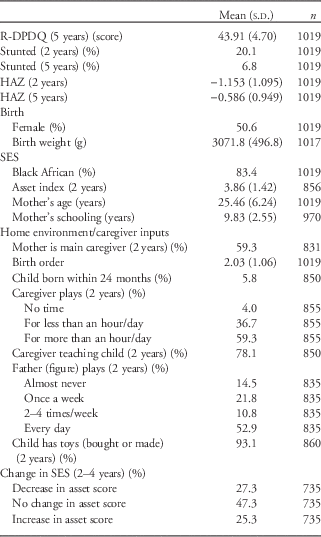
None of these variables were found to be independently associated with cognitive function in our sample after controlling for the other factors described above, so they were not included in the final regressions for the sake of parsimony. (Details of these additional tests are available in Casale et al.Reference Casale, Desmond and Richter 20 ) The mean values of the covariates included in the final analysis are shown in Table 2.
Mean values of the regression variables
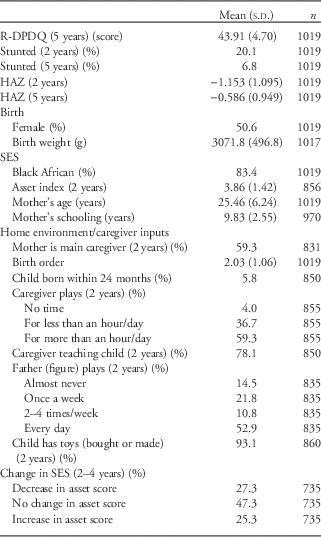
R-DPDQ, Revised Denver Prescreening Developmental Questionnaire; HAZ, height-for-age Z-score; SES, socio-economic status.
Results
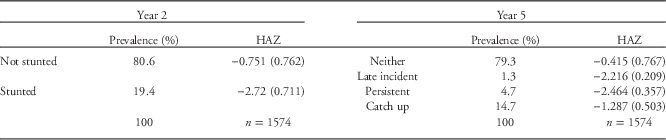
Table 3 presents stunting status and mean HAZ at 2 and 5 years. The frame on the left-hand side of the table shows that at 2 years, the 19.4% of children who were stunted had a mean HAZ of −2.72, and the 80.6% who were not stunted had a mean HAZ of −0.751. The right-hand side frame shows stunting status and mean HAZ at 5 years for these same children. Of the full sample of children, 79.3% were not stunted at 2 or 5 years (‘neither’) and mean HAZ at 5 years for this group is −0.425. Another 4.7% were stunted at both 2 and 5 years (‘persistent’) with mean HAZ at 5 years of −2.464. Only a small percentage of children, 1.3%, exhibit late incident stunting and mean HAZ at 5 years for this group is −2.216. The remaining 14.7% constitute those who were stunted at 2 years but not at 5 years. The mean HAZ at 5 years for this ‘catch up’ group is −1.287, which is just less than a s.d. below the mean for those who were not stunted in either year, but over 1 s.d. higher than the mean of those who were stunted in both years or just in year 5.
Stunting status and mean height-for-age Z-score (HAZ) at 2 and 5 years
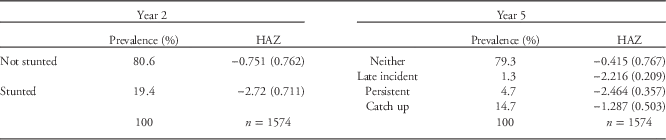
Standard deviations in parentheses.
Although late incident stunting is not common in this sample, the rate of recovery from stunting is high. About 75% of children who were stunted at 2 years had an HAZ score of ⩾−2 s.d. at 5 years. Furthermore, this high rate of recovery does not appear to be an artefact of small changes around the cut-off. The mean change in HAZ between 2 and 5 years for the catch up group is 1.343 (s.d.=0.864), none had a change in HAZ of <0.2 s.d., and only 21 of the 231 children or 9.1% had a change in HAZ of between 0.2 and 0.5 s.d.
For the late incident group, however, the mean change in HAZ between 2 and 5 years is −0.532 (s.d.=0.225). Among the 20 late incident cases only one had a change in HAZ of <−0.2 s.d. but another 8 out of 20 (or 40%) had a change in HAZ of between −0.2 and −0.5 s.d. Although this still suggests a considerable fall off in growth, we are cautious about the results for this group given the low sample size and the smaller changes around the cut-off.
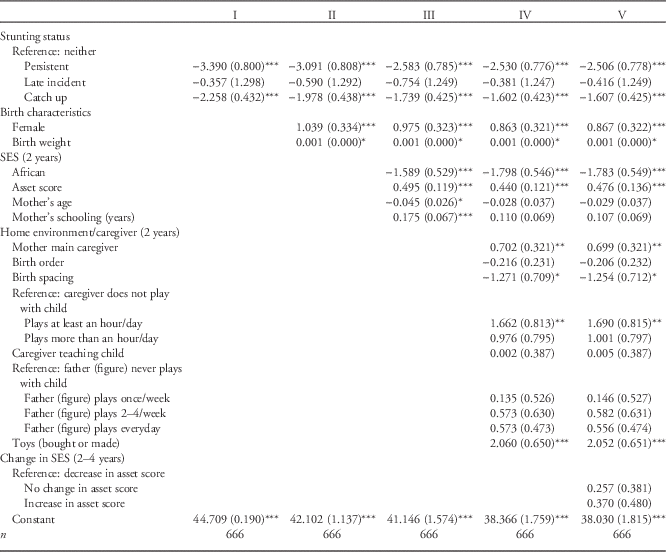
Table 4 displays the unadjusted regression estimates, as well as the estimates from multivariate linear regressions where an increasing number of covariates is introduced with each model. Here, we restrict the analysis to the final regression sample of n=666, so that we can observe the varying effects of the covariate sets on the results.
Estimates from cognitive scores regressions at 5 years (ordinary least squares coefficients)
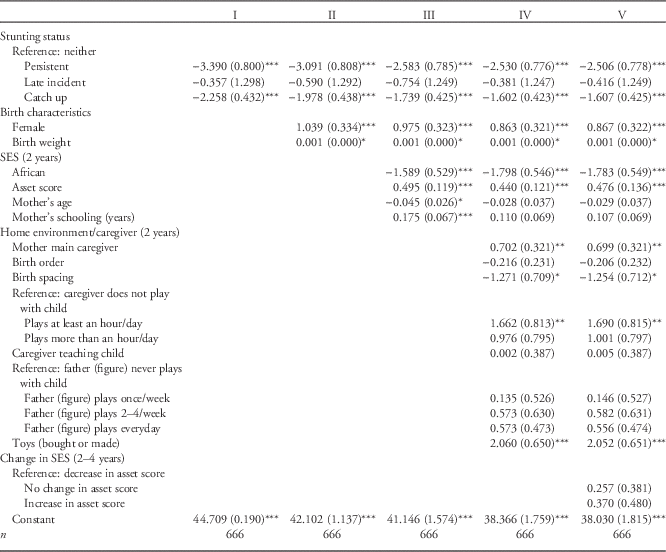
SES, socio-economic status.
Standard errors in parentheses. The regressions are run on the sample of children who had non-missing data on the full set of explanatory variables in ‘Model V’.
***P<0.01; **P<0.05; *P<0.10.
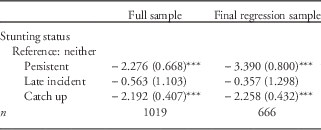
The unadjusted estimates on the final regression sample suggest that children who are persistently stunted score 3.39 points less on the cognitive measure than children who were neither stunted at 2 or 5 years, and this is significant at the 1% level. Children with late incident stunting also score less, but by a very small amount (0.36 points), and the coefficient is not significant. Those who recovered from stunting do considerably worse; they score 2.26 points less than children who were neither stunted at 2 or 5 years, and this result is strongly significant at the 1% level.
As we would expect, controlling for an increasing number of covariates reduces the coefficients on the stunting status variables, with birth characteristics and socio-economic status having the largest effects. Overall, the coefficient for children with persistent stunting drops from −3.39 to −2.51 (moving from Model I to Model V), and the coefficient for the catch up group drops from −2.26 to −1.61, but both remain strongly significant. The coefficient on late incident stunting remains small and statistically insignificant.
Although the different size effects for the catch up and persistent stunting groups suggest that the catch up group do not perform as poorly as the persistently stunted group, the coefficients are not significantly different from each other (F(1,644)=1.16; Prob>F=0.283). We also tested whether the inclusion of a variable capturing severe stunting (HAZ<−3 s.d.) at 2 years affected the results. We might expect this if, for example, children who catch up were not as badly stunted to begin with (or similarly, if those who are persistently stunted were more severely stunted at 2 years). Using Model V controls, we find that the coefficient on severe stunting at 2 years is not significantly correlated with cognitive function at 5 years, and the coefficients on ‘persistent’ and ‘catch up’ remain significant and largely unchanged at −2.61 and −1.65, respectively (compared with −2.51 and −1.61 without controlling for the severity of stunting).
A number of the controls are significantly related to cognitive function. Girl children do better than boy children and birth weight has an independent positive effect on cognitive function. Of the set of socio-economic status variables, the asset index and the dummy variable for black African children are significant, with positive and negative effects, respectively. Mother’s education had a significant effect in Model III, but in Model IV when variables representing the home environment and caregiver inputs are included, the coefficient is no longer significant. This suggests that the positive effect of mother’s education on cognitive function operates through some of these other variables.
Of the home environment/caregiver variables, whether the mother is the main caregiver is important, as is whether the mother/caregiver played with the child for at least an hour a day. Whether there were toys bought or made for the child in the home also has a strong positive effect on cognitive development. Birth spacing, however, has a negative effect on cognitive function, suggesting that another birth within 24 months of the index child places pressure on parental and other resources. A change in the asset index between 2 and 4 years had no impact on the child’s cognitive score.
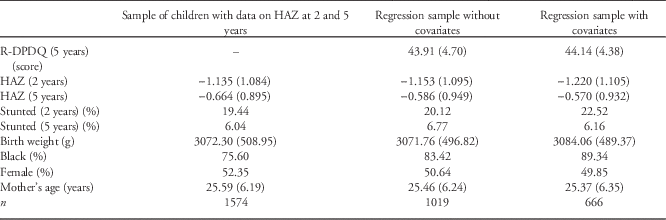
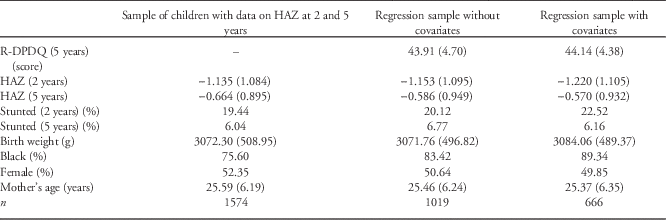
As noted above, our sample size diminishes quite substantially from 1574 to 1019, due to missing values on the cognitive function score, and from 1019 to 666, with the inclusion of the covariates. To investigate the implications of this loss, we summarize in Table 5 the mean values of some of the key variables for the three different samples. The most substantial change is in the proportion of black children in the sample, which increases from 76% to 89%. There is very little difference across the samples in, for example, mean birth weight, mother’s age and the cognitive score itself.
Mean characteristics for varying samples
R-DPDQ, Revised Denver Prescreening Developmental Questionnaire; HAZ, height-for-age Z-score.
Standard deviations in parentheses.
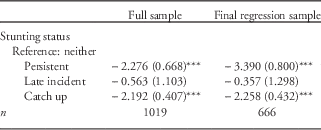
The prevalence of stunting at 2 years does increase by 3 percentage points with the loss of cases, indicating that taller children are being lost from the analytical sample. However, the loss of taller children does not appear to change the overall findings of the research. We attempt to show this in Table 6 by comparing the results on the unadjusted regression for the final regression sample of 666 children (Model I in Table 4) with the results of an unadjusted regression on the sample of 1019 children for which we have information on cognitive function. Although the size effects are larger for the persistent stunting variable as cases are dropped, there is very little difference in the coefficients on the ‘catch up’ variable (−2.192 v. −2.258). Importantly, the substantive findings are consistent; children with persistent stunting do worse than those who were not stunted, as do the children who recovered from stunting between 2 and 5 years. This gives us confidence that the results are not being driven by the non-random exclusion of cases due to the introduction of the covariates.
Estimates from unadjusted regressions, ordinary least squares coefficients (dependent variable=cognitive function scores at 5 years)
Standard errors in parentheses.
***P<0.01.
Discussion
In our sample of children from the Bt20 cohort study, we find that 75% of children who were stunted at 2 years were no longer stunted at 5 years. The children who recovered from stunting at 2 years still performed significantly worse on our cognitive assessment at 5 years than did children who were never stunted. This relationship remains significant when we include a full set of controls for potential confounding variables. Children who are no longer classified as stunted perform better than children who remain stunted, but the difference is not significant. Our results appear to provide further evidence that the negative implications for cognitive development of growth retardation within the first 1000 days are not mitigated by subsequent catch up growth.
Our result that children who recover from early stunting perform worse on cognitive assessments than those who were never stunted is similar to that of Mendez and AdairReference Mendez and Adair 16 and Crookston et al.’sReference Crookston, Schott and Cueto 17 multi-country analysis. However, in both of these studies the better performance of the catch up group in relation to the persistently stunted group was significant. In our study we find the same pattern, but the difference is not significant. In contrast to these findings, Crookston et al.Reference Crookston, Penny and Alder 18 , Reference Crookston, Dearden and Alder 19 found that children from a Peruvian cohort who experienced catch up growth had cognitive scores similar to children who were never stunted. The Crookston et al. multi-country study includes analysis of the same Peruvian Young Lives data set, although in the multi-country analysis they focus on outcomes at age 8, rather than at age 4.5–6 years as was the case in the single country study.
Direct comparison to either the multi-country or single country Crookston et al. analyses is complicated by the age at which early stunting was assessed. Unlike in our and the Mendez and AdairReference Mendez and Adair 16 analyses, in which stunting was assessed at 2 years, the Young Lives data used by Crookston et al.Reference Crookston, Schott and Cueto 17 – Reference Crookston, Dearden and Alder 19 includes stunting measured at 6–18 months. The finding by Glewwe and KingReference Glewwe and King 14 that the 18–24 months period is critical suggests that the differences in timing may lead to differences in the assessment of the importance of catch up growth. Some proportion of the children who were assigned to the catch up group in the Crookston et al.Reference Crookston, Schott and Cueto 17 – Reference Crookston, Dearden and Alder 19 analysis may have started to recover from stunting in the 2nd year of life. Had these children been assessed at 2 years they may not have been classified as stunted. The inclusion of children who experience early catch up may be pulling the average cognitive scores for the overall catch up group upward. Similarly, the children who become stunted between 18 and 24 months may be pulling the average score for never stunted children downward.
Although our results on stunting recovery are similar to Mendez and Adair,Reference Mendez and Adair 16 we do not find, as they did, that severe stunting played an independent role in predicting cognitive scores. Berkman et al.Reference Berkman, Lescano, Gilman, Lopez and Black 31 also report a significant impact of severe stunting in the 2nd year of life on cognitive development. Our failure to find an independent effect of severe stunting may relate to the differences in age of children at follow-up. We examined cognitive development at 5 years of age, before the start of formal schooling. Mendez and AdairReference Mendez and Adair 16 have information on cognitive function at 8 and 11 years and Berkman et al.Reference Berkman, Lescano, Gilman, Lopez and Black 31 at 9 years of age. A supportive schooling environment (and continued growth in height) may help mitigate the impact of stunting and children who were moderately stunted may be more likely to benefit. Notably, the importance of severity increased in the Mendez and AdairReference Mendez and Adair 16 analysis between 8 and 11 years.
To allow for comparison with other work in this field we refer to children who were stunted at 2 years but not at 5 years as having experienced catch up growth. There are alternative definitions of catch up growth. Cameron et al.,Reference Cameron, Preece and Cole 6 for example, define catch up as an improvement in HAZ greater than that which would be predicted by regression to the mean, operationalized in the conditional growth measures used in, for example, Adair et al.Reference Adair, Fall and Osmond 32 Boersma and WitReference Boersma and Wit 33 distinguish between three types of catch up growth: type A where a child experiences an increase in height velocity such that their height deficit is swiftly eliminated; type B where the period of growth is prolonged; and type C which is a combination of A and B. Moreover, they draw a distinction between catch up growth and the resumption of a normal growth velocity.
Using the Cameron et al.Reference Cameron, Preece and Cole 6 definition of catch up growth or identifying those children who could be classified as having type A catch up, may well alter our findings on the association of catch up growth and later cognitive outcomes. Recovery from stunting is a weak definition of catch up. It is possible that a child who is stunted at 2 years and then resumes a normal growth velocity will no longer be defined as stunted at 5 years. As children get older (and taller) a standard deviation in the reference population is associated with a larger and larger absolute difference in height. A child can remain the same absolute amount shorter than the mean and recover from stunting because relative to the mean that absolute difference is no longer 2 s.d. below. It is possible that they even fall further behind in absolute height and still recover from stunting, because the change in the size of a standard deviation with age is large enough.Reference Leroy, Ruel and Habicht 34 , Reference Lundeen, Stein and Adair 35 Our use of the most common definition of catch up has allowed for direct comparison, but further work is clearly needed to investigate the implications of different definitions of catch up on the conclusion that it does not lead to improved cognition.
Our paper provides further evidence of the importance for cognitive development of linear growth, and by implication, nutrition, in the first 2 years of life. However, additional research is required to examine if the age at which early stunting is measured influences the assessment of the impact of catch up growth on subsequent cognitive outcomes. Moreover, further research is required to investigate the extent to which the negative cognitive impact fades over time, and if it fades equally for moderately and severely stunted children. Finally, alternative definitions of catch up need to be tested, before it is concluded that catch up growth does not mitigate the impact of early growth retardation on later cognitive outcomes.
Acknowledgements
The authors would like to thank Celia Hsiao, Shane Norris and Linda Richter for their helpful suggestions and guidance during the preparation of this paper.
Financial Support
Birth to Twenty is funded by the Wellcome Trust, the University of the Witwatersrand, the South African Medical Research Council and the South African Human Sciences Research Council.
Conflicts of Interest
None.
Ethical Standards
The Birth to Twenty Study was granted approval by the Committee for Research on Human Subjects at the University of the Witwatersrand, Johannesburg.