Introduction
Carbapenem-resistant Acinetobacter baumannii (CRAB) has emerged as a significant global pathogen tied to healthcare-associated infections. This gram-negative coccobacillus is particularly challenging due to its resistance to multiple antibiotics and persistence in hospital environments. Reference Perez, Hujer, Hujer, Decker, Rather and Bonomo1 CRAB infections primarily affect critically ill patients in intensive care units (ICUs) and risk factors for acquisition include mechanical ventilation, central venous catheters, and prior antibiotic use. Reference Zhang, Xiao, Li, Li, Li and Pang2 In Israel, CRAB is prevalent in hospitals and in long-term care facilities (LTCFs). High-dependency rooms in internal medicine wards often house critically ill patients who cannot be admitted to ICUs, further contributing to outbreaks beyond ICU settings. Reference Ben-David, Cohen, Levi, Keren-Paz, Tasher and Zandman-Goddard3–Reference Nutman, Temkin, Wullfhart, Schechner, Schwaber and Carmeli5
CRAB can cause severe infections, including central line-associated bloodstream infections (BSI) and ventilator-associated pneumonia which lead to high mortality. Reference Wang, Ge, Chen, Komarow, Hanson and Reyes6 Indeed, risk factors for CRAB mortality include BSI, mechanical ventilation, multidrug resistance, and inadequate initial antibiotic therapy. Reference Yang, Sun, Wu and Zhang7,Reference Guo, Xue, Tang, Ding and Zhao8 Few studies reported that CRAB BSI are associated with 30-day mortality of over 60%. Reference Falagas and Rafailidis9,Reference Ballouz, Aridi, Afif, Irani, Lakis and Nasreddine10
As for other multidrug-resistant organisms, a key debate in the literature is whether CRAB directly causes high mortality or merely serves as a marker of severe illness. Attribution assessment remains difficult due to varying study designs, populations, and control groups, as well as the need to account for patients’ baseline severity and appropriateness of therapy. Reference Yang, Sun, Wu and Zhang7,Reference Falagas and Rafailidis9,Reference Wang, Zhang, Wu, Liu, Ma and Lai11–Reference Falagas, Bliziotis and Siempos13 Some studies suggest carbapenem resistance increases mortality (eg, pooled odds ratio (OR) of 2.22 in one meta-analysis), Reference Lemos, de la Hoz, Einarson, McGhan, Quevedo and Castaneda14 while others, found no effect after adjusting for confounders. Reference Esterly, Griffith, Qi, Malczynski, Postelnick and Scheetz12
Mortality differences have also been observed between CRAB infection and colonization. Colonized patients often have high mortality rates, Reference Peghin, Givone, de Martino, Ali, Graziano and Isola15–Reference Zhou, Yao, Zhu, Ren, Yang and Fu18 with some studies reporting a rapid transition from colonization to infection within 4–7 days, Reference Peghin, Givone, de Martino, Ali, Graziano and Isola15,Reference Cogliati Dezza, Covino, Petrucci, Sacco, Viscido and Gavaruzzi16 while others note longer intervals. Reference Wong, Chen, Chau, So, AuYeung and Yuen19 Few studies have examined the combined effects of detection timing (admission vs hospital-acquired) and detection type (colonization vs infection) on clinical outcomes.
This study aims to investigate the characteristics of high-risk patients with CRAB colonization or infection and to assess patient’s outcomes according to CRAB status (colonization vs infection) and detection time (upon admission vs hospital-acquired). It attempts to disentangle the impact of CRAB colonization or infection from underlying patient severity, providing a clearer understanding of its contribution to adverse outcomes and seeks to identify risk factors and evaluate early and late mortality while accounting for the implementation of infection control measures during the study period.
Methods
Settings
A retrospective cohort study was conducted at a 515-bed, university-affiliated hospital in Hadera, Israel, from January 2023 to December 2024. The hospital includes six high-dependency rooms across four internal medicine wards and two surgical wards, plus 30 dedicated single rooms for ventilated or critical patients in the ICU (13 beds), cardiac ICU (12 beds), and stroke unit (5 beds).
Data collection and definitions
All CRAB sample results were retrieved from the laboratory’s computerized systems. We collected demographic data and hospitalization dates. Clinical and laboratory parameters from the first 48h of hospitalization were used to calculate Charlson Comorbidity Score (CCS) and modified APACHE-II score (excluding pH and FiO2). Mortality data (assessed at 30 and 90 days) were available 2 months after the study ended and were accessed through a national database.
Patients were categorized into 5 groups: CRAB negative (A_screen); CRAB present on admission (POA)—within two days from admission (B groups): divided to patients with CRAB on screening-cultures only (B_screen) and clinical CRAB (B_clinical); and acquired-CRAB (C groups) also divided to C_screen and C_clinical. Combined groups (B_comb and C_comb) were created for certain analyses. Patients known to be carriers (identified upon previous hospitalizations or in other facilities) were excluded.
Study periods
The study comprised an early phase (January–June 2023), when CRAB screening was introduced but not fully implemented, and a late phase (July 2023–December 2024), when admission screening became widespread, and a CRAB cohort was established.
Screening protocol and infection control measures
Patients screened upon admission when: (1) arriving from LTCFs/other hospitals, (2) admitted to ICU/high-dependency rooms, (3) mechanically ventilated, or (4) transferred within the hospital. Weekly re-screening was conducted for hospitalized patients meeting these criteria. Known carriers were not screened unless de-labeling was attempted. Close contacts were screened ad-hoc if exposed to CRAB carriers.
From July 2023, a section of one internal medicine ward (4 rooms, up to 10 patients) was dedicated to CRAB cohort care. Cleaning protocols using 2000ppm bleach twice daily, with terminal cleaning after discharge, were implemented in all internal medicine wards.
Microbiological methods
Screening used skin swabs with pre-moistened sponges on four limbs. Specimens were enriched overnight in BHI broth and cultured on modified CHROMagar MDR-Acinetobacter plates (Hylabs, Rehovot, Israel). Clinical isolates were identified by MALDI-TOF MS (Bruker Biotyper, MA, USA) and antimicrobial resistance determined by meropenem and imipenem disk diffusion susceptibility testing per CLSI guidelines.
This study was approved by the institutional review board (HYMC0167-24).
Statistical analysis
Categorical variables were presented as counts and percentages, and continuous variables as medians with interquartile ranges (IQRs) or means with standard deviations (SDs). Group comparisons were performed using Fisher’s exact test or Mann Whitney test, as appropriate. The length of stay (LOS) was log-transformed due to right-skewed distribution.
Risk factors for CRAB-POA and for CRAB-acquisition were assessed using univariable and multivariable Firth logistic regressions versus patients not having CRAB (A vs B_comb, C groups excluded; A vs C_comb, B groups excluded).
Mortality at 30- and 90-days was assessed using univariable and multivariable Firth logistic regressions, in two models: in one, A group versus each of the 4 CRAB subgroups, and in the second, A group versus B_comb and versus C_comb. We also used Kaplan–Meier (KM) curves for 30- and 90-day mortality. Log-rank tests with Benjamini–Hochberg-adjusted pairwise comparisons were used for exploratory purposes but did not account for time-dependent exposure.
A 1:1 propensity score matching analysis and Firth logistic regression for 30-days mortality was performed for clinical versus colonized patients: B_screen versus B_clinical and C_screen versus C_clinical (A group excluded). Details in supplementary methods.
To analyze time to mortality, time-varying Cox models using survSplit() were constructed to account for delayed CRAB acquisition and correct immortal time bias, treating CRAB status as a time-dependent covariate and time to mortality as the outcome. Models were adjusted for age, APACHE II, CCS, ICU stay and stratified by mechanical ventilation and study period due to non-proportional hazards. Three separate Cox models (each for both 30- and 90-days mortality) were constructed comparing: (a) the five CRAB subgroups, (b) CRAB-negative versus CRAB-positive (B and C combined), and (c) A_screen versus B_comb versus C_comb groups. In these models, patients who transitioned from A to C groups were counted as A_screen from admission to CRAB acquisition and as C groups after acquisition. Schoenfeld residuals were used to verify the proportional hazards assumption. Model-based cumulative hazard plots were generated. Analyses summary available in supplementary Table 1.
All statistical analyses were performed using R version 4.4.2 (R Foundation, Vienna, Austria). Key packages included survival (Cox regression), survminer (survival plots), logistf (Firth logistic regression), dplyr (data manipulation), and ggplot2 (graphics). All tests were two-sided (p < 0.05). Attributable death was determined by an infectious disease specialist (RC) who reviewed each case.
Results
Patient characteristics
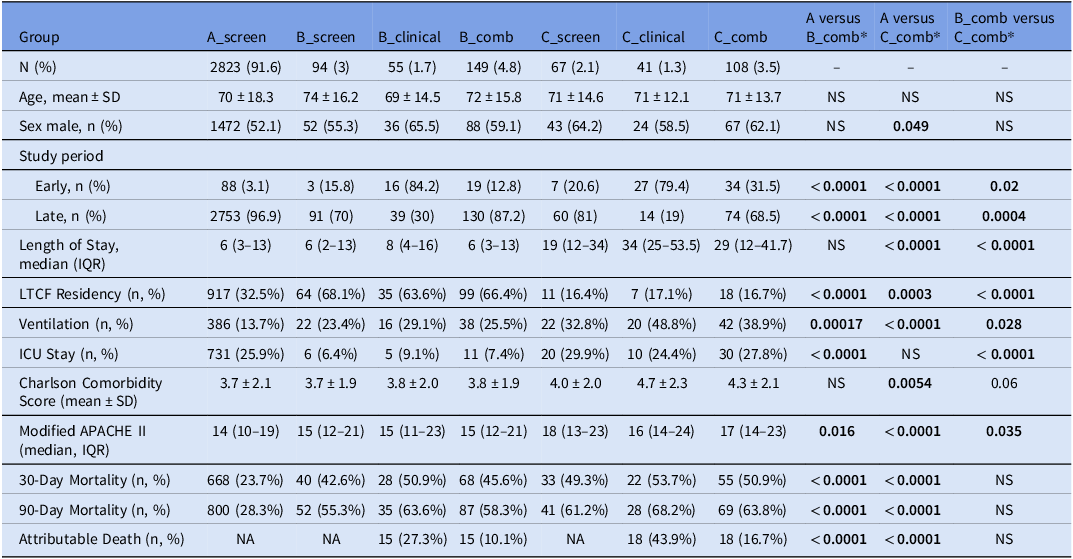
A total of 3080 patients were screened for CRAB: 2823(91.6%) tested negative, 149(4.8%) had CRAB on admission (Group B), and 108(3.5%) acquired CRAB during hospitalization (Group C). Nine patients transitioned from B_screen to B_clinical (median of 14 days, IQR 4-61); and 5 patients from C_screen to C_clinical (median 26 days, IQR 18-29). Among 96 patients with clinical CRAB isolates, 124 clinical specimens were identified (26 blood, 54 sputum, 26 wound, 17 urine, and 1 empyema). Table 1 provides detailed demographic data, clinical features, and mortality rates.
Demographics, clinical characteristics, and outcomes of patients stratified by CRAB colonization and infection status

CRAB—Carbapenem resistant Acinetobacter baumannii, A_screen, patients that never had CRAB; B_screen, CRAB carriers upon admission; B_clinical, patients with CRAB in clinical samples upon admission; B_comb, B_screen & B_clinical, C_screen, patients identified during hospital stay with screening samples only; C_clinical, patients acquiring CRAB in clinical samples during hospital stay; C_comb, C_screen & C_clinical; SD, standard deviation; Early, January 2023 to June 2023, Late, July 2023 to December 2024; LTCF, Long Term Care Facility, APACHE II –Acute Physiology And Chronic Health Evaluation II score, NA, not applicable. *p value is reported, Mann–Whitney U test was used for continuous variables, and Fisher’s exact test for categorical variables, significant results are in bold.
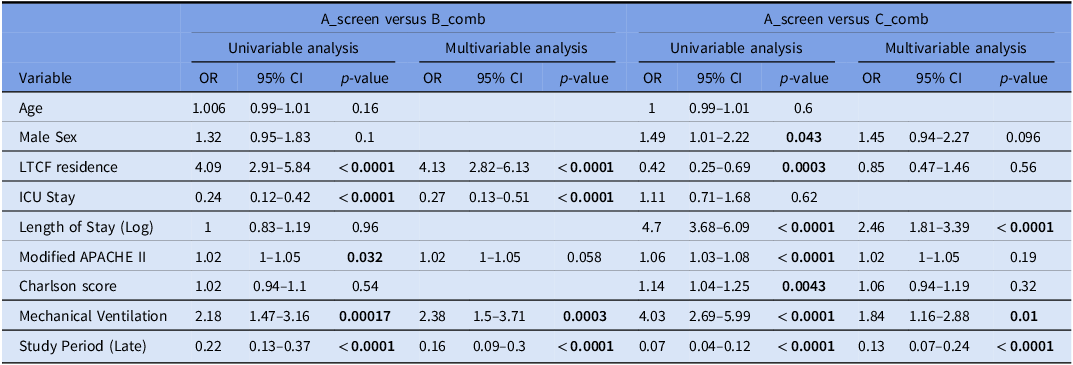
Among 149 patients with CRAB on admission: 94(63%) were from skin screening only and 55(37%) clinical samples. CRAB-POA patients (B_comb) were more likely to be admitted from LTCFs (66.4% vs 32.5%, p < 0.0001), had higher median APACHE II score (15 vs 14, p = 0.01), were more frequently ventilated (25.5% vs 13.7%, p = 0.00017), but less likely to be admitted to the ICU (7.4% vs 25.9%, p < 0.0001), compared to those without CRAB (A_screen).
Of the 108 CRAB acquisitions: 67(62%) were found on screening samples, and 41(38%) via clinical samples. 49 of the 108 (45%) had not been screened upon admission due to failure to adhere to screening protocol (63% of whom were during the early study phase), and 59 remainders were identified through weekly screenings or clinical samples. When compared to those without CRAB (A_screen), patients who acquired CRAB (C_comb), had longer LOS (median 29 vs 6 days, p < 0.0001), higher ventilation rates (38.9% vs 13.7%, p < 0.0001), higher CCS (4.3 vs 3.7, p = 0.005), and higher APACHE II scores (17 vs 14, p < 0.0001). They were less likely to be admitted from LTCF (16.7% vs 32.5%, p = 0.0003).
Predictors for CRAB carriage and acquisition
Table 2 describes the results of the Firth univariable and multivariable analyses. For CRAB-POA—multivariable analysis identified LTCF residency (OR 4.13, p < 0.0001) and mechanical ventilation (OR 2.38, p = 0.0003) as significant factors, while ICU stay was negatively associated (OR 0.27, p < 0.0001). Regarding CRAB acquisition—multivariable analysis identified LOS (OR 2.46, p < 0.0001) and mechanical ventilation (OR 1.84, p = 0.01) as significant predictors, while the later study period was protective (OR 0.13, p < 0.0001).
Univariable and multivariable firth logistic regression analyses of risk factors for CRAB on admission and hospital-acquired CRAB

Multivariable models compare A_screen to B_comb and C_comb separately. B_comb, B_screen & B_clinical; C_comb, C_screen & C_clinical; OR, odds ratio; CI, confidence interval; LTCF, Long Term Care Facility; APACHE II, Acute Physiology and Chronic Health Evaluation II, significant results are in bold.
Mortality analysis
Patients with CRAB (POA or acquired) exhibited significantly higher mortality rates compared to those without CRAB at both 30 days (B: 45.6%, C: 50.9%, A: 23.7%, p < 0.0001) and 90 days (B: 58.3%, C: 63.8%, A: 28.3%, p < 0.0001). Early and late mortality were highest in clinical-CRAB subgroups (B_clinical: 50.9%, 63.6%, C_clinical: 53.7%, 68.2%, respectively).
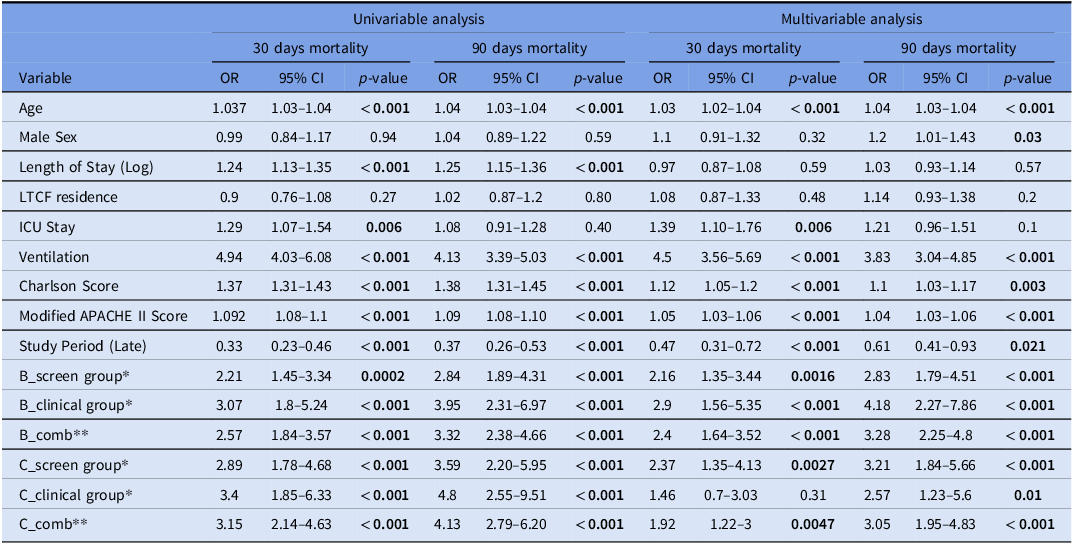
Univariable Firth logistic regression analyses for 30-days mortality identified significant mortality associations with older age, LOS, ICU stay, mechanical ventilation, higher CCS and APACHE II scores, and CRAB status, while the late study period was protective. Multivariable analysis at 30-days found similar results. More results in Table 3.
Univariable and multivariable firth logistic regression analyses for 30-day and 90-day mortality

B_comb and C_comb were analyzed separately versus A_screen. OR, odds ratio; CI, confidence interval; LTCF, Long Term Care Facility; ICU, intensive care unit; APACHE II, Acute Physiology and Chronic Health Evaluation II.
* Compared to A_screen, **Models for B_comb and for C_comb were run separately and were also compared to A_screen. Significant results are in bold.
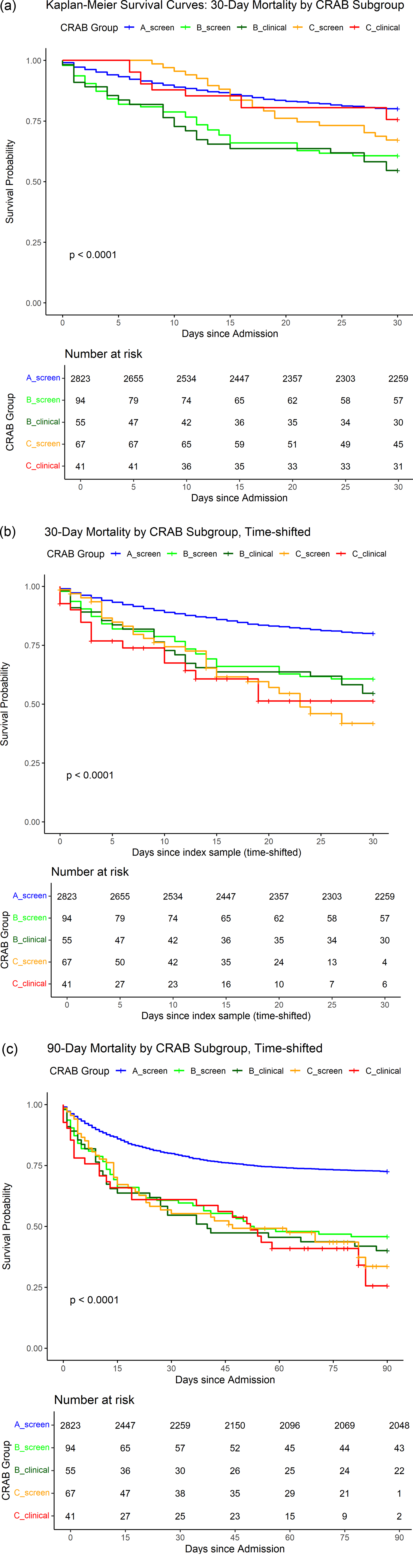
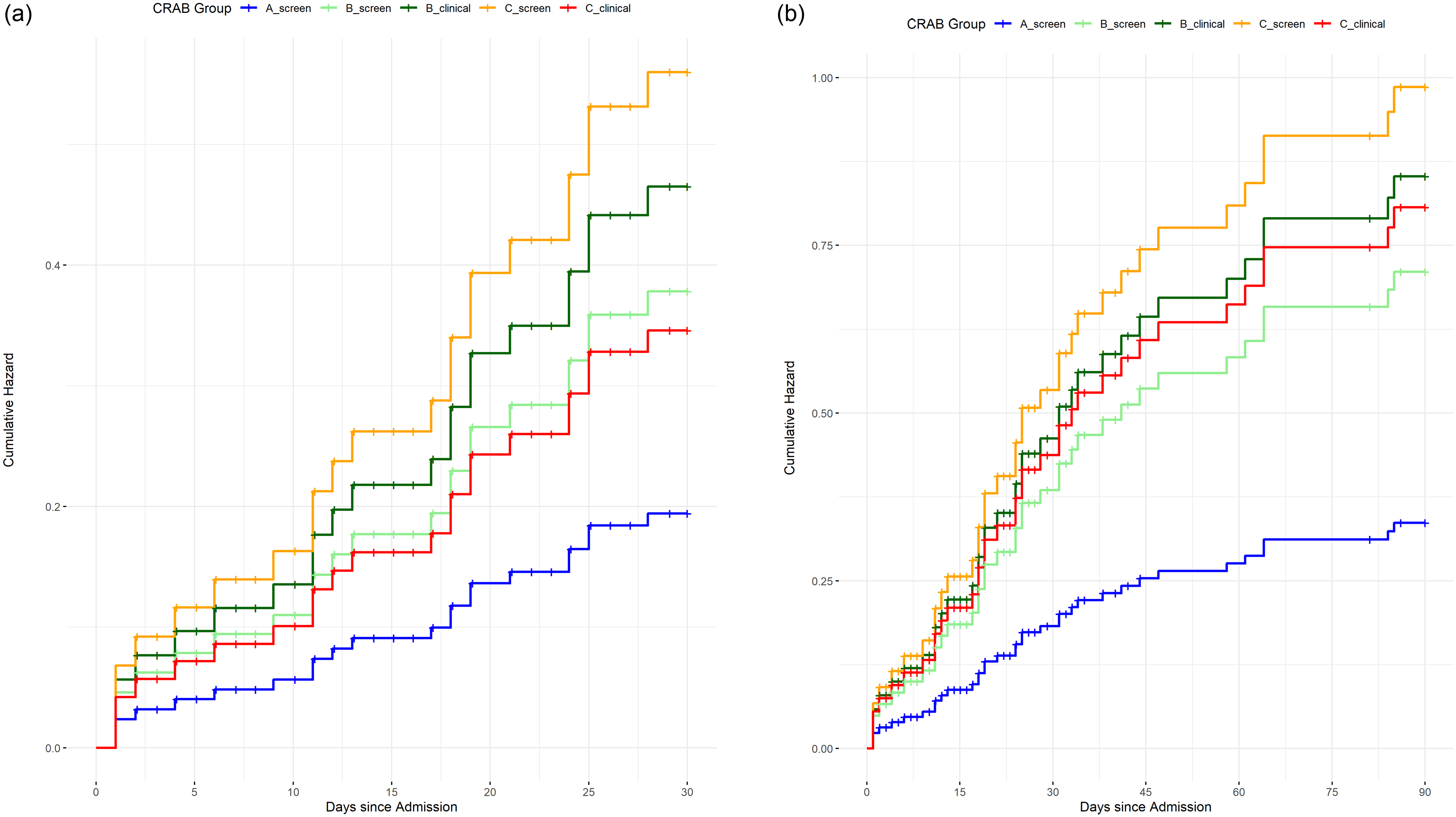
Unadjusted KM survival curves (Figure 1A) demonstrated significant differences in 30-day mortality across CRAB subgroups. Mortality appeared to rise ∼7 days following CRAB acquisition. To better visualize this pattern, we generated additional plots (Figures 1B–1C) in which survival time for hospital-acquired CRAB groups was shifted to start at the time of first positive culture. Log-rank tests comparing A_screen to each CRAB-positive subgroup were statistically significant (all p < 0.0001); however, these unadjusted tests do not account for immortal time bias.
Kaplan–Meier survival curves for 30- and 90-day mortality by CRAB subgroup. 1A: Unadjusted 30-day survival curves from hospital admission for five subgroups: CRAB-negative (A_screen), CRAB on admission (B_screen, B_clinical), and hospital-acquired CRAB (C_screen, C_clinical). 1B: Time-adjusted 30-day curves. For C_screen and C_clinical, time zero is shifted to the day of CRAB detection; other groups remain admission-based. 1C: 90-day curves with the same time adjustment as in 1B. Note: Panels 1B and 1C do not adjust for immortal time bias; model-based estimates correcting for this are shown in Figures 2 and 3.

Mortality of clinical versus colonized cases
Subgroup analyses comparing clinical infection to colonization showed that patients with clinical CRAB on admission (B_clinical) had significantly higher 30-day mortality compared with those with CRAB in screening samples only (B_screen), after 1:1 propensity score matching (OR = 2.28, p = 0.034). No significant difference was observed between C_clinical and C_screen (OR = 0.91, p = 0.83).
Cox proportional hazard models
Multivariable Cox regression models were adjusted for age, ICU stay, APACHE II score, CCS, and LTCF residency. Mechanical ventilation and study period were included as stratification variables due to violation of the proportional hazards assumptions. In the 30-day model, CCS also violated the proportional hazard assumption (Schoenfeld p = 0.0097); however, it was retained for consistency with the 90-day model and because of clinical relevance. A sensitivity analysis excluding CCS yielded similar hazard ratio estimates, supporting this inclusion.
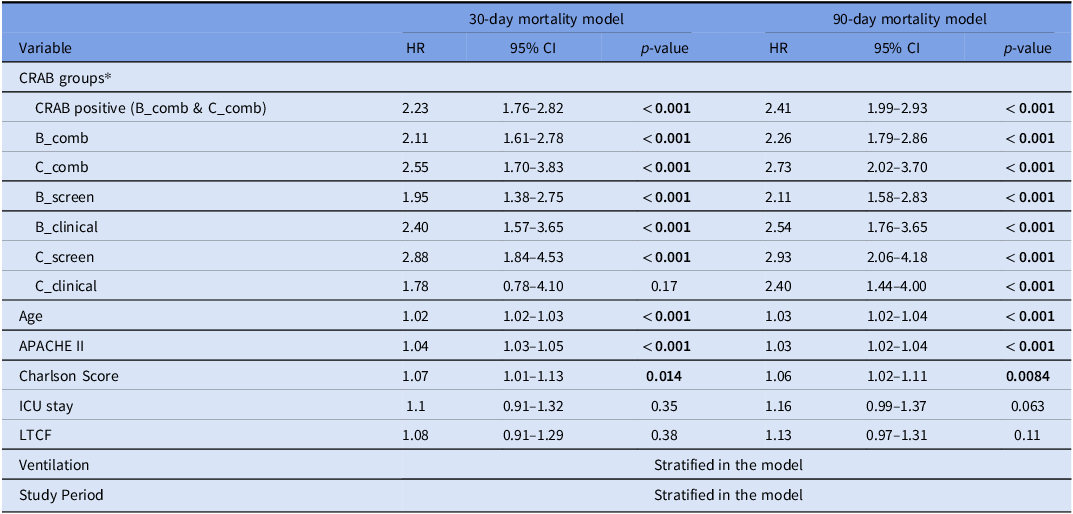
These time-varying, immortal-time-adjusted multivariable Cox models confirmed that all CRAB-positive subgroups were associated with increased mortality, with hazard ratios ranging from 1.78 to 2.88 for 30-day mortality and from 2.11 to 2.93 for 90-day mortality, compared to CRAB-negative patients (Figures 2A, 2B; Table 4).
Adjusted hazard ratios for 30- and 90-day mortality by CRAB subgroup. 2A: Adjusted hazard ratios (HRs) for 30-day mortality from a time-varying Cox model comparing CRAB-positive subgroups to CRAB-negative (A_screen), adjusted for age, ICU stay, APACHE II, Charlson score, and LTCF residence; stratified by mechanical ventilation and study period. 2B: Same model applied to 90-day mortality.

Mortality risk at 30 and 90 days by CRAB status: time-varying multivariable cox models

Hazard ratios (HRs) are adjusted for age, APACHE II, Charlson score, ICU stay, and LTCF. Mechanical ventilation and study period were stratified due to proportional hazards assumption violations. *CRAB subgroups were compared to the A_screen reference group. B_comb, B_screen and B_clinical; C_comb, C_screen and C_clinical. CI, confidence interval; LTCF, Long Term Care Facility; ICU, intensive care unit; APACHE II, Acute Physiology and Chronic Health Evaluation II; B_comb, B_screen & B_clinical; C_comb, C_screen & C_clinical. Significant results are in bold.
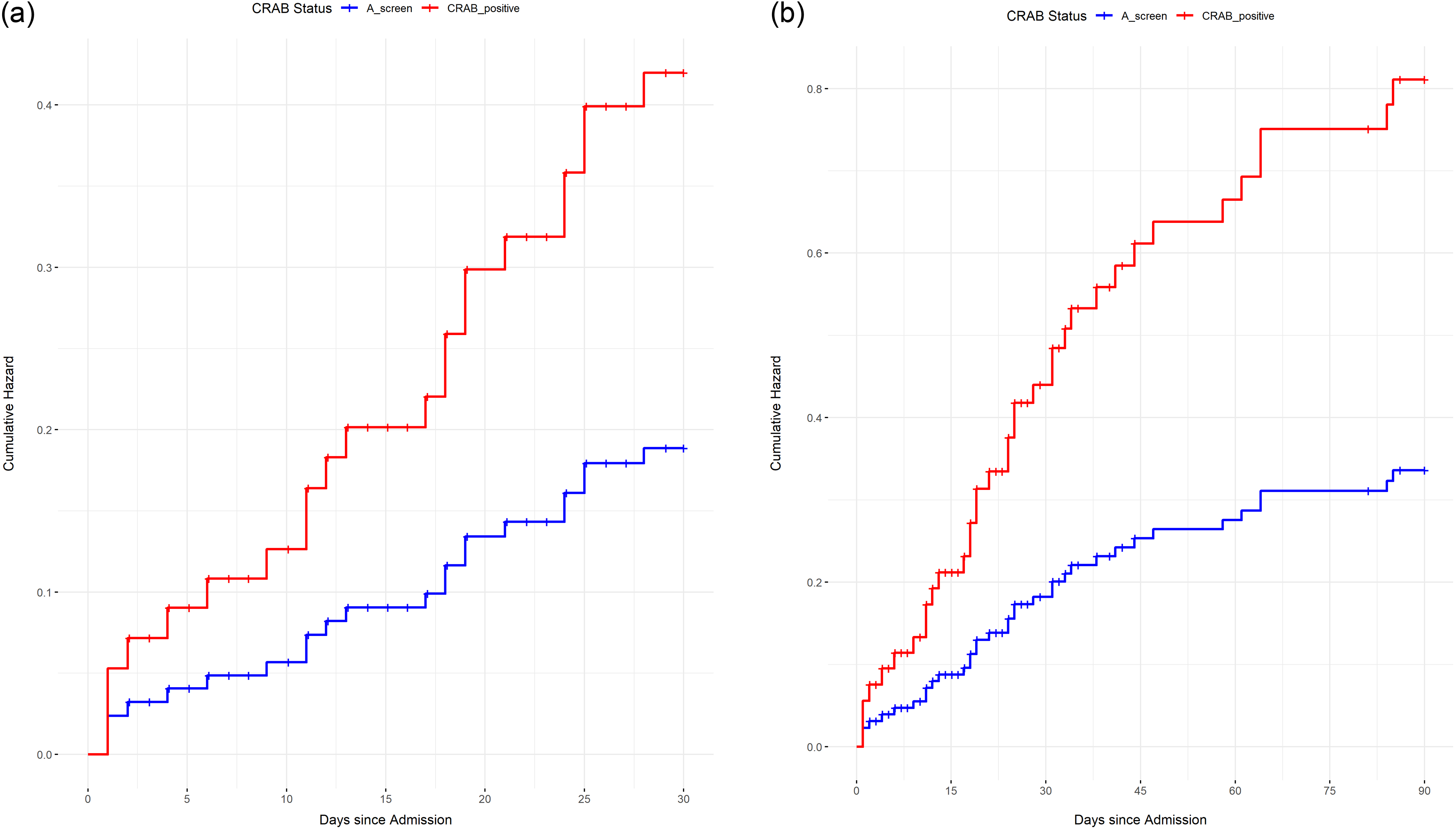
The simplified, immortal-time adjusted cumulative hazard curves comparing all CRAB-positive patients (B and C groups combined) to non-CRAB patients for 30-day and 90-day mortality are shown in Figures 3A and 3B, respectively, reflecting approximately twice the cumulative hazard in CRAB-positive versus CRAB-negative patients. Plots comparing B_comb and C_comb versus A_screen can be found as supplementary Figures 4A–B.
Adjusted cumulative hazard curves for mortality in CRAB-positive versus CRAB-negative patients. 3A: Cumulative hazard curve for 30-day mortality comparing CRAB-positive (combined B and C) versus CRAB-negative (A_screen), from a Cox model adjusted for age, APACHE II, Charlson score, ICU stay, and LTCF residence; stratified by ventilation and study period. 3B: Same analysis for 90-day mortality.

Attributable mortality
Attributable mortality was higher in patients that acquired CRAB in clinical samples (C_clinical) (43.9%) than in those with clinical CRAB-POA (B_clinical) (27.3%), suggesting hospital-acquired clinical CRAB infection may more directly contribute to mortality than CRAB-POA.
Impact of study periods
During the late study period, we observed a significant shift in CRAB detection patterns. For CRAB-POA, the proportion identified through screening increased substantially compared to clinical samples (70% vs 15.8% in the early period, p < 0.0001). Similarly, for hospital-acquired CRAB, the proportion detected through screening increased from 20.6% to 81%, while those identified via clinical samples decreased from 79.4% to 19% (p = 0.0004). The late period was strongly protective against CRAB acquisition in multivariable analysis (OR 0.13, p < 0.0001) and associated with reduced mortality in both 30-day (OR 0.62, p = 0.029) and 90-day (OR 0.62, p = 0.026) analyses, after adjusting for patient characteristics and severity markers.
Discussion
This study offers a comprehensive evaluation of the clinical impact of CRAB colonization and infection among hospitalized patients in a tertiary care hospital, leveraging a large cohort, granular subgrouping, and a range of analytic methods to disentangle the relationship between CRAB status and patient’s severity status. The results suggest that CRAB carriage—whether detected via screening or clinical specimens - is associated with increased early and late mortality (adjusted HRs of 1.78–2.93 across subgroups) compared to non-carriers, even after rigorous adjustments for comorbidities, illness severity, and other confounders.
This study contributes to the ongoing debate, supporting CRAB as a contributor to adverse outcomes. CRAB could manifest in several levels among at-risk hospitalized patients: non-carriers (screened negative), unscreened (status unknown), asymptomatic carriers (detected only by proactive screening), clinical isolation without active infection, and undisputed clinical infection. Delineating between these levels could be challenging, as screening is not always practiced and has sensitivity limitations; clinical isolation (eg, from urine or sputum) may represent both colonization and infection, and there may be a progression from the former to the latter over time. This adds a difficulty to reach agreement regarding the clinical significance of CRAB. In this study we defined 3 major groups—non-carriers, screen-only carriers and patients with clinical isolates, that may represent both infection and clinical carriage. Our findings suggest that CRAB-positivity is associated with worse outcomes for several reasons.
First, there were clear-cut statistically significant differences between known non-carriers and CRAB patients across multiple analytical approaches, adjusted to multiple covariates. This aligns with several previous studies. Reference Yang, Sun, Wu and Zhang7,Reference Cogliati Dezza, Covino, Petrucci, Sacco, Viscido and Gavaruzzi16,Reference Abbo, Carmeli, Navon-Venezia, Siegman-Igra and Schwaber20–Reference Blanco, Harris, Rock, Johnson, Pineles and Bonomo23 Second, although statistical significance was not consistently achieved, clinical CRAB tended to be associated with higher mortality than colonization alone (63–68% vs 55–61% at 90 days), especially among patients with CRAB-POA. Matched propensity score Firth model showed OR of 2.28 (p = 0.034) in clinical POA compared with screening POA. This pattern aligns with previous studies. Reference Wang, Ge, Chen, Komarow, Hanson and Reyes6,Reference Peghin, Givone, de Martino, Ali, Graziano and Isola15–Reference Zhou, Yao, Zhu, Ren, Yang and Fu18,Reference Abbo, Carmeli, Navon-Venezia, Siegman-Igra and Schwaber20
Third, among patients with hospital-acquired CRAB, mortality increased in the days following acquisition (Figure 1A), suggesting a temporal link between CRAB-acquisition and clinical deterioration. Others also reported similar time frames. Reference Peghin, Givone, de Martino, Ali, Graziano and Isola15,Reference Cogliati Dezza, Covino, Petrucci, Sacco, Viscido and Gavaruzzi16 Fourth, remarkably high mortality rates among patients with CRAB on screening alone (55% and 61% at 90 days) may indeed represent these patients frailty, but also the possibility of undiagnosed clinical CRAB infection leading to rapid demise. The high frequency of progression from rectal/sputum colonization to clinical infection was previously demonstrated, Reference Latibeaudiere, Rosa, Laowansiri, Arheart, Namias and Munoz-Price24 and results may differ when the more sensitive skin screening is practiced, as in our study. Reference Nutman, Temkin, Lellouche, Ben David, Schwartz and Carmeli25 Fifth, the attributable mortality assessment found high mortality rates related directly to CRAB (higher in acquired cases).
Our study sheds light on distinct risk factors associated with CRAB-POA versus acquisition. Consistent with existing literature, CRAB-POA was strongly associated with LTCF residence and mechanical ventilation. LTCFs have been reported as important amplifiers of resistant bacteria including CRAB. Reference Wiener-Well, Tordgman, Bnaya, Wolfovitz-Barchad, Assous and Yinnon26–Reference Mortensen, Trivedi, Rosenberg, Cody, Long and Jensen29 The protective effect of ICU regarding CRAB-POA merely reflects the limited ICU access. Regarding CRAB acquisition, prolonged LOS and mechanical ventilation were significant factors that may serve both as risk factors and as consequences of acquisition.
The later study period was strongly protective against CRAB-acquisition as was described by other facilities that introduced hospital-wide intervention. Reference Alon, Mudrik, Chowers and Shitrit30 The reduced mortality in this period cannot be attributed solely to changes in patient mix or severity, as these factors were controlled. Our intervention-bundle effectiveness is particularly noteworthy given resource constraints and inability to maintain dedicated staff allocation, suggesting that even imperfectly implemented measures can yield significant improvements.
Strengths and limitations
Strengths of this study include a large, well-characterized cohort; granular classification of CRAB subgroups; robust statistical techniques; and the natural experiment provided by infection control implementation. Limitations include: (1) single-center retrospective design, as our findings may not be generalizable to all settings given possible different patient population, prevailing CRAB strains, and baseline infection control practices across institutions, as well as generalization of our findings outside of Israel; (2) potential residual confounding by unmeasured variables such as appropriate antibiotic therapy, specific comorbidities, and severity of CRAB infection; (3) subjective determination of attributable mortality, as the determination of attributable mortality was not made through a standardized protocol; (4) possible changes in clinical practice, episodic outbreaks and other quality improvement initiatives over the study periods may have influenced our results in unaccounted ways; (5) lack of molecular typing limited our ability to confirm transmission pathways and identify particularly virulent clone groups. Reference Nutman, Glick, Temkin, Hoshen, Edgar and Braun31 We also did not separate BSI from other clinical infections due to small subgroups. Potential misclassification of CRAB status, especially due to inconsistent application of surveillance cultures, may have led to biased estimates of CRAB status with effect on mortality. While this cannot be ruled out, some studies found that misclassification in healthcare databases did not affect multivariable model calibration and discrimination. Reference van Doorn, Brakenhoff, Moons, Rutten, Hoes and Groenwold32
Clinical implications include highlighting the prognostic significance of CRAB detection, even if only by screening. High mortality rates of colonized patients may alert physicians to investigate potential subclinical infection among carriers and provide targeted treatment earlier. High rates of CRAB-POA from LTCFs suggest the need for targeted screening of patients from these facilities. Our results provide evidence that investments in infection control can yield significant patient benefits even when implemented imperfectly, demonstrating real-world effectiveness of feasible intervention bundles.
Conclusion
Both CRAB colonization and clinical infection are associated with approximately twice the risk for early and late death, even after adjustment for underlying patient’s morbidity. This risk may be reduced by implementation of enhanced infection control measures such as patient cohorting and targeted screening of high-risk patients, especially those admitted from LTCFs.
Supplementary material
To view supplementary material for this article, please visit https://doi.org/10.1017/ice.2025.10315
Acknowledgments
None.
Financial support
This study was not funded.
Competing interests
The authors of this study have nothing to disclose and no conflict of interests.