Introduction
Much debate surrounds the need for smoking cessation clinics for patients with chronic disease such as chronic obstructive pulmonary disease (COPD) (Chapman & McKenzie, Reference Chapman and McKenzie2010; Zwar, Reference Zwar2008). The descriptive evaluation set out in this paper was conducted to assess the benefit of providing an intensive smoking cessation treatment for participants with a chronic disease and /or complex needs within an existing Hospital Admission Risk Program (HARP) funded clinic, ‘No Drawbacks’, at The Northern Hospital, Epping, Victoria, Australia. The model chosen follows a common therapeutic practice in the United Kingdom (U.K), which aims to provide individualised smoking cessation clinics for all smokers, and to treat at least five percent of the estimated local population of people who smoke or use tobacco in any form each year. The UK model aims for a success rate of at least 35% at four weeks, validated by CO monitoring. National Institute for Health and Clinical Excellence (NICE) guidelines define success as the individual having not smoked in the third and fourth week after the quit date, validated by CO monitoring with a reading of less than ten parts per million (ppm) at the four week point (NICE, 2014). However, it can be argued that a realistic success rate is one that is CO verified for 12 months, as the highest relapse rates occur between four weeks and one year. This significant rate of relapse is illustrated by the finding of a 2005 review of English smoking treatment services, where 14.6% of participants were CO validated as abstinent at 12 months and 17.7% when self-reporting was included, indicating a relapse rate of 20% from four weeks to one year (Ferguson, Reference Ferguson2005).
The European Respiratory Taskforce (ERT) has recommended that individuals with COPD should have access to targeted programs for optimal outcomes. Smoking cessation is arguably the only therapeutic intervention that can halt the progression of this debilitating disease (GOLD, 2011). This cohort comprises individuals who have a greater need to stop smoking, and find it more difficult to do so (evidence level B). The ERT Taskforce recommends that COPD patients be offered access to a program for smoking cessation with three essential elements. These are firstly, pharmacotherapy, including Varenicline and combination nicotine replacement therapy (NRT) (evidence level A); secondly, behavioural treatments that are intensive, multisessional and conducted by trained smoking cessation professionals (Evidence level B) (Fiore & Baker, Reference Fiore and Baker2011; Tonnesen et al., Reference Tonnesen, Carrozzi, Fagerstrom, Gratziou, Jimenez-Ruiz and Nardini2007; Zwar, Reference Zwar, Richmond, Borland, Peters, Litt and Bell2011), and thirdly, through objective monitoring, including measures of expired CO levels (evidence level B) (Bittoun, Reference Bittoun2008).
A model of care that focuses on smoking cessation for respiratory patients and which could be used with any client group was developed by Renee Bittoun in Sydney, Australia, in 2006. This model bases treatment on the Bittoun Combination Nicotine Replacement Algorithm, and is a 12 week intensive program using Combination NRT pharmacotherapy and intensive one-on-one support in a clinic environment. All participants in Bittoun's (Reference Bittoun2006) study had been diagnosed with a respiratory illness (n = 62). The evaluation recorded a success rate for participants of 60% at three months CO validated abstinence (Bittoun, Reference Bittoun2006). Unfortunately, this cohort did not have a 12 month follow-up abstinence assessment.
The Bittoun model of care was used by Buckley et al. (Reference Buckley, O’Dowd, Gannon and Brennan2006) for a general population sample (n = 115) in rural Victoria.
Abstinence results at three months were CO verified at 52% (n = 99); six and 12 month results were self-reported and showed a similar reduction in success rate to the English study reported above (Ferguson, Reference Ferguson2005).
The ‘No Drawbacks’ smoking cessation clinic was established at Epping Hospital in northern Metropolitan Melbourne in 2007. It uses the Bittoun Combination NRT Algorithm (Bittoun, Reference Bittoun2006). Therapy at the clinic incorporates the measures recommended by the ERS Taskforce. The sample population was drawn from volunteers who were clients of the clinic between 2007 and 2010. The sample was restricted as all participants were required to meet the criteria of the Hospital Admissions Risk Program (HARP) in force at Epping Hospital, as part of a funding requirement for the clinic (Department of Human services, 2004). A majority of the participants whose outcomes are analysed in this study had a diagnosis of moderate to severe COPD.
This evaluation arose from a perceived need to identify indicators of probable success in smoking cessation for COPD clients at twelve months which had not been established in previous studies, to allow targeting of prospective clients most likely to achieve validated abstinence at twelve months in the interest of cost-effectiveness of future clinics.
The evaluation has a range of aims. The first aim is to explore the impact of client variables on prospective rates of successful smoking cessation of a sample of participants with chronic disease, at three months, six months and one year. Variables include demographic data, (age, gender, education, country of birth, primary diagnosis, preferred language, marital status, socioeconomic status,) variables associated with smoking (family history of smoking, number of quit attempts, Fagerstrom score for nicotine dependence), anxiety score, depression score, motivation level and completion of the three month program.
The second aim of the evaluation was to record the successful smoking cessation attempts of the chronic disease participants at three months, six months and one year, firstly as CO verified and, when CO verification was not possible, through self-reporting at six months and one year.
The third aim of the evaluation was to investigate if anxiety, depression, self-efficacy, quality of life and motivation had any effect on the success of a chronic disease client in smoking cessation.
Method
Study Design
This study was designed as an evaluative descriptive study of a new smoking cessation service offered in a Victorian metropolitan hospital. It had the purpose of establishing a comparison with the methodologies and results of other smoking cessation clinics of this design, and the identification of the most effective elements of the service. This process entailed the identification of a range of variables within the participant group. This identification of variables was designed to assist in the prediction of rates of successful smoking cessation using logistic regression.
Setting
The No Drawbacks Clinic operated in the Outpatients department of The Northern Hospital, Epping, Victoria, on a Monday and Thursday mornings 9–12 pm. Participants organised their own transport to and from the clinic.
Recruitment and Sample
Sampling for the study was complex. Participants’ inclusion in the ‘No Drawbacks’ clinic program required that they meet the eligibility criteria for a HARP service. Eligibility for a HARP service requires a diagnosis of moderate to severe disease and/or complex needs, and frequent presentations to hospital, or risk of presentation to hospital. The chronic diseases included in the HARP criteria were chronic respiratory disease, chronic heart disease and diabetes. (The Department of Human Services, 16 January, 2014).
From this pool, the smoking cessation ‘No Drawbacks’ clinic facilitators, engaged primarily with clients with moderate to severe respiratory disease, defined by a Respiratory Function Test; of Forced Expiratory Volume in one second (FEV1) of below 60% predicted and a FEV1 and Forced Vital Capacity (FVC) ratio of 70% or less were (GOLD, 2011). A minority of smoking participants with other chronic diseases including heart disease, cancer and diabetes were also treated in the ‘No Drawbacks’ clinic. Clients with mild disease who had an admission to hospital were also offered smoking cessation.
Intervention
Smoking Cessation Program - The ‘No Drawbacks’ Clinic
The clinic model was based on best practice models of care, with individualised one-on-one treatment of participants behaviours and nicotine addiction. (Bittoun, Reference Bittoun2006; Fiore & Baker Reference Fiore and Baker2011; Zwar, Reference Zwar, Richmond, Borland, Peters, Litt and Bell2011). The clinic provided client specific education, to optimise the individual's use of behavioural strategies to become smoke free. These behavioural strategies were based on the theoretical framework of behaviourism that is the basis of cognitive behavioural therapy (CBT). CBT theory explains behaviour in terms of reinforcement and cue conditioning. The action of nicotine on the brain reinforces the behaviour of smoking. Other behaviours, environments, events and feeling states which occur at the same time as smoking, become conditioned cues, leading to reinforcement of smoking behaviours. These include behaviours such as smoking in the house or car, smoking with a coffee or while talking on the phone, not smoking in a hospital, pub, or restaurant. By becoming aware of the habits around smoking, the individual can work on extinguishing the conditioned cues that reinforce smoking behaviour (McLeod, Reference McLeod2007). The clinic provided participants with individualised behavioural and psychological strategies, education and information. Participants received some forms of NRT and other pharmacotherapy to aid in the treatment of nicotine addiction (Bittoun, Reference Bittoun2006).
A descriptive evaluation of the application of eligibility criteria, and the processes and outcomes of the clinic were conducted in accordance with ethics guidelines approved by The Northern Hospital, Epping. Two smoking cessation facilitators trained by Renee Bittoun staffed the clinic.
Initial Assessment
Data collection by facilitators began as part of the initial assessment interview. Potential participants discussed treatment options with the facilitators at this stage. The assessment process for the three month program included the collection of a smoking history covering: age of commencement of smoking, number of cigarettes smoked daily, times of abstinence, family history, alcohol consumption and smoking associated rituals (smoking in the house or car, smoking with caffeine drinks/alcohol, on the phone as indicated by Bittoun (Reference Bittoun2005). The initial assessment included recording participants’ Fagerstrom score for nicotine dependence (Bittoun Reference Bittoun2006; Buckley et al., Reference Buckley, O’Dowd, Gannon and Brennan2006; Heatherton, Reference Heatherton1991). Participants’ motivation to quit was assessed on a 10-point scale taken from the tools used in motivational interviewing (Miller & Rollnick, Reference Miller and Rollnick2002). Expired CO levels were measured using a Bedfont smokerlyser that was calibrated every six months as per manufacturer's guidelines. The treatment options discussed with participants, included NRT, Bupropion and Varenicline (the latter became available in Australia in February 2007). At completion of the initial session, participants decided whether they wished to enroll in the three month program. Those who accepted were included in the evaluation, and their General Practitioner (GP) was informed by letter. Pharmacotherapy for these participants was recommended in line with current best practice guidelines, including GOLD and COPDX guidelines (GOLD, 2011; McKenzie, et al., Reference McKenzie, Frith, Burdon and Town2010), and prescribed by the GP after consultation. Where non-prescription NRT was recommended, it was either supplied by the smoking cessation facilitator (21mg 24 h Quit X brand patches, 4 mg Quit X lozenges) or purchased by the participant items such as gum, inhalators, micro-tabs. NRT was provided by the clinic for three months at no charge, the cost of being covered by the Northern Alliance HARP Program.
Facilitators assessed participants at baseline, three months, six months and twelve months (if available), through participant completion of the Hospital Depression and Anxiety Scale, (HADS) (Zigmond & Snaith, Reference Zigmond and Snaith1983), Australian Quality of Life (AQoL) Questionnaire, (Berlowitz & Graco, Reference Berlowitz and Graco2010; Khan & Richardson, Reference Khan and Richardson2010; Richardson, et al., Reference Richardson, Khan, Ghen and Iezzi2012) and the General Self-Efficacy Scale (GSES) (Schwarzer & Jerusalem, Reference Schwarzer, Jerusalem, Weinman and Wright1995). These questionnaires were chosen as validated tools for measuring variables of mood, quality of life and self-efficacy for which Northern Alliance HARP had licenses. Questionnaires were usually completed at the clinic, with a minority collected by telephone if the participant was not able to return to the clinic. Participants were encouraged to attend the clinic weekly to fortnightly over a three month period and were monitored for a further nine months, with the frequency of visits being tailored to individual need. Some ongoing treatments included telephone interventions scheduled at the request of the participant (Bittoun, Reference Bittoun2006; Buckley et al., Reference Buckley, O’Dowd, Gannon and Brennan2006).
Outcomes
All participants who attended the clinic for more than one session were included in the analysis. Participants who chose not to continue the three month program after at least two visits or who could not be contacted were assessed as being continuing smokers. Successful quitting at three months was defined by CO measurements of ≤ five ppm as per Bittoun (Reference Bittoun2005), to validate smoking status. A client report of no smoking (in the time preceding an appointment with the smoking cessation facilitator) was considered smoke free (Benowitz, et al., Reference Benowitz, Jacob, Ahijevych, Jarvis, Hall and LeHouezec2002; Bittoun, Reference Bittoun2006).
Statistical Analysis
Categorical data was reported as frequencies and percentages and continuous variables as means, standard deviation and range. Univariate logistic regression was used to assess which baseline factors were associated with successful quitting. The dependent variable was smoking status (quit versus continuing smoker) at three months, six months and one year. Independent variables were baseline client characteristics, presence of anxiety and depression, self-efficacy, quality of life, motivation to quit and program completion. Factors with a p value < 0.05 and 95% CI not containing one were considered statistically significant. The statistical analysis was conducted using the Program SPSS 17.
Results
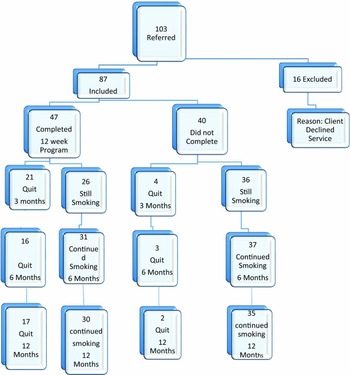
A total of 103 HARP eligible clients were assessed for inclusion in the evaluation. Of these, 16 clients refused to participate, or only attended the first assessment of the service. These clients were eliminated from the subsequent analysis. 87 clients participated in the evaluation (Figure 1).
Participant flow through the program to three months and at six and twelve months.

Baseline Characteristics of the Total Sample
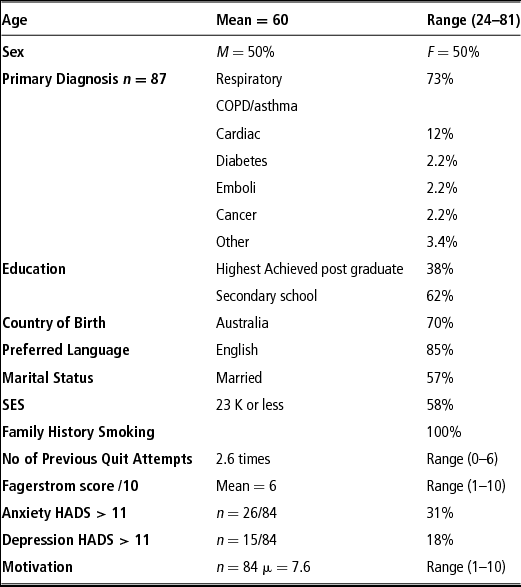
All participants enrolled in the evaluation have a diagnosed chronic disease as a condition of program eligibility. Table 1 indicates that a large percentage of participants (72%) had a primary diagnosis of moderate to severe COPD or asthma.
Baseline characteristics of the total sample

The participants in this evaluation were predominantly born in Australia (70%) and from an English speaking background (85%). Those of non-English speaking background were offered interpreters in line with the policy of Northern HARP Alliance. The participants were slightly more likely to be married (58%) and most of the sample had completed secondary school education (62%). A large percentage of the participants (58%) were receiving a Government aged pension and were therefore considered of low socio-economic status. All participants had a family history (parents, grandparents, siblings) of smoking and most participants had tried to quit smoking at some time in their lives (mean = 2.6, range 0–6). The Fagerstrom score mean (mean = 6, range 1–10) indicated that participants were addicted to nicotine at a medium to high level (Heatherton, Reference Heatherton1991). The participants experienced a similar rate of depression (18%) to the general population of older Australians (10–15%) (Beyondblue, 2013), but experienced a much higher anxiety rate (participants in this evaluation 30%, older Australian population 10%) (Beyondblue, 2013). These participants were highly motivated as a group, (mean = 7.6) even though the range reported was from 1 to 10, to attempt smoking cessation (Miller & Rollnick, Reference Miller and Rollnick2002).
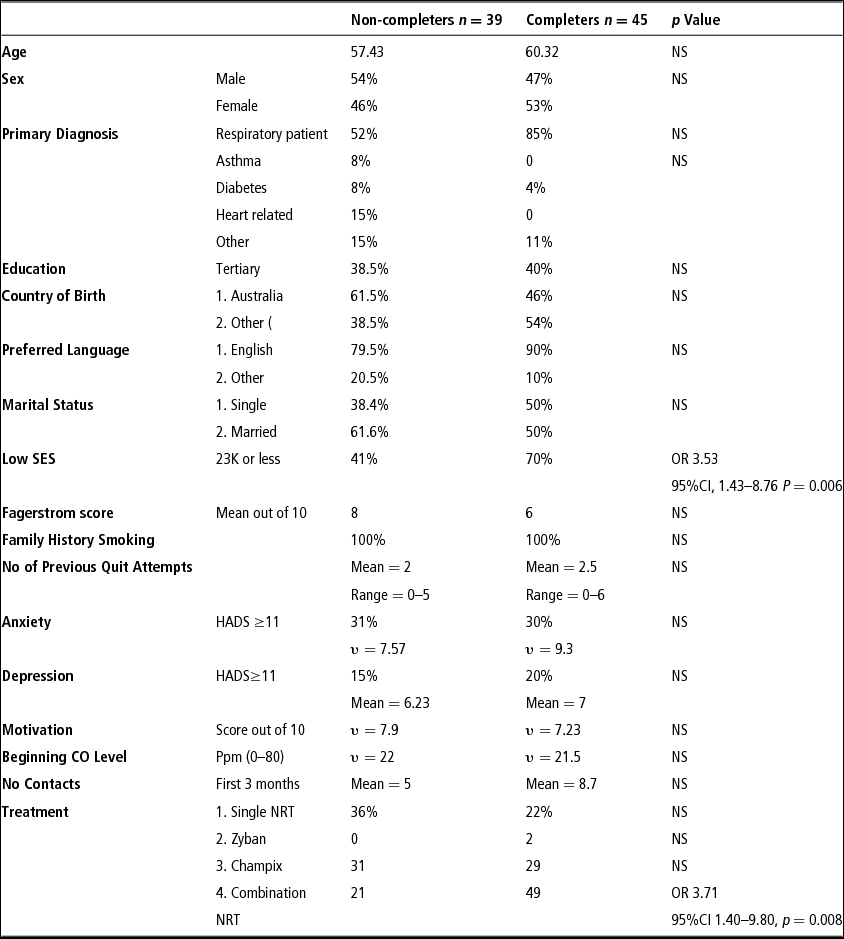
The first aim of the program was to investigate factors that may predict successful quitting for the moderate to severe chronic disease group, at three, six and twelve months. All the factors in Table 2 were analysed using univariate logistic regression, factors with a p value < 0.05 and 95% CI not containing one were considered statistically significant. The only factor that was statistically significant was completion versus non-completion of the program.
Factors predictive of successful smoking cessation and the difference between the completers and non-completers

Note: ‘υ’ is NS (not significant).
At three months, the odds of quitting was higher amongst those who completed the twelve week program versus those who did not was (OR 6.6., 95%CI: 2.0 to 21.6, p = 0.002). By twelve months, the odds of remaining a non-smoker amongst those who completed the program versus those who did not was (OR 18.5, 95%CI 2.3 to 147.3, p = 0.006).
Multivariate analysis was conducted with participants divided into those who completed the program (completers n = 45) and those who did not complete the program (non-completers n = 39). The two groups differed on two variables which were socioeconomic status (income less than $23,000 per annum (OR 3.53 95%CI, 1.43– 8.76 p = 0.006)) more likely for completers, and most used treatment modality (combination NRT for OR 3.71 95%CI 1.40–9.80, p = 0.008) again more likely for completers.
Further multivariate analysis demonstrated that an income less than $23,000 was no longer significantly predictive of program completion after adjusting for the presence of respiratory disease. (OR Respiratory 4.53, 95%CI. 1.05–19.41, p = 0.042 and Income OR 1.5, 95%CI, 0.44–5.06, p = 0.514). The only difference between completers and non-completers was the treatment modality. The completers were more likely to use combination NRT as treatment (49% versus 21%), indicating that this treatment modality may have been the most successful for this group.
Smoking Cessation Rates
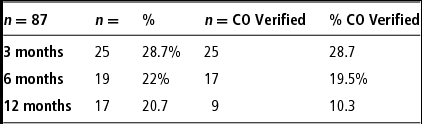
The second aim of this program was to determine the success of an individualised smoking cessation program for participants with moderate to severe chronic disease. Smoking cessation rates were measured as percentages of the total sample at three, six and twelve month point prevalence time periods (Table 3).
Number and percentage of total participants who reported smoking cessation and number and percentage of participants’ verified smoke free by CO reading < 5 ppm

The paper also explored the effect of some other variables that were collected including motivation, general self-efficacy, and quality of life on the success of smoking cessation, to find out if they influenced this sample in any way.
Motivation
Both completers and non-completers were equally motivated to quit as measured by a score of above five out of ten on a ten-point scale where 0 = no motivation and 10 = the highest motivation that the participant could envisage (Miller & Rollnick, Reference Miller and Rollnick2002). The mean score was 7.9 for completers and 7.23 for non-completers. There was no significant difference between the groups.
General Self-Efficacy Scale
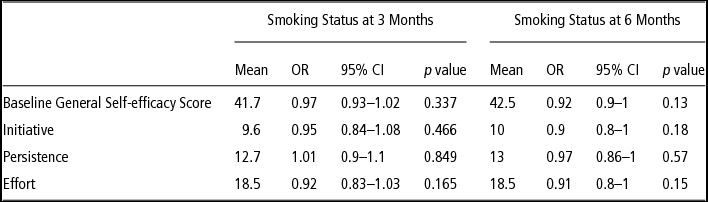
The results of the General Self-Efficacy Scale (GSES) were analysed using logistic regression as a total score at baseline, n = 74 and then by the score of GSES divided into the three different areas of self-efficacy. These areas include initiative, persistence and effort at baseline, to predict smoking status (quit or not quit) at three and six months. Only eight participants completed the GSES at twelve months so that data was not included. It was found that total score of general self-efficacy at baseline did not predict smoking cessation status at three months (OR = 0.97 95% CI = 0.93–1.02, p = 0.337) or six months (OR = 0.96, 95% CI = 0.91–1.01, p = 0.130) (Table 2). When the baseline self-efficacy score was divided into the three areas: effort, initiative and persistence, logistic regression was also non-significant indicating that none of the areas of self-efficacy at baseline predicted smoking cessation status at three and six months (Table 4).
Mean and odds ratio of baseline total GSES and baseline initiative, persistence and effort prediction of smoking status at 3 months and 6 months

Baseline self-efficacy scores were analysed using t-test analysis to explore the effect of self-efficacy initiative, effort and persistence on completers verses non-completers. While total baseline self-efficacy did not predict program completion (t = 1.4 p = 0.08), initiative scores at baseline did significantly predict that participants were more likely to be in the completers group (t = 1.72, p = 0.04) but not persistence scores (t = 1.5, p = 0.06) or effort scores (t = 0.85, p = 0.19). This result indicates that participants with a higher self-efficacy initiative scores were more likely to complete the three month intervention, even though they were not more likely to be smoke free at three and six months.
Australian Quality of Life (AQoL) Questionnaire
Participants were given the AQoL questionnaire at baseline, three months and twelve months. Only eight participants completed the AQoL at twelve months so that data was not included. There was no difference between the completers and non-completers at baseline (t = 0.68, p = 0.24). However, by three months, those participants who had quit at three months had an improvement in their AQoL score compared with those who had not quit, even though this was not a significant finding (t = 1.4, p = 0.07).
Discussion
The primary aim of the evaluation was to describe variables that may impact successful smoking cessation on a sample of smokers diagnosed with a chronic disease. It was found that the only variable that predicted successful smoking cessation at three months, six months and one year was completion of the three month program. This program consisted of an assessment, regular CO monitoring, support and education regarding habits and treatment options for nicotine addiction. The result indicated that the program benefitted participants with chronic disease to achieve smoking abstinence (Bittoun, Reference Bittoun2006; Fiore & Baker, Reference Fiore and Baker2011; Tonnesen et al., Reference Tonnesen, Carrozzi, Fagerstrom, Gratziou, Jimenez-Ruiz and Nardini2007; Zwar, Reference Zwar, Richmond, Borland, Peters, Litt and Bell2011).
Given that the sample was not randomised, the result may be explained by a self-selection of participants who would have succeeded anyway in smoking cessation. This conclusion was supported by post analysis that showed that the group of participants who were part of the completers group also scored significantly higher on the component of self-efficacy, initiative.
The second aim of the evaluation was to describe the success rate of the smoking cessation clinic in terms of percentage of participants who quit smoking at three months, six months and one year. The result was affected by the inability to achieve a majority CO verification of smoking cessation status, except at three months due to a low rate of clinic attendance by participants.
The results of the three month CO verified success rate was 28.7%. This was a lower rate of success than Bittoun (Reference Bittoun2006) result of CO verified 60% or the Buckley et al. (Reference Buckley, O’Dowd, Gannon and Brennan2006) result of 52%, reported as mostly CO verified. The samples in these evaluations may explain the difference in results. Bittoun (Reference Bittoun2006) sampled general respiratory clients, Buckley et al. (Reference Buckley, O’Dowd, Gannon and Brennan2006) sampled the general population, and this evaluation sampled a group of chronic disease patients who are noted as ‘hard to treat’ (Bittoun, Reference Bittoun2006; Reference Bittoun2007), meaning clients considered less likely to achieve smoking abstinence due to being more dependent on nicotine and therefore resistant to treatment. This conclusion was evidenced by the result that the most effective treatment modality for the sample of successful participants was Combination NRT. The more dependent a smoker is on nicotine the more NRT was needed to combat withdrawal symptoms (Bittoun, Reference Bittoun2007).
A further aim of the evaluation was to investigate whether variables such as anxiety and depression, motivation, self-efficacy and quality of life could indicate success in smoking cessation, after the sample was divided into two groups; completers and non-completers of the program. None of these variables were significant. This was a surprising result. For example, nicotine is known to be a powerful antidepressant and self-medicating a feature of the treatment resistant smoker, mainly for depression (Bittoun, Reference Bittoun2007). However this sample did not appear to experience any more depression than the general population of older Australians (Beyondblue, 2013).
Further post analysis explored differences between the groups of completers and non-completers. As mentioned above, it was found that combination NRT was the most used treatment in the group that completed the program, and completion of the program was the only factor that predicted smoking cessation. This suggested that the treatment of the addiction was the most important factor in treating this sample. The result may have been mediated by the supply of some free NRT to all participants, but further research is needed to ascertain the relationship between free NRT, compliance to use of NRT and successful smoking cessation to twelve months (Ferguson, Reference Ferguson, Shiffman and Gitchell2011).
This result was interesting given the focus on the success rate of Varenicline for nicotine dependence. Research is inconclusive about the difference between NRT and Varenicline as a more successful treatment for smoking cessation. (Aubin, et al., Reference Aubin, Bobak, Britton, Oncken, Billing and Gong2008; Burton, Reference Burton and Tiffany1997; Coe et al., Reference Coe, Brooks, Vetelino, Wirtz, Arnold, Huang and O'Neill2005), but a Cochrane Review (Cahil et al., Reference Cahill, Stevens, Perera and Lancaster2013) indicates that Varenicline is the most successful mono-therapy for smoking cessation, being more successful than single forms of NRT (OR 1.57; 95% CI 1.29 to 1.91), and to bupropion (OR 1.59; 95% CI 1.29 to 1.96). However, when comparing a combination NRT (defined as two types of NRT used concurrently with Varenicline, it was found that Varenicline was not more effective than combination NRT (OR 1.06; 95% CI 0.75 to 1.48) (Cahill et al., Reference Cahill, Stevens, Perera and Lancaster2013). This descriptive evaluation concurred with this result. Further research is required to evaluate the best treatment modality for smoking cessation in people with a chronic disease.
Limitations
The evaluation was affected by sample bias. It could not be funded unless the participants were able to meet HARP guidelines (The Department of Human Services, 2004). The majority of the participants were further restricted to a diagnosis of chronic respiratory disease. The applicability of the results is therefore quite limited.
The descriptive evaluation may have been further strengthened by assessing feasibility including, time spent and cost of the service. This was not the original aim; the evaluation focused on efficacy of a one-on-one model of care for smoking cessation. Further research needs to assess cost and time of service provision to further strengthen the need for this type of service. The evaluation was limited by an inability to contact all participants at twelve months to conduct a smoking cessation survey and to validate smoking status by CO monitoring. This may have underestimated the actual success rate of the given that all non-contactable participants were considered smokers. The lack of follow-up data also affected the collation of data for measures of anxiety and depression, quality of life, self-efficacy and motivation for the six and twelve month follow-up. This data may have clarified the impact of these variables on the success rate of smoking cessation at twelve months.
Conclusion
The descriptive evaluation has concluded that a limited sample of participants with chronic disease who are highly addicted to nicotine have more success using an extended one-on-one program lasting three months. The most preferred treatment option is combination NRT, but this needs to be compared with Varenicline in further research. Motivation, quality of life, anxiety and depression, and self-efficacy, as a total score do not influence the outcome of participants completing the program, and who are more likely to be smoke free.
Acknowledgements
The researchers would like to acknowledge the editing support of Ms Evelyn Lomas, and Ms Alex Elhert for their enthusiastic work in helping with the collection of data and the operation of the clinic. I would also like to thank Ms Sylvia Morrissey for her expert editing help. Without this support this publication would not have been possible.
Financial Support
This research received no specific grant from any funding agency, commercial or not-for-profit sectors.
Conflict of Interest
None.
Ethical Standards
The authors assert that all procedures contributing to this work comply with the ethical standards of the relevant national and institutional committees on human experimentation and with the Helsinki Declaration of 1975, as revised.