Between April 6, 1917, and November 11, 1918, the United States called into service a military force four million strong. Members of the comparatively minuscule professional military trained the citizen-soldiers. The U.S. government, helped significantly by the militaries of Britain and France, sent roughly half of them to Europe to fight. Many arrived in France never having handled the weapons with which they would wage war. Though sometimes unprepared for combat and frequently overly enthusiastic in pursuit of military objectives—some thought reckless and foolhardy—this American Expeditionary Force and the promise of its replenishment helped bring the Great War to an end. When the guns finally fell silent, nearly eight million soldiers from the warring nations were dead. More than 115,000 of those were American.Footnote 2
American involvement in wars and state-sanctioned violence outside of North America was not entirely unheard of in 1917. Many soldiers who waged the Great War for America had come of age aware of the exploits associated with the Spanish-American War, if not with vivid memories of the war itself or a clear sense of the extent to which it had expanded America's empire. But the eventual scale of American involvement in Europe's “fratricidal strife” was unprecedented for an overseas conflict. Only those who had lived through America's Civil War had experienced a military mobilization like it, and the stakes in that war had been undeniably concrete and, for many, painfully local. The Great War, with its tangled web of causes, not to mention its distance from the United States, allowed for a far higher degree of ambiguity.
America's Protestant and Catholic clergy did their best to annihilate the war's ambiguity in a hail of rhetoric, image, and action.Footnote 3 If they doubted the course that Christ commanded Christian men to take in the Great War, they gave little indication. Christian clergy argued frequently and vociferously that a marauding, demonic German foe threatened vital American interests and precious American ideals. Monsignor C. F. Thomas of St. Patrick's Cathedral in Washington, D.C., used the occasion of George Washington's birthday in 1918 to make these points with force. “The cause is just and righteous. Our sanctuary has been violated. Our rights despised. Our honor assailed in its tenderest spot. Our champions have gone forth to avenge the insult, to regain the confidence of the world in our greatness and power.”Footnote 4 Aside from a (deliberately?) vague reference to a violated sanctuary, Monsignor Thomas built his case for war out of abstractions: despised rights, assailed honor, insults; the goal of the war was, in his eyes, also rather abstract: to regain the world's confidence. The absence of concrete, material interests was, in fact, a key theme in American discussions of the war. Throughout the war, religious leaders echoed President Woodrow Wilson in establishing a direct connection between the absence of an immediate national interest and the righteousness of America's involvement in the war. True virtue, many proclaimed, was modeled by those who, to quote the famous war poet Alan Seeger, fought “for honor, not for gain.”Footnote 5
But to say that America and Americans had no immediate material stake in Europe's war—at best a half-truth, but a conceit not central to this piece—is not to say that Americans entered the war without intense and ulterior motives. As David Kennedy established a quarter century ago and Richard Slotkin argued again recently, many groups of Americans looked for immediate domestic gains as a result of their involvement in the war. Left-leaning progressives, many of whom had a healthy skepticism of war in general, saw in this particular war an opportunity to “end all war” and also to challenge the hold of large industry on the means of production and distribution. African Americans, most famously W. E. B. DuBois, rallied to the flag in the hope that service in war would finally purchase equality.Footnote 6 Recent immigrants to the United States sought removal of their hyphenate identity and access to full “Americanism” through the fires of combat.Footnote 7
In this attempt to find an increased measure of acceptance, influence, and authority through war, two groups often found themselves at cross-purposes: American ministers and the young American men who filled the Army's ranks. Clergy in America had long been concerned about the state of their social, cultural, and moral authority. As Gail Bederman and Clifford Putney have argued, clergymen in the late nineteenth and early twentieth centuries were haunted by ghosts of effeminacy and worked tirelessly to convince men that Christianity was for them, implicitly linking their own cultural capital to the religious lives of men.Footnote 8 The young men who served in the American Expeditionary Force, though generally less troubled than American clergy by perceptions of decline or marginalization, still saw in war the age-old opportunity to be baptized by fire into manhood and, further, to use their service and sacrifice as a basis for cultural and civic authority in the post-war world.
This article examines the wartime relationship between these two groups and argues that, in an ironic turn, American soldiers used muscular Christian ideas and images—ideas and images of which Protestant and Catholic clergy were the primary developers and traffickers—to critique and marginalize chaplains and, more generally, to re-imagine religious authority in ways that placed soldiers beyond reproach. Rather than submit to the religious leadership and moralist critiques of questionable men, soldiers often leveled their own critiques and authorized or marginalized chaplains based largely on their willingness to preach and live a “muscular” faith defined by a direct, unadorned preaching style, a permissive moral code, and a desire to encounter and even participate in battle.
The Great War brought clergy and young men together in an environment fraught with uncertainties both age-old and specific to the moment. Like all men and women who have encountered and waged war, the young men and chaplains who traveled to France wondered what combat would be like. Would they hold up to the physical and psychological strains? Would they ever see their loved ones and their homes again? The young men who volunteered or were drafted to fight the Great War left behind them a nation in transition and joined an organization, the military, that was adjusting on the fly to the demands of fighting a major overseas conflict. In addition to uncertainties about who would lead them, how they would be outfitted, and where they would serve, soldiers faced significant questions about the kind of nation to which they would return and their place in it. Would soldiers be able to return to their old jobs, assuming they were physically able? Would the nation embrace its newest veterans or keep them at arm's length? Would war truly forge America's increasingly diverse population into one nation, or would ethnic and religious differences, not to mention radically different visions of the political, social, and economic order, prove insoluble?
On top of persistent concerns about their status in the United States, chaplains in the American Expeditionary Force and its auxiliary support services faced a great deal of uncertainty as to their place in the war effort. Like much of the U.S. military in 1917, the U.S. military chaplaincy was unprepared for a major overseas war. There were no uniform standards in place for the appointment of chaplains, no policies governing the assignment of rank or promotion; and the storied heroism of Civil War chaplains was a distant memory clouded by a recent history of incompetence, disrespect, and political favoritism.Footnote 9 Moreover, Christian authority relationships—Protestant and Catholic—were complicated by life on the Western Front.Footnote 10 The diverse religious and regional identities of the soldiery meant that chaplains could hardly take legitimacy for granted. The exigencies of war trumped existing personal relationships and denominationally specific legitimating criteria. More fundamentally, the form and content of revelation changed on the Western Front. War, combat, and violence—already viewed by many as paths to a more authentic experience of life—took on a religious, revelatory significance to soldiers and to many clergymen as well.Footnote 11 The Great War, many soldiers and chaplains proclaimed, was a new Sinai or Golgotha on which a world-changing religious event was occurring. Those present could testify most reliably to the doctrinal content of this new revelation, and those present in greatest number, those most involved in the event, were the soldiers themselves.
This rather contained discussion of religious authority as imagined, critiqued, and exercised in the American Expeditionary Force is one piece of a larger story of the place of religion in the American war effort, but it contains many of the themes of that story and follows its general trajectory.Footnote 12 To wit, religion infused soldiers' experiences of war and gave them a vocabulary for discussing and rendering meaningful both tragedy and triumph; further, soldiers demonstrated a significant degree of theological creativity in imagining the metaphysical and applying religious images and narratives to their lives, sufferings, and deaths. Prior works on religion in the United States during the Great War era have missed much of this story due to their focus on clergy and denominational and extra-denominational organizations.Footnote 13 The broader historiography of the Great War has understandably focused on soldiers as victims of callous, even murderous leaders and of increasingly sophisticated propaganda. The theme of victimization is of vital importance to any discussion of the First World War (and all war, for that matter), but it has pushed from our gaze the soldier as agent, not to mention the soldier as theologian; it has also obscured several important truths about war—its magnetism, its centrality to the construction of western manhood, and the degree to which war experiences are converted into valuable social, cultural, political, and religious capital.
I. “Dominies and Doughboys”
As America's religious leaders pondered with measures of enthusiasm and dread the nation's declaration of war with Germany, quite a few were sanguine about the opportunity war presented for clergymen. The adventures and trials of war, they proclaimed, would place religious leaders in the advantageous position of living and dying among the soldiers, coming to know and be known by young men. Henry Hallam Tweedy of Yale Divinity School imagined the benefits of this experience for America's churches.
[Soldiers] will recall days in the dugouts and nights in the hospitals, when they came to know a different type of minister, a “beloved captain,” who marched through the mire with song and laughter, and crept with them through the darkness and shadow of death in No Man's Land. An almost irresistible attraction will draw them to the churches of such ministers. To their leadership they will be inclined to render obedience; to their messages they will listen with respect.Footnote 14
According to Tweedy, the masculinity and courage of ministers would engender new reverence, new obedience in young men. War's dark cloud was threatening, but its silver lining for American churches was brilliant indeed.
Episcopal Bishop Charles Brent, chief of chaplains for the American Expeditionary Force (AEF), expressed sentiments similar to Tweedy's in an article published on May 10, 1918, by Stars and Stripes, the official newspaper of the AEF in France.Footnote 15 Citing the “experiences of our Allies,” Brent hoped that the chaplain would emerge “from the obscurity of rather an anomalous adjunct of the Army into one of the most honored and essential agencies in the military establishment.” Brent wrote of the chaplain, “He is capable of giving a morale that no one else can, and in heroism and virility he has been found second to none. Even in our young history, chaplains have already displayed those characteristics which make them powerful for good and conspicuous as leaders.”Footnote 16 The Stars and Stripes' soldier-editors did Brent a favor by substantiating his claim with an article, printed on the same page, that reported on Chaplain William J. Farrell's recognition for “personally [conducting] an ambulance along a heavily-shelled road, and helping to gather and comfort the wounded.”Footnote 17
Tweedy and Brent imagined the Great War as an opportunity for ministers to make reputations as men and to establish themselves among young men as relevant, authoritative voices.Footnote 18 The reality of religious leaders' presence among American fighting men on the Western Front was, however, more complicated. Throughout the course of the war, AEF chaplains and auxiliary workers from the YMCA and the Knights of Columbus would prove themselves “virile” and “heroic.” Some, at least, would give “morale as no one else [could].” But the meaning of these “gains” would be contested at many turns by a skeptical soldiery. In the Stars and Stripes article cited above, Charles Brent also wrote of the Army's decision to remove rank insignia from chaplains: “With or without rank the commission by which the chaplain acts is the supreme commission of the ministry of the church which he represents, and of the One Commander of the Army of God.”Footnote 19 Brent believed chaplains to be authorized from above. Historically and militarily, he was correct. Practically speaking, he was wrong.
One indication of an alternate view of religious authorities as a group and of religious authority more generally came less than a week after Easter Sunday, 1918, in a Stars and Stripes editorial titled “Dominies and Doughboys.” The author of the piece agreed with Tweedy and Brent that the Great War presented an opportunity for clergymen. However, he perceived that opportunity somewhat differently.
One of the benefits to arise from this war is going to be the knowledge that the average parson (meaning the lucky parson in khaki) will gain about the average soldier (meaning the average man). This knowledge will do to the parson a world of good. In the light of that knowledge, he may be able, in turn, to do a world of good to the average man—in time.Footnote 20
The assumption, here in print for the consumption of fighting man and “lucky parson” alike, was that religious leaders would have their eyes opened on the Western Front. They would begin their assignments out of touch with “the men”—the “average man” being unknown to the “average parson”—but would receive an education in Christian living by walking among them. Would parsons be influenced by these models? The prognosis was uncertain. Change depended on the dominies. “Taking it by and large … it is safe to say that if the parson is a ‘regular guy’ at heart, he will learn that the average man has an awful lot more good in him than the whole brood of parsons (and those who train parsons) ever suspected; and the average man is a lot more responsive to the things of the spirit—though in his own way—than the average parson could have dreamed possible.”
According to the editorialist, religious leaders and those who trained them had failed, and would continue to fail, to recognize Christian goodness in regular men. They had shown themselves unwilling or unable to validate men's varied and often personal responses to spiritual influences. If the religious leader was, in his heart, a “regular guy”—he was apparently not a “regular guy” on the surface—he would see how wrong he had been. The chaplain would then admit that his Christianity had been shallow and uninformed and that “it is not always the man, say, who cusses the worst who is bound for perdition.”
He will have seen that same man comfort children frightened by bombardment, with the tenderness and skill which their own mothers could not bring to bear. He will have seen that same man go out and rescue a wounded comrade under fire. He may see that man pay the supreme sacrifice without a whimper. And having seen all that, the parson will be mighty lenient judging that man on little scores.Footnote 21
Soldiers, the author wrote, were virtuosos whose skills respected none of the boundaries set by traditional wartime gender roles. They could comfort, rescue, and silently sacrifice better than any woman, all while they fought and killed better than any man. In light of these soaring moral examples, the Stars and Stripes' advice for chaplains in France was simple: watch and learn; see true Christianity in action; turn to it. Then and only then, the editorial concluded, will “the parson … get down to bedrock in his appraisal of men, and not spend too much time fussing about their exterior embellishments. When he gets down there, the doughboy can understand the dominie. The former will lose his distrust of the latter, and the latter will lose his skepticism about the former.”Footnote 22
“Dominies and Doughboys” is shot through with a spirit of inversion which, if taken seriously, could not but destabilize religious authority on the Western Front. The author's jumping-off point, estrangement between young men and clergy, was, as we will see, nothing new. But his analysis of the cause of estrangement and his vision of the route to reconciliation pinned blame entirely on the clergy. Young soldiers were the embodiment of manly and womanly virtues—they were the true church. Clergy had missed these truths and needed to realize them if they hoped to be blessed by the soldiery. Without that blessing, a chaplain's work would fail.
What is one to make of such an editorial? Was it an isolated opinion piece pointing to sentiments held only by its soldier-author? What can one learn from Tweedy, Brent, and the Stars and Stripes about the state of religious authority and religious authorities on the Western Front? To begin answering these questions, it is important to note the similarities among the voices. All agreed that a problem existed in relationships between young men—the soldiers—and their appointed spiritual keepers. Tweedy sensed a lack of respect for and attention to clergy; Brent wrote of obscurity and lingering doubts as to chaplains' masculinity and capacity for heroism. The Stars and Stripes editorialist confirmed these perceptions and added that chaplains were unduly concerned with matters of superficial morality. All also agreed that demonstrations of masculinity, virility, and heroism would be central to mending the relationship. Tweedy and Brent believed that when ministers revealed their true virile selves to the world, the men would automatically recognize their value and religious authority. The editorialist believed that if ministers were “regular guys,” they would come to understand the deep connection between a soldier's sublime masculinity and his essential Christianity, and thus halt all clerical “fussing” about superficialities. All three voices confronted the stereotype of the effeminate minister abroad in early twentieth-century America as either misperception or fact, and saw masculinity—either revealed to the troops or acquired by contact with them—as part of the solution. Finally, Tweedy, Brent, and the editorialist all looked to war as the event that would make right what was wrong between clergy and young men. War would, in their eyes, reveal the truth.
Each of these authors expressed understandings of the relationship between masculinity and religious authority widespread in both Progressive-era American culture and the American Expeditionary Force. For at least four decades before the Great War, clergy had been hard at work arguing that Christianity was not only a masculine religion, but that muscular men embodied the spirit of Christ most perfectly. Their treatises, sermons, and institutions defined a Christian ideal that placed manliness and physicality, vigor and strenuousness, above theological erudition, pastoral service, and other allegedly sissified, overcivilized pursuits.Footnote 23 This program, known generally as “muscular Christianity,” emerged out of efforts to bring men back into the Christian fold, the feminization of which had long been a source of concern for clergy. In the second decade of the twentieth century, muscular Christianity appeared to be ascending. As Clifford Putney writes, proponents of muscular Christianity and the institutions associated with it were widespread and influential in the 1910s.Footnote 24 Episodic revivals, such as those sponsored by the Men and Religion Forward Movement, and the rising popularity of the YMCA, placed muscular Christianity and its spokesmen near the center of American Christian life. One senses, though, in the words of Tweedy and Brent, a deep and enduring concern for the state of relations between men and the churches. It is clear that somehow, in spite of all the successes, American clergymen still found themselves facing a “man problem.”
Yet it is also clear that muscular Christianity exerted a powerful influence on many members of the Great War generation. Theirs was the world of the YMCA, church-sponsored Boy Scout troops and numerous other church-related organizations for boys. Anglo-Protestant cultural icons such as Teddy Roosevelt, Billy Sunday, Rudyard Kipling, and Robert W. Service filled pages with speeches, sermons, and poems that made strenuousness and virility the highest virtues of western Christian manhood.Footnote 25 Evidence of the effects of muscular Christianity appears frequently in writings by and about American soldiers. Some, like Dinsmore Ely, who flew with the famous Franco-American Lafayette Escadrille in the Great War, were allegedly reciting militarist Christian dicta at the tender age of four. Ely was raised in Winnetka, Illinois, but in 1898 or 1899 traveled to his family's ancestral Presbyterian church in Pennsylvania for a centennial celebration. There, according to his father, young Dinsmore stood before the church and spoke the following poem.
John Jay Chapman recalled the presence of similarly militaristic turns of phrase in the religious practices of his fallen son Victor: “He continued to the end of his life to make the sign of the cross in saying the same prayers that [his mother] had taught him—which ended with the phrase—‘and make me a big soldier of Jesus Christ who is the Lord and Light of the world.' He folded his hands like a crusader as he said them. He was a part of the middle ages in this piety.”Footnote 27
Though Victor Chapman's father chose to locate his son's “piety” in the Middle Ages, it was decidedly twentieth century.Footnote 28 Chapman, Ely, and countless other American men who fought the Great War had been raised to see being “a big soldier of Jesus Christ” as a grand—if not the grandest—expression of the Christian faith. And though “soldiering for Christ” often served as a metaphor for mission work, evangelism, or other non-military Christian endeavors, the advent of a war pitting “Christian” armies against the anti-Christian German “Hun” gave these young men the opportunity truly to “fight for Jesus.” What Tweedy's fictive “beloved captains” and Brent's actual chaplains faced on the Western Front, and what we find distilled in the “Dominies and Doughboys” editorial, was not the failure of muscular Christianity among young men, but the powerful appeal of muscular Christian equations between the masculine virtues of struggle and strenuousness and the ideal Christian life. Moreover, the Stars and Stripes' critique of chaplains was not exceptional in anything other than its length and the breadth of its readership. Soldiers used muscular Christian caricatures of effeminate, misguided, small-minded Christian ministers to marginalize spiritual shepherds who sought to counsel or critique the American soldier. Thus did early twentieth-century efforts to masculinize the Church provide young men with the basis for keeping churchmen at arm's length in the complex moral circumstances of war.
II. Home-Front Concerns, Western-Front Critiques
In the decades prior to the Great War, masculine Christian leaders, often spouting chauvinist discourse, had sought to undermine the “narrow-minded moralist” and the “weak, forgiving, putative Christian” with self-consciously “masculine,” self-consciously corrective Christian polemic and instruction for men.Footnote 29 American soldiers were aware of and engaged in these struggles within American Christianity and applied the masculine, muscular critique to religious leaders on the home front. They maintained in their public and personal correspondence that there was something wrong with religion in America and that religious authorities in the United States did not understand the true nature of the World War. In church-centered attempts to sculpt the moral worldview of Americans at war, soldiers and war workers saw further evidence that clergymen remained mired in questionable teachings and creeds while war was revealing new and profound truths. In the end, many home-front clergy and faithful just didn't get it.
The Stars and Stripes, like the letters and diaries of the men who read it, was dominated by news of the war and by stories of the lives of those fighting it. Both the men and the paper, however, kept an eye on events in America, particularly events pertaining to the war. Some of the harshest prose published by the Stars and Stripes was directed toward those who detracted from the importance of the war or the heroism of the soldiers. Home-front religious leaders were frequent objects of this type of ire. Moralistic men and women, the paper's soldier-authors wrote, undercut and insulted the character of the AEF by worrying openly to congregations and other audiences about soldiers' moral shortcomings. One historian has described the concern with soldierly morality as a somewhat misguided outgrowth of the Progressive, reformist mentality.Footnote 30 Whether misguided or not in terms of moral history, this wartime “crusade against vice” provoked soldiers to rail against the “narrow minded” and “effeminate” Christian leaders who preached it.
An editorial in the June 28, 1918, issue of the Stars and Stripes captures this critical tone perfectly. “Onward Christian Soldiers” responded to a fundraising “offensive” launched by the YMCA on the home front. The goal of this “drive” was to raise one hundred million dollars to benefit soldiers through YMCA services and ministries on the Western Front. The Stars and Stripes supported the campaign on the grounds that “it means shelters and new stages for [stage and screen actress] Elsie Janis and those who are to follow in her fancy steps. It means movies and music, huts and hospitality, chocolate and cheer.” Yet the writer was suspicious of YMCA fundraising tactics and, citing a YMCA hymn—“Lift up the Red Triangle/Against the things that maim—/It conquers booze the wrecker, /It shuts the house of shame”—he questioned the sincerity, masculinity, and authority of the campaign's leaders and donors. “We most devoutly hope that no old ladies of either sex will be beguiled into contributing a single centime to that $100,000,000 in the delusion that, without our brothers of the Red Triangle, the A.E.F. would relapse into a riotous group of venereal drunkards.”Footnote 31 The Stars and Stripes' soldier-authors found this moralistic faith and its focus on alcohol consumption, venereal disease, and other matters of ill conduct both corrosive and corrupt. In order to fill church coffers, home-front clergy unscrupulously tainted the reputations of men fighting for Good and Right with tales of sin and vice convincing only to those with the rusted moral compass, if not the outward appearance, of an elderly woman.
The Stars and Stripes argued more forcefully against narrow-minded moralism and in favor of the soldier's absolute moral rectitude in a July 26, 1918, editorial discussion of foul language. In the piece, titled “Just Plain Cussing,” the editors admitted that swearing was “a careless habit born of sometimes years of careless speech” but asserted also that “it doesn't at all imply blasphemous thoughts or irreverence towards the Deity on the part of the doughboy.” This doctrine was not simply constructed of convenience, the editors continued; soldiers had encountered “the holy” in combat and had demonstrated their Christian virtue in its presence.
A soldier who cusses may not be what the ladies call a “nice” man, but it doesn't follow that he's an irreverent, godless wretch. He has seen too much of the works and wonders of God, too much of the divine in the actions of God's children around him to be blasphemous at heart. So, when some of our brethren, both here and at home, are inclined to be captious, we ask them to hold up a bit and reflect.
How could a man who had seen and known God in combat be considered anything like blasphemous or irreverent? Didn't the work that he was performing in the cause of God, civilization, and his fellow man make all such “sins” shrink to nothingness?Footnote 32
Infantry officer Lambert Wood and war nurse Helen Dore Boylston agreed with the Stars and Stripes that home-front moral standards and those who trumpeted them were irrelevant in the context of war. Wood, a twenty-two-year-old Oregonian serving with the First Division, used a letter to his mother to voice his disdain for hometown agencies, “Podunk Relief Societ[ies],” in his words—that facilely demonstrated “great patriotism by giving a chicken dinner.” Yet he saved the balance of his frustration for the home-front Christian moralist.
Every time I see an article headed, “Is the Youth of Our Country Becoming Atheists?” or “What of the Morals of Our Soldiers?” it is to laugh! They are all right, thank you. Please send more men and ammunition! We haven't got time to worry about our morals! Otherwise engaged at present. After the war, you will read articles and try to figure it out. Maybe they aren't all right—but anyway, we are healthy and happy.Footnote 33
It was hard for those back home to see, Wood complained, but there were more important enemies to fight than alcohol, swearing, and promiscuity. Let's save civilization first, he suggested, and then worry about clean living. Describing a mid-September 1918 incident in which her orderly had gotten drunk and slept through his shift, Helen Boylston asked, “How is one to judge them? Ordinary standards are no good here. My boys have always worked for me with all their might. Why should I turn on them when they are foolish?”Footnote 34
Sexual encounters with French women presented a more complex problem than profanity and alcohol, and raised the concern of officials at home and in France for a number of reasons. First and most practically, as David Kennedy and Jennifer Keene point out, venereal diseases, passed from prostitutes to soldiers and back again, threatened to reduce troop strength.Footnote 35 To limit the military effects of sexual misconduct, the AEF made houses of prostitution off-limits to soldiers, instituted a sexual education program to dissuade soldiers inclined to visit prostitutes, and distributed prophylaxes to contain the problem among the insistent. The program worked to drive VD rates to historic lows in the Army. Second, as already noted, the image of the AEF mattered greatly to its supporters, commanders, and soldiers. Many within and without the military had argued that military life could, generally speaking, straighten crooked arrows. France was known, however, to be a more permissive moral environment than the United States, and military life there might well allow crooked arrows to fly their “natural” course while also bending more than a few who had once been straight. Had the problem of venereal disease spread rapidly and given legitimacy to such concerns, the war effort, the AEF, and the righteousness of American soldiers might have come under attack.Footnote 36
Despite campaigns and warnings, there were those who availed themselves of the opportunity to have sex as they would not have at home. There were also those, like American pilot Kenneth MacLeish, who resisted but were sympathetic toward those who did not. MacLeish wrote to his fiancée, Priscilla, on December 4, 1917, “I'm beginning to understand why so many soldiers go wrong in Paris. Of course temptations now … are perfectly frightful.”Footnote 37 Every night, he continued, at least two women approached him to grab his arm. He found them “repulsive,” but confessed, “just lately some ideas have entered my head that scared me.” MacLeish's moral anchors were his family, his ideals, and the woman he hoped to marry. Yet he was confronted with the painful fact that he might never see his family or his fiancée again.
Danger demands its rewards in excitement. The greater the danger, the stronger the desire. Why should I refrain? These are some of the thoughts that have arisen lately. They aren't very powerful in me because I have decided to live, while I live in a way which would make you happy and, if I must die, in a way which would make you proud. But I guess there are many men in our service who aren't as lucky as I am… . I don't blame them nearly so much now. I'm inclined to pity them.Footnote 38
MacLeish understood the forces driving men to “sin.” He admitted to feeling them himself. The moral circumstances of war in France combined with uncertainty regarding the future led men to seek what pleasure was left in life. Some could resist, MacLeish wrote, but those who could not did not deserve chastisement from home-front moralists. Their behavior, he thought, indicated that the faith and values that were supposed to rein them in were woefully inadequate. MacLeish then pinned the blame for the flimsiness of soldiers' morals on America's religious leaders and institutions. “[Soldiers] don't need to have what remnants of their religion remain to them collected and strengthened. Their crying need is for something practical and tangible which will drive the old saying, ‘Eat, drink, and be merry for tomorrow you may die,’ out of their heads. That's why I think people and churches back in America are on the wrong track.”Footnote 39 Repackaging a broken faith would serve no one well. But as MacLeish observed further, there was a “crying need” for some sort of remedy.
The problem of morally questionable behavior was not merely a figment of the moralist imagination; nor was concern about soldierly conduct confined to the home front. Life in France gave soldiers access to alcohol, tobacco, and prostitutes, as well as the means, the time, and a rationale for overindulgence. Many soldiers and war workers commented privately on the prevalence of foul language, drinking, and other “questionable” activity. From very early in the war effort, though, soldiers, war workers, and their official public voice attempted to shape the conversation about wartime moral lapses and their potential consequences. What was at stake in such conversations? Of the many possible answers, two are especially relevant to this discussion. First, by arguing that soldiers' moral shortcomings were divorced from their “true morality,” the soldier-authors of the Stars and Stripes, soldier-poets, and the doughboys whose words were read only by loved ones could short-circuit concerns about soldiers' eternal fates. Though some soldiers appeared to be sinners, the argument went, they were really and truly saints. Second, assertions of soldierly virtue implicitly questioned the need for clergy and their saving ministrations on the front lines (with doughboys like these, who needs dominies?), thereby keeping religious authorities off balance and focused, perhaps, on offering the praise and support that the American Expeditionary Force and its soldiers wanted.
The critiques of religion and religious leadership abroad in early twentieth-century America were not issued to every soldier along with his boots, pack, rifle, and gas mask.Footnote 40 Not all recoiled at Christian moralism and derisively gendered its proponents feminine. But these critiques of home-front Christianity and this masculinist dynamic were taken up by many American soldiers, and often provided the criteria by which religious authorities' reflections on war were judged as either legitimate or not.Footnote 41 Soldiers' active engagement in the framing of moral issues and the concomitant undermining of religious authorities provided a clear and concise defense against those who questioned in any way the righteousness of the war. Critics were effeminate, superficial, out-of-touch pseudo-Christians.
We can see this logic at work in the writings of Charles Biddle, who twice voiced concerns, like those expressed in the Stars and Stripes, about the falsity and effeminacy of home-front religion. Biddle, a pilot first with the Lafayette Escadrille and later with the American Air Service, reacted critically to Harry Emerson Fosdick's tract The Challenge of the Present Crisis and the type of Christianity that Biddle thought it represented. He did not dismiss Fosdick's thoughts out of hand (“I think [the book] is excellent and contains much food for thought”), but he took strong issue with the reverend's stance toward Germany. “I cannot … at all agree with the author in his prayer to God to bless Germany (see p. 54–55).”Footnote 42 Fosdick's prayer read, in part, “O God, bless Germany! At war with her people we hate them not at all … We acknowledge before Thee our part in the world's iniquity … We dare not stand in thy sight and accuse Germany as though she alone were guilty of our international disgrace. We all are guilty.”Footnote 43 In Biddle's opinion, Fosdick did not have it quite right. He was shamefully soft on a savage enemy.
You remember the picture I sent you, “Ne leur pardonnez pas, mon pere, car ils savent ce qu'ils font.” [Father, do not forgive them, for they know what they do.] The same thing applies to the methods of the Huns in general and not simply to their bombing of women and children. During this war I shall kill as many Huns as possible … Fosdick in his book quotes Walt Whitman as having said “God damn the Turk.” I think the same prayer would be even more suitable in the case of the Hun. You will say I am bitter. I am and I should be ashamed of myself if I were not.Footnote 44
Biddle had no trouble pinpointing responsibility for the outbreak of the war and for its ruthless conduct. Guilt resided in Germany and was shared little, if at all. In Biddle's eyes, Germany deserved not forgiveness but damnation.
The softness of which Charles Biddle found Harry Fosdick guilty was, on his reading, a wider phenomenon. Indeed, he believed it to be characteristic of a strain of Christian faith with which he had no desire to be identified. Having survived a shelling of the hospital where he was recovering from a bullet wound, Biddle turned his thoughts again to forgiveness. “Forgiving and forgetting with regard to such a thing, is to my mind, as I have said before, not a sign of Christian spirit but of pure weakness. If Christianity requires us to forgive them I am afraid I am no Christian.”Footnote 45 The object of his critique was more general than earlier, the tone harsher. Biddle was convinced that weakness and “the Christian spirit” had been confused, and was unwilling to identify himself with such an error. Asking God to bless or forgive the Germans demonstrated, in his mind, a misunderstanding of the Christian message. And though Biddle did not say it outright, we can speculate that he had a cure in mind for Fosdickian forgivers and effeminate “Christian” weaklings. Send them to feel the heat of battle and see the viciousness of the enemy. War will make true Christians of them.
III. Men of God, Men of War: Religious Authority on the Western Front
Soldiers and their official newspaper critiqued religious leaders on the Western Front as frequently as they critiqued those at home and used similar criteria in their evaluations: moral tolerance, masculine style, and appreciation of the gravity of the war. To these they added a more explicit statement of the importance of clergy encountering combat. War, they proclaimed, would reveal both Truth and true manhood, and would substantiate or undermine religious authority.
The editorial staff of the Stars and Stripes described quite clearly their ideal chaplain in a poem titled simply “The Chaplain” and published on March 8, 1918, as part of a series on figures in army life. The poem, it is safe to assume, was more prescriptive than descriptive.
The poem's stanzas follow an A-B-B-A format with regard to theme. Theme “A” is the relationship between soldierly behavior and salvation; theme “B” is the relationship between the ideal chaplain and the soldier. The crux of theme “B,” as stanzas 2 and 3 demonstrate, is that chaplains should speak when asked either for a sermon or a prayer, and should then serve the soldier eagerly. To expand a bit a metaphor from stanza 3, the chaplain is like a bartender, with a message “right on tap” and ready to pour. According to the poet, that message should always feature a Christ fully at home in the American Expeditionary Force: setting “His people free” and righting wrongs even unto death. As important as the ideal chaplain's pastoral demeanor and Christology, however, is his soteriology, the subject of theme “A.” As stanza 1 states and stanza 4 echoes, salvation has nothing to do with swearing, smoking, or drinking. All that Peter the heavenly “sentry” needs to know is that a soldier did his duty and fought as the officers appointed over him ordered. To prove himself legitimate, “the Chaplain” had to walk a narrow path indeed; he could never express a doubt as to the fates of those waging violence in support of the Allied cause.
The place of the chaplain in the AEF was taken up again in “Etiquette Hints for Doughboys,” a regular tongue-in-cheek feature written for the Stars and Stripes by Private Hudson Hawley under the pseudonym “Bran Mash.” On April 26, Mash turned his attention to “Church Manners.” He wrote for the benefit of those “who have not been in the habit of going to church before joining the Army” and thus may be unfamiliar with “certain rules of deportment which must be lived up to,” to satisfy “visiting brethren and sistren.”Footnote 47 Mash sympathized with the men who “may be inveighed into attending a service” and recognized that “some colonels anxious to coddle the mother vote at home, institute church services for the whole regiment, and get everybody to go by the simple expedient of falling everybody in, presumably for wood detail, and then springing church on them.”Footnote 48 The advice offered to those caught so unscrupulously contained an anti-authoritarian, mildly anticlerical edge. After warning soldiers not to spit tobacco juice in ranks but rather to “let it trickle gently, and … try to conceal it by use of a handkerchief,” Mash counseled them not to be “in too much of a hurry to time the preacher … you'll get plenty of time to inspect the face of that interesting piece of chronometry when the Good Man begins on his 20-minute prayer.” He also reminded soldiers not to embarrass the chaplain by exposing him as out of step with the flock: “Don't snicker,” he wrote, “when he prattles on about the evils of shooting craps.”Footnote 49
It is not surprising that a humor piece would paint the chaplain in such negative hues. But the characterization of the chaplain as long-winded, moralistic, and capable of drawing a crowd only by trickery hit American chaplains where they were most vulnerable: in the soft spot that was their connection to American soldiers. Bran Mash's portrayal, though clearly not representative of the full mosaic of relationships between soldiers and religious leaders, did distill a series of sentiments particularly corrosive to clerical authority. It portrayed the chaplain as an inept outsider, one who gains an audience with true men only by mother-coddling subterfuge and alienates the gathered men further with an off-key message played at length. The importance of anything the chaplain might say was trumped, in Mash's opinion, by the pressing question of how to dispose discreetly of tobacco-infused spit.
We can read these portrayals of Christian ministers in many ways. One can interpret them as an official attempt to correct clerical attitudes and behaviors—to mold religious authorities to the culture of a military at war. The poem “The Chaplain,” described above, is a rather clear example. One can also look at these writings as attempts to entertain the soldiery—bits of prose designed to bring young men facing death to laugh a bit at the personalities around them and, perhaps, even at themselves. The Bran Mash piece, as noted, certainly has this flavor. As the “official” newspaper of an army at war, the Stars and Stripes had a vested interest in countering all forces that might drag down morale or, more critically, undermine the will to fight. A chaplain or other religious figure was potentially well positioned to do either by raising moral questions about war in general, the Great War in particular, or the eternal consequences of a soldier's behavior. In this light, the preceding Stars and Stripes articles seem to administer a prophylaxis against “effeminate” theologies inimical to the enthusiastic pursuit of victory and to offer not-so-subtle guidance to newly minted chaplains. Whether corrective and coercive, or demeaning and entertaining, these pieces also shared a third quality, namely, they expressed to a great extent the beliefs and opinions of the Stars and Stripes soldier readers. These articles and many others are, in fact, accurate expressions of soldierly likes and dislikes vis-à-vis religion and the men charged with propagating and maintaining it.
As described in the personal writings of American soldiers and war workers, the situation of the would-be religious leader on the Western Front was precarious. Some wrote of genuine dislike for chaplains and YMCA workers; others admired them as “men” and appreciated their religious work.Footnote 50 Individual soldiers and war workers did not, however, treat a chaplain's commission or his presence as necessarily indicative of religious authority. They required proof of his embrace of a direct, unsentimental approach to faith, his acceptance of soldierly moral imperfections, and his willingness to be tested in the cauldron of combat. These criteria functioned both positively and negatively; they legitimized and delegitimized those who would speak in God's name.
The importance of “manly” personality and style as foundation stones of religious authority and legitimacy emerges in account after account written by soldiers, war workers, and chaplains as well. This approach to matters of faith was defined by plain speech, good humor, and moral tolerance. Soldiers embraced those who displayed these qualities and dismissed those who did not. Sergeant Peyton Campbell, an advertising copywriter turned soldier, praised his unit's “Chaplain Urge” for knowing precisely how to speak to young men, and asserted that soldiers embraced him because of his style. Campbell observed in a July 7, 1918, “diary-letter” to his parents that Urge “has a great deal of influence over the fellows because of his personality, and incidentally because he doesn't ‘preach.’”Footnote 51 In a letter to an unknown recipient, Robert Kean described the positive impression made by his chaplain, the morally tolerant John B. McCormick. McCormick, a “small good-looking, pink cheeked” Episcopalian originally from Michigan, “seemed very young for a spiritual adviser,” but had nothing of the moralist in him. Kean wrote, “He … always finds the best wine in town, plays poker and is my idea of a regular minister. Nothing hypocritical about him.”Footnote 52 McCormick had shown himself to be—in the words of the Stars and Stripes editorial—“a regular guy.”
Chaplains who knew how to talk to soldiers also needed to develop a good sense of how (and how not) to judge them. Chaplains could gain good standing or reaffirm their marginality based on the moral code they espoused and on which they acted. Richard Ashley Blodgett was put off by a chaplain whose preaching included judgment of those who swore, and wrote of the experience in a February 2, 1918, letter to his mother. “Last Sunday a priest held a service here and I attended in the proper manner, though quite disgusted because he held forth for half an hour on swearing. Anyway, he meant well though he was slightly tiring.”Footnote 53 While recovering in a Paris hospital, Torrey Ford came across a “Methodist minister from Rockland, Maine”—emphatically not a “regular guy”—who was “taking a slight furlough from his Y.M.C.A. services while he has something or other cut out.” Ford indicated to his parents in a February 1918 letter that he and some friends had some fun at the minister's expense. “We have a good time hooting his ideas on low-necks, dancing, cards and rum. His troubles are more painful than the rest of ours are. We even curse for him when the worst he can get out is ‘Cracky!’”Footnote 54 The minister's moralism was, to Ford, laughable.Footnote 55
As important as a masculine style and moral tolerance were to a chaplain's legitimacy, nothing could make or break his reputation as a man and as a minister like his actions in and around combat. Time and again public and personal literature took note of a chaplain's composure or lack thereof under fire and related his battle demeanor to his standing among men.Footnote 56 With shells exploding and bullets tearing through dirt and cloth and flesh, one learned what was hidden beneath the literal and figurative surface—whether the chaplain (or, for that matter, any man) was a “regular guy” at heart.
The Stars and Stripes published many accounts of chaplains being decorated for bravery in combat, making clear that the masculine ideal of religious leadership could be realized. A September 13, 1918, story about “Doc,” a Baptist pastor from Arizona, described encounters with combat as required of chaplains while also asserting that specifically religious benefits came with them. Doc had become a YMCA chaplain with a combat unit in France and, the author wrote, “like all good chaplains he was in the thick of things at the Marne and would come out wild-eyed and reverent after each engagement.” He always carried his own pack, went on foot, and never attempted to set himself apart. “None come out of such an adventure saying that Old Doc doesn't know what it's like.”Footnote 57 The article reported further that in a recent engagement Doc had attempted to rescue his wounded colonel and had, in the effort, been gassed and wounded by shrapnel. In the eyes of his men, Doc had been revealed as one of them. They acted accordingly.
When Doc came to in the evacuation hospital, he found that his outfit had stealthily cut-off and confiscated all his Y.M.C.A. insignia and sewn on their own emblem instead. Later, in Paris, he was ordered to resume his proper decorations, but once he had crossed the line into Battle Land once more, there was an immediate and violent order restoring the Army escutcheon. Whereat Doc, who never can remember whether he is a doughboy or a Baptist or what, roared with laughter.Footnote 58
Having been revealed as a masculine “regular guy” by the light of combat, Doc no longer belonged in a YMCA uniform. Having shown himself to be unconcerned about the distinction between doughboy and Baptist, Doc and those like him could be ordained finally and truly. The traditionally congregational polity of Doc's church and other churches aside, the inversion of the religious authority relationship here is telling. Soldiers evaluated and blessed the chaplain, not vice versa.
In their personal writings, soldiers remembered how chaplains stood the test of combat and recalled fondly those who showed themselves to be true heroes. Michael Donaldson of the 165th Infantry—the nationalized version of New York's famous Fighting Sixty-Ninth—wrote glowingly of his chaplain, the famous Father Francis Duffy, that “he was with us in all our trials and weary marches, the dreary days in the trenches, when it seemed next to impossible that we would ever come out alive, and by his example, his brave understanding, comradeship and his great spirituality, he breathed the fire of life into the soul of the Sixty-ninth.”Footnote 59 Chaplain Benjamin Lacey, a Presbyterian from North Carolina, acted notably enough under fire to gain mention in Private Clarence Lindner's letter dated October 16, 1918.
We have the original “fighting parson.” … He is an Oxonian, and a scholar of merit—and he is by way of being an artilleryman of some note hereabout. Well, we captured some big German guns and Chaplain Lacey got a gun crew together, put the whole German battery in a position to shoot its former owners, and boomed away a whole night at the German lines with German munitions.Footnote 60
A captain in Lindner's unit asked him who was running the German battery, to which Lindner replied, “Our parson.” The captain rushed to confirm “the marvel” of militant Christianity, an act that secured the chaplain's standing in Lindner's mind and likely in his battalion as well. “A big two-legged man is Parson Lacey, and a soldier, by Heaven.” Once again, the soldier blessed the chaplain.
When a chaplain did not prove himself to be a “big two-legged man and a soldier,” soldiers were not surprised. The weight of much of the Stars and Stripes' writing on top of muscular Christian caricatures of the “meek and long-suffering” clergyman certainly tilted soldiers' expectations away from truly masculine clergy.Footnote 61 Thomas Barber wrote hauntingly of his encounter with an anonymous chaplain who “had a face typical of weak clergymen the world over,—thin, high-strung, somewhat ascetic, and utterly unused to looking at the disagreeable facts of life.” The disagreeable facts of life—in war so vivid, so disagreeable—included a staggering number of dead bodies for the chaplain to bury. According to Barber's memoir, this chaplain reacted by embracing his task with an enthusiasm indicative of madness.
He talked in a disjointed, excited manner. His discourse ran something as follows,—“Let's see—I buried forty-seven between Esnes and the top of that hill, and seven up there; that makes fifty-four; I'll bury a hundred before night! Nobody ever buried so many men before. I am out for a record!” He would laugh hysterically,—“Any of you fellows seen any dead ones around here?” … His eyes were brilliant, burning with feverish excitement. Clearly, he was utterly beyond himself with the general horror of the situation and for the moment, at least, utterly insane.Footnote 62
The chaplain's response was certainly understandable. The shock of seeing the dead and the horror of having to handle corpses evoked (and evokes) reactions from madness to anger, laughter to tears.Footnote 63 The anonymous chaplain, “so manifestly drunk with horror,” was in good company in his madness. Barber realized this; he had seen similar cases, but, he added, “never such an aggravated one.” Yet his assessment of the chaplain reflected no sympathy. Barber knew simply that this chaplain was “a weak man.”
Soldiers believed that in testing the masculine bodies and hearts of clergymen, the war separated strong from weak, manly from effeminate, legitimate from illegitimate. Those chaplains and religious leaders found masculine were, to borrow a phrase from the editorialist who penned “Dominies and Doughboys,” “able to do a world of good” for the men whom they served. Shifting notions of authority do not imply hostility or out-of-hand rejection. But chaplains had much to overcome, much that they themselves had forged. And for every soldier like Bogart Rogers who wrote fondly of chaplains as “a fine lot of fellows … who have seen the war, know what it is, and act accordingly,” there were those, like Thomas Barber, who judged chaplains harshly for their weakness.
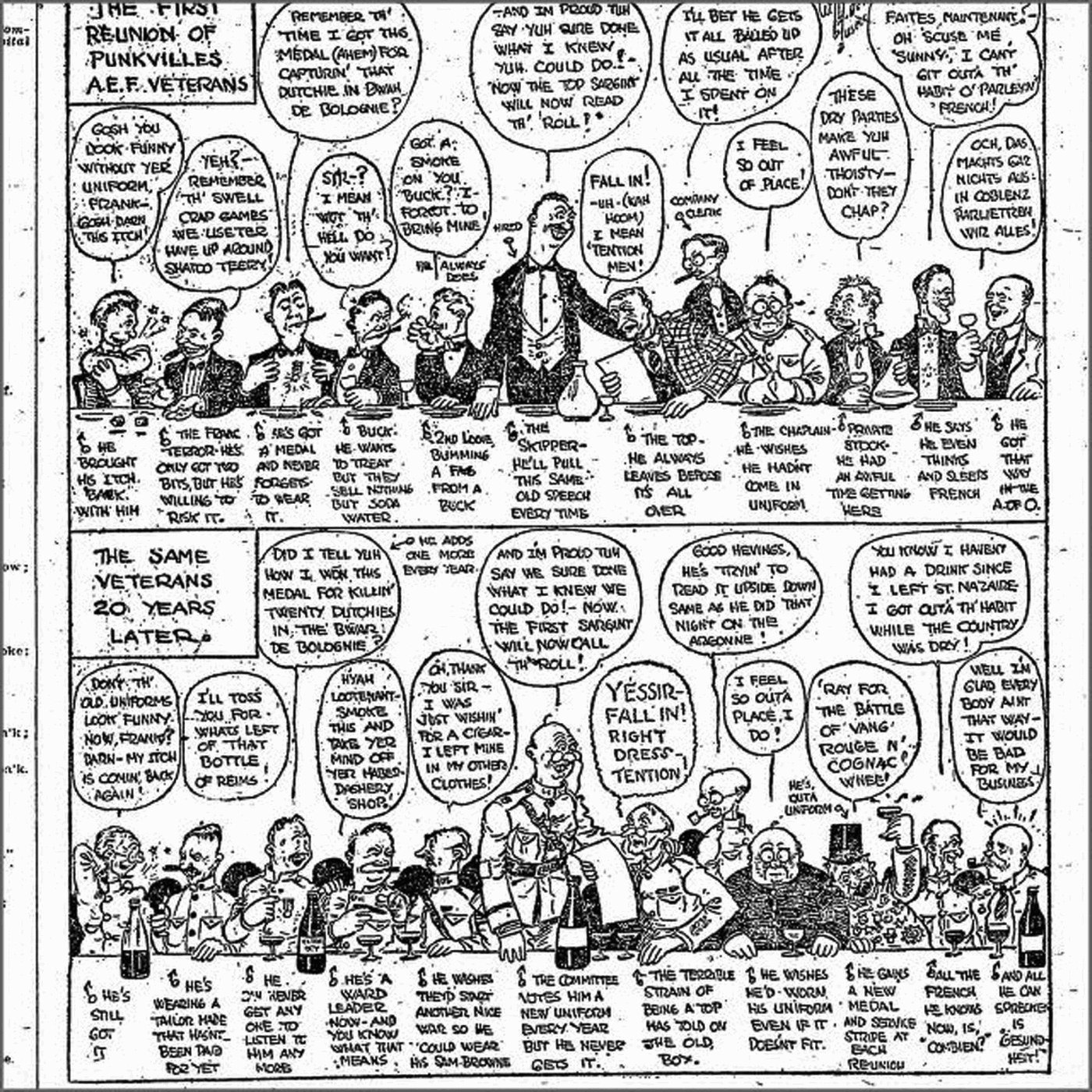
The creator of a March 7, 1919, Stars and Stripes editorial cartoon titled “Twenty Years After” was of the latter sort.Footnote 64 He looked at the future of the relationship between soldiers and clergy, doughboys and dominies, and saw a reflection of the rather bleak present. The cartoon juxtaposes the first and twentieth reunions of a fictitious group, “Punkville's A.E.F. Veterans” (fig. 1). In each frame, the soldiers are gathered around a banquet table, arranged in a style vaguely reminiscent of Da Vinci's Last Supper, though with word bubbles and commentary to aid in interpretation. The men pictured are caricatures of memorable wartime personality types: the braggart, the gambler, the French speaker, the drinker, the loquacious commander and his mousy clerk. In the first panel all are dressed in civilian clothes signifying their relief at being released from military duty. In the second panel, they are older, more laughable, and dressed in uniform, signifying nostalgia for their days of glory. This rule of dress holds for all but the chaplain. In both frames he sits on the right side of the table not conversing but staring straight out at the reader. He is overweight, bespectacled, and apparently very uncomfortable. In the first frame he says to the reader, “I Feel So Out of Place.” “The Chaplain,” reads the commentary, “wishes he hadn't come in uniform.” Twenty years later, surrounded by uniformed men, he has gained weight, lost hair, and come dressed in clerical garb. Again, he stares directly at the reader and says, “I Feel So Out'a Place I Do.” Commentary again informs the reader, “He wishes he'd worn his uniform even if it doesn't fit.”Footnote 65
“Twenty Years After,” Stars and Stripes, March 7, 1919.
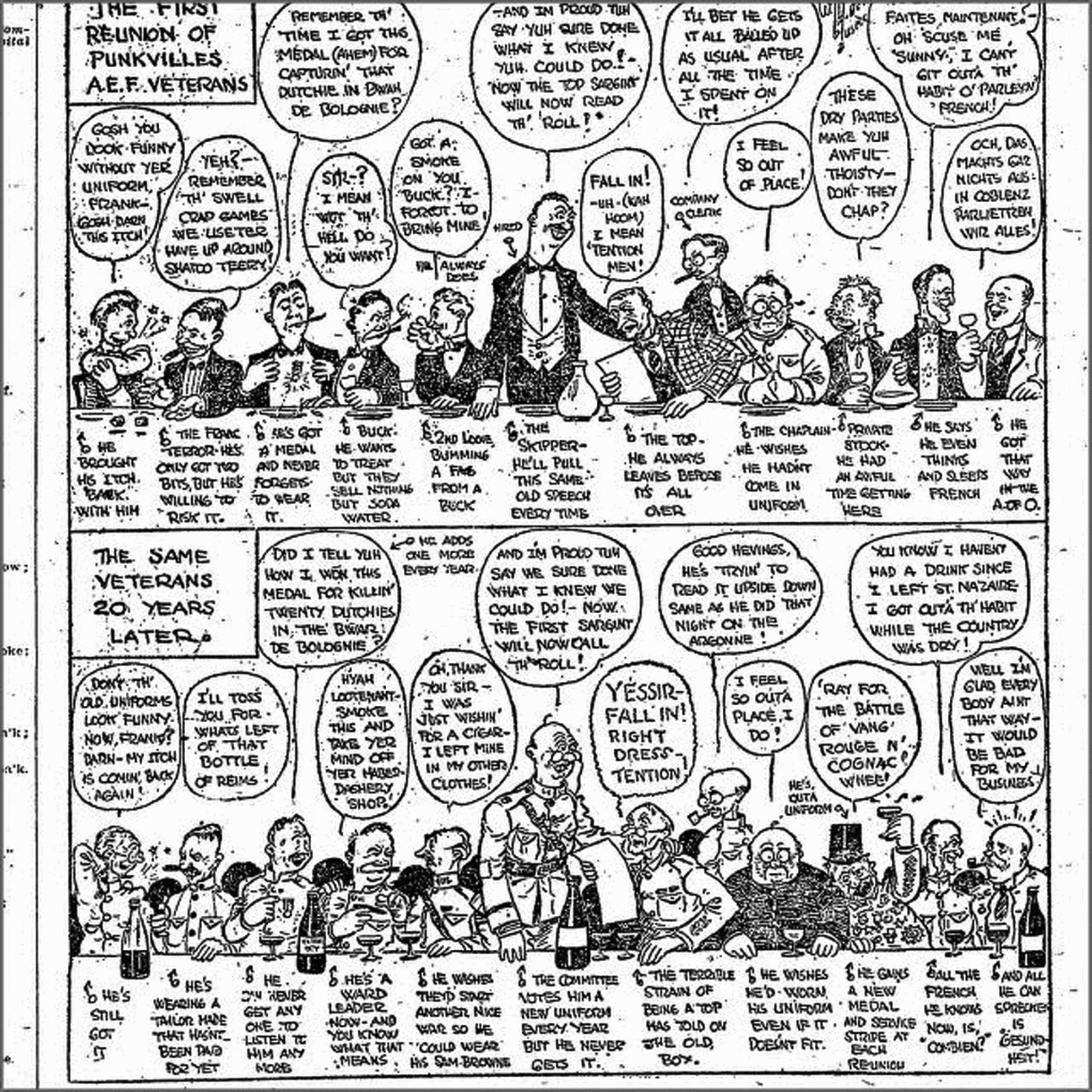
The message of this cartoon is clear as far as the chaplain is concerned. He is in the army but not of the army. He is hopelessly, somewhat pathetically, and enduringly out of touch with the men. One or twenty years from now, the braggart will brag, the drinker will drink, the gambler will gamble, and the chaplain, like the uniform he has outgrown, will not fit. Though the chaplain is not painted as a Judas, the cartoon asserts once and for all that with or without his involvement, soldiers will always be who they will be and do what they wish to do.Footnote 66
IV. “Dominies” among the Doughboys
Because writings from the pens of chaplains themselves are less robust, it is difficult to close the circle completely to say that chaplains altered their approaches to ministry to suit the soldiers' publicly and privately described masculine ideal. Extracts from the writings of a young Reinhold Niebuhr, and Catholic chaplains Francis Duffy and George McCarthy, do, however, indicate concern for perceptions of clerical masculinity and for a chaplain's standing among the soldiers. This admittedly small sample, coupled with soldiers' voices from across the confessional spectrum, indicates that denominational and traditional lines were no barrier to wartime equations of masculinity and religious authority.
Reinhold Niebuhr was the twenty-five-year-old pastor of Detroit's Bethel Evangelical Church when he toured local camps where young men were training for war. His reflections on the experience indicted all clergymen who walked among the soldiery. “Like myself, [chaplains] have mixed the worship of the God of Love and the God of battles. But unlike myself, they have adequate symbols of this double devotion.” The division within Niebuhr's clerical guild between those in official service and those merely lending their voices to the cause extended beyond uniforms and insignia to masculine affect. Niebuhr knew why. “Ministers are not used to authority and revel in it when acquired. The rather too obvious masculinity which they try to suggest by word and action is meant to remove any possible taint which the Christian faith might be suspected to have left upon them in the minds of the he-men in the army.” In order to preach to “he-men,” these chaplains felt they needed to become he-men.
Father Francis Duffy, a man of significant military experience and imposing stature, described himself in his memoir as “a soldier” and wrote proudly of his boys' physiques and aggressive, violent physicality.Footnote 67 He also responded directly to those who might equate religiosity with effeminacy, drawing on his “sturdy,” “broad-shouldered” men for support. “It was the vogue at one time to say with an air of contempt that religion is a woman's affair. I would like to have such people come up here [to the front lines]—if they dared: and say the same thing to the soldiers of this Company and of this Regiment—if they dared.”Footnote 68 In other words, those who thought “religion” effeminate or feminizing were likely themselves cowards vis-à-vis the war and would probably find themselves set upon by angry Christian soldiers if, once at the front, they repeated their views. In Duffy's eyes, the truly weak were those unaware of Christianity's masculine face.
Father George McCarthy was more concerned than Duffy with establishing his masculinity by writing of his war work. In the opening pages of his memoir, McCarthy pointedly gave his reason for requesting transfer from the Red Cross to the AEF: “[The Red Cross] did not authorize frontline service [and] this would not do.”Footnote 69 He also wrote frequently of the risks that he faced and of their broad masculinizing effects. “Entering that forest was like going into some vast fatal Iroquois Theater saturated with death-dealing gas. It was even then being swept by a tornado of screaming, bursting shells, scattering far and wide fumes of mustard and chlorine, a single inhalation of which meant unspeakable agony and death. But our brave boys were there with souls to be prepared.”Footnote 70 Writing of the general effects of his experiences—part seventeenth-century Jesuit mission, part twentieth-century chaplaincy—McCarthy stated, “Boys went into the trenches, but men came out of them.”Footnote 71 McCarthy, having been there, was now unimpeachably, on his own account, a man.
What was at stake for McCarthy and these other men of God? Were they driven to think and write, to act as they did by a desire to establish themselves as necessary members of the community and legitimate voices of religion? Were they simply acting as they felt they should, unconscious of the soldiers' masculine standard? The wartime environment makes one set of motivations difficult to disentwine from the other.Footnote 72 The answer is made somewhat clearer by the public, post-war masculine displays of two AEF chaplains. On February 7, 1919, American soldiers waiting to return home from France opened the Stars and Stripes and saw the sporting page headline: “Chaplains Matched For Ten Round Fight/To Lay Down Bibles For Boxing Gloves/Fighting Parsons Matched for Ten Round Go at Palais de Glace/Both Men Are Athletes/Bout Will Mark Epoch in A.E.F. Fistic History—Chaplains Will Also Act As Seconds.” The article began somewhat wryly:
Two preachers, men of peaceful and lamblike disposition, becoming fired with a war-like spirit, will temporarily put behind them such phrases as “Turn the other cheek” and “Forgive thy brother” and, donning boxing gloves, will engage in a real ten round nip and tuck boxing contest. The scrap will mark an epoch in the boxing game. If not the first battle of its kind, it will be at least one of the very few of its kind ever held anywhere.Footnote 73
The fight was to pit Chaplain Earl A. Blackman of the 130th Field Artillery against the Reverend Charles Rexrode of the 316th Military Police. Blackman had sought an opponent through the sporting editor of the Stars and Stripes, and Rexrode was the first of two chaplains to respond. The author wrote playfully of Rexrode's response: “When he read the challenge he was ‘exceedingly wroth’ and desiring to uphold the fighting record of the 316th Military Police, he communicated with the Y.M.C.A. athletic director of the 91st Division and made known his willingness to “smite” the challenger “hip and thigh.”Footnote 74
We can read this event as a simple novelty fight, and it clearly had some novelty to it. But something significant and religious was also at stake in the very idea of this post-war masculine display. Perhaps since the trench was no longer available, Blackman and Rexrode stepped into the ring to challenge the perception that they were men of “lamblike disposition” living lives of meek forgiveness. Despite its clever deployment of scriptural language, the paper too acknowledged that a religious lesson was to be learned from this event. A poem that appeared in the sporting page's header read:
In its opening lines the poem juxtaposes the “scrapping” preachers and reviled moralist Dr. Carl Doney. According to a November 1, 1918, editorial in the Stars and Stripes, Doney, then president of Willamette University, had returned home from a trip to the front and delivered a series of alarmist anti-tobacco, anti-alcohol speeches titled “What I Saw In France.” He called for a halt to tobacco sales to soldiers and, according to the piece, authorized himself by claiming that his work had taken him “within three miles of the German trenches.” Doney represented all that the Stars and Stripes and many of its readers disliked in American Christianity. He was unwilling to look beyond superficial behaviors to recognize a man's true goodness, and he shamelessly invoked the power of the war to lend more authority to his position. The poem's message to Doney and other “effeminate” moralists is one of utter disdain.Footnote 76
The message to Blackman and Rexrode is more subtle. They were clearly more acceptable to the doughboy than the illegitimate Doney and his ilk. But what of their masculinity and their authority? Would their boxing accomplish what clerical heroics and sacrifices in wartime could? The playful tone of the article and poem suggest that the standard masculine activity of boxing would not force soldiers to revise their stereotypes of Christian clergy. The poet remarked that seeing “Wildcat Bligh” or “Knockout Jenks” at the altar bearing the marks of his boxing match would be amusing, novel, “a lark.” By way of comparison, a March 15, 1918, piece comparing the fighting prowess of four heavyweight contenders, Jack Johnson, Peter Jackson, Bob Fitzsimmons, and Peter Slavin, referred to Jackson, the speculated victor, as “the greatest man in that group of four immortal gladiators.”Footnote 77 In wartime, a chaplain could approach and even claim kinship with his soldiers by imitating their masculine Christian ideal. Once the war ended and the struggle returned to the smaller stage of athletics, that opportunity was gone. The masculine chaplain eager to display his toughness was again to the soldier as Rexrode and Blackman were to boxing phenom Jack Johnson. The former was a battered shepherd, the latter an “immortal gladiator.”Footnote 78
But it is hard to keep a good man down, and less than two years later, former chaplain Earl A. Blackman was back in the headlines. This time the publication was The American Legion Weekly and the article, “The Parson with a Punch,” announced that Blackman, of Chanute, Kansas, had been elected National Chaplain of the American Legion. The Legion was founded in March of 1919 by veterans of the Great War to “keep alive the spirit” of the war and to give a national voice to those who had served in the war. One set of issues addressed by the Legion was the persistence of religious division and moralistic pettiness on the home front. Earl Blackman was a near perfect choice to lead the counterattack.
As the article announcing Blackman's election proclaimed, he had sparked controversy among the moralists in his church by attending a dance, but rather than answer his critics’ calls for reckoning, he tendered his resignation and went fishing for two weeks. Upon returning, Blackman learned that the majority of his congregation had refused to accept his resignation and wanted him back in the pulpit. With their imprimatur he set about refashioning the church in his image—building a gymnasium in the basement, offering instruction in boxing, and working in every way that he knew to “put religion over” on the members of his community. Blackman was, by his own estimation, a modernizer and popularizer of the faith. He had no use for Sunday blue laws and Prohibition; he argued that dance was not sinful per se but that the church had ceded control of dance to “the devil” and needed to take it back. Most of all, the American Legion Weekly proclaimed, Blackman was “at all times a man's man.”Footnote 79 And what could be more Christian than that?
V. Conclusion
Since the days of the Great War, much has changed about the relationship between the military and society, and between religious institutions and the military. Today, media, politicians, and wide swaths of the American public—not to mention the armed services themselves—hold up servicemen and servicewomen as moral exemplars. The values of the military, we hear from many corners, are American values lived out, refined, perfected. Crises and scandals influence such rhetoric in ways that seem, at times, counterintuitive. The moral failings of a soldier or group of soldiers are, invariably, an occasion for reassurances that the few bad apples prove the rule of soldierly virtue. The battle of words, ideas, and soteriologies waged aggressively by the Stars and Stripes and its soldier-readers in World War I is over.Footnote 80
The military chaplaincy is no longer, to use Charles Brent's words, “an anomalous adjunct” of the military, but a fully professionalized, fully integrated service with a wide range of pastoral tasks, from the mundane to the exciting, the grim to the joyous. Nothing about the current state of these institutions was presupposed by those waging the Great War. Indeed, as I have attempted to show, the terms of their “armistice” were worked out on the march. But as we look at the relationship between young men and clergy, soldiers and chaplains at war in France in 1917 and 1918, it looks more and more as if the doughboys forced a victor's peace on the “dominies.”