1. Introduction
The lace sector has now collapsed in Britain, but Cluny Lace, a small firm in Ilkeston (Derbyshire) still relies on old Leavers machines made in the nineteenth century to manufacture lace, as they have done since 1845. Because they can no longer dye their produce locally, they make weekly trips to Calais. They also go there to have their bars made, or their bobbins and carriages repaired. In so doing, they are using a 200-year-old route: from 1816 onwards, lacemakers from the Midlands started migrating to Calais and northern France.
Up until this point, the histories of lacemaking in Nottinghamshire and Calais have been told separately. The British account was first written by William Felkin (1795–1874), a lacemaker himself and the most eminent Victorian of Nottingham. In 1867, he published his magnum opus, History of the machine-wrought hosiery and lace manufactures. Modern historians Stanley D. Chapman, Roy A. Church, Katrina Honeyman and Sheila Mason have updated and enriched Felkin's narrative.Footnote 1 The history of lacemaking is still remembered in the East Midlands. Today, despite the closure of the Lace Centre in 2009, the former ‘city of lace’ still boasts a Framework Knitters Museum, a textile gallery in the local Industrial Museum, a lace market heritage trail, and one of the new Nottingham Castle galleries, due to open in 2020, will be about lace. About 250 miles south-east of Nottingham, Calais is also proud of its lacemaking history. The industry is now reduced to three small firms, each struggling to get by. Nevertheless, in 2009 the town opened its Cité internationale de la dentelle et de la mode (International Museum of Lace and Fashion), to preserve its history and possibly appeal to tourists. The son of a Nottinghamshire manufacturer, Samuel Ferguson, first narrated the lace history of Calais, relying on first-hand evidence provided by lacemaking pioneers.Footnote 2 Henri Hénon, himself a chair of the manufacturers’ syndicate, expanded on this.Footnote 3 Since then, Michel Caron, Benoit Noël and Christian Borde have revived this local history.Footnote 4
But, no history of the migration flow and of the economic and social connection between both areas has been written. Exactly how many workers emigrated from Nottinghamshire to the Calais area is not known. Did most migrants travel back and forth, or did they usually settle for good in Calais? Did word of mouth play a major part in the decision to emigrate or, at a time when print culture was gaining ground, did newspapers also have an influence? What type of connections existed between the two places? How did labour migration and technological transfer interact? These are questions that have not been addressed so far. This may be because lace was relatively marginal when compared to the staple sectors of industrialisation, tyically cotton spinning and weaving, iron, steel, machinery, or the railways. Another reason may be that, unlike William and John Cockerill in Belgian textiles and machinery, Aaron Manby and Daniel Wilson in French machinery and ironworks, or Thomas Brassey, John M. Mackenzie and Joseph Locke in continental railway-building, no major engineer, entrepreneur, or company stands out in the history of the technological transfer in lace. But the development of a machine-made lace industry in northern France relied on hundreds of anonymous British artisans who emigrated there between 1815 and 1870. Most came from Nottinghamshire, and most settled in or near Calais.
This case study is thus inscribed in the thriving field of migration studies. Over the past 30 years or so, the study of the patterns and processes of British migration has been revitalised. Arthur Redford's pioneering book on domestic migration has been expanded and enriched by Dudley Baines's work and by the prosopography conducted by Colin Pooley and Jean Turnbull.Footnote 5 Using E. G. Ravenstein's older model and Arthur Redford's argument about the dominance of short-distance moves as a starting point, these historians discuss various types of migration and their relationship with each other and try to assess how internal migration and overseas emigration could be articulated.Footnote 6 There has also been a significant body of research on emigration to the United States (Charlotte Erickson), to the Empire (Marjory Harper and Stephen Constantine) or to both (James Belich, Eric Richards). As a result, we know considerably more about flows that were previously studied mostly from the viewpoint of the receiving countries.Footnote 7 British emigration has also been better understood in the context of European migration, for example, as being part of the large transatlantic flows from the 1840s to the 1930s.Footnote 8 However, British emigration to the continent is addressed only marginally, if at all, in the existing scholarship. It is true that these flows were minimal, in comparison with the 14.5 million Britons who reputedly emigrated to non-European destinations between 1816 and 1914. However, these flows were not insignificant. In the sample studied by Pooley and Turnbull, 12.3 per cent of the 146 emigrant families in the period 1750–1839 went to western Europe, and still so did 6.8 per cent of the 459 families in 1840–1879. But there are archival and historiographic reasons for the relative absence of research on British emigrants to Europe. Only passenger lists for long-haul voyages to destinations outside Britain and Europe have been kept at the National Archives. In the incoming ports, the same applies: in the US, in Canada, and in Australia, there are detailed records of incoming passengers, but in most European countries, these records were deemed unnecessary for short-distance trips. In addition, most of the research on emigration to the US, Canada, Australia, New Zealand, and South Africa has been undertaken by English-speaking historians who rely primarily on English-language sources. In Europe, the British seldom subsisted as identifiable anglophone communities: either they returned to Britain, or they integrated, married local people, and spoke the languages of their incoming countries. As a result, the memory of their British origins faded, relegated to the pages of local or family history. In consequence, the social and cultural dynamics of British migration to Europe are little understood.
One sub-field of the discipline that has addressed these flows is the history of industrialisation, because British manufacturers and engineers played an active part in the industrial revolution on the continent. These patterns of technological transfer were first approached from a top-down perspective. The studies by W. O. Henderson and Sidney Pollard mostly addressed the economic dimension from a ‘diffusionist’ point of view: it was primarily the story of British engineers and entrepreneurs who went to Europe for business purposes, and therefore contributed to the industrial education and take-off of the continent.Footnote 9 This model has been refined. Several flows have been studied and other approaches have been proposed. For the eighteenth century, J. R. Harris has produced a huge study on the 1,000 or so British artisans who went to France, while Renaud Morieux has provided a framework for the study of ‘diplomacy from below’ by mapping the interactions between French and British sailors, fishermen, and migrant workers across the Channel.Footnote 10 For the nineteenth century, Rainer Fremdling has studied in detail the circulation of Welsh iron puddlers and their impact on the continental iron industry. There have also been works focusing on other industries in specific countries.Footnote 11 Taken together, this body of scholarship suggests continuous exchanges between Britain and the continent – even during the Napoleonic wars – either through industrial visits and espionage, or through the emigration of engineers, in mechanics, in iron and steel, textile (linen, cotton), mining, and the railways.
But we still need an overall social history of these flows. Focusing on the lace connection, the purpose of this case study is to contribute to this. It addresses the question of the relationship between industrialisation and the development of machinery and free trade in Britain on the one hand, and labour migration on the other. It relies on printed and archival sources, both local and national and on both sides of the Channel, including consular records and parliamentary papers. It is organised into four parts. First, it describes hosiery and lacemaking and their working conditions in early nineteenth-century Britain. Second, it maps the political economy of smuggling and emigration to France. Third, it focuses on the lives of the British lacemakers in Calais. Fourth, it assesses the 1848 crisis and the assisted emigration scheme that led several hundred lacemakers to start new lives in Australia.
2. Hosiery and lacemaking in early nineteenth-century Britain
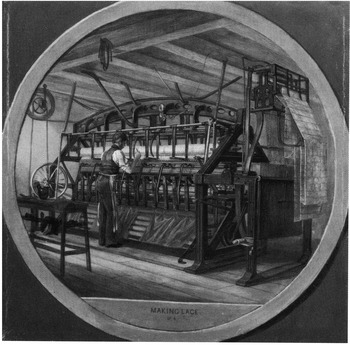
By the early nineteenth century, lace was handworked by women and children exclusively. In Britain this sizeable sector of employment was concentrated in the traditional rural areas of Bedfordshire, Buckinghamshire, and Northamptonshire.Footnote 12 Mechanised lacemaking did not grow out of this industry but out of hosiery, the stronghold of which was the East Midlands, particularly Nottinghamshire. Hosiery had been relatively prosperous until about 1810, when men's fashion shifted from stockings to trousers. This change in fashion provoked a major crisis, exacerbated by the free hand given by the government to the manufacturers, as could be seen during the Luddite crisis over the adoption of textile machines in 1811–1816. The industry needed about 30 years to recover and was not mechanised until the second half of the century. Meanwhile, framework knitters – or ‘stockingers’ – tried to imitate handworked lace, a valuable commodity that was then still a craft luxury industry. Many framework knitters, frame smiths and mechanics of the East Midlands devised small inventions, which improved the stocking frames. In 1809, John Heathcoat (1783–1861) patented a bobbin-net lace machine, which made him a leading lace entrepreneur. His machine was further improved by John Levers, who in 1813 invented a machine, the ‘Leavers’ (Figure 1). Mechanisation transformed the sector. The Leavers machine became successful from the 1840s, with the use of the Jacquard technique of punched cards that further transformed the technology. Machine-made lace competed with and gradually replaced handmade lace.
Thomas Hollis, ‘Making lace’, n°4 (undated, probably late 1840s or 1850s). The Leavers machine was by then a large one, water or steam-powered and using the Jacquard technology (to the right). Copyright: Stanley Chapman.

Although most of the lace was not produced in Nottingham itself, the city kept a central position in the trade, thus resembling the part played by Manchester in the cotton industry. Machines were expensive (£200, £300 and up to £1,000 per unit: £17,000–£85,000 approximately in present-day prices). It was common practice to rent them, to purchase them on credit, or to buy them secondhand in the crisis of the late 1820s to the early 1830s. This still left room for small businessmen, many of whom had originally been framework knitters themselves. By 1829, 46 per cent of the net machines in the East Midlands were owned and worked by small operators owning one to three machines.Footnote 13 Most were operated in the upper storeys, including attics and garrets, or cellars of houses whose other storeys were occupied by shops and lodgings, while even ‘stables, kitchens and the most unlikely buildings were accommodated’.Footnote 14 At the same time, the position of these small entrepreneurs was unstable. By the 1840s, large factories relying on water or steam-powered machines were being built, as they had been in the cotton industry.
Some of the female lace ‘runners’ (embroiderers) may have started in handworked lace, but most of the early male lacemakers had a background in framework knitting. This was very much a family, domestic industry. At the same time, the dominance of large merchant companies that employed up to thousands of stockingers, combined with the intensification and increased division of labour, along with the resulting deskilling tendencies, undermined this strong artisan culture. By the early nineteenth century, framework knitters had theoretical independence, but although they were paid a price for a commodity, rather than for working hours, they were, in effect, wage earners. Many tried to preserve some independence and form trade union associations.Footnote 15 Their champion was Gravener Henson (1785–1852), whom E. P. Thompson portrayed as one of three ‘truly impressive trade union leaders’ of the time, alongside John Gast and John Doherty, arguing he ‘challenge[d] comparison with Francis Place’.Footnote 16 Henson remained involved in various attempts, for example, in the early 1830s, to fight competition from French lace. He said he knew more about the trade in Calais than in Leicester and was often consulted for his expertise in the trade.Footnote 17 He advocated the establishment of certain institutions that already existed in France, such as local chambers of commerce, conseils de prud'hommes (courts for labour disputes), and schools of design. A self-taught man, Henson also wrote a History of the framework knitters.Footnote 18
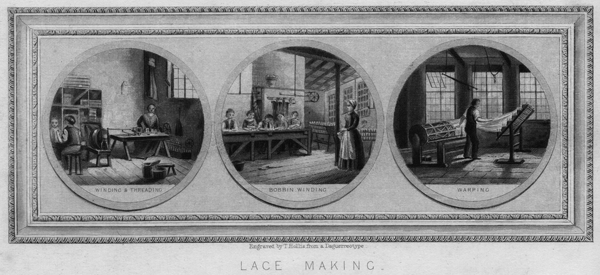
Machine laceworkers were highly skilled and supposedly better paid than the framework knitters, although this changed over time: while the twisthands who operated the machines might have earned 30–40 shillings a week in 1824, this declined to 24 in 1828, 18 in 1833 and an average 15 in 1857, not much more than the average 12 shillings earned by framework knitters. It was common practice for machines to be worked in two shifts, for example, one from 4 am to 2 pm, and the other from 2 pm to midnight. In total, each man worked ten hours a day; they worked all of Friday night, and the working week ended at 6 pm on Saturdays. As in hosiery, women and children worked with male adults. Children replaced and refilled the bobbins – working for up to ten hours a day from early age. Women and young girls bleached, dyed, and dressed the lace (Figure 2). There were more women and children in the trade than adult men and the plight of these low-paid workers became a matter for public debate in the 1840s. When parliamentary committees investigated and discussed child labour in 1833 and 1841, two major arguments were advanced against the regulation of working hours in the lace industry. One was that female and child labour was mostly domestic. The other was fear of foreign competition. Echoing common opinion among manufacturers, William Astill, who had resided in France, argued ‘that if the labour of children and young persons in the lace trade were to be regulated according to the provisions of the present Factory Act, that it would give so great an advantage to the foreign manufacturer as seriously to injure the English’.Footnote 19 Indeed, by then, France had become a serious competitor for Nottingham lace. The emigration of the Nottinghamshire lacemakers played a key part in this.
Thomas Hollis, ‘Lace making’, from a daguerreotype (undated, probably late 1840s or 1850s). While the twisthands were men, the other operations were performed by women and children, for example, bobbin winding. Copyright: Stanley Chapman.

3. The political economy of smuggling and emigration
Before the transition to manpowered machinery, France had been a leader in the production of handmade lace, partly because of its luxury market. During the Revolutionary and Napoleonic Wars, improvements seldom crossed the Channel from Britain to France, despite smuggling and some attempts by Napoleon to foster innovation. In Britain, prohibitions on the emigration of artisans and the export of machinery, which had existed since the eighteenth century, prevailed until 1824 and 1843, respectively. However, after the end of the Napoleonic Wars, these bans were not much respected, and lacemakers did not wait that long to begin exporting machinery to France. Machinery was smuggled throughout the wars and by 1816 the first bobbin net lace article was manufactured in France. Cross-Channel trade on the ‘smoggleurs’ (a French word for long thin boats specialising in the activity) went on and played an important part in the making of the Calais industry.Footnote 20
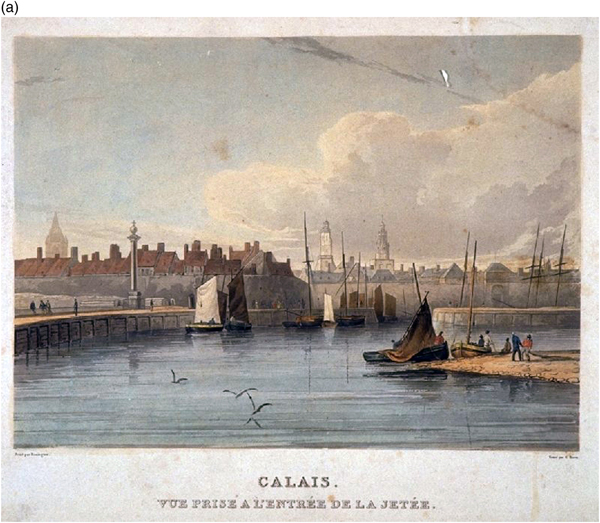
After Richard Parkes Bonington, Calais. Vue prise l'entrée de la jetée. R. P. Bonington (1802–1828) was the son of Richard Bonington (1768–1835), one of the three pioneers who established a lacemaking business in Calais in 1817. Copyright: Calais, Musée des Beaux-Arts.

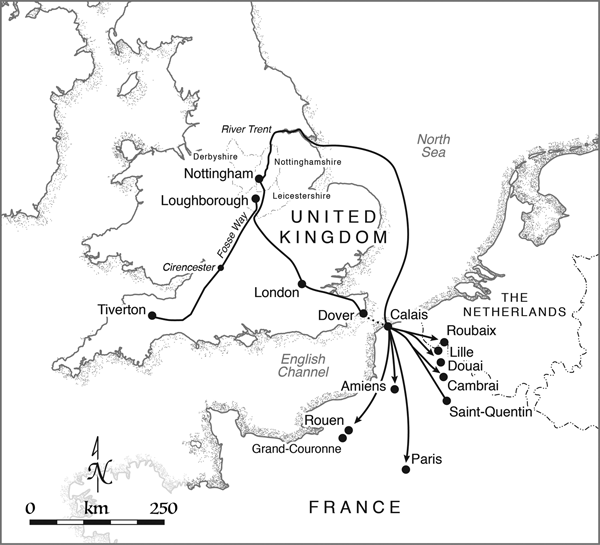
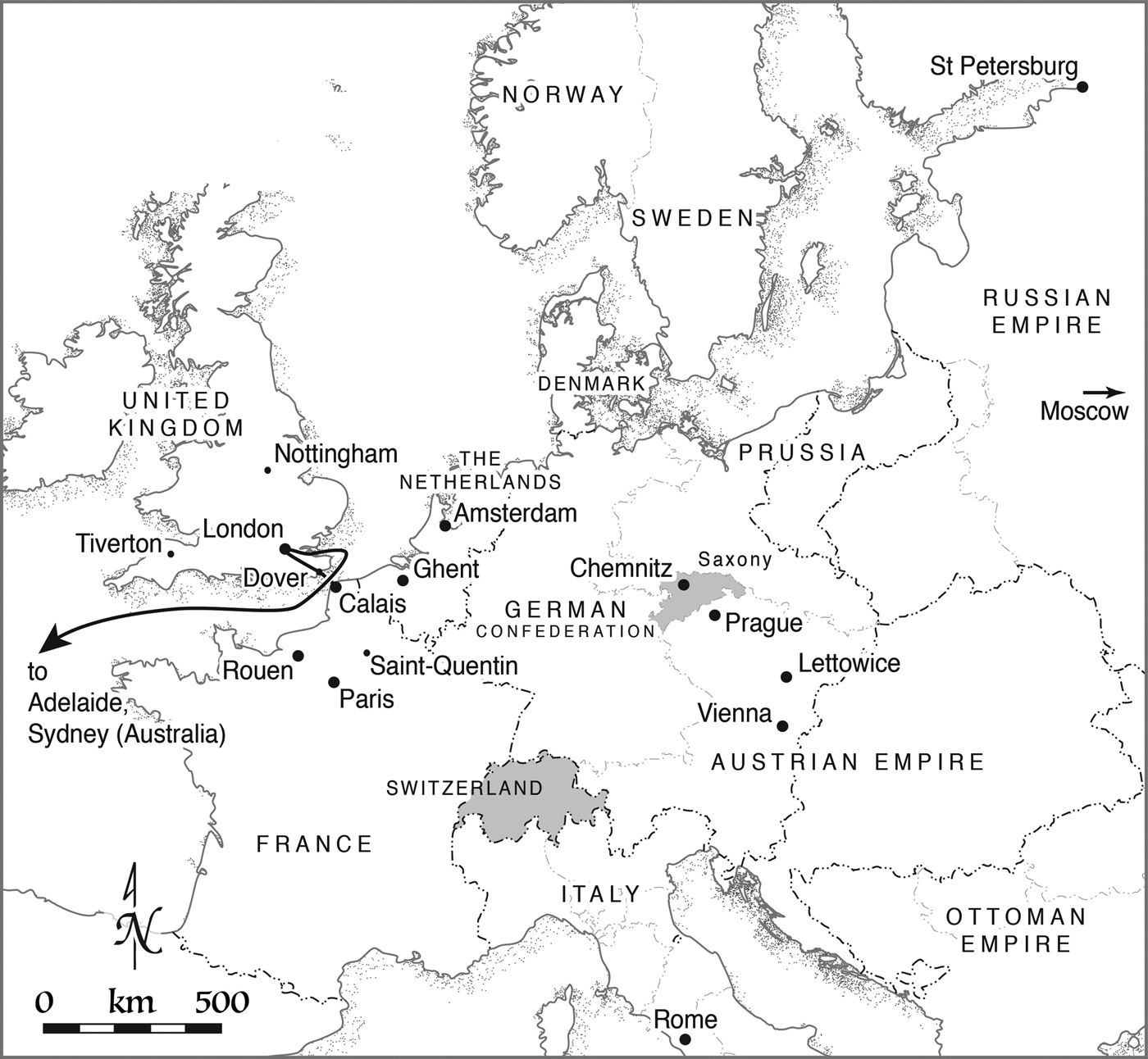
The industry slowly started to develop, following the impetus of a group of men who set up a lace business in Calais. When Heathcoat's patent ended in 1823, resulting in a boom and declining wages in Britain, many lacemakers, both entrepreneurs and artisans, came to live in Calais, marking the beginning of many decades of emigration. This was also a way of escaping the cutthroat competition that led many to bankruptcy in Nottinghamshire, especially after 1826. Emigrant lacemakers headed to Lille, Cambrai, Douai, Rouen, and Paris, where Heathcoat set up a steam-powered factory in 1818 before transferring it to Saint-Quentin, in Picardy, in 1826 (Figure 4). Some also travelled to Belgium and the US, while others operated hand frames in Switzerland and Saxony, and powered machines in Prussia and in Vienna in Austria. In Letovice (Lettowitz), in modern-day Czech Republic (then the Habsburg Empire), British machines were imported, and the company created in 1832 soon benefited from imperial protection, resulting in a long-term enterprise.Footnote 21 By 1839, at least seven machines built in Nottingham were operated in Moscow by British workers (Figure 5). But France became the major continental country of lace production, and surprisingly Calais its major centre.
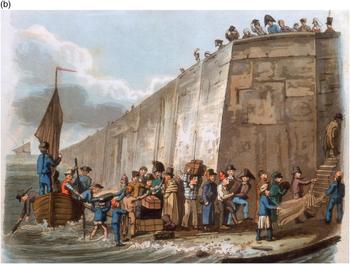
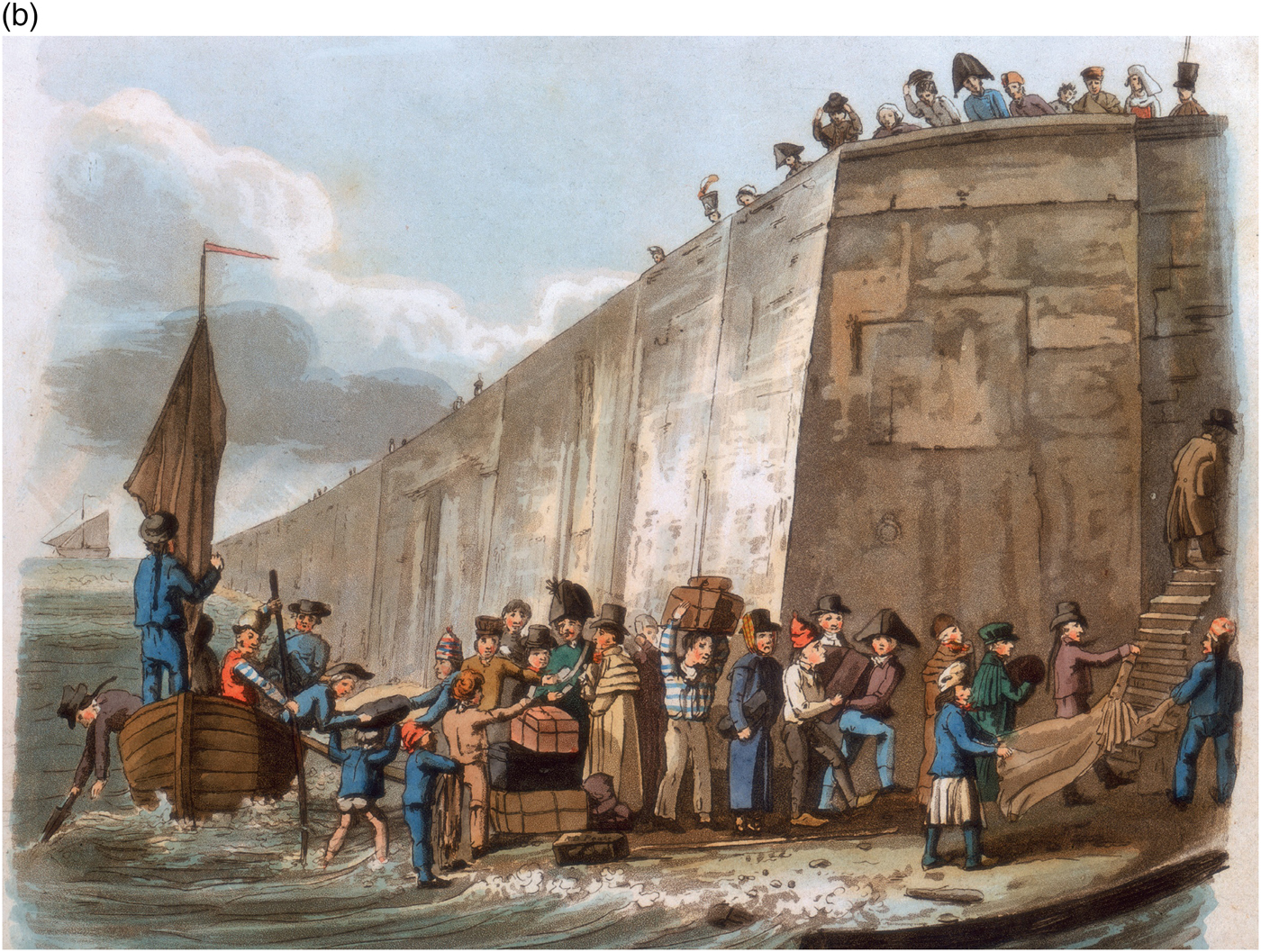
Travellers arriving in Calais, 1816. Aquatint. Private collection.
Emigration of British lacemakers (1815–1870). Map created by Miles Irving.

Emigration of British lacemakers (1815–1870). Most British lacemakers emigrated to the north-west of the European continent, but some went as far as Saxony and Russia. In 1848, a group of Calais lacemakers emigrated to Australia. Map created by Miles Irving.

Calais had a smaller harbour than Boulogne or Dunkirk and its connections to the hinterland were inferior, and it was not close to the major French cotton centres. But with its border town Saint-Pierre-lès-Calais, it possessed several assets. Once in France, lacemakers neither had to pay the 30 to 35 per cent French tariff on imports, nor resort to the traditional but less reliable option of smuggling machines across the Channel. They could easily compete with the French hand lacemakers. Steam navigation, which in the 1820s made the crossing from Kent to Calais into a journey of roughly five hours instead of nine, made daily contacts easier. Calais was also connected to the North Sea economy. It was equally close to Paris. Saint-Pierre was then a different municipality from Calais and it proved more attractive, particularly when Calais banned night work to limit noise nuisance in 1832. Eventually, however, the two were merged in 1885.
Because of the British ban on the export of machinery, and because of the French tariffs, the smuggling of cotton thread, lace and machines went on between both countries until the 1850s. Smugglers’ premiums between Calais and Kent varied, reportedly from 10 per cent on lace to Calais, and 15 to 20 per cent on machines to northern France, and 33 per cent on cotton to Lille in 1824.Footnote 22 The attitudes of the authorities were mixed. These imports were viewed with benevolence by the French local authorities. And it seems that British customhouse officers also allowed such smuggling to the continent. Smuggling worked both ways, with finished lace also being introduced into Britain.Footnote 23 However, as David Todd has argued, the French national authorities first insisted on preserving the prohibitive system that had been set up during the Empire; under the Restoration, the customs administration was large, with some 25,000 officials, and it was powerful.Footnote 24 This may account for why smuggling premiums remained high, and why competition remained less cutthroat in France than in Britain. But while premiums were high on cotton imports, the influx of foreign machinery and skilled workers was not rejected. Some advocates of tariff protection like Friedrich List, who derived his National system of political economy (1841) from his observations in France in 1837–1840, argued for the importation of capital and skilled labour and against that of agricultural produce and raw material. This was basically what France did in the period 1815–1848.
As for Britain, the 1824 repeal of the ban on the emigration of artisans signalled that Westminster was turning away from its traditional mercantilism. Changes in 1834, 1841 and 1846 paved the way for free trade. Still, obstacles remained.Footnote 25 For instance, when in 1834 the French government allowed the import of thin cotton yarns from Britain, while other yarns remained banned, Nottingham manufacturers were alarmed at the boost it would give to France. But because of the high duties on them (about 50 per cent), ‘an Old Townsman’ of Calais rightly remarked that English alarm was not justified:
The French manufacturer, because the duty is to be so high, can get it cheaper from the smuggler! … Consequently, the idea of the alteration being detrimental to the interests of Nottingham is a bugbear, and nothing else.Footnote 26
Smuggling was not an anomaly; it was an integral part of the economy of the Channel. It is impossible to assess it accurately, but the figure of half a million pounds a year, just for lace, was mentioned.Footnote 27 For the British lacemakers in Calais, it remained important. This infuriated Nottinghamshire competitors, including Henson who waged a determined campaign to ban the evil trade. In 1824, when interviewed by a Select Committee, he denounced smuggling, against which ‘His Majesty's government would never interfere’.Footnote 28 He later wrote:
While the English were thus totally losing the silk lace trade, the French were rapidly gaining the cotton lace trade, though they affected to prohibit both; the former being really and rigidly prohibited, the latter only speciously in order to encourage English workmen to establish machines in France, and to make one piece and smuggle another, thus completely outwitting us, in which the original patentee [Heathcoat] unfortunately took the lead.Footnote 29
Meanwhile, machinery continued to be exported. In 1832, manufacturer William Morley toured France and Belgium, trying to assess it; he estimated there were about 2,000 machines.Footnote 30 In 1833, Henson was involved in a campaign waged by some of Nottingham's leading men against French lace competitors, in a depressed context, targeting the Board of Trade, which Henson accused of not reciprocating on the high French duties, at a time when free trade ideas were gaining ground in Britain. Appointed assistant secretary to the committee that he set up, Henson conducted his own crusade against exports of machines. He made his case against free trade after persuading 32 lace manufacturers to sign his document. Then he set out on a long journey around the ports to discover who the machine smugglers were, and during his tour seized machinery being embarked for France by a London merchant.Footnote 31 When this merchant sued for the recovery of his property, Henson conducted his own defence. The Nottingham Committee, embarrassed by the turn of events, broke up. Henson lost in court, and his defeat marked the collapse of the campaign to oppose machine exports to France.Footnote 32 Still in 1838, Henson complained that ‘Calais [was] rising upon the ruins of Nottingham.’Footnote 33 A few years later, the Nottingham lace manufacturers complained that 34 warp and bobbin machines had been exported in a month: ‘So bold has this trade been carried on, that machines were openly packed at a neighbouring village, and taken to a wharf in open day.’Footnote 34
The failure of Henson and other protectionists can be explained by different factors. Fighting against smuggling came at a cost for the state, and the most serious convictions in Britain were against smuggling into the country, not out of it: after all, smugglers to the continent marketed British goods. But there was another factor at play: whereas the export of lace machines was seen by Nottingham lace manufacturers as a threat, it was profitable for its machine manufacturers. And the emigration of artisans had been legal since 1824. In 1833, an anonymous ‘Observer’, who obviously produced lace machinery, argued in the Nottingham press:
In Calais alone are 150 men employed in building carcasses … The greater part of the machinery now in Vienna were built in Calais and Lisle; and machines are now building in France for exportation. … There are probably 300 workmen of all descriptions, now or lately employed in England in the same manufacture of lace machinery for exportation: if such exportation is prevented, it is clear that these workmen will be discharged … And it will be borne in mind, that a removal to France is not now the kind of affair it was thought some years ago: so many workmen have passed and repassed, that the road has become perfectly familiar; and too many are now living there for any to fear the want of society. … The sole question to be determined therefore, is whether it is better to export machinery, or the makers of machinery!Footnote 35
In other words, as workers could freely emigrate, machines had to be allowed for export, otherwise British machine making would be under threat. This free-trading argument would strike a chord in 1841, when a new select committee investigated the practice at length. In 1843, the export of machinery became legal. Free traders had won the upper hand and the final blow would come with the 1860 Cobden-Chevalier treaty.
The production of manufactured lace and the making of machines now followed different patterns. The making of lace gradually expanded to the continent. By 1842, the Nottingham Journal, which voiced the demands of lace manufacturers against the export of machinery, estimated that while in 1832 5,500 out of the 7,390 world's lace machines were in England (74 per cent), this had now dropped to 2,000 out of 5,473 (36 per cent), while 2,800 machines were in France, mostly in Calais, and others in Switzerland, Saxony, Russia, Austrian dominions (Moravia) and Prussia.Footnote 36 Henson's nightmare had come true. However, these figures were probably exaggerated: the Calais Chamber of commerce only counted 893 in 1844, though there were some elsewhere in the North and in Picardy. And even when carcasses of the machines were made on the continental mainland, reputedly below the Nottingham quality, the internal mechanisms were still made in Nottingham and were smuggled into France. By 1842, while only 12 men in Nottingham were making machines for the domestic market, 150 men were making some for France; and by 1847, 80 workers were making bobbins and carriages for Austria.Footnote 37 In terms of machine building, the Nottingham area kept a lead.Footnote 38
Fundamentally, what was taking place was the creation of an integrated northern European market of lace and knitting, despite duties and the costs of transport and smuggling. When in 1837–1838 a parliamentary committee discussed postage, one of the central concerns was that its high cost hindered the circulation of business information, for instance: what were the wages overseas? What patterns were produced? The information communicated in newspapers was considered insufficient. Henson corresponded with many across Britain and Europe, and he argued for cheap postage.Footnote 39 At the same time, large quantities of information about lace already circulated between the East Midlands and Calais. Nottingham newspapers gave detailed accounts of machine and worker numbers both at home and overseas. This news was supplemented by hearsay, by letters and probably by professional agents. Another feature of this integration was the great fluidity of labour between both areas: emigration fostered more emigration, as studies on chain migration have often noted.Footnote 40 At a time of economic depression, it was reported that in Calais ‘a number of the English workmen have lately gone to England, being unable to obtain work’.Footnote 41 Finally, as Pooley has argued, other motives (marriage, family, health…) could also play an important part in what seemed, on the surface, to be simple labour migration.Footnote 42 All in all, we can infer from the local press and other sources that in the Midlands, information about the French lace industry was available, while the Nottingham papers were subscribed to in Calais. As a result, regardless of how long they lasted, most moves between the two areas were rational and well-informed – something that Baines, for example, had concluded about English and Welsh transatlantic emigration in 1860–1900.
4. ‘Little Nottingham beyond the seas’: the British lacemakers in Calais
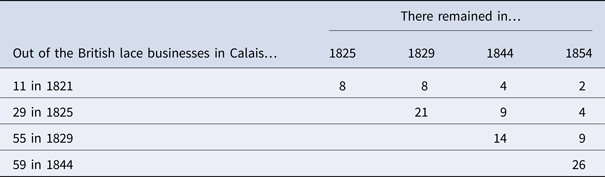
Overall in Calais, between 1815 and 1860, 270 Britons created some 230 different businesses.Footnote 43 The structure of the lace industry in Calais resembled that of Nottinghamshire, albeit on a smaller scale, consisting of small entrepreneurs, with just a couple of machines, which they often bought on credit. In 1828, for instance, 50 manufacturers (41 of them British) owned 121 machines, an average of 2.4 machines per owner, compared with an average of 5.7 in Britain in 1829.Footnote 44 Calais lacemakers had to cope with competition from craft lace in Normandy and Le Puy, which employed some 200,000 women to produce handmade lace which was often preferred to machine-made, until the 1870s. Between the 1850s and the 1950s, there were no major changes in the production of machine-made lace, but rather a series of improvements. Because of bankruptcies, turnover was high, as can be seen in Table 1.
The survival of British lace businesses in Calais (1821–1854)

Note: This table tracks businesses over time.
Source: Benoit Noël, ‘Outsiders’, 164.
Depending on trade cycles, the mobility of workers was also high, as many returned to Britain, while others moved to different parts of France. Many sources substantiate that, like many Britons who went to the continent for work purposes, British lacemakers in France saw themselves as temporary migrants. When Henson was interviewed on 23 March 1824 by the Select Committee on artisans and machinery, he bluntly explained that he had been to France late in 1823, and that all his ‘old acquaintances’ in Calais, ‘with the exception of about three, expressed their decided wish to return, if they thought this country [Britain] afforded them any protection against the general lowering of wages’.Footnote 45 Alongside other evidence, this points to the fact that the Calais success story was primarily the result of destitution, and that pull factors were superseded by push ones: rather than the prospect of fortune, it was job insecurity that led lacemakers to leave the Midlands. It was common for Calais entrepreneurs to recruit not just by using word of mouth, but also publicly, for example, with advertisements in the Nottingham papers, such as: ‘Nottingham Trade. Twist hands wanted. Wanted a few good Hands to work in Machines … Apply to Mr ATKINS, Union Hotel, Calais, France’.Footnote 46
From Nottingham, Calais was not much further than Tiverton, to which many of Heathcoat's workers had migrated in 1816, walking 200 miles, when he moved his staff and production there after Luddites attacked his Loughborough factory (see Figure 4). By the 1840s, the continent had become an obvious destination for Nottinghamshire lacemakers. Even before reforms in the postal service reduced the cost of postage, communication took place through the mediation of friends who transported parcels and letters when they travelled. ‘When any person comes [between Calais and Nottingham, Henson noted], he is loaded with letters.’ But such means made it more difficult for letters to be exchanged on a frequent basis. Henson complained about the resulting gap between the virtuous home and the vicious foreign land:
I know that parents have intensely suffered from that cause, not hearing from their children sometimes for five or six years. … it has a very bad effect. For instance, they have children at Calais, and they receive information that they are not conducting themselves as they ought to do, which is very much the case at that place, and they would reprehend them by a severe letter if the postage were not so high; they are guilty of dog-fighting, bear-baiting and breaking the Sabbath, and they would reprehend them if they could have communication with them.Footnote 47
Although there is no evidence of bear-baiting in Calais, this rhetoric about the virtue of Britain and the vice of France could hope to strike a chord with MPs. But it was true that despite their expectations, temporary migrants to Calais often ended up being permanent ones. In many ways emigrating to Calais and the other continental centres of lace production had more in common with domestic migration within mainland Britain than with overseas migration to the US or the Empire, in which case, in the early decades of the century, emigrants usually departed with the assumption that the move would be permanent. Berthoff and Baines have shown that in the second half of the century, through the revolution in transport and communication, the Northern Atlantic became a unified migration field, linking the British Isles with the East coast of the US and Canada: in textiles, mining, iron and steel, many British workers made optimal use of wage differences, and their moves could be compared with the earlier internal migration flows within the United Kingdom.Footnote 48 For instance, between 1861 and 1900, nearly 50 per cent of the 4.5 million natives of England and Wales who sailed for a destination outside Europe returned to Britain.Footnote 49 In many respects, the earlier moves between the Midlands and northern France mirrored this.
Many of the emigrants to Calais went back and forth between both areas, sometimes in response to economic variations but also to purchase cotton thread, which was of better quality in England, and spare parts for machines, the internal mechanisms of which were still produced in Nottingham, as we have seen. ‘Many of the principal bobbin and carriage makers have been lately in Calais for orders’, a paper reported in 1842.Footnote 50 There were also some hints in the local press of lacemakers going to Calais, while their wives and children stayed home, for some reason.Footnote 51 This suggests that some of the migrants were ‘transnational’, according to the concept elaborated by anthropologists and migration historians to characterise people who retained connections and identities with both countries.Footnote 52 Emigration did not imply definitive departure; and return did not necessarily mean definitive return. We lack more sources, for example, emigrant letters, to assess all the emotional dimensions of decisions about migration. Journeys may have involved the remittance of cash. The role of homesickness as a determining factor in these flows is also uncertain.
We can try to follow some Calais lacemakers and trace their migration patterns. For instance, in 1848, the Johnson family, who emigrated from Calais to New South Wales, was made up of Thomas Johnson (b. 1813 in Loughborough) and Phoebe Roper (b. 1823 in Douai, France) and Thomas's three children born 1837–1841 in Nottinghamshire. Thomas Harrison (b. 1800 in Sneinton, Notts) and his wife Maria (b. Stubbs, 1804 in Belper, Derbyshire) had seven children, born in Calais (1824, 1825, 1826, 1827), Hyson Green (Notts, 1833), Calais again (1835) and Douai (1842), suggesting movements between different areas. Phillip Hiskey was born in Calais in 1825, while his wife Hannah was born in Leicestershire and their two children were born in Calais in 1844 and 1847. Thomas Wells (b. 1803) and his wife Sarah (b. 1815) were born in Nottingham, while their children were born in Caen, le Havre, and Calais between 1831 and 1848, suggesting an itinerant migration in France, another pattern about which much remains to be learned.
4.1. Integration and rejection
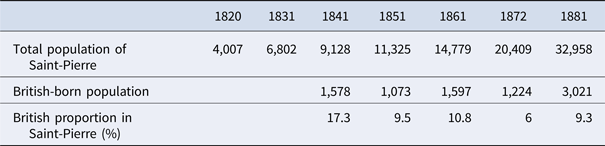
The British population in Saint-Pierre fluctuated, depending on trade cycles and other factors (Table 2).
Population of Saint-Pierre-lès-Calais, including the British emigrants

Sources: Archives départementales du Pas-de-Calais (hereafter AD 62), Recensements de population. For 1841, the number of Britons was assessed by Anne V. Fewkes, ‘Protestant families extracted from the 1841 census of St Pierre, Calais, France’, Nottinghamshire Family History Society 121 (December 1998). Thanks to family historian Philip Emerson, who has systematically compiled the occupations and addresses of these 1,578 British emigrants.
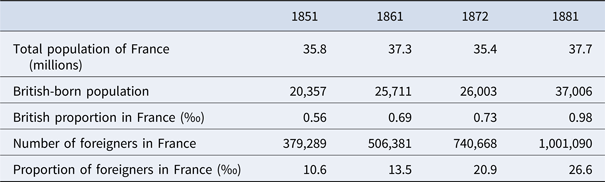
Although the foreign population was not counted in the census until 1851, other evidence suggests that the proportion of British-born reached a peak in the 1840s. The important variations of the following decades were not matched at a national level, where the British, though steadily increasing, remained a tiny minority, unlike the immigrants of other neighbouring countries, such as Belgians, Italians or Germans (Table 3).
Population of France, including the British emigrants

Source: Insee, ‘Données historiques de la Statistique générale de France’, https://www.insee.fr/fr/statistiques/2591397
The discrepancy between the ups and downs in the British population of Saint-Pierre and the slow growth of the British population of France can be explained by the fact that, in a general context of increasing mobility, the former one was heavily dependent on trade cycles – we shall see the impact of the 1847–1848 crisis.
Most of the British population in Saint-Pierre and Calais consisted of laceworkers and their families, but also included 37 servants, 5 butchers, 4 innkeepers – not to mention the Calais innkeeper who ran the ‘Red Lion’ (‘rue du Lion rouge’), 3 teachers, 3 Protestant ministers, and a wig maker. Calais was also home to some ‘rentiers’ (persons of independent means). The Journal de Calais, which was published from 1825, had advertisements in both languages, and began publishing a supplement in English, The Calais Messenger, from 1827. An Anglican chapel was opened in 1822, and Methodists soon founded their own. The first church proper was built in 1861. The presence of so many British people raised various issues. In November 1823, the mayor of Calais wrote to the sous-préfet regarding a Mr Pain (Mr Bread), a baker ‘in the English way’ in Saint-Pierre who wanted either to be able to settle in Calais, or to sell his bread there for ‘English families that are accustomed to it and prefer it to bread made according to French usage’ – the mayor suggested that his request be refused.Footnote 53 English games and sports were also practised. In 1837, a ‘boxing duel’ was reported by the police superintendent who interrupted it. In 1842, a Nottingham-born ‘pedestrian’ (runner) easily won a 100-yard race.Footnote 54 British cockfighting was said to be responsible for the soaring price of poultry. Later in the century and among better-off social groups, cricket and tennis were also reported. In this period following the Napoleonic wars, anti-British sentiment stoked by the two nations’ years of warfare could easily resurface, and the rising numbers of British in Calais had to integrate to avoid provoking local hostility.
From very early on, British-run businesses hired French workers and relied on French women to finish the lace. Less skilled though it may have been, the local workforce was both cheaper and more plentiful. Some marriages with French people helped with assimilation. In gender terms, the migration to Calais was primarily a male affair, as men operated the machines. In most cases, twisthands went with their wives and children, it seems, although there were examples of relatives left behind, for example, when a Nottingham paper reported the death of a young mother whose husband was ‘now of Calais’.Footnote 55 In other cases, young Britons went to Britain to marry fellow-subjects; several such marriages thus took place in St Mary's Church in Dover.Footnote 56 Several young men also married local French women. In 1848, William Brownlow (b. Lenton, Notts, 1821) and his wife Emma Courquin (b. Calais, 1821) emigrated to Australia with their three children. Thomas Pettit (b. Dover, 1810) emigrated with Joséphine Mattong (b. Calais, 1808), while Richard Goldfinch (b. in Deal, Kent, 1814) went with Eugénie de Sombre (b. Calais, 1820) and their four children born in Calais. By the 1860s, 20 per cent of the 50 Methodist babies baptised were born to Franco-British families, against 4 per cent of the 71 baptised in the 1840s; rates also rose among Anglicans. By the end of the century, at a time when British immigration had slowed down, most marriages were mixed.Footnote 57
4.2. The associational and political life of the Calais lacemakers
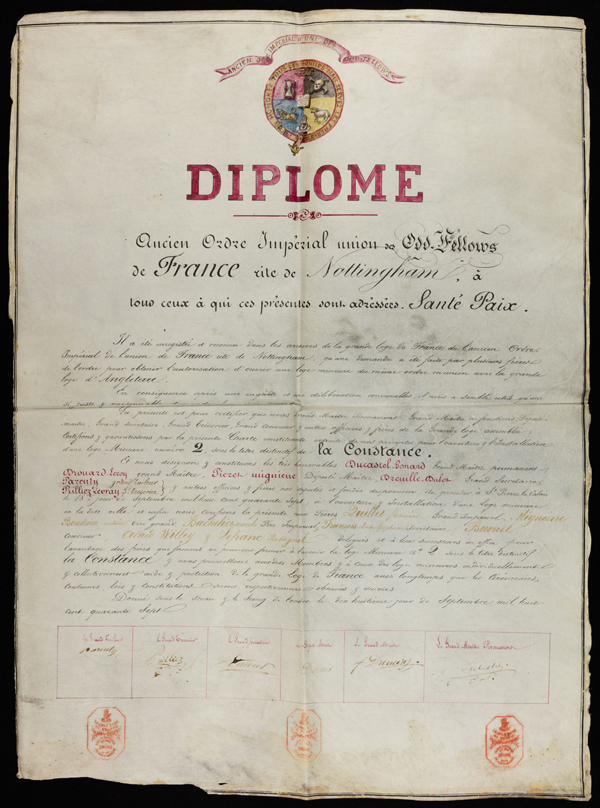
The Nottinghamshire lacemakers and framework knitters had a rich associational and political life. Christopher Richardson has shed light on the Owenite, Co-operative, self-taught and Democratic culture of the city.Footnote 58 Unsurprisingly, emigrants to Calais arrived with knowledge of these practices and often tried to reproduce them, while having to adjust to local circumstances. In 1817, Thomas Savage, a machine breaker who was later executed, declared in his depositions that there was a colony of Luddite refugees in Calais; E. P. Thompson considered this to be a possibility, but it has not been substantiated.Footnote 59 As early as 1825 – under the Restoration, when all unions, strikes or meetings were forbidden and could be seriously repressed – the French authorities were concerned with agitation, which they suspected had originated in Nottingham. In Paris the Interior ministry was obviously alarmed and sent an enquiring letter to the préfets of the three départements where lacemakers worked (Aisne, Nord and Pas-de-Calais), commenting on a resolution of the Nottingham lacemakers that demanded an eight-hour day and required that ‘a copy of the above resolution be transmitted to the Bobbin Net Committee at Calais, Lisle and St-Quentin, requesting their assistance in case of need, as required in the foregoing resolution’.Footnote 60 Only the Saint-Quentin authorities answered positively about discontent in the city, mentioning the suspected role of a ‘foreman’ who worked in Saint-Quentin but was currently in Nottingham. This was a rare insight into the activities of brokers and other go-betweens between both areas.Footnote 61 In terms of friendly societies, the fraternity of Oddfellows played an important part: in 1834 and 1843, two lodges were founded in Calais and Saint-Pierre; they offered mutual support in the case of disease or injury (except when caused by drink, fist fighting or venereal disease), and represented some form of sociability (Figure 6). They may also have played a political role and in December 1851, after Louis-Napoléon Bonaparte's coup, they were banned altogether along with the French lodges, which were notorious for their republican leanings.Footnote 62
By 1844, a French lodge of the Odd Fellows had been created in Saint-Pierre-lès-Calais by the British. This 1847 ‘diplôme’ was produced by this lodge, which could only gather French members. Such lodges were friendly societies that provided support in the case of disease or accident. They were also the only legal associations of workers under the July monarchy. In December 1851, following the coup by Louis-Napoléon Bonaparte, they were dissolved.

The Chartist movement was strong in the Midlands. It was in Nottingham that Feargus O'Connor, the only Chartist MP, was elected in 1847. James Epstein has also shown that the women's participation in the local industries was reflected in the strong local female Chartism. The presence of Chartists among the Calais lacemakers is not surprising, although evidence only exists from December 1845, when Feargus's Land Plan company was set up.Footnote 63 From then on, at least 23 Calais and Saint-Pierre inhabitants subscribed to the Chartist Co-operative Land Company.Footnote 64 The Northern Star also reported subscriptions from Calais, one of the rare overseas provenances, alongside Boulogne and Rouen.Footnote 65 Feargus celebrated this: ‘my little work upon “Small Farms” has crossed the seas; and is, I believe, destined to proclaim the triumph of labour’.Footnote 66 On several occasions, he quoted letters from Calais, for example, ‘from a frugal and honest working man, an Englishman earning his bread in France’, so as to inspire ‘all at home and abroad with home and consolation’.Footnote 67 Maybe Feargus's interest in Calais was related to his being the MP for Nottingham. Although he seldom showed much interest in foreign affairs, he went to France for a week in September 1849 and spent a day in Calais. When he asked to address the lacemakers, a Chartist friend told him: ‘You do not understand our Republic; a body of police would have you before you spoke three words.’Footnote 68 Feargus thus contrasted the freedom granted by the British constitution with the absence of liberties allowed on the continent, as it was common for British workers in France to do. The involvement of some in the Land Plan confirms that they saw themselves as temporary migrants, identifying themselves as British and longing to return to their native land.
5. The 1848 crisis and the Australian scheme
We have seen that the lacemakers were able to migrate back and forth to the continent, managing to create an economic niche that relied on technical knowledge. However, they were also part of an imperial economy and, in Victorian Britain, the ‘home’ could not be separated from the Empire. The cotton that was used for lace was mostly imported from the American South, whose economy was integrated to some extent into the British World. And, as 1848 was to prove, inland ripple migration, flows to the continent, and long-distance, imperial migration to the Australian colonies could be interwoven in complex patterns.
In 1846–1848, a major financial, trade, manufacturing and food crisis affected north-west Europe, to varying degrees. The lace market collapsed. In Calais, the situation became critical: the industry had virtually ground to a halt, with dozens of businesses ruined and hundreds of workers losing their jobs. The economic crisis across the country exacerbated anger against the Guizot cabinet and the July Monarchy. In February 1848, insurrection in Paris led to the fall of the regime, and the Republic was soon proclaimed. In various towns, this overthrow was followed in March by demonstrations and riots of jobless people against foreign workers. In Calais, the British consul E. W. Bonham reported:
On Sunday the cries of ‘A bas les Anglais’ were first heard in the Basse ville, these were redoubled yesterday and accompanied by much occasional abuse towards English workmen in the streets on the part of the lowest rabble. Some placards were posted, calling a meeting for last night to petition for work, bread and the expulsion of the English workmen: this meeting was attended by about 200 of the lowest of the mob.Footnote 69
The local press denied this protest. And the officer of the Colonial Land and Emigration Commission (CLEC) who was sent to Calais reported that ‘there has been no attempt to force the people out of employment, or out of France, because they are English’.Footnote 70 But a shroud of mystery hangs over these events, as the migrants reported ‘feelings of an hostile character on the part of the French towards the English, which [they] hoped had long ceased to exist, thus rendering their position one of both insecurity and destitution’.Footnote 71 Outbursts of xenophobia took place in other parts of the country. The inner logic of such riots was complex: for 30 years, French, British and ‘Anglo-French’ had worked together in the same neighbourhoods, in the same workshops and occupations. At the same time, ‘economic nationalism’ had been strong under the July Monarchy, with influential advocates such as statesman Adolphe Thiers, Roubaix manufacturer Auguste Mimerel or navy engineer Charles Dupin.Footnote 72 Some working-class newspapers such as L'Atelier also defended economic anglophobia.Footnote 73 In a period of extreme scarcity, when patriotism was exacerbated by the proclamation of the Republic, the 1848 version of ‘French jobs for French workers’ appeared to many to be a valuable rhetorical strategy. There is little evidence available of how this was experienced at the level of individuals, workshops or streets. In any case, an obvious result was that, to many British workers, leaving appeared to be the best option, especially in the context of low employment and the diminution of the lace market. By March 1848 there was no work available in and around Nottingham, where the local elite could not but dread an additional burden on poor relief. By late March, it was reported that ‘120 have arrived in Nottingham from Calais, as we are given to understand; and they tell pretty tales of French oppression and cruelty. Others from other ports have reached here, and a few have obtained admission to the Nottingham union workhouse.’Footnote 74 But in Calais, consul Bonham, a central figure in this crisis, had other prospects. On 21 March, he wrote to Foreign Secretary Palmerston:
a number from whom I shall receive and will tomorrow forward to your lordship a memorial, are most desirous to emigrate to Australia or any other of the British colonies. They are men of respectability now reduced by hard times, and generally with large families. … as strong able bodied men in the prime of life, industrious and intelligent they would be well able to turn their hands to any thing.Footnote 75
Compared to the US and Canada, Australia was not a preferred destination for most British emigrants. It was distant and therefore expensive, the passage costing about £13 per adult, typically several months of a worker's income. And Australian colonies, which had so far mostly consisted of convicts, had a poor reputation. However, British colonial authorities favoured the coming of migrants, especially skilled ones. The press also campaigned for emigration to the colonies, which was now presented as a way of alleviating poverty in Britain, something that the Chartists condemned as the ‘transportation of the poor’. The CLEC also assisted emigration, and their agency seems to have been central in this case, while three quarters of the funding came from the colonies themselves. It is therefore likely that Australia was suggested to the distressed migrants, who above all wanted ‘emigration to one of the British colonies, South Australia preferred’, as they wrote, and would not get funding for another destination horizon.Footnote 76 A group of several hundred applied to the government for assisted emigration to South Australia:
We, your memorialists, … pledge ourselves to be men of good moral characters and industrious habits, in full possession of health and strength, and men whose feelings revolt at the idea of becoming a burden to their native land.
If therefore, you can provide us with the means of free emigration, we shall cheerfully and gratefully accept them …Footnote 77
While the British press lambasted the supposedly ‘fraternal’ claims of the Republic and the distasteful attitude of the French to British workers, a ‘Committee for the Relief of the British Workmen, Refugees from France’ had been formed in London and sent a representative to Nottingham to raise a subscription. Robin F. Haines has underlined the interweaving of philanthropic and mercantilist interests in such schemes: public and private funding had to be found, although the skills of the lacemakers were of no value to the Australian colonies.Footnote 78 The CLEC rejected an unknown number of applicants, according to clear guidelines. First, some had been rejected at once ‘as bad characters’. Second, couples had to produce marriage certificates: some were suspected not to be married, and ‘some have even wives and families in this country [Britain] whom they have deserted’. This was not impossible, especially in the context of migration; Ginger Frost has convincingly argued that bigamy and cohabitation were not rare in the British working class, and were accepted in most communities, provided they conformed to some standards.Footnote 79 For the CLEC, the issue was not so much moral as financial: the deserted families might have requested either to be sent out to Australia, or to be assisted. Third, the CLEC objected to families with more than five children aged ten or younger. An argument based on health was put forward, for fear of the spread of ‘infantine complaints’ onboard resulting in high mortality; the other argument was that the cost of passage (about £20 per adult all in all, and half that for children) would mean that ‘the colony is burthened … with a heavy charge for emigrants whose labour will not be available until a remote period’ – this reminds us that assisted emigration was, in this case as in many others, paid for in the interest of the colony rather than that of the migrants. Eventually, 642 of the Calais applicants embarked on ships to Sydney and Adelaide. Whereas the British lacemakers in Calais had benefited from a greater circulation of people and goods across the Channel and the gradual repeal of state regulations, their destinies turned out to be largely a product of state policies – not an uncommon combination. Their emigration was not planned but accidental in many ways. What had begun as temporary, middle-distance migration ended as long-term, definitive migration.
The migrants spread across South Australia and New South Wales.Footnote 80 Although they shared a common geographical and occupational background, they dispersed and made their lives separately. There was no lace industry in Australia, and like many emigrants, they had to adjust. Some resumed occupations they had abandoned before, for example, George Stubbs (1806–1866) from Quorn (Leicestershire), who around 1839 had emigrated with his family to Calais, where he worked as a lacemaker, and who in New South Wales resumed joining, which was his initial trade. While some of the emigrants took part in the 1849 and 1850 gold rush, most found employment as servants and labourers. The Nottingham press published some of their letters, one of which ended: ‘What we have endured, were we to attempt to tell you, would put your faith to the test, and our powers of description to their utmost limit.’Footnote 81
6. Conclusion
By the 1850s, the industry in Calais had moved to factory production and started to shift from cotton to silk, with a greater focus on international markets. The part played by British businesses remained important. By 1851, there were 48 Anglo-French and 47 French businesses; British capital accounted for 54 per cent, French for 46 per cent. Four manufacturers dominated the local English fabric, including John and William Webster, the sons of one of the 1816 pioneers. During the Second Empire, the trade flourished.Footnote 82 By 1870, Calais accounted for 18 per cent of the total French and English machines. From the 1860s to the 1930s, Calais was the site of significant lace-making activity. The flow from British investors diminished, while local – both French and Anglo-French – entrepreneurs kept the lead in French lace until the 1960s, when the industry began to decline. However, until the 1950s lace machines were imported from Nottingham, which produced as much as 90 per cent of the world's machines. And, to this day, Calais has preserved some of the technology and language bequeathed by the British pioneers – from ‘le Leavers’ to ‘la wheeleuse’ – a female worker putting the thread into the bobbins.
The sophistication of the Nottinghamshire lace industry and its part in the rise of French lace had been crucial. As often, memory is selective and unfair. In France, whereas the names of the British pioneers were forgotten, Jacquard became an industrial hero and from 1910 has had his statue in central Calais, although he never went there; thus, the foreign origins of a luxury industry of which France boasts were concealed. John Levers, the genius mechanic who improved Heathcoat's bobbin-net machine, gave his name to generations of machines that were exported from Nottingham around the world. But his life is not well-known and he is neither in the Oxford dictionary of national biography nor even in Wikipedia: unlike Heathcoat, he did not patent his machine and with his brother Thomas he emigrated to Grand-Couronne (Seine-Inférieure), where they worked for a local manufacturer and died in 1848 – a street of this small town in the suburb of Rouen still bears the name of ‘Jean Leavers’.Footnote 83 In Nottinghamshire heritage, the emigration of lacemakers to Calais is virtually unknown: emigrants do not produce sources in the areas which they leave, and unless they become famous, their lives are forgotten. One exception is the emigration of Heathcoat's workers from Loughborough to Tiverton in 1816: this flow has been remembered by local historians in an exhibition and in festive 200-mile walks.Footnote 84 As for Calais, it is now mostly seen in Britain as a passing point for immigrants into Britain, not as one for Britons into the continent. One unpredictable location where the memory of the migrants to France has been preserved is Australia, where in the 1980s a ‘Society of the Australian Lace makers of Calais’ was created by the descendants of the British distressed Calais lacemakers who had emigrated in 1848.Footnote 85
The lace migrants exploited the technological gap between Britain and the continent. The problem of technological transfer is evident here: in lace, as in linen, cotton, iron, mechanics and the railways, the period 1815–1870 was one in which the industrialisation of western Europe largely relied on British ‘useful’ knowledge. In contrast to the export of capital, machines could not be transferred unaccompanied; they needed trained workers to operate them, at a time when textbook learning remained marginal and most technical education was informal. British twisthands could exploit this early form of knowledge economy.Footnote 86 At the same time, transfers took place in several directions, not just from Britain to the continent. In the 1840s, the French Jacquard technology was adopted in Britain. Another significant import to British lace manufacturing was, as in other sectors, the development of German international merchant houses. By the mid-nineteenth century, foreign houses conducted three quarters of the exports of Lancashire and Yorkshire. German merchants also played a significant part in lace from the 1830s, for example, Lewis Heymann, a former German Jew, who became a mayor of Nottingham in 1857.Footnote 87
In the history of British labour migration, the Calais connection is a minor but telling one. Flows of lacemakers (overall, a few thousand) were not organised from above, but grew out of a series of economic opportunities and constraints. Regions (the East Midlands, Devon, northern France), rather than national entities, are the crucial units of analysis. Practicalities and the circulation of information are essential in understanding the development of this chain migration. While these migrants were in many respects ‘tramping artisans’, many mediators (relatives, manufacturers, agents, authorities) played a critical part in providing information, advice and sometimes relief. The Nottingham-Calais connection was part of a wider network, as most migrants often experienced other moves, including to other towns, and sometimes other countries. They do not easily fit into categories of domestic and short-distance, as opposed to overseas and long-distance migration. In nineteenth-century Europe, many short or middle-distance migration flows were across national borders, and such was the case for many across the Channel. Nor do the Calais lacemakers easily fit into categories of temporary /definitive migrants: many saw themselves as temporary migrants, maintained many connections with their homes, and yet ended up as definitive migrants. Studying their movements helps us understand the complexity of the connections between the British and the continental industrial revolutions, between the British and European labour markets, between Europe and making of the ‘Anglo-world’, and between the local and the global.
Acknowledgements
Thanks are due to Stanley Chapman, Philip Emerson, Margot Finn, Jane Humphries, Gillian Kelly, Sheila Mason, as well as to the audiences of several seminars for exchanges on this text, to three anonymous reviewers for their valuable comments and to Leila Raffiee and Callie Wilkinson for proofreading earlier versions.