Introduction
Stereotactic ablative body radiotherapy (SABR) is a non-invasive technique that is based on the principles of stereotaxis where multiple radiation beams are precisely targeting the tumour. It permits a dramatic reduction in irradiated volumes facilitating hypofractionation with large daily doses [higher Biological Effective Dose (BED)] and a reduced overall treatment time.Reference Timmerman, McGarry and Yiannoutsos1
There is now a wealth of publications on lung SABR, mainly institutional series/phase I/II trials. SABR is considered the gold standard for appropriate patients where surgery is contraindicated. It may be considered an acceptable standard of care for peripheral medically inoperable stage 1 non-small-cell lung cancer (NSCLC) as the local control (LC) and overall survival (OS) results are very promising ranging from 73 to 97% [local control rate (LCR)] and 62 to 81% (OS).Reference Timmerman, McGarry and Yiannoutsos1–Reference Qiao, Tullgren, Lax, Sirzen and Lewensohn15Table 1 provides further details of LC and OS between external beam radiotherapy and SABR.
NSCLC SABR local control rate (LCR) and overall survival (OS) rates for stage 1 tumoursReference Timmerman, McGarry and Yiannoutsos1–Reference Qiao, Tullgren, Lax, Sirzen and Lewensohn15

Abbreviations: NSCLC, non-small-cell lung cancer; SABR, stereotactic ablative body radiotherapy; EBRT, external beam radiotherapy.
The evidence presented in literature overwhelmingly supports such a technique and understandably explains why it may be considered unethical not to offer an SABR service. Indeed, many articles suggest that it is comparable with surgical resection.Reference Onishi, Shirato and Hagata13, Reference Onishi, Araki and Shirato16, Reference Onishi, Shirato and Hagata17 Presently, there are only two studies that have compared SABR and surgery in operable patients only.Reference Onishi, Shirato and Hagata13, Reference Lagerwaard, Verstegen and Haasbeek18 Most studies have included inoperable patients, which can increase case selection bias into the research. The most current study supports the above results by showing the 1- and 3-year survival rates to be 94·7 and 84·7%, respectively and the LCR at 1 and 3 years were 98 and 93%, respectively.Reference Lagerwaard, Verstegen and Haasbeek18
Even so a direct comparison of SABR and surgery is required. To date only the ROSEL studyReference Hurkmans, Cuijpers and Lagerwaard19 aimed to do this. This was a phase III randomised trial, but owing to poor recruitment the study was terminated in September 2011. Nevertheless, it’s treatment planning (TP) and organs at risk (OAR) constraints have been recommended for use by the UK SABR Consortium.20, 21
The aim of this literature review focusses on the forward planned SABR TP technique as this would be the starting point for any clinical implementation in the author’s department. The most recent UK SABR Consortium report21 states that the majority of centres (7 out of 14) employ volumetric-modulated arc therapy (VMAT) delivery and 10 out of 14 use some sort of inverse planning technique for SABR.Reference Distefano, Baker, Scott and Webster22
Research Methodology
The primary literature sources used were academic and medical journals, online databases, e-journals, Encore (SHU library catalogue) and clinical trials. The online databases used were as follows: ScienceDirect (Elsevier), Medline, Embase, Cochrane Library, Cinahl (EbscoHost) and the independent resource of Google Scholar.
The secondary sources were grey literature. Government department reports and information from professional bodies were used. The two databases searched were Zetoc and OpenGrey.
Overall, 77 pieces of evidence have been reviewed for this study.
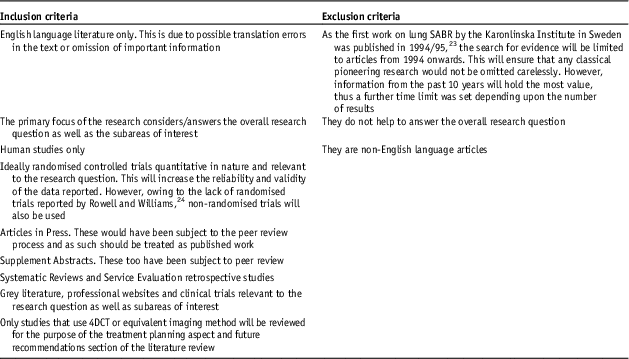
Literature was included/excluded if they fulfilled the following criteria as shown in Table 2.
Methodology inclusion and exclusion criteria

Abbreviations: SABR, stereotactic ablative body radiotherapy; 4DCT, four-dimensional computed tomography.
Literature search process
Advanced searches
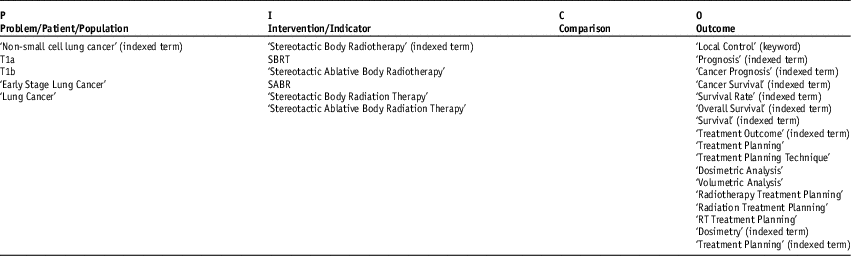
For the advanced searches, the PICO system was used to identify information gained through the literature search. For each key clinical question, a PICO table was created.
Advanced searching using Boolean logic was undertaken. For each PICO column, the ‘keywords’ were entered (using OR) and the resultant search saved. These searches were then combined (using OR) to achieve a search string that included all related term/words for that column (i.e., P: Patient/Population/Problem). Each search was date limited by refining the search by year. ‘AND’ was used to combine all of the ‘PICO’ columns.
‘AND’ meant that all the search words appeared in the article and ‘OR’ collects similar search terms. Phrase marks (““) were used to ensure searching of whole terms/keywords (i.e., stereotactic body radiotherapy).
All searches were attempted twice. The first was to establish how to use the database and to familiarise the researcher to the interface. The second being the actual search.
All searches were done using the ‘Subject Heading’ box ticked on and ticked off and the ‘explode’ tool was also used for all searches. The ‘major concept/focus’ tool was not used for searching as this reduced the amount of articles retrieved.
Keywords
Numerous searches and keywords were used for each column. Briefly, the summarised key searched terms can be seen in Table A1.
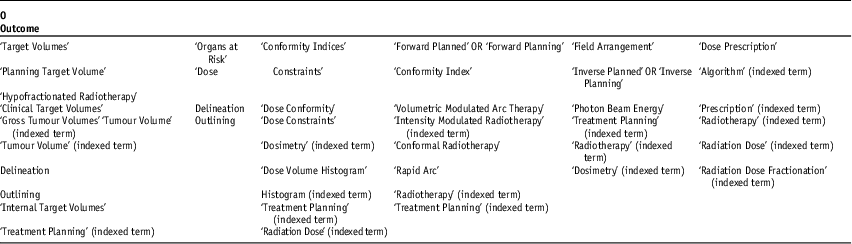
However, the outcome column was felt to be too broad to achieve suitable results, and thus was refined further, as seen in Table A2.
Key author searches
The following key researchers were used to identify any further research of relevance. The key researchers searched were as follows: Lagerwaard F, Timmerman R, Onishi H, Nagata Y and Hurkmans C.
Data extraction and analysis
A quantitative checklist method was used for data extraction based upon the quality assessment/critical appraisal tool SIGN. The data were collected and analysed manually and data synthesis was primarily via descriptive analysis of the extracted data.
Discussion
SABR TP technique
Gross tumour volume (GTV) and clinical target volume (CTV) delineation
The accepted standard in the majority of SABR trials and practice is that the CTV is the GTV with no margin for microscopic disease extension.20 In order to contour the GTV/CTV, a four-dimensional (4D) view of the tumour is required, with the breathing motion being the fourth dimension.
Internal target volume (ITV) delineation
For SABR, a four-dimensional computed tomography (4DCT) scan is preformed upon which an ITV created to take account of the breathing motion of the tumour within the patient.Reference Purdy25 This is defined as a tumour volume, which is obtained using a 4DCT scan on either a (i) maximum intensity projection (MIP) (this displays the ‘maximum’ extent of breathing, thus the maximum extent of the tumours position during the breathing cycle. It corresponds to the greatest voxel intensity values throughout the 4DCT), (ii) maximum inspiratory and expiratory scans or (iii) as contoured on all ten phases of a 4DCT scan.20 Thus, for SABR patients the ITV includes the mobile GTV and CTV.
The tumour is contoured on an MIP created from a 4DCT scan and an average intensity projection (AIP) is created. The AIP displays the 3DCT scan with voxels equal to the arithmetic mean of the 4DCT electron density. As the voxel density values in a 3D AIP dataset are more representative of the true density values that would be present during treatment, AIPs can be used for dose calculation.
It is important that all ITV contours are reviewed by two consultant oncologists with an additional review by a consultant radiologist highly recommended and considered best practice certainly for non-standard or complex treatments.20
PTV delineation
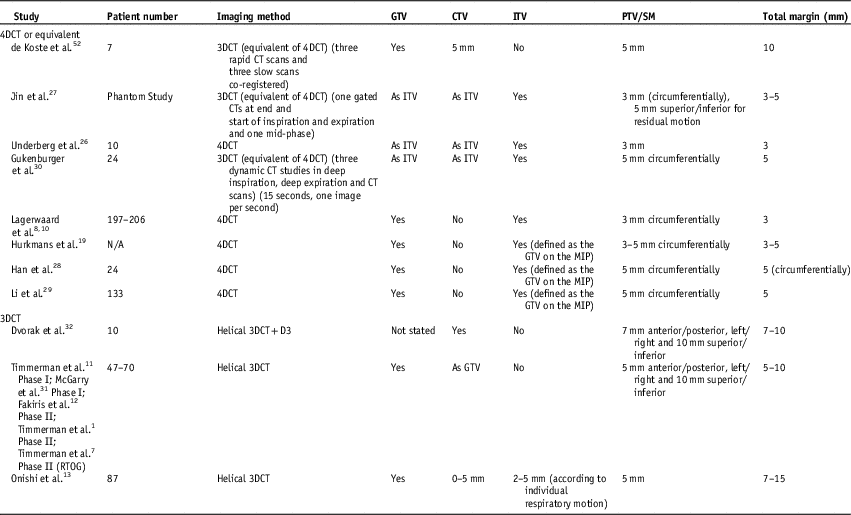
A set-up margin (SM) is applied to the ITV to create the PTV for SABR treatments. This is to account for potential set-up errors and external patient movement. Numerous studies (Table A3) using 4DCT or equivalent imaging modality to delineate the ITV have used margins of 3–5 mm.Reference Lagerwaard, Haasbeek, Slotman and Senan8, Reference Lagerwaard, Haasbeek, Smit, Slotman and Senan10, Reference Hurkmans, Cuijpers and Lagerwaard19, Reference Underberg, Lagerwaard and Cuijpers26–Reference Guckenberger, Meyer and Wilbert30 Other studies that have used larger margins of 5–15 mm overall have used 3D helical scanning as the imaging modality.Reference Timmerman, McGarry and Yiannoutsos1, Reference Timmerman, Paulus and Galvin7, Reference Timmerman, Papiez and McGarry11, Reference Fakiris, McGarry and Yiannoutsos12, Reference Yu, Liu and Yu14, Reference McGarry, Papiez, Williams, Whitford and Timmerman31, Reference Dvorak, Georg and Bogner32 It would therefore be advisable to begin with an ITV to PTV SM of 5 mm.
OAR delineation
In addition to the OAR outlined as standard (heart, total lungs and spinal cord), the consortium also recommend that the major airways are also contoured (trachea and proximal bronchial tree, the proximal brachial tree, the proximal trachea and the proximal bronchial tree plus a further 2 cm).20, 21
When non-coplanar beams are used the whole liver should be scanned (especially for lower lobe lesions) and additional OAR outlined (stomach, bowel, spleen, brachial plexus, oesophagus and liver). In addition, skin dose should be kept to a minimum to reduce cutaneous and subcutaneous toxicity. This is assisted by ensuring that beam entry points do not overlap on the skin.21
All OAR are outlined on the AIP of a 4DCT scan.Reference Hurkmans, Cuijpers and Lagerwaard19
Dose and fractionation schedules
Various dose fractionation schedules have been researched, ranging from a single fraction to ten or more and with a total dose (TD) of between 24 and 72 Gy.Reference Timmerman, McGarry and Yiannoutsos1, Reference Timmerman, Paulus and Galvin7, Reference Lagerwaard, Haasbeek, Slotman and Senan8, Reference Lagerwaard, Haasbeek, Smit, Slotman and Senan10–Reference Yu, Liu and Yu14, Reference Onishi, Shirato and Hagata17, Reference Blomgren, Lax, Naslund and Svanstrom23, Reference McGarry, Papiez, Williams, Whitford and Timmerman31, Reference Lagerwaard, Van Sornsen de Koste and Nijssen-Visser33, Reference Baumann, Nyman and Lax34
Dose fractionation regimes supported by the lung consortium20, 21 are as provided in Table 3.

The standard dose has been informed by the results of the RTOG 0236 trial.Reference Timmerman, Paulus and Galvin35 This was a multicentre phase II study. The prescription dose was 20 Gy/fraction over 3 fractions (60 Gy TD) without proper tissue heterogeneity. Subsequent analysis with heterogeneity correction showed the actual dose to be only 54 Gy total. This dose was associated with acceptable treatment-related morbidity.
The conservative dose fractionation is recommended when any a part of the PTV is in contact with the chest wall. The inter-fraction interval is recommended to be at least 40 hours, with a maximum interval of ideally 4 days between treatment fractions.Reference Hurkmans, Cuijpers and Lagerwaard19 If the dose constraints cannot be met at 55 Gy in 5 fractions, the very conservative fractionation schedules can be used. The conformity constraints are as per 55 Gy in 5 fractions.
It is important to mention that the doses are prescribed depending on the algorithm used.Reference Hurkmans, Cuijpers and Lagerwaard19
Biological Effective Dose (BED) and SABR
There has been much debate and discussion on the contribution of the BED for hypofractionated SABR, particularly as the underlying mechanisms of cell killing and the biological dose–response relationship between observed effects and hypofractionation is far from understood.Reference Kong, Guo and Zhaa36 In fact, after a review of literature, Partridge et al.Reference Partridge, Ramos, Sardaro and Brada37 suggested that owing to the high daily dose it is inappropriate to employ this, as the model does not accurately explain clinical outcomes as it is based upon the radiobiology rules of conventional fractionation, which is different to hypofractionation radiation therapy.
Nevertheless, the BED remains the only well-established and researched model as an estimation of radiation effect and as such needs consideration when deciding a dose/fractionation schedule for SABR. The general consensus in literature is that higher BED over a shorter period must be given to achieve a successful LCR.Reference Mehta, Scrimger and Rockie38
Onishi et al.Reference Hurkmans, Cuijpers and Lagerwaard19 undertook a retrospective evaluation of 245 patients. After a median follow-up (FU) of 24 months, local recurrence rate was 8·1% for a BED≥100 Gy compared with 26·4% for a BED<100 Gy (p<0·05) and 3-year OS rate for medically operable patients was 88·4% for BED≥100 Gy compared with 69·45 for a BED<100 Gy (p<0·05).
In two FU studies, Onishi et al.Reference Onishi, Shirato and Hagata17, Reference Onishi, Araki and Shirato16 concluded that a BED>100 Gy is considered to be a satisfactory SABR dose for stage 1 NSCLC, giving an LCR better than 85%. The BED was calculated at the isocentre and the median calculated BED was 116 Gy (range, 100–141 Gy).Reference Onishi, Shirato and Hagata17 This is echoed by Xia et al.Reference Xia, Li and Sun9
Similarly in America, Timmerman et al.Reference Timmerman, McGarry and Yiannoutsos1, Reference Timmerman, Paulus and Galvin7 concluded that 60 Gy over three fraction was the optimum dose. This is a calculated BED of 180 Gy. With proper tissue heterogeneity correction, the dose was 54 Gy in 3 fractions, which is a BED of 151·2 Gy.
Field arrangement (forward planned)
In order to achieve adequate target coverage using SABR while sparing critical structures including the skin surface, a multiple-beam field arrangement with the isocentre placed at the centre of the PTV is the conventional technique for SABR, which can range between 7 and 13 fields.Reference Timmerman, McGarry and Yiannoutsos1, Reference McGarry, Papiez, Williams, Whitford and Timmerman31, Reference Nagata, Negoro and Aoki39–Reference Brock, Bedford and Partridge44
All fields are non-opposing, evenly spaced and most of the literature supports a non-coplanar technique,Reference Timmerman, McGarry and Yiannoutsos1, Reference Fakiris, McGarry and Yiannoutsos12–Reference Yu, Liu and Yu14, Reference Onishi, Shirato and Hagata17, Reference McGarry, Papiez, Williams, Whitford and Timmerman31, Reference Nagata, Negoro and Aoki39–Reference Brock, Bedford and Partridge44 although it is also possible to use coplanar beam configuration depending on the size and location of the lesion. Han et al.Reference Han, Cheung and Basran28 and Nyman et al.Reference Nyman, Johansson and Hulten45 both used a combination of co-planar and non-coplanar beams. The large limitation of non-coplanar angles is the increase in delivery time.Reference Ong, Palma, Verbakel, Slotman and Senan42 However, with the advent of flatness filter-free linacs, treatment times for SABR have been shown to be halved.Reference Boda-Heggemann, Mai and Fleckenstein46
Beam angles should be directed so that the spinal cord receives the lowest dose possible; Timmerman et al.Reference Timmerman, McGarry and Yiannoutsos1 asked for no more than 6 Gy/fraction and beam weightings manipulated to deliver roughly equal absolute dose to the isocentreReference Timmerman, McGarry and Yiannoutsos1 and minimum beam segment area set to 4 cm.21
Beam energy
The lower megavoltage energies such as 4–6 MV should be usedReference Onishi, Shirato and Hagata13, Reference Yu, Liu and Yu14, Reference Onishi, Shirato and Hagata17, Reference Nagata, Negoro and Aoki39, Reference Nagata, Takayama and Matsuo40, Reference Xiao, Papiez and Paulus43, Reference Brock, Bedford and Partridge44, Reference Schuring and Hurkmans47 owing to the wide penumbra of high-energy beams, the small beam apertures used in SABR and the problems associated with build up. The plan is recommended to be calculated on a small dose grid (no more than 2·5 cm) to ensure the accuracy of the dose volume histogram calculations. For lung SABR treatments, all patients should be treated with 0·5 cm MLC or better capable linear accelerator.Reference Dvorak, Georg and Bogner32
Tissue heterogeneity correction
Dose delivered to the PTV and OARs for SABR of lung tumours are largely influenced by tissue density corrections.Reference Schuring and Hurkmans47 For SABR, it is strongly recommended that Type B algorithms should be used.Reference Xiao, Papiez and Paulus43 This is calculated based upon the electron density matrix of the attenuated tissues rather than equivalent path lengths. It is a more accurate estimation of dose near tissue/air interfaces.
Assessing the clinical acceptability of a plan
PTV conformity indices (CI)
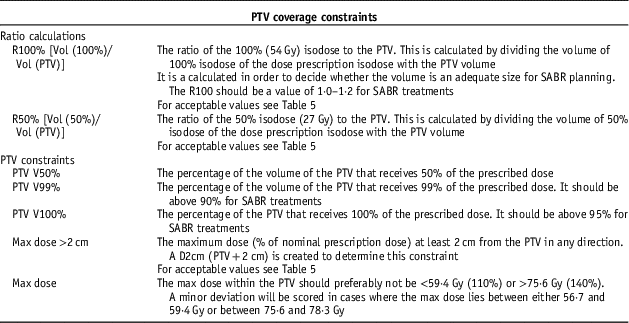
From the review of literature there were several standard CI used to assess the clinical acceptability of a plan. They are seen in Table 4, assuming the standard prescription dose.
PTV conformity indices
Abbreviations: PTV, planning target volume; SABR, stereotactic ablative body radiotherapy.
Prescription point
Owing to the highly inhomogeneous distributions accepted with SABR, target dose homogeneity in the PTV should be within 20%Reference Yu, Liu and Yu14, Reference Onishi, Shirato and Hagata17, Reference Nagata, Negoro and Aoki39, Reference Nagata, Takayama and Matsuo40 and the target reference point dose should be defined at the isocentre of the beam.Reference Nagata, Negoro and Aoki39, Reference Nagata, Takayama and Matsuo40
PTV dosimetric criteria
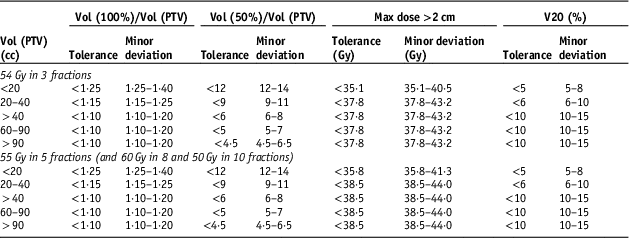
In order to critically assess the clinical acceptability of a plan, the conformity of the PTV coverage will be judged as given in the tables below, incorporating constraints used in the ROSEL study (Table 5).Reference Hurkmans, Cuijpers and Lagerwaard19
Dose conformity requirements for Type B models (54 Gy in 3 fractions and 55 Gy in 5 fractions and 60 Gy in 8 and 50 Gy in 10 fractions)Reference Hurkmans, Cuijpers and Lagerwaard19
Abbreviations: Vol (100%)/Vol (PTV), ratio of prescription isodose (e.g., 54 or 55 Gy) volume to the PTV; Vol (50%)/Vol (PTV), ratio of 50% prescription isodose (27 or 27·5 Gy) volume to the PTV; Max dose>2 cm, maximum dose (% of nominal prescription dose) at least 2 cm from the PTV in any direction; V20, percentage of total lung volume—GTV receiving >20 Gy; PTV, planning target volume; GTP, gross tumour volume.
OAR dose constraints
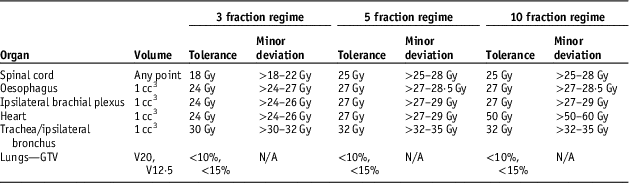
The OAR constraints recommended by the Lung Consortium are also from the ROSEL trial (Table 6).Reference Hurkmans, Cuijpers and Lagerwaard19 They are based on the highest dose/fractionation regimes reported in lung SABR and therefore should be safe for lower BED regimes used in lung SABR.20
OAR dose constraints AdministratorReference Hurkmans, Cuijpers and Lagerwaard19
Abbreviations: OAR, organs at risk; GTP, gross tumour volume.
Summary
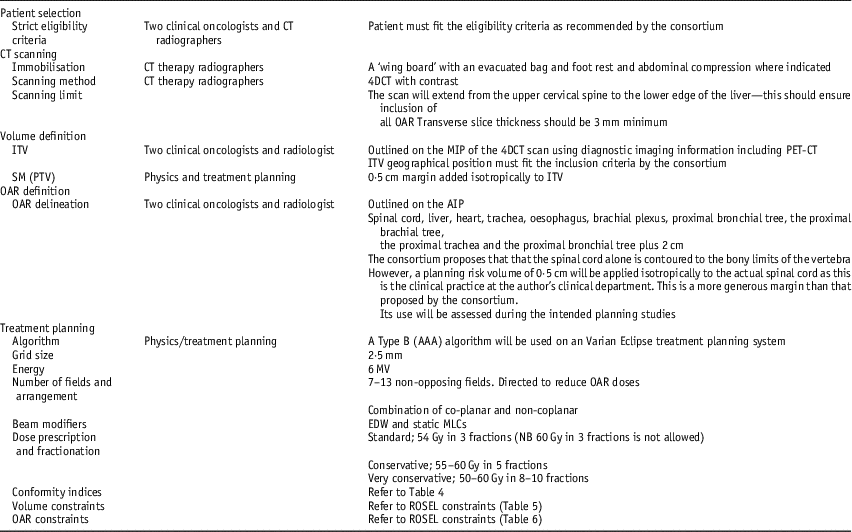
From the literature, SABR is more commonly associated with conventional forward planning,Reference Timmerman, McGarry and Yiannoutsos1, Reference Timmerman, Paulus and Galvin7, Reference Lagerwaard, Haasbeek, Slotman and Senan8, Reference Lagerwaard, Haasbeek, Smit, Slotman and Senan10, Reference Onishi, Shirato and Hagata13, Reference Yu, Liu and Yu14, Reference Onishi, Shirato and Hagata17, Reference Timmerman, Paulus and Galvin35 with only a few researchers using co-planar inverse planned treatments.Reference Brock, Bedford and Partridge44, Reference Schuring and Hurkmans47–Reference Verbakel, Senan, Cuijpers, Slotman and Lagerwaarrd49 It would therefore be advisable to start any SABR as a forward planned technique initially and then progress to other techniques. Table 7 provides a summary of the technique proposed.
SABR pre-treatment summary
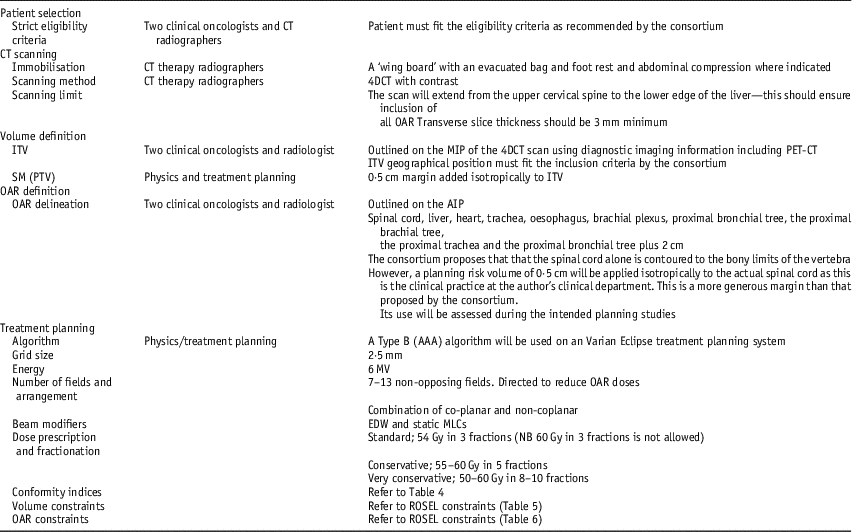
Abbreviations: SABR, stereotactic ablative body radiotherapy; 4DCT, four-dimensional computed tomography; OAR, organs at risk; ITV, internal target volume; MIP, maximum intensity projection; PET-CT, positron emission tomography computed tomography; SM, set-up margin; PTV, planning target volume; AIP, average intensity projection.
Future developments
This review focussed on the forward planned SABR TP technique as this would be the starting point for any clinical implementation in the author’s clinical department. However, presently it would seem that VMAT sets the standard for SABR planning and delivery. Ong et al.Reference Ong, Verbakel and Cuijpers50 compared techniques and found that VMAT achieved a superior CI and lower V45 Gy to the chest wall (p<0·05) compared with all other techniques and gave far quicker delivery times (of a 7·5 Gy fraction) than other techniques: 3·9 minutes (VMAT), 11·6 minutes (conformal SABR) and 12 minutes (fixed-field intensity-modulated radiotherapy).Reference Ong, Verbakel and Cuijpers50 Indeed, Naviarria et al.Reference Navarria, Ascolese and Mancosu51 found that the median beam on time was reduced by 75% for VMAT plans and Boda-Heggemann et al.Reference Boda-Heggemann, Mai and Fleckenstein46 found by using flatness filter-free linacs during one breath hold, treatment time was reduced by half.
These results are being echoed throughout the most current literature; VMAT gives improved highly conformal dose distributions while achieving accurate dosimetric delivery and improved treatment times.Reference Brock, Bedford and Partridge44, Reference Schuring and Hurkmans47–Reference Verbakel, Senan, Cuijpers, Slotman and Lagerwaarrd49
Acknowledgements
I am very thankful to my husband and to Sheela Macwan my Supervisor for supporting my work during the last year.
Financial Support
This work was supported by Besti Cadwalader NHS Trust.
Conflicts of Interest
None.
Appendix
Keyword/term searches
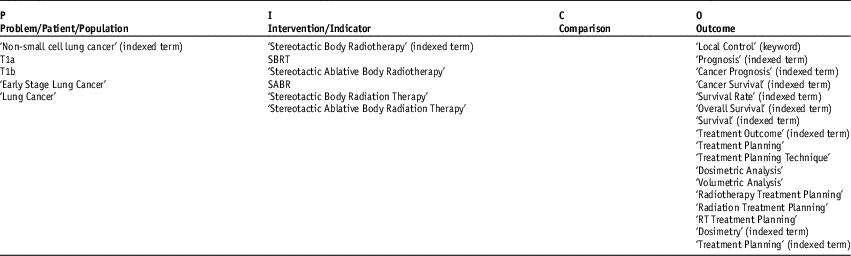
Keyword/term searches
Summary of volumes and margins applied in literature