Introduction
Although the traditional practice of slashing and burning fallows is a cheap method of land preparation in the Amazon, several disadvantages are associated with it. Denich et al.Reference Denich, Kanashiro, Vlek., Lal, Kimble and Stewart1 document that burning of fallows leads, through volatilization, to losses of soil nutrients (nitrogen, sulfur, phosphorus, potassium, calcium and magnesium). In addition, there are losses of soil biomass and the local populations incur external costs due to smoke and accidental firesReference Nepstad, Moreira and Alencar2, Reference Mendonca, Diaz, del, Nepstad, Seroa, Alencar, Gomes and Ortiz3. To overcome these problems, a mechanized, fire-free land preparation technology which is characterized by simultaneous bush clearing and mulching of fallows has been developed. Through this technology, carbon losses are considerably slowed down and soil nutrients are availed to cultivated crops for longer periods. The mulch left in the fields also helps in improving soil conditions and preventing erosion. Thus the farmers are able to increase their crop yields per unit area of landReference Denich, Vielhauer, Kato, Block, Kato, Sá, Lücke and Vlek4. In this regard, the mulch technology can be viewed as a possible alternative to slash-and-burn practices as it would enhance farmers' level of production through increased land productivity and sustainability of fallow systems.
The mulching technology (MT) can hypothetically be regarded as a type of technological change that results in changes of the total factor productivity. This implies that if prices of output and inputs are kept constant, farmers can produce a higher output with the same inputs, or the same output with fewer inputs. This may also mean that the efficiency or productivity of one or more inputs used in the production process is increased and total costs of production per unit of output are reduced. KatoReference Kato5 and Mendonca et al.Reference Mendonca, Diaz, del, Nepstad, Seroa, Alencar, Gomes and Ortiz3 indicate that labor is a major constraint to the sustainability of the slash-and-burn practices and conclude that this factor could be an important constraint that farming households have to consider when deciding whether to adopt or reject any appropriate technology for land preparation. There is particularly a shortage of labor during land preparation, leading to delayed planting and hence reduced yields. The MT has been developed for the Bragantina region with the anticipation that it will assist to overcome this problem, and reduce the losses of nutrients and biodiversity from the fallow ecosystems.
Against this background, it can be hypothesized that the application of the MT enhances the efficient use of farm inputs, and enables farmers to raise their land productivity and to protect their environment. Several comparisons of crop yields realized from applications of slash-and-burn and mulching technologies have been done at an experimental level since 1997 and up to 2000Reference Denich, Kanashiro, Vlek., Lal, Kimble and Stewart1, Reference Denich, Vielhauer, Kato, Block, Kato, Sá, Lücke and Vlek4–Reference Kato6. The results of these comparisons are mixed, indicating that the MT can only achieve the level of yields of slash-and-burn farming if accompanied with the application of inorganic fertilizers. These external inputs compensate for the absence of ash-fertilizing effects experienced in slash-and-burn practices and the microbial immobilization of soil nutrients during the decomposition of the mulch layer. However, much of the research work on alternatives to slash-and-burn agriculture in the Amazon has so far focused on engineering aspects of land preparation equipment and machinery, agronomic characteristics and soil fertility issuesReference Denich, Vielhauer, Kato, Block, Kato, Sá, Lücke and Vlek4, Reference Sommer, Denich and Vlek7. There are no detailed economic studies that have been conducted to assess the profitability and feasibility of this new technology, from the perspective of both the farmers and the society. The latter is particularly important as the use of fire in slash-and-burn agriculture may generate losses or costs that not only adversely affect the landowners and farmers but also the societyReference Mendonca, Diaz, del, Nepstad, Seroa, Alencar, Gomes and Ortiz3. Thus, the objective of this paper is to conduct cost and benefit analysis in order to analyze the financial and economic profitability of the mulch technology and therefore justify its feasibility as an alternative to the slash-and-burn practices among the farmers of the Bragantina region, eastern Amazon. Using the concept of ‘with’ and ‘without’ project (here mulching technology), the paper conducts the cost–benefit analysis at two levels: private and social. At the private level, only the costs and benefits accruing to the farmers are considered, while at the social level, shadow pricing of cost and benefit streams has been applied and external costs arising from the slash-and-burn system have been incorporated.
The rest of the paper is outlined as follows: the next section discusses the study area and data generated through farmers' trials of the MT and how the analysis is conducted. The results of the cost–benefit analysis are discussed and conditions necessary for the feasibility of MT as an alternative to slash-and-burn practices are identified in the third section. Finally, some concluding remarks and policy implications are mentioned in the last section.
Study Area and Methodology
The Bragantina region
The data analyzed in this paper were collected in early 2004 from different field trials of the MT in the Bragantina region of eastern Amazon in Brazil. The region is located in the north-eastern part of the state of Pará. It occupies an area of 20,000 km2 and has a population of 463,680 inhabitants. Most of the region is suitable for agriculture, with most areas covered with secondary forests of various ages and fields with annual cultures, plantation crops and pasturesReference Sommer, Denich and Vlek7. The cultivated areas are dominated by small-scale farmers who apply fallow-based farming systems which rely heavily on burned ashes for the supply of soil nutrients. During the current survey, the land holding size for small-scale farmers in the region was found to be 21.17 ha per household. Although commercial farms and cattle holdings have expanded into this region, the area can still be termed as culturally homogeneous compared with more recently colonized parts of the AmazonReference Mendoza-Escalante, Börner and Hedden-Dunkhorst8.
Slash-and-burn agriculture has been practiced for several decades in the Bragnatina region. It is characterized by a fallow-based farming system on a continuous piece of land, whereby after cropping for 1–2 years, the land is abandoned for the fallow period which lasts for an average of 6 years. Due to demographic pressure, the fallow period is increasingly becoming shorter, making the secondary vegetation (capoiera) lose its vitality and hence leading to forest degradation, deterioration of soil conditions and decreasing agricultural yieldsReference Denich, Kanashiro, Vlek., Lal, Kimble and Stewart1. Following the introduction of the MT to overcome these and the other previously mentioned disadvantages of the slash-and-burn practices (see the Introduction section), farmers were expected to cultivate the cleared land for 4 years (two crop growing periods, each of 2 years) but maintain the 6-year fallow period. Moreover, they were expected to increase their capital investments as land cultivated through the MT requires additional external inputs such as fertilizers. Important annual crops grown in the region and used in the cost–benefit analysis include cassava (mainly for flour), beans, rice, black pepper and corn.
On-farm testing of the MT
The MT involves application of a high-powered tractor coupled with vegetation-chopping equipment (hereafter mulching equipment)Reference Denich, Vielhauer, Kato, Block, Kato, Sá, Lücke and Vlek4. This equipment cuts the bushes (trees, grasses, etc.), chops them into chips of less than 4 cm3 and lays them as mulch on the top soils. During crop planting, inorganic fertilizers have also to be applied as the decomposing mulch ties up the soil nutrients, a factor that can contribute to substantially low yieldsReference Kato5.
On-farm trials of the MT have been conducted by farmers in the Igarapé-Açu and Bacarena municipalities of the Bragantina region since 1998. Yet, most farmers (96% of 61 smallholders) who volunteered to carry out the trials started at the end of 2001 or at the beginning of 2002. In both municipalities, farmers were supplied, free of charge, with all the necessary inputs (mulching equipment, seeds, fertilizers and pesticides) but they were expected to provide labor for all farm operations. In Igarapé-Açu, farmers decided on the size of the area cultivated as well as the crops to be planted, whereas in Bacarena, the experimental design was defined by the Albras, an aluminum mining company. The Albras had incorporated the MT into its social and environmental development project because of a legally imposed requirement to compensate local communities for the negative environmental effects of aluminum production. In both municipalities, extension on MT was provided by researchers from the Brazilian Agricultural Research Corporation (Embrapa) and its trainees, such that the expected extension bias was minimal.
The cost–benefit analysis results presented in this paper are based on data collected from all farmers (61) who by February 2004 had tested the MT in their farms and also practiced slash-and-burn in separate plots. These data cover all yields from the 2001/2002 cropping season, maize and bean yields from the 2003/2004 cropping season (second season) and partially harvested cassava that had been planted at the beginning of 2003. The full cassava yields for the second cropping season were extrapolated based on what had been harvested by February 2004. In addition, plot-specific data from seven farmers who had grown cassava and beans on slash-and-burn plots were used to increase the database on this activity. For the distribution, 74% of the 61 farmers came from Igarapé-Açu municipality and the rest from Bacarena. All the additional seven farmers came from Igarapé-Açu municipality. A structured questionnaire was used to elicit the data from both groups of farmers. All farm inputs (including labor) and costs incurred by farmers during these trials were recorded systematically using recalling questions. In addition, farmers were requested to recall and state the yields realized from each crop they cultivated during the different cropping cycles (see the subsection on ‘Choice of crop enterprises and cropping cycles' scenarios’).
‘With’ and ‘without’ technology ex post comparisons
The use of cost–benefit analysis in this paper allows the determination of the worth of investing in the MT. The methods of cost–benefit analysis are advanced, allowing project analysts to determine viable and non-viable investment initiatives. Of importance has been the ‘with’ and ‘without’ project ex ante comparisons which consider costs and benefits arising from a proposed investment (‘with’ project) and compare them with those arising from an existing situation or the ‘without’ project alternative. This concept is applied in this paper to assess the feasibility of the MT being used as an alternative to the traditional slash-and-burn practices of fallow farming.
The current analysis uses ex post data collected from an on-farm assessment of the MT by the farmers. The investment alternatives ‘with’ and ‘without’ MT (hereafter ‘with’ MT and ‘without’ MT respectively) are used to generate the incremental net benefit arising from the application of the MT in the cultivation of various crops/crop combinations. This incremental net benefit is then discounted at an appropriate discount rate and for the number of years covered by the cultivation and fallow cycle in order to generate the net present value (NPV) or the present worth of incremental net benefit of investing in MTReference Hanley and Spash9. This can simply be written as:

where NPV(with MT) is the NPV of cultivating a certain crop/crop combination while applying the MT, and NPV(without MT, i.e. with slash-and-burn) is the NPV of cultivating the same crop/crop combination (as with NPV(with MT)) using the slash-and-burn practices. NPV(MT use) is the NPV indicating the incremental net benefit due to the application of the MT. The NPVs reported in this paper are for the NPVs(MT use) only.
The criterion provided in economics literature for choosing a viable or profitable investment is that the NPV has to be positive. In the comparison of two investments (say an old one and a new one) in order to gauge which one is to be retained or adopted, as is the case in this paper, the NPV of the old or existing investment is subtracted from that of the new one. The new investment is qualified as a feasible alternative if the calculated NPV is positive. This implies that such an analysis can be used to justify whether the tested investment is a feasible alternative to the existing one, even in conditions where both investments are not profitable, i.e., both have negative NPVsReference Gittinger10. In this paper, therefore, positive NPVs(MT use) would only indicate that the MT is a feasible alternative to slash-and-burn farming. However, it is also indicated in the discussion of the results as to whether investing in the MT was profitable. To test whether the profitability and feasibility can be retained with slight variations of magnitudes of costs and benefits, a sensitivity analysis has been conducted.
Choice of crop enterprises and cropping cycles' scenarios
The cost–benefit analysis conducted in this paper does not include all the 39 crop enterprises grown during the MT trial period as farmers did not have similar crops/crop combinations. Confronted with this problem, a quantitative analysis of the most frequent crops/crop combinations cultivated by farmers, in both first and second cycles, was conducted. The crops/crop combinations identified through this analysis were cassava for making flour (hereafter referred to as cassava flour), cassava flour and beans, and cassava flour and maize (corn). In the second cropping cycle, these three are represented by about 80% of the cultivated crops/crop combinations.
The MT allows farmers to adopt two cropping cycles, each lasting for 2 years, as opposed to the single cycle of the slash-and-burn system. However, most farmers followed their traditional practice of cultivating plots for only one cropping cycle and only 8.2% of the 61 farmers went ahead to cultivate land for the second cycle. This was not in line with the advice provided by scientists who introduced the MTReference Kato5. When asked for the reasons of not embarking on a second cropping cycle, many farmers reported negative experiences with second cycle crops under slash-and-burn. This may suggest that uncertainty with regard to the performance of the new technology was the main reason for risk-averse farmers not to extend the cropping period.
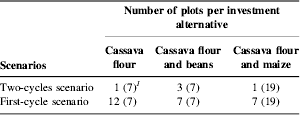
With a very small sample of farmers (8.2%) who tried the MT in accordance to the set guidelines, comparison of ‘with’ and ‘without’ MT alternatives is likely to produce inconclusive results. To overcome this problem, two scenarios, featuring the above crops/crop combinations and the variations of the cropping cycles, are developed. These are labelled ‘two-cycles’ and ‘first-cycle’ scenarios (Table 1) and are discussed in detail in the subsequent paragraphs of this section. Further, the analysis is done on a per hectare basis and not per farmer. Thus all costs and benefits are presented as averages per hectare. A certain crop/crop combination within a given scenario forms an alternative for investing the MT. With three crops/crop combinations and two scenarios, there are a total of six different investment alternatives (three per scenario). A total of 12 alternatives of one-hectare model farms were developed: six for the slash-and-burn and six for the MT.
The number of plots analyzed for each investment alternative.

1 Numbers in parentheses represent the number of plots where the slash-and-burn practices were applied. NPVs calculated for these plots are subtracted from those estimated from the ‘with’ MT plots in order to justify the feasibility of the MT.
For the ‘two-cycles’ scenario, costs and benefits data are analyzed from 8.2% of the 61 respondents who had the above selected crops/crop combinations in their first and second cropping cycles. In addition, other kinds of crops grown by the same farmers in the second cycle were included, though, as it was found out later, only rice featured in the case of cassava flour and maize combination. The ‘two-cycles’ scenario fits very well with the specifications of the scientists who introduced the MT. It also allows the analysis of farmers' preferred choices of crop combinations in one of the study areas, Igarapé-Açu municipality, where about 83.3% of the 61 farmers were given the option to choose their own techniques of crop husbandry. However, with the exception of the cassava flour and beans alternative the number of plots analyzed within this scenario is too low to warrant conclusive comparisons with slash-and-burn plots.
In the case of the ‘first-cycle’ scenario, only the first cropping cycle of the farmers with the above selected crops/crop combinations is considered for the MT investment. Hence, the cropping period has the same length (one cropping season) as in the slash-and-burn system. All farmers with a single cropping cycle are included in this scenario. Further, farmers that planted two cycles are included without considering their costs and benefits of the second cropping cycle. In this case, we analyze a situation that could have arisen if all the farmers had opted for a single cropping period.
The NPVs calculated from costs and benefits of each of the above six investment alternatives in these scenarios are compared with those analyzed from the slash-and-burn plots (‘without’ MT plots). As Table 1 indicates, the number of slash-and-burn plots (figures in parentheses) are appreciably high to allow comparisons with the MT plots within similar investment alternatives.
Considerations of different costs and benefits
Types of costs and benefits included in the financial analysis
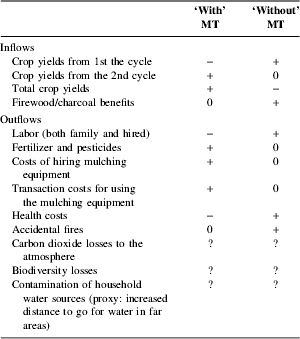
The costs and benefits used for the financial analysis are valued at the market prices faced by the farmers. The main cost components or outflows considered are farm inputs such as fertilizer, seeds and pesticides, hiring of the mulching equipment, labor (both family and hired labor) and transaction costs. The latter include contracting costs for mulching equipment and farmers’ opportunity costs of time spent acquiring extension services. Family labor is valued at its opportunity cost using the local wage rate. In this case, it is assumed that the household members are likely to find employment elsewhere in the local area during the time of farm operations. Table 2 shows which outflows existed or were entered for the ‘with’ and ‘without’ MT comparisons.
Possible inflows and outflows of the ‘with’ and ‘without’ MT comparisons and their hypothesized relative levels.

(+) and (−) denotes hypothesized relative levels (whether higher or lower, respectively) of inflows and outflows of the ‘with’ MT alternatives, as compared with those of the ‘without’ MT alternatives. (0) stands for the non-existence of the inflow and outflow and (?) means it is difficult to determine the monetary value of the outflow from the collected data.
Source: data adapted from Denich et al.Reference Denich, Vielhauer, Kato, Block, Kato, Sá, Lücke and Vlek4; Mendoza-Escalante et al.Reference Mendoza-Escalante, Börner and Hedden-Dunkhorst8; Denich et al.Reference Denich, Kanashiro, Vlek., Lal, Kimble and Stewart1; KatoReference Kato6 and KatoReference Kato5.
The transaction costs incurred by farmers in order to secure contract services of the mulching equipment and acquire any extension information related to their application are valued from the opportunity cost of labor (local wage rate). It is assumed that farmers spent an average of one and a half days to acquire these services.
The inflows or benefits arise mainly from the crop yields harvested from the cultivated plots. These are captured mainly through the calculation of the gross value of production (GVP), which is basically the crop yields multiplied by the farm gate prices. The GVPs for the ‘without’ MT scenario were calculated from a single cropping cycle while those of the ‘with’ MT scenario were derived from two cropping cycles (see also the subsection on ‘Choice of crop enterprises and cropping cycles’ scenarios’). For the ‘without’ MT scenario, the value of firewood collection is included in the analysis among the benefits. This benefit arises because farmers practicing slash-and-burn usually collect the post-burning residues (half-burnt wood) and use them as firewood for roasting of cassava flour, cooking, or charcoal productionReference Withelm11, Reference Sommer12.
Drawing on past studies conducted in the Amazon on slash-and-burn land preparation and its alternatives, several hypotheses have been made on how different inflows (benefits) and outflows (costs) would vary if MT is introducedReference Denich, Kanashiro, Vlek., Lal, Kimble and Stewart1, Reference Denich, Vielhauer, Kato, Block, Kato, Sá, Lücke and Vlek4, Reference Kato6, Reference Mendoza-Escalante, Börner and Hedden-Dunkhorst8. These changes are presented in Table 2 and denoted with (+) and (–) for increases and decreases, respectively. Outflows indicated with question marks (?) are difficult to predict, while those marked with a zero (0) do not feature in the literature as having any consequences on the technology employed in land preparation. Although the specific outflows and inflows are not the core subject of analysis and discussion in this paper, it is important to consider the influence they are likely to have on the incremental net benefits calculated from the ‘with’ and ‘without’ MT scenarios. This influence is captured in the discussion of different cost categories in the subsection ‘The relevance of crop yields in influencing the feasibility of the MT’ and through the sensitivity analysis conducted in subsection ‘Sensitivity analysis’.
Types of costs and benefits streams included in the economic analysis
All the inflows and outflows considered in the financial analysis (see subsection above) were also used in the economic analysis after calculating their shadow prices. Shadow pricing was applied in the economic analysis in order to ensure that the financial inflows and outflows reflect their opportunity costs or real scarcity in society [for the society, only the regional level (Bragantina region) is considered]. Thus, for the economic analysis, the traded and non-traded farm outputs (mainly crop yields) and inputs are revalued to reflect their shadow prices. In addition, unpriced negative impacts such as costs of accidental fires and illnesses caused by smoke are included among the outflows of ‘without’ MT analysis. The data for these two economic outflows were elicited in 2002 by Mendoza-Escalante et al.Reference Mendoza-Escalante, Börner and Hedden-Dunkhorst8 through interviews of 271 randomly sampled farmers in the Bragantina region. During this survey, farmers were asked to give monetary estimates of any losses they had incurred as a consequence of accidental fires (e.g. death of livestock, burning of fences, destruction of pastures, crops, orchards, plantations, etc.) and expenses incurred for the treatment of smoke-related sicknesses such as asthma, bronchitis and other respiratory ailments. In addition, farmers were asked to state the number of days they stayed without working due to the illnesses. Although farmers were requested to give the actual costs or losses incurred since 1991, only data for the three years prior to the survey (i.e. 1999–2001) are considered as it is presumed that the rest may not be reliable due to farmers’ reduced capacity to recall all the information. This is reflected by the fact that about 60% of the values provided by the farmers fell on this period. The calculation showed that negative external costs arising from accidental fires and smoke-related illnesses are about R$ 22 ha−1 and R$ 0.3 ha−1 respectively. These values are far less than the costs estimated in the much more severely burnt western Amazon, where, for instance, Nepstad et al.Reference Nepstad, Moreira and Alencar2 calculated R$ 254 ha−1 as the losses from accidental fires. Notably, other important negative external costs arising from fires such as losses from closure of regional airports and traffic collisions due to impaired vision are not included in the current analysis, because interviews with local officials suggested little or no relevance.
In revaluing the tradable and non-tradable agricultural outputs and inputs, export and import tariffs, quotas and other market restrictions that could artificially inflate or deflate prices were considered. To revalue labor, costs of land preparation had to be separated from the costs of other farm activities. This is because it had been assessed during the survey that there is a high and unfulfilled demand for labor during land preparation, which used to delay the operation. Thus the local wage rate paid during this period is a good estimate for the opportunity cost of labor and its marginal value product, and is therefore regarded as the economic rate. For the other farm activities (fertilizer application, weeding, etc.), it is estimated that the number of days that rural labor can expect to find employment during this period reduces by 12.5%. Thus, labor for these activities is revalued by multiplying the financial values with a conversion rate of 0.875. This is in agreement with Gaspary and Schmidt'sReference Gaspary and Schmidt13 recommendation that, as a rule of thumb, the financial wages in developing countries should be reduced by 10–25% in order to arrive at the shadow wage rate.
Conducting the financial and economic cost–benefit analysis
Cash flows or dynamic cost–benefit analyses were modeled to measure the financial and economic returns of crop cultivation over a 10 year investment period (payback period). For the ‘with’ MT plots, cultivation is done for 4 years and then followed by a fallow period of 6 years. Thus the investment period ends when the fallow is ready for the next cultivation. Since the plots are ready for cultivation in the tenth year, a NPV of the anticipated 4 years of crop production is included as the residual value (salvage value) of the investment (i.e., investment cycle of 4+6 years, plus a residual value). On the other hand, the ‘without’ MT plots are at the end of the second cultivation cycle by the end of the tenth year. Therefore, it is assumed that this investment has no residual value since farmers are no longer interested in farming the plots after 2 years of cultivation (i.e., investment cycle of 2+6+2 years, without a residual value).
The cost–benefit analyses are conducted at constant prices (do not include interest and inflation). Both inflows and outflows are discounted over the 10 years’ period to reflect the time value of money. A discount rate of 10% is used for both financial and economic analyses. On the basis of qualitative information gathered during the survey, this discount rate is assumed to reflect the opportunity cost of capital for the local farmers and the Bragantina region society. Since the opportunity costs of land are not included, the analyses conducted in this paper allow comparison of returns to land when using different technologies of cultivation.
Results and Discussion
Financial and economic profitability of the MT
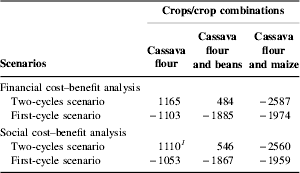
Results of the financial and economic cost–benefit analysis are presented in Table 3. As described in the subsection “‘With’ and ‘without’ technology ex post comparisons” only the differences of the NPVs of ‘with’ and ‘without’ MT are stated in this table. For the cases where these NPVs are positive, it was also found that all the ‘with’ MT and ‘without’ MT investment alternatives were profitable (had positive NPVs). This indicates that the slash-and-burn agriculture is profitable to the farmers, but the application of MT would be more profitable. Since different scenarios of cultivation cycles and crops/crop combinations are tested, the results presented in this table also assess which investment alternatives would be profitable and feasible with the application of the MT.
NPVs in R$ ha−1 of the incremental net benefit of using the MT.

1 Unlike in the other investment alternatives, the social NPV is lower than the private one for the cassava flour alternative of the ‘two-cycles’ scenario. This is because the labor costs of farm operations, other than land preparation, are considerably higher in the ‘without’ MT scenario compared with the ‘with’ MT to the extent that shadow pricing and additional external costs do not raise the social NPV of MT investment.
Both financial and economic values show a similar trend in all the six alternatives that have been tested. This indicates that the social pricing of costs and benefits does not play a major role in the analysis. This is mainly because most of the farming inputs and outputs are just traded within the region without being influenced by the prevailing import and export tariffs. Nevertheless, it is important to note that external costs, such as greenhouse gas emissions and biodiversity losses, have not been included in the analysis due to difficulties of generating the data during the survey period.
The calculated NPVs of the incremental net benefit of using the MT are positive only in the case of the ‘two-cycles’ scenario if either cassava flour or a combination of cassava flour and beans were planted for two cultivation cycles. While the positive results of both financial and economic analyses of the cassava flour alternative cannot be relied on, since only a single farmer tried the MT, the analyses of cassava flour and beans are important in that they indicate conditions under which MT can be a feasible alternative to slash-and-burn practices from both financial and social points of view. First, it is clear that this feasibility can only be achieved, both financially and socially, if two cycles of cultivation are adopted. Secondly, using the technology and adopting the two cultivation cycles would not support this feasibility without farmers selecting profitable investment alternatives. Our results indicate such an alternative would be a combination of cassava flour and beans for both cropping cycles.
The results also indicate the rationality of farmers in investing in profitable endeavors, since the two alternatives with positive NPVs fall under the ‘two-cycles’ scenario which reflects the ‘real’ situation under which the MT had been anticipated to be a feasible alternative to slash-and-burn practices. However, one has to be cautious with this argument since about 21% of all the respondents were from the Bacarena trial area, where farmers were not allowed to make independent decisions on the kinds of crops to cultivate. As some of the scenarios are based on very few cases from the database, generalizability of the results is also limited. In addition, there exists a number of potentially confounding factors whose influence could not be ruled out. Among these are farming skills and soil quality, which are however expected to have minimal effects since we report the difference of NPVs of two systems on the same farm.
The relevance of crop yields in influencing the feasibility of the MT
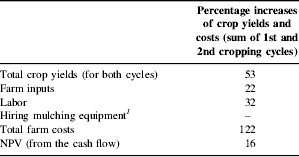
The dominant feature of the profitable investment alternatives in MT is the capacity to produce yields that are high enough to offset the costs, including the cost of hiring the mulching equipment. Thus, the cassava flour, and cassava flour and beans alternatives with positive NPVs gave considerably higher crop yields than most of the investment alternatives with negative NPVs. Since the analysis conducted in this paper compares the incremental benefits of using the MT and those of the slash-and-burn approach, it is important to compare, at constant prices, the yields of the former with those of the latter. The cassava flour and beans alternative within the ‘two-cycles’ scenario is considered for this simple comparison of crop yields and costs due to its profitability and feasibility (Table 4). It was found that the total yields of this investment alternative of MT were higher than those realized from the single cycle of slash-and-burn by 53%. Thus, the considerable increase of yields when the MT is applied is a key factor for the profitability of the cassava flour and beans alternative of the ‘two-cycles’ scenario.
Percentage increases of crop yields and costs of ‘with’ MT scenario as compared with those of the ‘without’ MT scenario of the financially feasible alternative of cassava flour and beans.

1 Notably, the hiring costs of the mulching equipment represent 41% of total costs of investing in MT. Comparisons are however not possible because this cost category is absent in the ‘without’ MT calculations.
With these results, it can be deduced that the total yields of the MT investment in the cultivation of cassava flour and beans are considerably higher than those of the slash-and-burn farming mainly due to cultivation of land for a longer period (two cropping cycles instead of a single one). Moreover, this may be as a result of farmers' adherence to instructions on fertilizer application, since, as documented by KataReference Kato5 and KatoReference Kato6, earlier farm trials had shown that fields prepared with fire-free technologies relied mostly on external sources of soil nutrients in order to produce higher yields than those realized from the slash-and-burn plots.
When the total costs of the cassava flour and beans alternative of the MT are compared with those of the slash-and-burn agriculture, it was found that the former are enormously higher than the latter, by 122% (Table 4). Further investigation showed that most of the cost categories of this ‘with’ MT alternative had higher magnitudes of costs than those of the slash-and-burn. Specifically, the labor requirements of using the MT increased by 32%. This was because of increased labor requirements for additional or different farm operations, such as planting within mulched fields, fertilizer application and weeding. It was confirmed through both quantitative and qualitative data that although the labor demand for land preparation had decreased, the increase of total labor requirements when using the MT was one of the key reasons why its acceptability among the farmers was low (about 8.2%).
The costs of tradable farm inputs (mainly inorganic fertilizers) increased by 22%. These relatively high costs reduce the incremental net benefit of investing in MT. Thus, even if the benefits (crop yields) increase by 53%, the NPV increases by only 16% after modeling the cash flows for a 10-year period. Hence, slash-and-burn can be regarded as a less-intensive technology of farming which does not require high capital investment (labor and farm inputs), but gives lower returns in terms of yields. In contrast, mulching is a more intensive technology which demands higher quantities of fertilizers and eventually labor, but gives higher returns. This goes well together with the opinion of Mendonca et al.Reference Mendonca, Diaz, del, Nepstad, Seroa, Alencar, Gomes and Ortiz3 that there is an inherent rationality to the use of fire in the Amazon mainly due to resource restrictions, such as labor and cash.
The results analyzed in Table 4 further support the argument that it is the relatively higher yields produced within the mulched plots that largely influence the viability and feasibility of MT. Except for labor, the results are also in agreement with the hypotheses indicated in Table 2 concerning the behavior of different cost categories when MT is applied.
Sensitivity analysis
Sensitivity analysis is applied in the cost–benefit models to gauge which factors are likely to increase or reduce the expected returns on the use of MT and hence influence its viability and feasibility. Notably, the setting of the scenarios and the crops/crop combinations as explained in the subsection ‘Choice of crop enterprises and cropping cycles' scenarios’ can be viewed as an important variation that determines some of the conditions under which MT is likely to be a feasible alternative to slash-and-burn agriculture in Bragantina. Variations tested in the sensitivity analysis include the level of GVP, discount rate, cost of hiring the mulching equipment, labor costs (family and hired labor) and costs of tradable farm inputs. The results of varying the values of these benefit and cost streams by 25% (both reductions and increments) did not have any influence on the base NPVs of the MT investment. It was therefore deduced that the profitable and feasible MT alternatives are considerably insensitive (stable) to small increments or reductions of benefit and cost streams.
Conclusions and Policy Implications
Using the concept of ‘with’ and ‘without’ project this paper investigated the feasibility of applying a mechanical MT as an alternative to the traditional slash-and-burn practices in the Bragantina region. Its results reveal that this technology is profitable, both financially and economically. However, for it to be a feasible alternative to the slash-and-burn practices of the study area, certain conditions have to be fulfilled. The key condition is farmers' willingness to abandon the old tradition of a single cropping cycle, which is a common practice in slash-and-burn agriculture, and adopt two cycles, without which the MT cannot be profitable. Coupled with the two cultivation cycles, is the choice of profitable crops. The analysis has demonstrated that, for farmers to realize positive returns from the MT, certain crop enterprises or crop combinations have to be adopted. Among the combinations tested, growing of cassava flour and beans for the two cropping cycles emerged as a feasible investment alternative that could be suggested to the farmers.
The profitability of the MT is evidently due to the high yields produced by those farmers who fulfilled the above conditions. Thus the production of higher yields than in the slash-and-burn alternative has been identified as the dominant factor that can be associated with the technology. This implies that farmers adopting this technology in the future can raise their farm incomes and augment their food supplies.
The MT reduces the workload for land preparation for the smallholder farmers. However, the total labor requirements (for all the farm activities) increase when compared with the slash-and-burn alternative. Thus, at least for the moment, labor costs are likely to remain one of the crucial constraints that would hinder the financial and economic feasibility of the MT. Noting also that the case study farmers did not make own payments for the hiring costs of mulching equipment during the trials, this result has an important policy implication. To spur adoption of the technology, dissemination strategies could target farmers that are well endowed with both labor and capital. Unfortunately this would perpetuate an undesirable extension pattern, in that farmers who least need extension services will be targeted. In any case, advantages and disadvantages of the technology should be communicated to all the farmers. The extension message should inform them that although the MT is input intensive, it has a comparative advantage over the slash-and-burn farming because it is profitable when the stipulated guidelines are adhered to.
It was found that the conditions hindering feasibility of the technology are related to specifications developed by the scientists who introduced it. This would imply that intensive extension support services would be required if farmers are to abandon the slash-and-burn practices and adopt the mulching techniques. However, mechanisms to motivate farmers to follow the stipulated mulching guidelines, e.g. having two cycles of cultivation for four years, and crop husbandry practices such as application of fertilizers should be in place for them to realize the full benefits of using this new technology. An example of such a mechanism is a technology specific crop-yield insurance, which could buffer some of the uncertainties encountered when embarking on a second cropping cycleReference Börner14.
The capability of the MT to lower the negative effects of fire on the environment is a considerable advantage for both farmers and society. Admittedly, it is difficult to support fully the feasibility of the MT since, due to lack of data, not all the externalities of slash-and-burn farming were included in the analysis. Moreover, the costs of the farmers during the trials were highly subsidized and not all of them were allowed to make own crop husbandry decisions. Thus, it would be of imperative importance to conduct a similar analysis after farmers have adopted MT and shouldered all the farm costs as well as exercised their discretion in all farm decisions. It is only after conducting such an analysis that it would be possible to conclude without hesitation that MT is a feasible alternative to the slash-and-burn practices of the eastern Amazon.
Acknowledgements
The authors gratefully acknowledge the financial support of the German Ministry of Education and Research (BMBF) which funded the Phase III of the ‘Studies on Human Impact on Forests and Floodplains in the Tropics (SHIFT ENV 44) Project’. This paper is a product of the research conducted within this project.