Implications
This study covers the utilization (digestibility) of whole-crop cereal silages (WCCSs) under some of the conditions used in practice (heifers fed at high intakes). These results can therefore be used by farmers and advisors to predict the energy content (based on the organic matter digestibility) of WCCS harvested within the range of maturity stages investigated in this study, when making feed rations for these kind of animals. The results also show that harvest without a grain processor is also possible at early dough stage without a decrease in starch digestibility, and that conventional grass silage machinery therefore can be used at harvest.
Introduction
Barley, oats and wheat are species commonly used for the production of whole-crop cereal silage (WCCS) in areas where maize production is not possible because of the climatic limitations. The WCCS can be used alone or together with grass silage in the diets of dairy and beef cattle. The time frame for harvesting WCCS is usually longer than for grass silage and the former can be harvested at a wide range of maturity stages, resulting in different forage composition, but with similar forage quality. The most pronounced changes in chemical composition of WCCS during post-heading maturation are the increase in starch concentration (Nadeau, Reference Nadeau2007) and the decrease in neutral detergent fibre (NDF) concentration (Khorasani et al., Reference Khorasani, Jedel, Helm and Kennelly1997; Borowiec et al., Reference Borowiec, Furgal, Kaminski and Zajac1998; Nadeau, Reference Nadeau2007) as a result of a higher proportion of ears in the plant dry matter (DM). There can also be differences in chemical composition depending on cereal species (McCartney and Vaage, Reference McCartney and Vaage1994; Khorasani et al., Reference Khorasani, Jedel, Helm and Kennelly1997; Nadeau, Reference Nadeau2007). The digestibility of WCCS changes during maturation and differs among species. There are a number of studies in which in vivo digestibility of WCCS by sheep has been determined, comparing both maturity stages at harvest (Südekum et al., Reference Südekum, Röh, Brandt, Rave and Stangassinger1995; Borowiec et al., Reference Borowiec, Furgal, Kaminski and Zajac1998; Crovetto et al., Reference Crovetto, Galassi, Rapetti, Sandrucci and Tamburini1998) and cereal species or cultivars (McCartney and Vaage, Reference McCartney and Vaage1994; Emile et al., Reference Emile, Jobim, Suralt and Barrière2007). However, using non-producing, sheep such as adult wethers, fed at a maintenance level to estimate the digestibility of a forage in high-producing cattle is not without problems. In particular, starch digestibility can be misleading when investigated in sheep, as they can chew and break the pericarp of the kernels more efficiently than cattle (Van Soest, Reference Van Soest1994). Furthermore, feeding animals at maintenance or ad libitum level can also affect the digestibility of WCCS as passage rates may vary with the intake level (Südekum et al., Reference Südekum, Röh, Brandt, Rave and Stangassinger1995). Although energy evaluation systems such as the new Nordic system NorFor (Gustavsson et al., Reference Gustavsson, Mehlqvist, Volden, Larsen and Gudmundsson2005) include equations to account for the effect of feeding level on digestibility when calculating energy supply or requirement, it is not clear if these equations apply to WCCSs. Acosta et al. (Reference Acosta, Stallings, Polan and Miller1991) fed whole-crop barley silage harvested at boot stage and soft dough stage to heifers at 90% of ad libitum and found decreased WCCS digestibility with the later harvest. However, WCCSs usually are harvested in the period between boot and soft dough stages of maturity. A comparative study was therefore conducted to evaluate digestibility in dairy heifers at high intakes, of oats, six-rowed barley and two-rowed barley harvested at the heading, early milk stage and early dough stages of maturity. The two main hypotheses tested were that oats would have lower digestibility than barley and the organic matter (OM) digestibility would be similar at all maturity stages.
Material and methods
WCCS
Oats (Avena sativa L., cv. Cilla) and six-rowed barley (Hordeum vulgare L., var. vulgare, cv. Olsok) were sown at the end of May 2003 at Röbäcksdalen Research Centre, Swedish University of Agricultural Sciences, Umeå (Latitude 63°, 35 North, Longitude 20°, 45 East), Sweden. Two-rowed barley (H. v., var. distichum, cv. Pasadena) was sown at the end of March 2003 at the Swedish University of Agricultural Sciences, Alnarp (Latitude 55°, 39 North, Longitude 13°, 04 East), Sweden. The three cereal cultivars were chosen as they were commonly used in their respective region of cultivation.
The oats and barley in Umeå were harvested using a mower conditioner (Kverneland TA339, Kverneland group, Kverneland, Narway) at the heading (barley July 17, oats July 23), early milk (barley July 30, oats July 31) and early dough (barley August 7, oats August 18) stages; these corresponded to maturity stages 59, 73 and 83, respectively, in the decimal code proposed by Zadoks et al. (Reference Zadoks, Chang and Konzak1974). Barley was harvested at Alnarp using a mower conditioner (JF-Stoll, Sonderborg, Denmark) at the early milk (decimal code 71; June 25) and early dough (decimal code 83; July 7) stages. Oats and barley harvested at the heading and early milk stages in Umeå, and barley harvested at the early milk and early dough stages in Alnarp were wilted overnight. Oats and barley harvested in Umeå were baled using a Welger RP220 baler (Welger, Wolfenbuttel, Germany) (theoretical length of cut (TLC) 45 mm); barley harvested at Alnarp was baled using a New Holland D1010 baler (New Holland, Zedelgem, Belgium) (TLC 120 mm). Kofasil® Ultra (sodium nitrite, hexamine, sodium benzoate, sodium propionate; Hansson & Möhring, Halmstad, Sweden) was added to all the forages during baling at an average concentration of 5 l/t fresh matter, in order to prevent the growth of clostridia and yeast. All bales were wrapped in 12 layers of 0.25 mm white plastic film within a maximum of 8 hours from baling, and stored for a minimum of 65 days before opening. The forage harvested at Alnarp was transported by truck to the Swedish University of Agricultural Sciences, Umeå, where the feeding experiment was conducted. The bales were examined on arrival, and additional layers of plastic film were added if necessary.
Animal experiment
The experiment was designed as an incomplete change-over trial, with three periods, each 4 weeks long, and eight dietary treatments as described by Wallsten et al. (Reference Wallsten, Nadeau, Bertilsson and Martinsson2009). Thirty-two heifers of the Swedish Red breed, averaging 326 kg (s.d. of 55) were used and the animals were held and fed individually in a tie stall barn. Each experimental period was divided into two parts. The WCCSs were fed ad libitum (105% to 110% of the voluntary forage intake) during the first 17 days and intake was measured during the last 7 days. During the last 11 days, each animal was offered restricted amounts of WCCS at 0.95 times its average ad libitum intake. During the last 5 days of restricted feeding, all faeces were collected from all heifers for digestibility analysis.
Feed was distributed twice daily at 0900 h and 1400 h throughout the trial. One square bale (two-rowed barley) or half a round bale (oats and six-rowed barley) was cut for every 4th to 6th day using a bale cutter (Emeco, Hökmark, Sweden; TLC 60 mm) to make it easier to ration the silages. The cut silages were kept in containers at temperatures at or below 0°C and no problems with aerobic instability occurred. The rather large particle size of the fed silages did not allow a correct analysis with a Penn State separator. Instead a visual examination of the cut silages was carried out to get a rough estimation of particle size. This showed that all silages contained particles as long as 300 mm of length (whole straw), but the majority of particles seemed to be around 60 to 100 mm in length. In addition to WCCS, all heifers were fed with allowances of 0.4 kg of soybean meal/day, 0.1 kg of minerals/day and 0.1 kg of a vitamin premix twice/week.
Sampling and analysis of forages and orts
Samples of the fresh crops (before ensiling) of six-rowed barley and oats at all three stages of maturity were collected by drilling samples from three randomly chosen bales of each forage (n = 3) immediately before the bales were wrapped in plastic. Samples of the fresh crop of two-rowed barley were collected from different parts of the swaths before baling (n = 1) at both maturity stages. Samples for fermentation products in the silages were collected by drilling samples from three randomly chosen bales of each silage (n = 3) immediately before the plastic was removed. Samples of the silages and soybean meal were taken every day during the 11-day period of restricted feeding during each experimental period and samples were bulked for each period (n = 3). All samples were stored frozen until analysis (−20°C). The frozen silage samples were ground in a meat grinder with a 13 mm diameter screen (Palmiaverken, Söderhamn, Sweden), carefully mixed, and finally sub sampled before analysis. When orts were found during the last 7 days of each experimental period, they were collected and bulked per period and animal. Larger quantities of orts (>3 kg/heifer and period) were sub sampled, as described for the silage samples. All faeces were collected during five consecutive 24-h periods. At the end of each collection period one sub sample/animal was collected for analysis (n = 12). All samples were stored at −20°C before analysis. The final sub samples of fresh crops, silages, orts and soybean meal were dried in a forced-air oven at 60°C for 16 h and then ground in a 1-mm hammer mill. The faecal samples were freeze-dried (in a Heto CD 8 unit) and ground in a 1-mm cyclone mill.
The fresh crops and silages were analyzed for DM, ash, crude protein (CP), ash-free NDF, ash-free acid detergent fibre (ADF), lignin, starch and water soluble carbohydrates (WSCs). Volatile fatty acids, ethanol, lactic acid, ammonia-N and pH of the silages were analyzed using silage fluid, extracted by pressing the thawed samples. The soybean meal was analyzed for DM, ash and CP. Orts with a combined weight >1 kg/heifer for each period (68 of the 88 collected) were analyzed for DM, ash, CP, NDF, ADF and starch; the remaining, smaller orts (20 of the 88) only were analyzed for DM and ash. The faecal samples were analyzed for DM, ash, CP, NDF, ADF and starch.
The DM concentration was determined by drying at 103°C for 16 h, and ash was determined by combustion at 550°C for 3 h. The fermentation profile, CP, NDF, starch and WSC concentrations were analyzed as described by Wallsten and Martinsson (Reference Wallsten and Martinsson2009). The ADF concentration was determined according to Goering and Van Soest (Reference Goering and Van Soest1970) and lignin was determined using the ADF residue (permanganate method; Robertson and Van Soest, Reference Robertson and Van Soest1981).
Calculations and statistical analysis
Digestibility was calculated as intake in relation to faecal production 1-day delayed averaging the whole 5-day period. For the OM and CP digestibility both WCCS (corrected for soy bean meal) and diet digestibility was estimated, and for the correction the soy bean meal was assumed digestibilities of 900 g/kg OM and 920 g/kg CP (Spörndly, Reference Spörndly2003).
The statistical analyses were performed using the MIXED procedure in SAS (Litell et al., Reference Litell, Milliken, Stroup and Wolfinger1996). For the digestibility data one value per animal and period was used (n = 12) and the statistical model used was:

where Yijklmn = dependent variable; μ = general mean; Pi = effect of the ith period (i = 1, 3); Bj = effect of the jth block (j = 1, 8); Ck = effect of the kth crop (k = 1, 3); Ml = effect of the lth maturity stage (l = 1, 3); C × Mkl = effect of the interaction between the kth crop and the lth maturity stage (kl = 1, 8); Hj(m) = effect of the mth heifer within the jth block (m = 1, 4); eijklmn = residual error. The factor heifer within block was random, whereas the other factors were fixed. Because the dry matter intake (DMI) varied among the diets, the DMI (kg/100 kg live weight) was included in the model as a covariate. The model also was used without the DMI covariate in order to evaluate its effect. Carry-over effects from the previous treatments were tested initially. However, these effects were not significant (P > 0.10) and they were excluded from the final model. When the F-test for the crop × maturity stage interaction effect was significant (P < 0.05), pair-wise t-tests with Tukey’s adjustment (level of significance P Tukey’s < 0.05) were performed between treatment means, using the PDIFF statement in SAS. If the crop × maturity stage interaction effect was not significant it was removed from the model and the single crop and maturity stage effects were evaluated. Starch digestibility was determined only for crops with more than 10 g starch/kg DM, excluding six-rowed barley and oats at heading and two-rowed barley at early milk stage. Differences in starch digestibility were, therefore, determined using the contrast statement in SAS and were considered significant if P < 0.05. The following comparisons were evaluated.
1. oats at early milk stage – six-rowed barley at early milk stage;
2. oats at early dough stage – six-rowed barley at early dough stage;
3. oats at early dough stage – two-rowed barley at early dough stage;
4. six-rowed barley at early dough stage – two-rowed barley at early dough stage;
5. oats at early milk stage – oats at early dough stage;
6. six-rowed barley at early milk stage – six-rowed barley at early dough stage.
Results and discussion
Chemical composition of fresh crops and silages
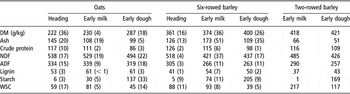
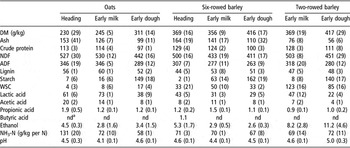
The chemical compositions of fresh crops and silages are presented in Tables 1 and 2. The DM content of the oat crops, especially at heading and early milk stages, was low compared with the barley crops, despite wilting the crop before baling. The DM content at the early milk stage was similar to that reported by Nadeau (Reference Nadeau2007) for an unwilted fresh crop of oats (252 g/kg). The low DM content for oats at the heading and early milk stages could, therefore, be related to ineffective wilting. Part of this might be because the yield of oats was higher and the swaths in the field therefore thicker than those of six-rowed barley (data not shown). The DM content of oats at the early dough stage was not only lower than that of the barley in this study, but was also lower than the 357 to 368 g/kg reported in previous studies (Bergen et al., Reference Bergen, Byrem and Grant1991; Mustafa and Seguin, Reference Mustafa and Seguin2003; Nadeau, Reference Nadeau2007). The ash concentrations varied between silages; they were higher in oats and six-rowed barley harvested at the heading and early milk stages of maturity than in the other silages. Previous data on ash concentrations in oats and barley at different maturity stages vary between 50 and 90 g/kg DM (Bergen et al., Reference Bergen, Byrem and Grant1991; Khorasani et al., Reference Khorasani, Jedel, Helm and Kennelly1997; Nadeau, Reference Nadeau2007). The high ash concentrations in six-rowed barley and oats at the heading and early milk stages were a result of the very dry weather in Umeå before these harvests. Both the mowing and baling procedures disturbed a lot of dust, resulting in soil contamination of the harvested crop. The CP, NDF, ADF and WSC concentrations decreased, whereas starch and lignin concentrations increased, with increasing maturity stage of the harvested crop. The WSC of the fresh crop of oats and six-rowed barley was somewhat lower than in other studies (Bergen et al., Reference Bergen, Byrem and Grant1991; Nadeau, Reference Nadeau2007). The two-rowed barley had WSC concentrations similar to that reported by Nadeau (Reference Nadeau2007) for barley. The concentration of WSC was highest in silages of two-rowed barley, intermediate in six-rowed barley and lowest in oats at the same maturity stages and decreased during ensiling for all crops except the six-rowed barley at the early dough stage. However, the latter showed a decrease in starch concentration, indicating that starch may have been hydrolyzed into sugars during ensiling. Similarly, Nadeau (Reference Nadeau2007) reported starch hydrolysis during ensiling of WCCS.
Mean (s.d. in brackets) chemical composition (g/kg DM if not otherwise stated) of fresh crops of whole crop oats, whole crop six-rowed barley and whole crop two-rowed barley, harvested at the heading, early milk and early dough stages of maturity (n = 3 for oats and six-rowed barley and n = 1 for two-rowed barley)

DM = dry matter; NDF = neutral detergent fibre; ADF = acid detergent fibre; WSC = water soluble carbohydrates.
Mean (s.d. in brackets) chemical composition (g/kg DM if not otherwise stated) and fermentation profile of silages of whole crop oats, whole crop six-rowed barley and whole crop two-rowed barley, harvested at the heading, early milk and early dough stages of maturity (n = 3)

DM = dry matter; NDF = neutral detergent fibre; ADF = acid detergent fibre; WSC = water soluble carbohydrates
anot detected (butyric acid was found in one bale only).
Effect of maturity stage on in vivo apparent digestibility
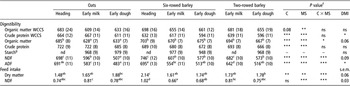
The crop × maturity stage interaction effect was not significant for the WCCS OM digestibility (Table 3), but the maturity stage effect was. At the heading stage the average WCCS OM digestibility (698 g/kg) was higher (P Tukey’s < 0.05) than at early milk (647 g/kg) and early dough (652 g/kg) stages. For the diet OM digestibility, however, the crop × maturity stage effect was significant. The diet OM digestibility of oats at the heading stage was higher than at the early milk and early dough stages, whereas there were no significant differences between maturity stages for six-rowed and two-rowed barley. The decrease in OM digestibility was the result of a large corresponding decrease in NDF digestibility (NDFD). Six-rowed barley had the most rapid decrease in NDFD and no decrease in NDFD was detected in six-rowed barley from the early milk to the early dough stage. The NDFD of oats decreased from heading to the early milk stage and further to the early dough stage; it therefore exhibited a slightly slower decrease in fibre digestibility compared with six-rowed barley. In two-rowed barley, NDF and ADF, digestibilities were higher at the early milk than at the early dough stage of maturity, similar to oats. The increase in ear weight is largest during milk stage as the weight of the ear reaches its maximum already at the early dough stage of maturity (Tottman, Reference Tottman1987). It is therefore reasonable that the decrease in fibre digestibility corresponds to this increase in ear weight. The two-rowed barley at the early milk stage was harvested somewhat earlier than the six-rowed barley (maturity stage 71 compared with 73) and the digestibilities of fibre and OM for two-rowed barley at the early milk stage were numerically intermediate between those for six-rowed barley harvested at the heading and early milk stages. At the early dough stage, however, digestibilities of two-rowed and six-rowed barley were similar. This indicates that the fibre digestibility of whole crop barley silage decreases quite rapidly after heading until the early/middle milk stage; thereafter the decrease is slower or levels out.
Least square means and standard error of LSM of WCCS and diet digestibility (g/kg) and intake (kg/100 kg live weight) and F-test significance for C, MS, C × M interaction and covariate DMI

C = crop; MS = maturity stage; DMI = dry matter intake; WCCS = whole crop cereal silage; NDF = neutral detergent fibre; ADF = acid detergent fibre.
a–eLeast square means within the same row with different letters are significantly different (P Tukey < 0.05).
fLevels of significance are indicated by ns (not significant; P < 0.1; *P < 0.05; **P < 0.01 and ***P < 0.001).
gStarch digestibility was not determined for silages with a starch concentration less than 10 g/kg DM.
Starch digestibility was lower in six-rowed barley when harvested at the early dough stage than when harvested at the early milk stage (P = 0.017). Despite that, starch digestibility was high at the early dough stage for all crops, demonstrating that these crops can be harvested this late without the need for additional processing of the kernels. The starch concentration of WCCS increases at later maturity stages than early dough, but, unless the grain is processed at harvest, the digestibility of starch usually decreases when the silages are fed to cows (Jackson et al., Reference Jackson, Readman, Huntington and Sinclair2004). The crop × maturity stage interaction effect was not significant for the CP digestibility, but the maturity stage effect was. The CP digestibility at early dough stage was lower (P Tukey’s < 0.05) for both the WCCS (599 g/kg) and the diet (674 g/kg) than at the heading (646 and 703 g/kg) and early milk (642 and 699 g/kg) stages.
Effect of species on in vivo apparent digestibility
The two-rowed barley crop in this study was harvested with a different baler than the other crops and this may have affected the particle size of fed silages. The reported effects of particle size on digestibility of silages vary, though. Jaster and Murphy (Reference Jaster and Murphy1983) showed that DM digestibility in Holstein heifers was higher for long than for chopped alfalfa hay, whereas Soita et al. (Reference Soita, Christensen, McKinnon and Mustafa2002), showed that barley silages with a TLC of 4.7 mm had higher digestibility than that with a TLC of 18.8 mm when fed to steers. The actual particle size of the silages fed in this study was much longer than 18.8 mm, and few studies have measured differences in digestibility of silages with this long particle size.
The crop effect for WCCS OM digestibility was not significant. The diet OM digestibility, however, was lower for oats than for six-rowed and two-rowed barley at the early milk and early dough stages of maturity (Table 3). Lower OM digestibilities for oats than for barley have been found earlier when measuring in vivo digestibility in sheep (McCartney and Vaage, Reference McCartney and Vaage1994), and also for in vitro experiments using both rumen fluid and enzymatic degradation (Nadeau, Reference Nadeau2007). Six-rowed barley had lower starch digestibility than oats (P = 0.011) and tended to have lower starch digestibility than two-rowed barley (P = 0.094), when the crops were harvested at the early dough stage of maturity. This suggests that the early dough stage is the latest maturity stage that whole-crop barley can be harvested without losing in starch digestibility, unless a grain processor is used during harvest. The crop effect for WCCS and diet CP digestibility was significant and oats had a higher (P Tukey’s < 0.05) average CP digestibility (650 and 710 g/kg) than two-rowed (624 and 685 g/kg) and six-rowed barley (613 and 680 g/kg). In contrast to this McCartney and Vaage (Reference McCartney and Vaage1994) reported lower nitrogen digestibility for oats than barley when the crop was harvested at the milk/soft dough stage.
The NDF and ADF digestibilities did not differ significantly between oats and six-rowed barley, except for a higher NDFD of the latter at the early dough stage. The NDF and ADF digestibilities were higher in two-rowed barley than in oats and six-rowed barley at the early milk stage. At the early dough stage, the NDF were lower in oats than in both barley varieties. The NDF and ADF digestibilities of both two-rowed and six-rowed barley at the early dough stage were higher than the 454 g/kg (NDF) and 447 g/kg (ADF) reported by Acosta et al. (Reference Acosta, Stallings, Polan and Miller1991), who used Holstein heifers in their study. In contrast to the results of Acosta et al. (Reference Acosta, Stallings, Polan and Miller1991), we recorded lower ADF than NDFD; this was the case at all maturity stages. The ADF digestibility was expected to be lower than the NDFD because the proportion of lignin is higher in ADF than in NDF. The difference between NDF and ADF digestibilities seemed to increase with increasing maturity, probably as a result of more cross linkages between lignin and hemicellulose, shielding the cellulose chain more in the later maturity stages. For oats, the difference between NDF and ADF digestibilities also increased with maturity stage, but the overall increase was smaller than for barley.
Effect of DMI as a covariate
The DMI varied between the silages; this is a potential problem when feeding at allowances close to ad libitum intake (Table 3). Feeding at maintenance probably would have resulted in a more equal intake among the different forages. However, the aim of this study was to evaluate digestibility at high intake levels, in order to reflect feeding practices on farms. Südekum et al. (Reference Südekum, Röh, Brandt, Rave and Stangassinger1995) show that increasing the intake of whole-crop wheat silage fed to steers from maintenance to ad libitum decreased the average OM digestibility with 3.7 percent units and fibre digestibility with 8.8 percent units. The decrease was more pronounced (5.3 and 14.1 percent units for OM and NDF digestibilities, respectively) for the most mature crop harvested at the hard dough stage (Südekum et al., Reference Südekum, Röh, Brandt, Rave and Stangassinger1995). The DMI covariate effect in this study was not significant for the WCCS OM digestibility, but was near-significant (P < 0.10) for the diet OM digestibility. The diet OM digestibility increased for the six-rowed barley at heading (713 g/kg) and was significantly higher (P Tukey’s < 0.05) than either of the other six-rowed barley silages when the DMI was excluded form the statistical model. Moreover, the diet OM digestibility of oats at heading decreased without the covariate (679 g/kg) and was significantly lower (P Tukey’s < 0.05) than that of six-rowed barley at the heading stage. The covariate also seemed to have an effect on the NDF and ADF digestibilities. The fibre digestibilities of oat silage decreased at heading (in g/kg: NDF = 691 and ADF = 681), but increased in six-rowed barley at heading (in g/kg: NDF = 758 and ADF = 712) when the covariate was excluded from the statistical model. As a result of these differences, the NDF (but not ADF) digestibility was significantly higher in six-rowed barley than in oats when harvested at the heading stage, if the covariate was not included.
Conclusions
The increase in starch concentration could only partly compensate for the decrease in NDFD from heading to the early dough stage of maturity, resulting in decreasing OM digestibility with advancing maturity. Starch digestibility of WCCS is high at early dough stage of maturity. If a higher quality is the aim the WCCS should be harvested no later than the full heading stage, but if a high yield of the crop is more important it should be harvested at early dough stage.
Acknowledgements
The authors would like to acknowledge The Regional Foundation for Agricultural Research in Northern Sweden (RJN), The Swedish Farmers Foundation for Agricultural Research (SLF), Agroväst and The Swedish University of Agricultural Sciences for supporting this study financially. We would also like to thank Hans Arvidsson and Associate Professor Birgit Frank for their help with harvesting the crops; the staff at Röbäcksdalen Research Centre, Umeå, for carrying out the animal experiment; and Börje Ericsson at Kungsängen Research Centre for help with sample preparation and analysis.