Introduction
Institutional violence and associated risk factors within state hospitals have largely remained unexamined in the literature in spite of high violence prevalence rates: almost one-third (31.4%) of state hospital inpatients will engage in a violent assault during their hospitalization course.Reference Broderick, Azizian, Kornbluh and Warburton 1 This dearth of research is particularly true for state hospital inpatients adjudicated Not Guilty by Reason of Insanity (NGRI). An NGRI status indicates that an individual has been evaluated and deemed guilty of a criminal act but, due to mental disease or defect, was incapable of either knowing or understanding the nature of their act or was incapable of distinguishing between right and wrong at the time of their crime. 2 Unfortunately, the majority of research examining violence and associated risk factors has been conducted among state hospital inpatients upon release into the community.Reference Vitacco, Balduzzi, Rideout, Banfe and Britton 3 , Reference Almeida, Moreira, Moura and Mota 4 Such research provides little insight into violence that occurs within the walls of the hospital and jeopardizes the safety of the patients and staff. Existing research also has not focused specifically on NGRI inpatients, but rather state hospital inpatients broadly. This is problematic because preliminary research demonstrated that the rates of violence toward other patients and staff were higher among NGRI inpatients than patients committed as Incompetent to Stand Trial.Reference Broderick, Azizian, Kornbluh and Warburton 1 To further expand this scant literature, the current study aimed to evaluate both psychiatric symptoms and criminogenic risk (ie, risk factors that, when present, increase an individuals’ risk of engaging in criminal activity and/or violence) as they relate to institutional violence over time during NGRI inpatients’ hospitalization.
Narrow research has been conducted on psychiatric symptoms and criminogenic risk factors that may contribute to institutional violence risk among NGRI inpatients. Particularly concerning is that research examining violence among NGRI inpatientsReference McDermott, Edens, Quanbeck, Busse and Scott 5 has largely focused on psychiatric symptoms while neglecting criminogenic risk factors.Reference Grevatt, Thomas-Peter and Hughes 6 , Reference Ross, Hart and Webster 7 Given that an NGRI commitment status indicates a nexus between criminal behavior and mental illness, research examining traditional criminal risk factors for violence, in conjunction with psychiatric symptoms, may elucidate important treatment targets for NGRI inpatients and enhance institutional safety.
The relationship between severe mental illness and violence is complex.Reference Douglas, Guy and Hart 8 A recent meta-analysis indicated that approximately 1 in 5 community psychiatric inpatients engaged in violent behavior during their hospitalization.Reference Iozzino, Ferrari, Large, Nielssen and De Girolamo 9 This study also found that among other factors (eg, being male, history of violence, and alcohol abuse diagnosis), schizophrenia was linked to institutional violence.Reference Iozzino, Ferrari, Large, Nielssen and De Girolamo 9 Similarly, in another sample of community psychiatric inpatients, schizophrenia was associated with increased risk of institutional assault.Reference Flannery, Wyshak, Tecce and Flannery 10 Furthermore, in a forensic state hospital sample, 82% of which were NGRI inpatients, both impulsivity and psychiatric symptoms, as measured by the Brief Psychiatric Rating Scale, were associated with greater violence.Reference McDermott, Edens, Quanbeck, Busse and Scott 5 Moreover, based on a literature review and synthesis of qualitative features of violent prisoners, those with a severe mental illness diagnosis (schizophrenia or other psychotic disorder, bipolar disorder, or major depression) and active psychiatric symptoms (psychotic symptoms, confusion, or depression) were more likely to engage in institutional violence than those without these characteristics.Reference Schenk and Fremouw 11 Taken together, this research suggests a link between severe mental illness and violence risk among psychiatric inpatients and individuals who are criminally engaged. However, these studies did not take another body of literature into consideration when examining violence—namely the role of criminogenic risk factors. It was long assumed that criminal justice involvement for individuals with mental illness was due to untreated mental illnessReference Morgan, Flora, Kroner, Mills, Varghese and Steffan 12 ; however, in the past 15 years, it has been recognized that criminogenic risk significantly contributes to criminal justice involvement to a greater degree than does psychopathology.Reference Skeem, Steadman and Manchak 13 , Reference Draine, Salzer, Culhane and Hadley 14
Research has identified eight central criminogenic risk factors including: antisocial personality, antisocial attitudes, antisocial peers, substance abuse, history of antisocial behavior, relationship/familial problems, vocational difficulties, and lack of leisure activities.Reference Andrews 15 There is concordance between these criminogenic risk factors and factors that have been associated with institutional violence within forensic settings. For example, a recent meta-analysis examined individual factors that differentiate violent versus nonviolent psychiatric inpatients across a variety of inpatient settings, including a community acute psychiatric hospital, a forensic hospital, and veterans inpatient psychiatric units.Reference Dack, Ross, Papadopoulos, Stewart and Bowers 16 This study found multiple risk factors that increased probability of violence, two of which could be considered related to criminogenic risk factors: a history of violence and a history of substance abuse.Reference Dack, Ross, Papadopoulos, Stewart and Bowers 16 Additionally, a diagnosis of schizophrenia was most strongly associated with increased inpatient violence compared to all other diagnoses. Other studies have indicated that antisocial behavior, criminality, and impulsivity were associated with institutional violence in forensic psychiatric hospitals and correctional settings.Reference Walters 17 , Reference Douglas, Strand, Belfrage, Fransson and Levander 18 In sum, these studies indicate that independently, psychiatric symptoms and criminogenic risk factors may be important predictors for violence among individuals with psychiatric symptoms and criminal justice involvement. As such, these factors may also confer greater risk for violent behavior among NGRI inpatients, which is the focus of the current study.
Given the multifaceted relation between mental illness, criminogenic risk, and violence, the current study sought to provide clarity on this topic in a sample of NGRI state hospital inpatients—a high-risk and understudied group. Because NGRI patients are at the crossroads of mental illness and criminality, the current study examined associations between psychiatric symptoms, criminal risk factors, and future institutional violence. As an exploratory aim, we provided updated rates of violence among NGRI inpatients, as well as descriptions of patient characteristics. First, we hypothesized that NGRI inpatients who engaged in institutional violence during the 6-month follow-up period would report more severe psychiatric symptoms at the time of assessment compared to NGRI inpatients who did not engage in institutional violence during the follow-up period when controlling for previous violence. Second, we hypothesized that NGRI patients who engaged in institutional violence during the 6-month follow-up period would report higher criminogenic risk at the time of assessment than people who did not engage in institutional violence during the follow-up period when controlling for previous violence.
Methods
Participants
Participants consisted of 164 male (82%), 33 female (16.5%), and 3 transgender (1.5%) forensic mental health inpatients adjudicated NGRI and hospitalized under California Penal Code 1026 in the California Department of State Hospitals (DSH). Participants had a mean age of 44.57 years (SD = 12.55), and were predominantly Caucasian (n = 74, 37%) and African-American (n = 39, 19.5%); however, other racial groups were represented, including American Indian/Native American (n = 7, 3.5%), and Asian (n = 11, 5.5%). Additionally, 25 (12.5%) participants were Hispanic. Data on racial and ethnic identity were missing for 1 participant. Most participants were single or nonpartnered (n = 146, 73%), whereas the remainder were married/partnered (n = 18, 9%), divorced or separated (n = 29, 14.5%), or widowed (n = 6, 3%). The majority of participants identified as heterosexual (n = 159, 79.5%). The average years of education were 12.72 (SD = 2.34).
Participants were hospitalized for an average of 7.21 years (SD = 6.47). Many participants reported previous misdemeanor (n = 138, 69%; n = 3 missing data) or felony convictions (n = 131, 65.5%; n = 5 missing data). Participants’ primary psychiatric diagnosis was identified from their medical files and included schizophrenia (n = 84, 42%), schizoaffective disorder (n = 65, 32.5%), bipolar I (n = 21, 10.5%), and major depressive disorder (n = 6, 3%). The remaining 11% of participants (n = 22) had another disorder, including substance use disorder, delusional disorder, pedophilic disorder, or unspecified psychotic disorder. Two individuals (1%) had a primary diagnosis of antisocial personality disorder.
?>Overall, demographics of the participants appear to generally reflect the composition of the total NGRI patient population of these facilities. Point-in-time administrative census data at the time of data collection found that the NGRI inpatients include 85.4% males and 14.6% females while the mean age of NGRI inpatients was 49.7 years (SD = 13.2). The overall NGRI inpatient population at these institutions had a higher average length of hospitalization when compared to the research sample (hospital-wide mean = 9.88 years; SD = 8.29 versus sample mean = 7.21 years; SD = 6.47). The percentages of the total hospital NGRI population’s primary diagnoses appear similar to the percentages of the research sample’s diagnoses: schizophrenia (51.5%); schizoaffective disorder (30.2%); bipolar disorder (7.1%), major depressive disorder (2.8%); and other diagnoses including substance abuse disorder, personality disorder, and delusional disorder (8.3%). Administrative data were not available for other demographic categories including ethnicity, partnership status, or mean years of education.
Measures
The Demographics and History Questionnaire
The Demographics and History Questionnaire is a self-report questionnaire developed for this study to obtain information on participants’ demographics (eg, age, race, gender), criminal history, and psychiatric history.
The Self-Appraisal Questionnaire
The Self-Appraisal Questionnaire (SAQ)Reference Loza 19 is a 72-item true/false self-report measure of criminogenic risk factors that is commonly used in clinical and research settings to assess criminal risk. The SAQ produces a Total score and 7 subscale scores subscales (ie, Alcohol and Drug Abuse, Anger, Antisocial Associates, Antisocial Personality Disorder, Conduct Problems, Criminal History, and Criminal Tendencies). This measure has evidenced adequate internal consistency (Cronbach’s alpha ranging from .69 to .88),Reference Loza, Conley and Warren 20 , Reference Mitchell, Caudy and MacKenzie 21 and concurrent and predictive validity for assessing recidivism.Reference Loza, Neo, Shahinfar and Loza-Fanous 22 High SAQ Total scores are associated with significantly higher rates of violent offenses and institutional infractions, as well as a greater frequency of previous offenses and arrests,Reference Loza, Conley and Warren 20 reconviction,Reference Mitchell, Caudy and MacKenzie 21 and reincarceration.Reference Loza, Neo, Shahinfar and Loza-Fanous 22 For the purposes of the current study, only the SAQ Total score (Cronbach’s alpha = .89) was used as a general indicator of criminogenic risk.
The Brief Symptom Inventory
The Brief Symptom Inventory (BSI)Reference Derogatis and Melisaratos 23 is a 53-item self-report measure assessing psychiatric symptom distress during the past week. Participants respond to the BSI items with a 5-point Likert-type response option (ranging from 0 = not at all to 4 = extremely Reference Derogatis 24 ). Nine symptom dimension scores (eg, somatization, depression, anxiety), and 3 global indices (ie, General Severity Index [GSI], Positive Symptom Total, Positive Symptom Distress Index) can be calculated from the BSI, with higher scores indicating greater psychiatric symptoms and distress. The 9 BSI dimensions have shown strong convergent validity with the SCL-90-R (alpha ≥ .92).Reference Derogatis and Melisaratos 23 The GSI produces an overall score from the average of all the participant’s responsesReference Derogatis and Melisaratos 23 ; for this reason, the GSI was used in the current study (Cronbach’s alpha = .96). The GSI has shown strong test–retest reliability (alpha = .90)Reference Derogatis and Melisaratos 23 and internal consistency (Cronbach’s alpha = .97).Reference Derogatis 24
The Measure of Criminal Attitudes and Associates
The Measure of Criminal Attitudes and Associates (MCAA) is a self-report measure of participants’ number of criminal associates (Part A) and participants’ criminal attitudes (Part B).Reference Mills 25 Part A assesses the participants’ number of and contact with criminal associates to produce a Criminal Friend Index. Higher scores on this index indicate more involvement with criminal associates and are correlated and with total number of convictions (Pearson’s r = .36) and incarcerations (Pearson’s r = .44).Reference Mills 26 Part B is comprised of 46 items assessing criminal attitudes with agree/disagree response options. Part B produces 4 criminal attitudes subscale scores including Attitudes toward Entitlement, Attitudes toward Associates, Attitudes toward Violence, and Antisocial Intent. For the current study, the Criminal Friends Index, Attitudes toward Violence (Cronbach’s alpha = .83), and the Antisocial Intent (Cronbach’s alpha = .75) subscales were used. We did not use the Attitudes toward Entitlement (Cronbach’s alpha = .64) or Attitudes toward Associates (Cronbach’s alpha = .63) scales due to low reliability values.
Institutional violence
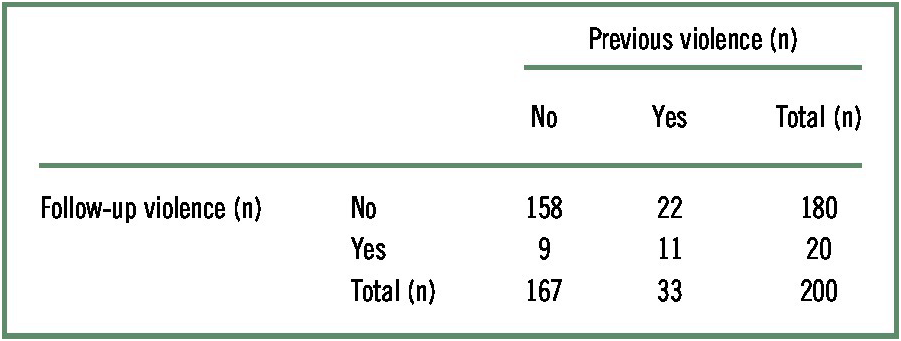
Institutional violence data were collected from a review of administrative data (special incident reports) electronically captured as part of general operations at each state hospital facility. Violence included aggressive acts toward staff or another patient in which an act of hitting, pushing, kicking, spitting, gassing, or similar acts are directed to cause potential or actual injury. Verbal aggression was not included. Recorded violence toward staff or other patients during 6 months before and 6 months after completion of the self-report questionnaires listed above. These data were coded separately for violence before (ie, previous institutional violence) and after (follow-up institutional violence) the self-report assessments where 0 = no violence and 1 = violence. See Table 2 for a breakdown of the violence data.
Procedure
Prior to the initiation of this study, all procedures were approved by the Texas Tech University and the California Committee for the Protection of Human Subjects, two institutional review boards for the protection of human subjects. Potential participants consisted of all NGRI forensic mental health patients from two secure hospitals within the DSH. As all study materials were in English, only English speaking/reading patients were eligible for participation. Patients received a general announcement that a study was in progress and all NGRI patients were afforded an opportunity to express interest in the study. Potential participants that expressed interest in the study met individually with a member of the research team and were informed of the nature and purpose of the study and consented to participate. Potential participants who were unable to provide consent or declined participation were excused to return to their regularly scheduled activities. Patients consenting to participate were administered the San Diego Quick Assessment of Reading Ability,Reference LaPray and Ross 27 a brief reading level screening test. Those who scored a reading level below 6th grade were excluded from the remainder of the study. Those scoring a 6th grade or higher reading level were provided a manila envelope containing the measures in counter-balanced order. Participants were instructed to complete the measures without including identifying information (eg, name, patient number), and they were not compensated for their participation. Overall, 237 NGRI inpatients were approached to participate in this study. Of these individuals, 18 declined participation (7.6% refusal rate). Of the remaining 219 individuals that agreed to learn about the study, 12 did not meet the eligibility requirement (eg, reading level), resulting in 207 total consented participants.
Data analysis plan
Statistical Package for the Social Sciences (SPSS) version 25 was used to conduct all analyses. Frequency analyses were used to explore the institutional violence data. One-way analysis of covariance (ANCOVA) and multivariate analysis of covariance (MANCOVA) were used to test the hypotheses that NGRI inpatients who engaged in institutional violence during the 6-month follow-up period would report more severe psychiatric symptoms and higher criminogenic risk at the time of assessment compared to NGRI inpatients who did not engage in institutional violence during the follow-up period. Follow-up institutional violence was dichotomized into 1 = violence and 0 = no violence, which was used as the independent variable. ANCOVA was used to test mean differences in the BSI GSI scores, SAQ Total scores, and the MCAA Criminal Friends Index scores between the follow-up violence groups after controlling for previous institutional violence (dichotomized into 1 = violence and 0 = no violence). Similarly, MANCOVA was used to test differences in the linear combination of the MCAA Attitudes toward Violence scores and the MCAA Antisocial Intent scores between follow-up violence groups after controlling for previous institutional violence.
To better clinically contextualize the results, receiver operating characteristic (ROC) curve analyses were conducted, and a preliminary clinical cutoff score is provided for analyses that indicated significant mean differences between the follow-up violence groups on the criminal risk or psychiatric severity distress measures. The ROC curve analyses were conducted bivariately (ie, 1 predictor and 1 criterion variable) given that is how these assessments would likely be used in clinical settings.
Results
Data screening and preparation
Missing data were imputed using expectation maximization, given that only 3.11% of the data were missing and missingness was completely at random (Little’s Missing Completely at Random Test; χ 2[21 047, N = 204] = 15 285.28, p > .999).Reference Tabachnick and Fidell 28 Four participants were missing violence information from their chart; therefore, they were excluded from the analyses. We identified univariate outliers, which were considered as variable scores that were greater than ±3.29 SD from the mean. All univariate outliers were winsorized and retained in the dataset for the analyses.Reference Tabachnick and Fidell 28 Multivariate outliers were identified using Mahalanobis Distance, but there were no multivariate outliers. Furthermore, the dependent variable distributions were assessed for normality. The SAQ Total score was not significantly skewed. The BSI GSI, MCAA Criminal Friends Index, MCAA Antisocial Intent, and MCAA Attitudes toward Violence distributions were significantly positively skewed; therefore, a square root transformation (ie, sqrt) was performed, which best normalized the distributions.Reference Tabachnick and Fidell 28
Preliminary analyses
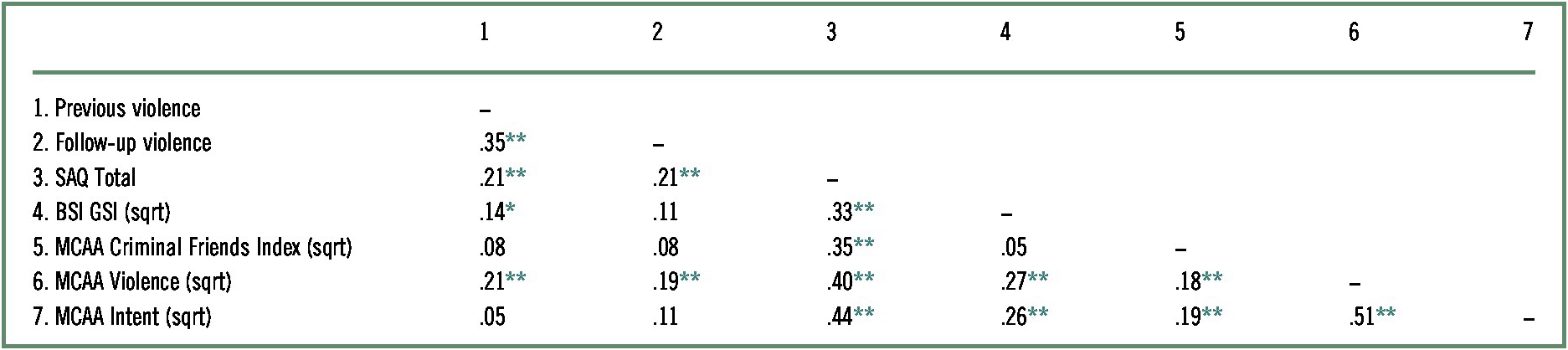
Covariates were considered if they were significantly different between the two groups: those with follow-up institutional violence and those without. There were no significant difference between the groups on age (F[1,175] = 0.001, p = .979), years of education (F[1,175] = 0.03, p = .871), race/ethnicity (χ 2[5, N = 200] = 2.36, p = .757), gender (χ 2[2, N = 200] = 2.41, p = .300), or sexual orientation (χ 2[4, N = 200] = 3.31, p = .508). Therefore, no demographic variables were included as covariates in the analyses. Previous institutional violence was significantly associated with follow-up institutional violence (χ 2[1, N = 200] = 23.91, p < .001); therefore, previous institutional violence was used as a covariate in the analyses. This is consistent with previous literature that indicates that previous violence is a strong predictor of future violence.Reference Lussier, Verdun-Jones, Deslauriers-Varin, Nicholls and Brink 29 Therefore, we are testing if psychiatric symptom severity and criminal risk differ between the follow-up institutional violence groups, beyond what is accounted for by a strong, known predictor (previous violence). See Table 1 for bivariate correlations and descriptive statistics for the variables included in the analyses.
Bivariate correlations.

Abbreviations: BSI GSI, Brief Symptom Inventory Global Severity Index score; MCAA Index, Measure of Criminal Attitudes and Associates Criminal Friends Index score; MCAA Intent, Measure of Criminal Attitudes and Associates Criminal Intent score; MCAA Violence, Measure of Criminal Attitudes and Associates Attitudes toward Violence score; SAQ Total, Self-Appraisal Questionnaire Total score; Sqrt, the variable was square root transformed.
* p < .05.
** p < .01.
Exploratory analyses
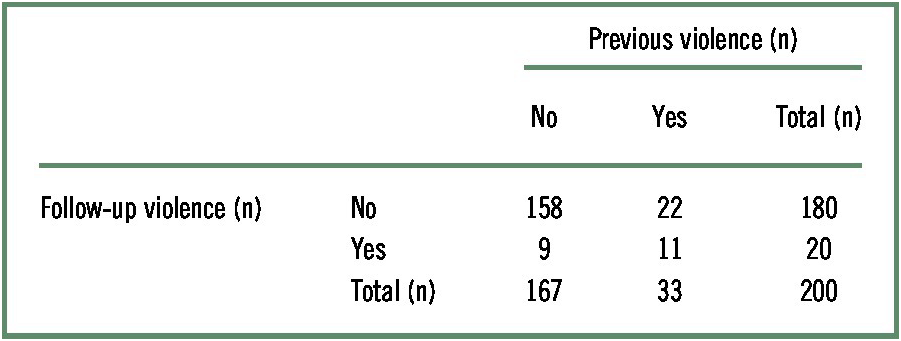
As seen in Table 2, 94.6% of those who were not previously violent were also not violent at follow-up. Additionally, 33.3% of those who were previously violent were also violent at follow-up. These data indicate that the majority of those who were and were not previously violent will go on to be nonviolent.
Contingency table of the number of participants who were previously violent and who were violent at follow-up.
Primary analyses
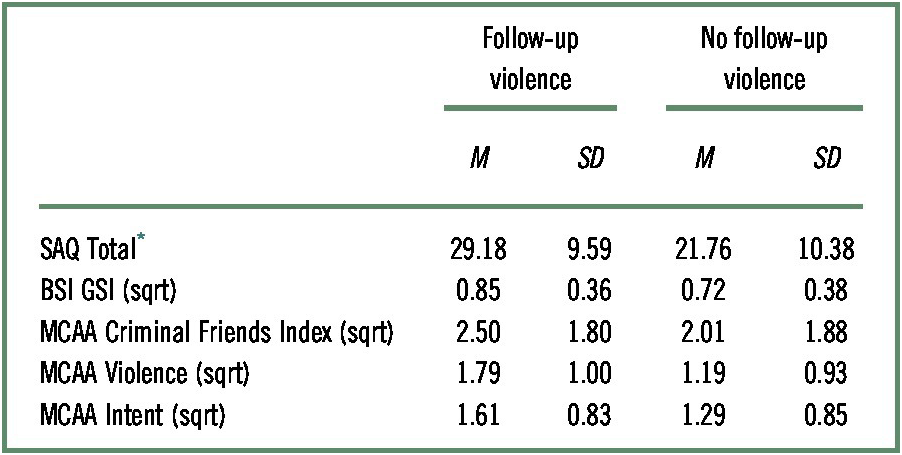
Using ANCOVA, differences in the BSI GSI (sqrt) scores were tested between follow-up institutional violence groups after adjusting for previous institutional violence. Levene’s Test indicated that error variances were not significantly different between the follow-up violence groups (F[1,198] = 0.30, p = .587), which is congruent with the assumption of ANCOVA. After adjusting for previous institutional violence (F[1,197] = 2.55, p = .112, η p 2 = .01, observed power = .36), the mean difference between the follow-up institutional violence groups on the BSI GSI (sqrt) was not significant (F[1,197] = 0.78, p = .378, η p 2 = .00, observed power = .14), indicating that psychiatric symptom distress was not associated with institutional violence at follow-up after considering participants’ previous institutional violence. See Table 3 for means and standard deviations.
Means and standard deviations of the dependent variables for those who were and were not violent at follow-up.

Abbreviations: BSI GSI, Brief Symptom Inventory Global Severity Index score; MCAA Index, Measure of Criminal Attitudes and Associates Criminal Friends Index score; MCAA Intent, Measure of Criminal Attitudes and Associates Criminal Intent score; MCAA Violence, Measure of Criminal Attitudes and Associates Attitudes toward Violence score; SAQ Total, Self-Appraisal Questionnaire Total score; Sqrt, the variable was square root transformed.
* Significant (p < .05) mean difference after adjusting for previous institutional violence.
Differences in the SAQ Total scores were tested between follow-up institutional violence groups after adjusting for previous institutional violence. Levene’s Test indicated that error variances were not significantly different between the follow-up institutional violence groups (F[1,198] = 0.95, p = .332). After adjusting for previous institutional violence (F[1,197] = 4.63, p = .032, η p 2 = .02, observed power = .57), the mean difference between the follow-up institutional violence groups on the SAQ Total score was significant (F[1,197] = 4.62, p = .033, η p 2 = .02, observed power = .57). See Table 3 for means and standard deviations. That is, participants with higher SAQ Total scores were statistically significantly more likely to engage in future institutional violence after accounting for their previous violent behaviors during hospitalization.
Although risk assessment is beyond the scope of this study, given the significant relation between SAQ Total scores and institutional violence, we decided to conduct a supplemental analysis to provide additional clinical context to the findings. Specifically, bivariate ROC curve analyses demonstrated that the SAQ Total score was significantly associated with follow-up violence (OR = 1.07, p = .004), and yielded an area under the curve (AUC) statistic of .71 (where an AUC of .50 would indicate chance-level prediction of follow-up violence). Youden’s J Index was calculated to identify the SAQ Total score that places equal emphasis on high sensitivity and specificity (ie, the SAQ Total score that had best balance between the highest true positive rate [sensitivity] and the lowest false positive rate [1-specificity] when predicting follow-up institutional violence). A preliminary SAQ Total cutoff score of 23 produced the best balance between sensitivity (.75) and specificity (.61). In other words, a score of 23 has a 75% chance of correctly identifying someone with future institutional violence; however, a score of 23 has a 39% (1-specificity) chance of falsely identifying that an individual will engage in future institutional violence. Therefore, an individual scoring over a 23 on the SAQ Total score may be more likely to engage in later institutional violence; however, the false positive rate should be strongly considered, and the SAQ Total score should not be used as a sole measure to assess the potential for future institutional violence.
Differences in the MCAA Criminal Friends Index (sqrt) scores were tested between follow-up violence groups after adjusting for previous violence. Levene’s Test indicated that errors variances were not significantly different between the follow-up violence groups (F[1,198] = 1.24, p = .267). After adjusting for previous violence (F[1,197] = 0.66, p = .418, η p 2 = .00, observed power = .13), the mean difference between the follow-up violence groups on the MCAA Criminal Friends Index (sqrt) was not significant (F[1,197] = 0.57, p = .451, η p 2 = .00, observed power = .12). This finding indicated that associating with criminal friends was not related to institutional violence at follow-up after accounting for previous institutional violence. See Table 3 for means and standard deviations.
Lastly, using MANCOVA, differences in the MCAA Attitudes toward Violence (sqrt) scores and the MCAA Criminal Intent (sqrt) scores were tested between follow-up violence groups after adjusting for previous violence. Homogeneity of covariance matrices was tested using Box’s M Test, which was not significant (Box’s M = 0.58, F[3,13 296.09] = 0.19, p = .905). After adjusting for previous violence (Wilk’s Λ = .97, F[2, 196] = 3.24, p = .041, η p 2 = .03, observed power = .61), there was no significant difference in the linear combination of these MCAA (sqrt) variables (Wilk’s Λ = .98, F[2,196] = 1.76, p = .174, η p 2 = .02, observed power = .37). These results indicate that attitudes toward violence and criminal intent were not significantly associated with follow-up institutional violence after adjusting for previous institutional violence. See Table 3 for means and standard deviations.Footnote 1
Discussion
The current study aimed to test differences in assessments of psychiatric symptom severity and criminogenic risk factors between NGRI state hospital inpatients who engaged in intuitional violence 6 months following the assessments and NGRI inpatients who did not engage in violence during the follow-up period when controlling for previous violence. Specifically, we hypothesized NGRI inpatients who engaged in institutional violence during the 6-month follow-up period would report more severe psychiatric symptoms and higher criminogenic risk at the time of assessment compared to NGRI inpatients who did not engage in institutional violence during the follow-up period. We also provided an exploratory description of patterns in institutional violence and preliminary cutoff scores for criminogenic risk assessments that were significantly associated with follow-up institutional violence.
Our study elucidated patterns in institutional violence among NGRI inpatients. Data indicated that 16.5% and 10% of this sample of NGRI inpatients engaged in institutional violence toward other patients or staff in the 6 months prior to and 6 months following the self-report assessments, respectively. Additionally, most patients who were not previously violent did not go on to be violent during the follow-up period; only 33.3% of those who were previously violent also engaged in violence during the follow-up period. Given the sample’s modest average length of hospitalization (7.21 years, SD = 6.47), these exploratory results indicated violence prevalence rates that are lower than the overall forensic inpatient violence rate of 31.4% found in previous studies.Reference Broderick, Azizian, Kornbluh and Warburton 1 However, considering the sample’s length of hospitalization at the time of the study, this prevalence rate is consistent with general findings that an individual’s risk of violence is highest upon and soon after admission, and then decreases over the course of hospitalization.Reference Broderick 30 These exploratory results aid in the provision of general rates of violence for those in this stage of their hospitalization and treatment.
The results in the current study also partially supported our hypotheses. That is, one of our assessments of criminogenic risk (the SAQ Total score) was significantly higher among NGRI inpatients who engaged in institutional violence during the follow-up period compared to those who did not, after controlling for previous institutional violence. However, our findings did not support significant differences between the follow-up institutional violence groups on specific aspects of criminogenic risk—specifically our measures of criminal attitudes (MCAA Attitudes toward Violence and the MCAA Criminal Intent) and criminal associates (MCAA Criminal Friends Index) after controlling for previous institutional violence. Similarly, there were no significant differences between the follow-up institutional violence groups on our assessment of psychiatric symptoms distress severity (the BSI GSI scores) after controlling for previous institutional violence. Although research has indicated that psychiatric symptoms are significantly associated with violence among other psychiatric patients, including inpatients,Reference Grevatt, Thomas-Peter and Hughes 6 , Reference Ross, Hart and Webster 7 our results do not support this association among NGRI inpatients after considering their previous violence. Perhaps NGRI state hospital inpatients—particularly in our sample—are more psychiatrically stabilized given their length of hospitalization compared to participants in previous studies that may include acute inpatients in other settings.Reference Iozzino, Ferrari, Large, Nielssen and De Girolamo 9 , Reference Flannery, Wyshak, Tecce and Flannery 10 This finding suggests that solely treating psychiatric symptoms may not be sufficient for reducing institutional violence among NGRI inpatients. Furthermore, when predicting violence, it is advisable to integrate comprehensive risk assessments in the assessment process (eg, at admission) rather than focusing on specific aspects of problematic behavior (eg, antisocial cognitions).
Traditional forensic state hospital treatment has focused on psychopharmacological interventions targeting active psychiatric symptoms.Reference Warburton 31 The results from this study are best understood in the consideration of what treatment needs remain after mental health symptoms are ameliorated. This cohort of NGRI inpatients, in an intermediate stage of treatment, is no longer committing violence due to acute symptomatology but instead due to residual, untreated criminogenic risk. These findings are consistent with previous research indicating that criminogenic factors, more so than psychiatric symptoms, increase risk for violence,Reference Skeem, Steadman and Manchak 13 , Reference Walters 17 , Reference Douglas, Strand, Belfrage, Fransson and Levander 18 and parallel recent findings in the correctional literature whereby justice-involved individuals with mental illness are at greater risk for criminal recidivism due to criminogenic factors than mental health functioning.Reference Morgan, Fisher, Duan, Mandracchia and Murray 32 , Reference Skeem, Winter, Kennealy, Louden, Tatar and Joseph 33
Implications for policy and practice
Regarding the assessment implications of our findings, we conducted exploratory analyses to further contextualize the significant difference in SAQ Total scores between the follow-up institutional violence groups. Results indicated that a preliminary SAQ Total cutoff score of 23 maximized the sensitivity and specificity of the prediction of institutional violence 6 months later. More specifically, a score of 23 demonstrated a 75% chance of correctly identifying someone with future institutional violence; however, there was also a 39% chance of falsely identifying that an individual will engage in future institutional violence. We discourage clinicians from using the SAQ Total score (or comparable risk assessment measure) as a sole measure of NGRI inpatients’ potential for future violence. Instead, it is important to synthesize risk predictions with other violence risk assessments (eg, Violence Risk Screening—10 [V-RISK-10],Reference Bjørkly, Hartvig, Heggen, Brauer and Moger 34 Historical-Clinical-Risk-Management-20, Version 3,Reference Douglas, Hart, Webster and Belfrage 35 Short Term Assessment of Risk and TreatabilityReference Webster, Martin, Brink, Nicholls and Desmarais 36 ) and objective data (eg, previously recorded violence) to best understand how to conceptualize the patient’s potential for violence, others’ safety, and the best treatment for the patient. Furthermore, replication of cutoff scores for predicting institutional violence using the SAQ or other risk measures is necessary; however, our results provide the first step toward evidence-based guidelines for using risk predictions to guide treatment efforts at reducing institutional violence among NGRI inpatients.
Clinical utility of risk assessments should not be limited to prerelease assessments, but also as an important treatment-planning tool with NGRI inpatients who are at an intermediate stage of their treatment pathway and inpatient hospitalization. Some of the major hurdles to an NGRI inpatient’s successful release from a state hospital include institutional rule violations and violence. These results show that criminogenic risk factors play a key role in violence, thereby greatly influencing eventual treatment success. By assessing criminogenic risk, a clinician would identify treatment targets—that is, substance abuse, criminal thinking, or anger management—as a focus of treatment. Importantly, holistically integrating criminogenic risk in treatment of mental illness may result in the even greater treatment success. 37-39 Leveraging treatments that target these criminogenic needs could a beneficial addition to the traditional psychiatric symptom-focused approach to treatment of NGRI inpatients.
Limitations and future directions
This study is not without limitations. First, we assessed criminogenic risk and psychiatric symptom severity at one time point and our follow-up violence records from the 6 months following our self-report assessments. Therefore, our study could not detect potentially important short-term changes in psychiatric symptoms or criminal risk that could impact violence, as indicated in previous studies.Reference Skeem, Schubert, Odgers, Mulvey, Gardner and Lidz 40 This could possibly explain some of our nonsignificant findings. Additionally, participants were in the DSH system, and they were required to have at least a 6th grade English reading level and demonstrate the capability for informed consent to participate. Our sample was also largely male and had been hospitalized for several years. Therefore, these findings may not generalize to other state hospital systems, NGRI inpatients with greater demographic heterogeneity, or those who do not meet our inclusion criteria. In addition, these findings may not generalize to patients who are earlier in their hospitalization course. Given the participants’ length of hospitalization, our participants were likely more psychiatrically stabilized than more recently admitted patients; therefore, they may not have been experiencing as severe psychiatric distress measured by the BSI. It is possible that newer patients who are less psychiatrically stabilized would demonstrate a different relation between their psychiatric symptoms and future violence. Furthermore, our study used self-report measures as our primary predictors, which are subject to recall bias and false reporting. Alternative measures of psychiatric symptom distress and criminal risk should be considered. Although we had data on institution violence reported in the patients’ hospital records, which provided objective violence data, it is possible that there was institutional violence that was not observed by staff or that was not recorded, which could impact the effect sizes of our results. Similarly, the observed power statistics (ie, the probability of detecting an effect if there is one) for our analyses were low, especially for nonsignificant results; however, it should be noted that the effect sizes for nonsignificant results were also very small (eg, η p 2 = .01). Thus, a very large sample would be necessary to detect such small effect sizes, which would likely lack clinical meaning. Nevertheless, the low power in the current study could have produced a false negative finding. Therefore, further replication of our work is warranted.
Future directions for this line of research are considerable. Examination of the interplay between psychiatric symptoms and criminogenic risk factors in the prediction of institutional violence amongst other commitment types (Mentally Disordered Offender, Incompetent to Stand Trial, etc.) could aid in the generalizability of the current study’s results across all forensic state hospital inpatients. Additionally, future examination of different stages of hospitalization (ie, recent admission vs intermediate hospitalization vs. approaching discharge to community) could help identify the most suitable window of time to target criminogenic risk treatment. Future research should also consider more intensive longitudinal research designs that allow for a more fine-grained examination of risk factors for violence among NGRI inpatients over time. Finally, replication of the use of the SAQ, an efficient self-report measure of criminogenic risk, as a predictive measure of inpatient violence in NGRI inpatients could represent a next step in establishing evidence-based guidelines for assessing this population’s violence risk.
Conclusion
Targeting the treatment of criminogenic risk factors, in addition to psychiatric symptoms, is an important and necessary facet of providing evidence-based care to the NGRI inpatient population. In this sample, criminogenic risk, and not psychiatric symptoms, was predictive of 6 months of postassessment institutional violence, when controlling for previous violence. A holistic approach of examining both psychiatric and criminogenic risk factors throughout the course of hospitalization will facilitate a greater understanding of pertinent violence risk factors, but also help pave the way for a treatment plan that adequately captures all domains of factors to help an individual succeed in both a forensic state hospital and, eventually, in the community.
Acknowledgments
Part of the work of Sean M. Mitchell was supported by a grant from the National Institute of Mental Health (S.M.M., T32 MH020061).
Disclosure
The authors declare no conflict of interest.